
Superbat 4G LTE MIMO Magnetic Mount Omni-Directional SMA Antenna
5.0Editor score
Dual SMA MIMO connections
IP67 waterproof housing
Omnidirectional 3 dBi gain
Three-meter low-profile cable
Our magnetic mount LTE antenna for vehicles guide compares signal coverage, connector types, MIMO support, mounting options, and durability for cars, trucks
A magnetic mount LTE antenna for vehicles can improve cellular reception where phone antennas are blocked by body panels, glass, or cabin materials. The right model also needs a compatible connector, suitable frequency coverage, and a secure mount that tolerates road vibration, weather, and repeated vehicle changes.
We compared all ten products by examining antenna type, supported frequency bands, gain, connector arrangement, cable length, mounting method, environmental protection, and intended equipment compatibility. The list covers combination GPS antennas, dedicated LTE models, MIMO antennas, active GPS units, and general-purpose magnetic bases.
Each review explains the product's strongest use case, installation considerations, and trade-offs based on the supplied specifications. The three highlighted selections represent a balanced premium option, a strong multi-device choice, and a budget-friendly wideband pick, while product availability and prices can change over time.
5.0Editor score

4.2Editor score
5.0Editor score
The comparison below organizes all ten antennas by their most important technical differences. Pay particular attention to connector type, MIMO configuration, supported bands, and whether the product is cellular, GPS, combined, or a universal magnetic mount.


The Superbat Car GPS + 4G LTE Combination Antenna is a dual-purpose antenna rated 4.3 stars. It combines a GPS L1 receiver with 4G LTE reception in one magnetic-mount package, making it especially useful for car stereos, navigation head units, vehicle trackers, and connected systems that need both types of signal.
We may earn a commission when you buy through this link, at no additional cost to you.
Its LTE section covers 698–960 MHz and 1710–2700 MHz, with 2 dBi gain, linear polarization, 50-ohm impedance, and a VSWR below 3.0. The GPS side operates at 1575.42 MHz with bandwidth above 9 MHz, 2 dBic zenith gain, and a 28±2 dB LNA, while the supplied three-meter RG174 cable terminates in an SMA male connector.
The main advantage is consolidation: one physical antenna can serve navigation and cellular functions without managing two separate roof or body-mounted units. The tradeoff is that this is not a dedicated dual-SMA MIMO antenna, and the listed cellular gain is relatively modest. Compatibility also depends on whether the vehicle system expects a combined connector and active GPS power rather than separate antenna ports.
This is a sensible choice for installers building a navigation, telematics, or connected car-stereo setup where both GPS and LTE matter. It may be less suitable for a modern MIMO router requiring two antenna inputs. For those applications, the Superbat dual-SMA antenna in another review is a closer match, while this unit remains attractive for its integrated design.
Combining GPS and LTE in one enclosure reduces the number of mounting points and keeps a vehicle roof or metal body looking less cluttered. It also simplifies installations where the connected head unit already presents a dedicated combined antenna interface.
The stated 28±2 dB LNA gain supports the active GPS section, which can be useful when navigation equipment sits behind a windshield or dashboard. Placement should still provide the clearest available view of the sky.
We may earn a commission when you buy through this link, at no additional cost to you.
The Wilson Electronics 311125 is a 4.2-star magnetic antenna created for cellular signal boosters and compatible Wilson equipment. It uses an omnidirectional pattern to receive incoming cellular signals from all horizontal directions, a practical choice for vehicles that continually change heading while traveling.
We may earn a commission when you buy through this link, at no additional cost to you.
Its dual-band design covers 800 and 1900 MHz, with the listing claiming improvement of up to 6.1+ dB for call quality and 3G data. The package includes a magnet mount, 12.5 feet of RG174 coax, and an SMA male connector, giving installers ample cable to reach an interior booster while keeping the antenna outside.
Its strongest application is cellular booster installation in a truck, van, or car. The long cable makes it easier to position the antenna on a metal roof or body panel and then run the lead to a compatible booster. However, the narrower band plan is less future-oriented than the 617–4000 or 698–2700 MHz alternatives in this guide, and it is not a GPS or MIMO antenna.
Choose the 311125 when the objective is straightforward: improve a Wilson-compatible cellular booster's outside signal reception. It is less appropriate for users needing contemporary 5G support, dual-antenna MIMO, GPS reception, or a modern router that no longer relies on 800/1900 MHz cellular bands.
A 12.5-foot RG174 lead gives the installer room to keep the magnetic base on an exterior metal surface while placing the booster inside the cabin or under a console. The omnidirectional pattern is suited to travel rather than a fixed direction of approach.
The product is specifically described for Wilson and weBoost cellular signal booster systems. Buyers should confirm that the booster's antenna port accepts an SMA male plug before installation.
We may earn a commission when you buy through this link, at no additional cost to you.
This GPS Navigation Antenna is a 4.5-star active aerial for vehicle navigation, tracking, telematics, and marine applications. It may share the visual language of an LTE antenna, but its operating frequency and active circuitry are specifically dedicated to GPS rather than cellular voice and data.
We may earn a commission when you buy through this link, at no additional cost to you.
The antenna operates at 1575.42 MHz ±3 MHz, uses a 28 dB LNA, and draws up to 10 mA from a 3–5 volt DC supply. It includes a three-meter extension cable and SMA male connector, while magnetic and adhesive mounting provide flexibility for cars, trucks, RVs, buses, boats, and other mobile equipment.
Its principal strength is straightforward GPS integration. A high-gain LNA can help preserve the navigation signal through cable runs and dashboard installations, and the magnetic base allows quick repositioning during testing. The limitations are equally clear: it does not handle LTE bands, cannot serve as a dual-SMA MIMO antenna, and may not work with a device that does not supply the expected active antenna power.
This is a good fit for a car stereo head unit, GPS tracker, mobile DVR, fleet system, or marine navigation device with a compatible active SMA GPS input. If the primary problem is poor cellular data rather than poor satellite positioning, choose one of the LTE models instead. For this GPS-only application, the combination of 28 dB LNA gain and flexible mounting makes it a practical pick.
The 28 dB active LNA is designed to boost the GPS signal received by compatible navigation hardware. Users should verify the device's connector and power requirements before connecting the aerial.
Magnetic mounting allows rapid testing at different points on a vehicle, while the included adhesive option supports a more permanent installation. Both choices are useful where drilling is undesirable.
We may earn a commission when you buy through this link, at no additional cost to you.
The Bolton Mighty Mag 5G is a 5.0-rated budget-oriented cellular antenna covering 617–4000 MHz. Its wide frequency range is the defining feature, allowing it to address low-band cellular signals, conventional LTE bands, and higher 5G-related frequencies within one compact magnetic unit.
We may earn a commission when you buy through this link, at no additional cost to you.
The antenna has a stated gain of 3.1 dBi and an omnidirectional pattern designed for vehicles in motion. A strong magnetic base attaches to metal without drilling, while the FME-female connection works with compatible booster antennas and mobile communication equipment when the appropriate adapter or cable is available.
This wideband reach is more future-conscious than models limited to 800 and 1900 MHz, making the Bolton a versatile choice for cellular boosters, mobile routers, and other compatible equipment. The 3.1 dBi figure is not as high as the nominal gain of the 7 or 8 dBi Bingfu sets, and a single connector does not provide true two-port MIMO.
The Mighty Mag is a compelling pick when the main priorities are broad frequency coverage, simple installation, and economical access to a vehicle-mounted cellular antenna. It suits people who already know their equipment uses FME connections. Users needing an SMA lead or dedicated dual-antenna MIMO should confirm cabling and port requirements before purchase.
A 617–4000 MHz span covers substantially more of the cellular landscape than a legacy dual-band antenna. It gives a vehicle installation more flexibility as it moves among carriers, local bands, and evolving 5G services.
The strong magnetic base lets an installer test several locations on the vehicle without permanent modification. A clear view of the sky and separation from other antennas generally matters more than simply choosing the highest point.
We may earn a commission when you buy through this link, at no additional cost to you.
The Bingfu 4G LTE Antenna MIMO 8dBi 2-Pack is a 4.2-star set of two magnetic antennas, each offering 8 dBi nominal gain across the 698–960, 1710–2170, and 2300–2700 MHz ranges. The pair is built for 4G LTE systems that benefit from two spatially separated antenna connections.
We may earn a commission when you buy through this link, at no additional cost to you.
Both antennas have strong magnetic bases, three-meter cables, SMA male connectors, and omnidirectional patterns. The supplied compatibility list includes mobile routers, hotspots, CPE equipment, cellular gateways, trail cameras, vehicle trackers, mobile DVR systems, industrial IoT devices, and numerous monitoring or control systems.
Two antennas are especially useful when the receiving equipment supports MIMO, allowing simultaneous reception on different cellular paths rather than relying on one feed. The high nominal gain and long leads also provide useful installation flexibility. The tradeoff is that the package consumes two device ports and the specified band coverage does not extend to the newer 5G frequencies covered by the Bolton model.
This is an excellent selection for someone building a vehicle-based LTE router, mobile hotspot, camera system, or industrial cellular installation around a dual-SMA device. It is less suitable if the equipment accepts only one antenna or if future use depends on 5G. Within conventional 4G LTE equipment, the two-pack provides a particularly useful combination of gain, reach, and application breadth.
MIMO equipment benefits from two antennas with different signal paths. Installing the pair on different areas of a metal roof or body can help the device evaluate a broader cellular environment than a single feed.
The compatibility range covers routers, modems, cameras, trackers, gateways, and industrial endpoints. Buyers should still verify the required connector type and whether the device expects SMA rather than RP-SMA.
We may earn a commission when you buy through this link, at no additional cost to you.
The Proxicast Large 3 Inch SMA Magnetic Antenna Base is a 4.4-star mounting platform rather than a complete cellular antenna. It lets installers position a compatible SMA male antenna on a vehicle's metal surface while routing a 6.5-foot flexible coax to a router, modem, radio, or GPS receiver.
We may earn a commission when you buy through this link, at no additional cost to you.
Its large three-inch magnetic base offers stable attachment, and a rubber cap protects the surface beneath the magnet. The base accepts cellular, HAM, ADS-B, GPS, 900 MHz, and other SMA antennas but explicitly excludes Wi-Fi antennas. Its coax terminates in an SMA female connector to mate with a standard SMA male antenna.
The major benefit is flexibility: an installer can select an antenna for the frequency and gain actually required, then use this base in a temporary or movable vehicle installation. It also supports numerous vendor platforms, including CalAmp, Cisco, Cradlepoint, Digi, MoFi, Pepwave, Proxicast, Sierra Wireless, Sixnet/Red Lion, Garmin, and FlightAware equipment.
Choose the Proxicast base when the main requirement is a robust, repositionable mounting point and you already own a suitable SMA antenna. It is not the right purchase for a buyer seeking an all-in-one LTE unit. Its low rating relative to some complete antennas also reflects a different role: it solves mounting and placement rather than supplying a specified cellular radiation pattern.
Because the antenna itself is interchangeable, this base lets an installer select radio-frequency characteristics separately from the mounting hardware. The resulting setup can be adjusted as the vehicle or communication requirement changes.
The rubber cap reduces direct metal-to-paint contact at the mounting point. It also provides a useful barrier against scratches when the magnetic base is repositioned during setup.
We may earn a commission when you buy through this link, at no additional cost to you.
The Wilson Electronics 12-Inch Dual Band Magnet-Mount Antenna is a 4.3-star model for 800 and 1900 MHz cellular systems. Its compact 12-inch radial is designed to improve reception relative to relying on a handset's internal antenna while the vehicle is moving.
We may earn a commission when you buy through this link, at no additional cost to you.
The antenna supports analog and digital cellular modes and is described as compatible with cellular, PCS, and iDEN providers. Its magnetic installation is removable, allowing the same unit to transfer between cars, trucks, or other vehicles without tools or permanent modifications.
This model is appealing for straightforward legacy cellular equipment and users who want a low-profile, quickly removable antenna. The universal mounting and provider compatibility make it easy to place on a metal roof, trunk, or other suitable surface. However, its 800/1900 MHz plan is narrower than the 617–4000 MHz and 698–2700 MHz models in this guide, so it may not address newer cellular bands.
The Wilson is best for an older phone, cellular terminal, or booster setup whose documented operating bands and connector match this antenna. It is less attractive for a modern 5G-capable router, a dual-SMA MIMO system, or a GPS navigation installation. Its main convenience remains the ability to move one compact antenna among multiple vehicles.
The removable magnetic design is useful for occasional installation, shared fleet use, or testing an external antenna on multiple vehicles. It avoids permanent holes and complicated disassembly.
At 12 inches, the antenna is less visually imposing than some larger roof units. Installation should still prioritize an unobstructed position with minimal metal and glass between the antenna and nearby cellular towers.
We may earn a commission when you buy through this link, at no additional cost to you.
The Bingfu Vehicle Waterproof Active GPS Navigation Antenna has the highest listed customer rating in this group at 4.6 stars. It is designed for mobile GPS applications where the aerial may encounter moisture, dust, and changing outdoor conditions.
We may earn a commission when you buy through this link, at no additional cost to you.
Operating at 1575.42 MHz, the antenna provides a stated 28 dB LNA gain and draws no more than 10 mA from a 3–5 volt DC source. It includes a three-meter cable, SMA male connector, magnetic mount, and double-sided adhesive piece. The listed applications include vehicle telematics, GPS trackers, mobile DVRs, buses, trucks, RVs, vans, security systems, and mobile radios.
The combination of active gain, weather-oriented construction, and two mounting methods makes it a strong dedicated GPS solution. The adhesive option can secure the unit where a magnet may be inconvenient, while magnetic mounting makes initial positioning easier. Since this antenna does not receive cellular bands, it cannot substitute for an LTE roof antenna in a mobile router installation.
Buyers should choose the Bingfu for tracking, navigation, or telemetry systems that explicitly support active GPS antennas with the appropriate voltage, connector, and current. It is a better fit than the general-purpose Proxicast base for a complete weather-resistant GPS aerial. Users whose primary issue is weak mobile data should remain with the LTE models in this guide.
The 28 dB LNA helps the GPS receiver work with the signal that reaches the antenna through its cable and mounting location. A clear sky view remains essential, especially for a unit installed beneath a dashboard.
Waterproof construction and adhesive mounting suit trackers, mobile DVRs, and other equipment exposed to rain, dust, and vibration. The included adhesive piece makes it possible to create a stable mount away from a strongly magnetic panel.
We may earn a commission when you buy through this link, at no additional cost to you.
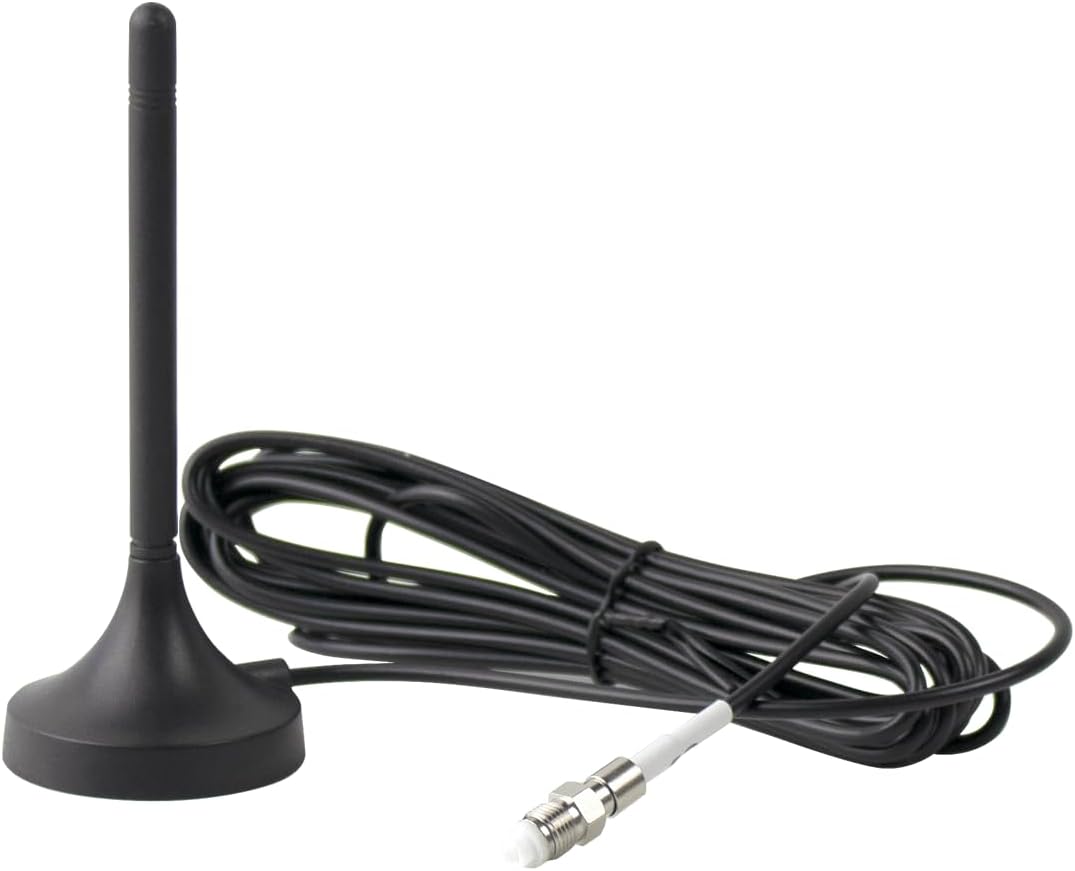
The Superbat 4G LTE Antenna MIMO Magnetic Mount is a 5.0-star premium pick for vehicles that need cellular reception and environmental resistance. It combines an omnidirectional antenna with two SMA male connections, allowing compatible receivers to use separate signal paths for MIMO operation.
We may earn a commission when you buy through this link, at no additional cost to you.
Its 698–960, 1710–2170, and 2300–2700 MHz frequency coverage is designed for 4G LTE voice and data applications. The listed 3 dBi gain is backed by a VSWR below 2.0 and 50-ohm impedance. A three-meter cable, IP67 waterproof rating, and sturdy ABS shell suit use with mobile hotspots, routers, modems, trail cameras, security cameras, and industrial gateways.
The dual connectors are the key feature. A single physical antenna can still feed two receiver inputs, which can be useful where two roof units would be inconvenient. The IP67 enclosure is a meaningful advantage for trucks, RVs, outdoor cameras, and weather-exposed installations. Its limitation is that the specified range remains LTE-focused and does not extend into the broader 5G range claimed by the Bolton antenna.
This is a particularly strong choice when waterproofing, a low-profile magnetic installation, and MIMO support all matter. Verify that the host device accepts dual SMA male connections and that its LTE bands align with the listed ranges. For a 5G-centered installation, the Bolton offers broader frequency reach, but for protected 4G MIMO use, the Superbat is the more purpose-focused choice.
The two connector sockets provide separate feed paths for compatible MIMO equipment. Positioning both elements together can simplify installation while preserving the spatial diversity the receiver expects.
The IP67-rated enclosure and ABS shell are useful for vehicles and equipment exposed to rain, dust, and road debris. A sealed antenna is particularly relevant for roof-mounted mobile routers and outdoor camera systems.
We may earn a commission when you buy through this link, at no additional cost to you.
The Bingfu 4G LTE 7dBi Magnetic Base MIMO SMA Male Cellular Antenna two-pack has a 3.9-star rating. It provides two omnidirectional cellular antennas with 7 dBi nominal gain, strong magnetic bases, three-meter cables, and SMA male connectors for compatible 4G LTE equipment.
We may earn a commission when you buy through this link, at no additional cost to you.
The antennas cover 698–960, 1710–2170, and 2300–2700 MHz and are described as compatible with major carriers including Verizon, AT&T, T-Mobile, and Sprint. Intended devices include cellular boosters, wireless routers, trail and security cameras, trackers, mobile DVRs, industrial gateways, hotspots, CPE systems, and vehicle communication equipment.
The two-pack gives MIMO-capable devices the inputs they need while retaining a higher stated gain than the Superbat premium model. That makes it attractive for establishing outside LTE reception on a vehicle roof or body. The important caveat is that nominal antenna gain does not guarantee a stronger connection in every location; tower distance, terrain, obstruction, network congestion, and device sensitivity all influence the result.
This set is best for budget-conscious builders of conventional 4G LTE vehicle systems that accept SMA rather than RP-SMA connectors. It should not be selected for 5G-only equipment, and buyers should verify that the receiving device supports two antennas. Despite its lower listed rating, it remains a capable and versatile package for the right hardware.
The stated 7 dBi gain can be valuable in rural areas, at the edge of coverage, or where the vehicle's own body blocks incoming signals. Actual improvement still depends on placement and the cellular network conditions at the time.
Owning two matched antennas simplifies a dual-port installation and makes it easier to compare mounting positions. Keep the two elements reasonably separated while avoiding a position dominated by surrounding metal.
We may earn a commission when you buy through this link, at no additional cost to you.
The correct antenna depends on the receiving device, required frequency bands, connector arrangement, and installation environment. Start with the equipment's ports and specifications, then choose the antenna design and mounting position that support those requirements.
Connector compatibility is the first practical checkpoint. The products in this guide variously use SMA male, dual SMA male, and FME female connections, while the Proxicast base accepts an SMA male antenna and presents an SMA female cable connector. A visually similar threaded connector may still be electrically incompatible, and some modern devices use RP-SMA rather than standard SMA. Check the receiving device's antenna socket, the required connector gender, and whether an adapter is appropriate for the installation.
The antenna must support the bands used by the carrier and equipment operating in the area. The list includes 800/1900 MHz legacy dual-band models, conventional LTE ranges from 698 to 2700 MHz, and a wideband 617–4000 MHz model. Wider coverage offers flexibility across carriers and evolving networks, but a label alone does not guarantee performance in every band. Consider the modem's supported bands, local network availability, and whether future service will use frequencies outside the antenna's listed range.
MIMO equipment uses two antenna paths to improve reception and throughput under changing conditions. A single-antenna model can be ideal for a single-port cellular terminal, while a dual-SMA antenna is more appropriate for a modern router, modem, or booster that explicitly supports two antenna inputs. The two-pack options can simplify a MIMO installation, and the Superbat premium model provides dual connectors from one low-profile housing. Do not connect a single lead to a MIMO device if the manufacturer requires both antennas to operate.
Antenna gain describes directional concentration and nominal efficiency rather than a guaranteed increase in download speed. Higher-gain products can help when placement, distance, and obstruction are unfavorable, but they do not create additional carrier coverage. The listed figures range from 2 and 3 dBi to 7 and 8 dBi, while the Wilson 311125 claims up to 6.1+ dB. Compare figures only when they represent the same type of measurement and focus on the antenna pattern, installation position, and actual system requirements.
A magnetic base must contact a substantial metal surface, but placement also determines how clearly the antenna can see nearby cellular towers. Roofs and upper body panels usually provide a better starting point than low bumper or door locations, although vehicle construction varies. Avoid burying the antenna beneath painted trim unless the base is designed for that surface. During testing, compare signal readings at several positions, keep cables away from sharp edges, and do not run them through moving hinges or doors.
Cable length determines how far the antenna can be separated from the receiver, while longer runs may introduce more loss. The reviewed models use cables ranging from the Wilson's 12.5 feet to the common three-meter length, with the Proxicast offering 6.5 feet. Choose enough length to reach from an exterior mount into the cabin without excess coiled cable, and route the coax away from ignition wires, sharp body seams, and heat sources. Confirm that the cable connector matches the antenna or base in use.
Vehicle antennas are repeatedly exposed to rain, dust, sunlight, road debris, vibration, and temperature changes. The Superbat MIMO antenna explicitly carries an IP67 rating, while several GPS products are described as waterproof or water-resistant. A magnetic base also needs to remain secure over rough roads. Check the housing, strain relief, and cable entry, and periodically inspect the mount for lifting or wear. Weather resistance does not eliminate the need to protect connectors and route cables safely.
A dedicated LTE antenna is the right choice for cellular data, voice, hotspots, routers, and boosters, whereas an active GPS aerial is designed for navigation and tracking. Combined GPS and LTE units can simplify certain head-unit installations but may not provide the separate connections required by a MIMO router. A universal base is useful when a vehicle already uses a standard SMA antenna or when the radio requirements may change. Always check voltage requirements for active GPS antennas and supported antenna types for cellular equipment.
Begin by identifying the device's antenna ports, supported frequency bands, connector gender, and any power requirements. Confirm that an active GPS model can receive the specified DC voltage and current. For a MIMO system, plan two mounting points, while a single-port device should use only the appropriate antenna. Inspect the magnetic base, cable, and connector before attaching the assembly to the vehicle.
Clean the selected metal surface and test the antenna in several plausible locations before final placement. Attach the magnetic base securely, route the cable through stationary gaps, and leave enough service loop to prevent tension at the connector. For adhesive-supported GPS antennas, allow the included adhesive piece to bond properly before relying on the installation during travel. Keep the antenna away from painted surfaces that can scratch and from metal structures that can distort the radio environment.
Check reception, signal stability, and system performance with the vehicle parked and then while driving. Recheck the mount after a few trips, especially if the surface is bumpy or frequently exposed to weather. Clean dirt and moisture from the housing with a soft cloth, avoid abrasive cleaners, and inspect the cable for cracking or pinching. Tighten or reseat connections only as directed by the antenna manufacturer, and replace the mount if it no longer holds securely.
A single LTE antenna uses one connection to receive cellular signals, while a MIMO antenna provides two signal paths for compatible equipment. The two paths can improve reliability and throughput when signals arrive from different directions. A dual-antenna product is necessary only if the modem or router explicitly calls for two antenna inputs.
It can be used on any vehicle with a sufficiently large, clean metal surface for the magnetic base. Some roof panels, aluminum bodies, or plastic trim may require an adhesive alternative or a different base. The connector and frequency requirements of the receiving equipment must also be compatible.
Start with an elevated, unobstructed metal location such as the roof, trunk lid, or upper body panel. Compare performance at several positions because vehicle design and nearby obstructions can affect reception. Avoid running the cable through a door hinge, and do not let excess cable coil beside the antenna.
Only if the tracker sends or receives data over a cellular network. A GPS receiver determines location from satellites, but a tracker with LTE connectivity also needs cellular reception. Some trackers use one combined antenna connector, while others provide separate GPS and LTE ports or a dual-SMA arrangement.
No. Higher gain does not create network coverage and cannot overcome congestion or a distant tower by itself. Placement, terrain, vehicle obstruction, network conditions, and receiver sensitivity all matter. A properly positioned lower-gain antenna can outperform a higher-gain unit installed in a poor location.
No. The product information specifically states that the base is not intended for Wi-Fi antennas. It supports compatible SMA male cellular, HAM, ADS-B, GPS, and 900 MHz antennas, subject to the radio and connector requirements of the device.
IP67 is an ingress-protection rating indicating protection against dust and temporary immersion under defined test conditions. It is useful for a vehicle antenna exposed to rain, dust, and road debris. The rating does not mean the electrical connector is waterproof, so cable entries and plugs still need careful installation.
Check the antenna socket on the modem, router, booster, camera, or other receiving device and review its installation manual. Standard SMA and RP-SMA can look similar but use different mating hardware, while FME is a different coaxial interface. The safest approach is to match the documented connector and add an adapter only when the electrical and frequency specifications support it.
The Superbat dual-SMA MIMO antenna is the leading all-around choice when low-profile mounting, IP67 protection, and LTE MIMO support are especially valuable. The Bingfu 8dBi two-pack is a strong alternative for conventional 4G routers, cameras, and mobile equipment, while the Bolton Mighty Mag provides the broadest frequency span and a straightforward entry point for compatible booster systems.
Before buying, prioritize the equipment's connector, required frequency bands, and MIMO configuration rather than gain alone. Dedicated GPS models are appropriate for navigation and tracking, combination units can simplify selected head-unit installations, and universal bases are valuable when the antenna itself needs to remain interchangeable. Then select a clean mounting point and allow enough cable for safe routing.
Finally, confirm current specifications, connector details, and product prices at the time of purchase, since availability and pricing can change. A properly matched antenna mounted in a favorable location is the most useful starting point for stronger, more consistent vehicle communication.