
SIRUI Night Walker 24mm T1.2 M4/3
4.9Editor score
S35 image-circle coverage
Wide T1.2 maximum aperture
Close focus at 0.3 meters
270-degree focus rotation
Cine Lens guide comparing ten options for full-frame and S35 cameras, including focal lengths, apertures, mounts, close focus, and construction.
Cine lenses give filmmakers a more controlled way to capture video, particularly when a production uses multiple cameras, changes focal lengths frequently, or depends on repeatable focus and aperture adjustments. The right lens should match your sensor, camera system, and creative priorities while delivering an aperture wide enough for the environments you plan to shoot.
This guide compares ten cine lenses from Rokinon, SIRUI, and DZOFILM across focal length, coverage, maximum aperture, mount compatibility, minimum focus distance, aperture control, optical design, and practical construction. It includes full-frame primes, S35 lenses, interchangeable-mount models, a four-lens kit, and a parfocal zoom so each option can be evaluated against a different production need.
Each selection shows why the lens earns its place and which filmmakers may benefit most from it. Ratings and specifications come from the supplied product information, while practical trade-offs are considered alongside features such as T-stop range, focus rotation, close-focus capability, and lens coverage. Prices and availability can change, so check current listings before purchasing.
4.9Editor score

4.9Editor score

5.0Editor score
The table below compares all ten featured cine lenses by coverage, maximum aperture, mount or system, and focus capability, making it easier to match a lens to a particular camera and filmmaking workflow.




The Rokinon Cine DS DS85M-C is a full-frame 85mm cine prime for Canon EF cameras with a listed rating of 4.5. Its 85mm focal length, T1.5 maximum aperture, eight-blade diaphragm, and full-frame coverage make it a natural choice for portraits, interviews, product work, and controlled narrative shots where a compressed-looking perspective and shallow depth of field are desirable.
We may earn a commission when you buy through this link, at no additional cost to you.
Color matching is one of the most valuable features for this lens. The DS line is designed to work with other Rokinon Cine DS lenses, and the unified gear and aperture positions help a camera assistant make repeatable changes without reorienting the barrel. The aperture spans T1.5 to T22, while the 72mm filter size provides a clear specification for building a filter kit.
The practical trade-off is that this is a manual-focus Canon EF lens rather than a universal or mount-interchangeable model. Its 28.3-degree full-frame angle of view and 17.7-degree APS-C angle of view reflect the 85mm focal length, so it is less suitable when a production needs a broad view or fast reframing between subjects. The 3.6-foot minimum focusing distance is useful for portraits but not especially intimate for tabletop work.
This lens is most appropriate for Canon EF filmmakers who already use the Cine DS line or want to add an 85mm prime to a matched set. It offers a distinctive combination of a bright aperture, classic portrait framing, and consistent physical controls, making it a strong choice for productions that value a traditional full-frame prime and manual filmmaking control.
The 85mm focal length gives filmmakers a useful separation between subject and background without moving into an extremely tight telephoto perspective. At T1.5, it also provides enough light-gathering ability for lower-light work, while the eight-blade iris can soften highlights and render out-of-focus points in a rounded shape.
Matched gear and aperture positions are valuable in a multi-camera or tightly scheduled setup. A crew member can change lenses without searching for a new reference mark, and the color-matched DS approach helps maintain a more consistent look across the set.
We may earn a commission when you buy through this link, at no additional cost to you.
The Rokinon Cine DS kit is the most complete starting point in this guide for a Canon EF filmmaker because it combines 24mm, 35mm, 50mm, and 85mm full-frame primes in one set. Its listed rating of 4.9 reflects the appeal of having a complete range of common narrative focal lengths rather than relying on a single lens or an adaptable zoom.
We may earn a commission when you buy through this link, at no additional cost to you.
Every lens in the set has a T1.5 maximum aperture, a T22 endpoint, manual focus and aperture control, dual-side focus and T-stop scales, and de-clicked aperture rings. The shared Cine DS design is intended to keep color rendering, gear position, and aperture orientation consistent. That makes the kit particularly attractive for short films, commercials, interviews, and small crews that need to change perspectives quickly.
Its limitations are inherent to a full-frame prime set. It does not include a telephoto option for distant subjects, and the 24mm remains the only notably wide perspective in the group. All four lenses require manual operation, which can demand focus discipline, especially for fast movement or unscripted interviews. The kit is also restricted to Canon EF rather than interchangeable camera systems.
For a filmmaker building a first small cinema package, this kit solves several problems at once: it provides four standard story angles, a consistent visual approach, and bright apertures. It is a compelling choice when the priority is a complete and coordinated lens set rather than the smallest possible collection of individual primes.
The 24mm handles environments and establishing views, the 35mm offers a versatile documentary perspective, the 50mm creates a natural conversational look, and the 85mm supports portraits and selective focus. Together, they cover a broad range of common production needs without an extreme telephoto gap.
Color-matched lenses and unified gear and aperture positions reduce the need to adapt to a different barrel layout between shots. The de-clicked aperture rings also support more discreet exposure changes, which can be helpful during interviews and live-action filming.
We may earn a commission when you buy through this link, at no additional cost to you.
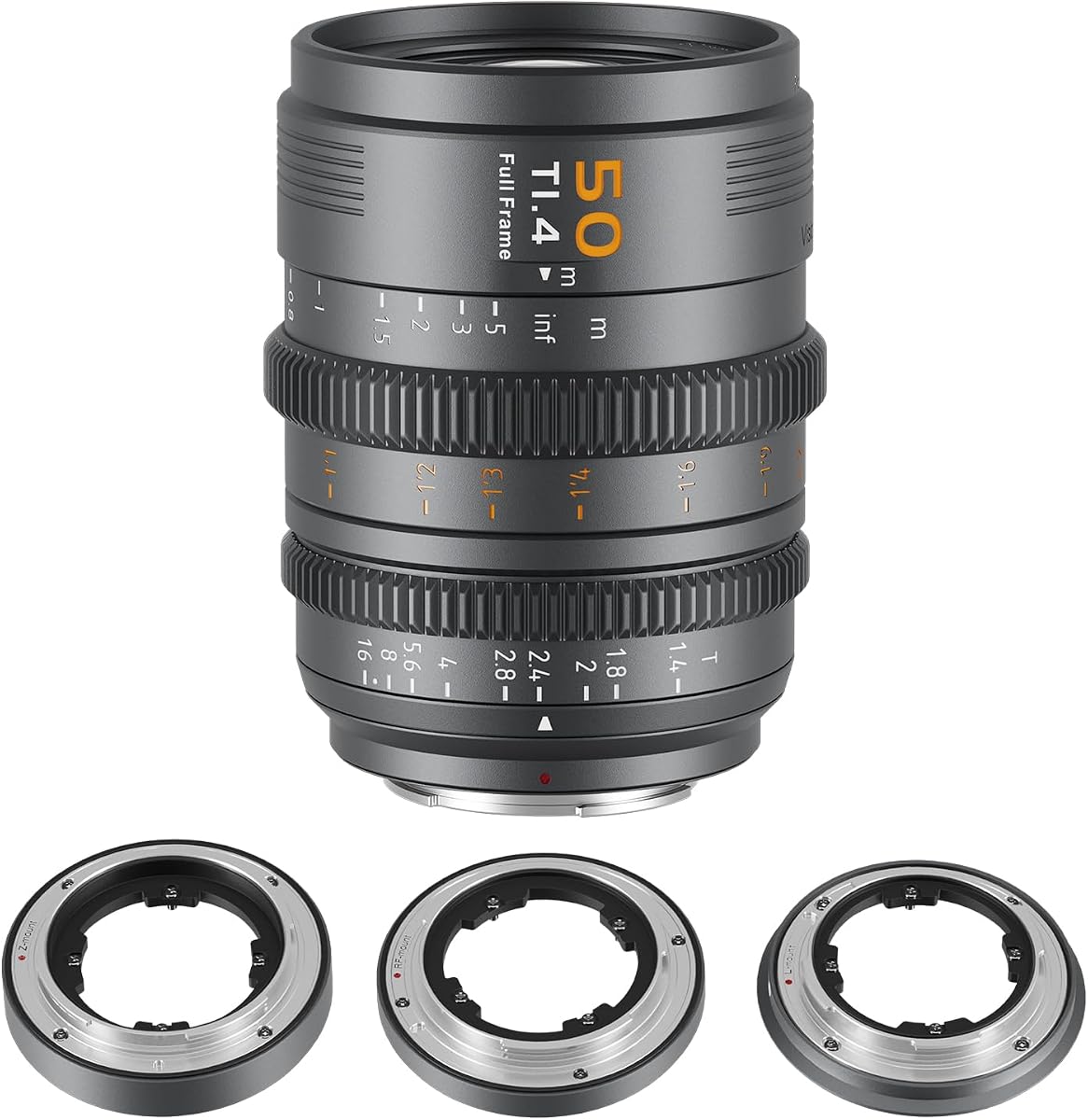
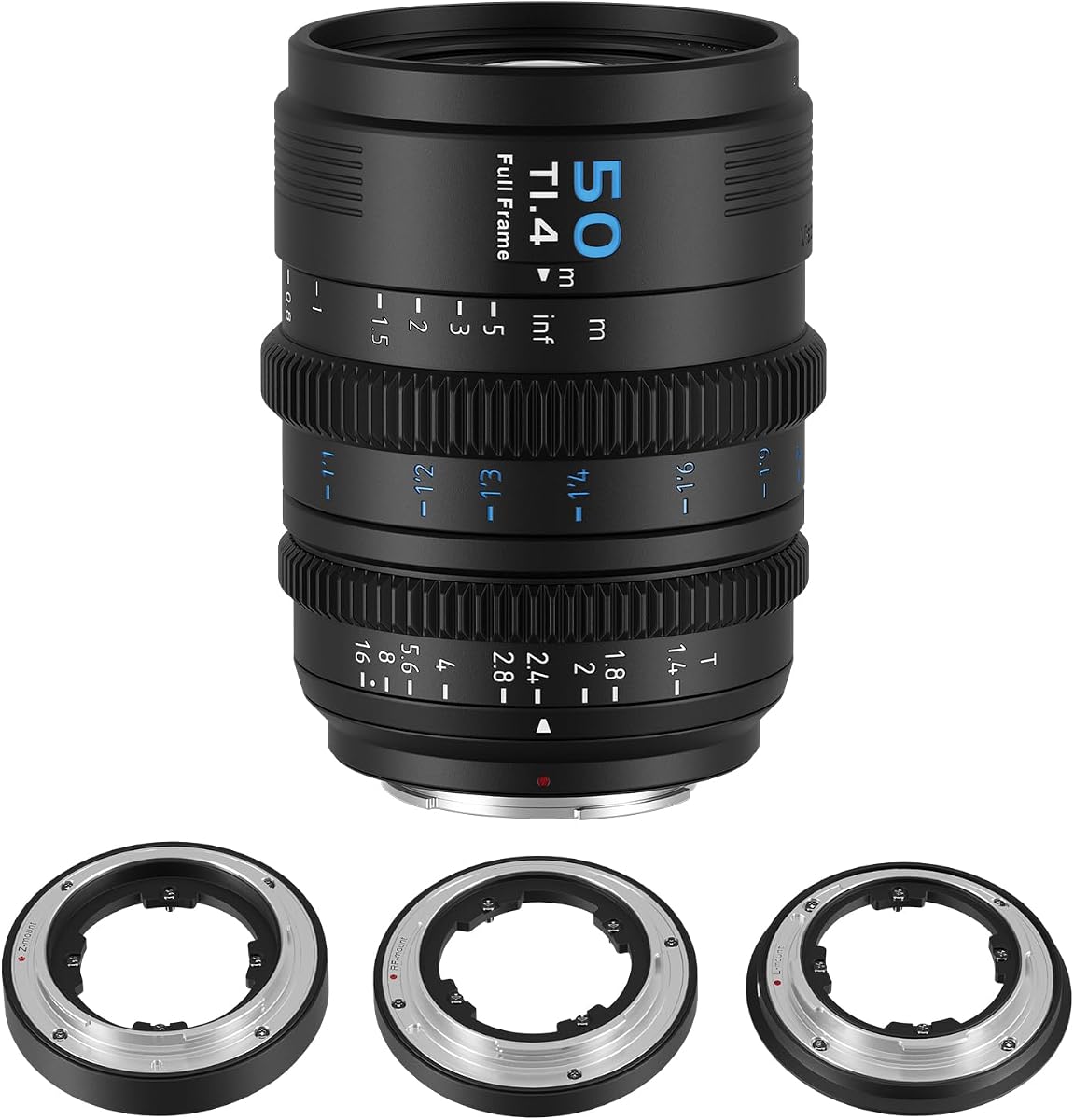
The SIRUI VP-1 Vision Prime 1 50mm T1.4 is a full-frame cine prime with a 5.0 listed rating and an unusually flexible mount system. It comes with a pre-installed E mount and user-interchangeable RF, Z, and L options, allowing filmmakers to move the same lens between Sony, Canon, Nikon, and Leica L-system cameras when using an appropriate mount configuration.
We may earn a commission when you buy through this link, at no additional cost to you.
Its optical design incorporates aspherical elements, advanced ED glass, and HRI glass with a stated emphasis on sharpness, distortion control, and chromatic-aberration management for high-resolution workflows. The T1.4 aperture supports low-light shooting and background separation, while the 50mm focal length remains one of the most versatile choices for narrative filmmaking, interviews, and documentary work.
The design also has a production-oriented consistency. The Vision Prime 1 set uses similar size and weight, matching gear positions, a 67mm filter thread, a 72mm outer diameter, and matched color temperature and tone. Each lens weighs around 600 grams, which is manageable for handheld, gimbal, travel, and documentary production. The trade-off is that the lens remains manual for focus and aperture, and changing mounts is a task that must be handled correctly.
This is a strong recommendation for a filmmaker who owns more than one camera system or plans to build a production package around the VP-1 series. It combines a useful 50mm focal length, a wide T1.4 aperture, consistent physical design, and cross-platform versatility without requiring a separate lens for every mount.
The interchangeable E, RF, Z, and L mount arrangement is the defining feature. It can simplify production planning for crews that need to support different camera brands, while also letting a filmmaker reuse a familiar lens when upgrading or switching camera bodies.
Aspherical, ED, and HRI elements form a design aimed at high-resolution capture, with particular attention to edge sharpness and chromatic aberration control. This makes the lens relevant to modern 8K-oriented workflows as well as conventional high-definition and 4K production.
We may earn a commission when you buy through this link, at no additional cost to you.
The Rokinon 35mm T1.5 Cine DS combines a full-frame 35mm perspective with a very close 12-inch minimum focusing distance, giving it unusual flexibility for a cinema prime. Its 4.6 listed rating reflects a balanced design that can function as a documentary lens, environmental portrait tool, product-detail lens, or conversational prime in a compact production package.
We may earn a commission when you buy through this link, at no additional cost to you.
The 35mm focal length provides a 63.1-degree angle of view on full-frame and 40.8 degrees on APS-C. That wider view is useful in confined interiors, for handheld observational work, and for compositions that need to retain environmental context. The T1.5-to-T22 aperture range and the Cine DS color-matching approach also make it easy to integrate with the other Rokinon DS options in this guide.
A 77mm filter thread is larger than the 72mm thread used by the listed 85mm DS lens, so filter planning should account for the difference. The lens also has no electronic communication features in the supplied information, meaning focus and aperture operation is manual. As with any fast manual prime, pulling focus requires practice and appropriate follow-focus technique.
The Rokinon 35mm is an excellent choice for documentary filmmakers, small crews, and Canon EF users who want a wide-enough standard lens with unusually close focus. It is less suitable for a system that needs electronic control or a mount that can be shared across camera brands, but its optical role is clear and highly useful.
The 12-inch minimum focus distance allows the 35mm to move from environmental images to intimate details without changing lenses. This is particularly valuable for food, tabletop, product, and detail work where the surrounding context still matters.
Compared with the 24mm options in this guide, the 35mm offers a more natural sense of depth while remaining wide enough for practical filmmaking. It can serve as the main lens for many documentaries, interviews, and narrative sequences when crews want to avoid the exaggerated perspective of an ultra-wide prime.
We may earn a commission when you buy through this link, at no additional cost to you.
The SIRUI Night Walker 35mm T1.2 is designed for Sony E-mount cameras and provides S35 coverage with a listed rating of 4.4. Its 35mm focal length produces a perspective equivalent to approximately 49mm on a full-frame frame, giving filmmakers a portrait-oriented view that is well suited to people, documentary interviews, and nighttime sequences.
We may earn a commission when you buy through this link, at no additional cost to you.
The T1.2 maximum aperture is the headline feature. It gathers a substantial amount of light, supports low-light exposure, and allows strong background separation when used at wide apertures. The optical design is described as controlling aberrations while maintaining sharpness at the maximum aperture, with minimal focus breathing intended to improve follow-focus performance.
Its physical specifications are clearly aimed at portable production. The aluminum housing weighs around 500 grams, the focus ring rotates 270 degrees, and the lens uses a 67mm filter thread. The 12-blade aperture can help shape out-of-focus highlights. The trade-off is coverage: the lens is specified for APS-C or S35, so it is not designed to cover a full-frame sensor.
This lens is a compelling match for Sony E filmmakers who prioritize a bright aperture, portrait perspective, and portable construction. It is particularly relevant to APS-C and S35 cameras such as the FX30, ZV-E10, A6500, and A6600. Full-frame users should look toward the VP-1 or Rokinon full-frame options instead.
A T1.2 maximum aperture is valuable when the available light is limited or when a filmmaker wants to keep ISO relatively low. It also provides more latitude to isolate a subject in environments where a T1.5 or T2.8 lens would not separate the background as strongly.
The 35mm focal length provides a flattering balance between environmental context and subject isolation on S35 sensors. The 0.4-meter close-focus distance gives it additional value for portraits, demonstrations, and detail-oriented inserts.
We may earn a commission when you buy through this link, at no additional cost to you.
The SIRUI Night Walker 24mm T1.2 RF is a wide S35 cine prime for Canon RF cameras, including the supplied compatibility list of RED KOMODO, EOS R7, R10, C70, and R50. With a 4.3 listed rating, its appeal rests on a distinctive combination of broad framing, a T1.2 aperture, and close focus that can support both environmental and intimate storytelling.
We may earn a commission when you buy through this link, at no additional cost to you.
The 24mm focal length is useful for landscapes, street scenes, interiors, and scenes that need to place a subject within a larger environment. Its T1.2 aperture can manage difficult light and create pronounced background separation, while the advanced optical design is described as providing high sharpness, controlled aberration, and minimal focus breathing.
Close focus at 0.3 meters adds considerable flexibility. Filmmakers can move from wide compositions to foreground details without immediately changing lenses, although a wide lens used at close range demands careful attention to perspective and working distance. The 270-degree focus rotation supports deliberate, repeatable manual focusing, and the lens uses a 67mm filter thread.
This is a good choice for a Canon RF filmmaker who wants a wide, fast prime for S35 production. It should not be selected for a full-frame workflow, and the broad perspective may be less forgiving in small rooms. For those who can operate within those constraints, it is a capable environmental storytelling lens.
A wide lens can establish location while still isolating a subject when stopped down or used with intentional focus placement. The T1.2 aperture gives creators room to choose how much of the environment remains sharp.
The 0.3-meter minimum focus distance allows rapid movement between environmental shots and close details. That makes one lens more versatile across a sequence, particularly for tabletop scenes, product inserts, and creative transitions.
We may earn a commission when you buy through this link, at no additional cost to you.
This Sony E-equipped version of the SIRUI Vision Prime 1 50mm T1.4 carries a 4.0 listed rating and delivers the same broad feature set as the interchangeable-mount option: full-frame coverage, a T1.4 maximum aperture, and a 50mm focal length. It is a sensible selection for a Sony E filmmaker who wants the 50mm prime without changing camera brands.
We may earn a commission when you buy through this link, at no additional cost to you.
Aspherical, ED, and HRI glass elements are combined to target high-resolution sharpness and control distortion and chromatic aberration. The listed camera compatibility includes Sony FX2, FX3, A7 IV, A7R V, A7S III, and A1 bodies. The shared series design also standardizes size, weight, gear position, filter thread, and color temperature across the three-lens lineup.
The main trade-off is that the listed rating is lower than that of the other Vision Prime 1 entry, although the supplied information does not explain why. Buyers should interpret ratings as a broad customer-satisfaction signal rather than a direct measurement of optical performance. Manual focus and aperture remain necessary, and the interchangeable mount system needs careful handling when moving between systems.
For Sony E users seeking a compact, bright, full-frame standard prime, this lens offers a strong feature set. It is especially attractive for documentary, travel, handheld, and gimbal work where the approximately 600-gram aluminum body and 50mm perspective are useful. The RF, Z, and L mount compatibility adds optional flexibility beyond the installed E mount.
A 50mm lens is easy to integrate into a broader production because it rarely feels excessively wide or restrictive. It can handle interviews, observational coverage, narrative scenes, and controlled setups without requiring a second lens merely to change perspective.
The compact aluminum body and consistent 50mm dimensions support travel and mobile shooting. A lens that is easier to carry is more likely to be used for varied footage, helping maintain continuity across a documentary or commercial shoot.
We may earn a commission when you buy through this link, at no additional cost to you.
The SIRUI Night Walker 24mm T1.2 M4/3 is an S35 cine prime with a 4.9 listed rating, making it one of the most well-regarded selections in this guide. It is built for Micro Four Thirds cameras and provides a wide perspective, a large T1.2 aperture, and a close 0.3-meter minimum focus distance in a housing that weighs around 500 grams.
We may earn a commission when you buy through this link, at no additional cost to you.
Its S35 coverage is designed for modern Micro Four Thirds cinema cameras. The supplied compatibility list includes the BMPCC 4K, GH5 II, GH5S, GH6, and Z Cam. The 24mm focal length offers a view equivalent to approximately 34mm on a full-frame frame, making it appropriate for landscapes, street scenes, interiors, and environmental storytelling.
The optical design is described as maintaining sharpness at the maximum aperture while controlling aberrations and focus breathing. A 12-blade iris, 270-degree focus-ring rotation, 67mm filter thread, and 84mm overall length support a practical cinema-oriented design. The limitation is straightforward: S35 coverage will not cover a full-frame sensor, and both focus and aperture are manual.
This is a particularly attractive choice for a Micro Four Thirds filmmaker who wants one wide, bright, lightweight prime. It combines a 4.9 listed rating with the series' useful close-focus capability. It is less suitable for full-frame production, but within its intended format, it offers a compelling combination of angle, brightness, portability, and useful close-focus range.
The T1.2 aperture is especially useful when filming at night, indoors, or in other low-light situations. It can help maintain a cleaner exposure than a slower lens and provides more freedom when isolating a subject against a complex background.
Many wide primes force filmmakers to accept weak close-focus performance. The 0.3-meter specification gives this Night Walker more flexibility for detail inserts, tabletop scenes, and intimate environmental shots.
We may earn a commission when you buy through this link, at no additional cost to you.
The Rokinon DSX85 DSX 85mm T1.5 is a full-frame portrait prime for Canon EF cameras with a listed rating of 4.7. It combines a classic 85mm focal length with a T1.5 maximum aperture, making it suited to interviews, portraits, narrative close-ups, and any shot that benefits from subject separation.
We may earn a commission when you buy through this link, at no additional cost to you.
Its optical construction uses nine elements in seven groups, including ultra multi-coated glass. The aperture runs from T1.5 to T34 through nine blades, while a 72mm filter thread provides another straightforward planning point. The stated angle of view is 28.4 degrees on full frame and 19.1 degrees on APS-C.
Compared with the Rokinon Cine DS 85mm included in this guide, the DSX is a more compact standalone offering according to the supplied product identity, and it has a T34 rather than T22 aperture endpoint. Manual focus and aperture are its primary constraints. A filmmaker who expects electronic control, cross-mount compatibility, or automatic exposure would need to look elsewhere.
The DSX85 is a focused recommendation for a Canon EF user who wants a fast 85mm without purchasing a larger matched set. Its high listed rating, bright aperture, and familiar portrait perspective make it particularly effective for creators who primarily shoot people and need a fast telephoto prime.
The T1.5 aperture helps filmmakers maintain exposure in dim interiors and evening environments while also enabling a shallow depth of field. These two benefits often make a fast 85mm especially useful for interviews and performance footage.
This lens is a practical alternative to purchasing a complete prime set when the production is portrait-led. Its dedicated 85mm configuration, 72mm thread, and straightforward Canon EF fit make it easy to add to a working kit.
We may earn a commission when you buy through this link, at no additional cost to you.
The DZOFILM Pictor 50-125mm T2.8 is a premium Super35 cine zoom with a 5.0 listed rating. Unlike the prime lenses in this guide, it covers a broad range from 50mm to 125mm while maintaining a constant T2.8 aperture, reducing the need to change lenses when a production needs several telephoto perspectives.
We may earn a commission when you buy through this link, at no additional cost to you.
Its defining operational feature is parfocal behavior, meaning the lens is designed to maintain focus across the entire zoom range. Minimal focus breathing is also specified, which makes the zoom more practical for a moving subject or a shot in which the framing changes continuously. The 16-slat iris provides a distinct mechanism for shaping out-of-focus highlights.
The Pictor is specified for PL and Canon EF camera systems and works with standard cine lens accessories. Its Super35 coverage is broader than a Micro Four Thirds S35 lens but narrower than a full-frame prime, so compatibility must be checked carefully. The zoom format also requires more deliberate support and framing practices than a compact prime, particularly during handheld movement.
For productions prioritizing fast lens changes, multiple focal lengths, and repeatable zoom operation, the Pictor is the standout premium selection. It is less appealing for a minimalist kit or a filmmaker who wants the widest possible full-frame coverage, but its parfocal design, minimal breathing, and constant aperture make it exceptionally purposeful.
The 50-125mm range covers a useful sequence from conversational framing to tighter portraits and detail shots. For a crew working quickly, this can simplify camera preparation and reduce interruptions caused by lens changes.
Maintaining focus across the zoom range is a major advantage when the subject moves or the operator reframes. Combined with the stated reduction in focus breathing, the parfocal design supports a more consistent visual experience than a typical video zoom.
We may earn a commission when you buy through this link, at no additional cost to you.
The best cine lens depends on sensor format, camera mount, focal-length strategy, aperture requirements, and the amount of manual focusing your production can support. Compare coverage and compatibility first, then evaluate the working features that affect a shoot.
Lens coverage must match or exceed the sensor area you intend to illuminate. Full-frame lenses such as the Rokinon Cine DS primes and SIRUI Vision Prime 1 can cover full-frame cameras, while the Night Walker lenses are specified for APS-C or S35 coverage. The DZOFILM Pictor uses Super35 coverage. A lens with a smaller image circle will not cover a larger sensor, and an incompatible mount cannot physically attach to the camera.
Choose full-frame coverage for maximum camera compatibility and consistent framing across sensor formats. Choose S35 coverage when using a matching camera and want a compact lens with a distinctive field of view. Always verify the exact camera model and intended production format before buying.
The mount determines which cameras can use a lens and how the lens is integrated into the rig. Canon EF appears on the Rokinon standalone primes and kit, Canon RF on the 24mm Night Walker, Sony E on the 35mm Night Walker, and M4/3 on the 24mm Night Walker. The SIRUI Vision Prime 1 supports a pre-installed E mount with interchangeable RF, Z, and L options, while the Pictor is offered for PL and Canon EF.
Confirm the mount before considering any other feature. Interchangeable systems offer useful flexibility, but each lens and camera combination must use the correct mount configuration and be handled according to the manufacturer's instructions.
Prime lenses give a deliberate perspective and consistent look, while a zoom can cover several framings quickly. The Rokinon kit spans 24mm, 35mm, 50mm, and 85mm, the Night Walker models are 24mm and 35mm primes, and the Vision Prime 1 centers on a 50mm. The Pictor covers 50-125mm and is built for projects that value fast focal-length changes.
Think in terms of shot requirements rather than a single flattering focal length. A wide prime helps with environments, a 35mm or 50mm supports many conversational shots, an 85mm emphasizes portraits, and a telephoto zoom provides reach without multiple lenses.
A wider T-stop gathers more light and makes it easier to create shallow depth of field. The Night Walker lenses lead this group with T1.2, followed by the Vision Prime 1 at T1.4, the Rokinon primes and kit at T1.5, and the Pictor zoom at T2.8. Each choice affects low-light capability, background separation, depth of field, and exposure consistency.
A fast lens is valuable for low-light work and expressive separation, but a filmmaker must also consider focus depth and whether the required background softness fits the concept. Do not choose an aperture purely by number; evaluate it alongside focal length, sensor format, and shooting distance.
Minimum focus distance indicates how close a lens can be to its subject, but a short minimum distance is only one part of the focusing experience. The Rokinon 35mm focuses as close as 12 inches, the Night Walker 24mm options reach 0.3 meters, and the 35mm Night Walker reaches 0.4 meters. The Rokinon 85mm lists a 3.6-foot minimum focus distance.
Prioritize close focus for products, food, hands, tabletop details, and intimate portraits. For conventional portrait work, consider focus depth, rotation range, and follow-focus technique as well. A longer focus ring rotation can support smoother manual adjustments.
Every featured lens is manually focused, and the supplied information likewise identifies manual aperture control for the relevant models. Manual operation can be an advantage because a crew can use a follow-focus system and repeat exact marks, but it also requires practice, especially with fast subjects or wide-open apertures. A cine-style geared ring and clearly printed scales are valuable operational details.
Budget time for focus practice and make sure the lens markings are clear under the lighting conditions of the set. If the production involves unscripted movement, electronic focus options may be important, but the lenses in this guide are designed around deliberate manual cinematography.
The number of aperture blades affects the shape of out-of-focus highlights and the character of the background. The Rokinon Cine DS 85mm uses eight blades, the Night Walker lenses use 12, and the DZOFILM Pictor uses a 16-slat iris. More blades can produce a rounder highlight shape, while the overall rendering also depends on aperture, distance, focal length, and scene contrast.
If stylized bokeh is important, look beyond the blade count and consider how the lens is used. Wide apertures and distant backgrounds create stronger defocus, whereas a subject close to the camera against a nearby background may show a more noticeable shape.
A matched set can reduce visible shifts when footage from different lenses is edited together. The Rokinon Cine DS series is color matched and uses unified gear and aperture positions. The SIRUI Vision Prime 1 series similarly shares matched color temperature and tone along with standardized dimensions and gear placement. A single zoom such as the Pictor offers another form of consistency by keeping the same optical design throughout its range.
For multi-camera commercial work, documentary series, or narrative shoots that will use several lenses, consistency deserves serious attention. Compare stated color matching, physical markings, gear positions, and filter sizes when building a complete package.
Before mounting a lens, confirm that the mount and camera body are compatible, compare the lens markings with the intended focal length or aperture, and clean both the rear glass and the camera mount. Attach the lens carefully, remove unnecessary caps, and avoid forcing the mount or turning the barrel through its locking mechanism.
Set focus at the actual shooting distance and mark the barrel with the included or appropriate reference tape. When changing lenses, use a consistent focus and aperture position for each marked focal length. For zoom work, check the focus carefully through the complete range and use the parfocal behavior of the Pictor to support more consistent framing during a zoom.
Store lenses in a padded case or padded compartment away from heat, moisture, impact, and direct sunlight. Keep front and rear caps on when the lens is not being used, clean glass with an appropriate lens cloth and lens-cleaning fluid, and avoid touching optical surfaces with bare fingers. If a mount is interchangeable, follow the supplied instructions carefully and confirm that the new configuration is secure before attaching the lens to a camera.
Cine lenses are designed primarily for manual operation and often include large, geared focus rings, consistent gear positions, aperture markings, and long focus-ring rotation. Standard video lenses may provide electronic focus, aperture control, stabilization, and communication with the camera. The right choice depends on your production workflow, camera system, and comfort with manual focusing.
No. The Rokinon Cine DS primes, the Rokinon DSX 85mm, and the SIRUI Vision Prime 1 are listed with full-frame coverage. The SIRUI Night Walker lenses provide APS-C or S35 coverage, while the DZOFILM Pictor is a Super35 zoom. Always check the camera's sensor format and the lens's stated coverage before purchasing.
The T-stop is the lens's light-transmission value after accounting for optical losses, so it gives a more meaningful exposure indication than a simple f-number. A T1.2 lens transmits more light than a T2.8 lens, but depth of field is also affected by focal length, focus distance, and sensor size. The aperture value should therefore be considered alongside the full optical setup.
A cine zoom saves time by covering several focal lengths without lens changes, and the DZOFILM Pictor adds parfocal focus and minimal breathing. A prime set can provide fixed perspectives and matched rendering across focal lengths. Zooms are often more convenient for fast productions, while matched primes can be useful when framing discipline and a consistent look matter most.
An S35 lens cannot cover the entire area of a full-frame sensor because its image circle is smaller. Depending on the camera, it may work with limitations, a crop mode, or an adapter, but those restrictions can change framing and field of view. For predictable full-frame results, use a lens specifically listed for full-frame coverage.
A parfocal zoom is designed to keep the same subject in focus as the focal length changes. This makes zooming more reliable during a moving shot or continuous reframing. The DZOFILM Pictor is specifically described as maintaining focus across its entire 50-125mm range and offering minimal focus breathing.
The supplied information identifies manual focus and aperture operation for the applicable products. Manual control allows precise marks and repeatability, especially with a follow-focus system, but it also takes practice. If a production requires automatic exposure changes or electronic focus, confirm camera and lens compatibility before relying on those features.
A single lens is often more practical for a specific camera system, focal length, or type of work. A matched set is valuable when a production needs several perspectives and benefits from consistent color and controls. The Rokinon Cine DS four-lens kit covers four common full-frame focal lengths, while the Vision Prime 1 series provides a consistent 50mm-centered approach with interchangeable mounts.
The Rokinon Cine DS four-lens kit stands out as the most complete package for Canon EF filmmakers, covering 24mm, 35mm, 50mm, and 85mm with coordinated controls. The SIRUI Vision Prime 1 50mm T1.4 is the most flexible single-lens choice thanks to its interchangeable E, RF, Z, and L mounts, while the DZOFILM Pictor 50-125mm T2.8 leads the premium zoom category with parfocal focus and a broad focal-length range.
For an individual fast prime, the right choice depends on your sensor and camera. The Night Walker models are particularly practical for APS-C, S35, and Micro Four Thirds users, while the Rokinon primes provide full-frame coverage for Canon EF systems. Prioritize correct coverage, a compatible mount, a useful focal-length range, and an aperture that supports your lighting before considering less visible differences in handling.
Current prices and availability may change, so check the latest product listing and confirm the included mount, accessories, and camera compatibility before ordering. Also verify that manual focusing fits the demands of your production and allow time to learn the focus, aperture, and close-focus characteristics of whichever lens you select.