
Uniden Atlantis 275
4.6Editor score
IPX8 floating construction
Selectable 1W to 6W
Dual-color daylight display
Emergency strobe and flashlight
Our guide compares the best Handheld VHF Radio for Dinghy Safety, evaluating waterproofing, transmit power, marine channels, alerts, battery life, and ease of
A handheld VHF radio is an important piece of safety equipment for any dinghy sailor, providing a direct line to other boats, nearby shore stations, and emergency services. The best model balances useful range with compact size, dependable flotation, readable controls, reliable charging, and protection from rain, spray, and accidental immersion.
This guide compares ten marine VHF handhelds for dinghy safety using published specifications and customer ratings. It examines transmit power, waterproof ratings, channel coverage, NOAA weather alerts, watch modes, emergency lighting, battery arrangements, displays, charging options, and practical features that matter aboard a small open boat.
Each review identifies the strongest reasons to consider a model and the compromises involved, helping readers match a radio to their sailing area, group size, and charging setup. Product availability and prices can change, so readers should verify the latest listing, regional channel requirements, included accessories, and current terms before purchasing.
4.6Editor score

4.6Editor score

4.9Editor score
The comparison highlights the major differences among all ten models, including maximum transmit power, water resistance, display type, channel and weather functions, emergency features, battery design, and charging method.




The Cobra BlueBound 350 White is a compact marine handheld with a 4.5 customer rating and a feature set aimed squarely at small-boat safety. Its most immediately useful qualities are the high-visibility orange floating core, switchable 1-, 3-, and 6-watt transmit power, and Tri-Watch function, which lets a sailor monitor Channels 9 and 16 while listening to a user-selected channel.
We may earn a commission when you buy through this link, at no additional cost to you.
The radio is built around an IPX7 waterproof specification, making it suitable for harsh marine use and potential full immersion. A selectable day or night LCD mode improves visibility under changing conditions, while access to 12 weather channels and the NOAA emergency broadcast channel provides information that can be essential when conditions deteriorate offshore. The three power levels also let users balance communication range against battery consumption rather than always transmitting at maximum output.
The main limitation is that the supplied specifications do not mention GPS, Bluetooth, or a water-activated strobe. That makes it a straightforward communications tool rather than a feature-packed distress device. Its IPX7 rating is also not the highest water-resistance level represented in this list, although that distinction should be considered in light of the radio's floating core, sealed construction, and intended marine role. Buyers who want simple operation and channel coverage may find that limited advanced connectivity is not a disadvantage.
This is a strong choice for dinghy sailors who want six watts of power, continuous access to distress and calling channels, and a radio that is easy to retrieve after a drop. It suits coastal cruisers, racing programs, and informal sailing groups that need reliable local communication without a complex setup. The best overall balance of range, visibility, weather information, and straightforward operation makes it an excellent first marine VHF handheld.
Tri-Watch is especially valuable aboard a dinghy, where changing conditions and nearby traffic can make fixed channel monitoring risky. The radio checks Channels 9 and 16 alongside the selected channel, helping the crew respond to distress calls, hails, and urgent marine traffic without abandoning ordinary communication.
Using one watt for nearby conversations and six watts when greater reach is needed can reduce unnecessary battery drain. This flexibility is useful on long days afloat, particularly when the crew also relies on the radio for NOAA weather information.
We may earn a commission when you buy through this link, at no additional cost to you.
The black Cobra BlueBound 350 provides the same core safety platform as the white version: a 4.5 rating, 6-watt maximum transmit power, selectable 1- and 3-watt settings, Tri-Watch, NOAA weather access, and a floating high-visibility core. Its black housing may appeal to sailors who prefer less conspicuous equipment or want to distinguish it from other gear aboard a shared dinghy.
We may earn a commission when you buy through this link, at no additional cost to you.
The orange core remains important even with a black exterior because it makes the radio easier to locate if it goes overboard. IPX7 waterproofing supports use in wet environments and potential immersion, while the day and night display selection helps maintain visibility in bright daylight or during a nighttime watch. The radio also allows the user to monitor three channels at once, including the two important marine calling and distress channels.
As with the white BlueBound 350, advanced location and wireless features are not listed. The radio focuses on conventional VHF communication, weather information, and user-adjustable transmit power. That simplicity is an advantage for some dinghy crews because fewer menu functions can make emergency use more direct. It may be less suitable for skippers who specifically want GPS coordinates, Bluetooth text messaging, or integrated man-overboard features.
The black BlueBound 350 is well matched to coastal dinghy sailors who need a dependable handheld with selectable power and continuous distress-channel access. It works especially well for crews that value a compact, conventional marine radio and NOAA alerts more than extended connectivity. For many buyers, the combination of flotation, visibility, six-watt output, and Tri-Watch is enough to make it a top-ranked choice.
A direct marine handheld can be easier to brief than a multifunction device. The Black BlueBound 350 keeps the essential tools close at hand: selectable power, NOAA alerts, and watch access to the principal emergency and calling channels.
The floating core separates the radio from the dark hull or surrounding water, making it easier for a crew member or passerby to spot. That visibility remains valuable even in a black housing because the functional core is high visibility.
We may earn a commission when you buy through this link, at no additional cost to you.
The Standard Horizon HX210 earns a 4.6 rating and stands out as a well-rounded safety radio for dinghy use. It combines selectable 1-, 2.5-, and 6-watt transmission with a floating IPX7 body, a high-capacity 1850mAh lithium-ion battery, NOAA and FM reception, and international and Canadian marine channel coverage. The supplied rapid charging cradle and both 12VDC and 110VAC cables make it especially practical for regular use.
We may earn a commission when you buy through this link, at no additional cost to you.
Its oversized full dot-matrix display should be easy to consult in changing conditions, and programmable function keys give users quick access to frequently used functions. A water-activated emergency strobe adds a valuable visual safety feature if the radio enters the water. The E20 menu system is designed to simplify operation, while all USA, international, and Canadian channels make the radio relevant to sailors who cross boundaries or need broader channel access.
The IPX7 rating is highly relevant for a wet, open environment, although it is not the top water-resistance designation represented here. The radio also lacks listed GPS or Bluetooth functionality, so it is not the right option for a sailor who wants position sharing or text-style communication. A three-hour desktop rapid charger is convenient but requires access to a suitable outlet, and users may wish to add a portable charging option for remote trips.
The HX210 is recommended for dinghy sailors who want a traditional marine handheld with a large display, emergency lighting, international channels, and a strong battery-and-charger package. It is especially attractive for families, clubs, and coastal cruisers that can recharge the unit regularly. The combination of straightforward operation, six-watt range, and thoughtful safety details justifies its place as an Editor's Choice.
The water-activated strobe can help a crew or rescuer locate the radio after immersion. This added visual signal complements audible transmissions and is especially useful in poor visibility, heavy rain, or low-light conditions.
The included rapid cradle, AC cable, and 12VDC cable cover common charging environments. A removable high-capacity lithium-ion battery gives the radio useful endurance, while a dedicated cradle reduces the chance of damaging charging contacts aboard a boat.
We may earn a commission when you buy through this link, at no additional cost to you.
The Uniden MHS75 has a 4.4 rating and focuses on rugged construction, flotation, and constant access to important marine channels. Its floating, submersible design is rated for up to 30 minutes at five feet, making it a natural fit for exposed cockpits and wet decks where dinghy gear is regularly handled.
We may earn a commission when you buy through this link, at no additional cost to you.
Selectable 1-, 2.5-, and 5-watt transmit power gives the crew flexibility between close-range conversations and longer-distance calls. Triple Watch monitors Channels 16 and 9 while the radio listens to the selected channel, with checks for activity every two seconds. The radio also includes all USA, international, and Canadian marine channels, along with NOAA weather channels and an emergency alert tone.
The maximum transmit output is one watt below the six-watt models in this comparison, which may matter when communicating with distant shore stations or vessels beyond line of sight. The supplied data also does not mention a water-activated emergency strobe, flashlight, GPS, or Bluetooth. Those omissions keep the design simple, but sailors seeking visual distress signaling or position sharing should look elsewhere.
The MHS75 is a sensible recommendation for dinghy sailors who prioritize rugged waterproofing, floating behavior, NOAA warnings, and rapid monitoring of the primary calling channels. It suits coastal group sails, fishing trips, and dinghy programs where every radio should be handled by multiple people. Its simple feature set and selectable power make it a practical, dependable choice rather than a highly connected one.
Triple Watch checks Channels 16 and 9 every two seconds while the selected channel remains audible. This approach is useful for a small crew because the radio can remain on a working channel without losing awareness of urgent traffic.
The floating body and JIS8 submersible specification are useful in dinghies where spray, rain, and accidental drops are common. Its five-watt maximum remains workable for many local and coastal communications.
We may earn a commission when you buy through this link, at no additional cost to you.
The Icom M25EVO Blue carries a 4.9 rating, the highest in this group, and combines a lightweight floating design with modern charging. At only 7.8 ounces, it is easy to carry in a jacket pocket, life-jacket pocket, cockpit storage, or dry bag without consuming much space or adding noticeable weight.
We may earn a commission when you buy through this link, at no additional cost to you.
Its IPX7 construction is designed for marine conditions, while the flashing behavior makes the radio easier to retrieve if it goes overboard. USB-C fast charging removes the need for a proprietary cable and allows recharging from a wider range of convenient power sources. The stated 11-hour lithium-ion battery life is particularly relevant to full-day dinghy sails, long coastal trips, and outings where charging opportunities are limited.
The available product information emphasizes compactness, endurance, waterproofing, and charging rather than advanced location or wireless features. While that simplicity helps preserve the radio's low weight and straightforward character, it means the M25EVO is not aimed at sailors who require integrated GPS, Bluetooth, or man-overboard functions. Buyers should also confirm the final channel configuration and included accessories for their region on the current listing.
The Icom M25EVO Blue is a premium recommendation for dinghy sailors who prioritize low weight, all-day endurance, fast familiar charging, and reliable flotation. It is particularly well suited to sailors who carry equipment in compact spaces or need a radio that will not become tiring to hold. Its exceptional rating, 11-hour battery claim, and USB-C convenience make it one of the most attractive choices in the guide.
The 7.8-ounce housing is easy to overlook in a pocket or life-jacket compartment. Lower carried weight matters during a long day of hiking out, changing watch positions, or moving around a small cockpit.
USB-C makes it easier to use the same charging ecosystem as many phones and other modern devices. That convenience can simplify preparation for a day on the water and reduce the need to carry a specialized cable.
We may earn a commission when you buy through this link, at no additional cost to you.
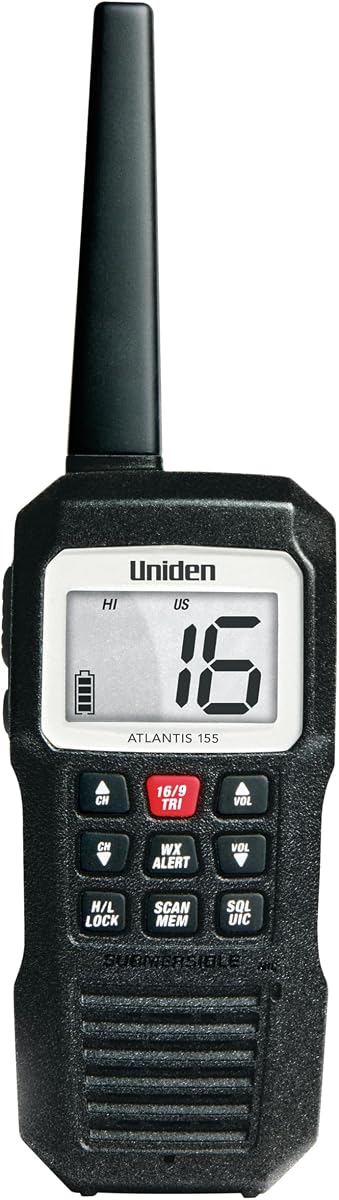
The Uniden Atlantis 155 is the most compact and approachable model in the guide, with a 4.1 customer rating. Despite its small profile, it provides the foundational elements of marine safety: flotation, IPX8 and JIS8 water resistance, NOAA weather channels and alerts, broad international channel access, and selectable 1- or 3-watt transmit power.
We may earn a commission when you buy through this link, at no additional cost to you.
Its 25-by-40millimeter LCD uses a paper-white backlight during the day and a red backlight at night. The radio floats, clears its speaker of water after submersion, and includes a 950mAh rechargeable NiMH battery set with a DC charging cable. A stated 10-hour battery life provides ample endurance for a typical day afloat without requiring a large charging setup.
The three-watt maximum is the main range limitation, especially for offshore routes, broad bays, or areas with large distances between boats and shore stations. The 4.1 rating is also the lowest among the ten products, indicating some mixed customer experiences without identifying a specific defect. A larger radio with six watts, GPS, or an emergency strobe may better serve sailors who prioritize maximum capability over a compact entry-level design.
The Atlantis 155 makes sense for beginners, club dinghies, and short coastal outings where a crew wants a small, floating radio with complete NOAA and marine channel access. Its high water-resistance rating and dual-color display are particularly reassuring for exposed use. It is best regarded as a capable basic radio rather than the most flexible choice for every sailing condition.
IPX8 protection and a floating design are valuable features in a small open boat. The ability to recover the radio and clear its speaker after submersion adds practical resilience to spray-heavy and rain-prone conditions.
A white daytime backlight and red nighttime backlight help keep the display readable at different times. The compact screen can be checked quickly without demanding much cockpit space or crew attention.
We may earn a commission when you buy through this link, at no additional cost to you.
The Uniden MHS338BT is the most connected radio in this roundup, with a 4.2 rating, 6-watt maximum output, integrated GPS, Bluetooth, a compass display, and NOAA weather alerts. It also floats, carries an IPX8 submersible rating, and includes both a water-activated emergency strobe and flashlight, creating a broad safety platform for dinghy sailors.
We may earn a commission when you buy through this link, at no additional cost to you.
Favorite Position mode allows a user to save the current location and manually enter other positions for later reference. Bluetooth connectivity supports the manufacturer's iOS and Android app for setup, text messaging with compatible VHF radios, and entering DSC directory information. Automatic backlight switching uses white for daylight and amber at night, while adjustable brightness and a large orange backlit display support quick reading in rough conditions.
A water-activated man-overboard feature can automatically activate when the radio enters the water, and the radio can auto-plot a received DSC distress call. These are meaningful advantages for sailors who want more than voice communication, but they also make the device more complex than a basic handheld. The 4.2 rating should be considered alongside the feature set rather than as the only measure of suitability.
The MHS338BT is a strong recommendation for technically comfortable dinghy sailors who want position data, wireless communication, and advanced distress features. It is especially relevant to crews that share coordinates, use compatible VHF text messaging, or want a radio capable of storing favorite positions. Buyers should be prepared to learn the menu and confirm app and regional DSC compatibility before heading offshore.
The integrated GPS and favorite position directory can help a crew describe where it is or return to a meaningful location. Automatic distress-call plotting adds context to incoming emergency information, although users must still understand the radio's DSC functions.
Bluetooth setup and text messaging can improve communication with compatible devices, but they are most useful when the crew is willing to learn the app and compatible radio procedures. Traditional voice and NOAA functions remain the core safety tools.
We may earn a commission when you buy through this link, at no additional cost to you.
The Uniden Atlantis 275 combines a 4.6 rating with six-watt maximum power, making it an unusually balanced value-oriented marine handheld. It floats, meets IPX8 and JIS8 standards, clears its speaker of water after submersion, and offers selectable 6-, 2.5-, and 1-watt transmit power. The result covers many of the core capabilities sought in a dinghy safety radio.
We may earn a commission when you buy through this link, at no additional cost to you.
Its large 25-by-40millimeter display uses a paper-white daytime backlight and red nighttime backlight, providing clear information in different conditions. The built-in emergency strobe and flashlight add useful visual functions, while reception of USA, Canadian, and international marine channels includes four-digit and Canadian B channels. NOAA weather channels and alerts help keep the crew informed as conditions develop.
A built-in lithium-ion battery pack, charging cradle, and AC and DC charging cables create a convenient charging package, and the product is backed by a three-year warranty and three-year waterproof warranty. GPS and Bluetooth are not listed, so sailors who need those features must move beyond this model. Otherwise, its feature set remains focused and practical rather than oversized.
The Atlantis 275 is our Best Budget pick because it combines high power, top-level flotation protection, weather alerts, and visual emergency features without placing advanced connectivity at the center. It is an excellent choice for club fleets, family dinghies, and coastal sailors who want a capable conventional VHF radio. Its 4.6 rating and broad channel coverage make it a confident recommendation.
The six-watt setting offers greater potential range than lower-powered compact alternatives. For a dinghy moving near other vessels, rocky coastlines, or distant shore stations, that extra output can be valuable.
The emergency strobe and built-in flashlight can support visibility and signaling in low-light conditions. They also help distinguish this model from the smaller Atlantis 155 without adding a complex app-driven interface.
We may earn a commission when you buy through this link, at no additional cost to you.
The Cobra BlueBound 150 is a compact radio with a 4.2 rating, designed around three lower power settings, a floating high-visibility core, and flexible battery compatibility. Its selectable output of 0.5, 1, or 3 watts lets the user limit energy use for nearby conversations while preserving more power when greater range is required.
We may earn a commission when you buy through this link, at no additional cost to you.
IPX7 waterproofing supports use in wet marine environments, and the radio floats with a high-visibility orange core to improve the chance of recovery after an overboard drop. Dual-Watch keeps Channels 9 and 16 accessible, allowing a dinghy crew to monitor the two important marine channels without constantly turning the radio. A large, clear LCD is designed for quick at-a-glance operation in changing weather and light.
The most interesting feature is power flexibility. The radio can use rechargeable or alkaline AAA cells, and its USB-C port provides a convenient way to recharge compatible rechargeable batteries. This can be helpful when access to a specialist charging cradle is limited. Its three-watt ceiling, however, makes it less suited to long-range offshore use than six-watt models.
The BlueBound 150 is a practical choice for day sailors, instructors, and short coastal trips where a small radio with flexible power options is sufficient. It gives up some range and lacks listed GPS and emergency lighting, but it covers NOAA alerts, Dual-Watch, flotation, and USB-C convenience. It works well for crews whose priority is compact handling rather than maximum communication reach.
Compatibility with both rechargeable and alkaline AAA cells gives the crew more ways to keep the radio ready. A spare set of alkaline cells can serve as a contingency when a dedicated battery or charging source is unavailable.
Dual-Watch provides access to Channels 9 and 16 while the radio remains on a selected channel. It is a simple, effective arrangement for a dinghy crew that wants constant awareness of calling and distress traffic.
We may earn a commission when you buy through this link, at no additional cost to you.
The Icom IC-M73 has a 4.5 rating and focuses on a straightforward marine handheld built around six-watt transmit power. Its distinctive hourglass shape is designed for easy handling, which is valuable when a radio must remain in the hand for long periods or be operated by several crew members aboard a moving dinghy.
We may earn a commission when you buy through this link, at no additional cost to you.
The radio is described as waterproof and submersible, making it suitable for a wet marine environment. It includes a charger and cigarette-lighter adapter, allowing direct recharging from a boat's 12-volt outlet during a trip. An optional speaker and microphone can extend the practical use of the set when the crew needs more flexible placement or hands-free communication.
The product information provided is much less detailed than for the other radios, so buyers should confirm the precise waterproof rating, channel coverage, battery life, and included components on the current listing. No GPS, Bluetooth, weather-alert, or emergency-light functions are listed in the supplied description. This may be acceptable for a sailor focused on conventional voice communication, but it offers fewer documented conveniences than several alternatives.
The IC-M73 is best suited to dinghy sailors who value a comfortable grip, solid transmit power, and simple charging from a vehicle or boat outlet. It is a credible choice for conventional coastal communication, especially for users comfortable with a more traditional radio format. Buyers should compare the final specifications and included accessories carefully before making a decision.
The hourglass form can provide a natural grip when the radio is held in a wet or moving environment. Ergonomics matter in a dinghy because a secure, understandable hold reduces fumbling when a crew member needs to respond quickly.
The included cigarette-lighter adapter is useful for replenishing the battery between trips or during a longer outing. It allows a crew to use a standard 12-volt charging point rather than relying only on a household outlet.
We may earn a commission when you buy through this link, at no additional cost to you.
The right marine handheld for a dinghy should be dependable, easy to operate in wet conditions, and appropriate for the range of the intended sailing area. Water resistance, flotation, power, channel access, battery life, and charging convenience deserve careful attention before purchase.
A dinghy radio will encounter spray, rain, washdown, and the possibility of being dropped into the water, so water resistance and flotation should be treated as core safety requirements. Every model listed here is described as waterproof or submersible, but the standards differ. The Atlantis 155, Atlantis 275, and MHS338BT have IPX8 ratings, while the Cobra BlueBound models, Icom M25EVO, and Standard Horizon HX210 carry IPX7 specifications. The Uniden MHS75 uses a JIS8 designation and is described as submersible for up to 30 minutes at five feet. A floating body is especially important because it gives the crew a chance to retrieve the radio after an overboard loss.
Maximum transmit power influences how far a radio can potentially carry a conversation, although terrain, antenna height, weather, obstacles, and the receiving radio also affect real-world results. Six-watt models such as the HX210, both BlueBound 350 variants, Atlantis 275, MHS338BT, and Icom IC-M73 are the strongest choices for greater coastal or offshore reach. The MHS75 reaches five watts, while the Atlantis 155 and BlueBound 150 top out at three watts, and the BlueBound 150 includes a half-watt setting. Lower settings are valuable for close-range use and battery conservation, so a radio with multiple outputs is more versatile than one that transmits only at full power.
A useful marine handheld should cover the channels used in the region where the radio will operate. All ten radios described here support major USA, international, and Canadian marine channels, while the Atlantis 155 and 275 specifically mention four-digit and Canadian B channels. NOAA weather channels and alerts appear throughout the group and can warn the crew of severe conditions or provide routine forecasts. The HX210 also receives FM broadcasts, which is useful for entertainment but secondary to marine safety. Before buying, compare the channel list with local requirements and confirm regional programming for any international sailing area.
Continuous monitoring of the primary distress and calling channels is one of the most useful capabilities a dinghy radio can provide. Dual-Watch monitors Channels 9 and 16, while Tri-Watch adds a user-selected channel to those two. The MHS75 uses Triple Watch and checks the two priority channels every two seconds. This functionality reduces the chance that a crew listening to a working channel will miss a distress call. The more connected MHS338BT can also monitor Coast Guard distress or hailing channels, a weather channel, and a regular marine channel through its Dual and Triple Watch modes.
Battery endurance determines whether a radio remains useful during a full day on the water. The Icom M25EVO advertises up to 11 hours, the Atlantis 155 lists 10 hours, and the HX210 includes an 1850mAh lithium-ion battery. Charging arrangements vary: the HX210 and MHS338BT include cradles, the BlueBound 150 uses USB-C, the M25EVO also uses USB-C, and the IC-M73 includes a cigarette-lighter adapter. The Atlantis 155 uses four AAA NiMH cells, while the BlueBound 150 accepts rechargeable or alkaline AAA batteries. A dinghy owner should consider not only runtime but also whether a spare battery or cable can be carried and how the radio will be charged between outings.
A screen that is easy to interpret quickly is important when a radio is being operated in wind, rain, darkness, or while a crew member is occupied with sailing. The HX210 has an oversized full dot-matrix display, and the Atlantis 155 and 275 use large 25-by-40millimeter screens with white daytime and red nighttime backlights. The MHS338BT has an orange backlit display with eight brightness steps and automatic white-to-amber switching. The BlueBound 350 and 150 provide simpler day/night or large clear display systems. Controls should be distinct enough to use with cold or wet hands, although the supplied product information offers limited detail about button layout for some models.
A radio can help locate a person or equipment after an overboard event, and additional visual features make it useful beyond ordinary voice communication. The HX210 has a water-activated emergency strobe, the Atlantis 275 includes an emergency strobe and flashlight, and the MHS338BT combines a water-activated strobe, flashlight, and automatic man-overboard behavior. The Icom M25EVO flashes to improve retrieval. The Cobra models rely on a high-visibility orange floating core. While a light is not a substitute for life jackets, required signaling equipment, or sound signals, it can add another means of drawing attention in darkness or rough water.
Advanced connectivity is useful but not required for every sailor. The Uniden MHS338BT provides integrated GPS, favorite position storage, compass information, Bluetooth setup, and text messaging with compatible VHF radios through the manufacturer's app. None of the other listed models has documented GPS or Bluetooth functionality. These features may help a crew communicate position or exchange information, but they add menus, compatibility considerations, and setup demands. A basic radio with excellent channel coverage, weather alerts, high power, and straightforward controls may serve a dinghy crew more effectively than a sophisticated device the crew rarely uses.
Before the first outing, read the included manual and familiarize yourself with channel selection, power adjustment, watch modes, volume, squelch, emergency functions, and charging. Program frequently used channels and the local emergency channel, then have every crew member practice switching on the radio, selecting a channel, adjusting power, and activating Dual-Watch or Tri-Watch. Test the radio with the crew and verify that everyone knows where it is stored and how to access it quickly.
Keep the radio in a protected but accessible position, such as a clipped pocket, life-jacket compartment, or waterproof cockpit pouch that allows controls to be reached. Do not leave it loose where it can strike the hull, fall behind a seat, or be swept overboard. Use the lowest effective power setting for nearby communication, monitor the priority calling channels, and preserve battery capacity for the remainder of the day. Follow the radio's guidance for NOAA weather channels and any DSC, GPS, or Bluetooth functions rather than assuming every function operates identically across models.
After use, disconnect the charging cradle if applicable and dry the radio and connector area with a clean, soft cloth. Keep charging contacts free of salt, sand, and dirt, and avoid using a charging cable or dock that is visibly wet. Rinse exposed equipment with fresh water when the manufacturer permits it, then allow it to air-dry fully before storage. Store the unit in a dry, temperature-appropriate place away from direct sun and extreme heat, and periodically inspect the housing, antenna, battery, contacts, and lanyard for damage.
Requirements depend on the vessel, operating area, and local maritime regulations. A portable VHF can be essential for communication with emergency services and other boats, but it does not replace required safety equipment. Check the applicable boating authority for your country and region, and carry the required licenses, signaling devices, flotation, and other gear alongside the radio.
Both ratings indicate strong water resistance, but they describe different test conditions. IPX7 commonly refers to temporary immersion in one meter of water for up to 30 minutes, while IPX8 is assigned according to the manufacturer's deeper or longer immersion specification. A radio that floats and provides detailed immersion instructions is especially useful for dinghy sailors, who should follow those instructions precisely.
Six watts is helpful when a sailboat may communicate with distant vessels, shore stations, or rescue services. A three- or five-watt radio may be sufficient for protected harbors, short coastal trips, and nearby fleets. Antenna height, line-of-sight conditions, weather, and the other radio also influence results, so wattage is only one part of real-world range.
Carrying one radio is better than none, but a second device can provide redundancy if the primary unit is lost, damaged, low on battery, or needed by another person. If multiple radios are carried, crews should establish a clear communication plan, agree on charging and watch procedures, and ensure the devices do not create unnecessary distracting noise on shared channels.
Dual-Watch monitors Channels 16 and 9 while the radio listens to the channel the user has selected. Tri-Watch retains those two priority channels and adds the selected channel, effectively allowing three channels to be monitored. These functions help a crew remain aware of distress and calling traffic without continuously turning the radio.
No. NOAA alerts and radio forecasts are valuable updates, but conditions can change quickly and reception may be limited by location or interference. A prudent sailor checks the forecast before leaving, monitors alerts while underway, and carries an appropriate marine weather subscription or backup method for detailed conditions.
GPS and Bluetooth can improve position awareness and allow compatible radios to exchange text information, but they are optional for many sailors. They are most useful to crews that understand the menu functions and confirm regional DSC or app compatibility. Traditional voice communication, NOAA alerts, flotation, and dependable power should remain the foundation of the choice.
Use a secure lanyard or clip and keep the unit in an accessible pocket or protected mount where it cannot slide under a deck fitting. Choose a radio with a floating high-visibility core or a flashing water-activated feature. Even with those protections, a radio does not replace a life jacket, sound signal, EPIRB, or other appropriate emergency equipment.
The Standard Horizon HX210 is the most balanced Editor's Choice, combining six watts of adjustable power, IPX7 flotation, international channels, a water-activated strobe, a high-capacity battery, and a complete rapid-charging setup. The Uniden Atlantis 275 stands out as the Best Budget option because it pairs a 4.6 rating with six-watt output, IPX8 protection, a large dual-color display, emergency lighting, and broad channel coverage. The Icom M25EVO Blue is the Best Premium travel option, distinguished by its 7.8-ounce weight, USB-C charging, flashing flotation, and stated 11-hour battery life.
The right radio for a dinghy should match the conditions rather than chase features a crew will never use. Start with flotation and water resistance, then choose power appropriate to the typical range. NOAA alerts, Dual-Watch or Tri-Watch, readable night lighting, and a charging method that fits the boat are all more valuable day to day than advanced connectivity. Skippers who routinely need GPS or Bluetooth can consider the MHS338BT, while conventional radios remain easier to brief and operate.
Before buying, verify the current product listing, regional channel programming, waterproof instructions, battery specifications, and included charging accessories. Product prices and availability can change, so compare the latest listing rather than relying on an old recommendation. Most importantly, practice using the radio before departure and keep it accessible, charged, and protected from loss.