
1.5ft Cat 6 Ethernet Cable
4.6Editor score
Compact 26AWG copper core
Gold-plated RJ45 contacts
Indoor and outdoor jacket
Short Ethernet Cables can tidy dense networks, so this guide compares length, category, shielding, connector design, bandwidth, and routing needs.
Short Ethernet cables connect nearby network devices without leaving excess wire hanging around. A properly sized cable can make patch panels, routers, switches, servers, and workstations easier to organize while supporting the speed and bandwidth required by modern networks.
We compared all ten products by length, Ethernet category, conductor construction, shielding, connector design, claimed bandwidth, and suitability for tight spaces. The list covers six-inch to two-foot options, multipacks, slim patch leads, flat cables, outdoor-rated models, and high-category shielded alternatives.
Each review identifies the strongest use case and any meaningful limitations, helping you choose based on fit and network requirements rather than appearance alone. Product details and availability can change, so confirm the current specifications, dimensions, and seller information before purchasing.
4.6Editor score

4.8Editor score
4.7Editor score
The table below compares all ten cables across length, category, construction, and practical routing features. It highlights where each option offers compact routing, multipack convenience, outdoor readiness, or higher-bandwidth headroom.


This two-pack of six-inch Cat6 patch cables is built for the narrowest of network connections. Its 4.6 rating reflects generally favorable customer feedback, while its standout trait is the 0.5-foot length, which minimizes excess cable around tightly grouped switches, patch panels, servers, and small network boxes.
We may earn a commission when you buy through this link, at no additional cost to you.
The listing identifies 26AWG wire, oxygen-free copper, four unshielded twisted pairs, and gold-plated contacts. It claims support for data rates up to 10Gbps and bandwidth of 250–500MHz, and says the cables comply with TIA/EIA 568-C.2. That makes the product a practical option where short reach and Cat6 performance are both important.
The main limitation is obvious: half a foot leaves almost no installation slack. It is best for straight connections between adjacent ports rather than equipment positioned at different heights or behind a movable panel. UTP construction also means it does not offer the interference resistance associated with a shielded cable.
This is a strong recommendation for a patch panel with closely aligned ports, a compact desktop arrangement, or a two-port upgrade where the existing leads are already too bulky. Measure the required gap before buying, and choose a slightly longer option if connector strain or equipment movement could affect installation.
The six-inch length keeps patch-panel wiring compact and reduces loops that can obstruct airflow or become difficult to trace. It is especially useful when switch ports and patch-panel ports sit directly opposite one another.
With 26AWG copper conductors and gold-plated contacts, the cable combines a small footprint with modern Cat6 performance claims. Short runs are well suited to the high-frequency signals expected from gigabit and potentially 10Gbps equipment.
We may earn a commission when you buy through this link, at no additional cost to you.
This one-foot, two-pack of Cat6 patch cables offers slightly more reach than a six-inch lead without becoming unwieldy. The 4.6 rating and broad device compatibility make it a sensible general option for connecting a router, switch, computer, game console, or nearby network component.
We may earn a commission when you buy through this link, at no additional cost to you.
Its listed construction uses 26AWG oxygen-free copper within four UTP pairs, with gold-plated connector contacts. The product claims 10Gbps data transmission and 250–500MHz bandwidth and cites TIA/EIA 568-C.2 compliance. It is also described as backwards compatible with Cat5, Cat5e, and Cat6 Ethernet cables.
A foot of cable gives installers slightly more positioning freedom than the half-foot option, though it remains too short for most room-to-room links. The unshielded design can be perfectly appropriate in ordinary home and office environments, but it may not be the first choice where severe electrical interference is expected.
Choose this cable when adjacent equipment needs a clean one-foot connection or when two matching leads will simplify a small installation. It is also a sensible backup cable to keep near a network cabinet. Avoid stretching the cable to reach ports that are farther apart, since unnecessary tension can stress the connectors.
One foot accommodates common switch-to-router and patch-panel-to-switch arrangements while remaining short enough for cabinet management. The extra few inches over a six-inch cable can make connector alignment noticeably easier.
The two-pack provides a convenient way to finish a short link or keep a spare on hand. Matching leads can also simplify visual organization in a small office, entertainment area, or home networking enclosure.
We may earn a commission when you buy through this link, at no additional cost to you.
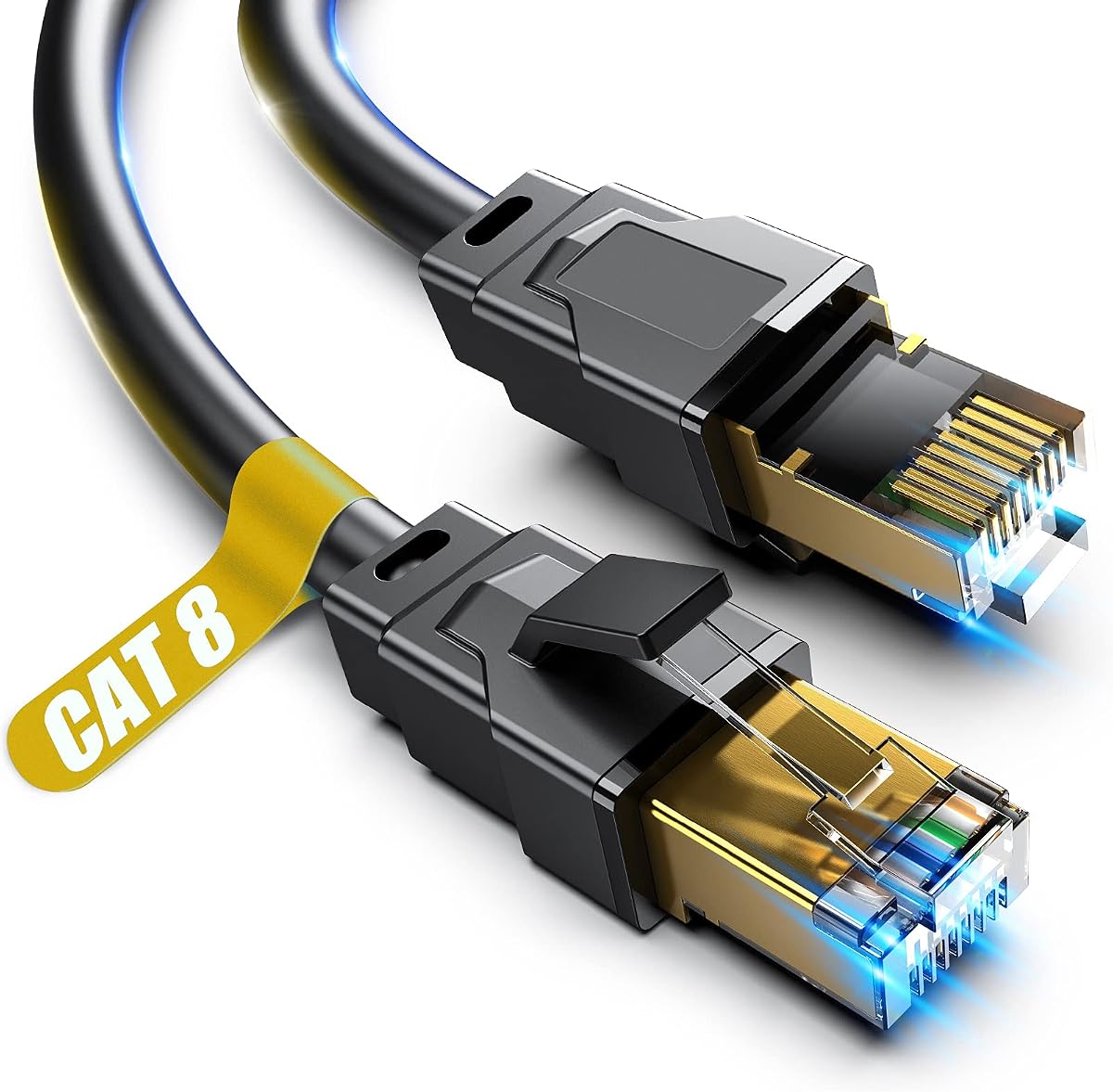
The Vabogu Cat 8 cable is the most advanced option in this group, with a 4.7 rating and a 1.5-foot configuration. It distinguishes itself through a claimed 40Gbps transmission capability, 2000MHz bandwidth, and a heavily shielded design suited to demanding indoor or outdoor links.
We may earn a commission when you buy through this link, at no additional cost to you.
The construction listing describes four pairs of thick 26AWG shielded twisted-pair copper, an aluminum foil shield, a woven mesh shield, and a UV-resistant PVC jacket. Shielded RJ45 connectors support compatibility with Cat5 through Cat7 equipment as well as numerous common devices, including routers, switches, NAS units, cameras, consoles, and smart TVs.
That level of specification is unnecessary for most home networks, where the connected equipment will rarely exceed gigabit Ethernet. It may also be excessive for a simple connection between two nearby ports. Buyers should compare the actual network hardware with the cable's capabilities so they are not paying for unused performance.
This cable is best for short, high-performance server links, specialized installations, or environments where shielding and outdoor-rated construction justify the added sophistication. It is also an attractive option for a user who wants one compact cable that can accommodate future high-bandwidth hardware.
Both an aluminum foil layer and woven mesh shield are specified, reducing vulnerability to interference compared with basic UTP construction. The approach is especially relevant near dense electronics or outdoor networking equipment.
The UV-resistant jacket and weather-resistant claims extend the cable beyond a desktop connection. It can accommodate short outdoor runs and is described as suitable for burial, although local installation requirements should still be considered.
We may earn a commission when you buy through this link, at no additional cost to you.
This ten-pack of slim, half-foot Cat6 patch cables holds the highest customer rating in the selection at 4.8. Its defining advantage is density: the listing says the cable diameter is almost half that of a standard Ethernet cable, making it especially appealing for data centers, server rooms, and crowded switch cabinets.
We may earn a commission when you buy through this link, at no additional cost to you.
The cables use 30AWG bare copper and twisted-pair construction. They are advertised for transfer speeds up to 10Gbps and 550MHz bandwidth, with a narrow boot and snagless connector design that helps with installation and removal. The short leads can also connect patch panels directly to switches with minimal cable clutter.
Thirty AWG is finer than the 26AWG or 28AWG alternatives in the group. While the product claims stable high-speed performance, buyers should recognize that slim patch cables trade some conductor bulk for space savings. The half-foot length also leaves virtually no slack, so alignment between adjacent ports must be excellent.
This is the strongest general recommendation for organized, high-density network spaces. The multipack is useful for technicians or users building multiple short links, while the narrow construction makes each cable easier to bend and route. For long reaches or unusually tight bend radii, a conventional one-foot or two-foot cable may be more appropriate.
The slim profile saves meaningful space in patch panels and rack-mounted equipment. It also makes bundles easier to arrange without creating oversized loops that interfere with airflow or neighboring ports.
Ten matching six-inch leads provide an efficient way to connect several adjacent devices. The package is especially useful for structured cabling work where consistency and compact routing matter.
We may earn a commission when you buy through this link, at no additional cost to you.
This 1.5-foot Cat6 cable combines a useful amount of reach with a straightforward black RJ45 design. It has a 4.6 rating and supports several common Ethernet standards, including 10BASE-T, 100BASE-TX, 1000BASE-T, and 10GBASE-T.
We may earn a commission when you buy through this link, at no additional cost to you.
Its 26AWG copper core and gold-plated contacts are designed to support stable data transmission, while the listing mentions uniform impedance, shallow return loss, lower crosstalk, and a higher signal-to-noise ratio. It works with computers, printers, consoles, servers, routers, switches, media players, NAS devices, and VoIP phones.
Unlike many basic indoor patch leads, this cable has double UV-resistant PVC and LLDPE jackets that are described as offering protection against abrasion, water, UV exposure, and temperature extremes. That makes it more adaptable for a short outdoor connection, although proper weatherproofing at the connectors remains important.
This is a good value-oriented choice when you need one moderate-length cable rather than a coordinated pack. Its 1.5-foot length offers better positioning flexibility than the shortest options while remaining suitable for cabinet and desktop installations. It is also a practical replacement for a failed indoor lead.
At 1.5 feet, the cable offers enough extra length to negotiate uneven port positions without creating a large service loop. That balance makes it useful in both small cabinets and desktop setups.
The stated support for common Ethernet rates, along with TIA/EIA 568B and ETL/RoHS compliance claims, gives the cable a reassuring specification profile. Actual speed still depends on the connected devices and network configuration.
We may earn a commission when you buy through this link, at no additional cost to you.
The two-foot version in this series provides more placement flexibility than the half-foot and one-foot models. It carries a 4.6 rating and is aimed at short-distance connections involving patch panels, switches, routers, servers, gaming systems, and surveillance equipment.
We may earn a commission when you buy through this link, at no additional cost to you.
Like the other cables in this two-pack family, it uses 26AWG wire, oxygen-free copper conductors, four UTP pairs, and gold-plated contacts. The product claims 10Gbps support, 250–500MHz bandwidth, and compliance with TIA/EIA 568-C.2, while remaining backwards compatible with earlier common Ethernet categories.
Two feet can still be too short for some equipment arrangements, but it is easier to install when ports are staggered, mounted vertically, or separated by a modest amount. The additional length should be gathered neatly rather than left in a large loop, particularly within a cabinet.
This is a good choice for a user who finds sub-foot cables frustratingly restrictive but wants to avoid a long patch lead. The included pair also makes it convenient to create two short links or retain one cable as a replacement. It works well for compact home offices, small media cabinets, and adjacent networking hardware.
Two feet gives installers more freedom than a one-foot patch cord while remaining suitable for close equipment connections. It is a useful middle ground between ultra-short patch leads and standard longer Ethernet cables.
The 26AWG copper conductors and gold-plated contacts align with the rest of this cable series. That consistency makes the two-pack convenient when multiple short connections need to look and perform alike.
We may earn a commission when you buy through this link, at no additional cost to you.
StarTech's one-foot N6PATCH1WH is a professional-oriented white Cat6 patch cord with a 4.7 rating. Its standout feature is explicit support for up to 100W PoE, making it particularly relevant to IP cameras, VoIP phones, access points, and other powered network devices.
We may earn a commission when you buy through this link, at no additional cost to you.
The cable uses 24AWG stranded copper conductors and UL-rated wiring, with IEEE 802.3bt and DTE power compliance cited for lower heating. Its connectors have 50-micron gold plating, while the snagless boots and strain relief are designed for repeated installation and removal in confined spaces.
The cable is individually tested against ANSI/TIA-568-2.D Category 6 requirements, according to the listing, and carries a lifetime warranty. It supports 1, 2.5, and 5Gbps connections and states that 10Gbps is available up to 160 feet, a substantial range for a one-foot lead.
Choose this model when PoE capability, documented testing, and a lifetime warranty matter more than multipack convenience. It is less attractive for ordinary internet-only connections because those do not need the higher 100W power allowance. Verify that the connected PoE device and network equipment support the corresponding power standard.
A 100W allowance makes the lead suitable for demanding powered devices in compatible networks. This can simplify installations by carrying data and power through one connection.
Snagless boots make the connector easier to release without damaging its locking tab. The molded strain-relief design is particularly useful for permanent patch connections that may be unplugged during maintenance.
We may earn a commission when you buy through this link, at no additional cost to you.
This ten-pack of one-foot flat Cat6 cables is a practical choice for installations where visibility and low-profile routing matter. Its 4.7 rating reflects strong customer reception, and the thin shape makes the leads easier to place under carpets, along walls, and behind furniture.
We may earn a commission when you buy through this link, at no additional cost to you.
The product listing specifies bare copper wire, UTP construction, and gold-plated RJ45 connectors. It claims support for up to 10Gbps data transmission and 550MHz bandwidth, making it suitable for home networks, offices, streaming, gaming, and everyday connections between routers, computers, and switches.
The flat form is less noticeable than a conventional round cable, but it is not necessarily the easiest option for a tight radius around a connector. It also remains unshielded, so buyers in electrically noisy settings may prefer a shielded model. The one-foot length still requires close port placement.
This cable is especially attractive beneath desks, behind wall-mounted equipment, or around furniture where a round lead would stand out. The ten-piece pack also provides enough matching leads for several devices. It is a good fit for home organization projects that prioritize a low visual profile.
A flat jacket sits closer to the surface beneath rugs and furniture. This can reduce visual clutter and make a short connection look more intentional than a rounded patch cord.
The multipack is useful when several nearby devices need the same short black cable. Matching leads streamline the appearance of entertainment centers, office desks, and small network cabinets.
We may earn a commission when you buy through this link, at no additional cost to you.
This 24-pack of one-foot Cat6A patch cables is designed for technicians and users who need many short links at once. It has a 4.6 rating and stands out through its slim 28AWG round construction, UL listing, and unusually large quantity.
We may earn a commission when you buy through this link, at no additional cost to you.
The listed cable supports up to 10Gbps with 550MHz bandwidth in compatible Cat6A environments. Stranded pure-copper conductors and gold-plated RJ45 contacts are used for connectivity, while snagless boots help protect the connector clips during installation and removal. The product is intended for switches, routers, patch panels, servers, and other Ethernet devices.
The small conductor size is central to the product's space-saving purpose. It can reduce cable congestion and improve cabinet airflow compared with a standard 24AWG lead. However, users should ensure that slim patch cables are appropriate for the signal path and bend radius required by their equipment.
This is a strong option for network installers, labs, offices, and anyone outfitting a cabinet with numerous short connections. A home user replacing one damaged lead may find the quantity excessive, and the one-foot length remains unsuited to distant devices. The value proposition depends on the number of links you genuinely need.
The slim round jacket uses less room than a conventional 24AWG patch cord, helping reduce congestion around switches and patch panels. It can also leave more working space for airflow in a densely populated cabinet.
Twenty-four matching leads suit larger structured-cabling jobs and make spare replacement easy. The bulk format is less convenient for a casual user who only needs to connect one nearby device.
We may earn a commission when you buy through this link, at no additional cost to you.
This two-pack of one-foot Cat6 cables earns a 4.7 rating and focuses on stable short-range networking with support for multiple PoE standards. It is designed for closely spaced switches, routers, modems, servers, computers, printers, access points, cameras, and other standard LAN devices.
We may earn a commission when you buy through this link, at no additional cost to you.
The listing states that the cable meets TIA/EIA 568-C.2 and TIA-568.2-D standards, supports up to 10Gbps and 500MHz bandwidth, and uses stranded 100% oxygen-free copper in UTP construction. Gold-plated RJ45 contacts are intended to resist corrosion and oxidation.
A molded strain-relief boot and reinforced spring clips target the release tabs that commonly fail during repeated installation. PoE, PoE+, and PoE++ compatibility is a useful distinction for connected IP cameras, access points, and VoIP phones, provided the network equipment supports the relevant standard.
This is a well-rounded pair for compact network installations that combine data and power. The one-foot length is ideal for adjacent ports but insufficient for separated equipment. It is also unshielded, so users in high-interference locations should consider a shielded short cable instead.
Support across PoE, PoE+, and PoE++ gives the cable broader usefulness for powered endpoints. It can serve cameras, phones, and wireless access points while also carrying ordinary network data.
Molded strain relief and reinforced connector clips address the stress points most likely to fail. These details make the pair suitable for installations that require regular reconfiguration or maintenance.
We may earn a commission when you buy through this link, at no additional cost to you.
The right short Ethernet cable depends on port spacing, cable diameter, network category, power requirements, and the environment where it will be installed. Measure first, then match the cable's construction and performance to the devices and standards involved.
Start by measuring the distance between the two ports, including the space occupied by the connectors and any bend needed to route the cable. A six-inch lead can look sufficient until the ports face different directions, sit at different heights, or are separated by a ventilation panel. A one-foot cable gives modest flexibility, while 1.5-foot and two-foot models accommodate more uneven arrangements without becoming cumbersome.
Choose the shortest cable that installs without pulling or sharply bending it. Excess length should be arranged in a controlled service loop, while a cable that is too short can place stress directly on the RJ45 connector and its locking tab.
Most short home and office links only require a cable compatible with the speed of the connected equipment. Cat6 is a common selection and supports advanced networks, while Cat6A and Cat8 provide additional bandwidth and headroom. A higher category does not make the connected devices faster, but it can be valuable in professional installations, future upgrades, or environments with demanding network equipment.
Check the supported category of both endpoints and any intermediate patch panel or keystone jack. The highest speed available from a device is the practical limit unless every component in the path supports the same category and installation standard.
A standard round Ethernet cable can become difficult to manage when every port in a switch is occupied. Slim patch cables use smaller conductors and connectors to reduce congestion and improve airflow around patch panels and network racks. The trade-off is that fine-gauge cables can be less forgiving of very tight bends and may have lower current capacity than heavier alternatives.
For a crowded cabinet, measure the available space behind the switch as well as the gap between ports. If the ports are tight but remain well ventilated, a slim six-inch or one-foot patch cable can be the neater solution.
UTP cables are lighter, smaller, and easier to route, making them suitable for most ordinary home and office environments. Shielded cables add protection against electromagnetic interference and can be preferable near powerful electrical equipment, industrial hardware, outdoor installations, or dense data-center environments. The benefit depends on proper connector shielding and a correctly grounded installation.
Do not pay for shielding by default if it will not solve an interference issue. Conversely, if a location produces intermittent errors or unstable links, a properly shielded short cable may be more appropriate than repeatedly replacing an unshielded lead.
PoE-enabled devices such as IP cameras, wireless access points, VoIP phones, and some lighting equipment require the cable to carry data and power. Check the PoE standard and maximum power requirement of the endpoint, then compare them with the cable and network equipment. PoE, PoE+, and PoE++ are not interchangeable in terms of available power.
A cable expressly rated for higher PoE levels provides clearer assurance, particularly for permanently installed powered devices. The network switch or injector must also support the same standard, and the cable should not be tightly coiled in a way that creates heat or difficult installation conditions.
Wire gauge influences conductor size, flexibility, bulk, and power handling. The selection includes 24AWG stranded copper, 26AWG copper, 28AWG slim designs, and 30AWG ultra-slim leads. Larger conductors generally create a thicker cable, while smaller conductors help reduce cabinet clutter. A medium-gauge lead is often easier to handle for occasional installation adjustments.
Choose the gauge that best suits the space and installation method. For tight bends, avoid forcing a heavier cable into a narrow radius. For a desk lead that will be moved regularly, flexibility may matter more than saving a few millimeters of cabinet space.
Indoor patch leads generally prioritize flexibility and compact routing, while outdoor or exposed cables need UV resistance, weather resistance, and stronger physical protection. Some listings use dual jackets or describe enhanced resistance to abrasion, moisture, and temperature changes. These claims do not eliminate the need to protect exposed connectors and entry points.
Choose a basic indoor jacket for an indoor link. Select a cable specifically described for outdoor use when the connection will be exposed to sunlight, rain, soil, or temperature swings, and confirm that the termination method is suitable for the environment.
Standards references such as ANSI/TIA-568-2.D, TIA/EIA 568-C.2, UL listing, and ETL or RoHS verification can provide useful evidence of construction and safety claims. Individual testing is another positive signal in professional settings. Still, those claims do not replace checking connector compatibility, cable length, and the intended network environment.
Finally, count the links you need. A two-pack is convenient for a small installation or spare, while ten- and 24-packs suit structured cabling work. Buy the quantity that matches the project and keep spare leads accessible for future replacement.
Plan the route before connecting either end. Short cables work best when the equipment ports are already aligned and the lead can enter without being forced sideways. Keep the cable away from sharp edges, hot equipment, moving fans, and closing drawers. If a lead must curve, use a broad, natural bend instead of folding it sharply at the connector.
Connect each cable by aligning the RJ45 plug with the port and pressing it in until the latch clicks. Listen for or feel the click before applying any sideways strain. When removing it, press down on the locking tab rather than pulling on the cable. Support the plug close to the connector so the connector boot, not the jacket, takes the handling force.
Inspect the ends periodically for bent pins, trapped debris, damaged boots, or a cable that no longer sits firmly. Disconnect and replace a damaged lead rather than forcing it into a port. For outdoor links, protect the connector from standing water and ensure the installation method preserves the jacket's weather resistance. Keeping short leads gently coiled without tight bends will help preserve connector and conductor performance over time.
A six-inch cable is useful when two ports sit directly opposite or very close together, particularly on a patch panel or small switch. It offers little positioning slack, so measure the port gap and connector direction first. A one-foot cable is often more forgiving for desktop equipment and minor adjustments.
A Cat6 cable can support 10Gbps over short distances when its construction and installation meet the applicable standards. Several products in this guide claim 10Gbps performance and specify compatible copper conductors and connectors. Your actual speed also depends on the network devices, patch panel, and complete signal path.
Usually not if the network equipment operates at gigabit speeds. Cat8 offers substantially higher bandwidth and robust shielding, but those benefits may not be visible in a basic home setup. It can be worthwhile for specialized professional equipment, future-oriented installations, or exposed locations where shielding is valuable.
Slim cables use finer conductors and often smaller connector bodies to reduce their overall diameter. That makes them easier to arrange in crowded patch panels and racks. Standard cables generally use heavier wire, which can be more flexible and robust but takes up more space.
No. The cable, PoE source, and powered device must all support compatible power standards. The StarTech and two-pack Cat6 options reviewed here explicitly support high PoE levels, while other cables may be suitable for ordinary PoE but do not make the same power claims. Check the maximum wattage required by the endpoint.
Flat cables are generally less noticeable beneath carpets, along walls, and behind furniture because they occupy less vertical space. They can still need careful routing to avoid pinching or sharp bending near the plug. Their flat shape is primarily an installation and appearance feature rather than a higher performance category.
Avoid creating tight coils or large loops inside a cabinet. Route the cables with gentle curves, use reusable hook-and-loop ties or compatible management panels, and keep connector boots aligned so they do not press against one another. Good organization reduces strain while improving airflow and troubleshooting.
It means a Cat6 or Cat6A cable can generally connect to equipment designed for earlier common Ethernet categories such as Cat5 and Cat5e, assuming the connectors and physical ratings are suitable. The connection will operate only as fast as the slowest supported device in the path. Backward compatibility does not make every older network installation equivalent to modern Cat6 performance.
The Cat6 Slim Patch Cables stand out as the most versatile option for crowded spaces, offering the highest rating, a very slim profile, and a useful ten-cable pack. The 1.5-foot Cat6 cable is a cost-conscious single-cable choice, while the Vabogu Cat8 option offers the strongest premium features for specialized, shielded, or high-bandwidth installations.
Prioritize physical fit first: measure the port spacing, inspect the connector area, and choose a length that can be installed without tension. Then consider conductor diameter, shielding, PoE requirements, environmental exposure, and category. A well-matched cable is not necessarily the highest-rated model, but one that fits the installation cleanly and supports the connected equipment.
Before making a final purchase, confirm the current product specifications, package quantity, connector arrangement, and seller details. Network hardware, standards, and cable availability can change over time, and short cables vary significantly in diameter and construction. Checking those details helps ensure that the selected lead integrates cleanly into your particular network.