
WiFi Sprinkler Timer
4.4Editor score
984-foot gateway range
Three-zone scheduling
Flexible misting modes
Our Programmable WiFi Water Timer guide compares 10 leading models for range, zone control, scheduling, app features, and outdoor durability.
A programmable WiFi water timer can automate watering while giving you remote control through an app, voice assistant, or a dedicated wireless gateway. The right model should combine flexible schedules with dependable connectivity, practical irrigation modes, and fittings suited to your outdoor plumbing.
We compared all ten products by examining their zone counts, range, scheduling options, irrigation modes, rain controls, app support, power systems, materials, and ease of installation. The list includes both WiFi-connected smart timers and one non-WiFi alternative for shoppers who want programmable multi-zone watering without an app.
Each review explains the product's strongest features, limitations, and ideal use case so you can judge fit before buying. Product ratings, features, and availability may change over time, and current prices can also vary, so compare the latest listing details before making a final purchase.
4.4Editor score

4.4Editor score
4.1Editor score
The comparison below highlights the major differences among ten programmable watering controllers, including connection method, zone capacity, scheduling range, and weather-related features. Nine products provide smart WiFi control, while the MOES model offers programmable multi-zone operation without WiFi.
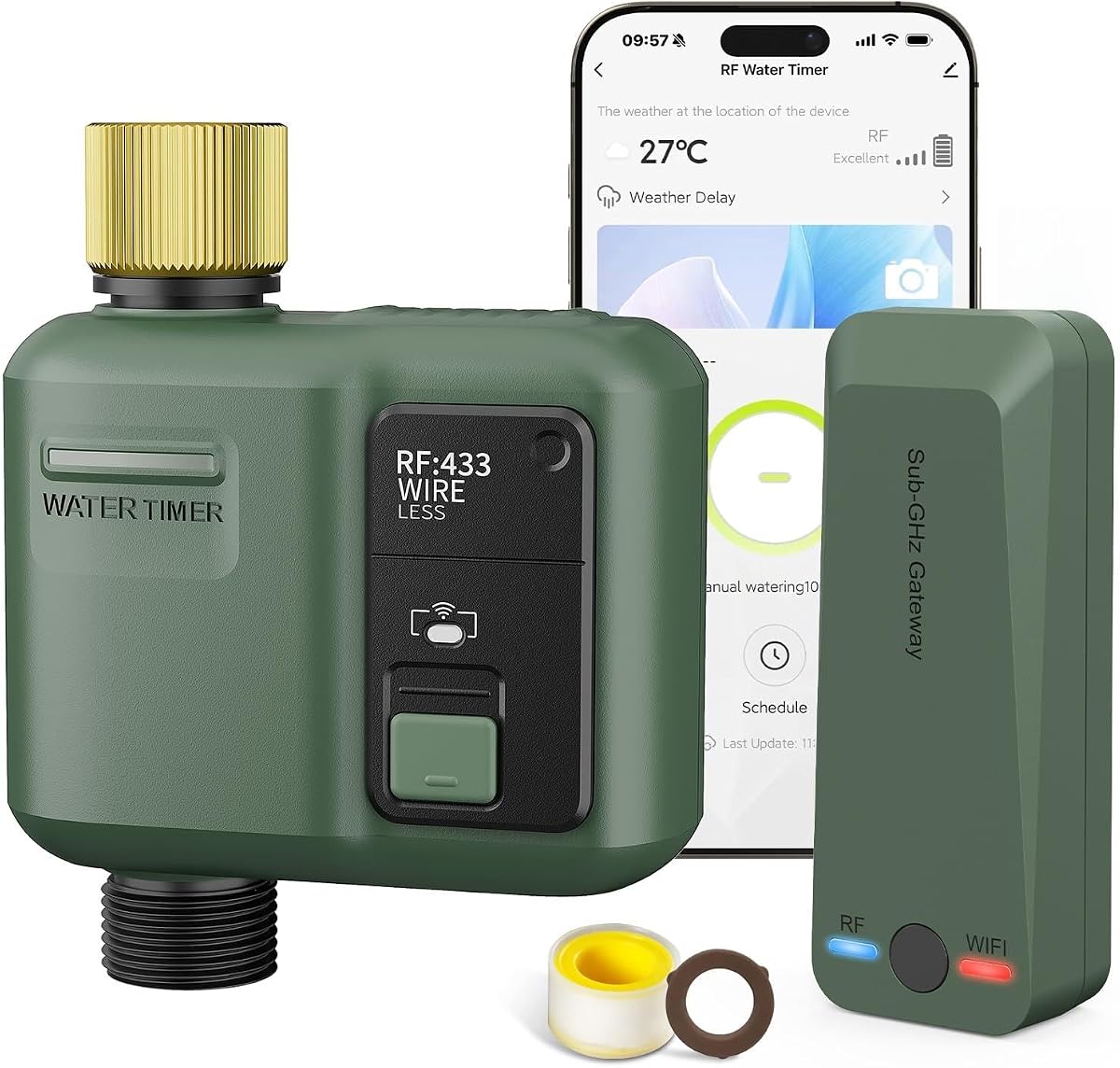


The WiFi Sprinkler Timer is a strong all-around choice for homeowners who want flexible watering control without moving beyond a familiar hose timer and app-based setup. Its 4.4 rating reflects a capable feature set, including a 984-foot RF connection, multiple watering zones, remote operation, and irrigation records. The dedicated gateway is especially useful for gardens where the timer sits far from the home router.
We may earn a commission when you buy through this link, at no additional cost to you.
Its scheduling system is among the most versatile in this guide. Users can configure individual start times, frequencies, and durations for multiple zones, with each run lasting from one minute to 24 hours. Single irrigation and recirculating modes cover everything from a standard sprinkler cycle to a gentle misting program. A rain delay can postpone watering by one to seven days, while smart rain detection and detailed session records help users see when the system started, how long it ran, and when it stopped.
The main trade-off is that this is a WiFi product rather than a Bluetooth-only controller. It connects through the Smart Life or Tuya Smart app on a 2.4GHz network, and Bluetooth is used only during initial setup rather than as a standalone control method. It also relies on a wireless gateway, so the full system must be installed and configured thoughtfully. Despite those requirements, it offers a rare combination of multi-zone control, long range, and extensive scheduling at an approachable tier.
This is the best general recommendation for buyers who want a programmable WiFi water timer for lawns, flower beds, vegetable plots, and drip systems. Choose it when range, three-zone flexibility, and multiple watering modes matter more than a non-WiFi design. It is particularly suitable for users of Smart Life or Tuya Smart who want schedules, rain controls, and manual operation in one economical system.
Independent zone programming lets lawns, flower beds, and vegetable patches receive different schedules. The broad duration range also accommodates brief misting as well as longer drip-irrigation periods.
The gateway and RF transmitter are rated for up to 984 feet, helping the timer remain reachable across larger properties. This makes the system more practical when an outdoor faucet is separated from the home WiFi router by walls or distance.
We may earn a commission when you buy through this link, at no additional cost to you.
The 984ft RF WiFi Water Timer is a straightforward smart controller for one hose-connected zone. Its 4.3 rating and feature set indicate a capable balance of range, scheduling, and outdoor construction. A dedicated gateway extends the usable connection distance to 984 feet, while the Smart Life or Tuya Smart app provides remote starting, stopping, and schedule management.
We may earn a commission when you buy through this link, at no additional cost to you.
The controller supports timed watering, weekly cycles, misting, rain delay, and manual operation. Users can adjust start times, watering duration, and weekly frequency, with durations extending from one minute to 24 hours. That range is useful for both short sprinkler sessions and prolonged drip-irrigation cycles. Voice control through Alexa or Google Assistant adds another convenient way to operate the timer without opening the app.
Physical construction is a notable strength. The product has a brass inlet, a built-in filter, and an IP55 water-resistant housing intended for outdoor use. The package includes the timer, gateway, waterproof gasket, and instruction manual, and the manufacturer provides a one-year warranty. Its limitation is that it serves only one outlet, so buyers with separate lawn, bed, and drip zones will need another arrangement or a multi-zone controller.
This model is a good fit for a single garden area where dependable remote access, simple programming, and a durable inlet are the priorities. It may be especially attractive to users who already use the Smart Life ecosystem and want a hose timer with enough range to reach a distant outdoor faucet. For multiple independently scheduled areas, a three-zone or dual-zone model would offer a better solution.
A brass inlet and integrated filter are designed to withstand regular outdoor use while helping reduce debris-related problems. The IP55 housing adds reassurance for installations exposed to rain and splashing.
Timed, weekly, misting, rain-delay, and manual modes cover common garden jobs. App and voice control make it simple to make an immediate adjustment without returning to the faucet.
We may earn a commission when you buy through this link, at no additional cost to you.
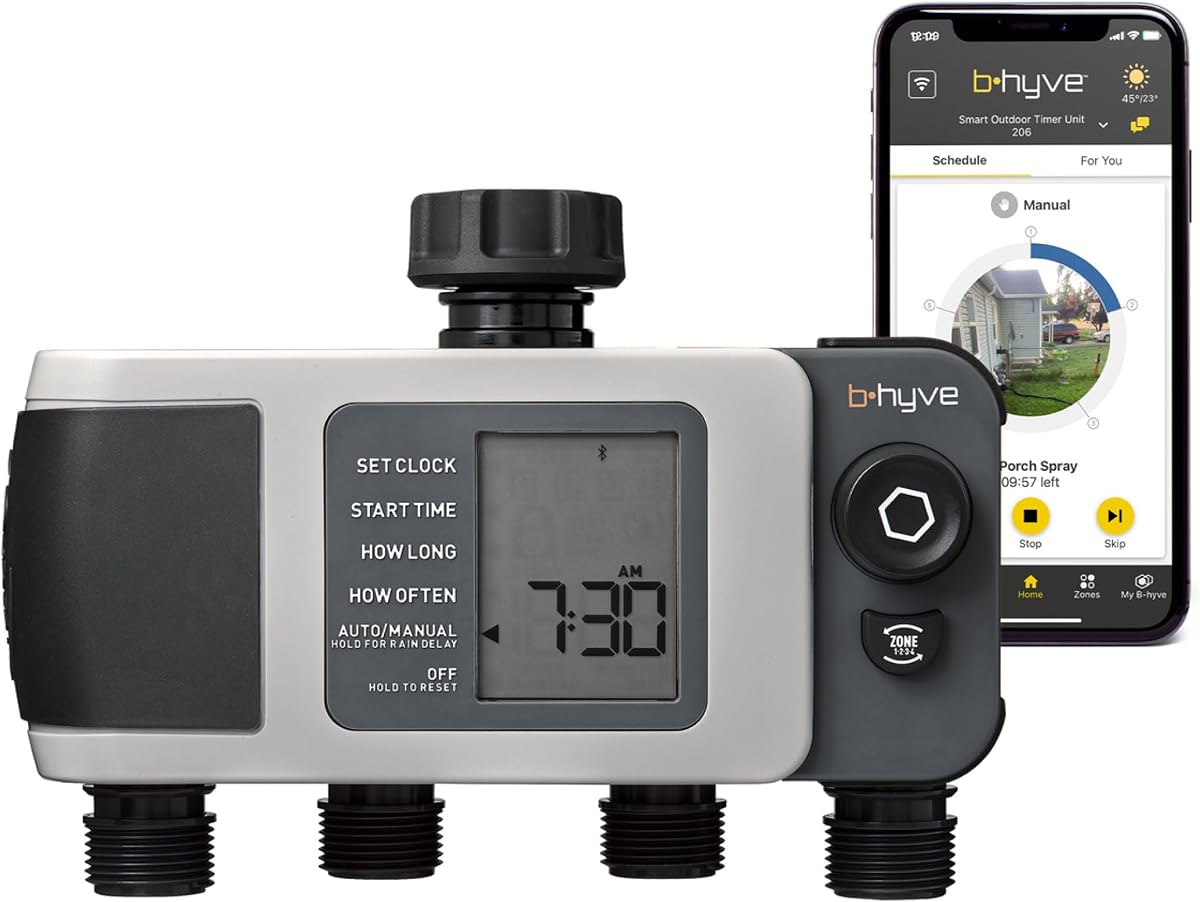
The Orbit B-hyve XD 4-Port Smart Hose Watering Timer is built for buyers who need more independently controlled outlets than a standard single-zone hose timer provides. Its 4.0 rating reflects a mature multi-zone design with phone-based programming, weather responsiveness, and a four-outlet layout. It can serve separate lawns, flower beds, and other garden areas through reliable scheduled watering.
We may earn a commission when you buy through this link, at no additional cost to you.
The timer can be programmed from a phone using its Bluetooth connection, giving users a direct way to create and adjust schedules. Its weather-responsive monitoring can adjust irrigation in dry conditions, while smart weathersense technology is intended to optimize watering schedules. The four-outlet configuration is the distinguishing feature, allowing multiple hose runs to be managed without replacing the entire timer for every additional zone.
Four outlets create more opportunities for installation errors, so correct hose routing and adequate pressure are important. Buyers should also note that the product description emphasizes Bluetooth programming rather than presenting this as a conventional WiFi timer. That distinction may not matter if local phone control and automatic scheduling are the priority, but it could disappoint someone who specifically wants remote access through the home network. The included two-year limited warranty provides useful coverage for private-use purchases.
This is the most logical choice for a property with four watering areas that need independent schedules. It is also worth considering for users who value Orbit's smart irrigation approach and weather-aware behavior over gateway-based range. Verify that the four ports align with the number and flow requirements of your hoses and sprinklers before installation.
Independent outlets let several irrigation areas run on separate schedules from one controller. This reduces the need for multiple standalone timers while preserving zone-level control.
Smart weathersense features and drought-related adjustments help the controller respond to changing conditions. These features are intended to keep watering more consistent than a fixed schedule alone.
We may earn a commission when you buy through this link, at no additional cost to you.
The WiFi Water Timer Smart Irrigation Controller with Gateway is an adaptable choice for homeowners who may expand beyond one faucet or timer. It carries a 4.4 rating and combines a 984-foot Sub-GHz connection, multi-zone scheduling, wireless power, and a gateway capable of supporting up to 64 devices. That scalability is the feature that makes it particularly attractive for larger irrigation setups.
We may earn a commission when you buy through this link, at no additional cost to you.
The controller supports daily, interval, and odd-or-even watering modes, allowing users to match schedules to lawns, drip systems, and garden beds. A weather-delay feature can automatically skip watering during rain and is claimed to reduce water use by as much as 50 percent. Installation is wire-free: two AA batteries are advertised to power the timer for up to eight months, removing the need for an outdoor outlet or routine charging.
A dedicated gateway is necessary, and buyers with a simple single-zone garden may not need the system's multi-device capacity. This model also focuses on scheduling and connectivity rather than detailed consumption tracking, so users who want precise flow data should consider a meter-equipped alternative. The security provisions are a meaningful strength: AES-128 encryption protects the connection, while over-the-air updates keep the system current.
This is the best pick for buyers who want a scalable, wire-free smart irrigation foundation. It is particularly useful when several timers may eventually be needed around a large property, since one gateway can serve as many as 64 devices. Choose it when long range, easy outdoor placement, and flexible multi-device management outweigh the added complexity of a gateway-based installation.
A single gateway can support up to 64 devices, creating a practical path for expanding coverage. Users can add timers without looking for a separate smart-home platform for each controller.
Two AA batteries are advertised to operate the timer for up to eight months. This removes the need to run electrical wiring to an outdoor faucet or routinely recharge the device.
We may earn a commission when you buy through this link, at no additional cost to you.
The WiFi Solar Sprinkler Timer is an appealing two-zone option for buyers who want to reduce battery maintenance. Its 5.0 rating is the highest in this guide, and the product stands apart through dual solar and Type-C USB charging. The solar panel can maintain the power supply in suitable sunlight, while USB charging provides a useful backup for cloudy periods.
We may earn a commission when you buy through this link, at no additional cost to you.
Each of the two outlets can have its own schedule with up to 10 watering plans per outlet. The app provides normal schedule mode as well as cycle-and-soak operation, allowing repeated watering within a selected period. Frequencies can be set for every day, every other day, or every two days, and users can customize start times, frequency, and duration. Rain delay can postpone a program by one to seven days, while manual watering provides immediate control without changing preset schedules.
The upgraded connectivity connects directly to a smartphone without an additional hub, but it only supports 2.4GHz WiFi. Solar performance also depends on placement, sunlight, and environmental conditions, so the USB port remains a valuable part of the design rather than an optional extra. Outdoor construction is well considered, with an IPX6 waterproof rating, metal filter, and 100 percent brass female thread connector.
This timer is best for a garden with two distinct irrigation needs and a location that receives meaningful sunlight. It is also a strong choice for users who dislike replacing batteries or running power cables to an outdoor faucet. Make sure the app and voice-control setup fit your smart-home routine, and position the panel where it can collect sunlight without being shaded by dense foliage.
Solar charging supports continuous operation in appropriate light, while Type-C USB offers a convenient recharge option. The combination makes the timer easier to maintain than a controller that depends entirely on disposable batteries.
Cycle-and-soak mode divides watering into repeated intervals within a chosen period. This can be useful for soil that benefits from gradual absorption rather than one long irrigation cycle.
We may earn a commission when you buy through this link, at no additional cost to you.
The Smart WiFi Sprinkler Timer 3 Zone is a feature-rich controller designed for properties with several irrigation needs. Its 4.2 rating reflects a broad combination of long RF range, three-zone programming, flexible watering modes, and detailed monitoring. It uses the Smart Life or Tuya Smart app and supports remote control, making it suitable for lawns, flower beds, and vegetable patches.
We may earn a commission when you buy through this link, at no additional cost to you.
Each zone can have its own start time, frequency, and duration, with duration extending from one minute to 24 hours. The timer supports single irrigation and recirculating schedules, offers five schedules plus a misting function, and can operate in fine-grained intervals down to one second. Its rain delay settings cover one to seven days, and smart rain detection can help avoid unnecessary watering.
The system depends on WiFi for operation, and Bluetooth is limited to initial setup rather than serving as an alternative control method. A gateway is also required to achieve the advertised 984-foot RF distance. The detailed irrigation records, custom zone names, and support for multiple devices make the app experience more organized, but first-time users should expect a more involved setup than with a basic mechanical timer.
This is a strong choice for users who want three zones and precise control but do not need the larger device capacity offered by the gateway system in fourth place. It works particularly well for mixed gardens where a lawn, planted bed, and drip section need different schedules. Choose it when fine-grained timing, misting, and watering history are important parts of your routine.
The controller can begin a single irrigation run in increments as short as one second and supports much longer scheduled periods. This flexibility suits both brief misting and extended watering programs.
Session records capture the start, duration, and end of each watering event. Users can use this history to check whether programmed areas are receiving the intended amount of water.
We may earn a commission when you buy through this link, at no additional cost to you.
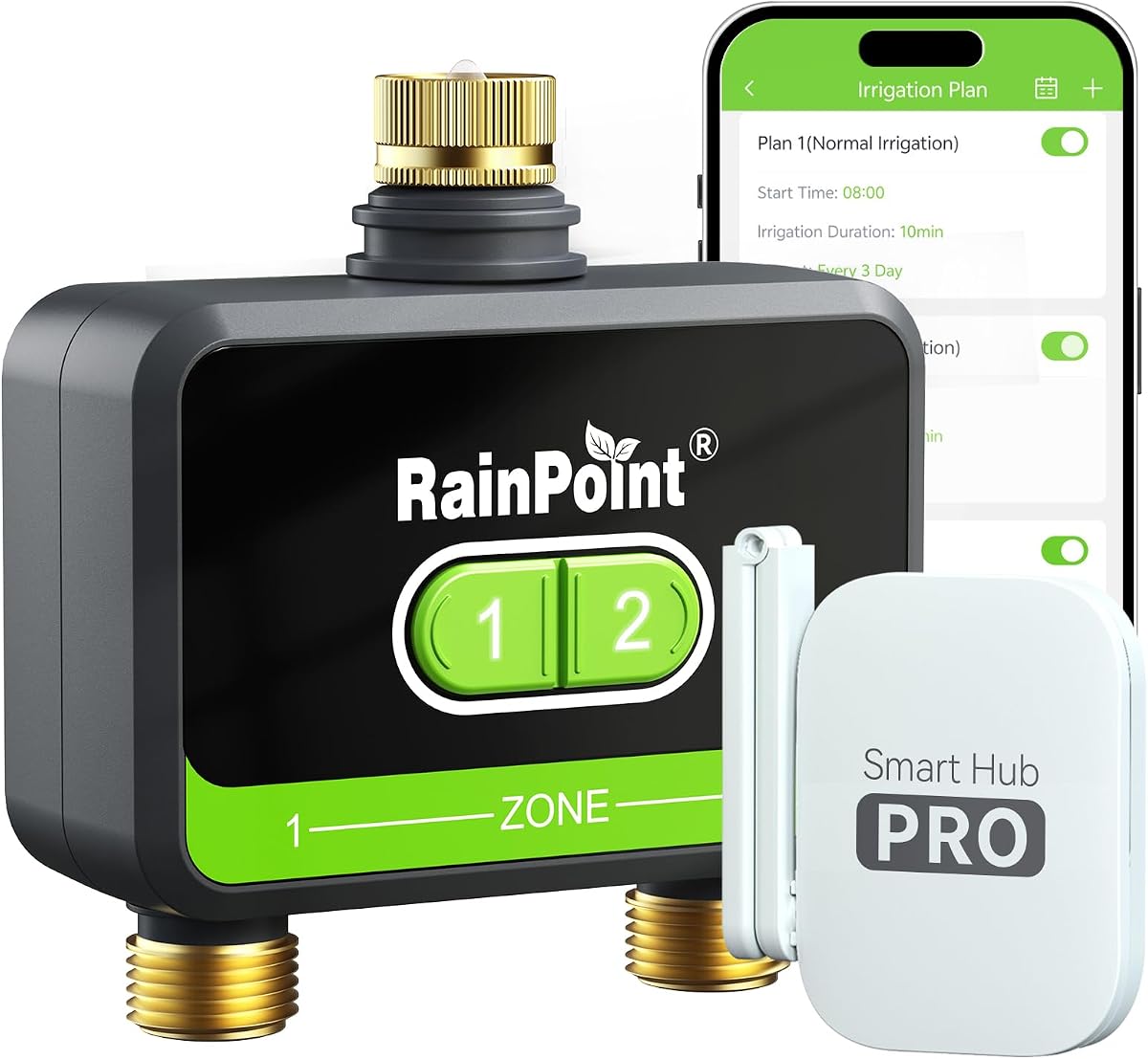
The RainPoint 2-Zone WiFi Water Timer is a refined option for buyers who want their irrigation plan to adjust with changing weather and seasonal needs. Its 4.1 rating is complemented by sophisticated automation, including Smart Scene scheduling, plant-based recommendations, and monthly seasonal adjustment. The timer connects to the RainPoint Home app through a 2.4GHz gateway.
We may earn a commission when you buy through this link, at no additional cost to you.
The two brass ports operate as independently programmable zones, and each zone can hold up to six custom schedules. Normal irrigation, misting, and cycle-and-soak modes cover several watering patterns. Five frequency choices—every day, odd dates, even dates, weekly, and every two to 30 days—make it easier to align watering with different plant needs and local restrictions.
Seasonal Adjust can alter monthly duration by a user-selected percentage from 10 to 200 percent. That feature is particularly useful because seasonal evaporation and plant demand change over the year, yet many fixed hose schedules do not. Smart Scene can also adjust schedules based on weather and synchronize with other RainPoint devices. The trade-off is that these deeper features depend on the RainPoint ecosystem and a functioning gateway, while the product does not provide the flow-meter data offered by another model in this guide.
This is the best premium option for a two-zone garden that benefits from weather-responsive automation and seasonal refinement. It is well suited to users who want recommendations, dynamic schedule adjustment, and integration with other compatible RainPoint equipment. Buyers should confirm 2.4GHz WiFi availability and consider how the app's automatic recommendations align with local watering rules.
Smart Scene can modify schedules in response to weather and coordinate activities with other RainPoint devices. This creates a more adaptive system than a controller limited to a fixed weekly timetable.
Seasonal Adjust changes watering duration by a percentage each month. Users can fine-tune the plan as conditions change without rebuilding every start time and run duration.
We may earn a commission when you buy through this link, at no additional cost to you.
The Orbit B-hyve XD 1-Port Smart Hose Watering Timer is a polished single-zone option for users who value local weather information and drought-aware control. Its 4.0 rating reflects a feature set that includes WiFi and Bluetooth programming, weather-responsive irrigation, and an IPX-5 waterproof design. The controller can be configured either through the network or locally through Bluetooth.
We may earn a commission when you buy through this link, at no additional cost to you.
The timer's automated watering is informed by local weather data, allowing it to adjust the amount of water delivered as conditions change. It can also account for drought levels and apply local watering restrictions. This makes it especially relevant for gardeners whose plants need schedules that respond to rainfall and dry periods rather than following an entirely static plan.
The single outlet keeps installation and operation manageable, but it cannot independently water several hoses at once. WaterSense certification is available when the system is paired with a compatible WiFi hub, so buyers who want that efficiency certification should confirm hub compatibility before purchasing. The IPX-5 certification protects against low-pressure water streams from multiple directions, although responsible installation remains important.
This is a good fit for one lawn, one flower bed, or one drip zone where weather-aware scheduling is more important than multi-zone expansion. It is also convenient for people who sometimes want nearby Bluetooth control while still having WiFi automation available. For several independent areas, choose a multi-port model rather than adding complexity to a one-port controller.
The timer uses local weather information to guide automated watering. This can make routine irrigation more responsive to recent rain and changing drought conditions.
Bluetooth allows local programming, while WiFi supports networked operation and remote irrigation control. The choice gives users flexibility during setup and day-to-day use.
We may earn a commission when you buy through this link, at no additional cost to you.
The RAINPOINT 2027 WiFi Water Timer is distinctive because it includes a high-precision flow meter for tracking actual water usage. Its 4.1 rating and metering capability make it especially useful for gardeners who want to design schedules around measured consumption rather than estimates alone. The built-in meter is stated to have an accuracy error of plus or minus 5 percent.
We may earn a commission when you buy through this link, at no additional cost to you.
The HWG023 antenna gateway supports signals up to 250 meters and is described as capable of penetrating three to four walls. Users can create up to six watering schedules, choose among three watering modes, and use five frequency settings. The timer can delay watering by one to 30 days during rain and increase frequency during dry spells, supporting a weather-responsive approach to plant care.
The inlet and outlet are made of brass for durability, and the product is rated to handle water pressure up to 116 PSI. That pressure capability is useful for connected drip lines and outdoor plumbing, although users should still verify that their entire hose and sprinkler setup can support the intended flow. The gateway's 250-meter range is shorter than the 984-foot systems in this guide, and the single-zone layout is less flexible for large properties.
This is the best choice for a user who wants visibility into water consumption while refining an automatic drip-irrigation schedule. It suits a single outdoor faucet or one connected zone and offers more measurement capability than most competing hose timers. Choose it when actual usage data is central to your watering decisions, and confirm that the gateway can reach the installation location.
The integrated flow meter records usage with a stated accuracy error of plus or minus 5 percent. Those records can help users build schedules around actual irrigation demand instead of rough guesses.
Brass inlet and outlet components are designed for repeated outdoor use and leak resistance. The stated 116 PSI maximum also makes the timer suitable for many common irrigation systems.
We may earn a commission when you buy through this link, at no additional cost to you.
The MOES 3 Zone Water Timer is a programmable multi-zone alternative for buyers who do not need app control or wireless connectivity. Its 4.5 rating is strong, and the product stands apart from the smart timers in this guide by offering three independently programmed outlets with no WiFi, app, hub, or Bluetooth requirement.
We may earn a commission when you buy through this link, at no additional cost to you.
One faucet can support separate lawn, shrub, vegetable-bed, flower-bed, or drip-line areas. When zones share the same start time, the timer runs them sequentially rather than opening every outlet together. This behavior helps reduce pressure conflicts across connected hoses and sprinklers, which is a meaningful advantage in installations where simultaneous flow would strain the plumbing.
The 3/4-inch brass inlet and outlet are designed for durability, although correct gasket placement, straight thread alignment, and careful hand-tightening are essential to minimize leaks. Watering duration can range from one minute to 23 hours and 59 minutes, while frequency spans one hour to 30 days. Rain delay can pause watering for one to 15 days, manual mode handles immediate needs, and low-battery protection closes the valve. The device uses two AA alkaline batteries.
This is the right choice for someone who wants three-zone automation but values simplicity over remote control. It is particularly helpful when several areas need different schedules yet the household does not want to configure an app, hub, or home network connection. Buyers searching specifically for a WiFi product should note that this model intentionally offers no WiFi, although it may still meet basic programmable watering needs.
Zones scheduled for the same time operate one after another. This reduces the chance that multiple hoses and sprinklers will demand water simultaneously and create avoidable pressure problems.
Three outlets can follow separate schedules without requiring a phone, hub, or cloud connection. It offers the core benefits of zone control for buyers who prefer a traditional timer interface.
We may earn a commission when you buy through this link, at no additional cost to you.
The most useful timer is one that matches your plumbing, watering zones, network layout, and daily routine. Consider the following factors before comparing models, because features such as range, zone count, and weather automation matter differently from one garden to the next.
A zone is an independently controlled outlet or irrigation area. One-zone controllers suit a single lawn, flower bed, or drip line, while two-, three-, and four-outlet models can manage different plant needs without forcing them onto one schedule. Count the number of hoses you need to control, but also consider whether every area needs its own program. A four-port controller may be ideal for four simple beds, while a dual-zone model with richer scheduling could suit two zones that require frequent adjustments.
Choose at least as many zones as you currently operate, but avoid paying for unused complexity if every hose follows the same watering plan.
WiFi range alone does not determine whether a timer will be reliable outdoors. A wall, a metal fence, a detached structure, or the distance from the router can weaken a direct connection. Products that include a dedicated gateway or Sub-GHz radio are often better suited to large yards because the gateway can communicate with the timer over a broader area. Check the stated range and think about obstructions rather than comparing the number in isolation.
For a distant or enclosed installation, prioritize a gateway with wall-penetrating range and verify that your property does not exceed its coverage.
Useful scheduling goes beyond selecting a start time. Look for independent start times, frequencies, and durations for each zone, along with options for daily, weekly, interval, odd-day, and even-day operation. Misting mode helps with delicate plants, cycle-and-soak can encourage gradual absorption, and recirculating schedules can suit certain drip systems. Fine-grained short durations are useful for a quick mist, while long maximum run times support slower irrigation.
Compare the available modes with the way your plants are actually watered, then confirm that each required area can have its own program.
Rain delay postpones a programmed run, while weather-responsive control can alter behavior when conditions change. A basic delay is useful for an unexpected shower, whereas weather-based automation may adjust frequency or duration during dry spells. Seasonal adjustment is another helpful feature because a schedule calibrated for spring may not be appropriate in summer. Smart Scene functions can go further by coordinating irrigation with forecasts and other compatible devices.
Choose the level of weather automation that matches your need for hands-off control and the reliability of the service in your area.
Check which app the timer uses and whether it is available for your phone. The products here reference Smart Life, Tuya Smart, or RainPoint Home, and some also mention Alexa or Google Assistant. Voice control is convenient, but app access is what allows schedule changes, manual starts, weather functions, and records. A Bluetooth connection may be useful for local setup, as with the Orbit models, but it should not be confused with full remote operation.
Confirm app and voice-platform support before installation, especially if you already manage other smart-home equipment through one ecosystem.
Brass inlet and outlet components are common among the stronger models in this guide and are designed for durable outdoor use. Check the hose thread size, faucet compatibility, and any stated pressure limit before buying. Water-resistance ratings also differ: IPX5, IP55, and IPX6 indicate different levels of protection against water. The rating does not replace careful installation, but it helps indicate whether a housing is suited to exposure in its intended location.
Match thread size and pressure requirements, then install the gasket correctly and avoid over-tightening connections that could damage the fitting.
Battery operation makes hose timers easy to install without outdoor wiring, but battery life varies with the model and schedule. Some systems are advertised to run for as much as eight months on two AA batteries. Solar-powered controllers include a panel and can also offer USB charging, reducing the need for routine battery changes. The best option depends on access to sunlight, willingness to recharge, and the amount of scheduled watering you want.
Favor a power method that suits the installation site, and check the battery or charging requirements before choosing based on connectivity alone.
Scheduling history can show when a program started, how long it ran, and when it ended. That information helps identify a stuck zone or an overwatered area. A built-in flow meter goes further by recording actual consumption, which can guide more precise schedule changes. These tools are not equally common, so buyers who want to reduce water use through measurement should place more value on them.
Choose basic logs for schedule verification, or favor a flow-meter model when measured consumption is central to your irrigation strategy.
Begin by identifying the faucet's thread size, the number of irrigation zones, and the location of the WiFi router or gateway. Install the timer at the outdoor faucet, confirm that the gasket is seated correctly, align the threads straight, and hand-tighten the connection. Avoid forcing a fitting that does not align, because uneven thread engagement can contribute to leaks. Connect the system to its specified app on a 2.4GHz network and complete any gateway pairing before creating full schedules.
Program each zone according to its plant type, soil, sun exposure, and local watering guidance. Start with conservative durations, choose an appropriate frequency, and add rain delay or weather adjustments where available. Confirm that simultaneous programs will not exceed the plumbing system's capacity. Run each zone manually first to verify hose routing, sprinkler coverage, and valve operation before relying on the automatic schedule.
For upkeep, inspect the gasket, filter, fittings, and hose connections periodically, especially after severe weather. Clean accessible filters as directed by the manufacturer and replace damaged gaskets. Check the app for successful schedule records, confirm that rain delays are behaving as expected, and monitor battery or solar status. If connectivity becomes unreliable, reposition the gateway rather than repeatedly resetting the timer, and contact the manufacturer or seller if the unit requires troubleshooting.
It depends on the model. Some timers connect directly to a 2.4GHz WiFi network, while others use a separate gateway to extend the connection between the home network and the outdoor timer. The Orbit B-hyve XD models also support local Bluetooth programming, but Bluetooth does not provide the same remote functionality as network or gateway control. Check the package contents and installation requirements before buying.
You can, provided the timer has enough independently controlled outlets and your plumbing can support the combined flow. Two-, three-, and four-zone models are designed to operate separate areas such as lawns, beds, and drip lines. A multi-zone timer is usually easier to manage than several unrelated controllers because each area can receive its own schedule. When several zones start simultaneously, sequential operation or pressure reduction may be necessary.
Rain delay postpones a scheduled watering event by the number of days selected in the app or timer. It prevents the next planned cycle from running during that period rather than automatically replacing the schedule with a different watering calculation. Models with weather-based automation can also adjust behavior according to local conditions. The available delay range and whether changes can be made from the app vary by model.
Yes, many of the reviewed timers can operate drip lines as well as conventional sprinklers. The important considerations are the system's required operating pressure, flow rate, and the length of the watering cycle. Long maximum durations and recurring schedules can support drip systems, while cycle-and-soak mode may help water absorb gradually. Verify that every connected hose and emitter is rated for the timer's pressure and flow characteristics.
Several models explicitly support voice control through Alexa or Google Assistant, including the 984ft RF WiFi Timer, the dual-zone solar timer, and the RainPoint 2-Zone WiFi Water Timer. Voice commands can be useful for starting or stopping a cycle, but the app remains necessary for detailed programming and features such as seasonal adjustments, water-usage records, and rain-delay settings. Confirm the latest compatibility and required account setup for the chosen model.
Many smart irrigation devices operate on the 2.4GHz band because it offers broader coverage and is compatible with a wide range of home routers and smart-home platforms. If your home network separates the 2.4GHz and 5GHz bands, the timer must be connected to the 2.4GHz SSID. A dedicated gateway may still use its own radio link to reach the outdoor unit, so follow the manufacturer's pairing instructions for the complete system.
Yes. The MOES 3-Zone Timer provides independent programming, sequential watering, broad duration and frequency ranges, rain delay, and manual operation without an app, hub, or WiFi connection. It is a practical choice for simple automation, especially where remote control is unnecessary. It will not provide smartphone scheduling, remote starts, weather automation, or irrigation records.
Check that the washer or gasket is correctly positioned, the hose threads engage straight, and the connection is tightened evenly by hand without excessive force. Brass fittings and water-resistant housings improve durability, but installation quality still matters. Run the system briefly and watch the connection for seepage. Also confirm that the faucet, hose, and sprinklers can handle the intended flow and that simultaneous zones do not create excessive pressure.
The WiFi Sprinkler Timer stands out as the best overall value because it combines three-zone control, a 984-foot gateway range, detailed irrigation records, and flexible irrigation modes. The WiFi Water Timer with Gateway is the strongest scalable option, offering multi-device support, wire-free battery operation, and secure over-the-air updates. For buyers wanting premium automation, the RainPoint 2-Zone Timer provides weather-responsive Smart Scene functions, seasonal adjustment, and independent schedules.
Prioritize the features that change daily operation: the correct number of zones, dependable connectivity, schedules that match your plants, and a power method suited to the installation. Long RF range matters for large or obstructed properties, while flow measurement can be especially valuable for drip systems. Buyers who only need basic multi-zone automation can also consider the MOES model, which deliberately avoids WiFi complexity.
Before purchasing, confirm the app, WiFi band, gateway requirement, hose thread size, pressure needs, water-resistance rating, and warranty terms against the latest product listing. Ratings and features can evolve as products are updated, while current prices and availability also change. Comparing those details at the time of purchase will help ensure that the selected programmable WiFi water timer fits the garden and budget.