
FishPRO 2026 Upgrade HD 1080P Underwater Fishing Camera
4.6Editor score
Seven-inch full-color IPS monitor
Dual infrared and LED lighting
Eighty-two-foot reinforced cable
A camera for kayak fishing can reveal fish movement, submerged structure, bait behavior, and the contours below your kayak. However, the most useful setup depends on whether you want a hands-free action camera for scenic footage or a dedicated underwater fishing camera with a display, lighting, and a long cable.
We compared all ten products by examining display quality, underwater resolution, viewing angle, cable length, waterproofing, lighting, battery capacity, recording support, mounting options, and portability. The list includes two action cameras and eight underwater fishing cameras designed for kayaks, lakes, boats, and ice fishing.
Each review identifies the product's strongest use case, practical advantages, and important limitations. Ratings reflect the supplied customer feedback, while specifications and feature descriptions come from the listed product information. Product availability and pricing can change, so confirm current details before purchasing.
4.6Editor score

4.6Editor score
4.2Editor score
As an Amazon Associate we earn from qualifying purchases.
The comparison below separates action cameras from live underwater fishing cameras, then compares the most important specifications for viewing clarity, reach, endurance, lighting, portability, and recording capability.


The AKASO EK7000 is an action camera rather than a live underwater fish finder, making it better suited to recording fishing trips than observing fish on a dedicated screen. With a 4.4 rating, it stands out for 4K30 video, 2.7K30 recording, 20-megapixel stills, four-times zoom, and broad accessory support.
We may earn a commission when you buy through this link, at no additional cost to you.
Its electronic image stabilization helps produce smoother footage when the kayak moves or the subject is in motion. The included 131-foot waterproof case allows use around and below water, although the wrist remote itself is not waterproof. A 2.4 GHz remote can start recording or frame a shot without touching the camera.
Built-in Wi-Fi connects to the AKASO GO app within a stated range of 10 meters, allowing mobile viewing, editing, and sharing. One limitation is that a microSD card is not included. The action camera also lacks the underwater display, night-vision illumination, and precise viewing angle offered by a dedicated fishing camera.
Choose this model if your priority is high-resolution video of casting, paddling, strikes, wildlife, and the surrounding lake. It is a strong companion to an underwater fish finder rather than a replacement for one. For anglers who want a single camera for both above-water and underwater action footage, the EK7000 offers the most versatile feature set in the list.
Electronic image stabilization reduces visible shake in action recordings. It is particularly useful during paddling, casting, reeling, and other situations where continuous movement can make ordinary footage feel uneven.
The AKASO GO app and built-in Wi-Fi provide a convenient way to move footage to a phone or tablet for editing and sharing. The stated wireless range of 10 meters is best suited to close-range operation rather than remote control across a large body of water.
We may earn a commission when you buy through this link, at no additional cost to you.
This AKASO EK7000 listing provides the same core imaging platform as the first product but is presented as an accessories-kit configuration. Its 4.6 rating is the higher of the two EK7000 entries, while 4K30 video, 2.7K30 video, and 20-megapixel photos support both detailed action footage and still capture.
We may earn a commission when you buy through this link, at no additional cost to you.
The 131-foot waterproof case is a major advantage for kayaking because it protects the camera during splash-heavy launches, shallow descents, and other wet conditions. A 2.4 GHz wrist remote provides convenient control of recording and framing, though the remote cannot be submerged.
The camera also includes four-times zoom, built-in Wi-Fi, and AKASO GO app support. Unlike the dedicated fishing cameras in this roundup, it does not provide a monitor for studying fish below the kayak. It is therefore a recording tool rather than an electronic aid for deciding where fish are holding.
Buy this version if you want the EK7000's 4K recording and waterproof housing in a kit-oriented package and plan to use straps, mounts, or other supplied accessories. It is especially appealing for documenting a full fishing outing rather than using a live underwater display. Confirm the included mounting pieces and current package contents before ordering.
The accessory kit makes it easier to mount the camera on suitable fishing gear or other stable surfaces without assembling a separate collection of mounts first. That convenience is valuable when the priority is capturing the outing rather than building a complex rig.
Combining 4K recording with a 131-foot waterproof housing broadens the camera's role. It can document the kayak environment above the surface and capture underwater sequences when the housing and camera are properly assembled.
We may earn a commission when you buy through this link, at no additional cost to you.
The Portable Fish Finder for Ice/Lake/Sea is the most complete general-purpose underwater camera in the group and earns the Editor's Choice designation. Its 4.6 rating is supported by a six-inch OLED display, 1080P HD imaging, a stated 2,000-nit maximum brightness, and a 220-degree wide-angle lens.
We may earn a commission when you buy through this link, at no additional cost to you.
It is designed specifically for kayak anglers as well as shore, pier, boat, lake, and ice anglers. A heavy-duty 25-meter cable supports 80 kilograms, while IP68 certification and the waterproof design suit wet environments. The 10,000mAh rechargeable battery is listed for up to 12 hours of continuous operation.
Four specialized modes—day, night, murky, and clear water—plus three adjustable viewing perspectives help adapt the image to different conditions. Eight infrared night-vision LEDs improve visibility in dark or low-light water. Timed recording of one-to-three-minute segments, zoom, replay, and an included 32GB memory card distinguish it from many live-only fish cameras.
This is the strongest recommendation for a kayak angler who wants both an easy-to-read monitor and recording features. The foldable sun visor, 1080P camera, depth-finding function, storage case, mounting hardware, and complete accessory set make it particularly versatile. Its larger display and longer cable add bulk, but that is a reasonable trade-off for a full observation and recording kit.
The six-inch OLED monitor reaches a stated maximum brightness of 2,000 nits, improving readability in direct sunlight. A triple-panel foldable sun visor adds further glare reduction, which is important when glare reflects from a lake or wet surroundings.
Timed one-to-three-minute captures, replay functions, zoom, and an included 32GB memory card make it possible to review promising underwater activity. This is a meaningful advantage over cameras that offer real-time viewing only and cannot preserve footage.
We may earn a commission when you buy through this link, at no additional cost to you.
The 1080P HD 4.3-inch IPS fish camera provides live underwater viewing with a wide field of view and a screen designed for daylight readability. Its 4.1 rating is the lowest among the listed products, but the specification set offers useful features for kayak anglers who mainly want immediate visual feedback.
We may earn a commission when you buy through this link, at no additional cost to you.
The 220-degree wide-angle lens gives the camera a broad view around the bait and nearby terrain, while infrared LEDs assist in dark or murky water. The stated visibility is 15 to 20 feet in clear water and 8 to 12 feet in murky water. A 50-foot waterproof cable supports up to 66 pounds of pull.
Its 6000mAh battery is listed for more than eight hours of continuous use, even with maximum brightness and infrared illumination active. USB-C charging allows use with a power bank or car charger. The 4.3-inch IPS display, sun visor, and adjustable mount make it convenient to attach the monitor to a rod or kayak.
The most important limitation is explicit: this model does not record video and cannot stream to a phone. It is designed as a distraction-free, standalone live monitor. Choose it when immediate underwater observation, daylight visibility, and long battery life matter more than saving footage or sharing a view with another person.
The 220-degree wide-angle lens provides a broader view than a narrow downward-facing camera. That can help an angler see approaching fish, submerged vegetation, rocks, and other structure around the camera position.
The IPS panel is designed to retain useful color and visibility in bright conditions, while the included sun visor reduces glare. The adjustable mount allows the screen to remain visible without requiring the angler to hold it continuously.
We may earn a commission when you buy through this link, at no additional cost to you.
The TMACTIME 1080P HD camera is a straightforward live-viewing system for anglers who want to inspect the water without navigating a more complicated interface. It has a 4.2 rating and pairs a 4.3-inch LCD display with a 1080P HD underwater lens and real-time monitoring.
We may earn a commission when you buy through this link, at no additional cost to you.
Six built-in infrared lights improve visibility in dark or murky conditions, making the system useful around dawn, dusk, under cloud cover, or when the water receives little sunlight. The camera and cable are rated IP68 and the underwater unit is designed for depths up to 15 meters.
Its 5000mAh rechargeable battery is listed for up to 10 hours of continuous use, a useful level for a full day on the water. The 30-meter cable provides substantial reach from a kayak, while the IP68 rating and 100-kilogram load capacity add practical durability for deployment and retrieval.
The included package contains a monitor, underwater camera with 30-meter cable, stand, charging cable, and manual. Its primary limitation is that it provides real-time viewing only, with no photo or video recording. It is best for anglers who want a compact, uncomplicated system for finding fish and underwater structure in real time.
The plug-and-play design reduces setup time at the launch. It is a practical advantage when an angler wants to begin examining structure quickly without learning an elaborate control system or managing separate accessories.
Six infrared lights illuminate the underwater scene in low-light conditions. Infrared imagery is especially useful for identifying silhouettes and movement when direct sunlight cannot penetrate the water.
We may earn a commission when you buy through this link, at no additional cost to you.
The FishPRO 2026 Upgrade is the premium monitoring system in the roundup, combining a large seven-inch full-color IPS monitor with true HD 1080P underwater imaging. Its 4.6 rating reflects a strong customer reception, while the screen size, lighting controls, cable design, and battery capacity distinguish it from more basic systems.
We may earn a commission when you buy through this link, at no additional cost to you.
Unlike cameras that offer only infrared night vision, FishPRO includes both infrared and white LED illumination. Infrared produces a black-and-white view, while LED can provide full-color underwater scenes. The monitor displays the active lighting mode, helping the angler know which image is being viewed without guessing.
The 10,000mAh battery is advertised for up to 20 hours of continuous use and can be charged through USB-C while in use. A magnetic monitor-to-spool connection allows the two components to be operated separately or attached together, and standard 1/4-20 mounting points support compatible tripods.
The 82-foot cable uses a listed 1.8-millimeter aramid-fiber construction with an 88-pound maximum load. Included 45-, 90-, and 180-degree adjustable fins permit different underwater viewing directions. The main drawback is that it cannot record video and has no HDMI output, so it is a live monitoring system rather than a DVR or streaming device.
The full-color IPS monitor is designed to remain readable from a wider range of viewing angles than basic LCD alternatives. A flip-up screen cover protects the monitor and doubles as a sunshade for outdoor visibility.
Switching between infrared and white LED illumination gives the angler a useful choice between low-disruption monochrome viewing and color scenes. This flexibility is particularly helpful when moving between clear daylight water, shaded areas, and dark underwater structure.
We may earn a commission when you buy through this link, at no additional cost to you.
The 4.3-inch HD LCD underwater fish camera combines a 720P underwater view, 200-degree wide-angle lens, and 12 infrared LEDs in a portable kit. Its 4.2 rating places it among the more highly rated live underwater monitors, particularly considering the reinforced cable and eight-hour battery.
We may earn a commission when you buy through this link, at no additional cost to you.
The 50-foot cable is listed to withstand up to 220 pounds of tensile force and resist pulling, twisting, and abrasion. That makes it a practical choice for repeated deployment from a kayak, dock, boat, or ice shelter. The IP68 waterproof lens is designed for cold, muddy, and deep-water conditions.
A 5000mAh rechargeable battery provides up to eight hours of continuous use. The package also includes a rugged carrying case and LED finger lights for nighttime operation. These extras improve portability and make the system easier to organize during a fishing trip.
The main compromise is 720P resolution, which is below the 1080P resolution offered by several alternatives. The supplied information emphasizes real-time viewing and does not list recording or phone streaming. It is a solid choice for anglers who value cable strength, a wide view, and a complete ready-to-use kit more than high-resolution saved footage.
The listed 220-pound tensile strength provides reassurance during repeated lowering and retrieval. A reinforced design can also be useful around weeds, rocks, and other structure that may place stress on a conventional line.
Twelve infrared lights provide illumination without the brightness of visible white light. The wide lens and infrared combination help reveal fish movement and terrain in shaded or low-light conditions.
We may earn a commission when you buy through this link, at no additional cost to you.
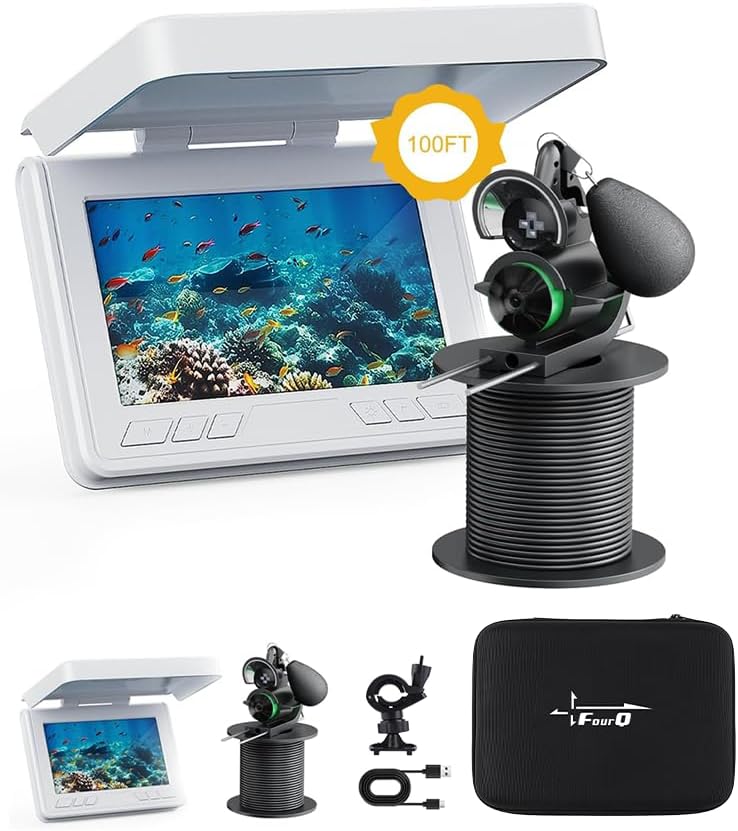
The five-inch IPS fish camera balances a moderately large display with a 100-foot waterproof cable, making it a natural fit for anglers who need to explore beyond the immediate position of the kayak. It has a 4.4 rating and is designed for sea, lake, ice, boat, and kayak fishing.
We may earn a commission when you buy through this link, at no additional cost to you.
Its 220-degree wide-angle lens provides a broad view around the camera, reducing the need to point directly downward. Infrared night-vision lighting helps expose fish silhouettes in dark or murky water, while the IPS display provides a clear live view of movement, underwater terrain, and bites.
The 6000mAh rechargeable battery supports up to nine hours of continuous operation. The IP68 waterproof system includes a 100-foot cable with a listed 100-kilogram pull strength, supporting deployment into deeper water and retrieval through heavier conditions.
The system is supplied with essential accessories and a carrying case for straightforward transport. It does not support photo or video recording, so its value rests on real-time observation. Choose it for anglers who prioritize a large screen, long reach, and dependable battery life without needing a DVR.
A 100-foot cable allows the underwater camera to be placed well away from the kayak, covering a larger search area than shorter 30- or 50-foot systems. It can be particularly helpful when checking deeper drop-offs or submerged features.
The five-inch IPS screen gives an angler a clear view while keeping the kayak compact. Combined with infrared illumination and a wide-angle lens, it offers useful awareness of both nearby fish and the surrounding bottom.
We may earn a commission when you buy through this link, at no additional cost to you.
The 220-degree portable fish finder combines a bright five-inch IPS screen, 8000mAh battery, and 98-foot reinforced cable for extended kayak and shoreline sessions. Its 4.6 rating is among the strongest in the list, and the specification set is especially focused on portable operation and adjustable viewing.
We may earn a commission when you buy through this link, at no additional cost to you.
A peak brightness of 1,500 nits and a foldable sunshade help the display remain readable in direct sunlight. The underwater camera uses eight infrared LEDs and a 220-degree wide-angle lens. Adjustable voltage, backlight, and chroma settings provide control over image appearance in murky water or changing conditions.
The battery is listed for up to 15 hours of continuous use, while USB charging allows connection to an adapter or power bank. The IP68 camera and 98-foot cable have a stated 170-pound tensile strength, supporting repeated handling in currents and rough conditions.
The kit includes the main unit, 30-meter cable and camera, adapter, stand, manual, and storage bag. Its compact handheld form is designed to fit into tackle boxes, although the sizable screen and battery are not the lightest option. It is a strong choice for all-day anglers who prioritize endurance and adjustable imagery over recording.
A stated 15-hour runtime gives this system an advantage on long fishing days, particularly when packed with a power bank for an even longer trip. USB charging adds flexibility for multi-day outings and remote launch points.
Voltage, backlight, and chroma adjustments give the angler more control over how the underwater scene appears. These controls can help compensate for changing water clarity and available light when a fixed image setting is less useful.
We may earn a commission when you buy through this link, at no additional cost to you.
The 4.3-inch LCD underwater camera offers a long 100-foot cable, infrared illumination, and straightforward operation at an entry-level position in the category. Its 4.2 rating reflects positive customer feedback, while the product details emphasize ease of use and portability.
We may earn a commission when you buy through this link, at no additional cost to you.
The system uses a 1000TVL program chip and 12 infrared lights to help anglers see fish and structures in bright or dark environments. Its fish-friendly camera design is intended to avoid unnecessarily disturbing nearby fish. The 100-foot cable includes a stated maximum weight capacity of 40 kilograms, or 88 pounds.
A rechargeable 5000mAh battery provides more than 10 hours of continuous use. The included portable box makes the system easier to transport between a kayak, shore, and other fishing locations. Mounts for attachment to a fishing rod or boat are also described, although users should ensure any attachment is secure and does not interfere with fishing.
The camera's underwater rating is IPX6, which differs from the IP68 ratings listed for many alternatives. It is a practical budget choice for live monitoring when the priority is long cable reach, infrared viewing, and battery endurance. The product details do not promote video recording, so it should be treated as a live observation system.
A 100-foot cable is unusually useful at the entry level because it permits broader underwater exploration from a small craft. It can reach farther than many shorter systems without requiring a larger premium kit.
The battery is listed for more than 10 hours of use, while the portable box makes the unit easier to carry and organize. That combination suits anglers who want a simple monitor for a complete day on the water.
We may earn a commission when you buy through this link, at no additional cost to you.
The right camera depends on how you fish, how much room your kayak has, and whether you want to watch fish live, record a trip, or capture action footage. These factors help narrow the most useful features before purchase.
Underwater fishing cameras use a tethered underwater unit and a screen to show fish, bottom structure, and bait behavior in real time. Action cameras instead record the angler's surroundings and may use a waterproof housing. If your main goal is finding fish below the kayak, an underwater fishing camera is the more relevant choice; if the goal is documenting the outing, consider an action camera.
Screen size, panel quality, brightness, and a sun visor all affect how easily you can interpret the image from a kayak. A four-point-three-inch LCD may be adequate for occasional checks, while five-, six-, or seven-inch IPS or OLED screens are easier to watch continuously. IPS is designed to offer wide viewing angles, and OLED provides strong contrast and brightness. Consider glare, reflections, and how the screen will be positioned in your cockpit.
Cable reach determines how far the camera can be placed from the kayak. Systems with 30- to 50-foot cables suit close-range searches, while 82- to 100-foot cables allow deeper drops and wider exploration. Longer cables need careful management to avoid tangles and snagging. Also review the stated load rating, waterproof depth, connector design, and whether the cable is manageable with one hand while paddling.
Infrared LEDs are standard on most underwater fishing cameras and work well in dark or murky water without visible glare. White LED lighting can reveal natural color but may be more noticeable to fish. A camera offering both modes gives you flexibility as daylight, water clarity, and depth change. Consider the number of LEDs, stated visibility range, and whether the monitor shows the active lighting mode.
A long day on the water can exceed a short monitoring session, so compare stated continuous-use times rather than capacity alone. A 5,000mAh battery is listed for up to roughly 10 hours on some models, while 8,000mAh and 10,000mAh batteries can provide longer runtimes. USB-C charging and power-bank compatibility add useful flexibility. Verify whether the camera can operate while charging and how much space the display and battery occupy.
Many fish cameras provide live viewing only, while some support timed recording, photos, replay, or saved clips. Recording is useful for reviewing fish behavior, identifying structure, and sharing catches or interesting moments. If you only need immediate information, a live-view system may be simpler. If you want evidence of what happened beneath the kayak, confirm that the model includes storage, recording controls, and compatible file support.
Kayak anglers need a camera that can be carried, mounted, and operated without interfering with paddling or line movement. Look for an included stand, rod or boat mounts, carrying case, and compact screen. A magnetic monitor-to-spool connection or adjustable bracket can improve positioning. Make sure the display can be secured for rough water and that the underwater camera has enough weight or ballast to remain stable.
IP68 appears on most dedicated underwater systems, while one listed model uses IPX6. The camera, cable, connectors, and monitor should all be considered, and the stated maximum depth should exceed your expected use. A high load rating helps when retrieving the camera from weeds or rocky structure. Rinse freshwater equipment after use in saltwater, inspect seals, and avoid pulling sharply against the cable.
Before launching, inspect the camera, cable, connectors, battery, and storage, then confirm that the waterproof seals are clean and properly closed. Charge the monitor fully and, if the model records footage, format the included or compatible storage card. Review the underwater camera's viewing angle and test it in shallow water before relying on it in deeper or unfamiliar locations.
Deploy the underwater camera beside the kayak rather than directly beneath unstable equipment. Lower it gradually, keep the line away from propellers, paddles, and fishing line, and watch the screen for movement, bottom contours, weeds, and structure. Use the lighting mode suited to the water, move the camera slowly, and avoid sharp pulls when weeds or rocks catch the cable.
After the trip, disconnect power, wipe the camera and monitor, and rinse the underwater unit and cable with fresh water, especially after saltwater fishing. Dry every part before storage, inspect seals and connectors, and remove the battery if the manual recommends it. Do not store a wet cable tightly coiled, and confirm that the camera remains dry before opening any compartment.
Yes, underwater fishing cameras are specifically used from small boats and kayaks because their screens and long cables let anglers examine fish and structure below or beside the craft. Secure the monitor where it is visible without blocking paddling, and route the cable away from moving parts. A lighter unit is more comfortable to position manually.
It depends on your objective. An action camera is better for recording 4K video of the kayak, casting, catches, and underwater scenery, while a dedicated fishing camera is better for watching fish and structure live on a display. Many anglers benefit from using both, but one is sufficient if you only need documented action or real-time observation.
Infrared lighting is especially valuable at dawn, dusk, under heavy cloud cover, or in deep water where little sunlight reaches. It can reveal fish silhouettes and submerged features without the brightness of visible white light. In shallow, clear, sunlit water, a wide viewing angle may be more useful than additional illumination.
Some do, while many offer real-time viewing only. The Portable Fish Finder OLED includes timed one-to-three-minute recordings, zoom, replay functions, and a 32GB memory card. The FishPRO, five-inch IPS, TMACTIME, and several other models explicitly do not support recording, so verify this feature before ordering.
A 30- to 50-foot cable is adequate for searching close to the kayak, while 82- to 100-foot cables provide better reach for deeper drops and wider exploration. The appropriate length depends on how you deploy the line, manage tangles, and retrieve the camera around structure. Longer is not automatically better if it is difficult to control.
Some systems are explicitly suitable for saltwater, while freshwater-focused models may require extra care. Check the product's stated applications and waterproof rating before use. Regardless of model, rinse the underwater camera and cable thoroughly with fresh water after fishing to reduce salt-related corrosion.
IPS displays are designed for wide viewing angles, which is useful when the monitor is mounted at an angle inside a kayak. OLED screens can provide strong contrast and very high brightness, making the six-inch OLED model highly visible outdoors. The best choice also depends on screen size, sunshade availability, and available cockpit space.
Lower the camera in a controlled arc, keep the line away from the fishing line, and avoid rotating the kayak while the cable is extended. Use the system's intended deployment method, retrieve the camera before repositioning, and keep the cable from rubbing across sharp kayak fittings. Long cables need especially careful routing.
The Portable Fish Finder OLED is the strongest all-around choice because it combines a large, bright six-inch OLED display, 1080P underwater imaging, a 25-meter cable, infrared lighting, multiple viewing modes, and timed recording with replay. FishPRO is the premium option for anglers who prioritize a seven-inch IPS screen, dual lighting modes, an 82-foot cable, and exceptional battery capacity.
For a lower-cost live monitor, the 100-Foot Underwater Camera provides useful infrared viewing, a long cable, and a simple four-point-three-inch screen. If your main objective is high-resolution documentation rather than seeing fish live, either AKASO EK7000 configuration can record 4K action footage and use a 131-foot waterproof housing.
Before buying, confirm the features you actually need: real-time viewing versus recording, cable reach, battery duration, display size, lighting mode, waterproof depth, and mounting hardware. Product specifications and availability can change, and current pricing should be checked on the linked listing for the most up-to-date information.