
5-in-1 Presence Sensor LWR02
4.3Editor score
Combined PIR and mmWave sensing
Matter over Thread connectivity
Tracks five environmental conditions
Flexible magnetic mounting
Compare the 10 best Mmwave Human Presence Sensor options for Home Assistant, Zigbee, Matter, Wi-Fi, battery power, detection range, and automation features.
Mmwave human presence sensors use radar to determine whether a room is occupied, including when someone is sitting, reading, sleeping, or otherwise remaining still. Unlike a conventional PIR motion sensor, they can distinguish the absence of people from simple inactivity, making them especially useful for lighting, climate, security, and energy-saving automations.
The products in this guide were compared by considering radar technology, detection range, supported smart-home platforms, connectivity, power options, environmental sensing, installation requirements, calibration features, and suitability for different rooms. The list covers Wi-Fi, Zigbee, Matter over Thread, and developer-oriented ESPHome models, as well as battery and wired designs.
Each review explains the stand-out capabilities, practical trade-offs, and ideal installation environment for that model. The top selections cover different priorities, including broad Home Assistant compatibility, a feature-rich premium option, and a flexible module for DIY projects. Product availability, ecosystem support, and prices can change, so confirm current details before purchasing.
4.3Editor score

4.4Editor score

5.0Editor score
This side-by-side comparison highlights each sensor's radar frequency, connectivity, power source, sensing features, and platform requirements, helping you identify the model that best matches your smart home.



The Akamatis Litos v3 is a polished Home Assistant presence sensor rated 4.4 out of 5. It combines 24GHz mmWave radar with an integrated VEML7700 ambient light sensor, allowing it to distinguish a quiet, occupied room from one where nobody is present. Its pre-flashed ESPHome firmware makes it substantially easier to use than a raw developer module.
We may earn a commission when you buy through this link, at no additional cost to you.
The HLK-LD2401 radar can detect movement and stationary objects up to 20 feet indoors. That reach makes the model practical for living rooms, bedrooms, offices, and open-plan areas. A Seeed XIAO ESP32-C3 controller and external antenna support more stable 2.4GHz Wi-Fi connectivity, while adjustable sensitivity gives installers some control over room boundaries and unwanted triggers.
The principal limitation is platform dependence. The Litos v3 works exclusively with an existing Home Assistant installation, and basic familiarity with the platform is recommended. It cannot serve as a turnkey Matter, Zigbee, Alexa, or SmartThings device, so buyers outside the Home Assistant ecosystem should not expect native compatibility.
It is the strongest general recommendation for readers who already run Home Assistant. The combination of true presence detection, light awareness, preinstalled firmware, and a compact light-permeable enclosure covers the most valuable automation inputs without requiring another light sensor. For a single, straightforward sensor that can be configured through Home Assistant, it offers an especially coherent package.
Pairing radar presence data with ambient light readings supports smarter routines, such as illuminating a room only when it is occupied and dark. The light-permeable front panel lets the VEML7700 measure conditions while preserving the sensor's understated appearance.
Because ESPHome firmware is already installed, setup does not require manual flashing. Home Assistant users can connect through the device hotspot, provide network credentials, and then fine-tune sensitivity and automation behavior.
We may earn a commission when you buy through this link, at no additional cost to you.
The SONOFF SNZB-06P24 is a feature-rich Zigbee presence sensor with a 3.8 rating. It combines 24GHz mmWave radar, ambient light sensing, zone positioning, and self-learning calibration. These features make it especially interesting for rooms where a simple presence flag is not enough to build reliable, context-aware automations.
We may earn a commission when you buy through this link, at no additional cost to you.
Up to seven configurable zones can be enabled or disabled within a four-meter range and 110-degree field of view. That granularity lets an installer focus detection around a sofa or desk while excluding a corridor, window, or neighboring room. The radar can sense subtle micro-movements such as breathing, while light measurements and historical data can support occupancy-aware nighttime lighting.
Self-learning calibration helps filter repetitive interference from appliances, pipes, and airflow. It cannot eliminate every source of false activation, but it offers a useful mechanism for adapting to the room after installation. Third-party users can configure advanced parameters through BLE in the eWeLink app, which adds flexibility but may feel more involved than a simple onboarding process.
This is a strong choice for SmartThings, Home Assistant, and Alexa users who want granular control and do not mind operating a compatible hub. USB-C power makes placement flexible, while broad Zigbee compatibility broadens its appeal. It is less suitable for a standalone household because the required hub and calibration process are central to the feature set.
Seven adjustable zones are the model's defining advantage. By excluding unwanted areas, you can make presence-triggered lighting and security routines more precise, particularly in rooms with several walkways or adjacent spaces.
The self-learning system is designed to recognize repetitive environmental movement and reduce false triggers. Periodic adjustments may still be necessary around strong fans, moving curtains, or other persistent sources of interference.
We may earn a commission when you buy through this link, at no additional cost to you.
This general-purpose Zigbee mmWave presence sensor carries a 4.0 rating and is particularly relevant to Home Assistant users who standardize on Zigbee2MQTT. It reports presence distance, illuminance, detection distance, and presence sensitivity, providing more automation data than a simple binary occupancy sensor.
We may earn a commission when you buy through this link, at no additional cost to you.
Its 24GHz radar detects both moving and stationary people and offers faster response and distance measurement than the 5.8GHz alternative referenced in its product information. The sensor supports intelligent scene linking, making it possible to activate lights when someone enters a hallway or wakes at night. Mounting options include walls and ceilings, allowing users to position the detection field more effectively.
The sensor must remain connected to a constant 5V, 1A USB supply. This is less convenient than a battery design but avoids battery replacement and supports stable operation. The product information also recommends Zigbee2MQTT over ZHA specifically to expose all functions, so compatibility with a plain ZHA setup may be less complete.
Choose this model when you already use Zigbee2MQTT and want a permanently installed, continuously powered sensor with useful distance and light information. It is a practical middle ground for technically capable users, although buyers seeking a broad range of supported hubs or simple battery placement should consider the alternatives.
Exposed distance, lux, detection range, and sensitivity values can support nuanced automations. These details are particularly useful for visual dashboards, room-specific logic, and diagnosing placement or sensitivity issues.
Constant USB power is suitable for hallways, entryways, bedrooms, and other locations where reliable presence information matters more than cable-free installation. Mounting location remains essential because the sensor should not be obstructed.
We may earn a commission when you buy through this link, at no additional cost to you.
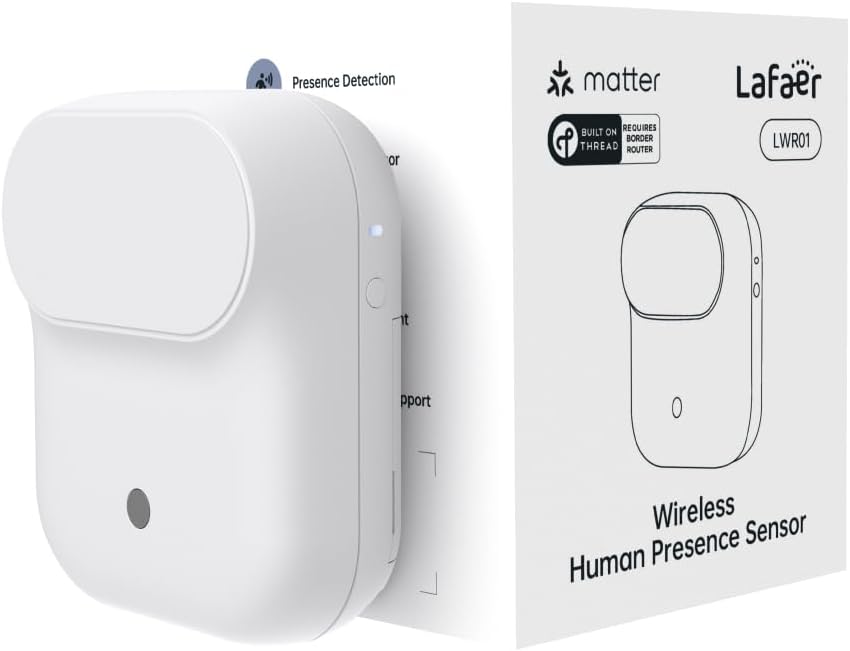
The LWR01 is a wireless mmWave presence sensor built around Matter over Thread. Its 3.3 rating reflects a useful but still developing feature set, including mmWave presence detection, ambient light sensing, battery operation, optional USB-C power, and IPX3 water resistance.
We may earn a commission when you buy through this link, at no additional cost to you.
According to the supplied information, the sensor can detect stillness up to 3.5 meters and movement up to six meters. This makes it useful for bedrooms, bathrooms, reading areas, and other spaces where lights should remain on while a person is present but inactive. A battery life of more than one year offers flexible placement without requiring a nearby outlet.
The product supports Apple Home, Amazon Alexa, Google Home, Samsung SmartThings, Home Assistant, and other platforms when an appropriate Thread-compatible hub or router is present. The listed requirements are extensive, including compatible Apple, Amazon, Google, Homey, and SmartThings hardware. Buyers should verify that their existing infrastructure supports the exact Matter and Thread functions they need.
The LWR01 makes sense for households seeking modern cross-platform compatibility and flexible placement. Its IPX3 rating also makes it a candidate for bathrooms and kitchens, although water resistance should not be confused with full waterproofing. Compared with the stronger-rated options in this list, it is most attractive to users who value Matter support and wireless installation over broader environmental measurements.
Operating over Matter allows one sensor to participate in several major smart-home ecosystems. The benefit depends on having a compatible hub or Thread border router already in place, so check the supported-device list before buying.
Battery power makes the LWR01 easier to position in cabinets, bathrooms, and other inconvenient locations. For continuous high-performance use, the manufacturer also supports Type-C wired power as an alternative.
We may earn a commission when you buy through this link, at no additional cost to you.
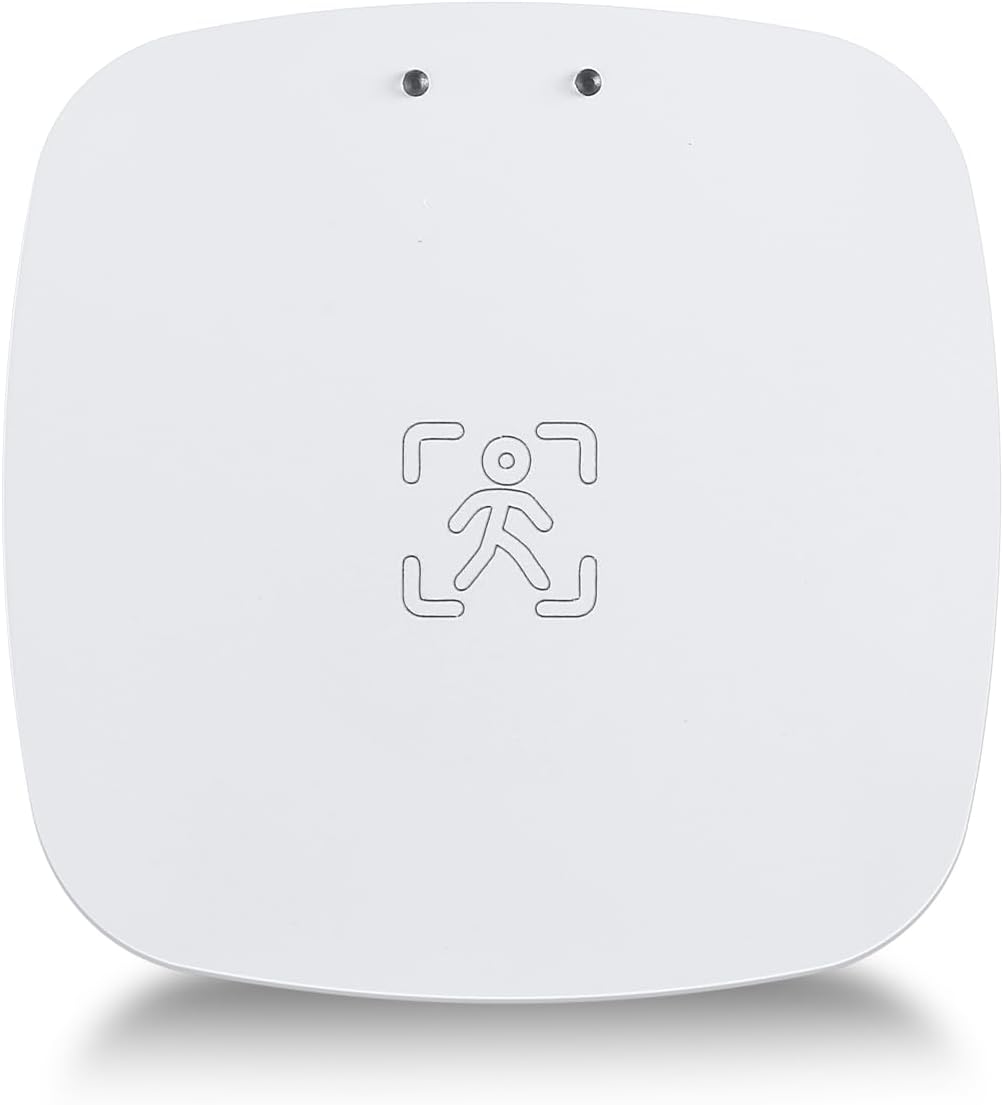
The LWR02 is a premium 5-in-1 sensor rated 4.3 out of 5. It combines 24GHz mmWave radar, PIR sensing, temperature measurement, humidity monitoring, and ambient light detection in one compact device. The dual-sensor architecture is the central idea: radar preserves an occupied state when someone is still, while PIR responds to larger movement.
We may earn a commission when you buy through this link, at no additional cost to you.
Its mmWave component can recognize breathing, sitting, and sleeping, while PIR helps identify walking or waving. An approximately 120-degree field of view covers a four-meter presence range and an eight-meter motion range. The hemispherical magnetic base can be angled as needed, and adhesive or shelf mounting provides additional installation options.
Two included AAA batteries can provide up to two years of operation, and rechargeable cells are supported. IPX3 splash resistance makes the housing suitable for bathrooms, kitchens, and laundry rooms. Matter over Thread expands compatibility with Apple Home, Alexa, Google Home, SmartThings, Home Assistant, and Homey, but users still need a compatible Thread border router.
The LWR02 is the most comprehensive premium model in this guide. It suits someone who wants occupancy, motion, climate, and light data from one device, especially where PIR-only sensors would lose the occupied state. The trade-off is a more complex environment-sensing package and the continuing requirement for battery maintenance and suitable Thread infrastructure.
Radar provides fine-grained presence awareness, while PIR offers a complementary motion signal with a longer stated range. Together they can reduce the chance that a fan, curtain, or small pet will make the room appear occupied while still retaining true static presence.
The supplied information emphasizes local processing and a local-first architecture. This approach is designed to limit the exposure of in-home occupancy data to third-party cloud services, making radar-based presence more privacy-conscious than camera-based detection.
We may earn a commission when you buy through this link, at no additional cost to you.
The THIRDREALITY Presence R2 is a battery-powered Zigbee 3.0 sensor rated 3.5 out of 5. It uses 24GHz mmWave radar to detect people through non-metallic materials such as wood and glass, while its AI-enhanced environment learning is intended to reduce common false triggers.
We may earn a commission when you buy through this link, at no additional cost to you.
Three standard AA batteries remove the need for wiring, allowing installation in cupboards, bathrooms, halls, and storage rooms. Five sensitivity levels give users a practical way to balance subtle posture changes against unwanted activation from everyday movement. Higher settings can capture small gestures, while lower settings are better suited to hallways where major movement is the relevant trigger.
The sensor supports Home Assistant through ZHA or Zigbee2MQTT, SmartThings, Homey Bridge, Homey Pro, Aeotec, and several Echo models with built-in Zigbee hubs. It can trigger lighting, thermostat, curtain, security-camera, and phone-notification automations when presence changes.
This model is a good fit for a Zigbee household that values wire-free installation. Its main caveats are the required hub, the potential for strong repetitive motion to trigger the sensor, and the need to tune sensitivity in the intended room. Compared with the R3, it prioritizes simple presence sensing rather than RGB indication and air-quality awareness.
AA power makes the R2 practical in locations where running a cable or maintaining a small battery pack would be inconvenient. A wide selection of supported hubs also lets it join an established Zigbee network rather than requiring a new proprietary bridge.
Five levels make it easier to account for room geometry. The supplied information notes that strong or repetitive motion, including some fan patterns, may still activate the radar, so placement and sensitivity should be tested together.
We may earn a commission when you buy through this link, at no additional cost to you.
The Fermion C4002 is a development-oriented mmWave module with a 5.0 rating, the highest in this roundup. It is not a finished wall sensor but a flexible platform for builders who want direct control over radar processing, Home Assistant entities, and custom automations.
We may earn a commission when you buy through this link, at no additional cost to you.
The module identifies motion up to 11 meters, static presence up to 10 meters, and micro-motion. Verified ESPHome YAML files are included, and a standard UART connection can expose occupancy, distance, energy, and illuminance entities. The documentation also covers Arduino, Raspberry Pi, ESP32, calibration, sensor-data parsing, and Home Assistant tutorials.
Adaptive noise filtering is designed to reduce interference from ceiling fans, moving curtains, and plants. Software-configurable distance gates allow users to define the monitored area and reduce detections from adjacent spaces. A 0-to-50-lux light sensor adds another automation input, while the 3.6-to-5.5V supply range supports both 3.3V and 5V systems without a level shifter.
This is the best choice for an ESPHome enthusiast who wants granular control and broad documentation. It can produce sophisticated automations, but wiring, enclosure design, power delivery, and potentially more technical setup are all part of the project. A homeowner seeking a ready-to-install consumer sensor will find easier options elsewhere in the guide.
Distance gates and configurable entities expose more of the radar's behavior than most finished sensors. This makes the C4002 valuable for custom dashboards, room geometry experiments, and automations that require a particular distance or energy threshold.
Official wikis, setup guides, tutorials, parsing examples, and calibration instructions support a faster path to a working installation. The included ESPHome configuration is particularly useful for users who want native entities without reverse-engineering the module.
We may earn a commission when you buy through this link, at no additional cost to you.
The Akamatis Presence v2.2 is a straightforward Home Assistant sensor rated 4.4 out of 5. It uses the HLK-LD2410B radar module and a Seeed XIAO C3 controller to detect moving and stationary people up to 20 feet indoors. It is a simpler alternative to the Litos v3 for users who do not need integrated ambient light measurements.
We may earn a commission when you buy through this link, at no additional cost to you.
The sensor arrives with ready-to-use ESPHome firmware, so there is no need to flash it manually. Setup involves connecting to the device hotspot and entering Wi-Fi credentials. USB-C power removes the need for batteries, while the external Wi-Fi antenna is intended to provide a more stable connection and better range.
Its main constraint is exclusive Home Assistant compatibility. The product information says Home Assistant must already be installed and running on a computer, and basic familiarity is recommended. It therefore offers limited appeal to Alexa, SmartThings, Matter, or Zigbee households unless they already maintain a Home Assistant environment.
Choose the v2.2 when reliable static-presence detection, compact dimensions, and minimal setup are the main goals. It provides a smaller feature set than the Litos v3, but the core radar experience is well suited to lighting, occupancy, and home automation. A separate illuminance sensor can be added if ambient light is also required.
The radar can continue reporting occupancy while someone watches television, works at a desk, or rests. This avoids the common PIR problem of lights switching off merely because movement has stopped.
Pre-flashed firmware and hotspot-based Wi-Fi setup make the sensor approachable within Home Assistant. The external antenna helps maintain a dependable network connection after the initial configuration.
We may earn a commission when you buy through this link, at no additional cost to you.
The THIRDREALITY Presence R3 is a visually distinctive Zigbee sensor rated 3.3 out of 5. Its 60GHz mmWave radar detects subtle micro-movements such as breathing, while the built-in RGB light can display occupancy, automation, or system status without relying solely on an app or dashboard.
We may earn a commission when you buy through this link, at no additional cost to you.
The RGB feature can provide ambient light and at-a-glance feedback through different colors or brightness levels. An ambient light sensor measures lux, and the supplied information also lists TVOC air-quality awareness. Lux and TVOC entity availability depends on the connected platform, and the indicator flashes red when dangerous air quality is detected based on TVOC levels.
USB-C power at 5V and 1A provides continuous operation without battery maintenance. The sensor uses Zigbee 3.0 and can serve as a Zigbee repeater, potentially improving mesh coverage. Home Assistant users can connect through ZHA or Zigbee2MQTT, and the listed compatibility extends to SmartThings, Aeotec, Homey, Homey Pro, and compatible Echo devices.
The R3 is most appropriate for someone who wants presence sensing, useful status lighting, and a possible mesh-network benefit in one device. Its drawbacks include constant power requirements, a relatively low 3.3 rating, and platform-dependent environmental data. Those considering it for only basic occupancy may find the R2 or Litos v3 more direct.
The RGB indicator can turn invisible automation states into an immediate visual cue. Different colors and brightness levels can distinguish room occupancy, device status, or selected automation conditions.
Zigbee repeater functionality may improve coverage in a larger home. The benefit depends on the router's position, power, and the number of other mesh participants, so it should not replace deliberate sensor placement.
We may earn a commission when you buy through this link, at no additional cost to you.
The Zigbee Human Presence Sensor is an entry-level mmWave radar model rated 3.2 out of 5. It detects both movement and people who are sitting, sleeping, reading, or otherwise remaining still, making it useful for bathrooms, bedrooms, and living rooms where ordinary motion sensors are insufficient.
We may earn a commission when you buy through this link, at no additional cost to you.
The radar is stated to detect motion up to 20 feet or six meters away. Two AAA batteries are advertised to last up to two years in typical use, so the sensor can be installed without a nearby outlet. A compatible Zigbee hub is still required, however, and the product information lists Echo devices with built-in Zigbee hubs, SmartThings, Home Assistant, Hubitat, and Tuya as potential ecosystems.
Its main advantage is a direct presence concept at an accessible price point. Lights can turn on when someone enters and remain on while the person is present, avoiding the need to wave or move. The trade-off is a comparatively modest feature set, with no mention of advanced zone mapping, self-learning calibration, RGB indication, or additional environmental sensors.
This sensor is best for a basic Zigbee automation system where dependable stationary-presence detection is the main requirement. Buyers should confirm that their chosen platform exposes the relevant presence entity and should test placement carefully. For extensive environmental sensing or granular room control, one of the more advanced models will be a better fit.
The key advantage is recognizing occupancy even during periods of complete stillness. This allows automations to reflect whether a person is in the room rather than whether they happened to move recently.
Two AAA batteries and an advertised two-year typical runtime simplify installation in locations without a power outlet. Actual runtime depends on motion frequency, radio behavior, battery quality, and the connected Zigbee network.
We may earn a commission when you buy through this link, at no additional cost to you.
The right mmWave presence sensor depends on your smart-home ecosystem, available power, room conditions, and the level of control you need. Review connectivity and installation requirements before comparing range specifications.
Connectivity determines whether a sensor can join your existing automation platform without replacing hubs or adding unsupported bridges. Home Assistant users can consider Wi-Fi models with ESPHome, Zigbee models supported by ZHA or Zigbee2MQTT, and Thread devices paired with a compatible border router. Matter over Thread offers broad ecosystem potential, but the actual controller and router must support the required Matter device type and Thread operation.
A headline range is only meaningful under suitable conditions. Some sensors distinguish a shorter static range from a longer motion range, while others provide configurable zones or distance gates. Consider the dimensions of the room, the sensor's viewing angle, nearby walls, doors, and the areas that should be ignored. A sensor with a shorter but well-defined detection field can outperform a longer-range model placed poorly.
The defining advantage of radar is detecting a person who is not moving. Look for descriptions of static presence, micro-motion, breathing detection, or energy-based occupancy rather than relying only on a motion-detection claim. Environmental learning, distance filtering, sensitivity levels, and complementary PIR sensing can further improve stability. Even advanced sensors may react to strong fans, curtains, moving plants, or repetitive mechanical movement.
Battery-powered sensors make placement in bathrooms, cupboards, and hallways easier, but they require eventual maintenance. Wired USB or USB-C models avoid battery replacement and can be positioned almost anywhere a cable reaches. Fully assembled consumer devices are more convenient than raw modules, which may require soldering, an enclosure, firmware configuration, and careful power delivery. The installation environment also determines whether an IPX3 splash-resistant housing is useful.
A built-in ambient light sensor can prevent unnecessary lighting when a room is already bright. Temperature and humidity expand the sensor's usefulness for comfort monitoring and climate-related automations, while TVOC data may provide an air-quality indication. These extras add value only if your platform exposes the corresponding entities. Verify support because some environmental readings may be unavailable or limited in particular ecosystems.
Radar presence sensing does not require a camera, which can reduce the need to capture images of people inside the home. Nevertheless, occupancy patterns can still reveal information about household activity. Local-first processing, local automation, and avoiding unnecessary cloud dependence can improve privacy. If this is important to you, look for explicit local-control claims and understand how the manufacturer's platform handles device data.
Pre-flashed ESPHome firmware and hotspot-based onboarding are convenient for many Home Assistant users, while developer modules can provide greater customization but require wiring and configuration. Zigbee sensors may need a coordinator, hub, and correct pairing method. Advanced settings can be accessed through a phone app, over Bluetooth, or directly in the automation platform. The easiest device is not always the most capable, so match setup complexity to your experience.
A good sensor should integrate with a stable hub, provide entities your platform can use, and receive useful firmware or configuration updates. Newer models may offer broader Matter support, but their ratings and long-term reliability may not yet be established. Established integration patterns such as Zigbee2MQTT can offer flexibility, while standards-based Matter devices can reduce ecosystem friction. Check documentation and compatibility details before committing to a model.
Begin by identifying the automation goal, the room geometry, and the platform that will receive the sensor. Install the unit on a wall, shelf, ceiling, or inside a cabinet where its radar field is unobstructed. Avoid placing it directly beside a window, fan, heating vent, curtain, or other regularly moving object, because these can create false activations. Follow the mounting guidance for the specific model and avoid obstructing the sensing area.
Power the sensor using its specified source, connect it to the appropriate hub or network, and complete the manufacturer's pairing process. For Home Assistant, use Zigbee2MQTT when the product documentation recommends it, while ESPHome models may require adding the supplied YAML and entering network credentials. Adjust detection distance, sensitivity, zones, and timing gradually, testing the room while all household members move, sit, and leave normally.
Maintain the sensor by keeping the face free from dust, moisture, and adhesive residue, and replace batteries before they are depleted. Recalibrate or re-evaluate sensitivity if furniture, airflow, or seasonal changes alter the room. Test the automation periodically by entering, remaining still, and leaving. Software updates, firmware changes, and ecosystem compatibility can evolve, so check the current documentation whenever you add the sensor to a new automation.
A PIR motion sensor reacts to changes in infrared energy caused by movement. An mmWave presence sensor uses radar to detect both movement and subtle signs of occupancy, such as breathing or changes in posture. As a result, an mmWave model can keep a light on while someone sits still, which a conventional PIR sensor may interpret as an empty room.
It depends on the connection method. Wi-Fi models can often join a home network directly, while Zigbee sensors require a compatible coordinator or hub. Matter over Thread devices need a Thread border router and a Matter controller, and some Matter functionality may also depend on the platform vendor. Check the compatibility list before buying a model for an existing ecosystem.
Yes, that is a major purpose of radar-based presence sensors. The models in this guide are designed to identify static occupancy and micro-motion rather than only large movements. Reliability varies with mounting, distance, room interference, and sensor quality, so installation and calibration remain important.
They can be suitable when the model has suitable environmental protection. The LWR01 and LWR02 have IPX3 water resistance for everyday splashes, making them candidates for bathrooms, kitchens, and laundry rooms. IPX3 is not the same as complete waterproofing, so the sensor should not be directly exposed to running water or excessive moisture.
Fans, moving curtains, plants, pipes, and other repetitive environmental movement can potentially trigger radar sensors. Several models in this guide offer adaptive learning, configurable distance gates, zone selection, or adjustable sensitivity to reduce the problem. Strong or recurring interference may still require repositioning the unit.
Wi-Fi is convenient for direct Home Assistant use and needs no separate radio coordinator. Zigbee is often well suited to established mesh networks and offers a broad range of compatible hubs, but it depends on reliable network coverage. Matter over Thread is attractive for broad ecosystem support, yet it requires compatible Thread infrastructure and confirmed device support.
Some models use replaceable batteries, including the LWR01, LWR02, THIRDREALITY R2, and the basic Zigbee Presence Sensor. Other models, such as the Litos v3, Akamatis v2.2, SONOFF SNZB-06P24, and THIRDREALITY R3, use wired USB or USB-C power. Battery models are easier to place freely, while wired models avoid battery maintenance.
A finished sensor is usually easier for a typical homeowner to mount and configure. An ESPHome module offers deeper control over distance gates, entities, calibration, and custom automations, but it may require wiring, enclosure work, and more technical setup. Choose the finished model for convenience or the module for customization and control.
The Akamatis Litos v3 is the leading all-around choice for Home Assistant because it combines reliable 24GHz presence detection, ambient light sensing, adjustable sensitivity, and pre-flashed ESPHome firmware. The LWR02 stands out as the premium option with Matter over Thread, dual radar-and-PIR sensing, five environmental measurements, and flexible mounting, while the Fermion C4002 offers the most control for DIY ESPHome builders.
Your priority should determine the selection. Choose a finished Wi-Fi or Matter model for convenient placement and broad ecosystem integration, a Zigbee model for an established mesh network, or a developer module for custom distance logic and local control. In every case, verify the required hub, power source, mounting position, and supported entities before making a final decision.
Product specifications, ratings, platform support, and prices can change over time. Review the current listing and official documentation, especially when purchasing for a long-term installation. Comparing current product details against your room, network, and automation requirements will lead to the most dependable result.
