
Dimmable Touch Sewing Machine Light
4.7Editor score
Touch-controlled brightness
Flexible adhesive-backed design
Universal household-machine fit
Compact low-voltage lighting
Simple installation
LED sewing machine light guide comparing brightness, mounting, adjustability, power options, and fit for home sewing, quilting, and craft tasks and workspace
A good LED sewing machine light should make dark thread, fabric edges, and tiny stitches easier to see without creating glare around the work area. The right model depends on your machine, workspace, preferred mounting method, and need for cordless portability. Strip lights, magnetic lamps, flexible arms, and clip lights each offer distinct advantages.
We compared all ten products using the supplied information, focusing on LED output, daylight color, beam direction, mounting choices, adjustability, power delivery, and compatibility with sewing machines or craft tables. The list includes adhesive strips, magnetic work lights, flexible goosenecks, clamp fixtures, and a rechargeable model for greater mobility.
Each review identifies what a product does best, where its design may be less convenient, and which sewists, quilters, or crafters are most likely to appreciate it. Ratings reflect the supplied customer feedback, while prices and product availability can change, so compare the current listing and features before purchasing.
4.7Editor score

4.6Editor score

4.7Editor score
This side-by-side comparison highlights the principal differences in light format, mounting system, adjustability, and power source, making it easier to identify the option that best matches your machine and sewing space.




The Madam Sew LED Sewing Machine Light Strip has a 4.6 rating and stands out as the most purpose-built option in this guide. Its flexible strip places 24 crisp 6500K LEDs close to the needle rather than relying on a distant overhead source. That arrangement can improve the visibility of dark cloth, black thread, seam allowances, and small construction details.
We may earn a commission when you buy through this link, at no additional cost to you.
The strip measures 12 inches and may be trimmed between LED segments, allowing owners of compact or vintage machines to reduce its length without disabling the remaining LEDs. Strong adhesive backing provides the main installation method, while three included clips add support in warm rooms or on textured finishes. The slim 1.8-inch width is designed to stay out of the fabric path.
The included three-button dimmer is a meaningful advantage over touch controls. Separate brighter, on/off, and dimmer buttons provide tactile operation, which can be easier when hands are dusty, damp, or occupied with fabric. The 98-inch cord reaches a nearby outlet, USB hub, or power bank, although the light is not cordless and does not include a USB wall adapter.
This is a strong recommendation for quilters and home sewists who want broad, even light over the needle plate. It is less ideal for someone seeking a compact articulated arm or a rechargeable fixture, but its adjustable length, long cord, and reliable physical controls make it especially practical for permanent or semi-permanent installation.
Positioning the strip beneath the machine arm spreads daylight-white illumination across the sewing area instead of creating one harsh point. The 24 LEDs and 6500K output are intended to improve contrast when working with dark fabric and fine thread.
The strip can be shortened between LED segments for compact setups, while adhesive and clips provide two forms of retention. Cleaning the mounting surface with rubbing alcohol before applying the strip can help the adhesive bond more reliably.
We may earn a commission when you buy through this link, at no additional cost to you.
This compact touch-control sewing light carries a 4.7 rating and offers a straightforward way to brighten a work area. Its daylight illumination is designed to reveal fabric, stitches, and thread more clearly, which can make long sewing or quilting sessions more comfortable and reduce the effort of visually tracking fine details.
We may earn a commission when you buy through this link, at no additional cost to you.
The flexible structure and adhesive backing allow the light to conform to many sewing-machine surfaces without complicated hardware. Touch control adds quick on-and-off operation and adjustable brightness in a single compact design. Because the fixture is intended to fit most standard household sewing machines, it is a broad choice for ordinary home setups.
The main limitation is that touch control may not feel as dependable as physical buttons when a user's fingers are wet, dusty, or covered with fabric residue. The supplied information also does not detail the cord length or specify whether a wall adapter is included, so buyers should inspect the package and current listing before ordering.
Overall, this is an appealing budget choice for anyone who wants uncomplicated lighting with adjustable brightness and minimal installation. It is best suited to a home sewist who values a compact adhesive fixture over an articulated arm, magnetic base, or rechargeable design.
The adhesive-backed flexible body follows the shape of the machine and avoids the footprint of a clamp or base. This makes the light especially convenient for renters and portable sewing spaces where permanent modifications are undesirable.
A sensitive touch control allows the user to change illumination levels for different fabrics or tasks. The quick on-and-off function also keeps daily operation simple.
We may earn a commission when you buy through this link, at no additional cost to you.
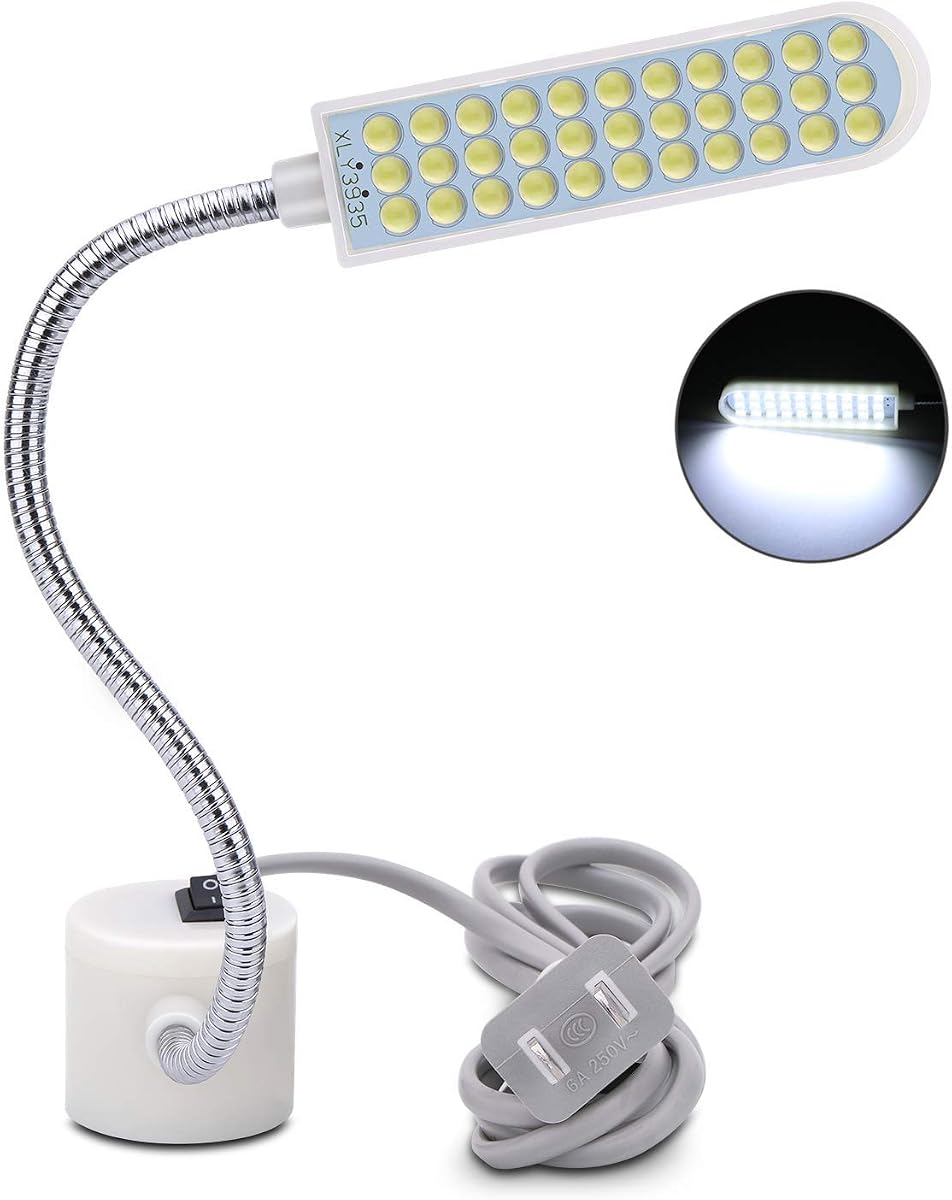
The two-pack 30-LED work light has a 4.7 rating and combines flexible positioning with a magnetic base. Each lamp includes a six-watt LED source and a long silicone gooseneck, allowing the beam to be aimed directly at the needle, presser foot, bench surface, or another detailed task.
We may earn a commission when you buy through this link, at no additional cost to you.
Two mounting discs and adhesive stickers are included in the package. The magnetic base can attach to suitable metal surfaces, while the adhesive discs offer a nonmetal mounting alternative on tables or other clean, dry areas. This versatility is useful if you sew at different stations or also use the lights for reading, handwork, drill presses, or lathes.
The silicone-covered neck is designed to remain flexible while reducing the exposed metal associated with some older work lights. The product information describes bright, natural daylight illumination without flicker or glare, but it does not state a lumen figure or color-temperature value, so comparisons based on brightness should remain approximate.
This pair is an excellent choice for users who want two directional lights and more than one mounting method. It is less convenient for use with a plastic sewing-machine housing if the adhesive disc does not hold well, but its goosenecks make it easy to redirect light whenever the work moves.
The two-lamp configuration is useful when a sewing station, serger, cutting table, or pressing area each needs illumination. It also provides a spare for shared or mobile workspaces.
Strong magnets handle metal machine bodies and workbenches, while the supplied adhesive discs expand the mounting options. Neither method is ideal for every surface, so placement should be checked before drilling or modifying equipment.
We may earn a commission when you buy through this link, at no additional cost to you.
The POWKER 30 LED Magnetic Light has a 4.5 rating and is a flexible task lamp designed for sewing machines, drill presses, desks, craft areas, and metalworking equipment. Its 30 LED beads provide the kind of concentrated illumination useful for detailed work, while the soft output is intended to remain comfortable during extended use.
We may earn a commission when you buy through this link, at no additional cost to you.
A silicone-coated gooseneck provides flexible positioning without leaving the entire metal neck exposed. The light can be bent toward the needle, presser foot, or work surface and then held in the selected direction. Its strong magnetic base is designed to remain stable despite vibration and movement during work.
The constant-current power supply is specifically described as helping prevent strobing, which can make a moving image look less stable and can be unpleasant for some users. A lifetime warranty also adds reassurance. The product information does not mention dimming, so buyers should expect a fixed level of illumination rather than user-adjustable brightness.
This light is best for workshops with metal surfaces and for users who value a freely bendable neck over a low-profile strip. Its limitation is clear: a magnetic base will not attach to an all-plastic machine housing unless another supported mounting solution is added.
The flexible neck makes it possible to move the light away from the machine and redirect it toward hands, tools, or small components. This is especially helpful when the built-in machine lamp casts light from an inconvenient angle.
The stated constant-current supply is intended to reduce strobing and support stable light output. That makes the lamp suitable for repetitive sewing tasks as well as machinery and bench work.
We may earn a commission when you buy through this link, at no additional cost to you.
The Sew Creative Flexible LED Sewing Machine Light has a 4.7 rating and is the most polished general-purpose option in the group. Its flexible gooseneck is designed to place bright, clear light directly where a sewing, quilting, or craft project needs it rather than illuminating an entire room.
We may earn a commission when you buy through this link, at no additional cost to you.
The product is positioned for sewing machines, workstations, and craft tables, with a mounting approach intended to be straightforward and not require complex tools. Energy-efficient LED output provides illumination without the heat associated with traditional bulbs, supporting longer working sessions and reducing eye strain in dim environments.
Compared with bare-bones magnetic work lamps, this model is backed by a one-year warranty and is described as a durable, long-lasting fixture. The supplied information does not provide a lumen rating, color temperature, cord length, or precise mounting dimensions, so buyers who require those measurements should review the current listing and package information.
It is a strong premium pick for crafters who want a flexible, professional-style task light and a dedicated warranty. It may be unnecessary for someone seeking the lowest-cost basic fixture, but its adjustability and broad intended use make it especially appealing to frequent sewists and quilters.
A bendable arm lets the user concentrate light on seams, appliqué, embroidery, or fine craft components. The fixture can follow the movement of the work rather than forcing a fixed lighting angle.
Energy-efficient LEDs illuminate the workspace without the heat of conventional bulbs. Clear, focused light can also make low-contrast details easier to identify when precision matters.
We may earn a commission when you buy through this link, at no additional cost to you.
The 36 LED Gooseneck Work Light has a 4.5 rating and focuses on soft, steady illumination for detailed tasks. Its LED array is described as non-flashing and non-pulsating, which is helpful for users who spend long periods examining seams, small components, or machine details.
We may earn a commission when you buy through this link, at no additional cost to you.
The flexible neck allows precise adjustment and is intended to hold its position without excessive sagging. A strong magnetic base makes the lamp easy to attach and remove, so the user can move the illumination between a sewing machine, drill press, bandsaw, 3D printer, workbench, or other suitable metal fixture.
Its greatest strength is straightforward repositioning. Rather than permanently attaching adhesive strips to a machine, the user can bring the light to the work and angle it as needed. The trade-off is that magnetic attachment is dependent on a sufficiently large, clean metal surface; thin or nonmagnetic housings may not hold it securely.
This is a good general workshop light for someone who wants a larger LED array and a flexible neck at a modest cost. It does not advertise dimming, and its mounting limitations make it less appealing for plastic machines or spaces without a suitable metal attachment point.
The listed non-flashing, non-pulsating output is intended to create steady visibility during repetitive tasks. It can help reduce the distraction caused by flickering or strobe-like light.
The removable magnetic base allows the light to follow the task. That flexibility is useful for shared rooms where one lamp may serve sewing, bench work, and hobby machinery.
We may earn a commission when you buy through this link, at no additional cost to you.
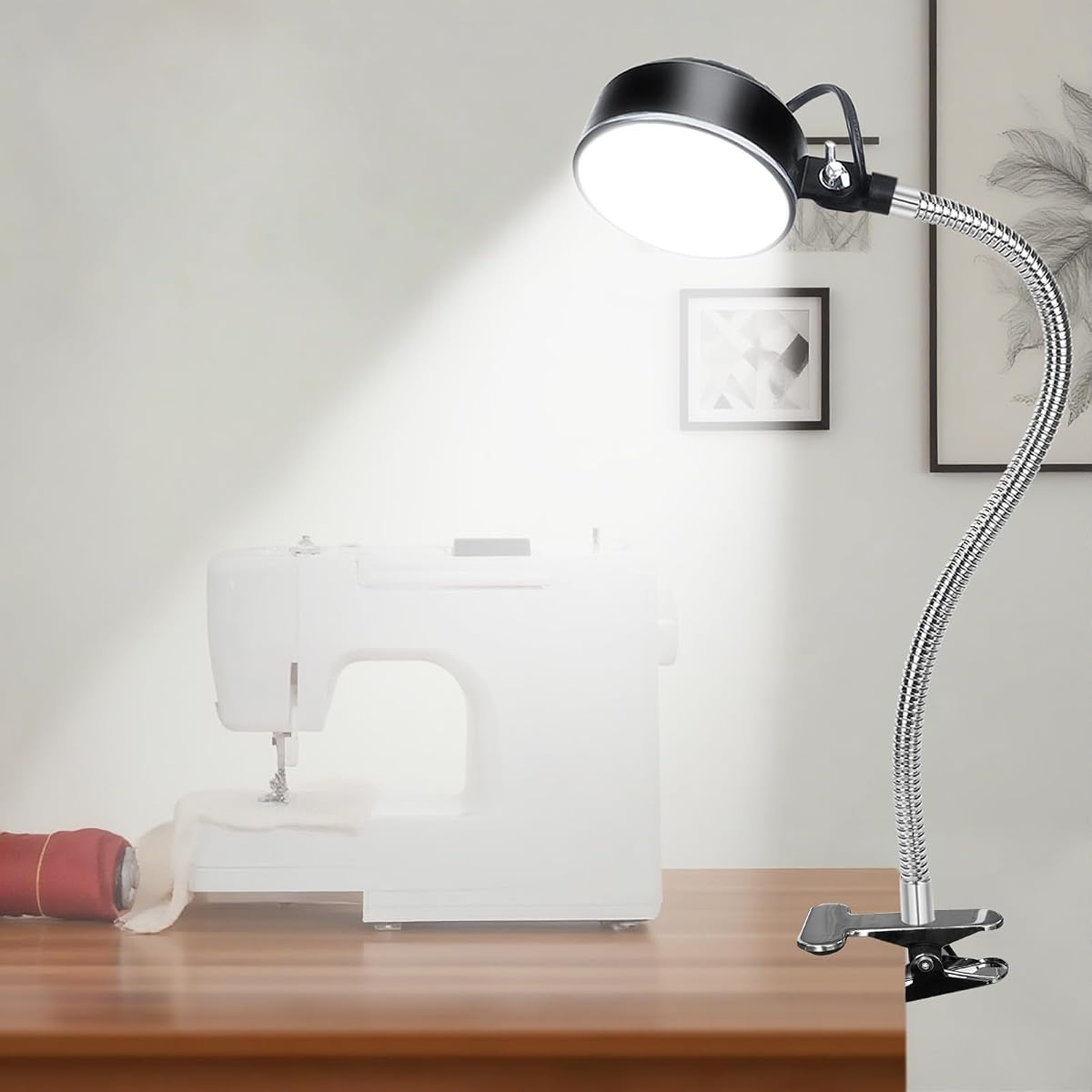
This flexible clamp light has a 4.3 rating and is the only product in the guide with a clearly stated output of 2,000 lumens. Its 60 LED beads and 20-watt source are designed to illuminate small, dark work areas, including sewing spaces, workbenches, electronics benches, and craft tables.
We may earn a commission when you buy through this link, at no additional cost to you.
The large-opening metal clamp is a strong alternative to adhesive or magnetic mounting. It can attach to metal, wood, glass, and plastic work surfaces, while a 15.7-inch flexible shaft with 360-degree adjustment allows the light head to be aimed precisely. Stainless steel and lightweight plastic construction add rigidity without making the fixture feel delicate.
Compared with compact strip lights, this model occupies more space and is better suited to a fixed workstation than a small machine. Its stated 2000-lumen rating may be more illumination than some sewing tasks require, and there is no stated dimming function, so users who need softer light may find the fixed output less adaptable.
For a dim garage, basement, or workshop where a sturdy bracket and bright focused light are important, this is a compelling option. It is less ideal for portable sewing because the clamp and long shaft are built to stay attached to a work surface rather than move casually around the room.
The stated 2000 lumens and 6500K white output are intended to illuminate confined spaces that lack natural or overhead light. The result is a useful option for workshops, basements, and detailed repair areas.
The thick, large-opening clamp grips the edge of a table or machine stand and resists accidental movement. A rigid shaft then holds the lamp head at the desired angle without relying on magnetic contact.
We may earn a commission when you buy through this link, at no additional cost to you.
The AMAZING POWER Bright Sewing Strip Light has a 4.5 rating and offers 17 LEDs in a cutable strip with cold-white 6500K illumination. It can be attached beneath a sewing-machine arm or used around another dry, clean area where task lighting is needed.
We may earn a commission when you buy through this link, at no additional cost to you.
The touch dimmer responds to a one-second press for on and off, while a longer two-to-three-second press adjusts brightness. This makes it convenient to alter the output for different fabric colors or changing room conditions. A 6.6-foot cord provides more reach than many compact strip-light designs.
Six adhesive wire clips are included to keep the cord organized, a thoughtful detail for workspaces where loose cables can interfere with sewing. The strip can be shortened at individual LED intervals, although buyers should follow the product's cutting guidance and avoid cutting at an arbitrary point.
Although marketed primarily for sewing, the strip can also illuminate cabinets, television backgrounds, or a crib area according to the supplied information. It is a flexible secondary-lighting option, but touch-only controls and the need for USB power make the Madam Sew model more attractive for users who prioritize physical buttons and a longer lead.
Cutting the strip between its LED sections allows it to fit a smaller machine or a limited mounting zone. Users should follow the illustrated cutting points and preserve the electrical connections between the retained sections.
Included adhesive clips help route the six-and-a-half-foot cable along a machine arm or wall. Keeping the lead controlled reduces clutter around the needle and fabric path.
We may earn a commission when you buy through this link, at no additional cost to you.
The Cutterpillar Flex Light has a 4.2 rating and is distinguished by its rechargeable USB-C design. Because it is not tethered to a wall outlet during use, it can be positioned around a sewing table, quilting machine, craft station, or other workspace without cable management becoming the central concern.
We may earn a commission when you buy through this link, at no additional cost to you.
Three brightness settings let the user choose between stronger illumination for detailed work and softer output for general tasks. The long, bendable gooseneck focuses the daylight-style light on seams, stitches, and intricate craft elements, while the cordless format makes it easy to carry between project areas.
The trade-off is that the battery must be recharged through USB-C, and the supplied information does not state a runtime, charging time, or exact battery capacity. A user who works for very long uninterrupted sessions may prefer a continuously powered strip or magnetic lamp that does not depend on remaining battery charge.
This is the most mobile option in the guide and a particularly attractive choice for quilters who move between an upright machine, long-arm machine, and craft table. It is worth choosing for convenience, while shoppers with strict brightness specifications should check the current listing for updated technical details.
The rechargeable design removes the need for a power cord during use. That makes the lamp easier to carry and position around bulky machines, long-arm quilting setups, and temporary craft surfaces.
Selectable brightness lets the user adapt the light to dark fabric, close inspection, or general illumination. The flexible arm further narrows the light toward the exact working area.
We may earn a commission when you buy through this link, at no additional cost to you.
The FAJ Flexible 60 LED Work Light has a 4.5 rating and combines a high-intensity COB source with an extra-long 12-inch gooseneck. The extended arm can bring light around obstacles or into the work area of larger machines while remaining flexible and able to hold its position.
We may earn a commission when you buy through this link, at no additional cost to you.
Mounting is versatile. A strong magnetic base handles suitable metal surfaces, while two included adhesive discs make it possible to mount the fixture on other clean, dry locations. This gives the light an advantage over magnetic-only lamps when the sewing machine or craft table has a plastic housing.
The source is described as bright and flicker-free, and a simple on-and-off switch keeps operation uncomplicated. It can serve sewing, woodworking, metalworking, bandsaw, and scroll-saw tasks. Because the supplied information does not list brightness controls, the light should be treated as a fixed-output task lamp rather than a dimmable fixture.
This is a strong choice for workshops needing reach and flexible placement, particularly if the preferred surface is not magnetic. It is less attractive for minimalists who want a small integrated strip, but the combination of a long neck, two mounting methods, and focused COB illumination makes it versatile.
The 12-inch gooseneck can curve around a machine housing or reach beneath a bulky arm. Its stated ability to hold position helps keep the light focused once it has been adjusted.
The magnetic base is convenient for metal equipment, while the included adhesive discs support nonmetal locations. This makes the light more adaptable to mixed home and workshop environments.
We may earn a commission when you buy through this link, at no additional cost to you.
The most useful sewing machine light is one that illuminates the needle evenly, stays securely positioned, and suits the surfaces and power arrangements in your particular workspace. Consider light coverage, controls, mounting, reach, and portability together rather than focusing on LED count alone.
The primary purpose of a sewing light is to reveal the needle plate, seam line, and fabric surface without shadows from your hands. A strip mounted close to the machine arm can spread light broadly across the work area, while a gooseneck or clamp lamp can provide a focused beam aimed at one exact point. Daylight-white output, including specified 6500K products in this group, is intended to improve contrast and make thread colors easier to distinguish.
Choose based on your workflow. A low-profile strip suits a stationary domestic machine, while a flexible arm is more useful when the fabric, presser foot, or machine angle changes frequently. Check the lamp head is capable of reaching the needle without being blocked by the machine body.
Adhesive strips are discreet and easy to install, but they work best on clean, dry, smooth surfaces and may perform less reliably on textured finishes. Magnetic bases are convenient and removable, yet they only attach to suitable ferromagnetic metal. Clamps grip table edges and other suitable structures without adhesive residue, making them strong options for shared or rented spaces.
The ideal mount is one that matches your machine and table. Adhesive mounting can be supplemented with clips, magnetic lights can be paired with adhesive discs, and a clamp works where a flat attachment surface is unavailable. Never force a magnet or adhesive pad onto a surface that could be damaged.
A flexible gooseneck lets the user redirect illumination as a project moves, while a fixed strip requires the machine or work surface to be repositioned. Long necks are useful around bulky housings and long-arm quilting machines, but they should hold their chosen angle without constantly collapsing. A 360-degree shaft adds further flexibility in clamp-style fixtures.
Prioritize practical reach rather than maximum length alone. Bend the neck before mounting, identify any obstruction, and confirm that the final light position clears the presser foot, fabric path, and moving machine parts. A shorter but stable arm may be more useful than a longer one that continually slips.
LED count is only one measure of perceived brightness. Beam concentration, reflector design, mounting distance, and color temperature all affect how clearly the work area appears. The 2,000-lumen clamp light provides the clearest numerical output in this group, while several products offer 30, 36, or 60 LED elements without a published lumen figure.
Daylight colors near 6500K can make black thread and dark fabric easier to see against a work surface. Touch or button dimming is useful when maximum output feels harsh. Fixed-output lamps may still perform well, but the user cannot reduce brightness for delicate fabric, late-night work, or a shared room.
USB-powered strip lights offer flexible placement because they can draw from a wall adapter, hub, or power bank, although the adapter may need to be purchased separately. Cordless rechargeable lamps eliminate trailing cables during use but require regular charging. Permanently powered magnetic or gooseneck lights avoid battery concerns and suit fixed stations.
Consider the distance from the machine to a practical outlet and how the cord will cross the workspace. Adhesive wire clips can secure a USB lead along an arm, while a long cord provides more placement freedom. Keep connections away from fabric trimmings and ensure the cable cannot catch on moving machine parts.
Physical buttons provide direct, tactile control and can be preferable when dusty or damp hands make touch sensors less reliable. Touch controls are more streamlined and often support quick on-and-off operation, brightness adjustment, or both. Some designs place the control on the cable, while others integrate it into the light body.
Choose the interface you will use most often. If you often change the light while handling fabric, a simple button or touch control is helpful. If your hands are frequently dusty, coated, or slightly damp, physical buttons may offer the more dependable experience. Check whether the controls include dimming rather than assuming every LED light is adjustable.
A compact sewing machine may have very little room beneath the arm, making a slim strip more appropriate than a bulky clamp or articulated head. Larger machines and quilting frames often benefit from a long gooseneck because the light must reach over or around the machine housing. The Madam Sew and AMAZING POWER strips can be cut at designated LED intervals for custom lengths.
Measure the available mounting area, the distance to the needle, and the clearance around the fabric path. Also consider whether the light should move with a portable machine or remain fixed at a dedicated table. The best fit provides illumination without obstructing the presser foot, hand wheel, thread path, or controls.
A sewing light can also serve handwork, electronics, model making, reading, drill presses, bandsaws, lathes, and 3D printers. Magnetic and gooseneck models are particularly versatile because they can move between equipment. Silicone-covered necks, metal shafts, and robust clamps may better tolerate frequent repositioning than a very thin adhesive strip.
Look for construction suited to the level of movement in your room. A stationary machine and careful user may be well served by adhesive lighting, while an active workshop benefits from a stable clamp or magnetic base. Confirm the stated warranty and check whether included discs, clips, or adhesive pads are sufficient for the surfaces you intend to use.
Begin by choosing a clean, dry mounting area and planning where the light should sit relative to the needle, presser foot, and fabric path. For an adhesive strip, wipe the surface with rubbing alcohol, allow it to dry, peel the backing carefully, and press the strip firmly along its length. The Madam Sew model also benefits from the included clips when extra security is needed. Magnetic lamps should be placed directly on a suitable metal surface, while clamp lights should be attached to a stable table edge.
Position the lamp before beginning detailed work. Bend a gooseneck slowly, supporting the head and neck rather than forcing a sharp fold, and make sure the fixture does not touch moving machine components. Adjust brightness when available: select a lower level for light fabric or nighttime crafting and a stronger setting for dark material, black thread, or deeply shadowed areas. Route power cords away from the needle and secure excess cable with the supplied clips or another suitable organizer.
For maintenance, switch off and disconnect the light before cleaning or repositioning it. Wipe the LEDs and housing with a soft, dry or lightly damp cloth, but avoid flooding joints, controls, and electrical connections. Do not pull on a flexed gooseneck, and do not cut a strip outside the manufacturer's marked LED intervals. Magnetic bases should be lifted rather than dragged across a finished metal surface, and rechargeable models should be recharged according to the current product instructions.
The best type depends on the machine and workspace. A close-mounted strip provides broad, even light across the needle plate, while a flexible gooseneck lets you aim a concentrated beam at the presser foot. For frequent repositioning or larger quilting machines, an adjustable arm is often more convenient than a fixed adhesive strip.
No, but many of the products in this guide are designed for broad compatibility. Adhesive strips need adequate space beneath the machine arm, magnetic bases require a metal surface, and clamp lights need a suitable table edge. Check the dimensions and mounting method before purchase, especially for vintage, compact, or unusual machine designs.
They can be less convenient than physical buttons because the control must detect a deliberate touch. Residue, moisture, or gloves may interfere with activation. A model with separate on, off, brighter, and dimmer buttons can provide more consistent daily operation in a busy workshop.
A magnetic light can be suitable when it is securely attached to a compatible metal surface and positioned away from moving parts. The light should never obstruct the hand wheel, presser foot, needle, or fabric path. Check the magnet's grip and the stability of the surface before sewing at high speed.
A rechargeable model is more portable because it can be used without a cable connected during the task. A USB-powered strip is useful when an outlet, computer, hub, or power bank is consistently available and often offers a continuous power option. Consider charging routine, workspace layout, and cord length before deciding.
Yes, and several products in this guide also work with workbenches, drill presses, lathes, bandsaws, 3D printers, and craft tables. Long-arm quilting setups may benefit from a flexible neck because the light can reach around the larger machine. The Cutterpillar Flex Light is particularly relevant to users who move between multiple stations.
The most useful light should illuminate the needle and surrounding seam clearly without washing out the fabric. LED count alone does not establish real-world brightness because beam design and mounting distance matter. A dimmable light is useful for adapting to different fabrics, and products with published lumen figures can be compared more directly.
Only at the designated cutting points, usually between individual LED sections, because cutting elsewhere can damage the circuit. The Madam Sew strip can be trimmed between LED segments, and the AMAZING POWER strip states that it can be cut by LED interval. Follow the product instructions and confirm the current listing details before cutting.
The Madam Sew LED Light Strip is the strongest all-around choice for sewists who want even daylight illumination close to the needle, a trimmable format, and tactile controls. The Dimmable Touch Sewing Light stands out as the budget-friendly option, while the Sew Creative Flexible LED Light offers a premium, easily positioned design backed by a warranty.
Prioritize the match between the light and your actual setup. Choose a strip for a compact machine with a clean mounting surface, a magnetic or adhesive gooseneck for flexible direction, a clamp for a fixed dark workbench, or a rechargeable light for portability. Also consider brightness controls, cord routing, and whether the mount will remain clear of moving parts and fabric.
Ratings and product features are useful starting points, but current prices, availability, included accessories, and package details can change over time. Review the latest listing before buying, verify power-adapter requirements, and confirm the mounting method is suitable for your machine and workspace.