
LifeStraw Personal Water Filter
4.8Editor score
Removes bacteria and parasites
Filters microplastics down to 1 micron
Supports 4,000 liters of water
Discover the best emergency water filter straw options, comparing filtration, portability, capacity, ease of use, and emergency-readiness features.
An emergency water filter straw offers a compact, battery-free way to turn questionable freshwater into more suitable drinking water while hiking, traveling, or responding to a disruption. The best model balances contaminant filtration, reliable flow, easy handling, useful capacity, and enough portability to remain in a backpack, vehicle kit, or go-bag.
This guide compares ten emergency water filter straws using the supplied product specifications and customer ratings. It considers filtration claims, pore size, filter construction, water capacity, dimensions, compatible containers, backflushing features, and practical use cases so readers can distinguish personal filters from multipacks designed for families or groups.
The list begins with the LifeStraw Personal for its strong rating, broad contaminant claims, and large filtration capacity. Later selections include certified options, detachable systems, multipacks, and compact models for different priorities. Product details and availability can change, so buyers should verify current specifications before making a final decision.
4.8Editor score

4.7Editor score

4.7Editor score
The comparison below places all ten emergency water filter straws side by side, highlighting their filtration approach, stated capacity, portability, and configuration. It is intended to make differences between a personal filter, a certified model, and a multipack easier to understand.




The LifeStraw Personal is a single-user emergency water filter straw built for hiking, travel, camping, and emergency kits. It carries a 4.8 rating, the highest among the products in this comparison, and stands out for a combination of extensive filtration claims, a compact personal format, and a stated capacity of 4,000 liters, or 1,000 gallons.
We may earn a commission when you buy through this link, at no additional cost to you.
Its membrane is reported to remove 99.999999% of waterborne bacteria, including E. coli and Salmonella, and 99.999% of parasites, including Giardia and Cryptosporidium. The product also removes the smallest microplastics found in the environment, down to 1 micron, and reduces turbidity to 0.2 microns. Those specifications make it a broad-purpose choice for freshwater encountered during outdoor travel.
The principal trade-off is simplicity. Unlike several competing products, its supplied information does not describe a multi-stage carbon-and-fiber system, a detachable housing, or a stated backflushing method. It is a straightforward personal straw rather than a configurable gravity system. Nevertheless, the large filtration capacity, 4.8 rating, and broad contaminant claims make those limitations reasonable for a solo traveler or a compact go-bag.
Choose the LifeStraw Personal if you want an established personal filter with a strong rating and broad contaminant coverage without paying for a larger multipack. It is a particularly sensible first emergency filter for hikers, travelers, and day campers, while households may prefer one of the bundle-oriented alternatives on this list.
The stated filtration percentages cover bacteria, parasites, microplastics, and turbidity, giving the filter a wider use profile than a sediment-only device. It is intended for making suitable water from common outdoor freshwater sources, subject to the manufacturer's instructions and appropriate source selection.
A stated 4,000-liter capacity gives the LifeStraw Personal a long useful life for regular hiking and travel. The product's one-filter format is particularly easy to distribute among different bags, vehicles, or kits without carrying an entire multi-filter system.
We may earn a commission when you buy through this link, at no additional cost to you.
The Practical Survival reusable filter straw set is a compact two-pack designed for people who want more than one emergency drinking option. It holds a 4.8 rating and includes two individually sealed filters, each with a stated capacity of up to 1,800 gallons and a potential service life of up to 10 years for the average user.
We may earn a commission when you buy through this link, at no additional cost to you.
Each filter uses a high-level membrane system reported to remove more than 99.99% of waterborne bacteria, including E. coli and Legionella, and more than 99.99% of parasites, including Giardia and Cryptosporidium. The supplied information also says the filters address the smallest microplastics found in the environment, down to 0.1 micron. BPA-free, FDA-compliant construction adds another point of interest for buyers focused on materials.
A trade-off is that the product information does not identify the same external NSF certifications listed for some competitors. It also includes two filters rather than a single ultra-light straw, although the filters themselves are only eight inches long and weigh two ounces each. Buyers wanting a spare filter for a vehicle, partner, or separate bag may find that redundancy useful rather than excessive.
This set is best for couples, families with two travelers, or preparedness-minded users who prefer backup options. It also works well for distributing one filter to a day pack and another to an emergency vehicle. Solo users who prioritize the smallest possible kit may favor the LifeStraw Personal, while certified buyers may prefer the S1 or S2.
Two individually sealed filters make it easy to keep one in active use and another in reserve. That arrangement reduces the chance of being left without a working option if one unit is damaged, heavily clogged, or assigned to a different bag.
At eight inches and two ounces per filter, the straws are easy to place in pockets, backpacks, vehicles, or emergency kits. Each also includes its own backflushing plunger, supporting routine cleaning without requiring a separate syringe.
We may earn a commission when you buy through this link, at no additional cost to you.
The five-pack configuration makes this straw filter especially relevant to families, camping groups, road trips, and emergency preparations that need one filter for each person. It has a 4.6 rating and focuses on a simple, no-learning-curve format, with each straw featuring a sediment prefilter and a 0.1-micron hollow fiber ultrafiltration membrane.
We may earn a commission when you buy through this link, at no additional cost to you.
According to the supplied information, the system can remove visible solid sediment, reduce claimed harmful substances by 99.99999%, and improve odor. The components are described as food-grade and BPA-free, while the compact design is intended for pockets, hydration bags, daypacks, or bug-out bags. Accessories are included for convenience, and no assembly is required before use.
The main limitation is a lack of a stated filtration-capacity figure. That makes it harder to estimate the total usable life of the five filters from the information provided. It also does not carry the explicit NSF certification details shown for certain competing products. Nevertheless, the five-filter format creates practical redundancy and avoids the delays created when several people must share a single straw.
Buy this pack when distributing individual filters is more useful than minimizing the number of items in one bag. It is a strong fit for family camping, team outings, vehicle kits, and household emergency organization. For a smaller outdoor kit or a buyer who places great weight on independent certification, consider one of the certified personal filters instead.
The five individual straws are designed to eliminate sharing and waiting at busy campsites or during group travel. That makes the set more convenient for families, instructors, fishing parties, and other situations where several people need water at the same time.
A five-pack can be divided among a day pack, vehicle, home kit, and other travel locations. This distribution adds practical redundancy and helps ensure that a suitable filter is already present when an unplanned trip or disruption occurs.
We may earn a commission when you buy through this link, at no additional cost to you.
The Membrane Solutions S1 stands out as the clearest certification-focused option in this guide. It has a 4.7 rating, meets NSF/ANSI 42, 372, and 401 standards according to the supplied information, and cites test report NBF21-004693-01. That combination of documented standards and a five-stage design makes it appealing to careful buyers.
We may earn a commission when you buy through this link, at no additional cost to you.
The filtration system combines a coarse screen, double-layer PP cotton fiber, coconut shell activated carbon, and hollow fiber ultrafiltration membranes. The stated pore size is 0.1 micron, the flow rate reaches up to 16.9 fluid ounces per minute, and the removable ends allow the unit to be extended with compatible setups. It weighs two ounces and measures 7.1 inches long and one inch wide.
The filter does not lower total dissolved solids, according to the product information. That is not a defect for an outdoor personal filter because it means the process is not designed as a desalination device. Its main practical limitation is that it is a single filter rather than a family multipack, and it costs more per unit than basic one-straw options without providing a detachable replacement cartridge.
The S1 is an excellent recommendation for buyers who prioritize independent certification, clear standards, and a substantial stated capacity of 5,000 liters. It works for hiking, camping, international travel, and emergency preparation, especially when the filter will be fitted to a compatible bottle, cup, soft pouch, or gravity-fed container.
NSF/ANSI 42 addresses chlorine and taste improvement, NSF/372 concerns lead-free materials, and NSF/401 covers microplastic and particulate reduction. These named standards give buyers a more useful basis for comparison than broad purification language alone.
Both ends are removable, which allows the filter to be extended and supports cleaning. A threaded inlet cap also supports backflushing, helping maintain flow when the membrane needs cleaning after filtering sediment-heavy water.
We may earn a commission when you buy through this link, at no additional cost to you.
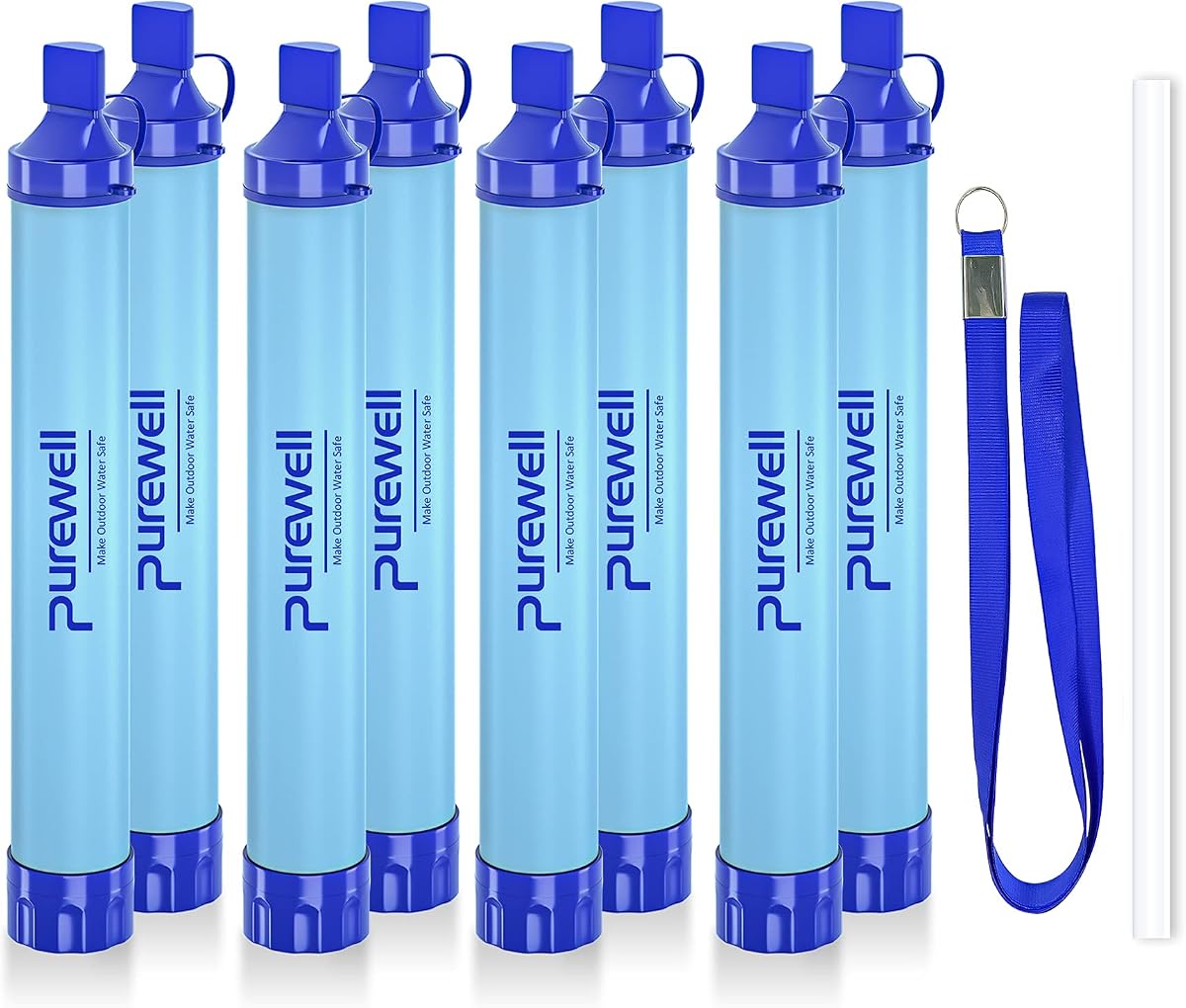
The Purewell eight-piece set is built for camping groups, families, and emergency kits that need multiple individual filters. It has a 4.6 rating and is described as SGS and TÜV certified, with test report ASH15-005515-01. Its stated 0.01-micron pore size is among the finest figures listed in this comparison.
We may earn a commission when you buy through this link, at no additional cost to you.
A five-stage system combines hollow fiber ultrafiltration, coconut shell activated carbon, mesh plugs, and double-layer medical-grade PP cotton fibers. The product information states that it filters up to 99.9999% of environmentally unfriendly water, odors, residual chlorine, organic matter, and other microscopic substances. It maintains a stated flow rate of 550 milliliters per minute and supplies 1,500 liters, or 396 gallons, per filter.
Its largest drawback is physical bulk. Eight filters and their associated components will not be as discreet or light as a single compact straw, and a group kit may require more storage than one personal filter. The filter also does not reduce total dissolved solids, so it should not be confused with a purifier designed to remove dissolved salts.
The Purewell set is a good choice when the number of users matters more than minimizing a kit. The 8.7-inch hose allows drinking without lying on the ground, the filters fit standard 28mm threaded bottles, and the stated weight is under 3.5 ounces. Large families and organized preparedness groups will get the most value from the configuration.
The stated 0.01-micron hollow fiber membrane is paired with a flow rate of 550 milliliters per minute. While pore size alone should not replace an understanding of the complete filter design, the specification indicates that this model is intended for high-precision personal filtration.
Eight filters let every member of a group carry an individual option. The filters can also be separated between several bags, vehicles, and rooms in a home emergency kit, providing redundancy at a scale smaller than a conventional group filtration system.
We may earn a commission when you buy through this link, at no additional cost to you.
The LifeStraw Peak Series is designed specifically as a personal backup filter for emergency, survival, camping, and ultralight hydration. It has a 4.7 rating and emphasizes a fast stated flow rate of 2.5 liters per minute, making it appealing when quick access to filtered water matters more than carrying multiple units.
We may earn a commission when you buy through this link, at no additional cost to you.
Its re-engineered membrane is intended to resist clogging from sand and silt, while durable, leak-proof materials are designed for drops, pressure, and rugged outdoor conditions. The filter is reported to remove 99.999999% of bacteria, 99.999% of parasites, and 99.999% of microplastics, with a membrane capacity of up to 1,000 gallons or 4,000 liters.
A removable threaded bottom cap increases setup flexibility by allowing attachment to water bottles and standard gravity hoses. The drawback is that the Peak remains a single personal filter, so households expecting to filter simultaneously still need multiple units. It also does not present the multi-stage construction or named third-party certifications emphasized by some competitors.
The Peak is a strong pick for hikers, travelers, and emergency planners who want a compact backup that can move water quickly. It is particularly suitable for placing in a vehicle or go-bag where rapid deployment is valuable, while the basic LifeStraw Personal offers a similarly compact alternative with a different filtration profile.
The 2.5-liter-per-minute flow rate gives the Peak a practical advantage when several drinks are needed in succession. A faster flow can reduce the time spent repeatedly squeezing or sipping through a restrictive straw, although real performance depends on the source and the filter's condition.
The membrane's stated resistance to sand and silt clogging is relevant when water contains visible sediment. Users should still follow the manufacturer's guidance, protect the intake where instructed, and maintain the filter properly to preserve flow.
We may earn a commission when you buy through this link, at no additional cost to you.
The Lightweight Reusable Survival Filtration two-pack is a compact option for campers, hikers, travelers, bikers, and family outings. It has a 4.3 rating, the lowest among the ten products, but its listed specifications include a five-stage design, a substantial 5,700-liter capacity, and support for both direct drinking and connection to compatible containers.
We may earn a commission when you buy through this link, at no additional cost to you.
The stages include a prefilter, activated carbon layer, and fine fiber membrane. The product is intended to reduce sand, sediment, visible particles, and unwanted taste or odor while improving water clarity. Its slim body is designed for backpacks, camping bags, travel kits, car storage, and other outdoor gear bags without taking up substantial space.
Compared with the leading choices, this product supplies fewer precise contaminant percentages and no named certification standard in the provided information. That makes its performance harder to evaluate against certified or laboratory-referenced models. The rating also suggests less uniformly positive customer feedback, although that alone does not identify a specific weakness in the design.
This set is best for buyers who want two compact filters and a high stated capacity without the physical size of a larger multipack. It is useful for car kits, backpacks, and family outings where redundancy matters. Buyers who need stronger documentary support for filtration performance should give particular attention to the certified S1 and S2 options.
The stated 5,700-liter capacity is one of the larger figures in the guide, yet the product remains a compact two-straw kit. That combination is attractive for repeated outings, provided users follow the stated cleaning and maintenance requirements.
The straws can be used directly from a water source or connected to compatible bottles, cups, and hydration systems. This flexibility makes the kit easier to adapt to different camps, trail conditions, and group routines.
We may earn a commission when you buy through this link, at no additional cost to you.
The Membrane Solutions S2 is the most maintenance-oriented model in this guide, with both ends designed to disassemble and an internal filter element that can be replaced. It has a 4.7 rating and appears in a four-pack, combining a personal straw format with a practical serviceable design for long-term users.
We may earn a commission when you buy through this link, at no additional cost to you.
The filter is certified to NSF/ANSI 42, 372, and 401 standards and uses a 0.1-micron hollow fiber ultrafiltration membrane, coconut shell GAC filter, and double PP fiber filter. The stated flow rate is 500 milliliters per minute, while the product information gives a long lifespan of at least 20,000 liters. Its detachable mouthpiece also connects with a common bottle for backflushing without requiring a separate syringe.
The S2 can be used directly, connected to a soft water pouch, or attached to a disposable bottle. An extension silicone pipe can add drinking distance, although tubing is not included. The primary trade-off is the larger four-filter configuration and the added complexity of a serviceable system compared with a basic disposable-style personal straw.
The S2 is the top premium choice for travelers, dedicated hikers, and households that expect regular use. Its replaceable element makes it attractive for owners who want to maintain one outer shell instead of discarding the complete straw, while the four-pack provides good distribution across bags and emergency locations.
Both ends of the S2 can be disassembled, allowing the filter element to be replaced while retaining more of the outer hardware. For frequent users, that serviceable approach can be more practical than treating an entire personal straw as a single sealed unit.
The detachable mouthpiece can connect to a common bottle for backwashing, removing the need to carry a dedicated syringe. Cleaner filter elements can help preserve useful flow and support the product's long stated service life when maintenance is performed correctly.
We may earn a commission when you buy through this link, at no additional cost to you.
This four-pack of 0.01-micron personal filter straws is designed for distributed emergency kits, camping trips, and travel. It has a 4.5 rating and provides four units, each with a 1,500-liter, or 396-gallon, filtration capacity. The package weighs 5.64 ounces, allowing the filters to be divided among several emergency locations.
We may earn a commission when you buy through this link, at no additional cost to you.
The supplied information states that the filter reduces 99.99% of harmful particles up to 0.01 microns. It uses a 550 milliliters-per-minute flow rate and a seven-inch extension tube that allows drinking from a source without lying on the ground. The straws also attach to hydration pouches and standard water bottles, giving them useful flexibility beyond direct use.
The pack's main limitation is that the listing provides no named laboratory or standards certification in the information supplied. That does not negate the stated performance, but it offers buyers less documentary context than products that identify specific certification reports. Its rating is also below several higher-ranked competitors, indicating a less emphatic customer consensus.
This four-pack is a good fit for households that want to place filters in multiple cars, bags, or rooms, as well as for families dividing one unit per traveler. The stated five-year shelf life supports long-term storage, while the compact flow and extension tube make it convenient for everyday outdoor use.
Four filters can be assigned to different vehicles, pack locations, and household emergency containers. Keeping several units in separate places reduces dependence on retrieving one kit from a single location during a time-sensitive disruption.
The seven-inch extension tube allows a user to drink from a stream, pond, or other source without lowering the body to ground level. It also keeps the main filter assembly away from mud and debris around the water's edge.
We may earn a commission when you buy through this link, at no additional cost to you.
The Portable Water Filter Straw two-pack is a lightweight family option for camping, hiking, travel, and disaster preparation. It has a 4.6 rating, and each 2.5-ounce straw is stated to filter up to 396 gallons, producing a combined capacity of 792 gallons. The filters measure 8.27 inches and are designed for direct drinking or use with common containers.
We may earn a commission when you buy through this link, at no additional cost to you.
Each straw uses a five-stage system consisting of a coarse screen, dual PP cotton, activated carbon, and a 0.1-micron hollow fiber membrane. Its stated flow rate is 16.9 fluid ounces per minute, or 500 milliliters per minute. Both end caps are removable for backwash cleaning, and the product includes a stated five-year shelf life for long-term storage.
As with several other options in the guide, the supplied information does not identify a named certification standard, so buyers wanting independently documented standards may prefer another model. The two-pack also has less total filtration capacity than many larger bundles, which matters for families planning to rely on it during extended disruptions rather than occasional outdoor trips.
This product is a good choice for a couple or small family that wants a backup without carrying a large multipack. Its low stated weight and broad container compatibility make it easy to add to a vehicle, hiking bag, or travel kit, while the removable caps support ongoing maintenance.
At 2.5 ounces per straw, the filters add little weight to backpacks, luggage, or vehicle kits. Carrying two also gives a small family or travel pair direct access to separate filters without moving to a large eight-piece bundle.
Removable end caps make backwash cleaning possible, which is especially relevant for a reusable product used around sediment and outdoor debris. Consistent cleaning can help maintain the product's intended flow and protect its stated 5,000-liter lifespan per filter.
We may earn a commission when you buy through this link, at no additional cost to you.
The right emergency water filter straw depends on the environments you expect to visit, the number of people who need water, and the level of documentation you want. The most important factors are filtration scope, usable capacity, flow, portability, maintenance, and container compatibility.
Start by identifying the contaminants you expect to encounter and comparing the product's stated removal claims. Bacteria and parasites are central concerns for untreated freshwater, while turbidity, sediment, microplastics, chlorine, odor, and taste may influence usability in other environments. The S1 and S2 are especially easy to compare because they name NSF/ANSI 42, 372, and 401 standards and provide test-report references, while the LifeStraw models list detailed percentages for bacteria, parasites, microplastics, and turbidity.
A smaller pore size should not be treated as the only measure of quality. Membrane design, prefiltration, activated carbon, certification, intended use, and proper maintenance all affect real-world performance. Compare the complete specification and follow the manufacturer's instructions for the water sources you expect to use.
Capacity indicates how much water the product is designed to filter before the element reaches its stated service limit. Individual filters range widely in the supplied data, from 1,500 liters to 5,700 liters, with the S2 reaching at least 20,000 liters. A larger capacity is useful for regular campers, long trips, or households that do not want to carry several replacement elements.
Choose a capacity that matches realistic use. Occasional hikers may be well served by a filter with several thousand liters, while frequent travelers may prefer a larger stated lifetime or a serviceable design. Treat all capacity figures as manufacturer claims and note that proper cleaning and storage can affect how long a filter remains effective.
A filter that is technically effective but painfully slow can be frustrating during exertion or dehydration. The LifeStraw Peak leads the listed flow figures at 2.5 liters per minute, while several alternatives state 500 or 550 milliliters per minute. These numbers provide a useful comparison, but the actual drinking experience will also depend on how clean the source is and how well the filter has been maintained.
For hiking, running, and hot weather, look for a balance between filtration performance and steady flow. For household or campsite use, where users can sit while drinking, a moderate rate may be less important. Always test the included or compatible connection before relying on a filter in an emergency.
Emergency preparedness requires balance because a filter that is too bulky may remain at home, while an overly compact device may be harder to operate. Personal models commonly measure around seven to nine inches and weigh between two and 3.5 ounces. Multpacks become less compact as a whole, but distributing filters among family members, vehicles, and separate bags can make them more practical.
Consider where the filter will actually live. A pocketable straw may suit day hiking, while a larger group pack may be more appropriate for camping. Check dimensions, included accessories, and compatible containers before deciding that a multipack fits the intended kit.
Reusable emergency filters need a realistic maintenance plan, especially after passing through sediment-heavy water. The S1, S2, Practical Survival set, and Portable Water Filter two-pack all mention removable ends or backflushing arrangements. The S2 goes further with a detachable filter element and a mouthpiece that connects to a common bottle for backwashing.
Prefer a design you can confidently clean with the tools already available in your kit. A backflushing plunger or bottle connection is convenient, but users should follow the specified cleaning method and allow the filter to dry as directed. Maintenance also matters because accumulated sediment can slow the flow and shorten useful filter life.
Independent certification gives buyers a clearer way to compare filtration and material claims. The Membrane Solutions S1 and S2 are stated to meet NSF/ANSI 42, 372, and 401 standards, and the Purewell product is described as SGS and TÜV certified with a named test report. The LifeStraw Personal states that its claims were verified in laboratories using protocols associated with the US EPA, NSF, and ASTM.
Certification is not a substitute for reading the complete specifications or using the product as directed. Look for the exact standard, contaminant category, and scope rather than treating a certification logo as proof that every imaginable contaminant has been removed. Select a certified model when documentary evidence is especially important to you.
One straw is appropriate for one person at a time, but a multipack prevents waiting and sharing. Two-filter sets are sensible for couples, while four- and five-packs suit families, teams, and distributed emergency preparations. The eight-piece Purewell set provides the broadest individual distribution in this guide, although it also occupies the most storage space.
Do not confuse the number of straws with a high-volume household system. A collection of personal straws can provide convenient access for multiple users, but each person still needs to sip through a filter. For sustained household use, compare these products with larger gravity, pump, or batch filtration systems that are designed to serve several people simultaneously.
Check whether the straw is intended for direct use, a threaded bottle, a soft pouch, a cup, or a gravity setup. The LifeStraw Personal and Peak can both be used with bottles, and the S1 fits a 28mm threaded container. The S2 supports several modes and can be extended with a silicone pipe, although tubing is not included.
Compatibility determines how comfortably the filter will be used in the field. A secure attachment can make drinking from a bottle or pouch easier and keep the filter body cleaner. Verify thread size and included accessories before departure, and carry a compatible container in the emergency kit if the selected straw depends on one.
Begin by reading the instructions supplied with the selected filter and inspecting the intake, outlet, threads, and end caps. Confirm that the housing is clean, the parts are assembled correctly, and any required protective shipping cap has been removed. Test the setup with clear, known water before relying on it outdoors, and make sure the intended bottle, pouch, or cup fits securely.
When filtering outdoors, choose an appropriate freshwater source and avoid contaminated water. Position the intake where it is less likely to pick up sediment, leaves, or debris, then sip through the straw or use the stated gravity, bottle, or pouch connection. Do not force unusually high flow, and pause if resistance becomes excessive. The extension tubes offered by certain models can help keep the intake away from the ground.
After use, follow the model's specific backflushing or cleaning procedure. Filters with removable caps may need to be disconnected and cleaned with the supplied plunger, syringe, or bottle connection. Let the filter dry as directed, store it in a clean protective location away from heat and direct sunlight, and inspect it regularly. Periodic testing and maintenance are especially important for filters stored for months or years in emergency kits.
An emergency water filter straw is designed to remove specific waterborne contaminants, but performance varies by model. The products in this guide list filtration of bacteria, parasites, microplastics, sediment, turbidity, chlorine, odor, or other particles to different degrees. Check the exact pore size, removal claims, and certification before use, and do not assume that any model removes dissolved salts, chemicals, or every type of pathogen.
No emergency water filter straw should automatically be considered appropriate for every source. Chemical contamination, fuel, wastewater, and other hazards require different treatment, and some listed products are not designed to reduce total dissolved solids. Use only sources allowed by the manufacturer, avoid visibly polluted water, and use an appropriate purification method when the water may contain substances outside the filter's stated scope.
Stated filtration capacity varies substantially across the guide, from 1,500 liters for some individual filters to at least 20,000 liters for the S2. The actual useful life depends on water quality, flow, cleaning, storage, and how the filter is used. Replace or service the element according to the manufacturer's guidance rather than relying only on the original capacity figure.
One filter can serve one person at a time, but a multipack is more convenient for families and groups. The five-pack and eight-piece options distribute individual filters among travelers, while two- and four-packs cover couples, small families, or multiple emergency locations. For longer household use, a larger group filtration system may be more efficient than many personal straws.
That depends on the bottle and the filter. Several products in this guide fit 28mm threaded bottles, attach to soft pouches, or work with standard disposable bottles, while others are designed primarily for direct use. Verify the connection type and dimensions before relying on a straw with a particular container, and make sure the attachment remains secure while drinking.
Backflush when the flow slows, after filtering visibly dirty water, and according to the manufacturer's maintenance schedule. The Practical Survival set includes plungers, the S1 has a threaded inlet cap for backflushing, and the S2 connects to a common bottle for backwashing. Proper maintenance helps restore flow and protect the filter element, but users should not improvise methods that could damage the membrane.
No. Pore size is one part of the specification, but prefiltration, membrane quality, activated carbon, flow, maintenance, and intended use also matter. Certification and verified contaminant-specific claims provide useful context that pore size alone cannot. A well-supported design with balanced flow may be a more practical choice than a specification-heavy model that is difficult to maintain.
Store the filter clean, dry, and protected from impact, heat, direct sunlight, and contamination. Keep end caps and accessories together in the same emergency container so the unit is ready for deployment. If the filter has a stated shelf life, check that information regularly and inspect seals or membranes for damage before an outing or an extended storage period.
The LifeStraw Personal is the strongest all-around starting point, combining a 4.8 rating, broad bacteria and parasite filtration claims, microplastic reduction, and a 4,000-liter capacity in a simple personal format. The certified Membrane Solutions S1 is the most specification-conscious choice for buyers who prioritize named standards, and the S2 stands out for its detachable element, bottle-assisted backflushing, and long stated service life.
The right choice ultimately depends on how and where the filter will be used. A solo traveler may prefer the LifeStraw Personal or Peak, a couple can select one of the two-packs, and a family or group should consider the four-, five-, or eight-piece sets. Confirm contaminant coverage, capacity, connection compatibility, cleaning requirements, and source suitability before committing.
Product details and availability can change, so verify the current listing and manufacturer instructions when purchasing. Keeping the chosen filter clean, dry, and stored with its accessories gives it the best chance of being ready when needed. Buying early also allows time to test the connection and become familiar with the drinking and backflushing process before an emergency.