
HEAVY DUTY IN-LINE COMPRESSED AIR PRESSURE REGULATOR FOR AIR COMPRESSOR
4.5Editor score
140 SCFM flow capacity
3/4-inch female NPT
7-215 PSI range
Bracket and gauge included
An air pressure regulator keeps compressed-air systems running at a stable, practical pressure, protecting tools and equipment from excessive force while improving control. A good model matches airflow, connection size, pressure range, and mounting needs without overlooking gauge visibility, adjustment security, or long-term durability.
We compared ten regulators using the specifications and product information supplied, focusing on practical differences rather than treating every model as suitable for every system. The list covers compact 1/4-inch units, higher-flow 1/2- and 3/4-inch models, wall-mountable designs, and options built for demanding pneumatic applications.
Each review explains the standout features, limitations, and best users for a particular regulator, while the comparison table makes connection sizes and operating limits easy to scan. Ratings and availability can change, and current prices should always be checked before ordering or planning a complete installation.
4.5Editor score

4.5Editor score

4.5Editor score
As an Amazon Associate we earn from qualifying purchases.
The table below compares all ten regulators by their most consequential specifications, including port size, pressure capability, flow rating, and included components. These differences help reveal which model fits a compact tool line and which is better suited to a workshop or production environment.


The SNS AR2000-N02 is a compact inline regulator for users who want dependable pressure control without a large installation. Its 4.2 rating reflects a practical balance of useful included components and straightforward operation. The most appealing elements are its 1/4-inch NPT connection, 0-150 PSI adjustment, and the supplied bracket and gauge.
We may earn a commission when you buy through this link, at no additional cost to you.
This model is built around an aluminum alloy body and a rated flow of 19.4 SCFM, or 550 liters per minute. It should therefore be considered carefully when several pneumatic tools operate at once. The pull-up rotary knob is intuitive: turning clockwise raises the setting, while turning counterclockwise lowers it.
The specified operating range of 41-140°F is useful for ordinary workshop conditions, though it is narrower than the wider temperature capabilities associated with some industrial installations. The 1/4-inch port also means adapters may be needed if the surrounding hose or manifold uses another thread size.
The SNS regulator is a sensible choice for airbrush work, maintenance tools, small pneumatic devices, and single-tool lines where moderate flow is sufficient. Buyers needing greater capacity should favor a 1/2- or 3/4-inch model. For a compact installation with a gauge and mounting support already supplied, it remains a convenient option.
Its compact construction makes it easier to integrate into an existing air line without taking up excessive space, while the included hardware simplifies installation. The rotating control is also easier to adjust quickly than a very stiff or deeply recessed mechanism.
The 1/4-inch NPT connection and 19.4 SCFM rating align well with small lines, individual tools, and applications that do not demand the full output of a large compressor.
Pulling up the rotary knob releases the adjustment, and rotating in either direction changes the setting intuitively. This design is useful for making quick corrections between different pneumatic tasks.
We may earn a commission when you buy through this link, at no additional cost to you.
The Heavy Duty Inline Compressed Air Pressure Regulator is the strongest option here for a workshop that needs generous airflow. It carries a 4.5 rating and pairs a 3/4-inch female NPT body with a 140 SCFM flow rate. Those figures make it better aligned with multiple pneumatic users than compact 1/4-inch regulators.
We may earn a commission when you buy through this link, at no additional cost to you.
Its output can be adjusted from 7 to 215 PSI, while the maximum input pressure is 250 PSI. The high-impact locking composite knob helps retain the selected setting, an important benefit in workshops where vibration, bumps, or frequent line servicing could otherwise alter the adjustment.
A wall-mounting bracket and gauge are included, reducing the need to source basic installation accessories separately. The trade-off is size: a 3/4-inch inline regulator and its fittings need more physical space than a 1/4-inch unit, and existing lines may require fitting changes.
This is a strong recommendation for fabricators, automotive shops, maintenance teams, and production environments that operate multiple air tools or equipment from a shared supply. Choose it when flow and adjustment range matter more than compact size. For a small benchtop setup, a smaller model would be more proportionate.
Its broad adjustment range also allows the same regulator to serve pneumatic tools, cylinders, and other equipment with different pressure needs. That flexibility, combined with the locking control, makes it a practical workshop centerpiece rather than merely a single-purpose line component.
A 140 SCFM rating provides considerably more capacity than the compact regulators in this list, making the model better suited to simultaneous pneumatic demand and larger workshop distribution lines.
The locking composite knob helps preserve the selected output pressure. This is particularly useful around industrial machinery and frequently serviced pneumatic systems where an accidental adjustment could interrupt work.
We may earn a commission when you buy through this link, at no additional cost to you.
The PneumaticPlus SAR200-N02BG is the most complete all-around package in this guide. It has a 4.5 rating, a 1/4-inch NPT inline body, and a fully adjustable 0-150 PSI range. Its relieving design, locking knob, included gauge, and included bracket make it especially well suited to professional air lines.
We may earn a commission when you buy through this link, at no additional cost to you.
The key operational advantage is the relieving mechanism. When downstream pressure rises above the setpoint, excess air is automatically vented, helping protect connected tools and sensitive pneumatic equipment. A push-to-lock adjustment knob holds the setting against vibration and accidental changes on a busy shop floor.
At 39 SCFM at 90 PSI, the regulator offers more flow than the other 1/4-inch models represented here. It is still not intended to replace a large 1/2- or 3/4-inch regulator for a heavily loaded system, but its capacity is well suited to general-purpose shop and production lines. The maximum supply pressure is 250 PSI.
The gauge and panel or wall bracket arrive with the unit, and the product is backed by a one-year limited manufacturer warranty. It is also described as precision manufactured in Korea to ISO 6953 compressed-air regulator standards, adding useful context for buyers who value documented production standards.
This is the recommendation for users who want professional features in a manageable 1/4-inch format. It suits air tools, actuators, spray guns, pneumatic machinery, and general shop distribution. Those needing very low regulated pressure should note that the range begins at zero, while high-flow users should consider a larger-port option.
The relieving design vents excess air when downstream pressure exceeds the selected setting. That behavior adds an important layer of protection for pneumatic tools, actuators, and equipment requiring consistent pressure.
A 0-160 PSI gauge and mounting bracket are included, along with a one-year limited warranty. These additions reduce setup work and make the unit easier to specify for a professional installation.
We may earn a commission when you buy through this link, at no additional cost to you.
The Ingersoll Rand ARO R37121-600-VS combines a recognizable compressed-air brand with a useful 59 CFM flow rating. Its 4.3 rating reflects a solid option for users familiar with ARO equipment. The inline 1/4-inch NPT format and flush-mounted gauge make it appropriate for controlled workshop installations.
We may earn a commission when you buy through this link, at no additional cost to you.
The regulator is relieving and uses a standard knob control, allowing excess downstream pressure to be relieved when it rises above the set level. Its adjustment range extends from 0 to 140 PSI, which covers many pneumatic tools and general shop applications without the broader span offered by some 225- or 250-PSI-capable regulators.
The 59 CFM rating is one of the strongest figures among the 1/4-inch options in this guide. It gives the unit more headroom than compact models rated around 19 or 20 SCFM, making it more realistic for a line serving several moderate-demand devices.
This is a good choice for shops that already recognize or maintain ARO pneumatic components, as well as buyers who prefer a flush-mounted gauge and straightforward standard knob. The main limitation is that the 140 PSI ceiling leaves less margin than regulators designed around higher maximum input pressures.
For general compressed-air control, the ARO model balances recognized branding, respectable flow, and a useful pressure range. It is especially attractive where a 1/4-inch port is required but occasional simultaneous use of multiple pneumatic accessories is expected.
The ARO name and standard knob control may appeal to maintenance teams accustomed to familiar pneumatic components. This can make training, replacement, and workshop standardization more straightforward.
A 59 CFM rating gives this 1/4-inch regulator substantially more flow capability than smaller models. That makes it a better fit for a shared line serving several moderate-demand pneumatic accessories.
We may earn a commission when you buy through this link, at no additional cost to you.
The LE LEMATEC Paint Spray Gun Air Pressure Regulator is tailored to users who want immediate control at the tool. It holds a 4.4 rating and combines an integrated 0-150 PSI gauge with an inline 1/4 NPT connection. The result is a practical choice for automotive refinishing, airbrushing, and detailed pneumatic projects.
We may earn a commission when you buy through this link, at no additional cost to you.
The readable gauge lets operators monitor pressure while working, and the responsive adjustment knob supports quick changes between tasks. For painting, that level of local control can help create more consistent atomization, smoother coverage, and better control over overspray and material waste.
Its solid brass body and robust adjustment knob are suited to demanding workshop environments. The stated 1/4 NPT male and female threads allow connection to compatible air compressors, hoses, and spray guns, although users should verify the gender and thread arrangement of their existing fittings.
Unlike several models in this guide, the supplied information does not provide a formal flow rating or maximum inlet pressure. That makes the regulator less attractive for a heavily loaded production line, where verified capacity and pressure limits are essential to proper sizing.
For painting and precision work, the LE LEMATEC is focused and easy to understand. It is a strong match for a dedicated spray-gun line, an airbrush station, or a mobile finishing setup, provided the attached equipment operates within the connection and pressure capabilities of the unit.
Placing regulation near the spray gun makes pressure changes faster and more visible. The integrated gauge helps the operator maintain a consistent working level while coating a surface.
A solid brass body and robust knob suit repeated adjustment and regular workshop use. The compact inline format also minimizes interference around spray equipment and hoses.
We may earn a commission when you buy through this link, at no additional cost to you.
The Primefit CR1401G is a compelling replacement regulator for builders who prioritize useful capacity and essential controls. Its 4.5 rating is strong, and the 60 SCFM at 100 PSI specification gives it one of the highest flow ratings among the 1/4-inch models here.
We may earn a commission when you buy through this link, at no additional cost to you.
Downstream pressure can be regulated accurately from 1 to 150 PSI, and the maximum inlet pressure is 200 PSI. A high-impact composite knob provides the primary adjustment, while the steel-protected gauge offers visual monitoring in a workshop where impacts and vibration are possible.
One detail deserves attention before installation: the pictured configuration supports one directional air flow, right to left. It can also be configured for left-to-right flow, but the direction must be set correctly for proper operation. Paying close attention to the marked ports prevents a frustrating installation error.
The unit includes a one-year limited warranty, and its replacement-oriented design may appeal to users maintaining compatible pneumatic systems. It does not list a mounting bracket, so installations requiring wall support may need to source that hardware separately.
This is the budget recommendation for a 1/4-inch line that needs real flow capacity without moving to larger ports. It is particularly suitable for replacement work, moderate-tool lines, and pneumatic accessories that benefit from a wide adjustment range. Users should verify airflow direction before finalizing the installation.
The 60 SCFM at 100 PSI rating is particularly useful for users replacing an aging regulator without wanting to reduce line capacity. It provides meaningful headroom for several moderate pneumatic loads.
The pictured setup directs air from right to left, while an alternate configuration handles left-to-right flow. Correct orientation is essential, so inlet and outlet markings should be verified before the unit is pressurized.
We may earn a commission when you buy through this link, at no additional cost to you.
The Milton 1114-8 fills a useful middle ground between compact 1/4-inch regulators and large 1/2- or 3/4-inch models. It has a 4.3 rating, a 3/8-inch NPT connection, and a maximum flow of 80 SCFM at 100 PSI. That combination suits medium-duty workshop and pneumatic lines.
We may earn a commission when you buy through this link, at no additional cost to you.
Its operating temperature range is 40-120°F, and the product is made in the USA. These details make it potentially attractive for users who want a moderate-capacity industrial component and a clearly stated temperature envelope.
The supplied information does not describe a gauge, adjustment range, or maximum inlet pressure in detail. Buyers who need at-a-glance output monitoring may need to confirm whether a gauge is present or plan to add a suitable instrument at the correct port.
The 3/8-inch thread offers a compromise when 1/4-inch capacity is too limited but 1/2-inch plumbing is unnecessary. It can also ease transitions between differently sized components when the correct adapters and compatible fittings are available.
Choose the Milton for a medium-flow line where a 3/8-inch NPT interface fits the system design. It is a sensible option for controlled workshop equipment, but users should verify the full pressure specifications and monitoring needs before making a final selection.
The 80 SCFM maximum at 100 PSI creates useful capacity for medium-duty equipment. It is a notable step up from smaller 1/4-inch regulators without requiring the footprint of a 1/2-inch or 3/4-inch unit.
A 40-120°F operating range and Made in USA designation provide clear information for buyers comparing industrial pneumatic components. Confirm that local line conditions remain within those limits.
We may earn a commission when you buy through this link, at no additional cost to you.
The 3/4-Inch Air Pressure Regulator is a flexible choice for larger compressed-air lines. It carries a 4.4 rating, supports regulation from 7 to 225 PSI, and includes a wall-mounting bracket. Its 3/4-inch female NPT connections are intended for substantial workshop or installation plumbing.
We may earn a commission when you buy through this link, at no additional cost to you.
One particularly useful feature is the pair of gauge ports. A gauge can be installed on either side, while a plug closes the unused port. This flexibility makes it easier to position the instrument where it is visible, particularly when the main line enters and exits in an awkward orientation.
The pull-to-unlock and push-to-lock adjustment knob makes the setting easy to change and secure once selected. Directional markings identify the inlet, outlet, and required airflow, which is useful for preventing installation errors in a crowded workshop.
The supplied information does not state a flow rating. Although the 3/4-inch size suggests suitability for higher-capacity systems, buyers responsible for designing a complete installation should verify that the regulator meets the air demand of every connected device.
This model is best for users needing a wide pressure range, flexible gauge placement, and a generously sized main-line connection. It is particularly useful for compressors, service lines, and pneumatic equipment where a standard 3/4-inch header is already in place.
Two gauge ports allow the instrument to be placed on either side of the body. A plug for the unused port keeps the installation tidy while preserving flexibility for different line layouts.
Pulling the knob up unlocks it, and pressing it in locks the selected setting. This gives operators a clear indication of whether the regulator can be safely adjusted.
We may earn a commission when you buy through this link, at no additional cost to you.
The 1/2-Inch Air Pressure Regulator offers a balanced middle ground for workshops that need more capacity than a compact line but do not require a 3/4-inch header. Its 4.4 rating, 7-225 PSI range, and included 0-230 PSI gauge make it versatile for general pneumatic use.
We may earn a commission when you buy through this link, at no additional cost to you.
The body is constructed from aluminum with corrosion-resistant components, and the compact footprint is designed to fit common compressor setups. A steel wall-mount bracket is included, while the regulator can also be installed directly into a rigid air line.
Two 1/4-inch gauge ports permit installation on either side, with a plug supplied for the unused side. The main ports are 1/2-inch, and clear IN and OUT markings alongside flow arrows help establish proper orientation during installation.
The pull-to-unlock and push-to-lock knob offers a clear adjustment sequence, while operation is supported up to 140°F. As with other larger regulators in this roundup, the product information does not list a formal flow rating, so exact sizing for unusually high-demand systems requires additional confirmation.
This is a strong choice for a general workshop header, compressor distribution point, or shared pneumatic circuit. It is especially convenient when the installation already uses 1/2-inch plumbing and benefits from a visible gauge and flexible mounting options.
The 1/2-inch connection gives installers a practical bridge between small 1/4-inch regulators and large 3/4-inch models. It is well suited to common rigid workshop air layouts.
The included steel bracket supports a wall installation, while direct rigid-line installation provides another option. This flexibility makes it easier to adapt the regulator to an existing compressor area.
We may earn a commission when you buy through this link, at no additional cost to you.
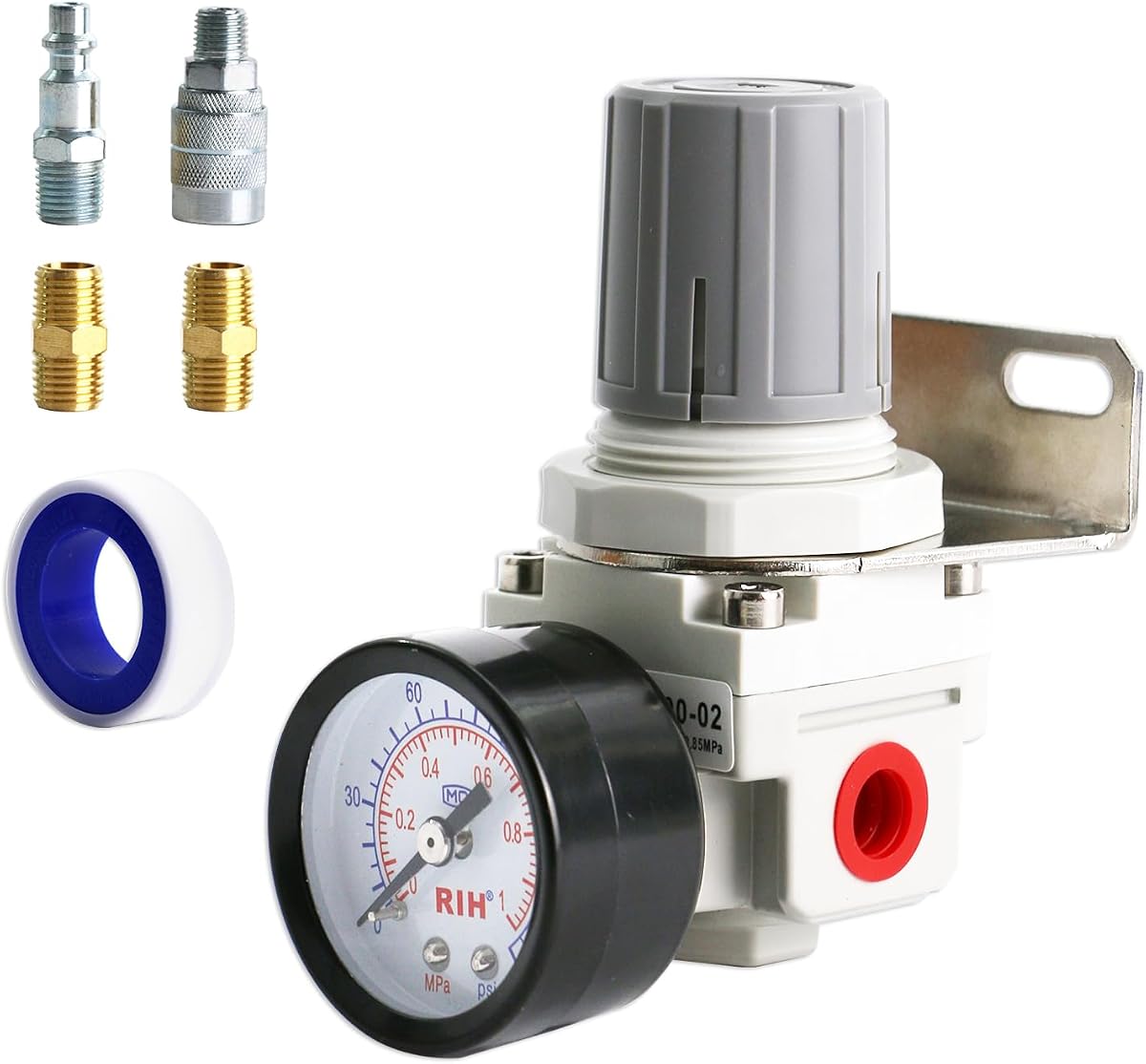
The RIH AR2000-02 combines the highest listed rating in the guide with one of the most complete basic installation packages. Its 4.7 rating is encouraging, and the supplied hardware includes a 0-150 PSI gauge, mounting bracket, air couplers, a plug kit, thread seal tape, and two 1/4-inch NPT fittings.
We may earn a commission when you buy through this link, at no additional cost to you.
That accessory bundle can save time for a new installation or a basic repair because common connection pieces are included. The regulator uses an aluminum body and has a 1/4-inch NPT connection. Pulling up the rotary knob releases the setting, and clockwise or counterclockwise rotation raises or lowers the pressure.
Flow is rated at 20 SCFM, or 550 liters per minute, at 90 PSI. This capacity suits light pneumatic tasks, individual accessories, and small air lines. It is not the appropriate choice for a heavily shared header serving multiple high-consumption tools.
The listed maximum pressure is 145 PSI, while the gauge displays 0-150 PSI. The working temperature range is 32-140°F. The manufacturer also advises applying additional PTFE tape if a joint leaks, providing a practical response to a common threaded-connection issue.
The RIH is a strong pick for basic work, especially when a complete set of installation accessories is desirable. It is also attractive for a straightforward replacement or a small dedicated tool line. Users should prioritize the included package, but also recognize that 20 SCFM limits its role in larger systems.
The included fittings, couplers, plug kit, bracket, gauge, and seal tape create a convenient installation package. This is especially helpful when several small pieces would otherwise need to be sourced separately.
The pull-up rotary control makes the adjustment state apparent, and the included seal tape supports a cleaner threaded connection. The instructions also address what to do if additional sealing is needed.
We may earn a commission when you buy through this link, at no additional cost to you.
Choosing an air pressure regulator starts with the air system's physical dimensions and operating demand. Thread size, flow capacity, pressure limits, adjustment behavior, and monitoring needs should be evaluated together rather than independently.
The port size determines whether the regulator can connect to the compressor, manifold, hose, or tool without extensive modification. A 1/4-inch NPT regulator is common for individual pneumatic tools and small lines, while 1/2-inch and 3/4-inch connections are more appropriate for workshop headers and higher-capacity systems. A larger port is not automatically a better regulator, because it may require larger fittings and take up more installation space. The correct choice begins with measuring the existing threaded connection and confirming whether it is male or female. Buyers should also verify that any adapter does not unnecessarily restrict airflow.
Flow capacity indicates how much compressed air the regulator can supply while maintaining its set pressure. Models in this guide range from roughly 19-20 SCFM for compact units to 140 SCFM for the heavy-duty 3/4-inch model. A regulator that is too small may cause pressure drop, slow actuator movement, weak tool performance, or an inability to support simultaneous demand. Conversely, extra capacity is unnecessary for a single low-consumption accessory. Compare listed flow figures, note the reference pressure where one is given, and consider both connected equipment and realistic concurrent use.
The adjustment range determines the working pressures the regulator can deliver, while maximum inlet and outlet ratings establish the boundaries of safe use. A model adjustable from 7 to 225 PSI is useful for varied workshop equipment, whereas a 0-150 PSI unit covers many common pneumatic tools and spray applications. Input capability must also exceed the compressor's operating pressure, and the chosen regulator should never be exposed above its stated limit. The gauge range should cover the intended working pressure with useful visibility, and operators need to understand whether the model can maintain a very low downstream setting.
A secure adjustment mechanism helps a selected pressure remain unchanged after setup. Some models use a pull-to-unlock and push-to-lock knob, while the RIH and SNS regulators use pull-up rotary controls. In either case, the lock reduces the chance of accidental changes caused by vibration, hose movement, or contact during maintenance. A locking mechanism is particularly valuable in production environments, around mobile equipment, and in locations where a pressure change could damage a workpiece or disrupt a pneumatic process. Buyers should also ensure the knob is easy to grip and that small adjustments remain possible.
A gauge makes pressure changes visible and allows operators to confirm that the regulator is performing as expected. Some products include a gauge, some provide flexible ports for installing one on either side, and the supplied information does not list gauge details for every model. If the product lacks a gauge, verify which thread and port should be used for installation. Dual gauge ports can be especially useful when visibility is poor or the regulator is installed close to a wall. The gauge range should be appropriate for the line, and the gauge should be positioned where it can be read safely during operation.
A relieving regulator can vent excess downstream air when pressure rises above the selected setpoint. This behavior helps stabilize a branch that feeds air tools, spray guns, actuators, or sensitive pneumatic equipment. The PneumaticPlus, Ingersoll Rand ARO, and Primefit descriptions specifically identify relieving operation, while other products focus more heavily on adjustment and installation. Relieving performance is valuable when downstream devices consume air unevenly or when maintaining a stable pressure ceiling is important. It may also create a recurring audible or exhaust-air presence that should be expected in the installation.
Mounting support can make a regulator easier to service and less likely to shift. The SNS, PneumaticPlus, heavy-duty 3/4-inch, 1/2-inch, and RIH products include brackets according to their supplied information, while other units may not. A wall or panel bracket is useful on a compressor wall or near a distribution header, whereas a rigid air-line installation may be preferable in a fixed manifold. The product's footprint also matters in crowded workshops. Buyers should leave clearance for the knob, gauge, fittings, and service access without creating a trip hazard or placing the regulator where hose movement can disturb it.
Directional regulators must be installed with the inlet and outlet oriented correctly. The Primefit unit, for example, supports right-to-left flow in its pictured configuration and can be arranged for left-to-right flow, but it must be configured properly. Clear IN and OUT markings or flow arrows reduce installation errors in larger systems. Threaded connections also require clean, properly prepared threads and suitable sealant. The RIH package includes thread seal tape, while the SNS and PneumaticPlus products emphasize straightforward 1/4-inch NPT connections. Before pressurizing the system, verify thread engagement and remove any installation debris.
Begin by identifying the inlet and outlet and confirming the regulator's flow direction against the direction of air through the system. Check that the compressor pressure will remain within the regulator's input rating, then attach compatible fittings without forcing mismatched threads. Apply suitable thread sealant where required, keep the adjustment knob at its lowest practical setting during installation, and confirm that all connections are secure before opening the air supply.
Connect the appropriate tool or pneumatic device, then operate it while watching the gauge. Adjust the setting in small increments, allowing the regulator to stabilize between changes. Lock the knob when the desired pressure is reached. Learn the pressure requirements of each tool and use separate regulated branches when different equipment needs substantially different settings, because a shared line may require compromises in flow or consistency.
Periodically inspect the gauge, knob, fittings, and mounting hardware. Check connections for leakage and remove moisture from the air line according to the compressor's drainage procedures. Do not exceed the stated maximum pressure, and avoid modifying the regulator body. If the adjustment becomes erratic, the gauge behaves incorrectly, or the unit has been damaged, depressurize the system and arrange inspection or replacement before returning it to service.
The correct size depends on the existing thread size and the regulator's rated flow. A 1/4-inch NPT model generally suits individual tools and small branches, while 1/2-inch and 3/4-inch models are better for shared workshop headers. Confirm both the connection thread and the combined SCFM demand before buying. Adapters can help with connections, but they should not be used to disguise inadequate flow capacity.
SCFM means standard cubic feet per minute, a way of describing air flow at standardized reference conditions. A regulator's SCFM rating indicates the approximate volume it can supply while maintaining its set pressure. The figure should be compared with the air consumption of connected equipment, especially if several tools or cylinders can operate simultaneously. Higher flow ratings are useful on shared lines but may require larger ports and more installation space.
No. Several regulators in this guide include a gauge, while others provide gauge ports or leave monitoring details unspecified. Check the package contents and product description before installation. If a gauge is not included, confirm the correct port size and whether an additional instrument is needed for safe operation and convenient pressure monitoring.
A relieving regulator can exhaust excess air when downstream pressure rises above the setpoint. A non-relieving unit generally does not vent that excess air. Relieving control is useful for feeding tools, actuators, and sensitive equipment that benefit from a stable pressure ceiling. The application, downstream behavior, and expected exhaust-air noise should all be considered when selecting the type.
Pull the adjustment knob up or outward to release it, then turn it toward the higher-pressure or lower-pressure direction indicated for that model. After the gauge reaches the desired setting, push the knob inward to lock it. The SNS and RIH models use pull-up rotary controls, while the 1/2-inch and 3/4-inch models use pull-to-unlock and push-to-lock knobs. Always follow the instructions specific to the installed regulator.
Adapters can make a 1/4-inch regulator connect to a 1/2-inch or 3/4-inch line, but they add fittings and may create restrictions or leak points. They are most appropriate for occasional connections, not a high-flow permanent header. For a heavily used system, matching the regulator port to the line is usually cleaner and more reliable. Confirm thread gender, sealing method, and airflow capacity whenever an adapter is used.
Pressure drift can result from a leak, an unsecured adjustment knob, excessive downstream demand, a restricted line, or a regulator that is outside its proper operating range. Check for audible leakage and verify that the locking mechanism is engaged. Also consider whether the regulator's SCFM rating can support all connected devices. A damaged gauge or a regulator that has exceeded its pressure limit may also require replacement.
Inspection frequency should reflect how critical the line is and how often the equipment is used. At a minimum, check connections, mounting security, and gauge readings during routine equipment maintenance. Critical production systems benefit from more frequent checks for leakage, unstable pressure, and knob movement. Always depressurize the system before servicing connections, and consult the manufacturer's instructions for model-specific care requirements.
The PneumaticPlus SAR200-N02BG is the strongest overall choice because it combines a 1/4-inch connection, relieving operation, a locking knob, useful flow capacity, and included monitoring and mounting hardware. The heavy-duty 3/4-inch model is preferable for shared high-flow workshop lines, while the Primefit CR1401G stands out as a capable budget replacement with a 60 SCFM rating.
The right decision still depends on your system rather than the badge. Match the port size, confirm that maximum input pressure is adequate, and choose flow capacity for realistic concurrent demand. Gauge placement, lock security, temperature limits, and directional markings can then determine which model integrates most cleanly into the intended installation.
Ratings, product availability, and prices can change over time, so check the current listing and included components before ordering. Confirm the final thread size, pressure requirements, and accessories against the compressor and connected equipment. Taking those extra steps helps avoid an incompatible purchase and supports a safer, more stable compressed-air system.