
Iron Forge 10-Foot 16-Gauge Cord
4.6Editor score
Compact ten foot length
Flexible at negative fifty-eight Fahrenheit
UL certified electrical rating
Lighted female connection
Cold weather extension cords compared for temperature ratings, length, gauge, durability, outlet design, and outdoor performance in this practical buying guide.
A cold weather extension cord must remain flexible, dependable, and safe when temperatures fall and moisture becomes common. The right model should combine a verified low-temperature rating with suitable wire gauge, adequate length, grounded connections, and a rugged outdoor jacket for garages, job sites, snowy yards, and holiday-light setups.
This guide compares ten extension cords created for demanding outdoor conditions. We evaluated the documented temperature ranges, amperage, wire gauge, length, outlet configuration, lighting features, resistance to water, oil, abrasion, and flame, while paying close attention to practical details such as strain relief and cord flexibility.
Each review explains where a particular cord fits best, along with its limitations and ideal uses. The top selections range from a compact 10-foot option to 100-foot cords for maximum reach, and every recommendation is based on the supplied product information. Prices and availability can change, so confirm current details before buying.
4.6Editor score

4.8Editor score

4.8Editor score
The comparison below highlights the major differences among ten outdoor-ready cords, including operating temperature, wire gauge, length, outlet design, and safety-related features. It is intended to make it easier to match a cord to the load, distance, and working conditions you actually face.




The Clear Power Heavy Duty Outdoor Extension Cord is a strong all-around choice for winter work requiring substantial reach. It earns a 4.8 rating from buyers and combines a 100-foot length with a 16/3 SJTW cable, a three-prong grounded plug, and a flashing connector light. Its documented operating range extends from negative 50 degrees Celsius to positive 140 degrees Fahrenheit.
We may earn a commission when you buy through this link, at no additional cost to you.
The cord is designed specifically for extreme climates, where ordinary insulation may become stiff and difficult to handle. Its jacket is described as resistant to water, weather, abrasion, and flame, while nickel-coated brass plug blades are intended to resist corrosion and help prevent arcing. A flashing indicator at the connector gives users an immediate visual indication that the cable is energized.
Its main trade-off is electrical capacity. At 10 amps, 125 volts, and 1,250 watts, it is less suitable for high-demand tools or appliances than the 15-amp alternatives in this guide. It also has a single connector rather than a triple-tap, so several devices cannot share one distant power source. These limitations are understandable given the exceptional reach and 16-gauge construction.
Choose this model when you need to reach a garage, outdoor receptacle, generator, snowblower, or work area far from the power source and the connected equipment does not exceed its ten-amp rating. It is our top overall selection because it directly addresses the core needs of a cold weather extension cord: verified cold performance, rugged outdoor protection, grounding, and an extremely long working radius.
A 100-foot cable can eliminate improvised electrical arrangements and keep connections farther from wet ground. That added reach is particularly useful when powering outdoor equipment across a yard, driveway, or work site where no conveniently located outlet exists.
The illuminated connector makes it easier to confirm that power is reaching the far end, while the blue jacket stands out in snowy or cluttered surroundings. Nickel-coated brass blades add another layer of durability for outdoor connector use.
We may earn a commission when you buy through this link, at no additional cost to you.
The Iron Forge Cable 16 Gauge All Weather Extension Cord is a practical choice when convenience and compact storage matter as much as long-distance power. It carries a 4.6 rating and uses a 10-foot length that is easy to carry to a garage, workbench, snowblower, or outdoor lighting setup. Its documented temperature range runs from negative 58 degrees Fahrenheit to positive 194 degrees Fahrenheit.
We may earn a commission when you buy through this link, at no additional cost to you.
This model is built for demanding environments, with resistance to oil, water, and flames. A lighted socket shows when the cord is receiving power, while slip-resistant design and heavy-duty strain relief support dependable handling. It is UL certified and rated for 13 amps, 125 volts, and 1,625 watts, with reinforced blades designed to resist bending and breakage.
A 10-foot lead will not solve a large distance problem, and 16-gauge wire is intended for lighter loads than the 12- and 14-gauge options elsewhere in the list. Nevertheless, the cord fills a useful niche: it provides more reach and greater versatility than a standard indoor extension cable without becoming cumbersome to coil, carry, or store.
This is the best budget selection for users who need a short, cold-rated outdoor cord for moderate loads. It works well near a power source, around a workshop, or for seasonal decorations. Check the connected device's amperage and the manufacturer's instructions, and use the cord only within its documented electrical rating.
Ten feet is often enough to move a tool, light, or appliance a few steps beyond a wall outlet. The short profile also reduces the amount of cable that must be routed across walkways, which can be useful in active work areas.
The illuminated female socket offers a quick visual check that current is reaching the end. That convenience can help prevent repeated unplugging or troubleshooting during low-light and winter conditions.
We may earn a commission when you buy through this link, at no additional cost to you.
The US Wire and Cable 12/3 Gauge Extreme Cold Weather Extension Cord stands out for its unusually broad documented temperature range. It has a 4.5 rating and is specified from negative 94 degrees Fahrenheit to positive 221 degrees Fahrenheit. The 25-foot length provides useful reach for home, workshop, and jobsite equipment.
We may earn a commission when you buy through this link, at no additional cost to you.
Its 12-gauge construction is a meaningful advantage when working with demanding tools, appliances, and other high-current equipment. The SJEOOW cable is described as weather resistant, abrasion resistant, and flexible, with a lighted plug and a blue-and-red high-visibility design. The product information also emphasizes resistance to moisture and kinking.
The product listing does not provide a precise amperage, wattage, outlet configuration, or certification detail in the supplied information. That makes it less straightforward to assess from this data alone, particularly when a specific device requires a known circuit capacity. The 12-gauge construction nevertheless suggests a substantial cable design for demanding use.
This cord is worth considering for extremely cold locations or broad indoor-to-outdoor seasonal work where flexibility and temperature tolerance are the priorities. Verify the complete electrical specification on the current listing before connecting equipment. If a triple outlet or explicit 15-amp rating is important, one of the more thoroughly specified models may be easier to evaluate.
The stated negative 94-degree Fahrenheit range exceeds the low-temperature figures given for the other products in the guide. It is a compelling specification for users operating in severe cold or transporting a cord between very different environments.
A 12/3 cable is better suited to demanding tools and appliances than the 16-gauge cords included here. Combined with a 25-foot length, it balances reach and current-carrying capability without becoming as unwieldy as a 50- or 100-foot lead.
We may earn a commission when you buy through this link, at no additional cost to you.
The Iron Forge Cable 12 Gauge Heavy Duty Extension Cord delivers 15-amp capability in a conveniently short 10-foot format. It earns a 4.7 rating and is built for indoor or outdoor projects in temperatures from negative 58 degrees Fahrenheit to positive 194 degrees Fahrenheit. The 12-gauge wire is the key difference from the company's 16-gauge alternative.
We may earn a commission when you buy through this link, at no additional cost to you.
The cable is described as resistant to oil, water, and flames, and its UL certification covers a 15-amp, 125-volt, 1,875-watt rating. A lighted socket confirms that power is present, while slip-resistant design, heavy-duty strain relief, and reinforced blades support durability during frequent connection and disconnection.
The obvious limitation is reach. At only 10 feet, this cord cannot bridge a substantial gap between an outlet and equipment, and it has one female connection rather than a multi-outlet tap. It is also a short cord to be marketed specifically as a cold weather extension cord, although its material and temperature specifications make it appropriate for the category.
This model is an excellent option for demanding tools positioned only a short distance from a grounded receptacle, particularly in cold garages or workshops. It may also serve as a short, high-capacity feeder into a power strip or other distribution device, provided the combined load stays within the cord's rating and all connections are used according to their instructions.
Twelve-gauge conductors provide a useful margin for tools and equipment that draw meaningful current. The ten-foot length keeps the cable manageable in crowded work areas where a longer cord would be inconvenient to route or store.
Oil, water, and flame resistance make the jacket appropriate for demanding work environments. Reinforced blades and strain relief further protect the points most likely to suffer damage during repeated use.
We may earn a commission when you buy through this link, at no additional cost to you.
The Watt's Wire 25-Foot Extreme Cold Outdoor Extension Cord is the most versatile multi-outlet option in this guide. It carries a 4.8 rating and combines 25 feet of 12-gauge cable with a lighted triple-tap female end, allowing three grounded outlets to be placed at a remote work location from a single supply.
We may earn a commission when you buy through this link, at no additional cost to you.
The cord is rated for up to 15 amps, 125 volts, and 1,875 watts. Its SJTW jacket resists moisture, sunlight, abrasion, and changing temperatures, while heavy molded plugs, reinforced connections, thick insulation, and flexible stranded copper are intended to withstand repeated bending, pulling, coiling, and storage.
A multi-outlet connector is more bulky than a standard end, and its three receptacles can be less convenient for a single large tool. The listed wattage is also an overall rating, not permission to operate three devices at their maximum draw simultaneously. Electrical plug connections should always be kept dry even though the cable jacket is weather resistant.
Choose this cord when you need to organize lights, chargers, tools, or several smaller pieces of equipment around a generator, workbench, or outdoor project area. The combination of reach, three grounded outlets, a 15-amp rating, and a lighted end makes it particularly useful for distributed power. Always keep the combined load within the published limit.
The triple-tap turns one remote connection into three grounded outlets. This can reduce the need for separate extension leads when several compatible tools, lights, or chargers need access to the same source.
The 12-gauge SJTW cable and reinforced molded components target repeated use in garages, shops, yards, and jobsites. Its lighted female end makes it easier to confirm that the three outlets are receiving power.
We may earn a commission when you buy through this link, at no additional cost to you.
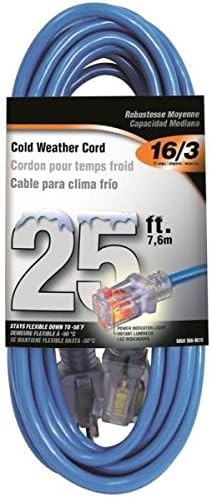
The Rocky Mountain Goods Cold Weather Extension Cord is a straightforward 25-foot option for seasonal outdoor tasks. It has a 4.5 rating and emphasizes flexibility down to negative 58 degrees, allowing the cable to remain easier to handle in cold conditions than a conventional extension lead.
We may earn a commission when you buy through this link, at no additional cost to you.
The cord is described as heavy duty, water resistant, and flame retardant. A power indicator light shows when it is active, while the stated outdoor uses include Christmas lights, snowblowers, and other equipment that needs additional reach. Its 25-foot length is a common middle ground between a short utility lead and a long yard-scale cable.
The supplied information is less detailed than for several other products: it does not state the wire gauge, amperage, wattage, certification, or number of outlets. Those omissions make it difficult to compare electrical capacity precisely. The water-resistant designation should also not be interpreted as permission to submerge the cord or expose connected plugs to standing water.
This product makes sense for users who primarily want a manageable, cold-flexible cord for holiday displays, compatible snowblower use, and general outdoor tasks. Before buying, check the full product page for the gauge and electrical ratings, and confirm that the connected equipment's requirements fall within those figures. Its simplicity and covered lifetime warranty are also notable.
Maintaining flexibility in freezing conditions makes routing and coiling easier. That is particularly valuable when the cord must be positioned around snow, vehicles, generators, or outdoor equipment in an awkward area.
A 25-foot length gives holiday-light strings and portable equipment more freedom than a short household extension cord. The illuminated indicator provides a convenient confirmation that the line is active.
We may earn a commission when you buy through this link, at no additional cost to you.
The Eastman 25 Feet All Weather Extension Cord is a versatile option for extending power around the home, garage, or outdoor project. It has a 4.5 rating, a 25-foot length, and a three-prong design. Its stated electrical rating is 125 volts and 1,875 watts, making it suitable for many common household and workshop loads.
We may earn a commission when you buy through this link, at no additional cost to you.
The jacket is designed to resist water, oil, abrasion, and corrosion. A power indicator makes it easy to determine whether the cord is in use, which can be useful in garages, sheds, basements, and outdoor areas where checking the far end would otherwise be inconvenient.
The most important caveat is that the supplied description does not provide a specific minimum operating temperature. Although it is called an all-weather cord and is clearly designed for outdoor use, shoppers with genuinely severe winter requirements may prefer a model that publishes a cold-flexibility figure. The wire gauge and certification details are also not stated in the supplied information.
This cord is a sensible general-purpose option when you want moderate reach, grounded connections, and a visible power status without a large multi-outlet head. It can serve outdoor lights, compatible tools, chargers, and workshop equipment, provided the connected load does not exceed its rating and standard electrical precautions are followed.
Protection against water, oil, abrasion, and corrosion broadens the situations in which the cord can be used. That makes it suitable for garages, work areas, and exposed outdoor connections where insulation may encounter several kinds of wear.
The three-prong arrangement supports grounded equipment, while the indicator light provides immediate feedback at the powered end. Both details are convenient in installations where the connection is not directly visible.
We may earn a commission when you buy through this link, at no additional cost to you.
The Southwire Coldflex Light Duty Extension Cord combines 100 feet of reach with high-visibility construction. It carries a 4.7 rating and uses 16/3 SJTW wire, with a fluorescent blue jacket designed to remain noticeable on cold outdoor worksites. Both ends are lit, offering clear power-visibility cues.
We may earn a commission when you buy through this link, at no additional cost to you.
Reinforced blades add protection at the plug, and the cable is described as flexible in extreme cold. The 100-foot length is particularly useful for distant generators, outdoor equipment, or connections across large work areas where a standard 25-foot cord cannot reach.
The term light duty is important. A 16-gauge cord is intended for lighter loads, so this model is less appropriate than the 12-, 13-, or 14-gauge options for high-current tools and appliances. In addition, a 100-foot cable requires disciplined routing to prevent trip hazards, especially around snow, vehicles, and busy work paths.
Choose this cord for moderate-power outdoor equipment that needs exceptional reach and easy visibility. It may also suit lighting installations where finding the far end in darkness is important. Confirm the complete electrical rating on the current listing and never exceed the load allowed for the cord, especially when it is fully extended.
The fluorescent blue jacket stands out against snow, grass, and cluttered job-site backgrounds. Lit ends add another visible indicator, helping users locate and verify the connection in low-light conditions.
At 100 feet, the cable can connect equipment located well beyond the reach of a typical household extension lead. Its 16-gauge construction makes that reach most appropriate for lighter compatible equipment rather than high-draw machinery.
We may earn a commission when you buy through this link, at no additional cost to you.
The HUANCHAIN 14/3 Gauge Heavy Duty Outdoor Extension Cord is a strong middle ground between short utility cords and extra-long models. It earns a 4.7 rating and offers 50 feet of reach, a 15-amp capacity, and a 125-volt, 1,875-watt rating. Its yellow jacket is intended to improve visibility and reduce trip risk.
We may earn a commission when you buy through this link, at no additional cost to you.
The product is described as flame resistant, waterproof and weather resistant to IP65, corrosion resistant, and cold resistant to negative 50 degrees Celsius. A socket indicator light shows when the cord is ready for use, while long strain relief is tested through 20,000 bending cycles. The company also states that each cord passes a 2,500-volt high-voltage test before shipment.
Fourteen-gauge wire is heavier than 16-gauge alternatives, and a 50-foot lead creates more routing work than a 25-foot model. The instruction to use the extension cord fully extended and avoid coiling during operation is important because heat can build up if a cable is tightly bundled while carrying current.
This cord suits medium- to heavy-duty household and industrial equipment that needs a meaningful extension radius. The high-visibility color, cold rating, and 15-amp capacity are especially useful around work areas, machinery, and outdoor installations. Keep connections dry and follow the full instructions for safe positioning and storage.
The bright yellow jacket makes the cable easier to notice in dim garages, snowy yards, and busy work environments. Fifty feet provides enough distance to reach outdoor equipment while remaining more manageable than a 100-foot cord.
The strain-relief section is described as passing 20,000 bending cycles without breaking. That durability claim is especially relevant where the cable is repeatedly connected, disconnected, routed, or repositioned around equipment.
We may earn a commission when you buy through this link, at no additional cost to you.
The POWGRN 50-Foot 12-Gauge Outdoor Extension Cord is the most fully specified premium option in the guide. It has a 4.8 rating, heavy-duty 12/3 SJTW construction, a 15-amp rating, and a maximum capacity of 1,875 watts. Its 50-foot length gives generous reach without the bulk of a 100-foot cable.
We may earn a commission when you buy through this link, at no additional cost to you.
The jacket is described as IP65 waterproof and weather resistant, wear resistant, heat resistant to 158 degrees Fahrenheit, corrosion resistant, and flexible down to negative 58 degrees Fahrenheit. A bright yellow color improves visibility, and an LED indicator confirms when the cord is powered. The female socket incorporates a hook design intended to simplify plugging, unplugging, and temporary hanging.
As with any long extension lead, routing requires care. A 50-foot cable can cross walkways, become caught under vehicles, or accumulate heat if handled poorly. The product also positions itself for major appliances and heavy-duty use, but users must still observe the stated amperage, wattage, and instructions rather than assuming every appliance is suitable.
This is an excellent choice for heavy-duty outdoor equipment, major appliances, and serious cold-weather projects. The combination of 12-gauge capacity, ETL and CETL listing, IP65 protection, extreme-cold flexibility, and a practical hook-equipped socket makes it a strong all-purpose choice. It is our premium recommendation for users who want substantial specifications and long reach.
The IP65 designation and weather-resistant SJTW jacket provide a robust enclosure for exposed outdoor use. Corrosion and heat resistance add further protection for seasonal equipment stored and operated in changing conditions.
The hook-equipped socket is intended to make connection and disconnection easier, especially in humid environments. It can also provide a temporary hanging point when the connector is not attached to equipment.
We may earn a commission when you buy through this link, at no additional cost to you.
Choosing an extension cord for winter use requires balancing cold flexibility, electrical capacity, reach, and environmental resistance. The following factors help separate a cord that merely looks rugged from one that is appropriately specified for the equipment and environment.
A cold weather rating should be based on the lowest temperature at which the cable is expected to remain flexible and functional. Products in this guide state minimum temperatures ranging from negative 50 degrees Celsius to negative 94 degrees Fahrenheit. The exact figure matters when the cord will be handled outdoors, stored in a vehicle, or operated around snow and ice.
Choose a documented temperature rating comfortably below the expected conditions. A more specific low-temperature claim gives buyers better information than a vague claim of all-weather performance.
Wire gauge determines how much current a cord can carry over its length without becoming overloaded. Twelve-gauge cables in this guide support higher-demand equipment, while 14-gauge and 16-gauge cords are better suited to lighter loads. Published amperage and wattage ratings provide the clearest way to judge whether a cable is appropriate.
Match the cord to the lower rating among the cord, the connected equipment, and the source receptacle. Never treat a long cord as if it were a permanent circuit.
Length should be sufficient to reach the equipment without creating unnecessary hazards, but not so long that the cable becomes difficult to manage. Ten- and 25-foot cords suit local work areas, while 50-foot cables bridge larger yards and workshops. One hundred-foot models offer maximum reach for distant generators, lighting, or equipment.
Measure the actual route and account for bends, vehicle clearance, and safe placement. A cord that reaches its destination but creates a trip hazard is not a good solution.
A standard single-outlet cord offers the simplest connection for one tool or appliance. A triple-tap provides three grounded outlets at the remote end, which is useful for lights, chargers, and several smaller devices. Multi-outlet heads are bulkier and the combined load must remain within the cord's total rating.
Count the equipment you need to power before choosing. Do not assume that three outlets permit three full-power tools to operate simultaneously.
Outdoor-rated jackets should be evaluated for resistance to water, abrasion, oil, sunlight, flame, and corrosion. SJTW and SJEOOW constructions appear among the choices, while some models also state an IP65 enclosure rating. These features help protect the insulation when the cable is routed across wet ground or around rough work surfaces.
Even a weather-resistant cord should have its plug connections kept dry. Water resistance describes the cable's construction, not permission to submerge it or ignore safe electrical practices.
A brightly colored jacket makes a cord easier to see around snow, vehicles, and busy work areas. Illuminated plugs or sockets provide quick confirmation that power is present, reducing unnecessary unplugging and making setup more convenient in dim conditions.
Visibility is a safety feature, but it should supplement—not replace—proper routing. Lights only show whether the cord is energized and do not indicate that the connected load is appropriate.
Cold-rated insulation should remain flexible enough to bend, route, and coil without cracking. Reinforced strain relief protects the transition between cable and plug, where repeated pulling and flexing usually cause damage first. Flexible stranded copper is also beneficial in models that frequently need repositioning.
Store the cord loosely and avoid sharp bends. If insulation cracks, the jacket is damaged, or a plug becomes warm, discontinue use and inspect or replace it.
Agency certification can provide useful evidence of testing for specific electrical standards. Iron Forge's 10-foot models are described as UL certified, POWGRN is ETL and CETL listed, and HUANCHAIN is ETL and CETL listed. Other models may provide additional approvals not fully captured in the supplied descriptions.
Check the complete listing and product markings before purchase. Certification should be considered alongside, rather than as a substitute for, matching the cord's gauge, length, and rating to the intended load.
Before using a cold weather extension cord, inspect the entire cable and both connectors. Look for cracked insulation, cuts, exposed conductors, bent blades, damaged strain relief, or a jacket that has been pinched or crushed. Do not use a cord with visible damage, and confirm that the three-prong plug, ground pin, and connected equipment are intact.
Connect the cord to a properly grounded source before attaching equipment, and keep the cord fully extended during operation. Route it away from vehicle tires, sharp edges, hot surfaces, standing water, and pedestrian paths. Avoid coiling a cord around equipment or under rugs while it is energized, and never overload a multi-outlet connector or the source circuit.
After use, disconnect equipment before unplugging the extension cord. Wipe off moisture and dirt, coil the cable loosely without tight bends, and store it in a dry place away from excessive heat. In freezing weather, let a cord that has been coiled or stored in a vehicle gradually warm and straighten before forcefully bending or connecting it.
The cord's published minimum temperature should be below the coldest conditions it will encounter. Models in this guide list minimum temperatures from negative 50 degrees Celsius to negative 94 degrees Fahrenheit, while several others specify negative 58 degrees Fahrenheit. Cold ratings primarily describe the cable's ability to remain flexible and functional, so the complete product specification and manufacturer instructions still matter.
Usually, yes. Lower gauge numbers indicate thicker conductors, and the 12-gauge models in this guide carry more current than the 16-gauge alternatives. That makes them more appropriate for demanding tools, appliances, and long cable runs. A 16-gauge cord can still be suitable for lights, chargers, and lighter equipment, provided its rating covers the load.
A cord with a weather-resistant or IP65-rated jacket can be used outdoors in suitable conditions, but plug connections should still be protected from water. No extension cord should be submerged, and standing water around connectors creates a risk. Use appropriate weather covers where permitted and keep both ends elevated on dry surfaces.
A power indicator can be a useful diagnostic feature, but it does not make unattended use safe. The connected equipment should still be monitored, the cord fully extended, and the total load kept within the ratings. An illuminated end only confirms that power is present; it does not verify that the wiring, circuit, or connection is being used safely.
No. A cord that is tightly coiled or bundled while carrying current can trap heat and create a fire risk. HUANCHAIN's product information specifically instructs users to use the cord fully extended and avoid coiling. This practice should be applied to all extension cords, especially during high-load operation.
Measure from the grounded outlet to the snowblower and allow enough extra length for routing without sharp bends. A 25-foot cord may be sufficient for a nearby driveway area, while a 50- or 100-foot model offers more reach for larger properties. Check the snowblower's electrical requirements and select a cord with adequate gauge, amperage, and cold rating.
Only if the cord, every connected device, the multi-outlet connector, and the source circuit all support the combined load. Watt's Wire offers a triple-tap option, but its 1,875-watt rating applies to the cord as a whole. High-draw tools running simultaneously can exceed that limit even when each individual tool appears acceptable.
IP65 indicates that the cord's rated enclosure is protected against dust and water jets from multiple directions. It is useful for exposed outdoor equipment, but it does not mean the cord can be submerged. Connector seals, proper positioning, and the manufacturer's instructions remain essential when using an IP65-rated product in wet conditions.
The Clear Power 100-Foot cord is the strongest overall choice when maximum reach and verified extreme-cold flexibility matter most. Iron Forge's 10-foot 16-gauge model is the best budget option for compact local use, while POWGRN's 50-foot 12-gauge cord stands out as the most fully specified premium choice with heavy-duty capacity and strong environmental ratings.
Prioritize the published temperature range, electrical rating, and required reach before considering convenience features. A lighted end helps with setup, and a bright jacket improves visibility, but neither substitutes for adequate wire gauge or safe routing. Match the cord to the equipment's requirements and avoid exceeding the total amperage, wattage, or circuit capacity.
Finally, confirm the current product listing, certification information, dimensions, and compatibility before ordering. Product specifications and availability can change over time, and prices also fluctuate. A careful comparison of the cord, the equipment, and the power source is the best way to select a safe and useful cold weather extension cord.