
Sony STRDH190
4.5Editor score
100 watts per channel
Four-speaker A/B switching
Phono and Bluetooth support
Best cheap AV receiver buying guide comparing ten affordable models for surround sound, HDMI support, streaming, karaoke, room setup, and everyday use needs.
A cheap AV receiver can still provide the central control and amplified sound needed for an engaging home theater. The right model should match your speakers, television, source devices, room size, and preferred features while avoiding unnecessary complexity. Important considerations include channel count, HDMI capabilities, wireless streaming, decoding, and setup assistance.
This guide compares ten affordable receivers across home theater, stereo, and flexible amplifier-style use cases. We evaluated the supplied specifications for output configuration, surround formats, video support, connectivity, room calibration, streaming, karaoke functions, and physical design. The list includes dedicated AV receivers, traditional stereo units, and multichannel amplifiers with important HDMI limitations.
Each recommendation highlights the product most suitable for a particular setup, from compact music systems to dedicated surround-sound installations. Features that can affect everyday convenience, such as Bluetooth Multipoint, automatic room correction, and onboard controls, are considered alongside more fundamental matters such as power and speaker compatibility. Prices and availability can change, so confirm current listings before purchasing.
4.5Editor score

4.0Editor score

4.2Editor score
The comparison below highlights each receiver's channel configuration, key audio or video capabilities, connectivity, and strongest use case. It is designed to show where compact stereo systems, general-purpose home theater receivers, and karaoke-capable amplifiers differ.


The Sony STRDH190 is a straightforward two-channel home stereo receiver with a 4.5 rating and a clear emphasis on music rather than home theater processing. It delivers 100 watts per channel at 8 ohms and 1 kHz, making it a practical choice for two stereo speakers or a four-speaker arrangement controlled through A/B switching. The low-profile enclosure is also easier to accommodate than a full-size AV receiver.
We may earn a commission when you buy through this link, at no additional cost to you.
Its strongest features are flexibility and simplicity. A dedicated phono input lets owners connect a turntable with the appropriate moving-magnet cartridge, while four stereo RCA inputs, a 3.5 mm input, and Bluetooth cover sources such as a music player, computer, television, and wireless streaming services. Built-in Bluetooth makes it useful for podcasts and everyday music without requiring a separate network streamer. The FM tuner includes 30 presets, and the full-size headphone output provides a convenient private listening option.
The main limitation is that this is not a surround-sound AV receiver. It has no multichannel decoding, no Dolby Atmos processing, and no HDMI switching for tying a television and game console into the same system. Its output is also designed for conventional stereo speakers rather than a 5.1 or 5.2 layout. Buyers who want a simple music hub may see those omissions as sensible restraint, while home theater users will need a different model.
This is the strongest budget recommendation for someone building a two-channel music system, combining a turntable with modern streaming, or controlling speakers in two separate zones. It is especially suitable for listeners who value clean operation, useful analog connections, and a slim footprint over cinematic sound effects. For those requirements, the STRDH190 provides a well-balanced feature set without the complexity of a full home theater receiver.
The STRDH190 can serve as the central hub for a traditional hi-fi system while also accepting modern sources. Its phono input, multiple analog inputs, Bluetooth, FM radio, and full-size headphone jack cover many common listening routines without requiring network-specific hardware.
Its low-profile body is only 5.25 inches tall according to the supplied information, making placement in conventional AV cabinets easier. Speaker compatibility covers a 6–16 ohm range, allowing more flexibility when matching the amplifier to compatible stereo speakers.
We may earn a commission when you buy through this link, at no additional cost to you.
The Yamaha RX300A is the most complete all-around home theater receiver in this guide, with a 4 rating and an extensive feature set for an affordable category. It provides 5.2-channel output, Dolby Atmos, DTS Virtual:X, and support for flexible 3.1.2 speaker layouts. The included setup microphone and automatic room optimization are especially helpful for users who want improved playback without navigating a complex manual calibration process.
We may earn a commission when you buy through this link, at no additional cost to you.
Video connectivity is another major strength. The receiver supports 4K at 120 Hz and 8K at 60 Hz, high-performance HDMI switching, Dolby Vision, HDR10+, HDMI eARC, and ARC. For gaming, ALLM and VRR can provide more convenient operation and smoother variable-refresh-rate picture performance when the television and source device support those features. Bluetooth Multipoint adds a convenient way to alternate between two wireless source devices.
Its limitations concern amplification and channel flexibility rather than missing headline features. The stated 70-watt rating may be modest for a large room or demanding speakers, especially when five speakers are driven simultaneously. It also does not offer the seven-channel amplification of higher-end receivers. Buyers with very large spaces should match it carefully to their speaker sensitivity and consider the possibility that they will need more substantial power in the future.
The RX300A is ideal for a family room or medium-sized listening space where modern HDMI, object-based audio, room correction, and convenient streaming matter. The Quick Guide, on-screen settings, sound modes, and four customizable scene presets lower the barrier for first-time AV receiver owners. It offers the strongest balance of modern video support and home theater audio features among the picks, making it the leading general-purpose recommendation.
Support for 4K120, 8K60, eARC, ALLM, and VRR makes the RX300A well suited to current televisions and gaming consoles. These functions should be matched with compatible source equipment and displays to obtain their intended benefits.
The included microphone measures room acoustics and speaker characteristics so the receiver can optimize playback. An intuitive guide, on-screen menus, sound modes, and scene presets make the system approachable for first-time users.
We may earn a commission when you buy through this link, at no additional cost to you.
The Denon AVR-S570BT has a 4.2 rating and stands out for its four HDMI 2.1 inputs, 8K support, and broad compatibility with current audio and video formats. It is designed as a dedicated 5.2-channel home theater receiver and provides 70 watts per channel, making it most appropriate for moderate-size rooms with appropriately matched speakers rather than oversized listening spaces.
We may earn a commission when you buy through this link, at no additional cost to you.
The receiver supports HDR, HLG, Dolby Vision, HDR10+, Dynamic HDR, VRR, and Quick Frame Transport. Audio formats include DTS HD Master, Dolby TrueHD, immersive audio, and 5.1 surround sound. Four HDMI 2.1 inputs are generous for a compact system, while the included eARC support can return compatible television audio over a single cable. Bluetooth streaming adds a practical route for music and other compatible audio sources.
Ease of use is another strength. Denon's on-screen setup assistant walks through connecting the television and sources, while EQ settings are available for optimizing different content. The receiver can also work with a compatible smart television remote, and the Denon Remote App provides iOS and Android control. Compared with the Yamaha RX300A, the notable tradeoff is the absence of supplied automatic room-calibration features, so buyers may need to handle sound-level matching and basic speaker configuration more directly.
The AVR-S570BT is best for buyers who prioritize abundant HDMI connectivity, 8K-capable video, current surround formats, and flexible control options. It works particularly well as the central hub for several consoles, streaming boxes, and a television. If careful speaker matching and room design are handled thoughtfully, it delivers a feature-rich home theater foundation without moving into the broader channel counts and amplification of a premium flagship.
Four HDMI 2.1 inputs reduce the need to constantly swap cables when using several consoles, streaming devices, or disc players. The single HDMI output supports eARC up to 40 Gbps according to the supplied specifications.
Support for Dolby TrueHD, DTS HD Master, major HDR formats, VRR, and smart remote operation makes this a practical hub for mixed entertainment. The dedicated mobile app adds another way to change inputs and navigate functions.
We may earn a commission when you buy through this link, at no additional cost to you.
The Pyle 5.2-Channel Hi-Fi Home Theater Receiver is an amplified system intended for buyers who want surround functionality in a relatively compact package. It carries a 4 rating and advertises a maximum output of 1000 watts. That headline figure should be interpreted carefully because maximum output is not the same as continuous RMS power, so comparing it directly with receivers that state sustained wattage can be misleading.
We may earn a commission when you buy through this link, at no additional cost to you.
Its useful features include a 5.2-channel layout, 4K Ultra HD passthrough, Bluetooth streaming, a digital-to-analog converter interface for computer audio, and protection against overcurrent, short circuit, and overvoltage. The digital connectivity can be valuable for listeners who already have a source capable of providing a clean digital signal. Wireless streaming adds convenience for everyday music, podcasts, and similar audio.
The supplied information does not identify a broad suite of surround decoders, room-correction tools, or advanced gaming features. Buyers who need Dolby Atmos object-based audio, sophisticated HDMI gaming support, or automatic speaker calibration may find a more specialized AV receiver easier to justify. The broad maximum-wattage wording also makes independent RMS specifications difficult to compare, so compatible speaker impedance and manufacturer documentation should be checked before installation.
This Pyle model is best suited to a straightforward five-speaker-and-subwoofer setup where space, basic surround output, and multiple source methods are the priorities. It may also suit users who want a digital input rather than relying exclusively on HDMI. For straightforward amplified home audio, it offers useful flexibility, but cinema-focused buyers should verify codec and HDMI requirements against their source equipment.
The receiver consolidates five-channel surround amplification and a subwoofer path into one unit. This can simplify a living-room or secondary media-zone installation when a full-size AV receiver would occupy more space.
Bluetooth supports convenient wireless playback, while the DAC interface offers another way to connect a computer's digital audio signal. These options make the amplifier useful for music as well as home theater.
We may earn a commission when you buy through this link, at no additional cost to you.
The Donner MAMP4 is a 5.1-channel audio amplifier with a 4.1 rating, designed for listeners who value source flexibility and karaoke functions over movie-format decoding. It powers five speakers and one subwoofer, with 60 watts RMS per left/right channel into 4 ohms and 25 watts RMS for each of the three surround or center channels. These figures are more useful for comparison than a generic maximum-power headline.
We may earn a commission when you buy through this link, at no additional cost to you.
Connectivity is unusually broad for an amplifier in this category. It accepts Bluetooth 5.3, USB media up to 64 GB, RCA, AC-3, AUX, optical, coaxial, FM radio, and two quarter-inch microphone inputs. The digital inputs can be particularly handy when connecting a compatible television that lacks an HDMI input. Its remote also provides treble, midrange, bass, echo, and Talkover controls in any input mode.
The most important limitation is explicit: it supports PCM decoding but does not support Dolby or DTS decoding, and it has no HDMI input. It therefore does not offer the object-based audio, HDR video switching, and gaming features associated with a conventional premium AV receiver. Its strengths make more sense when the goal is amplified multichannel playback, digital sources, media playback, and live vocal use.
The MAMP4 is an appealing choice for karaoke hosts, musicians, event organizers, or families that want to combine a home theater speaker set with microphones and numerous analog or digital sources. It can also automatically save input mode, volume, and EQ settings, reducing repetitive setup. Buyers seeking cinematic decoding should choose a conventional AV receiver, but those with a broad input and vocal agenda will find this model unusually adaptable.
Two quarter-inch microphone inputs support simultaneous wired microphones, while separate microphone volume, echo, and Talkover controls make the amplifier suitable for hosting, announcements, and musical performances. The remote can operate these functions across input modes.
The amplifier can retain the selected mode, volume level, and EQ settings between starts. That convenience is valuable in recurring setups where the same sources and sound adjustments are used repeatedly.
We may earn a commission when you buy through this link, at no additional cost to you.
The Donner MAMP6 is a six-channel amplifier rated at 3.9, making it the least highly rated product in this list but also one of the most flexible for multi-room or multi-speaker installations. It provides 1000 watts of peak power, corresponding to 25 watts RMS per channel. Each of the six channels can be controlled independently, and the stated speaker compatibility range spans 4 to 16 ohms.
We may earn a commission when you buy through this link, at no additional cost to you.
Its inputs include Bluetooth 5.3, USB media storage up to 64 GB, two pairs of RCA, AUX, FM radio, optical, and coaxial digital connections, along with two microphone inputs. As with the MAMP4, a multifunction remote controls bass, midrange, treble, echo, and Talkover. The amplifier also remembers its mode, volume, and EQ settings, which is useful in repeatable installations.
The lack of HDMI is the decisive constraint for many buyers. It cannot provide the convenience of switching several video sources through one receiver, and the supplied information does not indicate Dolby or DTS surround decoding. Its peak-power headline should also not be confused with the continuous output available on dedicated home theater receivers. Speaker sensitivity, impedance, and room size will matter when determining whether 25 watts RMS per channel is sufficient.
The MAMP6 is best for users who need six independently controlled amplified zones, a larger multi-speaker background music system, or a flexible karaoke setup using existing passive speakers. It is less appropriate as the central device for a modern television-based home theater. Its value lies in speaker deployment flexibility, broad inputs, and straightforward channel control rather than integrated video switching or cinematic audio processing.
Independent control gives each connected speaker its own volume level, which is useful for multi-room audio or a distributed speaker arrangement. The documented 4–16 ohm compatibility range offers broad passive-speaker matching options.
Bluetooth, USB, multiple RCA connections, AUX, FM, optical, and coaxial inputs make it possible to combine several source types. The lack of HDMI remains the main limitation for television and console integration.
We may earn a commission when you buy through this link, at no additional cost to you.
The Sony STRDH590 is a 5.2-channel home theater receiver with a 4.3 rating, making it one of the stronger-rated conventional AV receivers in this guide. It supports theater-style playback with five powered channels and a subwoofer output. Its 725-watt specification is listed alongside a 6 ohm, 1 kHz test condition, so it should not be interpreted as five continuously available channels each producing 725 watts.
We may earn a commission when you buy through this link, at no additional cost to you.
Video support includes 4K pass-through and HDR compatibility with HDCP 2.2, while the HDMI section has four inputs and one output with audio return channel. For music, Bluetooth streaming and Bluetooth Standby allow a paired phone to wake the receiver. The S Force PRO processor can create virtual front surround from only two speakers, which is useful when a full physical surround layout is not practical.
The product also includes a multichannel stereo setup, an FM radio tuner, a quarter-inch headphone jack, four stereo RCA inputs, and optical and coaxial digital outputs. Its supplied box contents are unusually useful, listing foldable headphones, a carry case, charging cable, and audio cable. The compromises are that the supplied information does not advertise 8K support, advanced variable-refresh-rate gaming features, object-based audio decoding, or automatic room correction.
The STRDH590 is a good fit for buyers who want a recognizable full-size home theater receiver but do not need the newest HDMI and gaming specifications. It works especially well for someone combining a television, streaming device, game console, conventional 5.1 speaker system, and stereo music playback. If Sony speakers or familiar electronics integration are priorities, its combination of surround support, Bluetooth, flexible inputs, and virtual processing is compelling.
S Force PRO can simulate a front surround effect with only two physical speakers. That makes the receiver useful in apartments, offices, or secondary rooms where the placement of rear channels is difficult.
After pairing a phone, Bluetooth Standby can turn on the receiver from the phone. This reduces friction when switching from casual listening to a television or game console.
We may earn a commission when you buy through this link, at no additional cost to you.
The Yamaha R-S202BL is a traditional stereo receiver with a 4.4 rating, the highest rating among the products included. It is designed for listeners who want uncomplicated two-channel amplification rather than video switching or surround processing. Its brushed aluminum finish and minimalist layout give it a straightforward appearance suited to a traditional hi-fi system.
We may earn a commission when you buy through this link, at no additional cost to you.
The central feature is the speaker selector for two systems. That allows one receiver to power two pairs of speakers, with independent selection between them, which is useful in homes where the main listening area and another room require separate audio. Bluetooth adds wireless streaming from compatible services and devices. A full-size headphone terminal, auto power standby, and 40 FM/AM station presets complete the everyday utility features.
It should not be considered an AV receiver despite the broader category name used for this guide. There is no HDMI, no multichannel decoding, no Dolby Atmos, and no video pass-through. Its stated frequency response extends from 10 Hz to 100 kHz with different tolerance bands, and the listed CD input sensitivity is 500 mV into 47 kilohms. Those details describe a straightforward analog music component rather than a modern cinema processor.
The R-S202BL is best for a living room, listening room, office, or secondary zone where two speakers and music are the priority. It is particularly attractive for owners who want to control two speaker systems without purchasing another amplifier. Buyers who require television audio return, surround formats, or gaming features should choose a 5.2-channel AV receiver instead; otherwise, this Yamaha provides an elegant and highly rated core.
The two-system speaker selector is the defining feature. It supports separate front and rear pairs with their own terminals, making it practical for multiple listening zones without a complicated switching amplifier.
Bluetooth, radio presets, a headphone output, and automatic standby cover common listening needs without the complexity of menus and video processing. The design is especially suitable for a secondary stereo setup.
We may earn a commission when you buy through this link, at no additional cost to you.
The JBL MA310 is a compact dedicated 5.2-channel AV receiver with a 4 rating and a stated output of 60 watts across five channels. It is designed to integrate with smart televisions, game consoles, streaming devices, and cable boxes while supporting a conventional five-speaker surround layout and subwoofer.
We may earn a commission when you buy through this link, at no additional cost to you.
Its HDMI section includes four inputs, one output, and ARC, offering enough switching capacity for a typical living-room system. Native decoding of Dolby and DTS formats provides the core surround functions expected from an AV receiver. Bluetooth 5.1 with Low Energy supports wireless music streaming, while the product description emphasizes high-fidelity reproduction for both music and movies.
The stated power is modest, making careful speaker matching important. Smaller rooms, efficient bookshelf speakers, and moderate listening levels are likely to be a better fit than a large space with demanding floor-standing speakers. The supplied information also does not mention automatic room correction, Dolby Atmos object-based processing, advanced gaming features, eARC, or 8K support, so buyers requiring those functions should verify them before choosing.
The MA310 is best for buyers who want a recognizable, compact home theater receiver with native surround decoding and an uncluttered connection set. Its white enclosure may suit contemporary interiors, while four HDMI inputs provide practical flexibility for a modern television setup. It is a strong option for a bedroom, apartment, or medium living room where surround sound and simple television integration matter more than flagship processing.
The receiver focuses on a standard 5.2 speaker arrangement, native surround decoding, and television connectivity. That makes it a practical fit for users who want home theater performance without a large feature list.
Four HDMI inputs can accommodate a game console, streaming box, disc player, and cable box. ARC provides a direct return path for compatible television audio, while Bluetooth adds wireless music.
We may earn a commission when you buy through this link, at no additional cost to you.
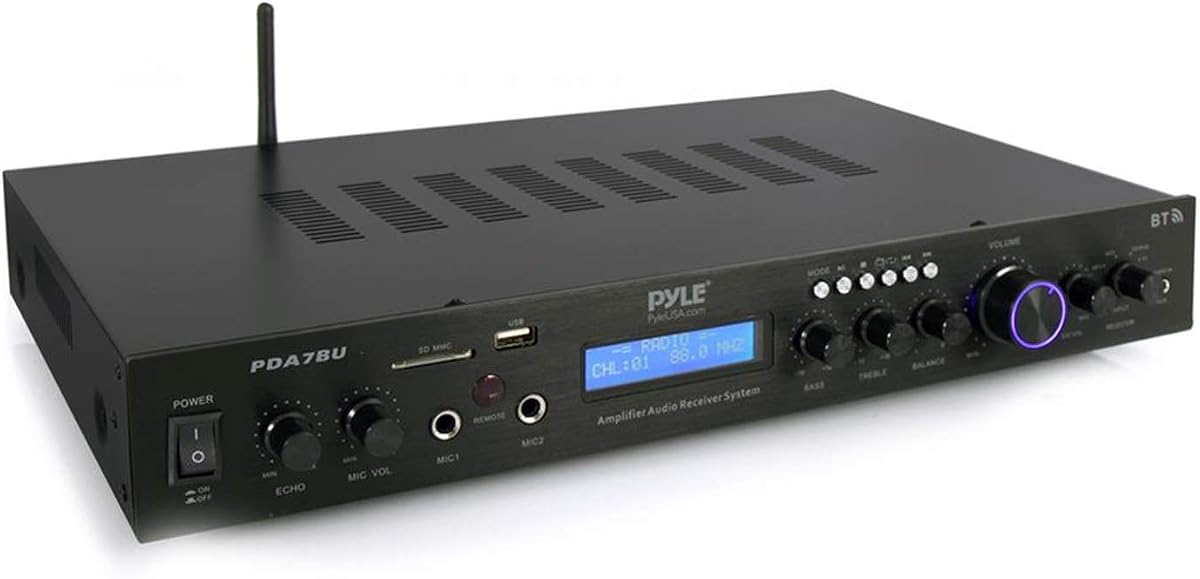
The Pyle PDA7BU is a compact home theater amplifier with a 4.1 rating and an emphasis on simple amplified playback and karaoke. It pushes 200 watts across five channels—front right, front left, center, surround right, and surround left—while providing a dedicated subwoofer output. The total-output specification should be considered in that context rather than as a per-channel RMS rating.
We may earn a commission when you buy through this link, at no additional cost to you.
Its source options are designed for accessible entertainment. Bluetooth connects with compatible tablets, phones, and computers, while a front-facing 3.5 mm auxiliary input, three RCA inputs, USB-A, and SD media support provide several wired and local-file routes. An FM radio, included remote control, detachable rack mounts, and FM antenna complete the package. The LCD display provides a visible indication of operating status.
Two 6.35 mm microphone inputs support simultaneous wired microphones, with adjustable echo and microphone volume. That makes the unit particularly practical for karaoke, small gatherings, announcements, and background music. It does not provide HDMI, so it cannot serve as a modern video-switching hub, and the supplied information does not identify advanced surround decoders or object-based audio support.
The PDA7BU is a strong choice for a secondary room, event space, rehearsal area, or straightforward home theater built around existing passive speakers. It is also approachable for karaoke users who want more than the stereo receivers in this guide. Buyers who need television return audio, gaming features, and modern surround processing should instead consider a dedicated HDMI AV receiver, while passive-speaker and microphone users will find this model direct and versatile.
Separate amplified channels support front, center, and surround speakers, with an additional subwoofer output. This arrangement lets an existing passive-speaker collection function as a complete home theater system.
Two microphone inputs, adjustable echo, and microphone volume support group singing and spoken use. USB, SD, Bluetooth, auxiliary, and RCA inputs provide numerous ways to deliver music and other audio.
We may earn a commission when you buy through this link, at no additional cost to you.
Choosing an inexpensive AV receiver starts with defining the source devices and speakers you already own. Channel configuration, audio decoding, HDMI requirements, power, calibration, and setup convenience should then be matched to your room rather than to the longest feature list.
A stereo receiver powers two channels and is best for music-only systems or modest television setups. A 5.2-channel receiver adds front left, front right, center, surround left, surround right, and a subwoofer output, making it the practical minimum for conventional home theater. The Yamaha RX300A, Denon AVR-S570BT, Sony STRDH590, and JBL MA310 use this general configuration. For a smaller room, virtual front surround, such as the Sony STRDH590 feature, may provide a useful effect without requiring rear speaker placement.
Match the receiver to the speakers you own, not to a theoretical channel count. Confirm that the amplifier provides powered outputs for every channel in your intended layout. A subwoofer also requires its own output and appropriate placement rather than sharing a full-size speaker connection.
HDMI support matters when the receiver will connect a television, game console, streaming box, or disc player. Four inputs provide comfortable flexibility, while a single output is normal for a one-display system. ARC returns compatible television audio to the receiver over HDMI, and eARC can support a wider range of audio formats. The Yamaha RX300A and Denon AVR-S570BT stand out with 4K120, 8K60, eARC, and current gaming-related features, while several karaoke amplifiers have no HDMI at all.
Check the television and source devices before selecting a model. A receiver advertised for 8K or 4K120 is useful only when the connected display and source support those formats. For a simple speaker setup with no television routing, traditional analog or digital inputs may be more useful than HDMI.
Surround decoding determines which encoded formats a receiver can present to the speakers. Native Dolby and DTS decoding is important for many disc and streaming sources, while Dolby Atmos and DTS Virtual:X add height-oriented or virtual effects. The Yamaha RX300A supports Dolby Atmos and DTS Virtual:X, and the Denon AVR-S570BT supports Dolby TrueHD and DTS HD Master among its listed formats.
Do not confuse an amplifier with a full decoder. The Donner MAMP4 explicitly supports PCM decoding but not Dolby or DTS decoding. It can still amplify multichannel audio supplied through compatible inputs, but it will not perform the same format decoding and processing as a dedicated AV receiver.
Power specifications are only meaningful when their test conditions are comparable. RMS output at a stated impedance and frequency is generally more useful than a headline maximum wattage. The Sony STRDH190 specifies 100 watts per channel at 8 ohms and 1 kHz, while the Yamaha RX300A and Denon AVR-S570BT list 70 watts. The Donner MAMP4 supplies RMS figures for different channel groups, and the Pyle products use maximum or total output.
Speaker sensitivity, impedance, room dimensions, and listening levels ultimately influence the result. Efficient speakers and a small or medium room can work well with modest amplification. Larger rooms or demanding speakers may require more headroom, so avoid selecting a receiver solely on its wattage figure.
Room correction can improve clarity, bass distribution, and speaker balance, but it cannot compensate for poor placement or incompatible equipment. The Yamaha RX300A includes a setup microphone that measures room acoustics and speaker characteristics. The Denon AVR-S570BT offers an on-screen setup assistant and EQ settings, while the JBL MA310 provides a more conventional AV configuration without supplied automatic measurement features.
First-time owners may value guided menus and simple scene or mode controls. More experienced listeners may prefer direct control and be comfortable calibrating the system independently. Compare the setup workflow with your comfort level and the complexity of the equipment already in the room.
Bluetooth is now standard on many affordable receivers, but its usefulness depends on codec support in the source device and the receiver. Bluetooth Multipoint on the Yamaha RX300A can maintain connections to two devices, making switching between phones, tablets, or computers more convenient. Bluetooth 5.3 appears on both Donner models, while Bluetooth 5.1 with Low Energy is listed for the JBL MA310.
Traditional connections still matter. Look for the number of RCA inputs, optical and coaxial digital inputs, phono capability, headphone output, USB media support, and radio tuners. The Sony STRDH190 stands out for its phono input, while the Donner MAMP4 and MAMP6 offer the broadest combinations of digital, analog, local-media, and radio sources.
Dual microphone inputs, adjustable echo, microphone volume, and Talkover can turn an amplifier into a useful event or karaoke hub. The Donner MAMP4 and MAMP6 provide these functions, as does the Pyle PDA7BU. These controls are uncommon on conventional home theater receivers and may make an amplifier-style model the more sensible purchase for a party room or speaking setup.
For multi-room audio, look at speaker selectors and independently controlled channels. The Yamaha R-S202BL can select between two speaker systems, and the Donner MAMP6 supports six independently controlled channels. Neither feature automatically creates network streaming or synchronized whole-home audio, so separate network streamers may still be necessary.
A lower-profile receiver may fit a media cabinet more easily than a full-size home theater component. The Sony STRDH190 is listed at 5.25 inches tall, while the Pyle PDA7BU includes detachable rack mounts for integration-style installation. Consider ventilation, cable routing, speaker-terminal access, and the space required to turn the volume control or connect a microphone.
Installation also depends on existing wiring. Confirm that your speakers use compatible impedance and connectors, and whether the receiver must sit near a television, streaming device, or audio source. The most feature-rich receiver is not the best choice if its dimensions, connections, or placement requirements do not suit the room.
Begin by inventorying your speakers, television, and source devices before connecting anything. Read the receiver's supplied documentation, confirm impedance compatibility, and plan speaker placement before attaching wires. Connect one source at a time, select the appropriate input, and start with a moderate volume so mistakes are easier to identify. Firmly seat every connector without forcing terminals, and avoid placing ventilation openings against a closed cabinet wall.
For a home theater receiver, complete the on-screen setup assistant or room-calibration process after all speakers and the subwoofer are connected. Set channel levels, speaker distances, and crossover adjustments according to the manufacturer's guidance. For Bluetooth, pair one device initially, confirm that the selected source is active, and use the app or remote to switch inputs. With karaoke models, start microphone and echo levels low, raise them gradually, and keep microphones away from speakers to reduce feedback.
Allow the receiver to operate within the supplied power requirements and avoid sudden shutdowns or unstable connections. Keep the ventilation path clear, use a surge protector appropriate for the setup, and do not overload a power strip. Dust gently with a dry cloth rather than spraying cleaner into openings. Firmware, application, and source-device updates can improve compatibility, while periodically checking connections and renewing nonrechargeable remote batteries helps maintain reliable operation.
An inexpensive AV receiver can provide a useful combination of amplified speakers, surround processing, HDMI switching, and convenient control. The best budget model depends on your display, source devices, room size, and speaker efficiency. A 5.2-channel unit is the practical minimum for conventional surround sound, while a stereo receiver is better for music-only use. Matching the amplifier to the room is more important than choosing the model with the longest feature list.
A stereo receiver primarily amplifies left and right channels and may support radio, Bluetooth, phono, and other music sources. An AV receiver adds home theater features such as surround channels, audio decoding, HDMI switching, video pass-through, and television audio return. This makes an AV receiver the better central hub for a television, game console, and surround-speaker system.
Dolby Atmos is desirable when your content uses it and your speaker system can take advantage of height effects. It is less essential for viewers who mainly watch standard surround programming or use a two-speaker setup. The Yamaha RX300A supports Dolby Atmos and DTS Virtual:X, while some lower-cost amplifier-style receivers do not provide those object-based decoding features.
There is no single wattage target because room size, speaker sensitivity, impedance, and listening preferences all matter. The most useful figures are continuous RMS ratings measured at a stated impedance and frequency, not a maximum or total wattage headline. Efficient speakers can sound good with modest amplification, while large rooms and demanding speakers benefit from more power and greater headroom.
Yes, if the receiver has compatible analog or digital audio inputs and the television can output audio through the appropriate connection. Optical and coaxial digital inputs can carry multichannel television audio, while RCA inputs provide an analog route. However, a receiver without HDMI cannot provide modern video switching, 4K or 8K passthrough, eARC, or current gaming features.
No. Peak wattage describes a maximum output condition, while RMS wattage better represents sustained power under continuous load. Comparing two receivers is most reliable when both use RMS ratings and similar impedance and frequency conditions. The Pyle 1000-watt maximum figures and the Donner peak-power claims should therefore be treated differently from clearly stated continuous RMS specifications.
Look for two microphone inputs, independent microphone volume, echo control, and a Talkover function that lowers background audio. The Donner MAMP4, Donner MAMP6, and Pyle PDA7BU all include dual microphone connections. These models prioritize vocal and event use, whereas conventional AV receivers usually focus on movie decoding and HDMI gaming features.
Some can, but they are not necessarily the same as networked multi-room audio. The Yamaha R-S202BL includes a selector for two speaker systems, and the Donner MAMP6 supports six independently controlled channels. You may still need separate volume controls, source distribution, and network streamers if each room requires independent content rather than the same audio feed.
The Sony STRDH190 is the most convincing budget choice for a two-channel music system, while the Yamaha RX300A offers the most complete general-purpose home theater package. The Denon AVR-S570BT stands out for its four HDMI 2.1 inputs, 8K video support, broad audio formats, and flexible control options. Each fills a different need rather than attempting to be the universal choice.
Prioritize channel layout, source compatibility, and room-appropriate power before secondary features. A receiver cannot compensate for poorly matched speakers or an impractical cable layout, while many headline features will remain unused without compatible content and source devices. Karaoke and multi-room buyers should give microphones, speaker selectors, and independent channel control more weight, while dedicated theater users should examine HDMI, decoding, and calibration.
Product listings, specifications, and prices can change, so check the current description and compatibility information before ordering. Confirm the number and type of inputs, speaker impedance, supported audio formats, HDMI version, room size, and included accessories. With those checks completed, one of these affordable receivers can provide a dependable foundation for music, movies, gaming, or events without requiring a large or complicated system.