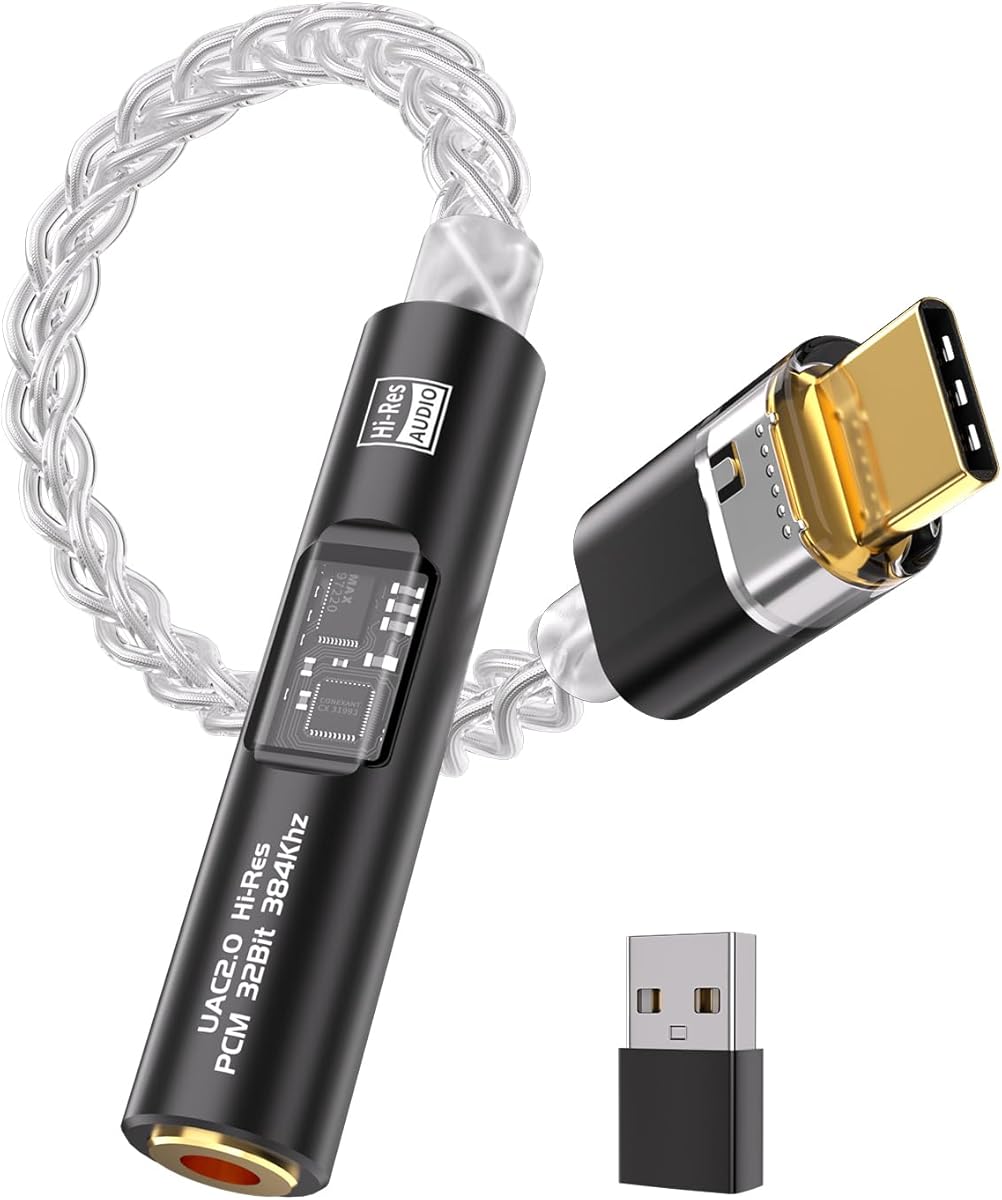
USB C to 3.5mm Audio Adapter
4.4Editor score
Dual CX31993 and MAX97220
Maximum 32-bit/384kHz support
USB-C and USB-A compatibility
Portable aluminum construction
Audiophile Dacs compared for sound quality, connectivity, headphone power, formats, and build, helping you choose the right desktop upgrade.
Audiophile Dacs sit at the heart of many digital listening systems, converting signals from computers, streamers, optical sources, and game consoles into analog audio for amplifiers, speakers, and headphones. A capable unit can reduce system limitations, expose more recording detail, and provide a cleaner foundation for both casual listening and serious critical evaluation.
This guide compares ten DACs using the specifications and features supplied for each product. We examine conversion chips, supported file formats, input and output options, headphone amplification, wired and wireless connectivity, preamp functions, display design, and physical construction, while also considering whether each product is better suited to a compact, desktop, or full-system installation.
Each review identifies the standout benefits and the most important compromises, helping you match a product to your existing equipment and listening priorities. The featured options range from a portable USB-C adapter to fully balanced desktop converters with sophisticated controls. Product prices and availability can change, so check the current listing before purchasing.
4.4Editor score

4.7Editor score

4.6Editor score
This side-by-side comparison highlights each DAC's conversion architecture, headphone capability, wired connectivity, and wireless options. It shows how each device is intended to fit into a desktop, portable, home-system, or mixed-source audio chain.


The BZINK USB C to 3.5mm Audio Adapter is a compact way to add dedicated digital-to-analog conversion and headphone amplification to a phone, tablet, or computer. It has a 4.4 rating and uses dual conversion and amplification components rather than relying entirely on the host device's built-in output. That makes it especially attractive to listeners who want a more consistent analog stage without assembling a full desktop system.
We may earn a commission when you buy through this link, at no additional cost to you.
Its supplied specifications highlight a CX31993 DAC paired with a MAX97220 amplifier, Hi-Res Gold Label certification, and support for maximum 32-bit/384kHz PCM decoding. The cable uses eight-strand, 4N single-crystal copper with silver plating, while the housing is made from aluminum alloy. A USB-A adapter broadens compatibility with computers and accessories that lack USB-C. The adapter is also suitable for calls, livestreams, and content creation, although its core appeal remains portable music playback.
The main limitation is obvious from the physical design: there is only a 3.5mm output and no visible preamp, gain, filter, or wireless control. Users who need balanced output, multiple analog outputs, or a way to connect powered speakers directly should choose a desktop model. Similarly, a compact adapter may not offer the same connectivity management as a full-size component. These constraints are reasonable for the portable role, but they narrow the range of systems it can serve.
Choose this adapter if your priority is a small, affordable path to higher-quality headphone listening. It is a particularly logical option for USB-C phones that lack a headphone jack, students, travelers, and anyone building a temporary desktop setup. The included USB-A adapter makes it more versatile than many similarly sized dongles. For balanced output or extensive system control, the Fosi Audio K7 is the stronger long-term desktop choice.
The adapter's USB-C plug and short integrated cable make it easy to carry between a phone, laptop, and portable listening setup. Its aluminum shell adds durability without turning the device into another box occupying desk space.
Support for up to 32-bit/384kHz PCM gives the adapter considerable format headroom. The included USB-A interface also extends compatibility, although actual playback quality depends on the source device, operating system, and file being played.
We may earn a commission when you buy through this link, at no additional cost to you.
The Fosi Audio K7 is a particularly strong all-round desktop DAC because it combines high-resolution conversion, substantial headphone power, balanced and single-ended outputs, and a wide range of wired and wireless inputs. Its 4.7 rating is the highest among the featured products. Rather than limiting itself to one role, it can serve as a headphone amplifier, digital hub, Bluetooth receiver, preamp-style source, or connection point for powered speakers and an external stereo amplifier.
We may earn a commission when you buy through this link, at no additional cost to you.
At its center are the AK4493S DAC, XMOS XU208 USB processor, and TPA6120 headphone amplifier stages. The supplied data lists support for PCM up to 384kHz/32bit and DSD256, with output power reaching 2100mW. A 4.4mm balanced output is available for compatible headphones, while 3.5mm and RCA connections cover conventional equipment. USB-C, optical, coaxial, and Bluetooth aptX HD/LL inputs make the K7 easy to integrate with computers, discs, game consoles, and phones.
Usability is a notable strength. Two large control knobs, five shortcut buttons, an angled chassis, and a high-resolution status display create a more approachable control surface than a bare converter. The all-metal body also provides rigidity and electromagnetic shielding. On the other hand, the product performs many jobs, so it is not as minimal as the Q6 or SU-1. New users may need to consult the manual to understand input selection, gain, shortcuts, and output behavior.
The K7 is best for listeners who want one compact component to handle several source types and drive demanding headphones. It is especially attractive for a mixed desktop involving gaming, music, and wired or wireless source switching. Those who only need digital conversion for stereo speakers can find a more specialized option in the Q6, while the ZD3 offers a more expansive home-system and preamp feature set.
USB-C, optical, coaxial, Bluetooth, and microphone inputs cover most modern listening scenarios. The result is a practical hub that can reduce the number of external converters and adapters surrounding a computer or game console.
The 4.4mm balanced output and stated 2100mW maximum output give the K7 more authority than a simple portable adapter. This makes it a practical match for high-impedance or demanding headphones when paired with the correct output and gain configuration.
We may earn a commission when you buy through this link, at no additional cost to you.
The Fosi Audio Q6 is a focused desktop digital-to-analog converter for people who already own an amplifier, headphone amplifier, or powered speakers. It combines an AK4493S DAC, XMOS XU316 processor, and OPA1612 op-amp with support for PCM 32-bit/768kHz and DSD512. Its 4.6 rating reflects a strong specification package, while its aluminum enclosure gives it a more permanent home-audio appearance than a portable dongle.
We may earn a commission when you buy through this link, at no additional cost to you.
Connectivity is broad for such a compact unit. Optical, coaxial, and USB-C inputs allow it to accept signals from computers, streamers, disc players, televisions, and tablets. RCA outputs feed stereo amplifiers or powered speakers, and a dedicated Sub-Out can serve a subwoofer. The measured specifications listed for the product are a signal-to-noise ratio of at least 121dB and total harmonic distortion below 0.00012%, values that support its positioning as a clean, accurate converter.
A critical distinction is that the Q6 does not directly drive headphones or passive speakers. Its RCA outputs require an appropriate amplifier or powered speaker. This limitation is not a flaw so much as a deliberate boundary: it keeps the device focused on conversion and avoids adding headphone amplification circuitry. It also means buyers should include an amplifier in their system budget if they do not already own one.
This is a strong choice for a minimalist desktop stereo where a computer or streamer feeds an existing amplifier. The Q6 also suits listeners who want very high format ceilings and care more about signal conversion than wireless convenience. If direct headphone use is essential, select the K7 or ZH3 instead. The product's lack of Bluetooth and balanced outputs may also make it less appealing for flexible all-in-one setups.
Maximum PCM 768kHz/32bit and DSD512 support provides ample headroom for high-resolution libraries. The XU316 processor and carefully specified analog section make the Q6 appealing when digital fidelity is the main reason for adding a converter.
Optical, coaxial, USB-C, RCA, and Sub-Out connections cover the common needs of a compact stereo. This makes the Q6 easy to place between digital sources and an existing amplification chain without requiring extra boxes.
We may earn a commission when you buy through this link, at no additional cost to you.
The Fosi Audio ZD3 is designed as a fully balanced DAC preamp for a serious home stereo rather than a minimalist desktop accessory. It carries a 4.6 rating and uses an ES9039Q2M conversion chip alongside an XMOS XU316 processor, QCC3031 chipset, and LME49720 output stage. Maximum format support reaches PCM 32-bit/768kHz and DSD512, positioning it for high-resolution digital sources and uncompromised analog output.
We may earn a commission when you buy through this link, at no additional cost to you.
Its defining feature is HDMI ARC input, allowing a television's audio to join computers, streamers, optical sources, coaxial equipment, and Bluetooth devices in one routing hub. Fully balanced XLR and unbalanced RCA outputs provide options for different amplifiers. A 1.5-inch OLED display, remote control, preamp bypass switch, and 12V trigger input/output make it easier to integrate with a larger system and coordinate it with other powered components.
The ZD3 lacks a dedicated headphone amplifier. Listeners using headphones should treat it as a converter and preamp feeding a separate headphone amplifier, or choose an all-in-one model such as the K7 or ZH3. It also carries more features than a simple DAC, meaning that users who only need USB-C and RCA may find the controls and installation more involved than necessary.
Despite those limits, the ZD3 is compelling for a living-room or dedicated stereo system that combines TV audio with multiple digital sources. Balanced outputs are particularly useful for long cable runs or a compatible amplifier, while the remote and trigger functions improve day-to-day operation. It is a better fit for system builders than for someone seeking a small headphone DAC, but it provides a clear path to flexible, high-resolution home listening.
HDMI ARC input is unusual in this category and allows a television to feed the same analog output chain as a computer or streamer. The result is a more centralized system with fewer source switches competing for amplifier inputs.
XLR and RCA outputs offer flexible amplifier connections, while the preamp bypass and 12V trigger improve integration with dedicated audio equipment. The OLED display also makes source and status information visible from across a room.
We may earn a commission when you buy through this link, at no additional cost to you.
The FiiO K13 R2R in black is a premium desktop DAC, headphone amplifier, and preamp built around a self-developed 24-bit R2R conversion architecture. Its 4.6 rating and extensive feature set make it one of the most specialized products in this guide. Rather than centering on a delta-sigma converter, it uses a four-channel fully differential complementary R2R design built with 192 ultra-precise 0.1% thin-film resistors.
We may earn a commission when you buy through this link, at no additional cost to you.
One of the K13's most interesting features is its choice between NOS and OS operating modes. NOS preserves the incoming sampling rate for a purer, more direct signal path, while OS upsamples to 384kHz for different performance characteristics and metrics. The result is a converter that lets listeners compare two approaches rather than committing to one permanently. A ten-band PEQ system, accessible through app and web control, adds further personalization.
Connectivity is comprehensive on the analog side. Balanced XLR line output, dual RCA outputs, 4.4mm balanced headphone output, and 6.35mm single-ended headphone output cover studio monitors, powered speakers, amplifiers, and a wide range of headphones. The stated 2400mW output is suitable for demanding models, while LDAC, AAC, and SBC over Bluetooth 5.4 support convenient wireless streaming. PCM 384kHz/32bit and DSD256 decoding provide high-resolution wired performance.
The principal compromise is input selection. Unlike several Fosi Audio models, the K13 does not list optical or coaxial digital inputs, so adding those sources would require an external converter. Its many modes and EQ options also demand more setup attention than a simpler device. Even so, the product makes sense for listeners who value R2R character, robust balanced output, and extensive sound adjustment over plug-and-play simplicity.
The four-channel fully differential R2R stage uses precision thin-film resistors with low stated temperature drift. NOS and oversampling modes give listeners a meaningful way to compare direct playback with a higher-rate processing path.
Ten PEQ bands, application and web-based adjustment, and shareable profiles make the K13 useful for correcting headphone response or creating saved configurations. The display and shortcut controls help keep those deeper features accessible on the desktop.
We may earn a commission when you buy through this link, at no additional cost to you.
The blafili B3 is a specialized Bluetooth receiver for bringing wireless phone, tablet, or computer audio into an existing wired sound system. It carries a 4.7 rating and supports LDAC, aptX HD, aptX Low Latency, aptX, SBC, and AAC. An ESS ES9018K2M DAC handles conversion, allowing the receiver to feed amplifiers, mixers, powered speakers, preamps, or other DACs without acting as an amplifier itself.
We may earn a commission when you buy through this link, at no additional cost to you.
Its output selection is unusually flexible. RCA, balanced XLR, optical, and coaxial outputs can work simultaneously, which helps with flexible routing and commercial installations. The supplied information confirms that optical is output only. A removable RP-SMA antenna can extend the stated wireless range of up to 33 meters, though range may decrease significantly without the external antenna. Silent pairing avoids beeps and voice prompts that could disrupt classrooms, worship spaces, offices, and other quiet environments.
There are important functional boundaries. The B3 cannot transmit audio from a television or stereo to Bluetooth headphones, and it cannot directly drive passive speakers. Its USB DAC mode supports up to 16-bit/48kHz, which is sufficient for basic computer use but modest beside the high-resolution wired specifications of many desktop DACs. Phone calls and notifications may also interrupt Bluetooth playback.
Choose the B3 when your main goal is adding capable wireless reception to an established amplifier or speaker system. Its multiple outputs, removable antenna, and custom broadcast naming make it particularly useful for shared or professional installations. For a general desktop DAC with stronger wired format support, consider the Q6 or SU-1. For balanced headphone output from one device, the K7 is the more relevant option.
The receiver converts Bluetooth streams to analog signals through its ESS DAC stage. Because several outputs can operate simultaneously, it can serve more than one part of a system without being limited to a single cable route.
Custom Bluetooth names, optional four-digit passcodes, silent operation, and a removable antenna make the B3 practical for venues, offices, schools, and homes. These operational details matter when reliability and control matter more than compact styling.
We may earn a commission when you buy through this link, at no additional cost to you.
The SMSL SU-1 is a high-resolution desktop decoder with a particular emphasis on MQA and MQA-CD workflows. Its 4.2 rating is lower than those of several products in this list, but the provided specifications reveal a capable conversion platform centered on the AK4493S DAC and XU316 processor. Maximum support reaches PCM 768kHz/32bit and DSD512.
We may earn a commission when you buy through this link, at no additional cost to you.
Its most distinctive function is MQA handling. The description notes support for cleaning a recording and encapsulating the sound, as well as decoding an MQA-enabled disc when the CD player's optical or coaxial digital output is connected. MQA-CD uses authentication signatures to confirm the source and restore the original high-resolution signal. For listeners with compatible MQA content, this can make the SU-1 more relevant than a general-purpose converter with similar headline resolution.
USB compatibility covers Windows 7 through 11, with a driver required, macOS 10.6 and later, driverless Linux, Android, and iOS. That broad platform support is useful for a decoder expected to serve several kinds of computer. The supplied information does not detail the exact analog outputs, preamp controls, headphone capability, chassis materials, or complete input selection, so buyers should verify those points against the current product listing and manual.
The SU-1 makes most sense for MQA-CD owners or listeners who actively acquire authenticated MQA material. Otherwise, a more extensively documented model such as the Fosi Audio Q6 may be easier to evaluate. Its lower supplied rating also suggests checking recent owner feedback before committing. Even with that caution, the combination of MQA-CD support and a high-resolution AK4493S platform gives the SU-1 a clear specialty.
MQA and MQA-CD support differentiates the SU-1 from converters focused only on high-resolution PCM and DSD. The feature is most valuable when the source provides compatible authenticated content and the rest of the chain preserves the decoded signal.
The listed operating systems cover Windows, macOS, Linux, Android, and iOS. Windows requires a driver, while Linux is described as driverless, an important distinction for users who move between different computer environments.
We may earn a commission when you buy through this link, at no additional cost to you.
The SMSL D1 is a compact desktop DAC built around ROHM's BD34352EKV converter and the latest XMOS XU-316 firmware. It supports PCM up to 32-bit/768kHz and DSD512, has a stated signal-to-noise ratio of 126dB, and lists total harmonic distortion plus noise at 0.00038%. The 4.2 rating places it behind the highest-rated products, but its format ceiling and clean measurement specifications remain attractive.
We may earn a commission when you buy through this link, at no additional cost to you.
Dual USB, optical, and coaxial inputs make the D1 a practical bridge between computers, streamers, disc players, and other digital equipment. Touch controls keep the front panel uncluttered, while the anodized CNC aluminum unibody chassis gives it a refined appearance and a durable, unified structure. A USB-A-to-C data cable is included for direct computer use, with driverless operation noted for macOS and Linux.
The built-in power-filtering system can optimize performance when the DAC is powered through USB. The supplied description specifically notes clear high frequencies, controlled bass, and smooth midrange, although these are general characterizations rather than controlled listening results. As a line-level converter, the D1's RCA output is intended for an amplifier or powered speakers; it does not provide a dedicated headphone output in the listed specifications.
Choose the D1 for a clean, compact desktop system built around RCA-connected amplification and high-resolution digital sources. It offers more traditional simplicity than feature-heavy units with screens, remotes, or extensive equalization. Verify the current outputs and control layout before purchase, and note that Windows requires a driver. For a subwoofer output, the Fosi Audio Q6 offers a more clearly specified integrated solution.
Touch operation avoids protruding knobs and keeps the aluminum enclosure visually uncluttered. Digital source selection and basic operation remain approachable, while the XU316 platform supports contemporary high-resolution formats.
A stated 126dB signal-to-noise ratio and 0.00038% THD+N indicate a low-noise design goal. The USB power-filtering system adds flexibility for simple computer installations where a separate power supply is unnecessary.
We may earn a commission when you buy through this link, at no additional cost to you.
The silver FiiO K13 R2R provides the same advanced conversion and headphone-amplification platform as the black version, but in a different finish for listeners who prefer a lighter visual treatment. It has a 4.6 rating and uses FiiO's four-channel fully differential complementary 24-bit R2R DAC with 192 precision thin-film resistors. Its technical identity is therefore closely matched to the black model's.
We may earn a commission when you buy through this link, at no additional cost to you.
The K13 supports PCM 384kHz/32bit and DSD256 decoding, while the stated 2400mW output supports a wide range of headphones. Outputs include balanced XLR, dual RCA, 4.4mm balanced, and 6.35mm single-ended connections. Its dual power supply supports clean operation, and Bluetooth 5.4 provides LDAC, AAC, and SBC streaming for users who do not want to rely on a wired computer connection.
The NOS and OS modes offer contrasting approaches to signal handling, while the ten-band PEQ system provides detailed response correction and preset options. These capabilities turn the K13 into more than a converter, allowing it to function as a preamp, headphone amplifier, wireless streamer, and configurable system center. The dual power supply and extensive controls also justify a deliberate setup process rather than immediate plug-and-play use.
Like the black edition, the silver K13 lacks listed optical and coaxial inputs. That limits direct use with disc players, television optical output, and other digital sources unless an additional converter is added. Choose this finish if you prefer its appearance or can find a better-equipped listing for your sources. In all other respects, it stands as a premium, feature-rich choice for R2R listeners, demanding headphones, and users who value EQ precision.
The same fully differential architecture serves line-level and headphone outputs, providing a coherent platform across XLR, RCA, 4.4mm, and 6.35mm connections. This is useful for listeners who move between speakers and headphones.
LDAC offers a convenient high-resolution wireless route, while the PEQ system allows detailed correction and saved profiles. Together they make the K13 suitable for both direct listening and system-specific tuning.
We may earn a commission when you buy through this link, at no additional cost to you.
The Fosi Audio ZH3 is the most feature-dense DAC, headphone amplifier, and preamp in this guide. It has a 4.6 rating and combines an AKM4493SEQ DAC, XMOS XU316 processor, four OPA1612 amplifier stages, and a fully balanced dual-power architecture. The result is designed to act as the central component in a serious desktop system connecting computers, game consoles, disc players, stereo amplifiers, active speakers, and headphones.
We may earn a commission when you buy through this link, at no additional cost to you.
Format support reaches PCM 768kHz/32bit and DSD512. Its 4.4mm balanced headphone output is listed at 2570mW into 32 ohms, while the 6.35mm single-ended output delivers 640mW into 32 ohms. A three-level gain switch covers headphones from 16 to 300 ohms. Line-level outputs include XLR and RCA, and digital inputs cover coaxial, optical, and USB. A 12V trigger supports system integration, while UAC mode switching broadens console compatibility.
The ZH3 also offers bass and treble adjustment, six filter types including Bypass, and two swappable op-amps. This makes it appealing to listeners who enjoy comparing tonal configurations or adapting the unit to different headphones. The controls are integrated into the screen, maintaining a coherent Z-Series appearance. However, the number of options can make the device less approachable than a simple converter.
Two output-level details deserve attention. The supplied notes state that RCA and XLR output levels differ significantly, so the correct selection depends on the connected equipment. They also clarify that EQ applies only to headphone output, not the preamp outputs. With those constraints understood, the ZH3 is an excellent choice for an enthusiast who wants extensive control, strong balanced amplification, and broad source support in one enclosure.
Bass and treble controls, six filter modes, and swappable op-amps provide several ways to shape the headphone presentation. These features are more useful to listeners who actively compare settings than to those seeking a completely hands-off device.
The balanced output's stated 2570mW into 32 ohms gives the ZH3 ample authority, while the gain switch accommodates a wide impedance range. Both balanced and single-ended headphone connections are provided for matching different equipment.
We may earn a commission when you buy through this link, at no additional cost to you.
Choosing an audiophile DAC begins with the rest of your audio system. Input needs, amplifier requirements, output topology, supported formats, and the degree of control you actually want matter more than headline resolution alone.
Begin by listing every digital source you expect to use. A computer or phone with USB-C is covered by nearly every product here, but optical disc players, network streamers, television optical output, game consoles, and older sources may require coaxial, optical, or specialized compatibility. The Fosi Audio K7 accepts USB-C, optical, and coaxial alongside Bluetooth, while the ZD3 adds HDMI ARC for television integration. The FiiO K13 models focus on USB and Bluetooth and therefore fit modern computer-centric systems particularly well.
Choose a model with native connections for your priority sources rather than planning to add an external adapter. Also verify that the included software, drivers, and operating-system support fit your computer. High format numbers do not compensate for inconvenient routing.
A DAC with a built-in headphone amplifier can power headphones directly, while a line-level converter needs an amplifier or powered speakers. The K7 and ZH3 are designed for demanding headphones and offer balanced outputs. The K13 also provides 4.4mm and 6.35mm headphone connections with substantial stated output. By contrast, the Q6 explicitly cannot drive headphones, and the SU-1, D1, and ZD3 require downstream amplification or active speakers.
Match output capability to the headphone's impedance, sensitivity, and preferred connection. Balanced output can reduce channel-matching concerns, but only when the headphone cable and amplifier are genuinely balanced. Do not assume that four-pin or 4.4mm labeling guarantees every part of the chain is fully balanced.
Output voltage and gain determine whether a headphone receives enough voltage, while excessive gain can create noise or distortion in sensitive earphones. The ZH3 provides a three-level gain switch for 16 to 300 ohm headphones, and the K7 lists up to 2100mW of output power. For line-level connections, the ZH3 notes that RCA and XLR levels differ, which can cause compatibility issues if the wrong mode is selected.
Look for volume controls, selectable gain, and clear output specifications. If connecting to an existing amplifier with its own preamp, verify the DAC's level behavior to prevent an overload. The goal is useful range, accurate output, and compatibility with the rest of the chain.
PCM 32-bit/768kHz and DSD512 are attractive headline capabilities, but useful results depend on the source, playback software, operating system, and the rest of the analog chain. The D1 and Q6 support PCM 768kHz and DSD512, while the K7 and K13 reach PCM 384kHz with DSD256. The BZINK adapter supports up to PCM 384kHz in a much smaller enclosure. None of these figures guarantee that every file will reveal a audible difference.
Prioritize a stable implementation, clean noise performance, and compatibility with the formats you actually own. The Q6 lists at least 121dB SNR and below 0.00012% THD, while the D1 lists 126dB SNR and 0.00038% THD+N. Specifications can help identify a clean foundation, but they should support rather than replace sensible system matching.
Most of the featured products use delta-sigma conversion chips from AKM, ESS, or ROHM. The FiiO K13 is the major exception, using a fully differential 24-bit R2R architecture with precision resistors. R2R enthusiasts often value the perceived musical character of the architecture, and the K13 adds NOS and oversampling modes so listeners can compare behaviors directly. Delta-sigma designs such as the AK4493S in the K7, Q6, ZH3, and SU-1 are popular for high-resolution and low-noise performance.
Do not assume one architecture is automatically superior for every listener. Consider the implementation, feature set, output stage, and system synergy. The practical choice is the converter whose controls, connectivity, and operating behavior best suit your music, equipment, and willingness to adjust settings.
Balanced XLR or 4.4mm outputs can help preserve signal integrity over suitable connections, while RCA remains the most common home-audio format. The ZD3 offers fully balanced XLR and RCA line outputs; the ZH3 combines XLR, RCA, 4.4mm, and 6.35mm outputs; and the K7 adds 4.4mm, 3.5mm, and RCA. If your amplifier has balanced inputs, a converter with balanced output may simplify the chain.
Single-ended output is not inherently poor, and balanced cabling adds no benefit when either end of the path lacks balanced electronics. Choose based on the equipment you already own. Confirm pinout, impedance expectations, and output level before connecting expensive equipment.
Simple converters focus on source selection and volume, while advanced models add displays, remote controls, equalization, filter switching, op-amp swaps, gain settings, and system triggers. The ZH3 offers the deepest customization, and the K13 provides ten-band PEQ plus NOS and OS modes. The K7 prioritizes a desktop hub experience with shortcut buttons and a status display. The D1's touch controls and the Q6's more focused design suit listeners who want fewer decisions.
More features can be valuable when you enjoy tuning and comparing settings. They can also create complexity, increase cost, and consume desk space. Choose the level of control that you will actually use rather than assuming the deepest menu is the most enjoyable.
Bluetooth support has become common in desktop DACs, but codec quality and implementation differ. The K7 supports aptX HD and Low Latency, the K13 uses LDAC, and the B3 is a dedicated Bluetooth receiver with XLR, RCA, optical, and coaxial outputs. MQA and MQA-CD support gives the SU-1 a different specialty. Such functions are worth prioritizing when they solve a real routing need.
Wireless audio cannot be evaluated solely by codec name because transmission conditions, source implementation, and the receiving path also matter. For dependable hi-fi use, keep a wired option available. Specialized support is most valuable when your library or existing equipment makes it genuinely useful.
Begin with the correct source, interface, and output. Connect the DAC to the intended amplifier, powered speakers, or compatible headphones, then select the input that matches your source. Use quality cables appropriate to the connection, avoid sharply bent leads, and leave enough space around desktop units for heat dissipation and access to controls.
For computer audio, install any required operating-system driver before playback, select the correct native sample rate in the sound settings, and confirm that the application is outputting to the DAC. On optical or coaxial sources, use a genuine digital connection rather than an analog substitute. When enabling high-resolution formats, verify that the source and playback software support the desired rate.
For headphone use, choose the correct gain for the model's impedance and begin with a moderate volume. On the ZH3, verify whether an EQ setting is needed, remember that EQ applies only to headphone output, and check RCA versus XLR output levels. Keep the unit ventilated, use its intended power supply, and update software or firmware when the manufacturer provides a verified release.
It depends on your source and the rest of the system. A dedicated DAC can improve consistency, provide cleaner conversion, and add balanced outputs or stronger headphone amplification, especially when the built-in converter of a phone or laptop is the only available option. The audible benefit is usually less dramatic when an already-expensive source has a strong integrated DAC. System matching matters more than the label alone.
No. Higher rates can be useful for compatible high-resolution content, but they do not automatically produce a better result. Source quality, file authenticity, software support, output implementation, and the amplifier or speakers influence the final sound. If the music you listen to is mostly lossless CD-quality files, the practical difference between a 96kHz and 768kHz converter may be negligible.
A DAC converts digital audio into an analog signal, while a headphone amplifier provides voltage and current suitable for driving headphones. Some products combine both functions. The Fosi Audio K7 and K13 are examples, whereas the Fosi Audio Q6 is a line-level converter that cannot directly drive headphones or passive speakers.
Use balanced outputs when the DAC and the connected amplifier or headphones support them and your system benefits from a fully balanced path. RCA is perfectly suitable for many stereo systems and avoids the need for balanced inputs. The important point is that the entire connection should support its intended topology; a balanced cable alone does not create balanced electronics.
They can be very convenient and modern codecs such as LDAC or aptX HD support high-quality wireless listening. Wired connections generally provide more consistent behavior and avoid interference, codec variability, and interruptions from phone notifications. The B3, K7, and K13 make wireless convenient, but they are most useful as additions to rather than replacements for every wired source.
A DAC can improve the source portion of the system by offering cleaner digital conversion and more appropriate output levels, but it cannot correct poor speakers, room acoustics, or an underpowered amplifier. It also cannot create detail that was never captured. The benefit is most apparent when there is a meaningful mismatch or limitation in the source path.
No. These formats describe supported capabilities, not guaranteed audible improvements. You need compatible source files, playback software, drivers, and an output chain that can take advantage of the data. Many listeners gain more from stable high-quality conversion, correct gain, low noise, and a well-matched amplifier or headphone than from the largest format number.
Many desktop models include or use USB power for convenient operation, while some provide enhanced internal power architecture. The FiiO K13 has a stated dual power supply, and the B3 uses a USB power cable with a power adapter not included. Follow the supplied instructions and use a stable, correctly sized supply rather than substituting an unsuitable charger.
The strongest overall choice is the Fosi Audio K7 because it combines high-resolution conversion, substantial headphone power, balanced and single-ended outputs, useful controls, and broad source compatibility in one compact enclosure. The FiiO K13 R2R stands out for its premium architecture, dual operating modes, extensive PEQ control, and powerful balanced output, while the BZINK adapter offers the simplest path to a portable dedicated DAC.
Prioritize the functions your system actually needs. The Q6 is an efficient line-level converter for an existing amplifier, the ZD3 integrates television and multiple digital sources into a balanced home system, the ZH3 offers the deepest customization, and the blafili B3 is built specifically for adding wireless reception to wired equipment. Resolution alone should not decide the purchase.
Before buying, verify current output specifications, driver requirements, included accessories, and the compatibility of every planned source. Product prices, bundles, and availability can change, so check the latest listing and manufacturer documentation at the time of purchase. The right audiophile DAC is ultimately the one that improves your sources, works cleanly with the equipment you already own, and provides controls you will genuinely enjoy using.