
Bambu Lab A1
4.7Editor score
10,000 mm/s² acceleration
Automatic bed calibration
Active flow compensation
Quiet operation
Compare the best 3D printer for engineering prototypes, including multi-material systems, build volume, accuracy, speed, and heated chambers for design teams.
Engineering prototypes demand more than a visually convincing model. The right 3D printer for engineering prototypes must balance dimensional accuracy, repeatability, material compatibility, build volume, and workflow automation while protecting the design intent from one print to the next. These printers also need dependable controls, monitoring, and thermal management for realistic evaluation models.
We compared ten FDM printers using the specifications and feature details supplied for each model, focusing on build volume, motion system, speed, calibration, active chamber heating, multi-material capability, filtration, and supported engineering filaments. The list covers entry-level machines for concept work, multi-color systems for visual prototypes, and professional models designed for demanding technical workflows.
Each review explains where the printer stands out, what trade-offs buyers should consider, and which types of engineering work it is best suited to handle. Ratings and feature information reflect the supplied product data, while availability and prices can change, so confirm the current listing and specifications before making a purchase.
4.7Editor score
4.7Editor score

3.5Editor score
The comparison below highlights the major differences in build volume, production speed, chamber control, and multi-material capability. It is designed to show which printer best matches a given prototype scale, engineering material, and workflow requirement.





The Original Prusa XL is a large-format, dual-toolhead printer with a 14.17-inch cubic build volume and a supplied rating of 3.5. Its defining advantage for engineering prototype work is the ability to switch between two materials during a print. That capability can support multi-color demonstrations, different material properties, and soluble support structures without forcing separate jobs.
We may earn a commission when you buy through this link, at no additional cost to you.
Its CoreXY motion system is designed to combine speed with stability, while the segmented heated bed divides the platform into independently heated zones. According to the supplied details, those zones improve energy efficiency and reduce warping across the large bed. The printer also integrates with PrusaSlicer and Printables.com, creating a relatively unified path from model preparation to production.
The main trade-off is the size and complexity of the machine. The listed rating is lower than those of the other nine products, which means buyers should assess the current customer feedback carefully rather than assuming the same satisfaction level. In addition, transportation requires some fragile parts—including the LCD, extruder assembly, Wi-Fi antenna, and spool holder—to be packed separately and installed after delivery.
Despite those considerations, the Prusa XL is most compelling for engineering teams that regularly need large prototypes, multiple materials, or soluble supports in a professional ecosystem. It is less attractive for someone seeking a simple first machine or a compact desktop workflow. For organizations that value large-format capability and integrated multi-material control, it remains our overall recommendation.
Two independently assigned tools can reduce the complexity of prototypes that combine contrasting colors, rigid and flexible sections, or dissolvable support material. The system's intelligent tool switching also aims to limit purge waste during transitions, making it more practical for iterative engineering work than treating every color or material as an entirely separate print.
A 360 mm cubic working area gives designers room to print larger housings, fixtures, and assemblies in one piece. The segmented heated bed is particularly relevant on a wide platform because local temperature control can help maintain adhesion near the edges and reduce the warping risks that become more visible as print area increases.
We may earn a commission when you buy through this link, at no additional cost to you.
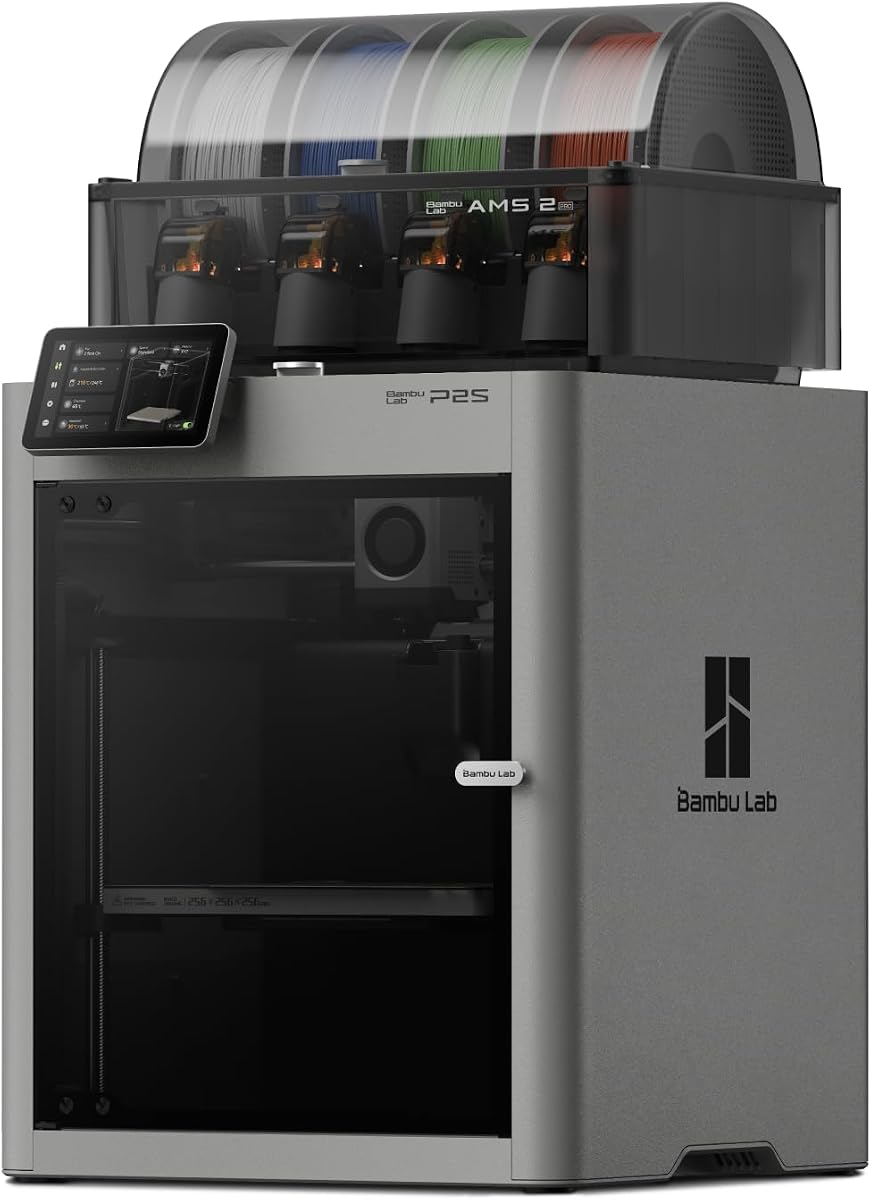
The Bambu Lab P2S Combo combines the P2S FDM printer with the AMS 2 Pro, creating a flexible production platform for detailed, multi-color engineering prototypes. Its supplied rating of 4.7 places it among the strongest customer-rated options in this group. The headline speed is up to 600 mm/s, supported by a PMSM servo extruder and active flow-rate compensation intended to preserve layer consistency at higher speeds.
We may earn a commission when you buy through this link, at no additional cost to you.
The AMS 2 Pro is the most important addition for many engineering teams because it manages four material sources and includes filament drying up to 65°C. This broadens the machine's practical value for visual assemblies, exploded views, color-coded interfaces, and prototypes that need multiple material properties. Its Adaptive Airflow System can also maintain a 50°C chamber for engineering-grade materials, while a carbon filter helps keep the surrounding air cleaner.
The P2S is not as expansive as some competitors in this list, but its strengths lie in speed, convenience, and workflow integration. AI failure detection, automatic calibration, quick-swap nozzles, and a stated 15-minute setup make it approachable for new operators. The important caveat is that the standard P2S does not support multi-color printing; the Combo configuration shown here includes the required AMS 2 Pro.
This is an excellent match for design teams that want fast iteration, clear presentation quality, and automatic multi-color handling without operating a large industrial enclosure. It is less suitable when maximum build volume or four independent nozzles are non-negotiable. For most mixed design-and-prototyping workflows, however, its 4.7 rating and integrated AMS make it one of the most balanced selections here.
Engineering teams often print many variants before settling on a design, so cycle time matters. A maximum speed of 600 mm/s can help reduce waiting time between iterations, while active flow-rate compensation is intended to maintain extrusion consistency as the printer accelerates and changes direction.
The included AMS 2 Pro supports multi-color and multi-material output without requiring a separate purchase. Its drying function is especially useful for moisture-sensitive filaments and helps maintain a more controlled material workflow for longer design sessions.
We may earn a commission when you buy through this link, at no additional cost to you.
The QIDI Max4 Combo is built for large prototypes and demanding engineering materials, offering a 390×390×340 mm build volume and an active heated chamber that reaches 65°C. Its listed rating of 4.4 reflects a strong overall proposition, particularly for users who need to print large molds, custom industrial parts, or complex assemblies without splitting them into smaller sections.
We may earn a commission when you buy through this link, at no additional cost to you.
Mechanical specifications reinforce its production focus. Closed-loop X and Y motors, a 2 mm lead screw, and an anti-backlash nut support stable motion and vertical consistency, while the printer can reach 800 mm/s and 30,000 mm/s² acceleration. The 40 mm³/s hotend and hardened steel nozzle are designed for standard polymers as well as abrasive carbon-fiber-reinforced nylon.
Multi-color capability expands through the separately available QIDI BOX. Once connected, the system supports up to 16 colors with features such as real-time filament-level monitoring and automatic pausing when filament runs out. Buyers should also note that the Polar Cooler is not included with the Max4 series and must be purchased separately if needed for the intended workflow.
The QIDI Max4 Combo is a strong recommendation for engineering groups that regularly produce large, dimensionally demanding parts or work with ABS-CF, PC, and PPS-CF. Its enclosed, high-temperature approach is more relevant than multi-color presentation for many technical teams. If those requirements are central, the large volume and active chamber give it a clear advantage over smaller enclosed machines.
A 390 mm square bed allows the Max4 to handle more than many desktop prototypes in one build. This can eliminate the need to divide a large assembly, preserve continuity between sections, and reduce the assembly and alignment work that follows a split print.
The 65°C active chamber helps control warping and supports consistent interlayer bonding when using demanding materials. Combined with the hardened nozzle and high-flow hotend, this creates a more capable platform for functional prototypes than basic open-frame systems.
We may earn a commission when you buy through this link, at no additional cost to you.
The Snapmaker U1 distinguishes itself through a four-toolhead system and a tool changer designed to complete swaps in five seconds. Its supplied 4.5 rating reflects a favorable customer response, while the independent toolheads let engineers combine rigid and flexible filaments, water-soluble supports, and other engineering materials in a single build without manually changing filament.
We may earn a commission when you buy through this link, at no additional cost to you.
The system avoids the repeated loading, unloading, and purging associated with some traditional material-change systems. According to the supplied information, this can reduce filament waste by as much as five times and make multi-color or multi-material printing up to five times faster. Its robust locking mechanism has been validated through more than one million swaps without a reported failure.
The underlying printer is also capable on its own. A rigid CoreXY motion system and lightweight carbon-fiber X-axis rails support speeds up to 500 mm/s, while the 270×270×270 mm build volume provides enough room for many functional prototypes. Automatic toolhead offset calibration, vibration compensation, fine-tuned extrusion, and first-layer calibration reduce the need for manual intervention.
The U1 is especially attractive for teams testing different material properties or creating presentation models with internal support structures. Its main constraint is the moderate build volume, which makes it less suitable for oversized assemblies. For desktop-scale engineering prototypes that benefit from fast, clean multi-material changes, however, the Snapmaker U1 offers one of the most distinctive workflows in this comparison.
Each toolhead carries its own filament and remains preheated, so material changes avoid the extensive purging associated with switching within one nozzle. This design is especially valuable for prototypes that need several colors, several material properties, or soluble support material.
Compatibility includes PLA, PVA, TPU, PETG, PCTG, ABS, ASA, PA, and PC. That range lets teams move from early concept models to functional and mixed-material tests without changing to an entirely different printer platform.
We may earn a commission when you buy through this link, at no additional cost to you.
The Bambu Lab A1 is an approachable desktop printer for early engineering prototypes, concept validation, and iterative design studies. It shares the top supplied customer rating of 4.7 in this group and emphasizes ease of use rather than industrial capacity. Its 10,000 mm/s² acceleration helps shorten print times, while active flow-rate compensation seeks consistent extrusion across changing flow conditions.
We may earn a commission when you buy through this link, at no additional cost to you.
Automation reduces the amount of setup knowledge required from first-time operators. Automatic calibration covers the Z-offset, bed leveling, and related first-layer concerns, and the 1-Clip quick-swap nozzle simplifies maintenance. Active motor noise canceling also makes the printer more suitable for offices, studios, and shared workspaces where a noisy machine could disrupt collaboration.
Multi-color output is possible through the optional AMS lite, so buyers should consider whether they need the base A1 or a Combo configuration. The supplied feature set is centered on standard desktop prototyping rather than demanding engineering materials, high-temperature chambers, or very large assemblies. That positioning is helpful for teams validating geometry and fit, but it is not a substitute for a heavy-duty production platform.
The A1 is best recommended for students, independent engineers, small teams, and organizations building an initial prototyping capability. Its strong rating, automatic setup, quiet operation, and speed make it a practical starting point. For larger parts, repeated multi-material work, or advanced materials, move up to a more capable system rather than stretching the A1 beyond its intended range.
Automatic bed leveling, Z-offset calibration, and flow compensation remove several common early obstacles. For new users, these features can mean fewer failed prints, shorter setup cycles, and more time focused on refining the prototype rather than learning every machine-specific adjustment.
Active motor noise canceling supports use in shared offices and design studios. The machine can therefore serve as an individual desktop prototyping station without generating as much operational noise as many conventional FDM printers.
We may earn a commission when you buy through this link, at no additional cost to you.
The FLASHFORGE Creator 5 Pro is an enclosed, four-toolhead printer focused on efficient multi-material output and industrial-style prototype production. Its supplied rating is 4.0, placing it behind several higher-rated alternatives, but the core feature set is compelling for teams that regularly combine colors or material types. The seven-second FlashSwap mechanism changes nozzles without flushing filament.
We may earn a commission when you buy through this link, at no additional cost to you.
That design supports the near-zero waste claim by avoiding the purge waste associated with changing material through a single nozzle. Four independent toolheads make it possible to assign separate filaments to separate parts of a prototype. The printer's active heated chamber reaches 65°C, while the rigid CoreXY structure, precision rails, and 1.5GT belts support speeds up to 600 mm/s.
Safety and monitoring are unusually prominent for a prototype printer. A dual HEPA 13 and activated carbon system is paired with continuous airflow to help trap ultrafine particles and fumes. An HD chamber camera supports real-time monitoring and time-lapse creation, while automated toolhead offset calibration, vibration compensation, and dynamic flow calibration support repeatability.
This Creator 5 Pro is a strong fit for an engineering studio or small production team that values independent tools, low transition waste, and a controlled enclosure more than maximum build volume. It may be excessive for straightforward single-material prototypes, but for mixed-material assemblies it offers a focused and efficient workflow.
Independent nozzles eliminate the need to purge one filament through a shared nozzle before loading another. The seven-second change process can improve throughput and reduce material consumption when a design repeatedly uses several colors or materials.
The sealed frame, active chamber, filtration, and continuous airflow work together to create a more stable environment for temperature-sensitive materials. These controls are particularly relevant for engineering polymers that can emit fumes or perform inconsistently in an open or poorly ventilated enclosure.
We may earn a commission when you buy through this link, at no additional cost to you.
The Bambu Lab P1S offers a balanced enclosed workflow for engineering prototypes that need more thermal stability than an open printer but do not require a large industrial toolhead system. Its supplied rating is 4.5, and the core specifications emphasize rapid production, straightforward setup, and dependable operation with a wide range of common engineering polymers.
We may earn a commission when you buy through this link, at no additional cost to you.
The printer reaches 500 mm/s and 20,000 mm/s² acceleration, which is valuable for teams running many design iterations. Automatic bed leveling helps establish a reliable first layer, while the enclosed body improves performance with advanced filaments. Setup is stated to take about 15 minutes, making the P1S practical for users who want a productive workflow without extensive manual preparation.
When connected to Bambu Lab AMS, the P1S can produce up to 16 colors and handle multiple materials. It is listed as ideal for PLA, PETG, TPU, PVA, PET, ABS, and ASA, capable with PA and PC, and not recommended for carbon- or glass-fiber-reinforced polymer. That limitation makes the model less appropriate for teams already working extensively with reinforced composites.
The P1S is a compelling general-purpose option for small engineering teams, educators, and prototyping studios. Its rating, speed, enclosure, and material range provide a strong balance without the more specialized complexity of a four-tool production machine. Choose it when dependable everyday output and multi-color potential matter more than very large builds or independent material nozzles.
High acceleration and a 500 mm/s maximum speed shorten cycle times between prototype revisions. For design reviews and fit checks, that speed can be more valuable than maximum machine size, especially when many small parts or several variants are printed in succession.
The P1S handles many common engineering polymers, but the supplied data does not support carbon- or glass-fiber composites. Teams using reinforced materials should select a printer with a hardened nozzle and explicit reinforced-material support rather than assuming compatibility from general filament acceptance.
We may earn a commission when you buy through this link, at no additional cost to you.
The FLASHFORGE Adventurer 5M Pro combines a high-speed CoreXY platform with accessibility-oriented controls. Its supplied rating is 4.0, but the 600 mm/s speed, 20,000 mm/s² acceleration, and fully enclosed structure make it a credible option for prototype iteration. Integrated vibration compensation is intended to reduce ghosting and ringing at higher print speeds.
We may earn a commission when you buy through this link, at no additional cost to you.
The one-click automatic leveling system helps establish the first layer, while a tool-free nozzle mechanism allows changes in approximately three seconds. The hotend supports several nozzle sizes—0.25, 0.4, 0.6, and 0.8 mm—so users can balance detail, throughput, and material efficiency rather than remaining locked into one extrusion profile.
Thermal capability reaches a 280°C nozzle temperature and a 110°C heated bed. The supplied material examples include ABS, ASA, PETG-CF, PLA, and PETG, although PETG-CF and the broader range of reinforced polymers require appropriate wear-resistant hardware and process tuning. The enclosed chamber and integrated dual filtration improve thermal stability and help manage fumes and particles.
This printer is a good fit for engineering teams that need speed, quick nozzle changes, and a manageable enclosed workflow without a multi-tool system. It is less suited to users who need automatic multi-color output within one build. For fast single-material prototypes and mixed nozzle sizes, its speed and convenience offer clear practical value.
The 0.25 mm option supports fine-detail prototypes, while larger nozzles can improve throughput for functional test parts. Rapid tool-free changes make it practical to adjust the print strategy as the design phase moves from visualization to fit testing.
The all-metal CoreXY frame provides a rigid base for high-speed motion, while the enclosure helps maintain stable temperatures. A built-in camera, status alerts, filament detection, and power-loss recovery improve supervision during long or unattended builds.
We may earn a commission when you buy through this link, at no additional cost to you.
The Anycubic Kobra 3 Max Combo stands out for its 420×420×500 mm build volume, which is among the largest offered by the printers in this guide. Its 600 mm/s maximum speed and 20,000 mm/s² acceleration are intended to support both large assemblies and rapid iteration. The supplied rating is 4.0, placing it in the middle of the group.
We may earn a commission when you buy through this link, at no additional cost to you.
The bundle supports multi-color printing, making it attractive for life-size prototypes that need visual distinctions between components. A dual-sided PEI spring-steel plate supports easy part removal, and the all-metal hotend reaches 300°C. These specifications are useful for common thermoplastics, but the supplied data specifically names PLA, PETG, and TPU rather than the wider high-performance material range of some enclosed competitors.
Operational safeguards include a filament-runout sensor, automatic pause when filament ends, offline printing, and resume after power outages. Automatic leveling and a G-sensor vibration-compensation system support consistency across the bed and during high-speed motion. These features are especially relevant for large prints, where a small fault can waste considerable material and time.
The Kobra 3 Max Combo is best suited to teams that prioritize volume and multi-color presentation over heated-chamber control. It may work well for prototypes in stable-room conditions using the listed materials, but engineers should verify enclosure and material needs if their designs require ABS, ASA, PC, nylon, or reinforced composites. Its sheer build size is its defining advantage.
The 500 mm height can accommodate tall housings, mechanisms, or full-scale mockups that exceed the vertical limits of conventional desktop printers. That capacity is especially useful when a prototype needs to remain intact rather than being divided and reassembled.
Filament runout detection and power-out recovery help prevent common failure scenarios from ruining extended jobs. These protections are valuable for large-format work because the cost of restarting a nearly completed print is much greater than on a small model.
We may earn a commission when you buy through this link, at no additional cost to you.
The FLASHFORGE Creator 5 Pro Industrial combines four independent extruders with a 65°C active chamber in a relatively compact 256 mm³ build volume. Its supplied rating is 4.4, and the design is aimed at offices, educational environments, and professional teams that need multi-color separation and stable engineering-material printing.
We may earn a commission when you buy through this link, at no additional cost to you.
Each independent extruder uses a dedicated nozzle, allowing color transitions without purging one filament through another nozzle. This protects material purity and reduces transition delays. The machine reaches 600 mm/s and 30,000 mm/s² acceleration, supported by a rigid all-metal frame and CoreXY architecture designed to limit vibration and maintain dimensional stability.
Thermal management is a major strength. The active chamber reduces the effect of seasonal and room-temperature variation on ABS, ASA, PC, and Nylon, while an outside-in cooling mode protects prints from drafts without compromising nozzle heat. A HEPA13 internal recirculation filter captures volatile particles and odors, helping the enclosed system remain suitable for controlled workspaces.
The industrial model is well matched to compact engineering prototypes, visual assemblies, and mixed-color functional models where material purity matters. Its limited build volume makes it less appropriate for full-scale mockups or large single-piece enclosures. Even so, the combination of independent nozzles, chamber control, filtration, and monitoring makes it a well-rounded option for teams that favor finish quality and controlled production.
Four independent extruders prevent color mixing and cross-contamination. Each nozzle can also be configured for a different material, making the machine useful for prototypes that need distinct colors or physical properties within the same build.
Maintaining the chamber at up to 65°C supports interlayer adhesion and reduces warping in demanding polymers. The HEPA13 recirculation filter and sealed enclosure help contain particles and odors while protecting the print environment from external drafts.
We may earn a commission when you buy through this link, at no additional cost to you.
The right engineering printer depends on the parts you need to make, the materials involved, and how much repeatability and automation your team requires. Build size, thermal control, motion accuracy, tooling, and workflow support should be evaluated together rather than one feature at a time.
Build volume determines whether a prototype can be printed as a complete assembly. The options here range from 270 mm cubes in the Snapmaker U1 to 420×420×500 mm in the Anycubic Kobra 3 Max Combo, with the Prusa XL offering a 360 mm cube. Consider not only the largest dimension, but also the usable area and whether tall or wide parts require the bed to be split into multiple smaller pieces.
Choose enough clearance for the part, supports, and any fixturing. Larger platforms are not automatically more accurate, so match the chamber and build area to realistic project sizes instead of paying for unused capacity.
PLA is useful for geometry and fit studies, while PETG, ABS, ASA, PC, PA, TPU, PVA, and reinforced polymers may be necessary for functional or assembly testing. Check nozzle temperature, heated-bed capacity, chamber heating, and whether a hardened path is present. The QIDI Max4 Combo and FLASHFORGE Creator 5 Pro models explicitly support demanding industrial-grade materials, while the Bambu Lab P1S is not recommended for fiber-reinforced polymers.
Match the printer's supported materials to the actual test requirements. A broader material list is helpful, but thermal control, hardware durability, and slicing profiles determine whether those materials print consistently.
Engineering prototypes should preserve dimensions closely enough for fit checks, assembly tests, and design evaluation. CoreXY systems are prominent in this list because they can maintain stable motion at high speeds. QIDI uses closed-loop X and Y motors, while the Adventurer 5M Pro and Creator 5 Pro Industrial use vibration compensation to address ringing and ghosting.
Do not rely on maximum speed alone. Look for a rigid frame, reliable motion components, automatic bed leveling, flow calibration, and repeatable first-layer preparation. Those details contribute more to practical consistency than a headline speed figure alone.
Multi-material systems let one prototype contain several colors, material properties, or a dissolvable support interface. The Prusa XL uses two tools, the Snapmaker U1 and both Creator 5 Pro listings use four independent toolheads, and the Bambu Lab P2S Combo and Kobra 3 Max Combo include multi-color hardware. Toolhead swaps reduce purge waste when each nozzle carries a separate filament.
Decide whether the prototype needs simultaneous materials or simply benefits from one material at a time. Independent tools are valuable for complex assemblies, but they add complexity and occupy more space than a standard single-extruder setup.
An enclosed heated chamber helps reduce warping and improves interlayer adhesion with high-temperature polymers. The QIDI Max4 Combo and FLASHFORGE Creator 5 Pro models reach 65°C, while the Bambu Lab P2S can maintain 50°C for engineering-grade materials. The Prusa XL instead emphasizes a segmented heated bed, which creates individually controlled zones across its large platform.
Choose active chamber control when ABS, ASA, PC, nylon, or similar materials are central to the work. For smaller prototypes in PLA or PETG, an enclosure may still improve consistency, but full chamber control may not be necessary.
Speed matters when teams print design iterations, multiple copies, or dense arrays of small components. Peak figures range from 500 mm/s to 800 mm/s in this group, but actual cycle time depends on the selected layer height, infill, acceleration limits, travel moves, geometry, and slicer profile. The high-flow QIDI hotend and independent-tool systems also reduce time lost during material changes.
Prioritize the fastest settings that preserve accuracy and surface quality. Running a machine continuously at its maximum advertised speed is rarely the best approach for engineering validation, where dimensional consistency comes first.
Long prototype prints benefit from cameras, abnormality detection, runout sensors, and power-loss recovery. The QIDI Max4 Combo can detect failures and pause automatically, while the Bambu Lab P2S includes AI failure detection. Enclosed models with HEPA or carbon filtration, such as the Creator 5 Pro Industrial, are better suited to materials that release fumes or particles.
Evaluate the actual workspace and materials. Filtration, chamber ventilation, and sealed construction can improve operator safety, but sensible material selection and an appropriate extraction plan remain important.
Engineering teams benefit from calibration and monitoring that reduce manual intervention. Automatic bed leveling appears across several models, while flow compensation, vibration compensation, toolhead offset calibration, and remote monitoring provide additional layers of control. The Prusa XL integrates with PrusaSlicer and Printables.com, and the Bambu ecosystem connects design, slicing, and monitoring through its established applications.
Choose a workflow that your operators can maintain. Automatic features are most valuable when they are understandable, consistently applied, and supported by profiles matching the materials and geometries your team prints.
Begin with a clean build plate and verify that the printer is correctly assembled, level, and loaded with the intended filament. Run the manufacturer's calibration routine, inspect the nozzle for debris, and confirm that the first layer is even across the usable area. For engineering polymers, dry the filament when required and load a validated material profile rather than relying on generic settings.
Slice the model with tolerances appropriate to its role. A visual concept model does not need the same dimensional controls as a mating part, so orient features to minimize supports, select an appropriate layer height, and compensate for the printer's known characteristics where the slicer supports that option. Pause and inspect the first layers before allowing a long prototype to continue.
During production, monitor the chamber temperature, extruder behavior, and print progress through the available camera or application. Keep the enclosure closed when thermal stability is important, clean the nozzle and build surface regularly, and avoid interrupting a print unless the system cannot safely continue. For multi-material jobs, confirm filament levels and drying status before the build begins and inspect interfaces where materials meet.
The best choice depends on part size and material rather than a single universal specification. The Bambu Lab P2S Combo is well suited to fast multi-color iteration, the QIDI Max4 Combo supports large builds and demanding materials, and the Original Prusa XL combines a large volume with dual-tool multi-material output. Select the machine whose build area, thermal capabilities, and automation match your actual prototype requirements.
An enclosed chamber becomes increasingly important as you move from PLA and PETG toward ABS, ASA, PC, and nylon. It reduces external drafts and helps maintain consistent temperatures that support interlayer adhesion. The QIDI Max4 Combo and FLASHFORGE Creator 5 Pro models offer active heating up to 65°C, which is useful for demanding materials and warm workshop environments.
Yes, especially for assembly demonstrations, interfaces, fit checks, and presentation models. Multi-color can reveal separate components or explain how parts interact without assembly. It does not automatically improve the dimensional accuracy of a functional part, so teams should still account for tool offsets, fit, and material-specific tolerances.
The answer depends on the largest prototype and whether it must be printed as one piece. The Anycubic Kobra 3 Max Combo offers a 420×420×500 mm volume, while the Prusa XL and QIDI Max4 Combo are better suited to large three-dimensional builds. Choose enough room for the model, supports, and fixturing without paying for unnecessary capacity.
ABS, ASA, PC, nylon, and reinforced composites generally need a heated chamber, strong bed adhesion, and a hotend that can reach the material's required temperature. Carbon- and glass-fiber filaments also require a hardened nozzle and a hardened motion or feed path. Confirm that every relevant component is compatible before selecting a printer.
No. Speed can shorten iteration time, but layer quality, dimensional consistency, motion stability, and reliable first-layer adhesion are more important for engineering evaluation. The best configuration is often a moderate production speed paired with accurate calibration, suitable layer height, and stable motion rather than continuously operating at the maximum claimed speed.
It can be very important, particularly with hygroscopic filaments that absorb moisture from the air. Moisture may contribute to bubbles, rough surfaces, inconsistent extrusion, or weak layers. The Bambu Lab P2S Combo includes drying in its AMS 2 Pro, while other systems can be supported by external drying equipment and careful filament storage.
Filtration is a major advantage when printing ABS, ASA, PC, nylon, or other materials that can emit particles and odors. Enclosed models with HEPA and carbon filtration offer better control than open machines, but filtration does not replace suitable ventilation, safe material handling, and an appropriate workplace safety plan.
The Bambu Lab P2S Combo stands out as the strongest all-around recommendation for teams that want fast iteration, multi-color output, automatic setup, and a supplied rating of 4.7. The Bambu Lab A1 is the most accessible option, while the Original Prusa XL offers a large-format, dual-tool workflow for organizations that need multi-material capability within the Prusa ecosystem.
Prioritize the requirements that directly affect your design work. Choose a large build volume for oversized assemblies, a 65°C chamber and compatible hotend for demanding polymers, independent toolheads for low-waste multi-material prototypes, and strong automation for repeatability. Do not let maximum print speed overshadow accuracy, thermal stability, or the usability of the monitoring workflow.
Before purchasing, verify the current listing, filament compatibility, included accessories, warranty terms, and machine dimensions. Prices and availability change over time, and optional equipment such as multi-material units or cooling components may affect the final setup. The best engineering prototype printer is the one that consistently produces the parts your team actually needs.