
LiNKFOR 192kHz DAC Converter
4.8Editor score
192kHz 24-bit support
Built-in RCA cable
PCM and LPCM compatible
Discover the best optical to RCA adapter options, comparing PCM and surround decoding, cable design, power, compatibility, and audio performance for home audio.
An optical to RCA adapter connects a digital optical or SPDIF audio source to a stereo system with left and right RCA inputs. The best adapter depends on source formats, cable layout, power method, and whether you need only basic PCM conversion or surround-sound decoding.
We compared ten adapters based on the supplied specifications, including supported sampling rates, output connectors, built-in cables, amplifier chips, housing materials, and compatibility with common TVs, players, and consoles. The list also separates basic stereo converters from models designed for Dolby or DTS decoding.
Each entry explains the most useful features and limitations so you can match the converter to your equipment. Product ratings provide an additional reference, while current prices and availability can change, so shoppers should confirm those details before making a final purchase.
4.8Editor score

4.4Editor score

4.3Editor score
The comparison covers input flexibility, decoding capabilities, connector layout, power requirements, and physical design, revealing which adapters suit basic PCM connections and which can decode surround audio.

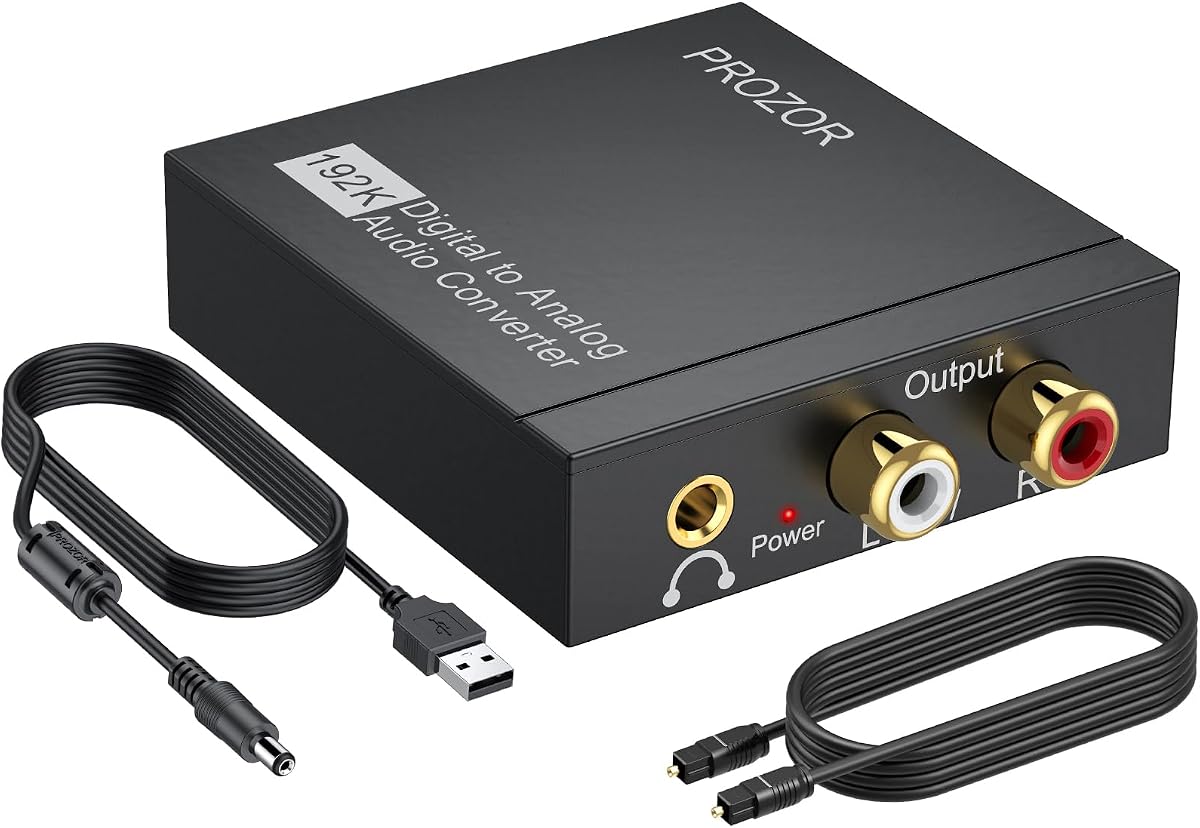


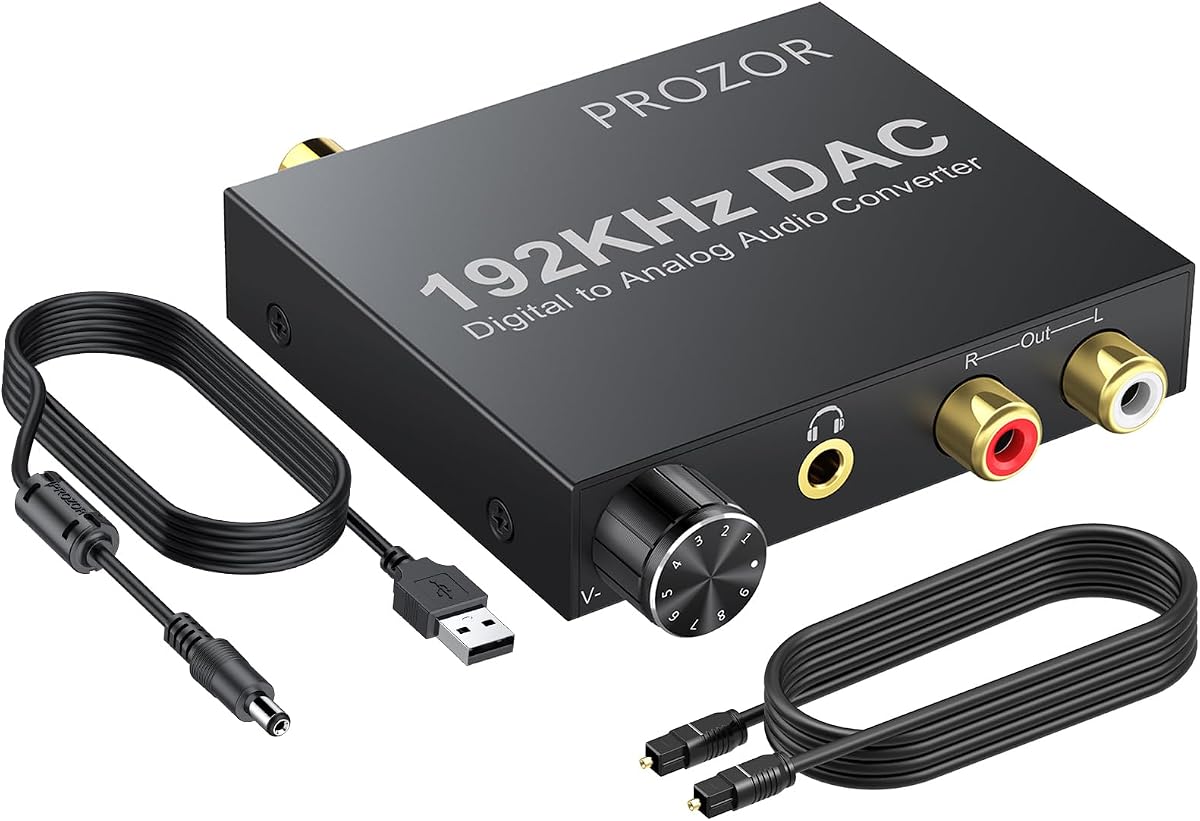


The PROZOR 192KHz Digital to Analog Audio Converter combines broad connector support with a serviceable aluminum design, earning it a place as the most flexible overall option in this guide. Its 4.4 rating reflects a strong balance of useful features, and the converter supports sampling rates from 32KHz through 192KHz with 24-bit SPDIF streams on both channels.
We may earn a commission when you buy through this link, at no additional cost to you.
Its main strength is input and output flexibility. Coaxial and optical/SPDIF signals can enter the unit, while left and right RCA outputs and a 3.5mm jack can carry the resulting analog audio simultaneously. The detachable converter box means users can replace or substitute RCA cables without replacing the entire unit, while the gold-plated connectors and aluminum housing help support reliable signal handling and heat dissipation.
The trade-off is that this is not a surround decoder. It supports uncompressed two-channel LPCM or PCM, so the source must be configured accordingly; Dolby AC-3 or DTS output may not work. It also needs a 5V 1A USB power source, and the supplied information notes that a power adapter is not included. Volume generally must be changed in the television settings rather than through the usual remote-control buttons.
This converter is a strong choice for anyone who wants both optical and coaxial inputs, analog RCA and headphone outputs, and a replaceable-cable arrangement. It is particularly useful for connecting a modern TV or game console to an older amplifier or powered speakers. For those seeking a simpler fixed-cable converter or automatic surround decoding, one of the other picks may be a closer fit.
Supporting optical and coaxial inputs gives the converter more practical value in a mixed home-entertainment setup. Simultaneous RCA and 3.5mm outputs also make it easy to compare speakers and headphones without changing the digital source.
The detachable DAC box separates the electronics from the attached analog cables, so a compromised cable does not require replacing the converter. Gold-plated RCA connectors and the aluminum enclosure complement that service-oriented design.
We may earn a commission when you buy through this link, at no additional cost to you.
The PROZOR 192KHz 7ft/2.1m cable converter offers a straightforward solution for users who want fewer loose components. It has a 4.4 rating and supports PCM signals at 32, 44.1, 48, 96, and 192KHz, including 24-bit incoming streams on the left and right channels.
We may earn a commission when you buy through this link, at no additional cost to you.
Its built-in audio amplifier chip and dual-channel operational amplifier are designed to improve output level, which is useful when driving an amplifier or powered speakers that may produce a quiet RCA signal. The compact body and integrated RCA cable reduce visual clutter and simplify placement behind a television or media console.
The design also includes a USB power cable with an integrated ferrite core to help limit electromagnetic and radio-frequency interference. That attention to power conditioning makes sense for a converter that sits between multiple electronic components. As with most basic stereo converters here, however, the unit requires two-channel PCM or LPCM and is not compatible with a 5.1 Dolby AC-3 signal.
Choose this model when a clean, compact arrangement matters and the provided cable length reaches your existing stereo equipment. It is well suited to televisions, Blu-ray players, DVD players, and game consoles. Those who need a detachable cable, a 3.5mm jack, or automatic surround decoding should consider the more versatile PROZOR converter or the eSynic decoder instead.
The integrated RCA cable reduces the number of visible connections around the media cabinet. It is a practical choice when the television and stereo are close enough for the supplied 7ft/2.1m length.
A dedicated amplifier chip is intended to address the low output level sometimes encountered with digital-to-analog conversion. This can make the converter more useful with older amplifiers and compact powered speakers.
We may earn a commission when you buy through this link, at no additional cost to you.
The PROZOR 192KHz Multi-Output DAC closely resembles the first converter in its input and output flexibility. It has a 4.4 rating, converts optical or coaxial PCM signals, and can provide analog left and right RCA output alongside a 3.5mm headphone connection.
We may earn a commission when you buy through this link, at no additional cost to you.
This model is well suited to users who want to move between powered speakers, an amplifier, and headphones without repeatedly changing the digital source. It supports the same broad set of sampling rates—32, 44.1, 48, 96, and 192KHz—and 24-bit SPDIF streams. The built-in amplifier chip targets low output volume, while gold-plated RCA connectors support dependable analog connections.
Its primary limitation is format support. Only uncompressed two-channel LPCM or PCM is supported, so a Dolby AC-3 or DTS source needs to be changed to a compatible output setting. It also requires a certified 5V 1A power adapter, which is not included, and television volume must generally be adjusted in the television's sound settings.
This is a good selection for a flexible home audio setup involving a television, game console, AV receiver, amplifier, or headphones. Its combination of two digital inputs, three analog outputs, and high-resolution PCM support gives it broad utility, though buyers who need automatic handling of surround signals should choose a dedicated 5.1 decoder.
Simultaneous RCA and 3.5mm outputs make the converter convenient for comparing analog speaker connections with headphones. The same digital source can remain connected throughout the switch.
Support for five common sampling rates and 24-bit channel streams covers standard television, music, and gaming sources. The source device must be configured to send uncompressed PCM rather than a surround encoding.
We may earn a commission when you buy through this link, at no additional cost to you.
The Neoteck 192kHz DAC Converter is a 4.4-rated option built around a 7ft/2.1m integrated cable. It converts optical SPDIF audio to left and right RCA signals for HD televisions, set-top boxes, Blu-ray and DVD players, and game consoles.
We may earn a commission when you buy through this link, at no additional cost to you.
Its high-performance amplifier chipset is intended to raise the RCA output level while maintaining a clear signal. The converter supports sampling rates from 32 to 192KHz and compatible 24-bit SPDIF incoming streams on both channels. Its compact, lightweight enclosure and integrated analog cable also make it easy to position near a wall-mounted television.
Users must set the source to uncompressed 2.0-channel PCM because Dolby AC-3 and DTS 5.1 signals are not supported. The unit requires a separable 5V 1A power adapter, and that plug is not included. The detailed guidance also emphasizes checking input and output modes, securing loose connections, and using shielded analog cables if noise appears.
The Neoteck is a sensible choice for a basic television-to-stereo connection where the source can output PCM and a longer integrated cable simplifies placement. It is less suitable for users who need surround decoding, a 3.5mm output, coaxial input, or a manually adjustable converter volume. Those requirements call for one of the more specialized PROZOR or eSynic models.
The 7ft/2.1m integrated cable is useful when the converter must sit near a television while the analog connections reach a stereo positioned farther back. It also eliminates the need for a separate RCA lead.
Most setup issues with this converter can be traced to output format, power, or a loose connection. Confirm PCM output, use a proper 5V 1A supply, and reseat the cables before changing equipment.
We may earn a commission when you buy through this link, at no additional cost to you.
The LiNKFOR 192kHz DAC Converter is the highest-rated product in this comparison at 4.8, making it a strong value-oriented choice for basic optical-to-RCA connections. It converts optical Toslink digital audio into analog left and right RCA output so a modern television can operate with older speakers or amplifiers.
We may earn a commission when you buy through this link, at no additional cost to you.
The converter supports sampling rates of 32, 44.1, 48, 96, and 192KHz, along with 24-bit SPDIF incoming streams on both channels. A built-in amplifier chip is intended to improve RCA output level and clarity. Its integrated 1.1m/3.6ft RCA cable and compact housing simplify installation without requiring a separate analog cable.
The important limitation is that it accepts digital PCM or LPCM but not 5.1-channel Dolby AC-3 or DTS signals. It must be powered through a 5V 1A USB cable. Unlike some premium decoders, it does not automatically translate surround audio into stereo, so source settings need to be checked before viewing or gaming.
This model fits shoppers who want a simple, compact converter for a television, set-top box, DVD or Blu-ray player, or game console. It is also a practical starting point for anyone beginning to build a home audio system with powered speakers. Buyers needing automatic surround handling should move up to a dedicated Dolby and DTS decoding converter.
A 4.8 rating makes this converter stand out among the basic PCM options. Its combination of a compact integrated cable, amplifier chip, and broad sampling-rate support covers the common needs of a two-channel home system.
The converter is specifically intended to bridge newer optical-output devices with older stereo speakers. That straightforward purpose makes it easy to understand and set up.
We may earn a commission when you buy through this link, at no additional cost to you.
The LiNKFOR Digital Optical SPDIF Toslink to Analog RCA DAC Converter is a compact 4.3-rated model for basic two-channel conversion. Its purpose is direct: turn optical Toslink signals from modern entertainment devices into analog audio for a stereo amplifier or powered speakers.
We may earn a commission when you buy through this link, at no additional cost to you.
The built-in amplifier chip is designed to raise the RCA output level, while support for 32, 44.1, 48, 96, and 192KHz sampling rates covers a broad selection of source material. A built-in 1.1m/3.6ft RCA cable keeps the installation compact and avoids requiring a separate analog lead.
It supports PCM and LPCM audio, but Dolby AC-3 and DTS 5.1 formats are not compatible. The device requires USB power at 5V and 1A. This means the user must supply an appropriate power connection and set the television or other source to a compatible stereo format before the converter can produce sound.
The LiNKFOR Stereo DAC is best for a uncomplicated television-to-old-speaker arrangement where only RCA output is needed. Its 4.3 rating reflects a competent basic product, though it offers fewer connections than the multi-output PROZOR options. Headphone users, coaxial-source owners, and viewers who need automatic surround conversion should choose a more specialized model.
This converter focuses on the most common requirement: optical input to left and right RCA output. That narrow scope can make installation easier for users who do not need coaxial input or a headphone jack.
The integrated amplifier chip is useful for obtaining a more suitable output level from the converted signal. It supports the converter's goal of making legacy speakers usable with modern source devices.
We may earn a commission when you buy through this link, at no additional cost to you.
The PROZOR 192KHz Volume-Adjustable DAC stands apart with a physical volume-control knob, providing direct level adjustment that most compact converters lack. Its 4.4 rating and broad connector support make it a strong premium pick for listeners who want more control over the analog output.
We may earn a commission when you buy through this link, at no additional cost to you.
Optical Toslink and coaxial digital inputs feed left and right RCA outputs and a 3.5mm jack. Sampling rates from 32 to 192KHz are supported, along with 24-bit SPDIF streams on both channels. The supplied description also states that the unit can eliminate noise when no signal is present and automatically mute for non-audio input signals.
Its aluminum metal housing is described as heat resistant, while gold-plated input and output interfaces are intended to reduce transmission loss. A one-meter optical cable is included. The unit still operates as a two-channel PCM converter rather than a surround decoder, so Dolby AC-3 and DTS 5.1 are not the intended input formats.
A certified 5V 1A supply is required, and the power adapter is not included. This model is ideal when television menus make remote volume control inconvenient, when a headphone output is desired, or when a user wants to fine-tune the converter level in a room with fixed amplifier settings. It is less appropriate when automatic surround decoding is the priority.
The built-in knob lets users set the converter's output level independently of source and television volume. This is especially useful when an amplifier has a fixed input level or the television does not expose optical-output volume controls.
The aluminum casing, gold-plated interfaces, dual digital inputs, and three analog outputs give this converter a more substantial feature set than the basic fixed-cable alternatives.
We may earn a commission when you buy through this link, at no additional cost to you.
The PROZOR 192KHz 5.1CH Decoder is designed for viewers and gamers whose source devices output Dolby AC-3 or DTS rather than standard PCM. With a 4.4 rating, it offers automatic conversion from digital surround signals to two-channel analog left and right RCA output.
We may earn a commission when you buy through this link, at no additional cost to you.
Digital optical and coaxial inputs are supported, and the converted audio can be sent through RCA connections or the 3.5mm jack. Dolby AC-3, DTS 5.1, LPCM, and PCM modes are listed as compatible source formats. The converter handles the surround signal and provides a 2.0-channel analog result for speakers or amplifiers that cannot accept surround input.
Its 192KHz sampling support and 24-bit SPDIF incoming streams offer a useful technical foundation for high-resolution audio. An adjusted amplifier chip and magnetic-ring power cord are intended to promote stable operation and reduce noise. The trade-off inherent to this approach is that a 5.1 mix becomes stereo; it does not recreate six separate speaker channels.
This decoder is a strong option for modern streaming devices, game consoles, Blu-ray players, and cable boxes connected to legacy stereo equipment. It is particularly useful when changing the television's output format to PCM is inconvenient or when a source automatically sends Dolby or DTS audio. Buyers seeking true surround-channel analog output would need a different type of device.
By decoding Dolby AC-3 and DTS signals, the converter can handle sources that default to surround formats. This reduces setup friction for streaming and gaming systems.
The decoder translates multichannel information into a two-channel analog mix for an amplifier or speaker pair. It preserves the ability to hear the source, although it cannot provide discrete surround outputs.
We may earn a commission when you buy through this link, at no additional cost to you.
The eSynic 192KHZ Optical to RCA Adapter is a 4.2-rated converter with a 7ft extended cable and a 24-bit DAC chip. It is positioned as a direct bridge between modern optical-output devices and older amplifiers, with support for 192KHz audio and two-channel PCM.
We may earn a commission when you buy through this link, at no additional cost to you.
Its aluminum housing and gold-plated RCA ports provide a more robust-looking construction than basic plastic converters. The extended fiber-optic cable is useful behind wall-mounted televisions or where the stereo sits well behind the screen. A status LED is listed as an operational indicator, and the product is designed for plug-and-play use without drivers.
There are some inconsistencies in the supplied information. One bullet claims that no external power is needed and that power is drawn from the optical port, while the compatibility guide says a 5V 1A USB power adapter is required and not included. Optical connections do not ordinarily carry usable power, so buyers should verify the package contents and confirm the actual power method with the seller.
The model supports PCM 2.0 only and does not decode Dolby or DTS 5.1 or 7.1. It is one-way, converting optical input to RCA output, and volume is controlled through the connected speaker or amplifier rather than the television remote. This is best for a PCM-capable source and a straightforward analog system, but the power ambiguity makes it a less confident recommendation than the fully consistent alternatives.
The 7ft fiber-optic cable is a practical advantage when the source television is mounted high on a wall. It can reach a converter positioned near legacy audio equipment without an additional optical run.
The supplied listing contains conflicting power claims. Because the compatibility section requires a 5V 1A USB adapter and states that it is not included, buyers should verify what ships with the unit rather than assuming it can operate without power.
We may earn a commission when you buy through this link, at no additional cost to you.
The eSynic 192KHZ Optical to RCA Adapter with Dolby AC-3 and DTS 5.1 decoding is the most format-flexible model in this guide. Its 4.3 rating reflects a capable solution for users who want surround signals decoded automatically rather than changing every source to PCM.
We may earn a commission when you buy through this link, at no additional cost to you.
The converter accepts Dolby AC-3, DTS, PCM, WAV, WMA, AAC, FLAC, and other listed formats, then down-mixes 5.1 audio into two-channel analog output. Its integrated amplifier chip is intended to produce a strong, clean RCA level. This makes it useful with streaming services, game consoles, Blu-ray players, cable boxes, and older stereo systems.
The listed specifications include sampling rates from 32 to 192KHz, 16- to 24-bit resolution, a 105dB signal-to-noise ratio, THD+N of -90dB, and a stated frequency response of 20Hz to 20KHz. The package includes a converter with an integrated RCA cable, a USB power cable, and a user manual. Because the output is analog RCA, the result is stereo even when the incoming source is 5.1.
This is the most compelling choice for users whose television, console, or streaming device automatically sends Dolby or DTS and who want fewer menu changes. It is less suitable if discrete 5.1 analog channels are required. The cable description also refers to both a built-in 1.1m RCA cable and a total 2.1m reach, so buyers should check the package and cable arrangement to ensure it fits their installation.
Native Dolby AC-3 and DTS decoding allows applications that default to surround audio to work without repeatedly switching the television to PCM. That convenience is the model's defining advantage.
The listed signal-to-noise ratio, distortion figure, frequency response, and 192KHz support present a technically strong specification set for a stereo downmixing converter.
We may earn a commission when you buy through this link, at no additional cost to you.
The right optical to RCA adapter depends first on source format, then on connector layout, power, cable placement, and output control. Checking these factors before buying prevents common problems involving silence, noise, unsupported surround signals, or awkward installation.
Most entry-level optical to RCA adapters expect uncompressed two-channel PCM or LPCM. That format works well for compatible television menus, music, and many games, but Dolby AC-3 and DTS signals require a decoder that can down-mix them to stereo. The source menu often contains an audio-output choice labeled PCM, Dolby Digital, or DTS, and the selected option must match the converter's capabilities.
Choose PCM-only models when you can easily configure every source and want a simpler converter. Choose a Dolby and DTS decoder when streaming apps, game consoles, or disc players automatically use surround formats and you want fewer setting changes.
Optical Toslink is the defining input, but some source devices offer a coaxial digital output instead. A converter with both optical and coaxial inputs gives you more freedom when connecting televisions, players, set-top boxes, and older audio components. Models with only optical input remain perfectly suitable when the source has a clearly accessible optical port.
Prioritize optical input for modern home entertainment, then consider coaxial input if you own legacy equipment or want one converter to serve several devices. Confirm that the source output is compatible with the converter before making a purchase.
Left and right RCA outputs are the minimum needed for a stereo amplifier or speaker pair. A 3.5mm jack adds useful flexibility for headphones, compact powered speakers, and other analog listening equipment. Models that provide both can feed two types of equipment from the same converter without replacing digital cables.
Match the outputs to your existing system rather than paying for connections you will never use. If your amplifier has red and white RCA inputs, prioritize a clear left/right output; if you regularly use headphones, include a 3.5mm output in the decision.
Integrated RCA cables create a compact installation and can be enough for a television placed near an amplifier. A longer fixed cable helps when equipment is separated or the television is wall-mounted. Detachable converter boxes offer a different advantage: a damaged or poorly fitting RCA cable can be replaced without replacing the electronics.
Measure the route from the source to the stereo before choosing a fixed length. For long installations or unusual furniture arrangements, a detachable design may be more valuable than an unusually long molded cable.
Most converters require USB power, commonly at 5V and 1A according to the supplied specifications. Some include a USB cable but not a wall adapter, while others mention ferrite-core or magnetic-ring versions of the power lead. A stable, certified supply can reduce electrical noise and improve reliability, so the power specification should be checked before ordering.
Avoid improvised power arrangements and verify whether an adapter is included. If a listing contains conflicting claims about whether external power is necessary, contact the seller or manufacturer and confirm the package contents before ordering.
Optical-output volume is often controlled separately from the television's speaker volume, so changing the remote volume may not affect a downstream sound system. Most basic converters rely on source settings and the connected amplifier for level adjustment. A converter with a physical volume knob offers greater independence and can be useful in installations where the amplifier or speakers have limited controls.
Look for an integrated amplifier chip when a converter must drive older speakers or a less sensitive amplifier. If manual converter-level control is important, choose a model with a dedicated knob rather than assuming every DAC includes one.
Most products in this category support up to 192KHz and 24-bit SPDIF streams, so the headline specification alone rarely distinguishes them. More useful differences include surround decoding, amplifier circuitry, connector materials, detachable construction, and power-cable design. Aluminum housings can improve heat dissipation and electromagnetic shielding compared with basic plastic enclosures.
Treat numerical claims as one part of the decision rather than the entire one. Match the converter to the source format, ensure its outputs reach the intended amplifier, and prioritize a construction and wiring arrangement that suit the installation.
Begin by identifying the correct digital output on the source television, player, console, or set-top box. Connect the optical cable to that source and to the converter's Toslink input, then connect the left and right RCA outputs to matching red and white inputs on the amplifier or powered speakers. If the model includes a 3.5mm output, connect headphones or compatible powered speakers there instead when needed.
Power the converter with a suitable 5V USB supply as directed by the included instructions. Before playing audio, set the source's digital audio output to PCM or LPCM when using a basic stereo model. If you selected a decoder with Dolby AC-3 or DTS support, you may also use those formats. Confirm that the appropriate source volume is enabled and adjust the television's digital audio output volume if its remote does not control the optical signal.
For the best results, keep the converter and analog cables away from power adapters, poorly shielded cables, and sources of interference. Use shielded RCA leads if buzzing occurs, reseat optical and power connections if there is no sound, and check the converter's power indicator. Do not change cables while audio is playing, and avoid using power hardware that does not meet the voltage and current requirements stated in the product instructions.
An optical to RCA adapter receives a digital audio signal through a Toslink or SPDIF optical connection and converts it into analog left and right stereo audio. This makes it possible to connect a modern television, game console, or disc player to an older amplifier, powered speakers, or another device that only accepts RCA inputs. It converts digital audio to analog audio; it does not perform the reverse conversion.
It can provide a clean digital-to-analog connection and may sound better than a television's built-in speakers or an unsuitable analog output path. However, the converter cannot create detail that was not present in the source recording, and actual results depend on the source, amplifier, speakers, cables, and room. The main benefit is compatibility with stereo equipment that cannot accept optical digital audio.
Only if the chosen converter includes Dolby AC-3 or DTS decoding. Most basic PCM converters in this guide cannot process 5.1 signals and require the source to be changed to PCM or LPCM. The PROZOR 5.1CH model and the eSynic Dolby/DTS model can decode surround formats and provide a two-channel stereo downmix for analog speakers.
First, confirm that the optical cable is firmly connected and that the converter's power light is operating. Next, set the source's digital output to PCM for a basic model, select the correct speaker output on the television, and check that the television's digital audio output volume is not muted. Also verify that the RCA cables reach the correct red and right, and white and left, amplifier inputs.
Many televisions adjust the volume of their built-in speakers separately from their optical digital output. In that case, the remote may not change the signal sent to the converter. Adjust the television's digital audio output volume in its sound settings, use the converter's physical volume knob if it has one, or control volume through the connected amplifier.
That depends on the model. The supplied product information indicates that most converters use a 5V 1A USB power connection, and several include a USB cable without including a wall adapter. The eSynic PCM listing contains conflicting claims, so verify its package contents before purchase. Using a certified supply that matches the stated voltage and current is the safest approach.
Yes, but only with a model that includes a 3.5mm output. The PROZOR options in this guide provide both left and right RCA outputs and a 3.5mm jack, allowing the converted signal to reach headphones as well as an amplifier. Models with RCA-only outputs require an additional 3.5mm-to-RCA arrangement if headphones must be used.
No. The rating shows the maximum sampling rate the converter can support, not a guarantee that every source contains 192KHz material. Most television and streaming content uses lower rates, and the audible result also depends on the source quality, converter circuitry, amplifier, speakers, cables, and listening environment. Format compatibility and installation are often more important than the headline rate.
The LiNKFOR 192kHz DAC stands out as the best budget-oriented pick because of its 4.8 rating, compact integrated cable, amplifier chip, and straightforward PCM conversion. The PROZOR 192KHz DAC earns the editor's choice for broader input and output flexibility, while the eSynic 5.1ch Decoder is the strongest premium choice for automatic Dolby AC-3 and DTS handling.
Most buyers should first confirm the audio format emitted by their source device. PCM-only converters are simple and dependable when source menus are accessible, while surround decoders reduce configuration friction for streaming and gaming. Connector coverage, integrated cable length, physical volume control, and the inclusion of a proper power supply should then guide the final choice.
Current prices and product details may change, so compare the latest listing, package contents, compatibility notes, and user feedback before purchasing. Confirming the source format and power method in advance is especially important because the simplest converter is only effective when the television or player is configured to send it the signal it supports.