
Vaonis Vespera Pro 2
5.0Editor score
12.5MP square imaging sensor
50MP mosaic capture mode
BalENS signal enhancement
Full manual exposure controls
Multi-night automatic stacking
A smartphone can become a surprisingly capable astrophotography tool when paired with the right optical hardware. The most useful setups range from app-controlled smart telescopes to conventional telescopes with phone adapters, giving beginners and experienced observers different paths to capturing the Moon, stars, and deep-sky objects.
We compared all 10 products by examining their intended astrophotography workflow, optical compatibility, smartphone integration, imaging features, portability, ease of setup, and compatibility with common observing equipment. The list includes smart telescopes, precision phone adapters, complete entry-level telescopes, and a wireless electronic eyepiece rather than focusing on phones alone.
Each pick highlights a different route into smartphone-assisted astrophotography, from automated deep-sky imaging to manual eyepiece photography. Ratings and product details reflect the supplied information, while availability and pricing can change, so readers should verify current product pages and accessory compatibility before making a purchase.
5.0Editor score

4.4Editor score

4.0Editor score
As an Amazon Associate we earn from qualifying purchases.
This side-by-side comparison covers three fully smart telescopes, four phone-adapter options, two complete telescopes with smartphone support, and one electronic eyepiece, revealing how automation, optical capability, and equipment compatibility differ.



The ZWO Seestar S30 Pro Smart Telescope is an approachable all-in-one system for smartphone-assisted astrophotography, and its supplied 4.4 rating reflects a favorable user reception. It removes most of the mechanical complexity associated with deep-sky photography by using an app for target selection, automatic acquisition, tracking, stacking, mosaics, and image delivery. That makes it a practical choice for anyone who wants to photograph nebulae, galaxies, the Milky Way, or the Moon without learning the entire traditional imaging workflow on the first night.
We may earn a commission when you buy through this link, at no additional cost to you.
Its most persuasive feature is the combination of automatic GOTO targeting and tracking with one-tap astrophotography modes. The dual-camera system can produce 4K-quality results, while the built-in light pollution filter is useful in urban and suburban locations where the sky is brighter. AI-assisted noise reduction, sky-and-foreground separation, intelligent imaging modes, and automatic mosaic stitching further reduce the number of manual decisions required. Its apochromatic optics are intended to preserve star definition and improve contrast, giving it a useful advantage when faint targets compete with artificial light.
There are important limitations. The telescope is designed for deep-sky imaging, the Moon, and the Sun rather than planetary observation, and the product information specifically advises keeping it stationary during deep-sky sessions. Its automation is most valuable when the device can remain fixed on a level surface or suitable support, so tripod vibration and accidental movement remain worth guarding against. It also requires a compatible smartphone or tablet and an app connection, meaning the phone serves as a controller and viewing device rather than the primary image sensor.
This is the strongest general recommendation for beginners, families, travelers, and anyone who wants productive astrophotography without assembling a complex imaging train. Its portability, filtering, mosaics, and assisted processing make it particularly useful for nights when time and experience are limited. The Seestar S30 Pro is less appropriate for a dedicated planetary observer, but for automated deep-sky and wide-field work, it offers one of the most approachable balances in this list.
Automatic finding, tracking, stacking, and mosaicking let new users concentrate on framing the sky and choosing targets. This is especially helpful for faint deep-sky objects that normally require careful polar alignment, cable management, and repeated exposure sequencing.
The integrated light pollution filter and AI noise-reduction workflow make the system more practical around cities, where much of the night sky is washed out. The automatic foreground separation can also help produce balanced landscape compositions under imperfect lighting conditions.
We may earn a commission when you buy through this link, at no additional cost to you.
The tridaptor Universal Phone Scope Digiscoping Adapter is a precision accessory for people who already own a telescope, spotting scope, monocular, binocular, or microscope and want to use a smartphone camera to capture the view. Its supplied 4.4 rating places it among the stronger-reviewed options here. Unlike a simple clip, this adapter uses three-axis adjustment to align the phone camera with an eyepiece and maintain a stable position during an exposure.
We may earn a commission when you buy through this link, at no additional cost to you.
The rigid aluminum construction is a major advantage for long-exposure astrophotography. Phone adapters that flex or shift can create soft corners, uneven focus, and unexpected vibration. The tridaptor's metal frame, rubber pads, and independent left-right, up-down, and forward-back adjustment help solve those problems. The Z-axis movement also helps reach proper eye relief, which can reduce dark edges and vignetting when the camera is aligned over the eyepiece.
Its supplied Bluetooth remote allows the user to trigger photos or videos without touching the optical equipment, reducing the chance that a tap will shake the telescope at the moment of capture. Compatibility is broad: it is designed for many iPhone and Android phones measuring 2.36 to 3.44 inches wide and for eyepieces with an outer diameter of 0.86 to 2.4 inches. The listed optical brands include Vortex, Swarovski, Celestron, Nikon, Zeiss, Kowa, Leupold, and others.
The adapter is best for an observer who wants adaptable smartphone imaging without replacing an existing optical system. It supports celestial objects as well as wildlife and distant scenes, so its value extends beyond astronomy. Buyers should measure both the phone and eyepiece before ordering because the product is not intended for shorter eyepiece models. Even with that caveat, its precision and sturdy design make it the most flexible independent phone adapter in the roundup.
Independent X-, Y-, and Z-axis adjustments make it easier to place the camera over the eyepiece with enough clearance to avoid dark borders. Accurate alignment also helps maintain consistent focus, which matters when a phone is being used as a fixed camera on an astronomical instrument.
A rigid metal frame is especially relevant under the low light conditions common in astrophotography. When the phone and optical device do not shift, the included Bluetooth remote helps capture images without physically touching the mount.
We may earn a commission when you buy through this link, at no additional cost to you.
The Celestron Basic Telescope Eyepiece Smartphone Adapter offers one of the most accessible ways to begin smartphone astrophotography with an existing optical device. Its supplied 4.0 rating indicates a generally positive reception, while the straightforward design makes it suitable for first-time users. The adapter centers a phone camera over an eyepiece and secures the assembly with adjustable knobs, allowing the phone to capture images and video through a telescope, spotting scope, binocular, monocular, or microscope.
We may earn a commission when you buy through this link, at no additional cost to you.
One of its strongest advantages is universal smartphone support. It is designed to work with current iPhone, Samsung Galaxy, and Google Pixel models, and it can accommodate most cases. That matters because removing a case for every session is inconvenient, while a case-aware design is more likely to remain part of the user's normal setup. Its durable metal frame and polymer body should also withstand regular transport in a telescope bag.
The main compromise is alignment. Instead of the three-axis controls found on more advanced adapters, this model uses a simpler positioning system. That is sufficient for many visual targets and bright astronomical subjects, especially the Moon, but it may require more patience to eliminate edge vignetting or achieve uniform focus across a phone camera. The eyepiece range of 29 to 45 millimeters also does not cover every optical accessory, including smaller barrel sizes used by some instruments.
This is a sensible pick for budget-conscious beginners who own a compatible telescope or spotting scope and want to experiment with smartphone photography. It is not the most refined alignment tool in the guide, yet it combines broad phone compatibility, straightforward operation, and portability. For learning the basics or sharing quick views with friends and family, it provides a practical pathway into the category without the complexity of a fully smart telescope.
The basic placement process is easy to understand: center the camera over the eyepiece and tighten the knobs. It is a direct way to learn how phone sensors interact with magnified optical views without adding another level of controls.
Support for common iPhone, Samsung Galaxy, and Google Pixel devices gives the adapter broad relevance. Its ability to work with most cases also reduces setup friction during star parties, birding trips, and travel.
We may earn a commission when you buy through this link, at no additional cost to you.
This version of the ZWO Seestar S30 Pro combines app-controlled smart telescope functions with 128GB of onboard storage, making it a compelling option for creators who want room to retain and edit images away from a computer. The supplied product listing does not show a numerical user rating, so its evaluation here focuses on documented features. It is designed to find and track objects automatically, then send results to a smartphone or tablet.
We may earn a commission when you buy through this link, at no additional cost to you.
Its dual-camera system can capture high-resolution images of the Moon, galaxies, nebulae, and the Milky Way. Intelligent modes for auto alignment, image stacking, time lapse, video, AI noise reduction, and mosaics make it possible to obtain a finished result through a guided workflow. Users may also save raw image files for custom editing, which is valuable for those who want more control than a one-tap processing mode permits.
Portability is another major strength. The telescope weighs just 3.6 pounds and is supplied with a tripod, carry case, solar filter, USB-C cable, quick guide, safety guidelines, and sticker pack. A built-in light pollution filter and anti-dew protection improve its suitability for extended sessions, while the stated battery life reaches up to six hours. As with the other Seestar offering, it is intended for deep-sky targets, the Moon, and the Sun rather than planetary viewing.
The lack of a numerical rating makes it harder to compare user sentiment with established products, but the feature set is well suited to mobile creators. The requirement for a smartphone or tablet is reasonable for a control-centric smart telescope, while the internal storage provides meaningful independence. Choose this version if generous onboard capacity, a long stated battery life, and travel-ready accessories are priorities.
With 128GB of internal storage, photographers can retain multiple stacked images and mosaics without immediately transferring every file. That is particularly useful for multi-object nights, travel sessions away from reliable internet service, and creators preparing files for later processing.
The included tripod, hard carrying option, solar filter, charging cable, and guidance materials reduce the number of separate accessories needed for a first outing. The light pollution filter and anti-dew protection add practical support for imaging under difficult conditions.
We may earn a commission when you buy through this link, at no additional cost to you.
The Celestron NexYZ DX Smartphone Adapter is a refined digiscoping solution for a phone user who wants controlled camera alignment and vibration-free shutter control. Its supplied 4.1 rating suggests a positive but not uniformly perfect user response. The adapter supports photo and video capture through telescopes, spotting scopes, binoculars, monoculars, and microscopes, making it a versatile bridge between a modern phone and conventional optics.
We may earn a commission when you buy through this link, at no additional cost to you.
Three directional adjustment knobs handle X-, Y-, and Z-axis positioning, while the Z-axis function helps the user frame the camera quickly and achieve proper eye relief. The spring-loaded slider accommodates a wide range of modern iPhone, Samsung Galaxy, and Google Pixel devices, including heavier phones and most cases. A Bluetooth shutter release eliminates the need to touch the optical device when taking a picture, which is a meaningful benefit in low-light and high-magnification situations.
Its specified eyepiece compatibility extends from 35 to 60 millimeters, including telescope eyepieces with 1.25-inch and 2-inch barrels. Two microscope adapters are included. The metal frame and polymer body are designed for field use, and the spring-loaded mechanism allows a phone to be removed and replaced without rebuilding the entire setup.
The NexYZ DX is best for observers who already own a suitable optical device and want repeatable alignment. It offers more control than the basic Celestron adapter and includes a remote that the basic model lacks. The trade-off is a narrower eyepiece range and a more involved device than a simple universal clip, so buyers should measure their equipment before ordering.
The adjustment controls make it easier to keep the phone camera square with an eyepiece and properly spaced for clear imaging. This is useful when a user changes targets, rotates the phone, or works with different eyepieces during an observing session.
The Bluetooth shutter release allows photos and videos to be started without touching the telescope. Avoiding contact helps prevent movement at the instant of capture, a common source of softness in magnified phone images.
We may earn a commission when you buy through this link, at no additional cost to you.
The Celestron NexYZ 3-Axis Phone Adapter is a solid precision option for producing repeatable images through an existing telescope or other optical instrument. It carries a supplied 4.2 rating and uses the same three-axis positioning concept that makes precise camera-over-eyepiece alignment possible. The adapter supports image and video capture through telescopes, spotting scopes, binoculars, monoculars, and microscopes.
We may earn a commission when you buy through this link, at no additional cost to you.
The spring-loaded slider and tension adjustments hold modern iPhone, Samsung Galaxy, and Google Pixel models securely, including phones that are relatively heavy or enclosed in cases. Independent X-, Y-, and Z-axis controls give the user more precise placement than a basic holder. That precision matters when the camera lens is wider than the apparent eyepiece field, because even a small centering error can introduce dark corners or uneven brightness.
Compatibility covers eyepieces from 35 to 60 millimeters in diameter, including 1.25-inch and 2-inch telescope eyepieces. Two adapters for microscopes are included, and the compact design is intended to fit easily into a gear bag. The durable metal frame and polymer body are suitable for regular field use, while the quick phone-change mechanism helps when one adapter supports multiple optical devices.
This NexYZ model is a good middle ground between a basic universal adapter and a more elaborate remote-control system. It does not include the Bluetooth shutter found on the NexYZ DX, so users may need another method to avoid touching the scope during capture. Even so, its three-axis control and strong phone support make it a dependable choice for improving framing and consistency.
Tension controls and three-axis movement keep the phone steady and correctly aligned. Consistent geometry makes it easier to repeat a setup between clear nights instead of rebuilding the camera position each time.
Support for telescopes, spotting scopes, binoculars, monoculars, and microscopes makes this useful beyond astronomical imaging. The included microscope adapters further expand its role as a general-purpose digiscoping tool.
We may earn a commission when you buy through this link, at no additional cost to you.
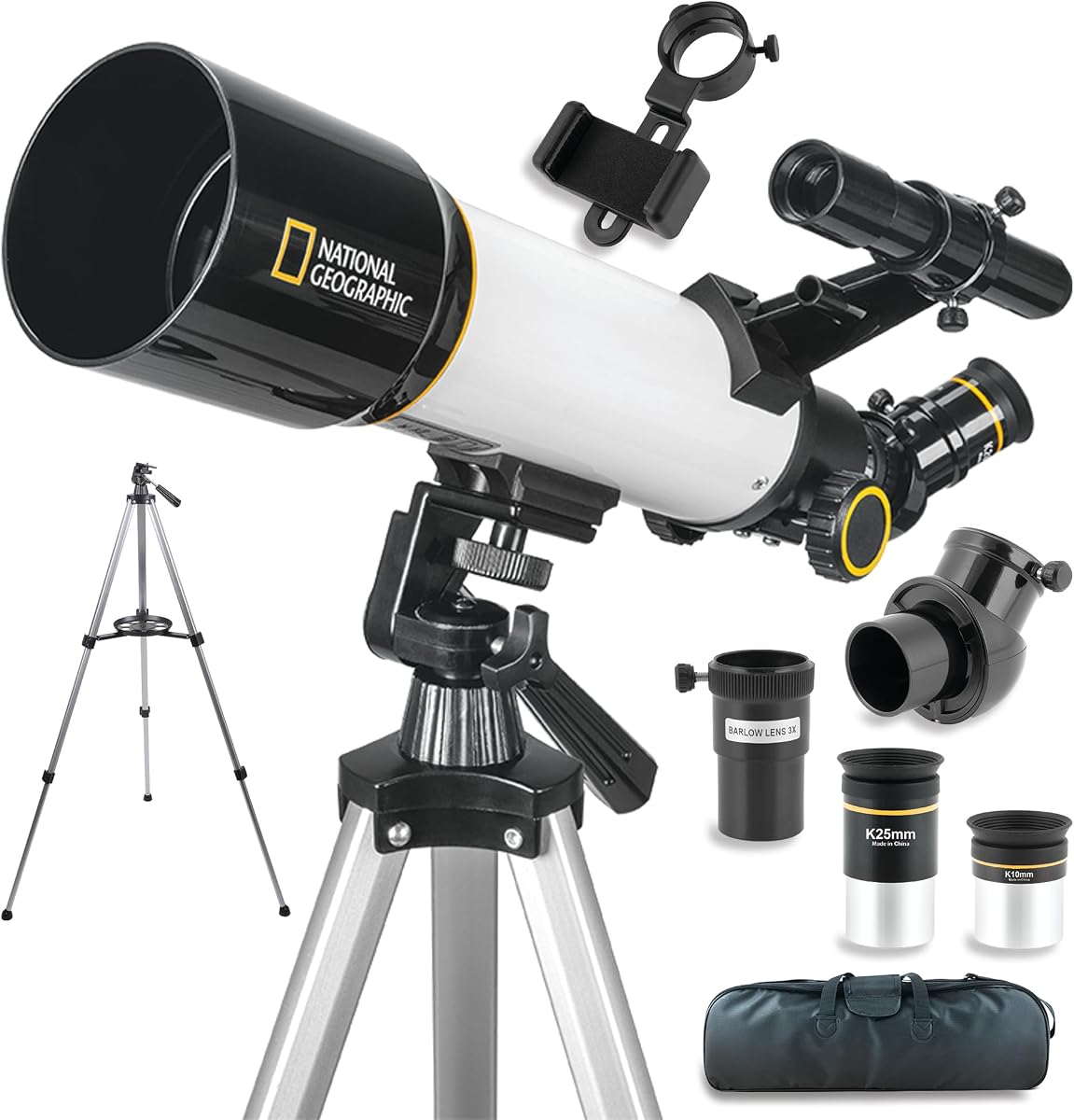
The National Geographic Sky View 70mm Refractor Telescope is a complete entry-level setup for visual astronomy and simple smartphone astrophotography. Its supplied 3.8 rating is the second-lowest among the rated products in this guide, so buyers should view it primarily as a convenient starter package rather than a sophisticated deep-sky imaging platform. The included smartphone adapter allows users to photograph the Moon or other targets without buying the optical system and adapter separately.
We may earn a commission when you buy through this link, at no additional cost to you.
Its 70mm aperture and 400mm focal length provide a practical combination for observing the Moon, planets, brighter deep-sky objects, nebulae, and star clusters. Two interchangeable eyepieces and a 3x Barlow lens provide listed magnifications of 16x, 40x, 48x, and 120x. A panhandle mount makes it easier to adjust the telescope smoothly, while the diagonal offers a comfortable viewing angle and the straight-through viewfinder assists with object location and alignment.
The package also contains an adjustable tripod with an accessory tray, keeping eyepieces and the Barlow lens close at hand. This is a complete, portable system for a family, student, or casual observer who wants to learn the fundamentals. Its astrophotography results will be more dependent on careful alignment, stable mounting, phone exposure control, and post-processing than those from an automated smart telescope.
Choose this telescope if the priority is learning astronomy with a coordinated setup and taking occasional smartphone images. It offers more than a bare adapter because it includes the telescope, mount, tripod, finder, optics, and phone connection in one package. It is not aimed at advanced deep-sky stacking, extensive mosaics, or highly controlled long-exposure workflows.
The supplied eyepieces, Barlow lens, diagonal, finder, mount, tripod, accessory tray, and smartphone adapter provide the core components needed to begin observing. This reduces the complexity of assembling a first telescope from separate accessories.
The included adapter is intended for Moon photography and other basic smartphone shots. Its value lies in accessibility: the user can concentrate on learning to aim and frame rather than first researching every component of a digiscoping setup.
We may earn a commission when you buy through this link, at no additional cost to you.
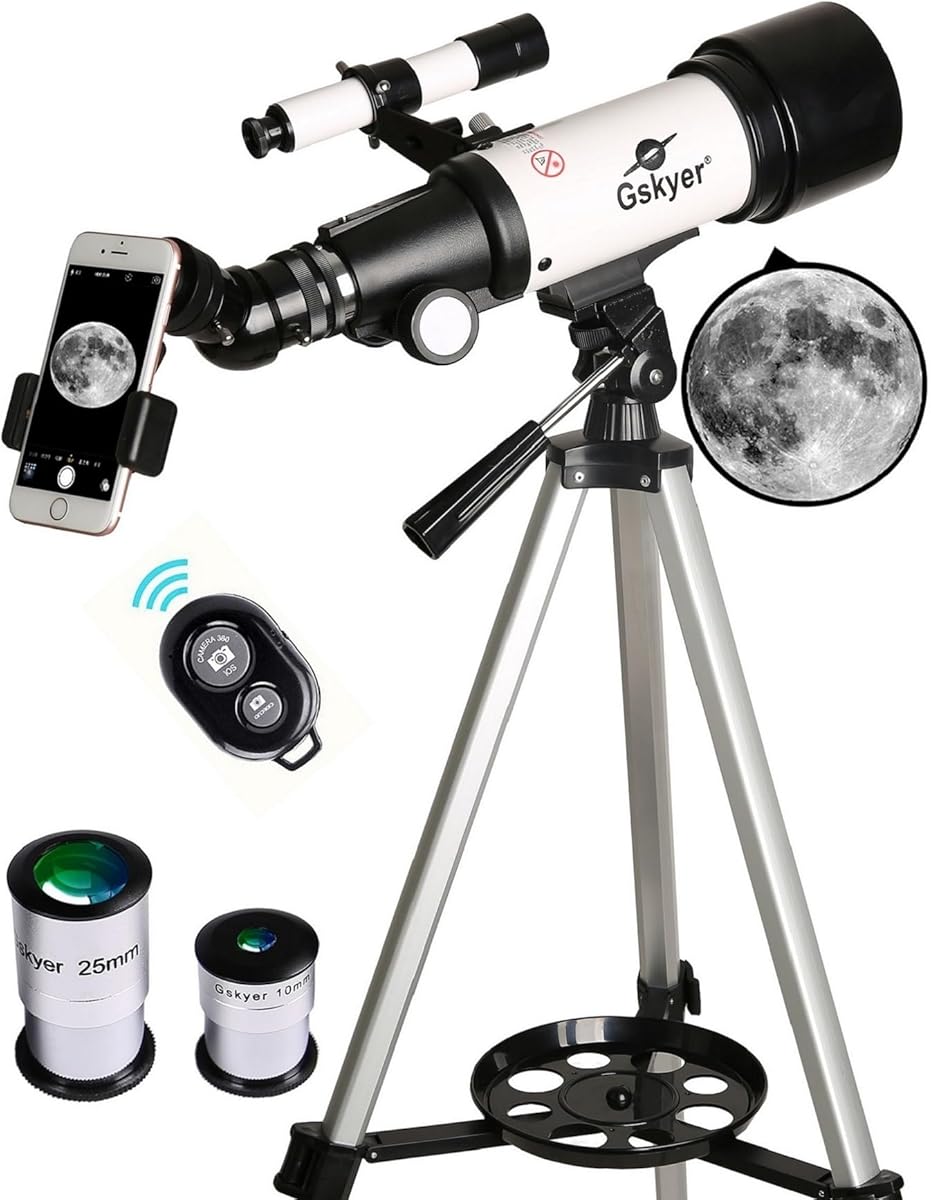
The Gskyer 70mm Aperture 400mm AZ Mount Astronomical Refracting Telescope is aimed at beginners, children, and casual observers who want both visual use and a path into smartphone photography. Its supplied 4.3 rating is among the stronger results in the roundup. The 70mm fully coated objective and 400mm focal length provide a conventional refractor setup for exploring stars and the Moon, while the included phone adapter and wireless camera remote make basic imaging straightforward.
We may earn a commission when you buy through this link, at no additional cost to you.
Two replaceable eyepieces and a 3x Barlow lens provide several viewing options, and the 5×24 finder scope with crosshairs helps users locate objects before switching to the main telescope. The adjustable aluminum alloy tripod supports multiple viewing positions, while the supplied carry bag allows the telescope and tripod to be packed together for travel or storage. That combination of features is particularly useful for families or people who observe away from home.
The wireless remote reduces the need to touch the telescope while taking a phone photo or recording video. The phone adapter connects the camera to the optical view, allowing images to be framed and captured from the handset. As with other entry-level refractors, the results will depend on the stability of the mount, accurate alignment, and appropriate exposure settings rather than automated stacking or mosaic functions.
This telescope is a good choice for someone who wants one coordinated package rather than separate accessories. It supports visual astronomy, basic astrophotography, and portable observing without introducing a powered mount or complex app. It is not designed for advanced multi-night deep-sky workflows, but it offers an approachable way to develop skills and understand how a smartphone camera can record magnified sky views.
The folding aluminum tripod and included carry bag make the whole system easier to transport. Portability increases the number of observing opportunities, whether the destination is a campsite, a dark-sky site, or simply a clear backyard.
The included wireless camera remote helps users take images and record video without touching the optical tube. Combined with the phone adapter, it creates a simple workflow for sharing lunar and terrestrial views.
We may earn a commission when you buy through this link, at no additional cost to you.
The Andoer WiFi Electronic Eyepiece offers a different way to connect a smartphone with a telescope. Rather than placing a phone camera over a lens, this compact electronic eyepiece fits a 1.25-inch telescope barrel and sends live viewing, image capture, and video recording to a phone or tablet over WiFi. Its supplied 3.4 rating is the lowest among the rated products here, making careful evaluation of the intended use especially important.
We may earn a commission when you buy through this link, at no additional cost to you.
The electronic approach removes the alignment problem associated with conventional phone adapters. Users do not need to determine whether a phone camera is centered, high enough, or close enough to capture a clean eyepiece image. It also uses a dedicated camera and supports 4K video recording according to the supplied information, which may appeal to users who want live remote viewing as well as saved recordings.
Its built-in 1600mAh lithium battery and included Type-C charging cable support portable operation. The compact camera can fit in a backpack and work for astronomy, bird watching, and other outdoor observation. WiFi connectivity allows the user to view and capture from the phone or tablet, although actual range and connection behavior will depend on the environment and connected device.
This product is most practical for someone who already owns a compatible 1.25-inch telescope and wants a wireless electronic viewing solution. It is less suitable as a standalone starter because an external optical device is required. The dedicated camera and wireless workflow are attractive, although the lower rating suggests users should consider the quality and stability of a particular installation and verify their telescope's fit before purchasing.
Because the imaging sensor sits in the eyepiece position, the system does not rely on a phone camera being manually centered over glass. That simplifies the connection and can reduce the dark-edge problems associated with poorly aligned adapters.
The phone or tablet functions as a live viewing screen and capture interface through WiFi. This makes the electronic eyepiece useful for sharing an observation or checking framing without crowding around the eyepiece.
We may earn a commission when you buy through this link, at no additional cost to you.
The Vaonis Vespera Pro 2 is the most technically advanced smart telescope in this guide and the strongest choice for astrophotographers who want both automation and advanced manual control. Its supplied 5.0 rating is the highest numerical score among the products. At the center of the system is a 12.5MP Sony IMX676 square sensor with 1.6 arcsec-per-pixel sampling and a limiting magnitude of 16, paired with a flat-field apochromatic quadruplet and stray-light baffles.
We may earn a commission when you buy through this link, at no additional cost to you.
Its wide 4.18-by-4.18-degree mosaic field can cover expansive nebulae and galaxy clusters, while automatic multi-night capture can stack data over dozens of hours across several evenings. BalENS signal enhancement is designed to reveal faint targets and suppress sky gradients automatically, while master dark calibration is applied across the workflow. These features reduce the manual effort involved in reaching a polished result without removing the ability to make informed adjustments.
Manual users can select exposures from 1 to 30 seconds, set gain from 0 to 30dB, and export FITS or TIFF files to PixInsight or Siril. The Singularity app supports both automated and fully controlled operation, and the stated 225GB storage, 11-hour battery, aluminum tripod, and hard case create a serious portable imaging package. The five-year warranty and origin in France further distinguish it from entry-level phone adapters.
This is the premium recommendation for a serious smartphone-controlled astrophotography system. It suits users who want to move beyond immediate phone-camera snapshots and produce calibrated, processable data for deep-sky work. The trade-off is complexity compared with simpler adapters, plus a much larger equipment commitment. Even so, the sensor, mosaic system, multi-night automation, and manual export options create the most advanced imaging path among the ten products.
The Singularity app allows a user to automate acquisition or take direct control over exposure and gain. That balance is valuable for beginners who want assistance and experienced imagers who need reproducible control over capture settings.
FITS and TIFF exports make the captured data compatible with established astrophotography processing software. Combined with multi-night stacking and a large mosaic field, this supports a workflow that extends well beyond a single phone-camera snapshot.
We may earn a commission when you buy through this link, at no additional cost to you.
The right smartphone astrophotography product depends on whether you want automated deep-sky imaging, a simple eyepiece camera connection, or a complete beginner telescope. Compatibility, optical quality, stability, and control should take priority over headline specifications.
A smart telescope is the most direct option for a user who wants the phone to control object finding, tracking, stacking, mosaics, and image processing. This reduces the learning curve and makes deep-sky imaging possible without assembling a separate camera, mount, guide system, and control computer. A phone adapter is more appropriate when you already own a suitable telescope or spotting scope and want to photograph the magnified image. A complete entry-level telescope offers both visual observing and a starter digiscoping path, while an electronic eyepiece provides a dedicated sensor and wireless viewing.
Choose a smart telescope for automation, an adapter for flexibility, and a complete telescope for learning. Match the product to the experience you want, not simply to the number of features on the box.
Phone adapters must be matched to both the handset and the eyepiece. The tridaptor supports a broad range of phone widths and eyepiece diameters, while the Celestron adapters list different minimum and maximum eyepiece sizes. The National Geographic and Gskyer packages include compatible adapters, and the Andoer electronic eyepiece requires a telescope with a 1.25-inch barrel. Smart telescopes reduce compatibility questions because they integrate the optical system, camera, and app, although a smartphone or tablet is still needed for control.
Measure your device and accessory before ordering. Check phone width, case dimensions, eyepiece diameter, barrel size, and manufacturer-specific clearance requirements.
Aperture determines how much light an optical system gathers, which strongly affects the visibility of faint astronomical targets. The complete refractors in this guide use 70mm apertures and 400mm focal lengths, providing a conventional starting point for the Moon, planets, and brighter deep-sky objects. The smart telescopes are built around integrated imaging systems: the Seestar emphasizes automated dual-camera capture, while the Vespera Pro 2 uses a 12.5MP square sensor and a wide field for mosaics. When comparing systems, consider the documented imaging resolution and field rather than aperture alone.
More useful imaging data can compensate for a larger aperture when paired with automation. Match optical reach to the targets you realistically want to photograph.
Long exposures reveal every movement in the imaging train. The Celestron adapters use a metal frame, a spring-loaded phone support, and adjustment knobs, while the tridaptor uses a rigid aluminum body and three-axis positioning. The Seestar automatically tracks selected objects but should remain stationary during deep-sky imaging. Traditional alt-azimuth refractors require a stable tripod and careful handling. A wireless or Bluetooth shutter control helps prevent user contact from shaking the setup at the instant of capture.
Use a solid support and avoid touching the telescope while recording. Stability is as important as camera resolution when judging fine detail.
Automatic imaging modes make the largest difference for beginners. The Seestar offers auto alignment, stacking, time lapse, AI noise reduction, and mosaic functions, while the Vespera Pro 2 adds 1- to 30-second exposure settings, 0- to 30dB gain, and FITS or TIFF export. Basic adapters leave exposure and focus in the photographer's hands. This is still useful for bright targets, but advanced faint-object work may require more control than a single tap can provide.
Automatic assistance is helpful for quick results. Manual controls and file exports are valuable when planning deeper, processable imaging projects.
An astrophotography product should produce more than a quick visual demonstration. The Seestar uses intelligent imaging modes, automatic mosaics, and AI noise reduction, and the listed 128GB version allows raw files to be saved for custom editing. The Vespera Pro 2 goes further with automatic multi-night stacking, BalENS processing, master dark calibration, and FITS or TIFF export to established processing software. Phone adapters generally deliver standard photos or videos, leaving stacking and enhancement to phone apps or desktop tools.
Choose built-in processing for convenience. Choose raw or scientific exports when you intend to build a serious astrophotography workflow.
Urban observatories benefit from filters, baffles, and signal-processing tools that help separate faint targets from a bright sky. Both Seestar versions include a light pollution filter, while the Vespera Pro 2 uses stray-light baffles and BalENS enhancement. A traditional telescope and phone adapter can still work under darker skies, but the operator must control exposure carefully and may need to crop or process the results afterward. A clear horizon, minimal moisture, and a stationary setup remain important even when advanced filtering is present.
Built-in light control is valuable in cities. Under dark skies, precise alignment and stable tracking become more visible priorities.
Portability determines how often the system can be used. The Seestar weighs approximately 3.6 pounds and includes a tripod, while one listing includes a carry case and 128GB of storage. The Andoer electronic eyepiece is compact and battery-powered for travel. The Gskeker telescope and tripod fit into an included carry bag, and the Celestron adapters are compact enough for a gear bag. The Vespera Pro 2 includes an aluminum tripod and hard case and lists an 11-hour battery. A larger system can still be practical if it fits the user's storage and transport arrangements.
Choose a package that can reach a dark-sky site comfortably. Portability often creates more observing opportunities than added features left at home.
Before the first imaging session, read the product instructions, confirm that the phone or tablet can run the required app, and verify the telescope, adapter, and eyepiece compatibility. Charge the battery, clear phone storage, enable airplane mode if it improves wireless reliability, and disable bright notifications. For a smart telescope, complete any required alignment or setup in the app before selecting a target. For a digiscoping adapter, center the phone camera over the eyepiece and adjust the controls until the circular field is symmetrical and free of dark edges.
Use a stable tripod or level surface and make all coarse adjustments before starting an exposure. Manual phone adapters work best when the observer first focuses the telescope visually, then aligns the phone over the same eyepiece. Use a Bluetooth remote or wireless release if one is available. With a smart telescope, select a target appropriate to the documented capabilities, begin with a shorter test, and allow the system to complete its tracking and stacking sequence. Avoid touching the optical system while it is capturing images.
After the session, disconnect cables and controls carefully, remove the phone from any adapter, and cap or protect optical surfaces as directed. Wipe lenses with a clean, soft microfiber cloth rather than pressing grit into the glass. Let a heated smart telescope cool before packing it, keep the device dry, and protect the tripod and adapters from impact. Download and back up images promptly, especially when onboard storage is limited or the optical device does not retain files indefinitely.
Most modern phones can work with a suitable telescope adapter, but the handset must fit the holder securely and be wide enough for the camera to see the entire eyepiece image. Smart telescopes also require a compatible smartphone or tablet with the relevant app. Check physical dimensions, case clearance, operating-system support, and available storage before buying.
A stable support is important even when a phone is the main camera. Manual exposures can reveal tripod movement, accidental knocks, and flexing adapters. Smart telescopes use motorized tracking, while conventional systems need a solid tripod and careful remote-triggered capture. A basic support may work for short images, but advanced faint-object work benefits from greater rigidity.
It depends on the product. The supplied Seestar listings explicitly say the systems are designed for deep-sky targets, the Moon, and the Sun, and are not suitable for planetary viewing. Conventional refractors can show planets visually, and their phone adapters may capture bright planetary images, but a planetary camera usually provides more suitable high-frame-rate results.
Dark corners usually indicate imperfect camera-to-eyepiece alignment. A three-axis adapter makes this easier because it controls left-right, up-down, and forward-back movement. Move the phone until the eyepiece field is centered and fills the frame evenly, then use fine focusing. Using a case-compatible holder and enough clearance from large phone camera modules can also help.
A smart telescope is usually easier for beginners and automated deep-sky imaging because it handles targeting, tracking, stacking, and mosaics through an app. A phone adapter is generally more affordable and flexible for someone who already owns quality optics. The right choice depends on the user's equipment, desired level of control, and interest in processable advanced data.
The Moon is the easiest target, while bright planets, star clusters, double stars, and some nebulae can also be captured under suitable conditions. The Seestar systems are specifically documented for deep-sky objects, the Milky Way, the Moon, and the Sun. Faint galaxies and extended nebulae generally benefit from tracking, stacking, and longer or multi-night capture.
An electronic eyepiece uses a dedicated camera and provides wireless live viewing without requiring the phone camera to be aligned over a lens. A phone adapter uses the handset camera directly and is often simpler or more economical. Electronic eyepieces require a compatible 1.25-inch telescope, while phone adapters must match both phone dimensions and the eyepiece diameter.
Keep optical surfaces protected, clean, and dry, and avoid leaving a heated smart telescope inside a sealed case while it is still warm. Store adapters separately from dust, protect the tripod from impacts, and back up captured images. A dry storage location and a protective case make it easier to transport the system without compromising delicate components.
The ZWO Seestar S30 Pro is the most approachable all-in-one choice for automated deep-sky, Milky Way, Moon, and wide-field imaging, while the Vaonis Vespera Pro 2 leads the group for advanced sensor capability, multi-night stacking, mosaics, and manual control. The Celestron Basic Telescope Eyepiece Smartphone Adapter serves buyers who already have compatible optics and want an economical way to begin phone-assisted astrophotography.
Prioritize the workflow that matches your experience and equipment. New users may value automatic targeting, filtering, and guided stacking more than raw controls, while experienced imagers may prefer FITS or TIFF export, adjustable exposure and gain, and multi-night capture. Those with an existing telescope should also measure their phone and eyepiece before choosing an adapter, because clearance and alignment determine whether the final images are clean and steady.
Product availability, ratings, included accessories, and pricing can change over time, so check the current listing before ordering. Confirm app compatibility, eyepiece dimensions, telescope requirements, storage capacity, and the contents of the package. Those checks can prevent an otherwise suitable device from becoming a frustrating night under the stars.