
SOLPERK 20W Solar Battery Maintainer Kit
4.5Editor score
Compact 20W monocrystalline panel
Smart 10A MPPT controller
Fully adjustable mounting bracket
Supports common 12V batteries
Explore the best small solar panels for shed, comparing power output, durability, charging options, installation, portability, and ideal off-grid uses.
Small solar panels for sheds can support lighting, battery maintenance, tools, cameras, and compact off-grid electrical systems. The right choice depends on available sunlight, power demands, battery type, mounting conditions, and whether portability or permanently installed equipment matters more to your particular shed.
We compared ten products spanning compact panels, portable chargers, lighting kits, and dedicated battery-maintenance systems. Our evaluation focused on stated output, cell efficiency, weather resistance, installation requirements, charging flexibility, cable length, expandability, and the types of shed projects each product supports.
Each review explains the product's strongest benefits, practical limitations, and ideal buyer. Ratings and specifications reflect the supplied listings, while current prices and availability can change. Always confirm electrical compatibility and total load requirements before purchasing equipment.
4.5Editor score

4.7Editor score

4.5Editor score
The comparison below covers ten solar products suited to different shed needs, from lightweight trickle charging and compact lighting to portable power and expandable battery systems. Specifications are taken from the supplied product information, and each listing links directly to its Amazon page.




The ECO-WORTHY 200W Solar Panel Kit carries a 4.6 rating and is the most substantial permanently installed option in this guide. It combines two 100W monocrystalline panels with a 30A PWM controller, mounting brackets, solar cables, and connectors. Its stated output of up to 800Wh per day makes it suitable for shed loads beyond simple lighting or battery maintenance.
We may earn a commission when you buy through this link, at no additional cost to you.
The kit stands out for flexibility. It can be configured for 24-volt series operation or 12-volt parallel operation, allowing the installer to match the battery arrangement. A corrosion-resistant aluminum frame, a junction box with an IP65 rating, and stated resistance to 2400Pa wind pressure and 5400Pa snow load make it suitable for exposed outdoor installation.
Its main trade-off is physical size and system complexity. Two panels require a suitable mounting area, cable routing, and careful placement without shade. The PWM controller is straightforward for basic charging, but buyers with more advanced power electronics requirements may prefer a different architecture. Users must also confirm that the kit's voltage configuration matches their battery bank.
This is a strong recommendation for a homeowner who wants a new shed to support several low- to moderate-power devices or maintain a bank of batteries. It is less suitable for a single camera or light, where the included capacity would be unnecessary. Choose it when permanent mounting, expandability, and useful daily production matter more than compactness.
With 200 watts of nominal panel capacity, this kit offers a more practical foundation for LED lighting, USB devices, ventilation controls, and other continuously operating equipment than a small trickle charger. Actual production varies with sunlight, panel orientation, temperature, shading, and system losses.
Pre-drilled mounting holes, plug-and-play cables, a 30A controller, and included Z brackets reduce assembly work. A fixed array should face available sunlight as directly as possible, and the battery system must be sized and wired according to the kit's configuration instructions.
We may earn a commission when you buy through this link, at no additional cost to you.
This Solar Shed Light Indoor Outdoor with Pull String Dual Lamp earns a 4.6 rating and focuses on a common shed need: lighting without running electrical cable. Its centralized battery box powers two pendant lamps, making it a better fit for a long workshop, divided storage area, or garage than a single compact fixture.
We may earn a commission when you buy through this link, at no additional cost to you.
The system provides 2000 lumens of cool-white light at 6500K, along with a 12000mAh battery and a solar panel described as having a 30% conversion rate. A pull string offers direct mode selection, while visible indicators show battery and operating status. The panel can charge fully in approximately six to eight hours of direct sunlight according to the listing.
Cable placement adds useful installation flexibility. The 16.4-foot solar-panel cable allows the panel to sit in stronger sunlight while the storage box remains nearer the work area. Each lamp has a 9.8-foot cable, and another extension cable is included. The trade-off is that this is a dedicated lighting system rather than a general-purpose panel for charging batteries or powering other equipment.
Choose it for workshops, garages, chicken coops, tool rooms, and similar spaces that need broad illumination without a wired connection. It is particularly effective when one central battery can serve two separate work zones. For powering tools, cameras, or battery banks, select a product with actual electrical output ports instead.
Driving two pendant lights from one central power box simplifies control and reduces the need for separate solar fixtures. The long lamp leads allow the lights to be hung at different heights and positioned over separate work surfaces.
Three pull-controlled modes balance brightness against operating time. The listing describes medium illumination for six to eight hours, high brightness for three to four hours, and an automatic nighttime mode lasting 12 to 14 hours after the battery has been appropriately charged.
We may earn a commission when you buy through this link, at no additional cost to you.
The SOLPERK 20W Solar Panel Kit has a 4.5 rating and offers a focused solution for maintaining a compatible 12V rechargeable battery. It is especially appropriate for a gate opener, small pump, tractor, motorcycle, RV battery, or another low-draw device stored near a shed. The included MPPT controller and adjustable bracket make it more complete than a bare panel.
We may earn a commission when you buy through this link, at no additional cost to you.
Its monocrystalline A-grade cells are listed at 21% to 30% efficiency, while the smart controller is described as improving charging efficiency and using three-stage charging to help prevent overcharging, overvoltage, and short circuits. Indicator lights provide charging status, and the controller reportedly takes no power from the connected battery when the sun is unavailable.
The main limitation is output. A 20-watt panel is best for maintenance and trickle charging rather than running power tools or replenishing a deeply depleted battery quickly. It is also a single-panel design, so expanding the array would require additional compatible equipment and wiring rather than simply adding another module to the supplied bracket.
This is our budget recommendation for a shed owner who mainly needs to keep a compatible battery topped up. It is also a good portable-maintenance solution for equipment around the property. Install the panel where it receives direct sunlight, secure the bracket firmly, and use the supplied alligator clip and accessory set as intended.
Rather than trying to support household loads, this system is designed to charge and maintain common 12V battery types, including LiFePO4, lithium-ion, AGM, SLA, gel, EFB, and flooded batteries. Confirm the battery manufacturer's charging requirements before connecting it.
The fully adjustable bracket changes the panel's angle throughout the day or across seasons. That flexibility is valuable around a shed, fence, roof edge, or other mounting point where a fixed orientation may not receive the strongest available sunlight.
We may earn a commission when you buy through this link, at no additional cost to you.
The Renogy 100W 12V Solar Panel Starter Kit carries a 4.7 rating and offers the strongest balance of useful capacity, included equipment, expansion options, and support. It includes a 100W panel and Wanderer 30A PWM controller, making it a practical starting point for a shed battery, lighting system, or small off-grid load.
We may earn a commission when you buy through this link, at no additional cost to you.
The panel is listed at 22.5% cell efficiency, with an average production of about 500Wh per day when sunlight is favorable. It can expand to as much as 400W with additional panels and supports AGM, gel, flooded, and lithium batteries. An RS232 Bluetooth port also allows optional remote monitoring through the Renogy DC Home app.
Safety and service coverage distinguish this kit. The panel is certified to UL 61730, CSA C22.2 No. 61730, IEC 61730, and IEC 61215, and the supplied information lists coverage for panel materials, workmanship, output, and the charge controller. The limitation is that a PWM controller is simpler than an MPPT design, while monitoring requires an additional Bluetooth module.
For most readers seeking a capable shed system, this is the most balanced recommendation. It provides enough output for meaningful daily charging without the footprint of a two-panel 200W kit. Choose it when a straightforward 12V installation, future expansion, battery choice, and long support coverage are the priorities.
At 100 watts, the panel is large enough to support a meaningful collection of low-power devices while remaining approachable for a first solar installation. The controller is designed for a 30-amp charging environment, and the stated expansion path allows the system to grow as energy needs increase.
The included service plan covers the solar panel, charge controller, and stated power-output term, providing more reassurance than a listing that only offers short standard support. Remote voltage and current monitoring is possible with the separately sold Renogy BT-1 Bluetooth Module.
We may earn a commission when you buy through this link, at no additional cost to you.
This 100W Portable Solar Panel has the highest rating in the group at 4.8 and is designed for users who want shed power away from a permanent installation. Its bifold format, integrated kickstands, and reinforced hanging loops make it suitable for campsites, vehicles, emergency preparation, and temporary use around a property.
We may earn a commission when you buy through this link, at no additional cost to you.
The panel supplies 19.8V at 100W through an XT60 connection, supports 12V batteries up to 12 amps, and uses 23.7% efficient monocrystalline cells. A built-in smart IC is listed as providing reverse-charge, overcharge, and overload protection. It can also work in series or parallel with a second matching panel to increase system output.
Durability is another strength. The ETFE lamination is described as dust and high-temperature resistant from -10 to 70 degrees Celsius, while the product carries an IP65 waterproof rating. The trade-off is connector specificity and the repeated setup required for mobile use. It is less suitable as a permanent, hardwired shed source where concealed wiring and a fixed controller are preferred.
This is a strong recommendation for someone who wants one portable panel to move between a shed, RV, campsite, and emergency kit. It also works well for keeping a compatible power station topped up. Check the XT60 input, battery charging limit, and power-station compatibility before buying, especially if your equipment uses another connector.
The folding design packs into a briefcase-like form and deploys with adjustable kickstands. It can be positioned toward the strongest sun, hung from a tent or RV fitting, or placed near a shed without requiring permanent roof mounting.
The 23.7% monocrystalline cell efficiency helps the panel generate more energy from limited space. Series and parallel connection support makes it possible to combine two units, provided the connected battery, controller, and power station are rated for the resulting configuration.
We may earn a commission when you buy through this link, at no additional cost to you.
The Renogy 200W Portable Solar Panel has a 4.5 rating and stands out as the most premium mobile option. It uses 16BB N-Type cells advertised at 25% efficiency, giving it substantial charging capability in a folding format suited to RVs, SUVs, campsites, and temporary power for a shed or workshop.
We may earn a commission when you buy through this link, at no additional cost to you.
At 13.89 pounds, it folds to 23.72 by 22.99 by 1.97 inches and uses a magnetic closure for convenient storage. Four kickstands support positioning at 40, 50, and 60-degree angles, while reinforced grommets help with outdoor setup. The panel is UL 61730 certified and also carries listed CE, RoHS, FCC, CA65, PSE, and ISO 9001 claims.
The panel can charge three devices directly through one 45W USB-C port and two USB-A ports. It also supports several named power stations, including Jackery Explorer 1000 v2, EcoFlow DELTA 3 and DELTA 3 Max, RIVER 3 Max, and Anker SOLIX S2000. The key limitation is that the panel's output is MC4 only, and the four-in-one adapter is not included.
Choose this model when high output, portability, and sophisticated direct charging all matter. It is particularly useful for camping, travel, and blackout preparation where a permanent roof array would be inconvenient. Verify your power station's solar input voltage, current, and connector requirements before purchase, and budget separately if you need the listed adapter.
The N-Type cell design and claimed 25% efficiency are intended to produce more power from the same panel area. That makes the 200W rating more practical for mobile use, particularly when vehicle storage space or available setup area is limited.
MC4 output supports compatible power stations, while the built-in USB hub offers a convenient alternative for phones, tablets, GPS units, and cameras. This dual-use approach reduces the need to carry separate charging hardware during travel or outages.
We may earn a commission when you buy through this link, at no additional cost to you.
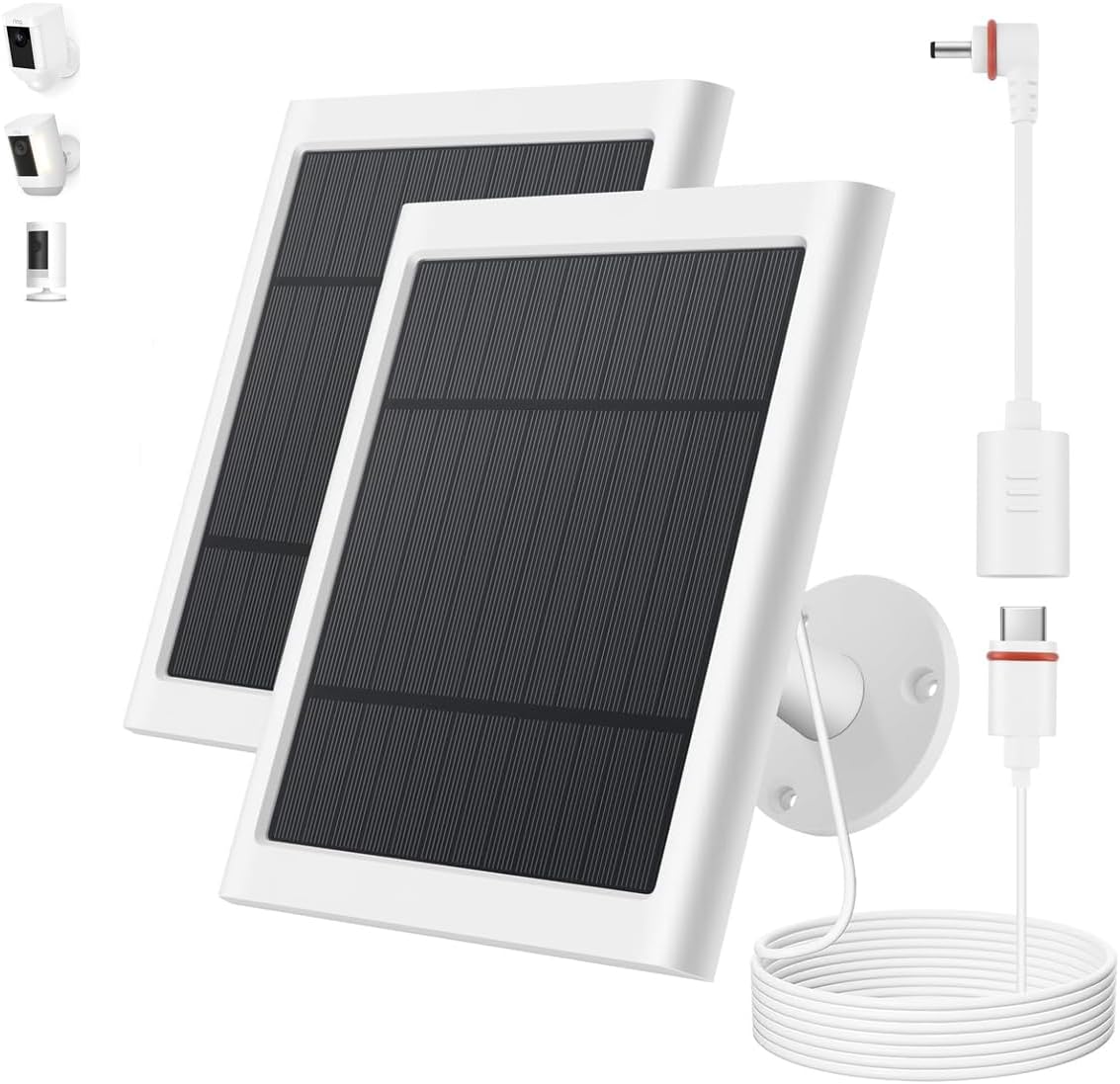
This two-pack 4W Solar Charger has a 4.2 rating and is purpose-built for cameras positioned around a shed rather than general battery charging. It is compatible with Ring Stick Up Cam 3rd and 2nd Generation battery models, Ring Spotlight Cam Plus and Pro battery models, and the Reolink Argus Pro.
We may earn a commission when you buy through this link, at no additional cost to you.
Each package includes a small panel, a 10-foot cable, a USB-C-to-DC barrel adapter, a 360-degree mounting bracket, cable clips, and screws. The adjustable mount and extended cable make it easier to place the panel in direct sunlight while keeping the camera in its required position. The interfaces are designed to resist damage in rain, hail, strong wind, and sun.
The 4W output is modest, and charging results depend heavily on sunlight intensity, weather, and installation angle. A further protocol consideration is important: the listing notes that compatible Ring devices will not begin accepting solar charging until their battery level falls below approximately 90%. It also recommends manual charging first when a battery is critically low.
This is a sensible choice for maintaining one or two security cameras with compatible battery packs. The two-pack makes it easier to monitor different shed entrances or corners. It is not a general solar panel for tools, lights, or large power banks, and the camera model and battery-protocol requirements should be verified before installation.
A dedicated low-output panel can reduce the frequency of removing and manually charging compatible camera batteries. Placement near a camera becomes easier when the ten-foot lead lets the panel remain in a brighter location than the device itself.
The panel and connections are built for outdoor exposure, while the rotating bracket allows fine adjustment toward the sun. Cable clips help secure the lead where it crosses a wall or fascia, reducing strain and improving the appearance of the installation.
We may earn a commission when you buy through this link, at no additional cost to you.
The 396-LED Solar Shed Light earns a 4.1 rating and is designed for flexible, no-wiring illumination. Its split construction separates the solar panel from the hanging light, allowing the panel to sit in direct sun while the fixture illuminates the desired shed, patio, barn, or outdoor workspace.
We may earn a commission when you buy through this link, at no additional cost to you.
The listing states that the 396 LEDs can cover as much as 400 square feet. A 16.4-foot extension cable gives the installer more control over panel placement, and the lamp hangs from a simple hook without electrical wiring. Five modes cover motion activation, bright and dim motion output, all-night constant lighting, daytime charging, and automatic activation at dusk.
A remote control adds brightness adjustment and programmable two-, four-, and six-hour shutoff schedules. The IP65-rated housing is designed for outdoor conditions, including rain, snow, and dust. The main limitation is the charging requirement: the product should receive six to eight hours of sunlight, and the listing recommends a full eight-hour initial charge for best performance.
Choose this fixture when a single light must cover a broad work area and several operating schedules are useful. It is less appropriate for a user who needs USB output or battery charging, because this is a lighting system rather than a general power panel. Positioning the panel in unobstructed sunlight is essential for dependable nighttime operation.
Motion-only settings are useful in seldom-used corners where full-time illumination is unnecessary. Constant and dusk-activated modes suit workshops, barns, and covered areas where reliable visibility is the priority, while the timer can reduce unnecessary nighttime consumption.
The extended cable separates energy collection from the light's hanging location. This arrangement allows the panel to face stronger sunlight while the lamp remains over a bench, doorway, animal enclosure, or storage area.
We may earn a commission when you buy through this link, at no additional cost to you.
The HISHEN FLOWE 100W Solar Panel carries a 4.6 rating and emphasizes a clean, low-maintenance installation. Its frameless Cleanedge structure is intended to reduce the dust, water, snow, and debris that can collect around the edges of conventional framed panels, helping preserve a clearer surface over time.
We may earn a commission when you buy through this link, at no additional cost to you.
High-efficiency 16BB A-grade monocrystalline cells provide a nominal 100 watts in a relatively compact format. The product is listed for shed roofs, small rooftops, RV roofs, marine cabins, home backup, and off-grid systems. Pre-drilled holes simplify mounting, and standard MC4 connectors make it more straightforward to compare with other 12V and 24V equipment.
This is a panel rather than a complete charging kit, so buyers must provide a suitable MPPT controller or inverter, battery system, cables, and appropriately rated connectors. The listing specifically advises checking the panel specifications against the intended controller or inverter. Its frameless design also deserves careful support and handling during installation to avoid unnecessary stress on the glass.
It is a good recommendation for a permanent shed installation where minimizing edge dirt accumulation matters. The compact 100W output is substantial enough for lighting, small electronics, and battery charging without requiring a large array. Select it when you already understand the electrical system or are working with an installer who can match the controller and battery safely.
The frameless profile eliminates the raised perimeter found on many conventional panels, where dust and debris can gather. Smooth surfaces also allow rain to wash away residue more effectively, supporting more consistent output and fewer routine cleaning tasks.
Standard MC4 connectors and a 100W module size make it possible to add compatible panels as energy needs grow. The charge controller and inverter must be selected with the combined voltage, current, and total wattage in mind before installation.
We may earn a commission when you buy through this link, at no additional cost to you.
The ZOUPW 100W Portable Solar Panel has a 4.6 rating and is particularly appealing to users who own different brands of portable power stations. Its 5-in-1 solar cable includes DC8020, XT60, Anderson, DC7909 or 8mm, and DC5521 connections, reducing the need to buy separate adapters for many common models.
We may earn a commission when you buy through this link, at no additional cost to you.
The foldable panel uses Grade A+ monocrystalline cells with a stated 23.5% efficiency. It weighs 9.48 pounds, folds to 24.13 by 21.06 by 1.77 inches, and has adjustable kickstands. A built-in controller also provides a 15W USB-C port and two USB-A ports, including a stated QC3.0 connection for phones, tablets, GPS devices, and cameras.
Outdoor construction uses ETFE lamination, and the panel itself is rated IP67 against rain and splashes. A zippered pocket protects the integrated controller and cables from moisture. The primary limitation is that a power station's input limit controls the actual charging rate; the listing notes, for example, that a station limited to 60W cannot accept the panel's full 100W output.
This is a strong choice for campers, RV travelers, and users maintaining emergency power away from the grid. It also works around a shed when a removable panel is preferred. Before purchase, verify the power station's input voltage, current, connector type, and maximum solar wattage, and use the kickstands or a suitable support to maintain the intended angle.
The five connector options cover many current portable-power ecosystems, from Jackery and EcoFlow to Anker and Bluetti models. That versatility makes the panel useful to someone who does not want to carry a separate adapter for every device.
The USB-C and USB-A charging hub provides a separate path for small devices. A built-in intelligent controller includes overcurrent and short-circuit protection, making the panel practical for travel, camping, and outages where carrying only a phone and tablet charger would otherwise be necessary.
We may earn a commission when you buy through this link, at no additional cost to you.
Choose by matching the product to the actual load, battery system, and available sunlight. Panel wattage alone does not determine performance, so installation orientation, controller quality, connector compatibility, weather exposure, and whether the system must remain portable all deserve equal attention.
Start with the lowest-demand purpose and avoid buying a large system unnecessarily. If the goal is only to maintain a battery, choose a dedicated trickle-charger kit; if the goal is lighting, a purpose-built solar light may be simpler and more efficient.
Match every part of the electrical chain rather than comparing wattage alone. A safe system requires compatible panel voltage, charge controller, battery type, cable rating, and load voltage.
Choose a sunny site and avoid shaded positions whenever possible. Adjustable brackets and kickstands can improve seasonal alignment, but they cannot compensate for a location that receives little direct sun.
Choose portability for mobility and flexibility. Choose a fixed system for consistent operation, neater wiring, and fewer repeated setup tasks.
Do not connect a bare panel directly to a battery unless the product is explicitly designed for that arrangement. A properly sized controller is essential for efficient, repeatable, and safer charging.
Prioritize a suitable protection rating, strong mounting points, and safe cable strain relief. Also consider how snow, debris, and future cleaning will be handled on the installed location.
Check the exact connector, voltage, and current specifications rather than relying on appearance or a brand name. Keep electrical connections dry, strain-free, and inaccessible to children or animals.
Plan for future loads before buying, but size the present installation correctly. Verify expansion limits and monitoring accessory requirements before finalizing the system.
Before installation, identify the load, battery, controller, cables, and panel as one compatible system. Read the instructions for both the solar product and the battery device, confirm connector polarity, and inspect each part for shipping damage. For permanent equipment, choose a sunlit, stable mounting point and avoid placing cables where they can be crushed, pinched, or exposed to standing water.
Charge portable panels and integrated solar lights fully in direct sunlight before relying on them during cloudy weather. Position folding panels using their kickstands and direct them toward the sun. For fixed systems, adjust the mounting angle seasonally when practical, keep the glass or laminated surface clear of dirt and debris, and use the supplied clips or brackets to prevent cables from pulling on their connectors.
Inspect the panel, connections, battery condition, and operating indicators regularly. Clean the surface with a soft cloth and plain water when needed, avoiding abrasive materials and harsh chemicals. If output declines, check for shading, dirt, loose wiring, and battery age before assuming the panel has failed. Do not ignore high heat, corrosion, damaged insulation, or exposed electrical connections.
The correct size depends on what the shed needs to power and how much energy it consumes each day. A small 4W to 20W panel may be sufficient for a compatible camera or battery maintainer, while a 100W panel can support lighting and small electronics. A 200W system offers greater headroom for several loads or faster battery replenishment. Calculate the daily load, add a margin for losses, and check the controller and battery limits.
They can work, but available sunlight and temperature affect output. Winter days are shorter, low-angle sunlight is common, and snow or dirt can reduce collection. A panel placed where it receives the strongest direct exposure will generally perform better than one under shade. Check the stated operating-temperature range and inspect for snow buildup when using a fixed installation in cold climates.
It can if the panel, controller, battery, and wiring are sized for the combined load. A charge controller prevents the battery from receiving inappropriate charging, while a distribution or inverter arrangement may be needed to provide the correct voltage for devices. Do not connect several loads that together exceed the controller, inverter, or wiring ratings, and allow headroom for startup surges.
It depends on the product. Kits that include a controller are ready to regulate charging, while a standalone panel normally requires a compatible controller for safe battery charging. Products designed for direct USB charging or a specific camera battery may manage charging internally. Always follow the manufacturer's connection instructions rather than adding a controller that the product was not designed to use.
Many products are designed for outdoor exposure, but the stated waterproof rating applies only to the panel or housing and may not cover every connector, port, or accessory. Keep unsealed connections dry, inspect them for corrosion, and avoid leaving a foldable panel where wind can tip it or where pooled water can collect. The supplied construction details should guide the exact installation.
A 4W panel can provide trickle charging for a compatible low-power camera in good sunlight, but it may not fully recover a deeply discharged battery quickly. Output varies with weather, angle, and cable placement, and some camera brands require their battery to fall below a specified level before solar charging begins. For reliable security coverage, consider a larger panel or retain a manual charging option.
Avoid connecting a raw panel directly unless its instructions explicitly describe that configuration. A suitable charge controller regulates the charging process and helps prevent overcharging or battery damage. It must be compatible with the panel output, battery chemistry, and system voltage. A prewired kit is usually easier for a first installation because the included controller and cables are intended to work together.
Keep the active surface clean and inspect the mounting, cables, and connectors periodically. Dust, leaves, bird residue, and snow can reduce output, while loose or corroded connections can create safety and reliability problems. Use a soft cloth, check for water intrusion, and confirm that the panel still receives direct sunlight. Replace damaged cables or connectors rather than repairing them with an improvised exposed connection.
The SOLPERK 20W kit is the budget choice for maintaining a compatible 12V battery, while the Renogy 100W Starter Kit is the most balanced all-around system for a permanent shed installation. The Renogy 200W portable panel takes the premium position for buyers who prioritize high efficiency, mobility, and direct device charging. The remaining products address narrower needs such as camera charging or off-grid lighting.
Prioritize the intended load, available sunlight, battery voltage, controller compatibility, and connector format before considering wattage. A smaller, well-positioned system can be more useful than an oversized panel placed in shade. For lighting, evaluate runtime and placement flexibility; for charging, verify battery chemistry, charging protocol, and whether the included controller supports expansion.
Product specifications, ratings, and availability can change, and current prices should always be checked on the linked Amazon pages. Compare the complete kit rather than the panel headline alone, confirm included mounting and connection accessories, and follow the manufacturer's installation instructions. The right small solar setup is the one that matches the shed's real energy demands and can be positioned for dependable sunlight.

