
ELEGRP Level 2 EV Charger 40Amp
4.5Editor score
Up to 9.6 kW output
IP67 all-weather housing
Five adjustable current levels
Discover the best portable EV chargers for road trips, with expert comparisons covering power, connector type, cable length, safety, portability, and compatibil
Portable EV chargers give road-tripping electric vehicle owners a dependable way to top up away from familiar charging networks. The right unit should fit your vehicle connector, work with the outlets available at your destination, provide enough cable reach, and remain easy to store between trips.
We compared ten chargers based on charging level, electrical output, connector and plug configuration, cable length, portability, weather resistance, safety features, display functions, scheduling options, and vehicle compatibility. The list includes both Level 1 backup units and faster Level 2 options for 240-volt destinations.
Each review reveals the circumstances in which its charger makes the most sense, from budget overnight charging to faster roadside recovery. Ratings reflect the supplied customer feedback, while specifications and features may vary; always check current product details and availability before purchasing.
4.5Editor score

4.8Editor score

4.9Editor score
The following comparison highlights each charger's charging level, connector, cable length, and most important portability feature, making it easier to identify the right option for your vehicle and travel destinations.




This 50-amp Level 2 charger earns the Editor's Choice position because it combines unusually high potential output with a genuinely portable NEMA 14-50 plug design. Its customer rating is 4.8, and the standout specifications include 240-volt charging, five adjustable current levels, a 25-foot J1772 cable, a delay timer, and a real-time LCD display.
We may earn a commission when you buy through this link, at no additional cost to you.
The charger is designed for situations where a traveler has access to a suitable 240-volt outlet and wants to regain meaningful range without waiting as long as a standard Level 1 session would take. Selectable settings from 16 to 50 amps provide some flexibility, although the circuit and vehicle must support the selected level. The supplied information estimates up to 45 miles of range per hour under favorable conditions, but actual results vary by vehicle, battery state, temperature, and charging curve.
Its portability comes from the NEMA 14-50 plug, storage bag, and 25-foot cable, which make it practical to move between a garage, campsite, rental property, or workplace. Ten-layer protection covers overvoltage, overcurrent, overcharge, overheating, and leakage concerns, while ETL and FCC certification adds useful assurance. The practical compromise is that many roadside locations do not provide a 14-50 outlet, and Tesla owners need a separate adapter.
This is the strongest all-around choice for drivers who already know where they will find a suitable 240-volt connection. It is less useful as an unplanned roadside solution because Level 1 charging is the only realistic option at ordinary household outlets. For a driver who regularly visits campgrounds, cabins, or workplaces with 240-volt service, however, the charging speed and adjustability make this charger especially attractive.
The 11.5 kW maximum output places this charger among the faster portable options in the group. Its adjustable current, delay timer, and LCD readings make it easier to match charging to the available circuit and planned departure time.
The plug-in design avoids a permanent installation, while the storage bag, wall mount, and long cable support both travel and regular home use. Always verify outlet type and electrical capacity before connecting it.
We may earn a commission when you buy through this link, at no additional cost to you.
This EVDANCE model is a practical choice for road-trippers who want one portable unit that can operate from either 120- or 240-volt outlets. It carries a 4.3 rating and includes both a NEMA 6-20 plug for Level 2 charging and a NEMA 6-20-to-5-15 adapter for standard household power. Its 25-foot J1772 cable adds useful reach in parking lots and garages.
We may earn a commission when you buy through this link, at no additional cost to you.
At 120 volts and 12 amps, the charger delivers 1.44 kW, with the supplied information estimating roughly two to five miles of range per hour. When connected to a 240-volt NEMA 6-20 outlet, it can deliver 3.68 kW and approximately 10 to 12 miles per hour. That flexibility makes it valuable at rentals, campsites, and roadside businesses that may offer either type of outlet.
The main limitation is outlet compatibility. It is not designed for NEMA 6-15, 10-30, 14-30, 14-50, or 6-50 outlets without an appropriate adapter sold separately. Vehicle compatibility is also more constrained than the headline wording might imply: Tesla, certain Mini Cooper Electric Hardtop models, and several named Toyota and Porsche variants are excluded from the listed compatibility range.
Choose this charger when broad outlet support matters more than maximum charging speed and you want one device for both ordinary household outlets and 240-volt locations. Check the complete vehicle and outlet compatibility lists before buying, particularly if you drive a Tesla or have an adapter-dependent setup.
The included adapter lets the charger move from 240-volt NEMA 6-20 service to ordinary 120-volt NEMA 5-15 outlets. This makes it a practical one-device solution for mixed travel destinations.
An IP66 housing, UL 94 V-0 fire rating, and LED status display provide practical durability and charging feedback. The included bag makes it easier to keep the long cable organized in a trunk.
We may earn a commission when you buy through this link, at no additional cost to you.
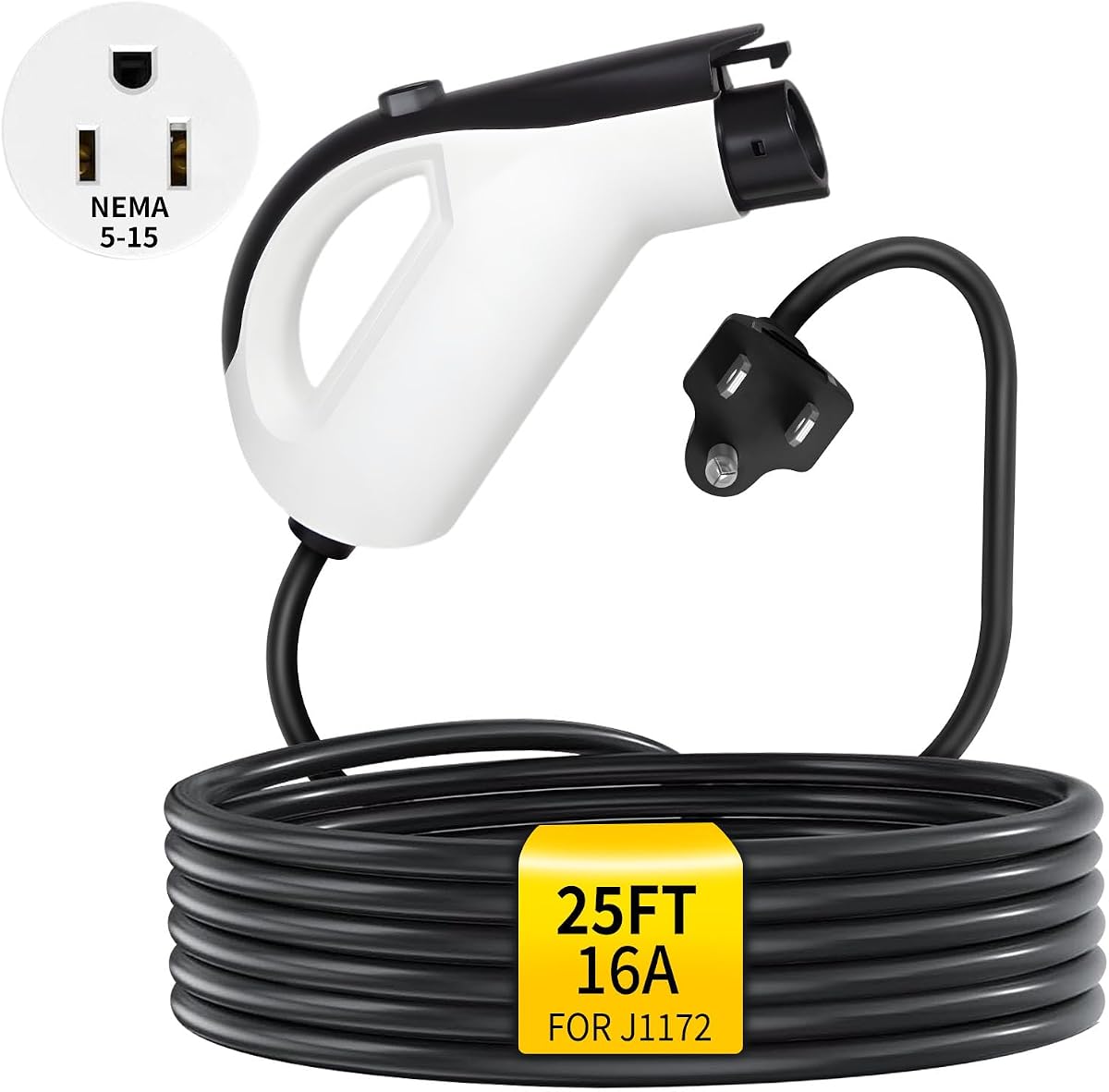
This Level 1 charger is a clean, uncomplicated backup for J1772 electric and plug-in hybrid vehicles. Its 4.7 rating reflects favorable customer feedback, while the integrated NEMA 5-15 plug allows direct use with common 120-volt household outlets. A streamlined boxless layout and integrated 25-foot cable keep it easier to store than a unit with a separate control box.
We may earn a commission when you buy through this link, at no additional cost to you.
The charger is intended for overnight top-ups, apartment parking, guest driveways, temporary parking, and emergency travel use. Supplied information estimates approximately three to five miles of range per hour, depending on vehicle settings, battery level, outlet condition, wiring quality, temperature, and circuit capacity. That pace makes it realistic for preserving range or adding modest mileage, but not for quickly recovering a deeply depleted battery before a long drive.
Temperature monitoring can reduce or stop charging if unusual heat is detected, and an IP55 weather-resistant construction supports protected outdoor use. The tradeoff is speed: there is no Level 2 mode, so drivers need enough time to leave the charger connected. It also uses J1772 rather than NACS and therefore will not directly fit Tesla vehicles without a suitable adapter.
This charger makes the most sense for drivers seeking a dependable emergency top-up that works in places where a 120-volt outlet is easier to find than a 240-volt connection. It is particularly sensible for plug-in hybrids with modest battery packs and for travelers who plan overnight stays rather than rapid turnaround.
The integrated household plug and boxless arrangement remove several common sources of setup friction. It can be carried directly to a rental, campsite, garage, or guest parking area.
Temperature monitoring adds a layer of operational protection, while IP55 construction supports use in protected outdoor locations. The 25-foot cable improves reach without requiring the vehicle to be parked directly beside the outlet.
We may earn a commission when you buy through this link, at no additional cost to you.
This charger is purpose-built for Tesla owners who want a portable charging option without carrying a J1772 adapter. Its 4.8 rating, native NACS connector, integrated NEMA 5-15 plug, and 25-foot cable make it a straightforward choice for Teslas with a NACS charging port. The listed vehicle range includes Model 3, Model Y, Model S, Model X, and Cybertruck.
We may earn a commission when you buy through this link, at no additional cost to you.
Using a standard 120-volt outlet, the charger provides Level 1 charging and may add approximately three to five miles of range per hour. That is useful for overnight top-ups in a hotel parking area, rental property, apartment lot, or campsite. It is particularly valuable for Tesla drivers who want a dedicated backup cord rather than relying on a mobile connector or shared charging cable.
Smart temperature monitoring helps identify unusual charging heat, and the IP55 construction supports protected outdoor use. A storage bag is included for trunk storage. The tradeoff is charging speed: the unit is designed only for Level 1, so long charging sessions are necessary. It also serves only vehicles using the NACS interface and is not a universal solution for a mixed-EV garage.
For a Tesla owner who values simple packing and dependable overnight range preservation, this is a focused and highly practical pick. Drivers who need rapid charging before continuing a long route should instead plan around compatible Level 2 destinations or a broader public charging strategy.
Using the vehicle's native NACS connector removes one common point of roadside friction. The charger connects directly to supported Tesla vehicles and standard household outlets.
The boxless layout, integrated cable, and included storage bag make it straightforward to keep ready with travel equipment. Temperature monitoring and weather-resistant construction support dependable use in varied conditions.
We may earn a commission when you buy through this link, at no additional cost to you.
The ELEGRP 40-amp Level 2 charger stands out as a premium road-trip option because it pairs strong output with a high IP67 protection rating and a wide stated operating-temperature range. Its 4.5 rating reflects generally favorable feedback, while five current levels, a one-to-twelve-hour timer, and a 25-foot cable make it versatile at destinations with suitable 240-volt service.
We may earn a commission when you buy through this link, at no additional cost to you.
Maximum output is listed at 9.6 kW, making it capable of substantially faster charging than Level 1. Adjustable settings of 16, 20, 24, 32, and 40 amps allow the charging level to be tailored to the circuit and vehicle. The NEMA 14-50 plug supports plug-and-play use without a permanent installation, and the long cable provides useful flexibility in garages and driveways.
Its premium case is supported by full ETL certification and ELEGRP PBE protection, described as combining full-link overheating protection with a three-layer safety system. The listed weather capability extends from minus 21 to 121 degrees Fahrenheit, which is reassuring for camping and changing seasonal conditions. As with any Level 2 unit, the outlet must be properly configured, and Tesla owners require a separate NACS adapter.
This charger is well suited to travelers who can reliably find a 14-50 outlet and want fast, adjustable charging in a durable package. It may be more specialized than a dual-voltage unit because it does not offer a 120-volt mode, but its charging performance and environmental protection justify considering it for regular road-trip use.
The 9.6 kW ceiling and selectable current levels provide meaningful charging speed for compatible vehicles. Full ETL certification and the PBE protection system add confidence for regular use.
An IP67 rating and broad stated operating range suit outdoor travel better than chargers with only basic weather protection. The portable form still requires access to a correctly configured 14-50 outlet.
We may earn a commission when you buy through this link, at no additional cost to you.
This Lectron charger combines a standard NEMA 5-15 plug with a 16-foot J1772 cable, making it a conventional Level 1 option for overnight travel charging. Its 4.4 rating is supported by a strong certification package: the product is ETL certified to the UL 2594 standard, FCC certified, Energy Star certified, and rated IP65 for dust and water resistance.
We may earn a commission when you buy through this link, at no additional cost to you.
At 15 amps and 1.65 kW, it offers more power than many 12-amp Level 1 chargers. The supplied information describes an additional 40 to 50 miles of overnight charging under suitable conditions, although real-world results depend on the vehicle, battery temperature, starting state of charge, and electrical supply. For many plug-in hybrids, that can be more than enough to replenish a daily commute.
Its shorter 16-foot cable is the main physical limitation when compared with the 25-foot cables in this roundup. The shorter lead still works well when the vehicle is parked near an outlet, but it offers less freedom in crowded lots or larger garages. As a Level 1-only product, it also cannot take advantage of the faster 240-volt connections available at many campgrounds and roadside businesses.
The charger is best for drivers who value recognized safety certification, recognizable vehicle compatibility, and an uncomplicated overnight setup. It is less appropriate for someone who needs to recover substantial range quickly. Read the included manual and verify the vehicle's charging requirements before relying on it during a trip.
ETL certification to UL 2594, FCC certification, and Energy Star certification distinguish this model. Overvoltage, overcurrent, and short-circuit protections add further operating safeguards.
The 15-amp output is useful for overnight replenishment without requiring a 240-volt circuit. Its shorter cable makes setup simple but limits reach compared with 25-foot models.
We may earn a commission when you buy through this link, at no additional cost to you.
This dual-voltage charger is a feature-rich option for road-trippers who want 120- and 240-volt flexibility without paying for the highest possible amperage. It has a 4.3 rating, supports Level 1 at 8 to 12 amps and Level 2 at 16 amps, and includes a 25-foot J1772 cable, carrying case, LCD display, and adjustable delay timer.
We may earn a commission when you buy through this link, at no additional cost to you.
At 120 volts, the maximum output is 1.44 kW, while a 240-volt NEMA 6-20 outlet enables 3.84 kW. Current can be selected from 8, 10, 12, or 16 amps, giving users more control over how the charger operates on different circuits. The 0-to-12-hour timer and real-time readouts for voltage, current, power, and status improve planning for overnight charging.
Safety features include an IP65 waterproof rating, a UL-listed cable, a rubberized connector, and protection against overcurrent, overheating, and electrical faults. The unit is compatible with many named J1772 vehicles, including BMW, Mercedes-Benz, Hyundai, Kia, Nissan, Rivian, Ford, Chevrolet, Volkswagen, and Toyota models. Tesla vehicles require a J1772-to-NACS adapter that is not included.
This charger suits travelers who want useful controls and two outlet types but do not need a 32- or 40-amp Level 2 unit. Its maximum 16-amp Level 2 output is modest compared with the most powerful models here, yet the combination of scheduling, monitoring, and outlet flexibility makes it a balanced all-around travel accessory.
The LCD shows live electrical information, and the delay timer can shift charging into a preferred period. Button-based controls avoid dependence on a phone or app.
Four selectable current levels let the owner lower charging demand when appropriate. The included NEMA 6-20 plug and 5-15-to-6-20 adapter broaden outlet compatibility.
We may earn a commission when you buy through this link, at no additional cost to you.
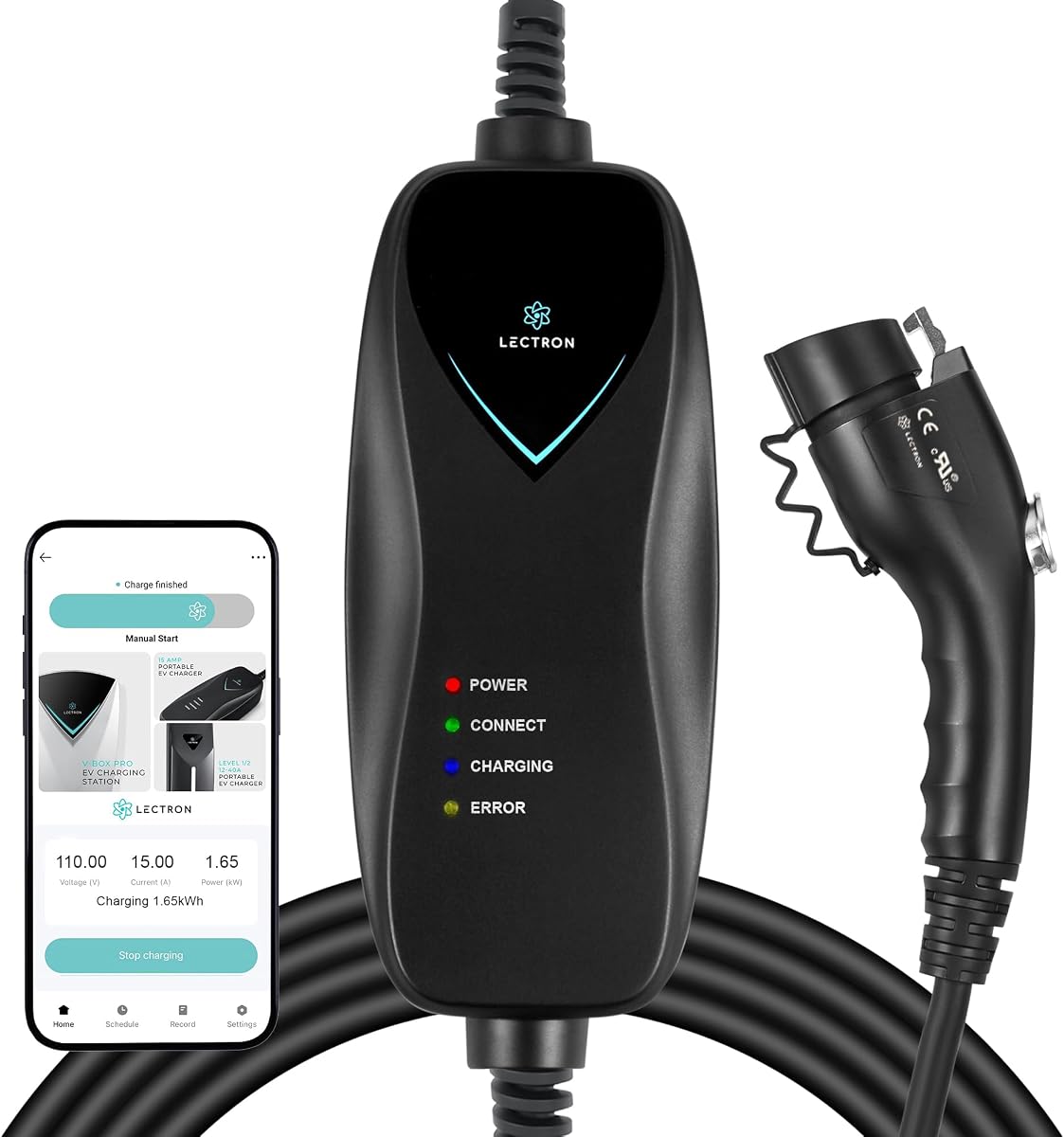
The WiFi version of the Lectron Level 1 charger adds remote monitoring and app-based control to a familiar 120-volt design. It carries a 4.3 rating and uses a NEMA 5-15 plug, 15-amp output, and a 16-foot J1772 cable. It is intended for J1772 vehicles from Ford, Rivian, Honda, BMW, Hyundai, Kia, Porsche, Nissan, Chevrolet, and others.
We may earn a commission when you buy through this link, at no additional cost to you.
Its most distinctive feature is connectivity. Through the Lectron app, users can check charging status and adjust charging current remotely. That can be useful when a vehicle is parked out of sight or when a traveler wants to confirm that a session is operating normally. The supplied information estimates approximately 40 to 50 miles of overnight range, though actual results depend on the vehicle and charging conditions.
The standard 120-volt connection makes the charger broadly accessible, and the IP65 rating provides dust and water resistance. The trade-offs are a short 16-foot cable, slow Level 1 charging, and reliance on WiFi connectivity for its remote functions. Those limitations make it better as a monitored overnight backup than as a rapid charging solution.
Choose this model if remote status checks and app control matter more than maximum cable reach. Drivers who want a longer cord, offline controls, or Level 2 speed may find another option in this list more closely aligned with their travel style.
WiFi connectivity allows users to view charging status and manage current through the Lectron app. This adds convenience when the vehicle is parked away from immediate view.
The 120-volt, 15-amp configuration works with standard household outlets and supports overnight top-ups. A shorter cable and app dependency may matter to buyers who value reach or standalone operation.
We may earn a commission when you buy through this link, at no additional cost to you.
This EVDANCE Level 2 charger combines 40-amp maximum output with one of the most informative displays in the group. Its 4.5 rating, six selectable current levels, one-to-twelve-hour delay function, and 2.4-inch TFT screen give users unusually detailed control over a charging session. The NEMA 14-50 plug and 25-foot J1772 cable support use at garages, workplaces, and suitable travel destinations.
We may earn a commission when you buy through this link, at no additional cost to you.
Maximum output reaches 9.6 kW at 240 volts, while current settings of 10, 16, 20, 24, 32, and 40 amps allow the charging rate to be adjusted. The screen reports charging current, voltage, power, energy, elapsed time, and operating status, while LED indicators provide an additional quick visual cue. A built-in chip supplies protection against leakage, grounding problems, voltage abnormalities, overcurrent, overcharging, overheating, and short circuits.
The IP66 rating and stated operating range of minus 22 to plus 122 degrees Fahrenheit support outdoor use. The charger also shuts off automatically when the vehicle reaches a full charge. As a tradeoff, it is strictly a 240-volt device and does not support ordinary 120-volt household outlets, so users must plan around compatible 14-50 connections.
This is a strong pick for drivers who want fast charging plus detailed on-screen information. It is especially useful for technical users who want to monitor power delivery and control current precisely. Tesla owners should obtain the required J1772-to-NACS adapter and verify that the vehicle accepts the selected charging rate.
The 2.4-inch TFT display provides detailed information about voltage, current, power, energy, time, and status. LED indicators make basic operating feedback visible at a glance.
Six current settings let the user balance speed against circuit limitations. The delay timer can shift the charging session, while the portable 25-foot design supports travel and destination charging.
We may earn a commission when you buy through this link, at no additional cost to you.
This dual-voltage charger combines Level 1 and Level 2 operation with a 4.9 rating, making it a strong budget-oriented choice for road-trippers who need outlet flexibility. It accepts 110- to 240-volt input, uses a 16-amp charging configuration, and is listed at up to 3.5 kW. The 1.8-inch color LCD provides clear operating information.
We may earn a commission when you buy through this link, at no additional cost to you.
Its supplied NEMA 6-20 power plug supports the Level 2 side, while an included US-standard plug adapter broadens access to household outlets for Level 1 charging. Users can customize the current and establish a delayed start or duration through the control box. The display reports current, voltage, power, temperature, and charging status, making it easier to confirm that a session is proceeding as expected.
The charging gun uses a universal five-hole US standard design, and the charger is compatible with J1772 electric vehicles. Built-in safeguards cover overvoltage, overheating, and overload, and it stops automatically when the battery is full. The trade-offs are a lower maximum output than the 40-amp Level 2 units and the need to ensure that the outlet, wiring, and selected current comply with local electrical requirements.
This model is a sensible pick for budget-conscious travelers who want one charger for ordinary outlets and 240-volt destinations. It is also useful as a general-purpose home and travel unit. Buyers should follow the product's safety guidelines, avoid worn or low-quality outlets, and never allow charging current to exceed the outlet's rated capacity.
The ability to operate on 110 or 240 volts gives this charger broader travel utility than a single-level model. Included plug options simplify use at ordinary household outlets.
The LCD displays live electrical data, and the controls support current adjustment and timing. Automatic shutdown and protections against overvoltage, overheating, and overload add useful operating safeguards.
We may earn a commission when you buy through this link, at no additional cost to you.
A useful road-trip charger must match your vehicle, charging port, available outlets, and departure schedule. Compare charging speed, connector type, cable reach, safety features, and storage before deciding.
Level 1 chargers use standard 120-volt household power and are broadly accessible, but they add range slowly. Level 2 chargers require a compatible 240-volt outlet and can restore meaningful driving range much faster. The right choice depends on where you plan to charge: ordinary hotels, restaurants, and rentals may offer 120-volt outlets, while some campgrounds, workplaces, and roadside businesses provide 240-volt service.
Choose Level 1 for overnight backup and Level 2 when fast turnaround is important. Faster charging is not automatically better if suitable outlets are difficult to find.
Most non-Tesla electric and plug-in hybrid vehicles in North America use the SAE J1772 connector, while newer Tesla vehicles use NACS. A J1772 charger cannot directly connect to a NACS-equipped vehicle without an appropriate adapter, and the adapter may not be included. Some J1772 chargers also exclude particular vehicle models, so checking the complete compatibility list is essential.
Match the connector to the vehicle you actually drive. Confirming the charging port and any model-specific limitations before ordering prevents a frustrating trip-time discovery.
A charger that supports 120 and 240 volts offers more destination flexibility than a single-voltage model. NEMA 5-15 plugs suit ordinary household outlets, while NEMA 6-20 and 14-50 configurations are associated with specified 240-volt receptacles. Some products include adapters, while others require separate accessories for particular outlet types. The selected amperage must not exceed the circuit and outlet capacity.
Map your likely charging locations before purchasing. A versatile plug and a clear list of supported outlet types are more useful than an attractive specification that cannot connect where you expect to stop.
Cable reach determines whether you can connect to an outlet without parking too close or using an extension device. Most options in this roundup use 25-foot cords, while the Lectron models use 16-foot cords. A longer cable can reach across driveways, garages, guest parking areas, and crowded lots, but it also takes more space to coil and store.
Choose a length that covers your normal parking geometry without becoming unnecessarily bulky. Keep the supplied cable dry and avoid pinching it at sharp edges.
Look for recognized electrical certifications, temperature monitoring, and protections against overheating, overcurrent, overvoltage, leakage, short circuits, and electrical faults. Weather-resistance ratings indicate whether a charger is suitable for exposed or sheltered outdoor use, but proper connector handling and outlet protection remain necessary. Certification labels and the stated IP rating should be considered together.
Prioritize recognized safety standards and intact weather protection. A premium enclosure cannot compensate for a worn outlet, damaged cable, improperly rated circuit, or unsafe operating practice.
An LCD or LED display can show charging status, current, voltage, power, temperature, and error conditions. Adjustable current is useful for matching the charger to different circuits, while a delay timer can postpone charging until a preferred period. App connectivity adds remote visibility but also creates another feature that must be configured before departure.
Choose controls that you will actually use. For most trips, a clear status display and simple timer are sufficient; remote app control is most valuable for drivers who regularly charge out of sight.
A genuinely portable charger should have a manageable control box, a cable that coils without excessive strain, and a storage bag or organized storage method. Plug-in designs are generally easier to move than permanently installed charging equipment. Some models also include holders for a control box, charging connector, or wall mounting.
Pack the charger where it will remain protected from crushing and moisture. Before leaving home, confirm that the power plug, adapter, cable, and storage bag are all together.
Warranty length and accessibility of support can be useful differentiators, particularly for a charger expected to serve as a travel backup. The products in this guide carry stated warranty periods ranging from one to three years, and one manufacturer offers U.S.-based support with specified hours. Warranty terms do not replace careful setup or safe use, but they can provide recourse if a unit develops a defect.
Save the receipt and inspect the charger before leaving for a trip. Review the warranty terms and compatibility exclusions so you understand what is covered before problems arise.
Before departure, identify the vehicle connector, inspect the charger and cable for damage, and determine what type of outlet will be available at your destination. Confirm that the outlet is properly grounded and that its amperage and circuit wiring support the selected charger setting. Never use a worn, loose, overheating, counterfeit, or visibly damaged outlet.
Connect the charger to the power source first, then attach the vehicle connector and begin the charging session. If the charger has adjustable current or a delay timer, choose settings that suit the circuit and your departure time. Follow the vehicle prompts and the charger's display, and do not use an extension cord unless the manufacturer expressly permits one. Stop charging when the vehicle indicates completion or when the charger terminates the session.
After charging, disconnect the vehicle connector before unplugging the power side, then coil the cable without sharply bending the connectors. Keep the control box and plug dry, inspect them before each use, and store the unit in its bag away from direct heat and crushing. Recalculate charging time for each vehicle, battery condition, outlet, and ambient temperature rather than relying on a single estimate.
No. The vehicle's charging connector, onboard charger limits, and supported electrical standards must all be compatible with the portable unit. Most North American vehicles use J1772, while many Teslas use NACS. Also confirm the charger's maximum amperage does not exceed what the vehicle or connection can safely accept.
Level 1 is more accessible because standard 120-volt outlets are widely available, but charging takes much longer. Level 2 can add meaningful range faster but requires a compatible 240-volt outlet. Many travelers carry a Level 1 backup for certainty and use Level 2 when suitable outlets are available.
The answer varies with charging level, battery size, starting state of charge, temperature, and the vehicle's charging curve. Level 1 models commonly provide only a modest amount of range per hour, while 16-amp and 40-amp Level 2 chargers recover range considerably faster. Treat advertised estimates as general guidance rather than guaranteed results.
It depends on the charger. A native NACS charger connects directly to a supported Tesla without an adapter, while a J1772 charger requires a J1772-to-NACS adapter. Some products include the appropriate connector for their intended vehicles, while others explicitly sell adapters separately, so verify both vehicle and adapter compatibility before traveling.
Only if the site provides a compatible outlet and the charger or RV circuit is rated appropriately. Some campsites offer ordinary 120-volt hookups, while others have 30- or 50-amp RV connections that cannot necessarily power a particular EV charger directly. Never plug an EV charger into an outlet or adapter without confirming the electrical configuration.
A longer cable provides more reach across driveways, garages, and parking lots, but it is bulkier and may be harder to store. A 25-foot cable is useful for many travelers, while a 16-foot model may be easier to manage. Choose based on your normal parking positions and storage space rather than maximum length alone.
Weather-resistance ratings indicate that some models can tolerate rain, snow, or dust, but no charger should be assumed immune to every outdoor condition. Use a properly grounded outlet, keep connections dry and fully seated, avoid damaged receptacles, and follow the manufacturer's temperature and weather instructions. Protect the unit from direct sun, standing water, and physical damage.
It is still useful as a backup because public charging sites can be busy, unavailable, or incompatible with your vehicle. A portable charger provides control over overnight top-ups at hotels, rentals, and workplaces. It also reduces dependence on public infrastructure, although charging speed depends on the outlet available at each stop.
The Level 2 Fast EV Charger 50Amp stands out as the strongest all-around choice for travelers who can secure a compatible 240-volt outlet, while the ELEGRP Level 2 EV Charger 40Amp offers a premium package with high output, IP67 protection, and flexible current settings. The Level 1+2 Portable EV Charger 16A provides the most budget-conscious path to dual-voltage flexibility.
Prioritize connector compatibility, available outlet types, and realistic charging time before comparing smaller features. A slower Level 1 charger with the correct plug may be more useful on a trip than a faster unit that cannot connect to your vehicle or the outlets on your route. Tesla owners should prioritize a native NACS charger or obtain an adapter in advance.
Product specifications, ratings, availability, and prices can change over time, so confirm the current listing and manufacturer instructions before purchasing. Check the vehicle compatibility list, outlet requirements, included accessories, warranty, and safety guidance, and keep a backup charging plan for every long road trip.