
ACEIRMC CH341A Test Clip Kit
4.4Editor score
Clip-based chip access
Supports 24 and 25 series
Includes 1.8V adapter
Suitable for in-circuit work
Bios Programmer Kit guide compares 10 USB flash programmers for BIOS and EEPROM chips, covering chip support, adapters, automation, compatibility, and needs.
A Bios Programmer Kit gives technicians and advanced repair hobbyists a dependable way to read, erase, write, and verify firmware held in SPI flash and EEPROM chips. The right kit should match the chip families you service, provide dependable power and adapters, and make common motherboard, router, set-top-box, and consumer-electronics repairs easier.
This guide compares ten supplied BIOS programmer kits and individual programmers by supported memory families, automatic functions, connection method, included accessories, voltage handling, and likely repair applications. It covers compact CH341A clip-based sets, EZP2019 and EZP2023 platforms, and the more specialized RT809F, without assuming that every kit suits every chip.
Each numbered review explains the practical strengths, limitations, and best users for its product, while the top picks highlight three distinct buying priorities. Product specifications and availability can change, and market prices fluctuate frequently, so readers should verify the current listing, chip list, software requirements, and included accessories before purchasing.
4.4Editor score

4.3Editor score

The table below compares all ten products by platform, supported memory, connection method, notable automation, and included accessories. Entries with incomplete supplied information are retained for transparency but cannot be evaluated as thoroughly as the fully documented kits.


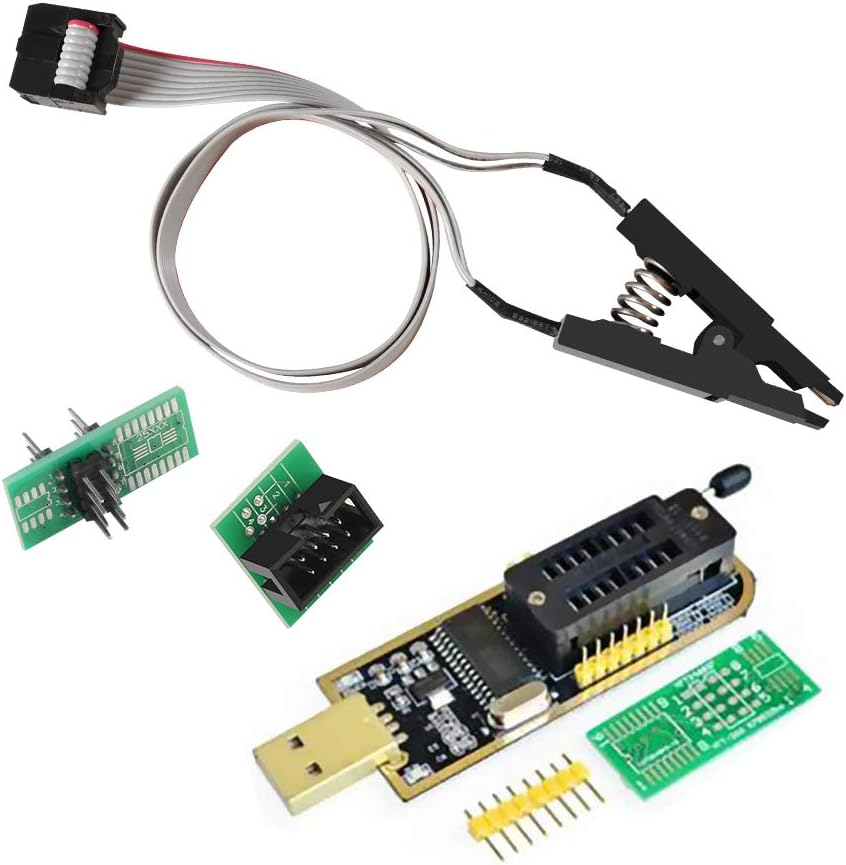

This CH341A-based BIOS programmer kit earns the Editor's Choice position because it combines a well-established USB programmer with the accessories needed for common SOIC8 repair work. Its supplied rating is 4.4, and the package is described as supporting 24, 25, and 93 series chips. The included test clip is the defining feature, allowing technicians to work with certain board-mounted chips without removing them first.
We may earn a commission when you buy through this link, at no additional cost to you.
The kit is especially useful for reading, backing up, erasing, programming, checking, and repairing firmware found in TVs, desktop motherboards, LCD devices, notebooks, routers, cards, DVDs, and set-top boxes. Its CH341A USB interface uses USB 1.1 communications, while the inclusion of a 1.8V adapter expands the range of boards that may be handled. A SOIC8-to-DIP8 adapter provides another connection route when a clip is awkward or unsuitable.
The main limitation is that hardware compatibility is never as simple as a family number. Peripherals surrounding a chip can affect communication, and the user must confirm that the target package, voltage, and chip family are supported. It is also a USB 1.1 design rather than the newer EZP platform, and the supplied listing does not describe the same level of automatic chip identification offered by the EZP2023 products.
This is a strong general-purpose choice for repair hobbyists and technicians who work on small SOP8 packages and want a clip-based setup. It is particularly attractive when a board might be soldered and the technician would prefer to probe the existing chip rather than remove it. Buyers should still verify the exact chip marking and inspect the board for conflicting components before relying on in-circuit programming.
The SOIC8 test clip can make a difficult board repair substantially more approachable by connecting to a mounted chip through its pins. This is particularly helpful for backup and firmware-reading tasks where removing the original package could cause damage or leave the board unusable.
The included 1.8V adapter broadens the kit's usefulness for compatible SPI flash devices found in phones, motherboards, and other equipment. The adapter should still be matched carefully to the target because incorrect voltage can damage a chip.
We may earn a commission when you buy through this link, at no additional cost to you.
The EZP2023 USB Programmer is a strong choice for technicians who want the programming platform to handle more of the setup process. It carries a supplied rating of 4.3 and supports 25-series SPI flash along with 24-, 25-, 93-, and 95-series EEPROM devices. Automatic identification is primarily described for 25-series chips, while the remaining EEPROM families may need manual selection.
We may earn a commission when you buy through this link, at no additional cost to you.
Automatic detection of whether a chip is seated correctly and automatic supply-voltage selection are meaningful improvements for repeated service work. They reduce the need to infer settings from a tiny marking and lower the chance of using the wrong operating mode. The programmer also offers an offline copy function, which is useful when reproducing a working image to another chip or preparing multiple boards.
The listing reports that an EN25T80 can be read in about three seconds and written in about nine seconds. Those figures make the platform appealing for diagnostic work and production-style preparation, although actual results depend on the chip, adapter, computer, and software environment. The supplied package includes a USB programmer and 15 adapters, giving users multiple physical options for supported packages.
This programmer is best suited to users who value automation, broad memory-family support, and an extensive accessory collection. It may be less attractive for a complete beginner because software setup and correct chip selection still matter. Anyone using EEPROM rather than SPI flash should confirm the exact device in the software before beginning, and drivers should be installed and tested before removing a chip from a working board.
Automatic placement and voltage detection make the EZP2023 less dependent on trial-and-error setup. These functions are particularly valuable for users who repeatedly service similar motherboards or memory chips.
The offline copy function supports a direct backup-and-duplicate workflow. A known-good image can be written to a replacement chip without continually relying on a live source device.
We may earn a commission when you buy through this link, at no additional cost to you.
This EZP2023 Universal programmer is a particularly compelling option for users who need to program many chips or duplicate firmware images. It has the highest supplied rating among the fully documented products at 4.5. Its automatic model identification, placement detection, and voltage selection reduce setup time, while the offline copy function is explicitly positioned for batch programming in a factory environment.
We may earn a commission when you buy through this link, at no additional cost to you.
The device supports 25-series SPI flash, 24-series EEPROM, 25-series EEPROM, and 93-series EEPROM, along with other memory chips. The supplied information also highlights support for PC software and programmer firmware upgrades. That combination makes it more than a simple one-off flashing tool, particularly for product-development teams that need repeatable programming and backup processes.
Its described applications include burning test chips, color TVs, DVDs, computer motherboards, and hard disks, giving the platform a broad electronics-repair orientation. The offline copy function is a standout if the main goal is to read a working chip and reproduce its contents. The automatic functions also help reduce common mistakes involving chip selection and supply voltage.
This programmer is a strong fit for experienced hobbyists, repair businesses, and small production teams. The main uncertainty is that the supplied listing gives less detail about the exact physical accessories than some competing kits, so the current package should be checked before ordering. Users should also confirm that their chip, package, and intended workflow fall within the software and adapter support.
Automatic identification and voltage selection make batch work more consistent. For factory programming or board validation, removing those manual steps reduces setup time and operator error.
Offline copying is particularly valuable when a known-good firmware image must be reproduced repeatedly. It also reduces dependence on the original device remaining accessible throughout the process.
We may earn a commission when you buy through this link, at no additional cost to you.
The EZP2019 remains notable for its extensive documented chip compatibility and generous collection of physical accessories. It has a supplied rating of 4.4 and uses a USB 2.0 interface advertised at up to 12 MBPS. Its listed functions include automatic chip identification, detection of whether a chip is present, automatic supply-voltage selection, and automatic offline copying.
We may earn a commission when you buy through this link, at no additional cost to you.
The supplied compatibility information spans major manufacturers and a long list of part numbers, including devices from Macronix, Nexflash, PMC, Saifun, Spansion, SST, GigaDevice, ST, Winbond, Atmel, and other families. Support extends across 24-series EEPROM, 93-series EEPROM, and many 25-series SPI flash chips. That breadth makes the EZP2019 valuable for users who service a varied collection of older boards and appliances.
The package includes the programmer, simple SOP8 and SOP16 sockets, several 150-, 200-, and 300-mil options, a 1.8V socket, a SOP8 clip, a USB cable, and CD software. Although the physical set is comprehensive, one concern is the stated working-system support of Windows 7 and Windows 8. Users on newer operating systems may need compatible drivers or updated software, so this point should be confirmed before purchase.
The EZP2019 is best for a technician who values a long supported-chip list and many connection options more than the newest EZP2023 features. It is also a good candidate for users who already know which sockets and adapters they need. Confirm software compatibility, obtain the proper high-voltage socket when required, and verify the exact chip marking before committing to a repair.
The long manufacturer and part-number list gives the EZP2019 an advantage for mixed repair inventories. A broad support list is particularly useful when every board on the bench may use a different flash manufacturer.
Sockets covering several SOP sizes, a clip, and a 1.8V option make it easier to handle different packages. Users should select the adapter based on pitch, body width, and required voltage rather than relying on visual guesswork.
We may earn a commission when you buy through this link, at no additional cost to you.
This CH341A clip-based kit offers a straightforward way to back up, erase, and program 24- and 25-series EEPROM and BIOS chips. Its supplied rating is 3.0, which is lower than the ratings documented for the other identified products. The listing nevertheless describes a practical package intended for users who want simple test-clip access without soldering a temporary connection to each target.
We may earn a commission when you buy through this link, at no additional cost to you.
The programmer is described as compatible with both CH341A and CH341B chips and offers 1.8V, 3.3V, and 5V output options. That voltage range is useful for a basic bench programmer, although the correct selection remains the user's responsibility. A USB 2.0 interface provides the physical link to the computer, while the SOP8 clip supports the central in-circuit workflow.
The supplied information is less detailed than for the EZP platforms, and it does not list the individual manufacturer part numbers supported by the software. This makes chip-level verification important. Users should consult the current software's device list rather than assuming every 24- or 25-series designation is equally supported. Board-mounted components may also affect the quality of a clip connection.
This kit is most appropriate for an entry-level hobbyist or compact repair setup that values a clip, multiple voltage options, and a simple USB module. It may also be useful as a secondary programmer for straightforward backup and writing tasks. Because its documented rating is comparatively low and its compatibility list is less specific, it should not displace a more comprehensively documented EZP model without checking current user feedback.
The clip design simplifies temporary access to compatible SOIC8 devices. This can make diagnostic reading and firmware backup less invasive, especially on densely populated boards.
Support for 1.8V, 3.3V, and 5V outputs covers several common device classes. Users should confirm both the chip's rated voltage and the programmer's adapter configuration before programming.
We may earn a commission when you buy through this link, at no additional cost to you.
The ACEIRMC Double-Clip Kit is designed around a straightforward repair idea: attach the programmer clip to a compatible chip and perform firmware operations without fully disassembling the device. It has a supplied rating of 4.4 and includes a CH341A USB programmer with double-clip packaging. The SOIC8 clip is intended for 24CXX, 25CXX, and 93CXX devices.
We may earn a commission when you buy through this link, at no additional cost to you.
Its software is described as supporting many 24- and 25-series EEPROM and BIOS chips in SOP8 and SOP16 packages. The programmer can handle backing up, erasing, programming, calibrating, and related maintenance tasks. That makes it useful for board-level repair where the technician wants to create a safety copy before attempting a firmware change.
There is an important compatibility caveat for ESMT SST class 25 chips: the supplied information says they can be read but not written because of CH341A characteristics. The listing also warns that some chips cannot be clipped directly because surrounding peripheral circuits interfere with the connection. These are meaningful limitations and should be checked before ordering or beginning work.
This kit is a good fit for repairers who prioritize simple physical access over automated chip identification. It is also appealing for users who need both SOP8 and SOP16 capability and can work around the stated chip limitations. The best candidates are boards with enough clear space around the target for a stable clip connection and chips that appear in the current software's supported-device list.
Creating a readable backup before writing new firmware is a prudent first step in board repair. Clip access makes this more convenient when the original chip is soldered in place.
The supplied description states that ESMT SST class 25 chips can be read but not written through this CH341A-based kit. Users handling those parts should choose a programmer with documented write support instead.
We may earn a commission when you buy through this link, at no additional cost to you.
ASIN B09DVMQTTH appears in the supplied product set, but the source data provides no product title, rating, image, price, or descriptive information. Without those details, it is impossible to determine whether the item is a standalone programmer, a kit, an adapter set, or a product from a related but different category.
We may earn a commission when you buy through this link, at no additional cost to you.
The absence of specifications prevents a meaningful comparison of chip support, automatic functions, connection types, included accessories, or repair applications. It would be inappropriate to infer features from the nearby ranking position because each Amazon listing can represent a materially different package. Any conclusion about its relative value would therefore be speculative.
A prospective buyer should open the current Amazon listing and verify the exact model, supported memory families, operating-system requirements, included sockets or clips, voltage options, and software. Reviews can provide clues about real-world reliability, but specific claims such as automatic chip detection or support for 24-, 25-, 93-, or 95-series devices must be confirmed in the listing or manual.
This product is not recommended as a primary choice based on the information available for this guide. It is included because the requested comparison contains ten entries and transparency requires acknowledging missing data rather than inventing details. If the live listing proves to include a well-documented EZP2023, EZP2019, or CH341A package, it could be reconsidered against the relevant sections of this guide.
The current product page is the only reliable place to confirm the model and package contents for this ASIN. Look for the manufacturer, programmer platform, supported chip families, and included hardware.
A listing's position in a generic product group does not establish that it supports BIOS flash chips. Require an explicit chip list or manufacturer documentation before buying for firmware work.
We may earn a commission when you buy through this link, at no additional cost to you.
ASIN B0C7LRF3M2 is included in the supplied ten-product set, but its title, rating, image, and descriptive specifications are unavailable. The listing therefore cannot be evaluated for BIOS or EEPROM programming, adapter coverage, voltage support, automation, or suitability for any particular device category.
We may earn a commission when you buy through this link, at no additional cost to you.
Because programmer kits can look similar while differing substantially in controller hardware and software, appearance alone is not enough to determine compatibility. A low-cost adapter board may not include a programmer, while a complete EZP or CH341A package may include several sockets, clips, and cables. Without the package description, those distinctions cannot be resolved responsibly.
A buyer should confirm whether the item includes the USB programmer, whether it is a standalone module or an accessory kit, and which voltage and chip families are explicitly supported. It is also important to determine whether the required software is bundled, whether drivers are available for the intended computer, and whether a compatible socket or clip is included.
This entry cannot earn a recommendation on the supplied evidence and should be considered unverified rather than poor. If the live page contains adequate specifications, the product could be compared with the EZP2019, EZP2023, and CH341A kits discussed here. Until then, selecting it over a fully documented product would add unnecessary uncertainty to a firmware-repurchase decision.
Check whether the box contains only adapters or the programmer itself. A complete kit should clearly state the controller, USB cable, sockets or clip, voltage adapters, and software requirements.
General references to flash programming are not enough for board-level work. Look for a list naming the relevant EEPROM or SPI flash families and any limitations involving package size or voltage.
We may earn a commission when you buy through this link, at no additional cost to you.
The Two-Set CH341A Test Clip Kit provides two complete programming sets rather than one. Its supplied rating is 4.2, and each set includes a CH341A USB programmer, a 1.8V adapter, a SOIC8-to-DIP8 converter module, and a SOIC8 test clip. That makes the package appealing to users who need a spare station or work on two computers or boards simultaneously.
We may earn a commission when you buy through this link, at no additional cost to you.
The stated support covers 24-, 25-, and 93-series chips, with applications including TVs, desktop motherboards, LCD devices, notebooks, routers, cards, DVDs, set-top boxes, and unlocking-software tasks. The listing says programming can be two to three times faster than an ordinary ATMEGA8-based 25-series programmer and describes an erase-and-check rate of approximately 2–3 Mbit per minute.
The programmers use a CH341A controller and USB 1.1 communications. As with other CH341A solutions, compatibility depends on the exact device, software, package, and surrounding circuitry. The listing also includes the notable note that some chips are affected by peripheral circuits and cannot be clipped directly, so a visual board check is essential before relying on the clip.
This bundle makes the most sense for a repair shop, classroom, or serious hobbyist with more than one active workstation. For a single user working on one computer, the duplicated hardware may be less economical than a newer EZP2019 or EZP2023 platform with automatic detection. If two complete, immediately usable sets are valuable, the package offers a convenient way to establish that arrangement.
Having a second programmer can prevent downtime when one setup is tied to a particular computer or cable. It also makes simultaneous backup and verification workflows more convenient.
The listing warns that surrounding components can interfere with direct clip use. Before committing to this package, confirm that the target chip is exposed enough to attach the clip without forcing it onto neighboring parts.
We may earn a commission when you buy through this link, at no additional cost to you.
The RT809F Programmer is the most specialized product in this comparison and the natural premium choice for users who want a larger adapter ecosystem. Its listing identifies the programmer with eight adapters, an IC clip clamp, and a 1.8V adapter. Unlike the simpler CH341A kits, the product is presented as a broader platform rather than a single-programmer-and-clip package.
We may earn a commission when you buy through this link, at no additional cost to you.
The supplied title emphasizes adapters and clamp-based connection, suggesting that physical versatility is the main differentiator. A broad selection of physical options is useful for technicians who encounter varied package sizes and connection conditions, while the IC clip can help with in-circuit work on compatible boards. The dedicated 1.8V adapter also suggests support for lower-voltage flash devices when paired with the correct configuration.
The available information is limited, however. No chip-family list, software details, operating-system requirements, automatic functions, or user rating were supplied. As a result, it would be inaccurate to claim that the RT809F supports every BIOS or EEPROM type or that it performs a particular operation faster than the EZP products. Those claims need confirmation from the current listing and documentation.
This is a sensible premium candidate for an established repair bench that values multiple adapters and clamp-based access over a minimal clip kit. It may also be useful for technicians who already know the RT809F platform and want to expand an existing setup. New buyers should confirm supported chip models, computer compatibility, software availability, and the exact eight adapters before ordering.
Eight listed adapters can make one platform more adaptable to different package and connection arrangements. Their value depends on whether they cover the specific sockets and clips used in the reader's repair inventory.
A more elaborate accessory package does not guarantee universal chip support. The current chip list, firmware, driver, and voltage requirements should be reviewed before treating the RT809F as a replacement for another programmer.
We may earn a commission when you buy through this link, at no additional cost to you.
The best BIOS programmer kit is not simply the one with the most accessories. Start with the chip families, package sizes, board voltages, and repair tasks you encounter, then evaluate automation, computer compatibility, and connection hardware.
A useful programmer must support the exact memory type found in the target device. The relevant choices commonly include 25-series SPI flash, 24-series EEPROM, 25-series EEPROM, 93-series EEPROM, and, on some platforms, 95-series EEPROM. Family labels alone do not guarantee that every part number works, so review the manufacturer's supported-device list and confirm that the target's complete part number appears.
In summary: match the exact chip before choosing a programmer, not just the board type.
BIOS chips are commonly encountered in SOIC8 and other small surface-mount packages, but sockets and clips vary in pitch and body width. Look for adapters that physically fit the target rather than relying on a broad SOIC designation. The EZP2019 package includes several socket sizes, while the CH341A kits center on a SOIC8 clip, and the RT809F listing describes eight adapters.
In summary: verify body width, pin pitch, pin count, and whether you need a socket or clip.
SPI flash and EEPROM devices may use 1.8V, 3.3V, or 5V logic levels. The programmer and its selected adapter must present the correct voltage, and in-circuit operation can be influenced by nearby pull-up resistors or other components. Kits that include a 1.8V adapter are more versatile, but the presence of an adapter does not make automatic selection safe on every board.
In summary: confirm the target voltage and board circuitry before using a clip or low-voltage adapter.
Automatic chip identification, placement detection, and voltage selection can save time and reduce configuration errors. The EZP2023 listings emphasize these functions, including automatic detection for mainly 25-series chips. Automated features are most useful when a technician handles many similar devices, but manual chip selection may still be necessary for EEPROM families or ambiguous markings.
In summary: prioritize automation for repeated work, but retain the ability to select devices manually.
A programmer is only useful if its software and drivers operate on the intended computer. Some listings mention Windows 7 and Windows 8, while newer platforms may require updated drivers or different release procedures. CH341A and EZP products are not necessarily interchangeable simply because they use USB, so check the required software, driver source, and operating-system support before purchasing.
In summary: confirm driver availability and the current software workflow on your exact computer.
A test clip can allow programming without removing a chip, saving time and reducing the chance of board damage. However, nearby components may obstruct the clip or interfere with communication. Socket-based programming is more appropriate for a removed package or a clearly accessible test socket. Some kits include both options, which provides useful flexibility as the technician moves between diagnostic and replacement work.
In summary: choose clip access for convenient probing, but inspect the board and use a socket when necessary.
Offline copy allows a programmer to duplicate a working image without needing a live source device throughout the process. This is valuable for creating replacement chips, producing multiple boards, and preserving a verified backup. The EZP2023 products explicitly highlight this function, and one is positioned for factory batch programming. These capabilities add value for users who repeatedly prepare or reproduce firmware.
In summary: choose offline copy when backups, duplication, or batch preparation are central to your workflow.
The physical package can include the programmer, USB cable, test clips, socket adapters, voltage adapters, and conversion modules. More accessories are useful only when they match the jobs performed. A two-programmer bundle makes sense for a multi-station shop, whereas a single user may gain more from a newer platform with automated detection. Review the package inventory instead of treating accessory count as the only measure of quality.
In summary: prioritize relevant adapters, a reliable cable, and necessary voltage accessories over sheer quantity.
Begin by identifying the target board, reading the complete chip marking, and checking the supported-device list for the programmer. Determine the package size and required voltage before selecting a socket, clip, or voltage adapter. Install the appropriate software and driver on the computer, connect the programmer, and confirm that the software detects the hardware before touching a board-mounted chip.
For an initial operation, read the existing firmware and save the file in a clearly named folder. Compare the reported chip capacity and contents with expectations, and keep at least one verified backup. When programming a replacement chip, use the correct socket and confirm that the package is seated properly. For clip-based work, inspect the board for obstacles, attach the clip without forcing it, and verify stable communication before erasing or writing anything.
After writing, read the programmed chip again and compare the new image with the source file. Reconnect or power-cycle the target board and perform a functional test appropriate to the device. Keep the programmer away from conductive objects and debris, route cables so they cannot pull a clip from a live board, and store adapters in labeled compartments. Never change voltage or adapters while a chip is being erased or programmed.
Sometimes. A compatible SOIC8 test clip can provide in-circuit access to some 24-, 25-, and 93-series chips without desoldering them. Nearby components may interfere with communication, so the programmer must also match the chip's family and voltage. If reading is unstable, remove the chip and use a properly fitted socket instead.
The EZP2023 listings emphasize automatic model identification, placement detection, and automatic voltage selection, along with offline copy functionality. The EZP2019 uses USB 2.0, is advertised at up to 12 MBPS, and includes a broad documented chip list with several sockets and a clip. Both can be appropriate, but the EZP2023 may be more convenient for repeated or batch work.
It depends on the target chip and the board providing its power. Some SPI flash devices use 1.8V, while others use 3.3V or 5V. A 1.8V adapter is useful when working with compatible low-voltage devices, but it must be configured correctly. Confirm the chip specification and the adapter's role before programming.
They can be suitable for routine backup, erase, and programming tasks involving supported 24-, 25-, and 93-series devices. Their clip-based approach and included adapters make them practical for many repairs, although some chips have limitations and nearby components can affect in-circuit communication. EZP platforms may offer broader documentation and more automation.
Read and save the original firmware first, then verify the chip model, capacity, voltage, and file size. Make sure the target image is correct for the exact board and revision, since a compatible but inappropriate BIOS file can prevent the device from starting. After writing, read the chip back and compare it with the source image.
Several products in this comparison support both SPI flash and EEPROM families, but support is model-specific. The EZP2023 and EZP2019 products list broad 24-, 25-, 93-, and related families, while the CH341A kits emphasize 24-, 25-, and 93-series parts. Always check the complete manufacturer part number and the software's current device list.
The clip may not make solid contact, the chip may use an unsupported package or voltage, or nearby circuitry may interfere with the data lines. The software may also have been asked to detect a different chip family. Inspect the connection, verify the voltage and marking, and try a socketed read after carefully removing the chip if the board value warrants it.
One fully documented EZP2019 or EZP2023 platform can cover many common tasks, while a CH341A clip kit is useful as a specialized in-circuit option. Two complete sets can support separate workstations or provide a spare, as offered by the two-set CH341A bundle. The right number depends on workload, device variety, and whether downtime is a concern.
The ACEIRMC CH341A Test Clip Kit is the most practical overall pick for common 24-, 25-, and 93-series work because it combines a clip, a 1.8V adapter, and a socket conversion module. The EZP2023 leads in automation and offline-copy capability, while the EZP2019 stands out for its extensive documented chip list and multiple socket options.
Prioritize exact chip-family support, correct voltage, and the physical package needed for the boards in your repair inventory. Clip access is convenient but not universal, sockets are dependable for removed chips, and automatic detection helps only when it recognizes the target. For a professional bench, a documented EZP platform may offer better workflow support than a minimal clip kit.
Market conditions and product packages can change, so verify the current listing, included accessories, software compatibility, and chip documentation before ordering. Also check current market pricing at the time of purchase, since the cost and availability of programmer kits and individual components may vary considerably.


