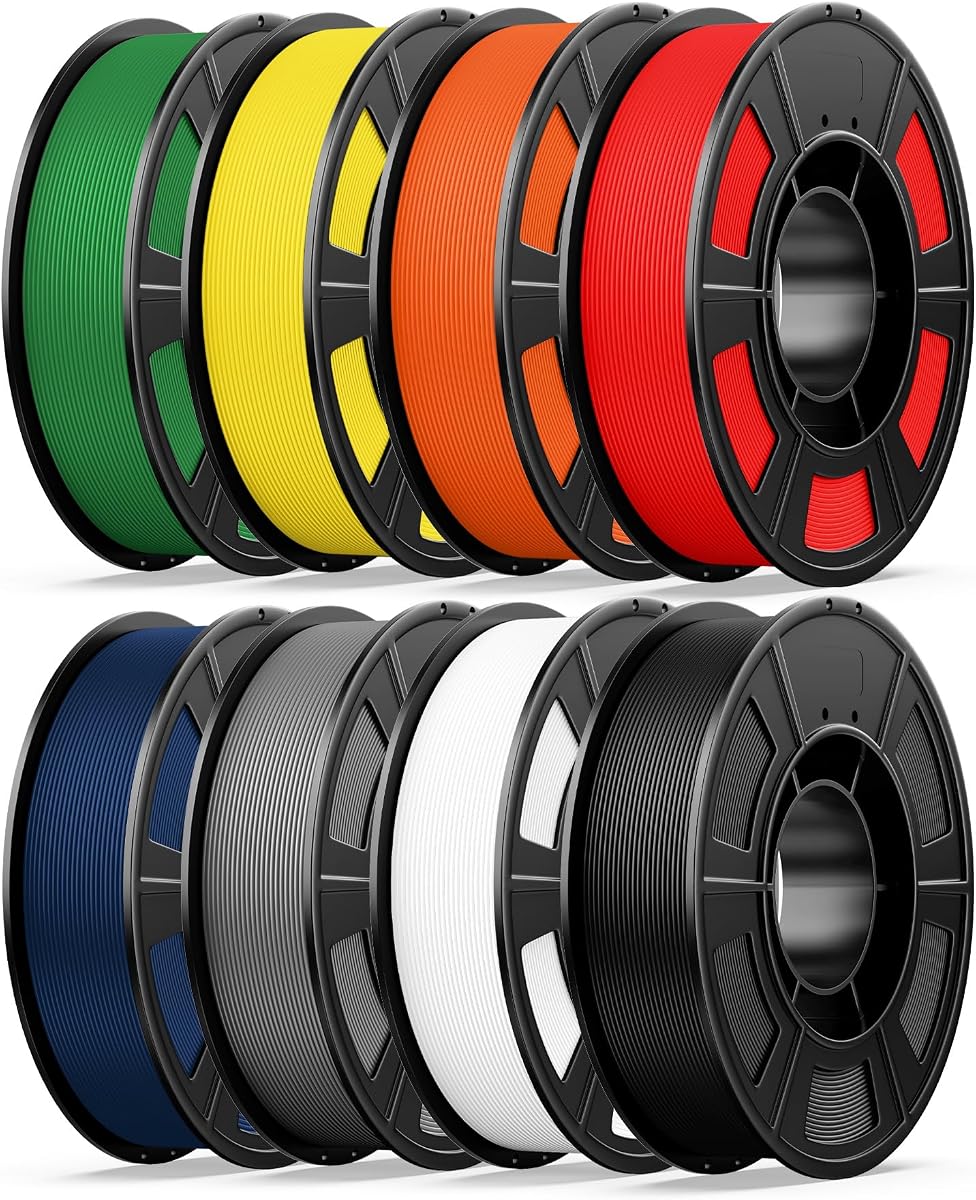
UJOY3D 8 Color Hyper PLA+ Bundle
4.6Editor score
Eight enhanced PLA+ colors
Individually vacuum sealed
Compact 250g spools
Our 3D printer filament sampler pack guide compares ten multicolor bundles for print testing, color variety, diameter accuracy, packaging, and printer fit.
A 3D printer filament sampler pack is a convenient way to compare colors, evaluate a material brand, and avoid committing to a large spool before testing. The most useful collections combine manageable 250g spools, clearly identified materials, reliable winding, and specifications that make it easier to determine which filament belongs in your next project.
We compared all ten packs using the information supplied for each product, focusing on spool count, filament type, color selection, dimensional tolerance, moisture protection, recommended settings, and compatibility with common FDM printers. The list also distinguishes compact standard PLA from enhanced PLA+ and multi-material sets, so each sampler can be judged against a different testing goal.
Each review explains what the pack is best suited for, from low-commitment color trials to broader material testing, while noting any fitment or handling limitations. Ratings reflect the listed customer feedback and can change over time. Product prices and promotions also fluctuate, so check the current listing before purchasing.
4.6Editor score
4.6Editor score

4.1Editor score
This side-by-side comparison covers ten multicolor filament samplers, emphasizing material type, color range, spool format, dimensional accuracy, and printer compatibility. The differences show whether a pack is best for routine PLA testing, enhanced strength, rapid sampling, or a broader comparison of colors and materials.



The SUNLU PLA Filament 1.75mm, 250g Spool Bundle is a straightforward sampler for anyone who wants to test several colors without committing to full-size spools. Its 4.4 rating reflects generally favorable customer feedback, and the product information emphasizes dependable layer adhesion, low warping, and compatibility with standard PLA profiles.
We may earn a commission when you buy through this link, at no additional cost to you.
Its strongest feature is the 250g format. Each compact spool is large enough for small models, prototypes, accent parts, and test prints, yet it reduces the amount of material left unused when a particular color is not a permanent favorite. The listed 1.75mm ±0.02mm diameter supports consistent extrusion, while precision winding is intended to reduce snags and interruptions.
The 140mm spool diameter, 36mm width, and 53mm center hole make the format broadly suitable for external-spool, top-mounted, and open-spool FDM printers. It is not automatically compatible with a Bambu Lab AMS or AMS lite; the manufacturer advises finding a suitable 250g adapter on MakerWorld. That small extra step is worth checking if multi-unit printing matters to your setup.
This pack is a good general recommendation for beginners, hobbyists, and anyone conducting routine color or surface-quality trials. It does not offer the material variety of a PLA-plus-and-PETG collection, but it focuses on dependable standard PLA in manageable quantities. For uncomplicated, low-commitment sampling, it is one of the most balanced options in the group.
The 250g size is particularly useful when testing colors, retraction, layer appearance, or general printability. It allows a meaningful test without creating the storage burden of a much larger roll, particularly when several colors share the same physical format.
Neat winding and a stated ±0.02mm tolerance address two common material concerns: loose loops and inconsistent extrusion. The result is intended to support clean details and dependable flow across ordinary models, toys, décor, prototypes, and utility parts.
We may earn a commission when you buy through this link, at no additional cost to you.
The KALIDORA 16 Spool Bundle is the most ambitious testing package in this roundup, combining 15 PLA+ spools with a crystal-clear PETG spool. Its 4.1 rating is the lowest among the selected products, but the breadth of the set offers a different kind of value: a substantial library for comparing color, rigidity, speed, and material behavior.
We may earn a commission when you buy through this link, at no additional cost to you.
All 16 spools use 1.75mm filament with a listed ±0.02mm tolerance and are individually vacuum sealed with desiccant. The clear PETG is particularly valuable because it lets users test a different material family rather than evaluating only shades of PLA. The PLA+ portion is designed for strong layer bonding and smooth output, while the clear PETG is intended for transparent or functional applications.
Fitment needs attention. These 250g spools work with most 1.75mm direct-drive and Bowden-tube printers, but the compact format is not compatible with automatic material systems such as AMS or MMU. The recommended bed temperatures also differ by material: 50–55°C for PLA+ and 60–65°C for transparent PETG.
Choose this bundle when you want a serious, organized comparison library or have several projects that can use numerous colors. It is less suitable for a first tiny test because it contains far more filament than a simple sampler, but its sealed, same-batch spools make it particularly appealing to builders who value variety and dependable organization.
Including clear PETG changes the testing equation. You can compare PLA+ for practical models with a transparent material that offers different feeding, adhesion, and finishing characteristics, all from a coordinated collection.
Individual vacuum packaging with desiccant helps each color arrive dry and ready for testing. That approach is particularly helpful when comparing materials, because moisture-related bubbles or brittle extrusion should not be the deciding variable.
We may earn a commission when you buy through this link, at no additional cost to you.
The SUNLU 250g Filament Bundle is a well-rounded choice for testing color, finish, and general PLA performance. It carries a 4.6 rating, tied for the highest customer score among these products, and provides eight 250g spools: black, white, grey, transparent, red, blue, orange, and green.
We may earn a commission when you buy through this link, at no additional cost to you.
This selection covers the core colors needed for prototypes, decorative objects, contrasting parts, and general hobby projects. The 1.75mm PLA is described as easy to print with low warping and dependable interlayer adhesion. A ±0.02mm tolerance, approximately 68 meters per spool, and neatly wound production support consistent feeding and detailed results.
The recommended profile calls for a 200–210°C nozzle, a 50–65°C heated bed, and a print speed of 50–100mm/s. These are sensible baseline settings for standard PLA, although individual printers may still require calibration. The 140mm spool diameter and 53mm hub hole fit most heated-bed FDM printers, and an AMS-compatible 250g adapter can be found through MakerWorld when needed.
This is an excellent recommendation for beginners and for users who want a dependable set of familiar colors without the weight of a 16-spool collection. It handles small prints particularly well and offers a transparent color that basic eight-color sets sometimes omit. For broad everyday testing, the combination of rating, color balance, and straightforward PLA characteristics is difficult to overlook.
The assortment includes fundamentals, vivid accents, neutral options, and transparent filament. That mix works well for multicolor models and makes it easier to choose a color before committing to a larger single-color purchase.
Low warping and a broad recommended temperature range make this a sensible introduction to standard PLA. The specified 50–100mm/s range also allows beginners to test several speeds while keeping the baseline process manageable.
We may earn a commission when you buy through this link, at no additional cost to you.
This SUNLU 250g PLA Filament Bundle provides eight 250g spools in black, white, grey, transparent, red, blue, orange, and green. Its 4.3 rating indicates solid customer reception, and the familiar 1.75mm format makes it a natural choice for a color-focused test print collection.
We may earn a commission when you buy through this link, at no additional cost to you.
The main strengths are practical rather than exotic. Low warping, dependable layer adhesion, neat winding, and a ±0.02mm diameter tolerance support reliable feeding. The recommended 200–210°C nozzle and 50–65°C bed temperatures are close to conventional PLA settings, reducing the amount of tuning required for a first test.
Like the related SUNLU 8-color set, this bundle uses a 140mm spool, 36mm width, and 53mm center opening. It fits most heated-bed FDM printers, while a 250g adapter from MakerWorld can make it usable with Bambu Lab AMS or AMS lite systems. Its stated compatibility with 99% of FDM printers should still be treated as a general guide rather than a guarantee for every machine.
This is a good choice for hobbyists, schools, and home users who want a manageable set of colors for model testing. The main reason to consider it over a similarly sized eight-color pack is to compare customer feedback and availability, so check the current listing details and reviews before deciding.
Neutral shades, primary colors, and transparent filament create a useful baseline for almost any color test. You can evaluate surface quality, color saturation, and printability without committing to numerous large spools.
Eight separate 250g rolls make it easy to keep only the colors you use. Vacuum-packed packaging protects the material, while a separate spool for each color simplifies comparisons and project organization.
We may earn a commission when you buy through this link, at no additional cost to you.
The Dynta 10 Colors 250g PLA Sampler is built for users who want more color choices without moving to full-size rolls. Its ten spools include black, white, grey, clear, red, blue, green, orange, yellow, and purple, and its 4.2 rating reflects generally positive feedback.
We may earn a commission when you buy through this link, at no additional cost to you.
The listed ±0.02mm tolerance and mechanical winding are intended to limit tangles, clogging, and excessive stringing. Each spool is individually vacuum sealed with desiccant, which protects against ambient humidity, bubbles, and brittle extrusion. This packaging is especially useful if the sampler will be stored for a while and opened one color at a time.
Compatibility covers mainstream 1.75mm FDM printers, with explicit mention of Bambu Lab A1 and A1 mini, Creality Ender series, Prusa+, and FlashForge systems. Recommended settings are a 190–230°C nozzle and 45–60°C heated bed, giving users a useful range for first-layer and temperature testing.
The pack is especially compelling for multicolor modeling, prototype testing, and learning parameter adjustments. Its only notable restrictions are that it does not compare multiple material families and the manufacturer recommends using opened filament within three months. Otherwise, it is a color-rich, well-protected sampler at a manageable per-spool size.
The inclusion of yellow and purple expands the palette beyond the most common basics. This is useful when judging saturation, contrast, or the visual effect of a color within a model rather than merely checking whether it feeds.
Individual desiccant packaging helps isolate each spool from humidity. For a sampler used over several months, that protection can be more valuable than a larger quantity of unprotected filament.
We may earn a commission when you buy through this link, at no additional cost to you.
The UJOY3D 8 Color Hyper PLA+ Bundle combines a strong 4.6 rating with eight useful colors and an enhanced PLA formula. It is positioned for users who want more toughness and better shaping than standard PLA while retaining the familiar 1.75mm FDM workflow.
We may earn a commission when you buy through this link, at no additional cost to you.
Eight 250g spools provide a total of 2kg and include black, jade white, grey, red, dark blue, green, orange yellow, and yellow. The formula uses refined raw materials for improved durability, and the manufacturer states that the spools contain virgin material without recycled impurities. Uniform color tone and anti-fading properties are also emphasized.
The stated dimensional accuracy is ±0.03mm, slightly wider than the ±0.02mm figure used by most products in this comparison, though it remains appropriate for typical FDM use. The recommended profile is 205–220°C, with 210°C suggested for the first layer, a 55–65°C heated bed, and a 200–400mm/s printing range.
This is an attractive sampler for hobbyists, students, cosplayers, and professionals who want enhanced PLA+ performance at a modest individual-spool size. It is especially relevant for functional parts, household items, and durable decorative models. Vacuum packaging and anti-tangling winding further support a clean first test, while the 250g format makes experimentation less wasteful.
The upgraded formula is intended to provide better toughness, fine shaping, and durability. That makes the pack more interesting than a standard PLA sampler when your test object needs moderate mechanical performance or a cleaner, more refined finish.
A suggested range of 200–400mm/s gives experienced users room to test faster production. Beginners can start at the lower end while still having a documented range for nozzle and bed temperatures.
We may earn a commission when you buy through this link, at no additional cost to you.
The SUNLU 250G PLA Filament 16 Color Bundle is the most extensive standard-PLA color inventory in the list, with 16 spools and 4kg of total filament. Its 4.4 rating and stated focus on reliable layer adhesion make it a strong choice for established hobbyists and creators who regularly use multiple colors.
We may earn a commission when you buy through this link, at no additional cost to you.
The assortment goes beyond the usual primaries. It includes black, white, grey, red, blue, green, yellow, orange, pink, silver, olive green, wood, clear, clear orange, clear red, and clear blue. The transparent variants provide a particularly broad test of how colored clear material appears and prints.
Every spool has a stated 1.75mm ±0.02mm tolerance and measures 140mm in diameter, 36.3mm wide, with a 53mm hub hole. The 100% neat winding rate is intended to reduce tangles and jams. Recommended settings are 100–200mm/s, a 210–240°C nozzle, and a 50–60°C bed.
A 250g adapter printed from MakerWorld is needed to use these small spools with Bambu Lab AMS. Beyond that caveat, this is an excellent library for multicolor art, models, organizational objects, and color-comparison tests. The trade-off is simply scale: it is more of a working collection than a minimal sampler.
Wood, silver, olive green, and three clear shades go beyond ordinary color sampling. These options let you evaluate translucent behavior, metallic appearance, or thematic finishes before deciding which material deserves a larger spool.
A large bundle can be inconvenient if winding is inconsistent, but the stated 100% neat winding and tight diameter tolerance directly address that concern. Each compact spool should be secured after use to keep the loose end organized.
We may earn a commission when you buy through this link, at no additional cost to you.
The SUNLU 3D Printer Filament Bundle is an eight-color PLA+ sampler for users who want more strength than standard PLA provides. Its 4.2 rating reflects positive customer feedback, while the product information focuses on better layer adhesion, reduced warping and stringing, and a brighter color finish.
We may earn a commission when you buy through this link, at no additional cost to you.
The bundle includes 250g spools with a 140mm diameter, 36mm width, and 53mm hub opening. Its 1.75mm ±0.02mm filament is intended to work across almost all standard 1.75mm FDM printers, and neat winding is promoted as a way to avoid knots and improve feeding consistency.
Recommended settings are a 210–235°C nozzle and 55–65°C bed. It is also described as compatible with SUNLU FDM printers, accessories, and filament dryers, along with common third-party machines such as the Ender 3 and Ender 3 V2. Always confirm the physical spool dimensions before buying if your printer has a restrictive holder.
This pack is a good fit for multicolor models, cosplay accessories, decorative pieces, and practical prototypes where enhanced PLA properties are desirable. It offers more strength-oriented potential than a basic sampler, although the durability claim should still be evaluated against your own geometry and loading requirements.
PLA+ is intended to offer a useful balance between printability and toughness. That makes the sampler suitable for projects where standard PLA might be adequate but improved layer bonding or impact resistance would be preferable.
Eight separate colors make it easy to create coordinated models without purchasing large rolls. The 250g format also reduces the risk of leaving large quantities of a less-used color in storage.
We may earn a commission when you buy through this link, at no additional cost to you.
The SUNLU High Speed PLA Filament Meta Pack is an eight-color sampler designed around quicker printing and stronger everyday parts. It has a 4.5 rating, placing it near the top of the group, and combines 250g spools with a PLA Meta formulation intended to resist breaking and bending.
We may earn a commission when you buy through this link, at no additional cost to you.
The eight colors support multicolor parts and decorative models, while the material is described as offering strong layer adhesion and warp-free results. A 1.75mm ±0.02mm tolerance, neat winding, and vacuum-sealed packaging address feeding consistency, tangling, and moisture-related print problems.
The recommended operating window is 185–225°C for the nozzle, 50–60°C for the bed, and 100–200mm/s for print speed. The material is suitable for most 1.75mm FDM printers. One important limitation is automatic material systems: the 250g spools are explicitly not compatible with Bambu Lab AMS.
This sampler is a strong choice for users who regularly print functional household items, toys, decorations, and other parts that benefit from improved toughness. Its eight-color format also makes it useful for visual tests. The lack of AMS compatibility limits multi-unit workflows, but standard single-extruder printers can use the full collection without an adapter.
PLA Meta is positioned as a durable variation of standard PLA, with improved impact and bending performance. It is a sensible choice for test pieces that will be handled repeatedly or used beyond temporary display models.
A 100–200mm/s suggested range provides room for both efficient production and controlled experimentation. The precise diameter and vacuum-sealed packaging help focus the test on the material rather than avoidable feeding or moisture issues.
We may earn a commission when you buy through this link, at no additional cost to you.
The Dynta 250g PLA 3D Printer Filament for Beginners is a focused six-color sampler for learning, educational use, and routine household projects. Its 4.3 rating indicates solid feedback, and the reduced assortment makes it easier for newcomers to understand which colors they actually use.
We may earn a commission when you buy through this link, at no additional cost to you.
Each of the six 250g spools has a 1.75mm ±0.02mm diameter, a 53mm bore, and standard PLA characteristics. Mechanical winding is used to organize the filament, while vacuum sealing with desiccant helps prevent moisture absorption, tangles, bubbles, and brittle extrusion. Recommended settings are 190–230°C for the nozzle and 45–60°C for the heated bed.
Fitment is clearly addressed in the product information. The spools are listed as compatible with Creality Ender-3 V3-series printers, Bambu Lab A1 mini, FLASHFORGE Adventurer 5M, and most FDM printers. If your spool axle is thicker than 53mm, however, check the machine specification before ordering because it may require additional support.
This is a sensible recommendation for beginners, schools, and users who prefer a smaller, less overwhelming color library. It provides enough material for genuine test prints without covering nearly every possible color, and the standard PLA profile should be easy to tune on common hardware. The pack is also made from renewable plant resources according to the manufacturer.
Six colors offer enough variety for basic multicolor tests without making storage or selection intimidating. New users can learn how color, bed adhesion, temperature, and feeding differ from one spool to the next.
The 53mm inner bore suits many modern FDM printers, but unusually thick spool axles can create fitment problems. Checking the printer's spool-holder dimensions before purchase prevents a simple compatibility mistake.
We may earn a commission when you buy through this link, at no additional cost to you.
The right filament sampler depends on your printer, the projects you expect to make, and the amount of risk you want to avoid. Consider material compatibility, spool format, color breadth, dimensional quality, and moisture protection before choosing a pack.
Standard PLA is the easiest place to begin because it is widely compatible, familiar to slicers, and suitable for most decorative and low-stress test objects. PLA+ is a better choice when your samples need greater toughness or improved layer bonding. The KALIDORA set is the only option here that includes clear PETG, allowing you to compare a different material family as well as many colors. Think about whether your test should evaluate ease of printing, strength, transparency, heat behavior, or simply color.
Most packs use 250g mini spools measuring approximately 140mm in diameter, 36mm wide, with a 53mm center hole. These are useful for low-waste sampling, but not every printer can physically hold them. Check the width of external spool holders and the size of any internal axle. A Bambu Lab AMS or AMS lite generally requires a suitable 250g adapter, which the relevant SUNLU listings recommend obtaining through MakerWorld.
Six colors provide a focused beginner set, eight spools are a versatile middle ground, and 16-color collections offer the most extensive palette. More colors are not automatically better if you only need to test a handful of shades. Larger bundles can also create partially used spools that take up space. For a new printer owner, a moderate assortment of neutral, primary, and transparent colors may deliver a better balance between variety and storage efficiency.
A stable filament diameter helps the feeder meter material consistently and supports even layers. Most products in this guide specify 1.75mm ±0.02mm, while the UJOY3D Hyper PLA+ set states ±0.03mm. Both tolerances are practical for common FDM systems, but tighter consistency can reduce under-extrusion or over-extrusion. The diameter specification matters most when you are testing fine details, thin walls, small nozzles, or repeatable calibration models.
Neat winding keeps the strand organized and reduces the chance of a loose loop catching the feeder. Every featured pack describes precision or mechanical winding, but handling also matters. Secure the filament end in the spool holes after opening, and avoid pulling the strand sideways while unloading. Vacuum-sealed packaging with desiccant helps protect against humidity, which can lead to bubbles, stringing, rough surfaces, or brittle extrusion.
Recommended settings provide a useful starting point, but they do not replace calibration. Standard PLA appears across a broad range of approximately 190–230°C, while the SUNLU PLA+ products generally use higher nozzle temperatures around 210–235°C. The UJOY3D Hyper PLA+ set suggests 205–220°C, and the SUNLU Meta Pack lists 185–225°C. Heated-bed guidance generally falls between 45–65°C. Start near the middle of the stated range, then adjust for adhesion and detail.
Some packs are explicitly designed for rapid output. The KALIDORA bundle supports high-speed printing up to 300mm/s, while the UJOY3D set suggests 200–400mm/s. The SUNLU Meta Pack recommends 100–200mm/s, and the standard SUNLU 8-color set suggests 50–100mm/s. High speed is only useful if your printer, motion system, cooling, and profile can support it. A slower baseline often reveals surface and temperature problems more clearly.
Compact spools save material, but opened filament must be protected from dust and humidity. Keep each color sealed in a dry box or bag with desiccant, and store it away from direct sunlight and temperature extremes. One product explicitly recommends using filament within three months after opening. The best sampler for you is one whose quantity and color selection you can use before that point rather than one that merely contains the most spools.
Begin by confirming that your printer accepts 1.75mm filament and that its spool holder fits the listed dimensions. Open one color at a time, remove it carefully without unwinding the strand, and secure the end in the spool holes. Check the filament for kinks, dirt, flattened sections, or a visibly damaged outer layer before loading it into the extruder.
Use the manufacturer's recommended nozzle and heated-bed temperatures as a starting point, then print a small test that includes a first layer, fine surface, and vertical wall. Keep the nozzle clean and make only gradual temperature adjustments. If adhesion is weak, clean the bed and verify leveling before increasing heat substantially; if the surface is stringy, check retraction, temperature, and filament moisture.
After printing, secure the filament end before removing the spool and return it to a dry storage environment. Keep opened material away from sunlight, dust, and humidity, and use a desiccant box or sealed bag with replaceable desiccant. Rotate through colors as needed instead of opening every sealed spool at once, and always recheck the manufacturer guidance for storage and recommended use periods.
A sampler lets you compare multiple colors or materials before committing to a full-size spool. It also reduces the amount of filament left unused when a color is not a permanent favorite. For testing, the most useful packs combine a manageable spool size with clearly stated diameter tolerances and recommended printer settings.
No. Most 1.75mm FDM printers accept standard 250g spools, but you should check the physical spool width, center hole, and holder clearance. Compact spools also need a suitable adapter for some automatic material systems such as Bambu Lab AMS or AMS lite. Always compare the listed spool measurements with your printer manual.
Choose standard PLA for beginner-friendly calibration, color evaluation, and decorative test objects. PLA+ is preferable when your prints need greater toughness, stronger layer adhesion, or better resistance to handling. The best approach is to begin with a basic model and compare the surface, adhesion, and strength before moving to a more demanding application.
It means the filament diameter may vary by up to 0.02mm around the nominal 1.75mm measurement. A tighter tolerance generally helps the feeder meter material consistently and supports cleaner details. It does not guarantee perfect results by itself, because temperature, speed, nozzle condition, retraction, and calibration also influence print quality.
Yes, but usually by changing the filament manually between prints or coordinating colors in separate parts. An automatic material system can reduce manual changes, although compact 250g spools may require a printed adapter. Several packs explicitly state that they are not compatible with AMS, so verify the listing before planning an automated color workflow.
Keep the filament end secured, place the spool in a sealed bag or dry box, and add or maintain desiccant. Store it away from direct sunlight, dust, humidity, and high temperatures. Vacuum packaging protects only until the spool is opened, so transfer unused filament to a proper dry-storage container promptly.
Start with the middle of the manufacturer’s recommended nozzle and bed temperature ranges. Print a small object with a visible first layer, flat top surfaces, and a vertical wall, then evaluate adhesion, stringing, surface texture, corners, and layer consistency. Change one variable at a time so you can identify what improves the result.
No. A larger collection is useful for multicolor projects, but it also creates more open spools, more storage needs, and a greater chance that some colors remain unused. Six or eight colors cover many basic tests, while 16-color packs make more sense for creators who regularly need specialty and translucent shades.
The UJOY3D 8 Color Hyper PLA+ Bundle stands out as a strong budget-oriented choice for enhanced strength and a wide high-speed range, while the SUNLU 8 Color PLA Bundle offers the most polished general testing experience with a 4.6 rating, familiar colors, and straightforward PLA handling. The KALIDORA 16 Spool Bundle goes furthest for comprehensive testing because it combines many colors, PLA+, and clear PETG in individually sealed packaging.
Prioritize the factors that affect your daily use rather than the number of spools alone. Confirm spool fit, decide whether standard PLA or a tougher formulation suits your samples, and consider automatic-feed compatibility if you use AMS or MMU. A focused six- or eight-color pack can be more useful than a larger collection if it matches the materials and quantities you actually print.
Finally, check current product details, customer feedback, and promotions before ordering, because filament listings and prices can change. Use the provided temperature ranges as a starting point, protect opened spools from moisture, and print a controlled test model so your conclusions reflect the material rather than inconsistent settings.