
120ml Foam Glue with Brush, Fast Cure
5.0Editor score
Fine needle-tip precision applicator
Fast initial drying schedule
Strong porous-material bonding
Explore the best glue for EVA foam with an expert comparison of foam-safe formulas, drying times, brush designs, flexibility, and multi-material compatibility.
Choosing glue for EVA foam is less about finding a stronger general-purpose adhesive and more about avoiding a bond that dissolves, shrinks, warps, or makes the foam brittle. A suitable foam-safe formula should penetrate porous surfaces without destroying their structure, remain flexible after curing, and provide enough holding power for craft, model, cosplay, and household projects.
The products in this guide were compared using their stated foam compatibility, application method, cure behavior, flexibility, waterproof performance, material range, and suitability for detailed repairs or larger assemblies. The list includes clear and dark-yellow formulas, brush-applied and needle-tip designs, and adhesives formulated specifically for EVA foam, styrofoam, RC aircraft, and mixed-material projects.
Each review shows why a particular adhesive may suit a different type of maker, from detailed foam crafting to demanding model-aircraft repairs. Ratings reflect the supplied customer feedback, while features and limitations come from the stated product information. Availability and pricing can change, so readers should confirm the current listing and technical details before purchasing.
5.0Editor score

5.0Editor score

4.4Editor score
This side-by-side comparison evaluates all ten adhesives by foam safety, applicator design, cure characteristics, material compatibility, and the projects each formula is intended to support.


This 120 ml brush-applied adhesive is a straightforward option for EVA foam crafts, model repairs, sponge projects, and mixed-material assemblies. It has a strong customer rating and stands out for its transparent cured appearance, flexible waterproof bond, and fine brush, which should appeal to makers who want clean results without moving to a separate applicator.
We may earn a commission when you buy through this link, at no additional cost to you.
The formula is described as specially made for foam, EVA, and pearl cotton, with the explicit goal of avoiding melting or damaging those materials. That distinction matters because many ordinary adhesives create overly rigid joints or visibly compromise porous foam. Once cured, the bond is said to remain soft and flexible while resisting water and impact, making it suitable for parts that may flex during use.
The main limitation is that the product information provides fewer application and compatibility details than several competing formulas. It does not offer a specific waiting time before pressing or a full-cure period, so users may need to observe the adhesive's behavior on a small scrap first. The listed range of foam, plastic, and sponge materials is useful, but it is not as detailed as the aircraft-focused alternatives.
This is a compelling choice for everyday EVA foam work, especially when appearance and flexibility matter. It suits detailed crafters, cosplay builders, and hobbyists who want a brush-equipped bottle and a discreet bond. Those needing a precisely documented cure schedule or broad model-aircraft compatibility may prefer one of the more specialized options in this guide.
The transparent finish is particularly useful when a joint remains visible on a finished foam model, decoration, or costume component. A clear cured adhesive helps preserve the appearance of the original foam without claiming to create an entirely invisible structural interface.
The built-in fine brush gives users more control around edges, narrow tabs, and irregular cut pieces. This reduces reliance on excess adhesive and makes the bottle practical for detailed projects as well as straightforward assembly work.
We may earn a commission when you buy through this link, at no additional cost to you.
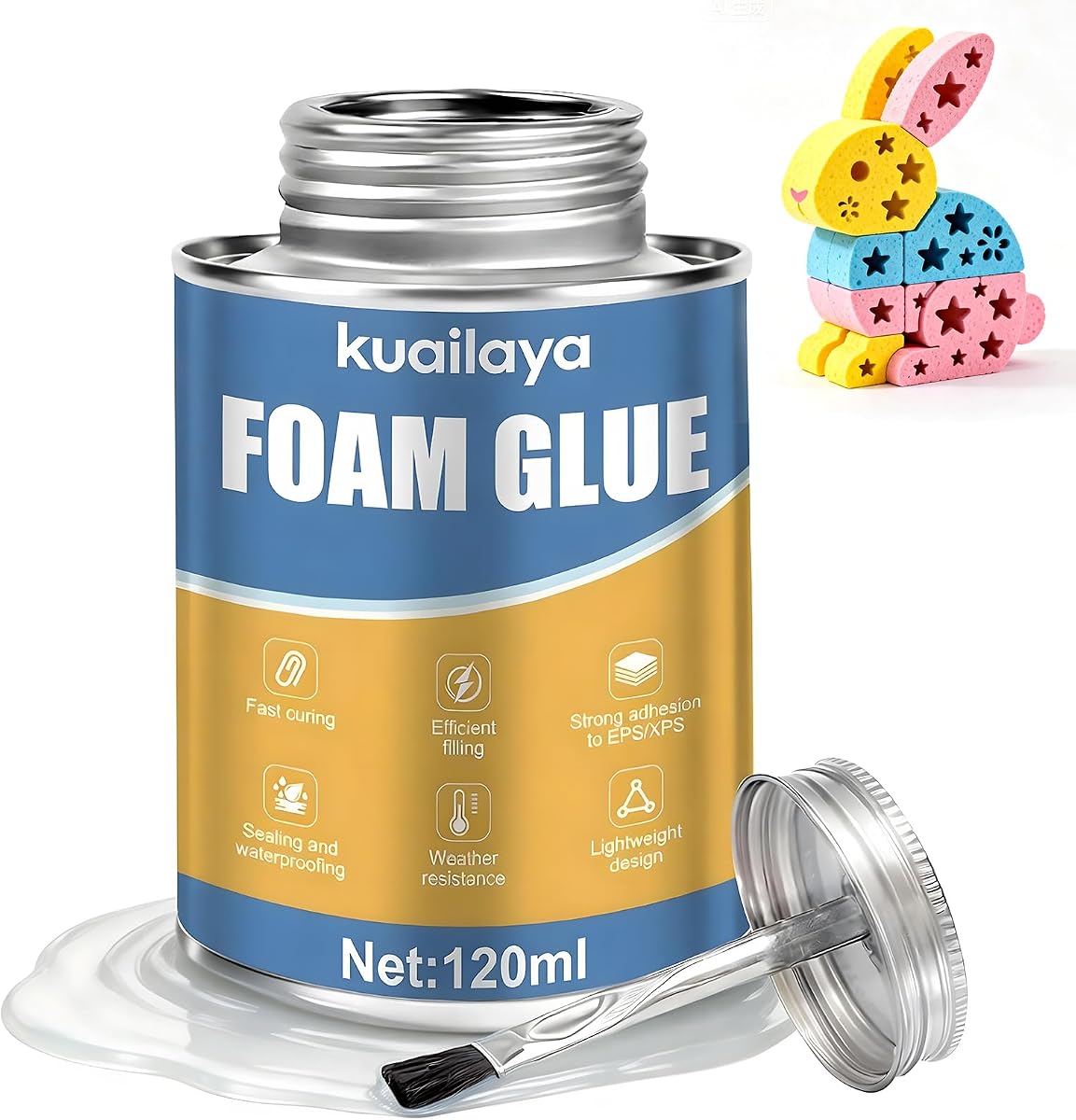
This kuailaya foam glue combines a foam-focused formula with compatibility across several craft and construction materials. Its customer rating is solid, while the defined ten-minute assembly window and 24-hour full-cure period make it easier to plan than an adhesive with vague drying guidance. The included foam brushes support controlled placement on porous surfaces.
We may earn a commission when you buy through this link, at no additional cost to you.
A key benefit is the claimed ability to generate grip quickly without excessively penetrating or dissolving foam. For lightweight models, signs, displays, and layered EVA work, this can be useful when parts must be repositioned during assembly. It also bonds to KT board, plastic, and wood, giving the product broader value for mixed-material projects where a foam-only adhesive would be unnecessarily restrictive.
The adhesive has an odor during application, and the instructions call for good ventilation. It also does not reach its strongest stated condition until a full day after bonding, so handling should account for that curing period. Transparency without whitening or hardening is another useful characteristic, particularly for projects in which the adhesive line might otherwise distract from the finished design.
This is a good general-purpose choice for crafters who regularly move between foam and rigid materials. Its clear instructions and multi-material support make it easy to recommend for assemblies involving KT board, plastic, or wood. Hobbyists needing specialized vibration absorption for RC aircraft may find an aircraft-oriented formula more directly aligned with their requirements.
The stated ten-minute wait offers a balance between allowing adhesive to spread and giving the maker time to align the joint accurately. It is long enough to position small parts without rushing, although the final bond should not be treated as fully cured immediately after pressing.
Compatibility with KT board, plastic, and wood makes this a practical contact adhesive for display construction and general craft assembly. That versatility is especially valuable when a single project contains foam skins over a rigid frame or base.
We may earn a commission when you buy through this link, at no additional cost to you.
This brush-cap adhesive is purpose-built for RC aircraft and foam models, with stated compatibility across EPP, EPO, EPS, balsa wood, and carbon fiber. It carries a strong customer rating and differentiates itself through a flexible, vibration-absorbing bond designed to tolerate the repeated stresses associated with flight, takeoff, and landing.
We may earn a commission when you buy through this link, at no additional cost to you.
Its built-in brush is valuable for applying an even layer to small, intricate airframe sections without putting adhesive on the maker's hands or workspace. The product sets within minutes and reaches full cure in 24 hours, while the recommendation to coat both surfaces and wait one to two minutes provides a clear process for a stronger joint. The cured bond is described as waterproof, UV-resistant, durable, and able to absorb shock.
The most obvious trade-off is color. The adhesive appears dark yellow rather than clear, making it less suitable for projects where appearance is the primary concern. It may also have an odor while in use, although the product information says it becomes odorless after complete curing. The bottle is not filled to the top for safe operation, so its nominal capacity should not be interpreted as a completely full bottle.
This formula is a strong choice for RC aircraft builders, repairers, and foam-model hobbyists who value flexibility and material compatibility over a clear finish. It is less compelling for delicate visible craft work, but for reinforced airframe joints and components exposed to vibration, its stated design is unusually focused.
A flexible cured joint can move somewhat with the foam rather than behaving like a rigid, brittle patch. The stated ability to absorb vibration and shock is particularly relevant for radio-controlled aircraft that experience repeated loads beyond those found in stationary decorations.
The recommended two-sided application method can improve coverage on porous foam. Allowing one to two minutes before joining gives the adhesive time to develop initial tack while preserving enough working time for accurate placement.
We may earn a commission when you buy through this link, at no additional cost to you.
Gorilla Original is not marketed as a dedicated EVA foam adhesive, yet foam is included among the surfaces it can bond. It has a strong customer rating and a well-established reputation for tough repairs, making it a useful option when an EVA foam project also includes wood, stone, metal, ceramic, glass, concrete, or other dissimilar materials.
We may earn a commission when you buy through this link, at no additional cost to you.
Its polyurethane formula expands into the material, creating a strong mechanical grip as it cures. That expansion can be helpful when filling small gaps or joining uneven porous surfaces, and the waterproof brown adhesive is designed to remain durable in indoor and outdoor conditions. The compact squeeze bottle also makes it convenient to keep available for occasional household foam repairs.
However, dedicated foam glues generally offer more explicit protection against melting, excessive penetration, and hardening. Gorilla Original's brown color will be visible on light foam, and its general-purpose characteristics make it less attractive for cosplay, decorative craft pieces, or other projects requiring a transparent or flexible finish. Users should also account for the curing behavior of an expanding polyurethane adhesive around foam.
The best reason to select this product is versatility rather than cosmetic foam work. It makes sense for a foam component attached to wood, a repair involving several rigid materials, or a household task where a proven waterproof polyurethane adhesive is needed. For large areas of exposed EVA or projects where appearance and flexibility are priorities, a specialized foam formula is usually the more appropriate choice.
A dedicated foam adhesive is optimized for porous, lightweight surfaces, while this product also bonds stone, metal, ceramic, glass, concrete, and more. That broader substrate range can be decisive when a foam repair forms only one part of a multi-material joint.
As the polyurethane adhesive cures, it expands into the substrate. On uneven or porous surfaces, that action can strengthen the connection, although it also makes this a less visually discreet option than a clear foam-specific glue.
We may earn a commission when you buy through this link, at no additional cost to you.
This foam glue emphasizes a strong, permanent bond that remains flexible and does not dissolve, shrink, or harden fragile honeycomb structures. It is intended for porous and non-porous materials and carries a customer rating that is lower than several alternatives, but its stated waterproof sealing behavior and multi-material compatibility make it worth considering for demanding craft assemblies.
We may earn a commission when you buy through this link, at no additional cost to you.
The adhesive is described as penetrating deep into the surface texture for strong holding power, yet it is formulated to avoid the material degradation associated with ordinary glues. It also maintains flexibility after curing and creates a waterproof layer intended to block rain and moisture. Compatible materials include EPP, EPO, EPS, balsa wood, and carbon fiber, giving it useful relevance to model-aircraft builders.
Its main weakness is the lack of a clearly specified applicator. Some competing products include a brush or needle tip, while this listing focuses on the formula itself. The ten-minute wait and press-together method are clear, but users may need another tool to spread the adhesive evenly. The rating also suggests that the overall customer experience may be somewhat less consistent than the strongest-rated options.
This product is a sensible choice for makers who prioritize waterproofing, flexibility, and compatibility with model materials over a built-in applicator. It can suit aircraft models, packaging, decorations, and general foam assemblies where moisture resistance is important. Those wanting the most controlled application may prefer a brush-equipped bottle with a similarly flexible, foam-safe formulation.
The cured layer is described as a waterproof sealant that blocks moisture while maintaining adhesion. This makes the adhesive relevant to model-aircraft projects and decorated pieces that may encounter humidity or incidental water.
The formula is specifically positioned as a solution to dissolving, shrinking, and hardening problems. Maintaining the original open-cell or honeycomb structure is especially important for lightweight parts that need to remain workable.
We may earn a commission when you buy through this link, at no additional cost to you.
This 4 oz brush-cap adhesive has the highest supplied customer rating and the most comprehensive stated feature set. It is explicitly designed for EPO, EPP, EPS, EVA foam, styrofoam, KT board, balsa wood, carbon fiber, plastic, and other lightweight materials, making it suitable for RC airplanes, gliders, drones, model kits, cosplay props, packaging, and household foam repairs.
We may earn a commission when you buy through this link, at no additional cost to you.
Its integrated brush gives makers controlled coverage around small parts and hard-to-reach areas. The resulting bond is described as strong but flexible, with the ability to absorb vibration, shock, and landing impacts rather than forming a brittle patch. It develops initial tack within minutes and fully cures in 24 hours, after which the adhesive layer is said to be waterproof and UV-resistant.
The product still requires sensible curing discipline. A joint may feel secure before reaching full strength, so early handling should be minimized. For demanding foam structures, applying adhesive to both mating surfaces may be more reliable than relying on a thin one-sided layer. As with many solvent-based or moisture-curing adhesives, working in a ventilated space is advisable even though the listing emphasizes reduced residue around the brush.
This is the most complete recommendation for a buyer who wants one foam adhesive to cover crafting, cosplay, repair, and model-aircraft work. The broad material list, precise applicator, clear appearance, and flexible durable bond reduce the need to choose separate products for different lightweight substrates. It is the strongest all-around pick in this guide, while specialized needle-tip users may still prefer the next-ranked option.
The unusually broad substrate list allows a maker to move from EVA and EPS to KT board, balsa, plastic, and carbon fiber without changing formulas. That flexibility is valuable for mixed-material model aircraft and display projects.
The stated shock- and vibration-absorbing characteristics help a foam component tolerate movement without a rigid, brittle joint. That makes the adhesive more relevant to outdoor models and cosplay pieces than a basic glue that becomes hard and brittle after drying.
We may earn a commission when you buy through this link, at no additional cost to you.
This 120 ml adhesive shares the highest supplied customer rating and takes a different approach to application through its precise needle tip. The included cap also contains a needle intended to keep the glue from drying out or clogging, giving it a strong appeal for detailed EVA sheets, sponge figures, pearl-cotton structures, props, classroom projects, and display pieces.
We may earn a commission when you buy through this link, at no additional cost to you.
The product is formulated for porous, lightweight materials that can be difficult to join with general craft glue. Application starts with cleaning away dirt or oil, after which a small amount is placed and spread evenly with a brush or another suitable tool. The adhesive initially dries in about one hour and completely cures in 24 hours, giving a clear distinction between handling readiness and final bond strength.
A fine applicator demands reasonable care. Users should avoid leaving the cap off unnecessarily because the narrow opening can be vulnerable to dried residue, and the supplied needle should be used as intended. The product information also recommends keeping the cap on between sessions and using the adhesive in a ventilated space. Those instructions are sensible for preserving performance and keeping the work area comfortable.
This is a premium-style pick for detail-oriented makers who value controlled placement and a broad portfolio of foam-based craft uses. The precise tip and brush-spreading method offer more control than a basic squeeze application. It is less obviously specialized for RC flight than the aircraft-focused formulas, but it is especially compelling for decorative assemblies, classroom activities, and finely cut EVA components.
A narrow needle tip places adhesive accurately along small tabs, seams, and detailed joints where a conventional bottle opening could deposit too much. This precision helps reduce squeeze-out and makes the adhesive easier to manage around detailed foam cuts.
The included needle addresses a common problem with fine-tip adhesives: dried glue blocking the applicator. Keeping the cap secured between sessions and cleaning the opening gently helps maintain consistent flow.
We may earn a commission when you buy through this link, at no additional cost to you.
TBTFW foam glue combines polyurethane strength with a clear, quick-grab formula and a strong customer rating. It is designed for EVA foam, craft foam, cosplay foam-clay modeling, insulation installation, packaging, and general craft assembly, offering a useful middle ground between immediate handling and the full 24-hour cure stated for maximum strength.
We may earn a commission when you buy through this link, at no additional cost to you.
The included brush allows controlled application, while the quick-grab characteristic can shorten the wait before parts begin to stay together. Once cured, the adhesive is described as fully transparent and unable to leave visible lines or warps on delicate foam paper or paper. It also forms a waterproof sealing layer that blocks rain and moisture, giving the bond value beyond simple assembly.
As with many fast-contact adhesives, a quick initial grab can also reduce the time available for repositioning. The user should align parts before joining and avoid assuming that an immediate grip represents maximum strength. Full curing still takes 24 hours, so the phrase quick grab should be understood as a practical assembly advantage rather than instant structural completion.
This adhesive is a good option for crafters who want a transparent joint, a fast working bond, and broad use across foam and packaging projects. It also suits cosplay makers and paper-oriented foam crafts where visible marks would be undesirable. For highly specialized RC work, a formula that explicitly discusses flight stresses may offer a more relevant feature set.
The quick-grab behavior can be valuable when a project has many small parts or when the maker wants to continue working soon after joining. Accurate alignment before contact remains essential because the fast grip may limit corrections.
The stated ability to dry without leaving lines or warps makes this adhesive appropriate for thin foam paper, decorative layers, and packaging details. Transparency helps the finished piece retain the appearance of the original materials.
We may earn a commission when you buy through this link, at no additional cost to you.
This 120 ml brush-equipped foam adhesive has the lowest supplied customer rating, but its stated technical characteristics remain relevant to EVA, EPP, EPO, EPS, EPE, rubber, plastic sheet, and lightweight wood projects. It is particularly suited to foam products bonded to one another and offers a gentle formula designed to avoid dissolving, shrinking, or hardening fragile structures.
We may earn a commission when you buy through this link, at no additional cost to you.
The most notable feature is its retained flexibility after curing. It is also described as absorbing vibration and impact, which makes it relevant to RC aircraft exposed to flight, takeoff, and landing stresses. The built-in brush provides even coverage in small or intricate areas, while the recommended ten-minute wait before pressing gives the user a defined positioning period.
The lower rating suggests that some buyers may have found aspects of the consistency, odor, or application process less satisfactory. A noticeable odor during use is explicitly mentioned, and the formula reaches peak bond strength after 24 hours. Applying adhesive to both surfaces is recommended for stronger adhesion, so users should not interpret a light one-sided application as equivalent to the intended bond.
This product is most appealing to model builders who value flexibility and vibration absorption and do not mind an odor during use. The brush and detailed material compatibility make it useful for lightweight assemblies, although those prioritizing the most consistently received experience may prefer a higher-rated brush-cap model formula.
The ability to absorb vibration and impact is especially valuable for foam aircraft components. A joint that flexes with the model can be less likely to crack than one made with a rigid adhesive that becomes brittle.
Applying the adhesive to both mating surfaces can improve the overall bond on porous foam. This extra step takes slightly more time but aligns with the manufacturer's recommendation for stronger adhesion.
We may earn a commission when you buy through this link, at no additional cost to you.
This clear foam adhesive is designed for high-strength bonding across EVA sponge, rubber, pearl cotton, plastic sheets, and light wood. Its customer rating is moderate, but the stated ability to withstand tensile and compressive forces makes it relevant for household repairs, model making, and craft assemblies that need more than a light contact bond.
We may earn a commission when you buy through this link, at no additional cost to you.
The brush permits controlled application and an even spread, while the transparent formula helps preserve the appearance of the finished repair. It is also described as quick drying, reducing the waiting time before the joint is handled or the project continues. A 120 ml capacity supports repeated repairs and larger DIY work without requiring a very small applicator bottle.
The main weakness is the absence of a clearly stated waiting time or full-cure period. That makes the quick-drying behavior less predictable for someone who wants a precise schedule, and the supplied customer rating is not as strong as that of the leading options. It is also worth considering the product's focus on high structural strength rather than explicitly emphasizing the same degree of flexibility as some dedicated foam glues.
This adhesive works well as a general-purpose choice for common foam repairs and mixed-material crafts. It is especially appealing when a discreet joint and substantial holding power are both important. Builders who need explicit cure times, impact absorption, or aircraft-specific performance should choose a more specialized formula with those details clearly stated.
The stated resistance to tensile and compressive forces makes the adhesive relevant to joints that will be squeezed, pulled, or placed under normal handling stress. That distinguishes it from products intended primarily for light decorative assembly.
Because the adhesive becomes transparent after drying, it can help keep visible foam repairs less distracting. The included brush also supports a thin, even application, which is useful when appearance and bond strength are both priorities.
We may earn a commission when you buy through this link, at no additional cost to you.
The right EVA foam adhesive should protect the material, create a durable joint, and suit the precision, flexibility, and environmental demands of the finished project.
EVA foam is porous and can absorb ordinary liquid adhesives more readily than rigid plastic. That penetration may weaken the structure, leave a rigid joint, or cause foam to dissolve, shrink, warp, and harden. A purpose-formulated foam glue should therefore be selected when appearance, dimensional accuracy, or long-term flexibility matters. Products in this guide describe themselves as foam safe and specifically address limiting excessive penetration or protecting delicate structures.
Choose a formula explicitly intended for EVA foam, styrofoam, or other porous foam whenever possible. A general-purpose adhesive may create a strong connection, but it does not necessarily preserve the lightweight material the way a dedicated contact adhesive does.
A rigid bond can crack or separate when the foam flexes, vibrates, or receives an impact. Flexible adhesives remain somewhat pliable after curing, which is valuable for RC aircraft, cosplay pieces, padded components, and decorations that may be handled. The strongest options in this list state that they absorb vibration and shock or maintain flexibility without melting the foam.
For stationary foam signs, rigid attachments may be acceptable, but models and wearable crafts benefit from a flexible cured layer. Check whether the manufacturer describes the final bond as flexible rather than assuming that initial tack predicts long-term rigidity.
Foam projects often involve narrow tabs, small cutouts, and irregular shapes where excess adhesive can be difficult to remove. An integrated brush gives direct control, a fine needle tip supports detailed placement, and a conventional squeeze bottle is best for larger coverage. The right applicator should match the scale of the work rather than simply the size of the project.
A brush-equipped bottle is convenient for general assembly, while a fine tip is preferable for small components and detailed seams. Whichever design you choose, clean the surface first and apply a controlled amount rather than flooding the porous material.
Initial grip and final cure are different stages. Some products begin holding within seconds or minutes, while others recommend waiting about ten minutes before pressing. One formula states an initial drying period of one hour, and several identify 24 hours as the point of full cure. These differences affect how quickly a joint can be moved, clamped, trimmed, or placed under load.
Follow the stated schedule rather than relying on surface dryness. If the adhesive permits two-sided application, use it where a stronger joint is required. Remember that a part that feels secure after assembly may still need the full cure period before heavy handling.
A useful glue for EVA foam may also need to bond a foam skin to plastic, balsa wood, carbon fiber, KT board, rubber, pearl cotton, or light wood. Broad compatibility simplifies model and display construction because separate adhesives can create uneven cure times, excessive residue, or visible differences between layers.
Check the full material list rather than assuming that a term such as craft glue covers every substrate. If a project mixes foam with a rigid component, select a formula that explicitly names both materials and has suitable flexibility for the combined joint.
For RC aircraft, outdoor decorations, packaging, and foam items exposed to humidity, waterproof performance can prevent moisture from weakening the joint. Several products in this guide claim waterproof cured layers, while some also specify UV resistance. These properties are more relevant outdoors than for a dry indoor craft that will never experience rain or condensation.
Look for a combination of waterproofing and flexibility when foam is exposed to changing conditions. A bond that blocks moisture but becomes rigid may still perform poorly if the material repeatedly flexes, so both properties deserve attention.
A transparent adhesive is generally preferable for cosplay props, decorative foam, signs, and model surfaces where the joint may be visible. Some foam adhesives cure clear, while one RC-oriented formula is explicitly dark yellow, and general-purpose polyurethane glue may leave a brown finish. Appearance should be considered alongside bond strength rather than treated as an afterthought.
For concealed structural joints, color may not matter. For visible craftwork, select a clear formula and test it on the same foam stock if possible, because different foam surfaces can absorb and display adhesive differently.
Several listed foam glues mention an odor during use, although some state that the odor is absent after complete curing. That is especially relevant to enclosed rooms, classrooms, and workspaces without good ventilation. A brush or fine tip can also reduce waste, while careful capping helps prevent spills and unwanted curing around the opening.
Work in a ventilated area and keep the container closed between sessions. Follow all safety directions supplied with the selected product, and avoid using adhesive near flames or other ignition sources when handling a solvent-based formula.
Begin by testing the adhesive on a small offcut of the same EVA foam used in the project. Confirm the color, surface finish, drying behavior, and compatibility with any non-foam materials before assembling the finished piece. Clean both mating surfaces thoroughly so that oil, dust, and loose particles do not interfere with contact.
Apply a thin, even layer using the built-in brush, needle tip, or a separate suitable applicator. Follow the product-specific instructions for waiting time and coverage. Where two-sided application is recommended, coat both porous surfaces and then align the parts carefully. Once joined, press the surfaces together and avoid moving the joint until the adhesive has reached the stated initial-holding stage.
Allow the assembly to cure fully before trimming, flexing, painting, or exposing it to heavy use. Keep the bottle tightly closed between sessions, clean residue from the cap and applicator, and store the adhesive away from direct sunlight. For a later repair, remove damaged foam carefully, inspect the mating surfaces, and use a compatible flexible foam adhesive rather than flooding the porous area with an unverified general-purpose glue.
A foam-specific adhesive is generally the safest choice because it is formulated to avoid dissolving, shrinking, or hardening porous EVA. The best option also depends on the project: brush-applied formulas suit general assembly, fine tips suit detailed work, and flexible waterproof formulas are preferable for RC aircraft or outdoor projects.
Some ordinary adhesives can bond EVA foam, but they may soak into the porous material, create a brittle joint, or cause the foam to warp. A dedicated foam formula controls penetration and retains more flexibility. If using another adhesive, test it on a small offcut and allow it to cure completely before judging the joint.
Initial grip may develop within minutes, but full cure commonly takes about 24 hours. The precise schedule depends on the formula, coating thickness, temperature, humidity, and materials involved. Treat a joint as provisional until the product's stated full-cure time has passed, especially if it will be under load.
A foam-safe contact cement can be suitable because it creates a strong bond while allowing some positioning time before joining. Apply it evenly, observe the stated waiting period, and align the parts carefully. Excess application can be difficult to remove from porous foam, so control the amount.
Many of the listed formulas support mixed-material assemblies involving plastic, KT board, balsa wood, light wood, or carbon fiber. Compatibility differs by product, so check its stated substrate list. The joined structure should also tolerate the different flexibility and expansion characteristics of foam and rigid materials.
An aircraft-oriented foam glue designed for EPP, EPO, EPS, EVA, balsa, or carbon fiber is the most relevant choice. Look for a flexible, waterproof bond that can absorb vibration and shock, along with a precise applicator for small airframe joints.
Use an adhesive specifically labeled as foam safe and apply only a thin, controlled layer. Excessive penetration is more likely when adhesive is over-applied or forced into an open-cell surface. Testing on a scrap piece is the safest way to confirm that the formula and foam stock work together.
Yes, provided the product lists EVA or the specific foam used in the prop. Clear, flexible formulas are generally preferred for visible costume parts, while a fine-tip applicator helps control glue around seams and detailed shapes. Allow the completed piece to cure fully before wearing or flexing it.
The Editor's Choice 4 OZ Foam Glue with Brush Cap offers the most balanced package for EVA foam and mixed lightweight materials, combining a strong customer rating, precise application, flexibility, and outdoor durability. The Best Premium 120ml needle-tip formula stands out for detailed craft work, while the 120ML clear special adhesive is an efficient budget-oriented choice for clean, flexible repairs.
Prioritize foam safety before raw strength. An adhesive should protect the material from dissolving, shrinking, or hardening, and its final flexibility should match the way the finished object will be used. Brushes suit controlled general assembly, fine tips support intricate details, and waterproof formulas deserve priority for RC aircraft, outdoor decorations, and moisture-prone projects.
Before buying, verify the current listing, compatibility list, cure instructions, and safety guidance because manufacturer details and availability can change. Comparing the live product page with the intended foam stock, joint design, and project environment will help ensure that the selected adhesive becomes a reliable long-term part of the finished build.