
CHANZON 100-Piece 940nm Emitter Set
4.5Editor score
940nm infrared emitters
One hundred-piece pack
Five-millimeter through-hole LEDs
45-degree emission angle
Ideal for DIY electronics
Discover the best IR LED light bulbs for security cameras, comparing 850nm, 940nm, and 980nm options, coverage, visibility, sockets, and installation needs.
IR LED light bulbs are supplementary infrared illuminators designed to support compatible security cameras in low-light or completely dark locations. A useful bulb must match the camera's wavelength sensitivity, provide enough coverage for the intended space, fit the available socket, and operate without creating distracting visible light.
This guide compares ten infrared lighting products across useful categories, including screw-in household bulbs, low-voltage circuit-board illuminators, and 940nm emitter components. The evaluation considers the stated wavelength, illumination range, beam angle, electrical requirements, installation method, visibility, and intended surveillance application.
Each review explains the product's strongest benefits, limitations, and best-fitting use case. The top selections represent the most practical choices for different priorities, while the remaining products provide specialized options. Product availability and pricing can change, so confirm current specifications and costs before purchasing.
4.5Editor score

4.4Editor score

3.2Editor score
The table below compares all ten products by wavelength, coverage, power or configuration, and installation style. It includes dedicated surveillance bulbs, circuit-board modules, individual emitter LEDs, and one listing that does not provide enough information to evaluate.


This 850nm infrared spotlight is the strongest general-purpose selection in the guide, combining a household-friendly E26 base with three high-power 3W LED emitters. It carries a 4.4 customer rating, and its most attractive specification is the stated ability to illuminate as far as 30 feet. That makes it especially relevant for cameras watching porches, driveways, hallways, yards, or other dark areas that need supplemental infrared coverage.
We may earn a commission when you buy through this link, at no additional cost to you.
The product is designed for cameras capable of detecting 850nm infrared light. Its three 3W LEDs are combined with a polycarbonate diffuser to produce a more even 45-degree field rather than relying on several visibly separated light sources. The listing describes an effective range of 20 feet and an optimal range of 15 feet, so buyers should distinguish the headline distance from the distance at which clearer illumination can be expected throughout the intended scene.
Installation is refreshingly straightforward because the unit uses a standard American E26 socket and 120V supply. There is no light sensor, meaning it remains on whenever the socket is powered. That continuous operation is useful for a camera that must be ready at any moment, although it offers no automatic daytime shutoff. The 45-degree beam also requires more deliberate placement than a 180-degree model, particularly when a broad room must be covered from one socket.
This is the best overall option for someone who wants a recognized 850nm standard, a practical stated reach, and uncomplicated installation. It is best suited to a compatible security camera pointed across a defined zone rather than one requiring invisibility or room-filling coverage. For users with a 940nm-only camera, choosing the wavelength-specific alternative is essential.
The concentrated 45-degree pattern is useful when a camera needs stronger illumination over a particular walkway or outdoor approach. Aim the bulb toward the camera's field of view rather than directly at the lens, and confirm the camera can detect 850nm light before installation.
A standard E26 base means the bulb can go into an existing lamp socket without adding a separate low-voltage driver. Because it is always on, place it where continuous infrared coverage is acceptable and where the visible source will not distract occupants.
We may earn a commission when you buy through this link, at no additional cost to you.
This 15W 850nm bulb is built for broad coverage rather than a narrow spotlight. Its five LEDs, milky diffuser, and stated 180-degree field can spread infrared light across living rooms, yards, driveways, and other spaces where a single concentrated source would leave dark edges. The product has a 3.6 customer rating and is most appropriate for cameras specifically sensitive to 850nm infrared light.
We may earn a commission when you buy through this link, at no additional cost to you.
The listing states that the bulb can illuminate an area up to 25 feet across and is designed to produce more even black-and-white footage in darkness. A built-in diffuser is intended to eliminate central hot spots and dark corners. It also supports both E26 and E27 sockets and accepts an 85-265V supply, making it versatile across common household and workshop installations.
As with other 850nm illuminators, the light may produce a faint red glow when viewed directly. The seller treats this as normal operating behavior rather than a defect. It is also always on when powered, with no automatic day/night sensor. Those characteristics may be inconvenient in a bedroom or occupied living area, but they are generally practical for a fixed surveillance location.
Choose this bulb when a 180-degree spread and broad room illumination matter more than invisibility. It is a sensible choice for a compatible 850nm camera positioned centrally in a dark area. Users seeking completely invisible output should instead choose a camera-compatible 940nm illuminator, while those needing a more focused beam can consider the higher-rated 45-degree option.
The diffuser's main purpose is to distribute light more uniformly than a bare LED array. Positioning the bulb near the center of the target area can help reduce dark corners, but actual image quality also depends on camera sensitivity, placement, and scene conditions.
Compatibility with E26, E27, and an 85-265V input range simplifies installation. Verify the socket's voltage and ensure the camera supports 850nm illumination before replacing an existing bulb.
We may earn a commission when you buy through this link, at no additional cost to you.
This 9W 850nm illuminator emphasizes efficient heat management and wide indoor coverage. It uses three 3W high-power infrared LED chips inside an aluminum alloy housing, and the manufacturer states that this construction helps extend service life to as much as 50,000 hours. No customer rating is currently supplied, so its performance assessment must rely on the listed design and intended use.
We may earn a commission when you buy through this link, at no additional cost to you.
The 180-degree beam is intended to cover a full room without requiring several bulbs. The listing identifies home security monitoring, CCTV systems, and pet-camera observation as suitable applications. Installation is straightforward because the E26/E27 screw base fits common lamp holders, while the 85-265V operating range accommodates varied electrical environments without an extra household driver.
This is an illuminator, not a security camera, and it cannot give an ordinary phone or a camera without infrared sensitivity the ability to see in darkness. It is also designated for indoor use only. The faint red glow produced by 850nm light should be understood as normal operation, while the product's lack of a published customer rating makes objective comparison with established options more difficult.
The bulb is best for a compatible indoor camera that needs broad 850nm coverage and where a metal housing is valuable for heat dissipation. Buyers may prefer a product with a visible rating history for higher-confidence purchasing. Still, for indoor, wide-angle installations using standard sockets, the listed features make this a practical supplemental lighting option.
Heat management is especially relevant for high-output LEDs operating continuously. The aluminum alloy enclosure is designed to draw heat away from the LED chips, supporting steadier output and potentially extending service life in an indoor installation.
The stated 180-degree beam makes the bulb more appropriate for broad areas than narrow accent lighting. Mount it where it can illuminate the camera's viewing area without pointing directly into the lens, which can cause glare or washed-out footage.
We may earn a commission when you buy through this link, at no additional cost to you.
This CHANZON pack is the budget-oriented choice for electronics builders rather than shoppers seeking a ready-made household lamp. It contains 100 clear, 5mm, two-lead 940nm infrared emitter diodes and carries a 4.5 customer rating. Because these are low-voltage components, they support custom illuminators, sensor experiments, communication projects, and other applications requiring a flexible DIY approach.
We may earn a commission when you buy through this link, at no additional cost to you.
The emitters operate at DC 1.2-1.5V with a listed current of 20mA. Their polarity is easy to identify: the longer leg is the anode, marked positive, while the shorter leg is the cathode, marked negative. Each LED has a 45-degree emission angle and a clear round lens, making the pack appropriate when a focused, directional infrared source is preferred over a room-filling fixture.
This product does not provide a screw base, integrated driver, housing, or finished power supply. Users must construct or purchase those parts and observe appropriate limits for the installed setup. It is therefore less convenient for a straightforward security-camera upgrade, but that same limitation gives capable users control over reflector shape, circuit arrangement, and the number of emitters used.
The pack is best for makers creating a custom 940nm illuminator for a compatible camera, testing infrared sensor circuits, or replenishing an existing electronics project. It is also a good choice when having spare emitters on hand is valuable. For a plug-in installation, select one of the E26 or E27 infrared bulbs instead.
One hundred emitters allow a builder to create a multi-LED array, spare a damaged component, or distribute infrared light across several small projects. The finished result depends on the selected resistors, power supply, wiring, and enclosure.
The stated operating values make these components approachable for breadboard and soldered projects. Always match the supply and current-limiting arrangement to the LEDs, and confirm that the target camera is sensitive to 940nm infrared illumination.
We may earn a commission when you buy through this link, at no additional cost to you.
This 940nm infrared bulb is the premium selection for a specific objective: adding night illumination without the faint red glow associated with many 850nm products. It uses five 3W infrared LEDs behind a milky polycarbonate diffuser and fits an E26 socket. Its 3.2 customer rating is the lowest numerical rating among the listed products with ratings, so buyers should weigh the desired invisibility against limited customer feedback.
We may earn a commission when you buy through this link, at no additional cost to you.
The 180-degree irradiation pattern is designed to spread light more uniformly than a spotlight configuration. The listing states an effective range of up to 20 feet and an optimal range of 15 feet, which can cover a dark room, yard, driveway, or camera-facing area depending on placement and surroundings. The diffuser helps reduce spot-like illumination and supports broad coverage around the bulb.
A 940nm camera is a non-negotiable requirement. Many modern security cameras include infrared-sensitive imaging, but a camera designed only for visible light will not benefit from this bulb. The unit also has no automatic sensor, so it remains on whenever the socket is powered. That behavior is predictable for continuous surveillance but may be undesirable in occupied sleeping or living spaces.
This is the best pick when a discreet, invisible source is more important than maximum reach or customer-rating strength. It also works well when a broad 180-degree field is desired within a moderate-sized area. Choose the 850nm spotlight instead for longer reach and a stronger published customer rating, or the 180-degree 850nm option for cameras that cannot detect 940nm light.
The 940nm output is intended to be invisible to the human eye, making this option suitable for areas where a visible red source would be distracting. The camera must still be able to detect and convert the infrared illumination into a usable image.
A milky diffuser and 180-degree pattern favor even room coverage over a narrow beam. Test the arrangement in darkness and avoid aiming the bulb directly toward the lens, as reflected infrared can reduce contrast or produce glare.
We may earn a commission when you buy through this link, at no additional cost to you.
This 48-LED 850nm illuminator board is a specialized option for builders modifying or assembling surveillance camera housings. Rather than plugging into a household socket, it is a round circuit board designed around a 12V supply. Its 4.2 customer rating gives it a stronger published history than several complete screw-in bulbs in the guide.
We may earn a commission when you buy through this link, at no additional cost to you.
The board carries 48 F5-size infrared LEDs, each with a 5mm bulb diameter, and has an overall board diameter of 53 millimeters. The listing specifically says it is suitable for a camera shell with a 50mm diameter. This makes it more relevant to a technically inclined installer than to someone seeking a fast household upgrade, because the board must be correctly positioned, connected, and enclosed.
Because it is a bare circuit-board product, the listing does not describe a finished enclosure, integrated connector, or plug-in power source. The installer must provide appropriate 12V power and safe wiring. The listed 850nm wavelength also means the receiving camera should support 850nm infrared illumination; the board is not a universal upgrade for every camera or smartphone.
The board is best for a custom camera enclosure where a dense ring or cluster of emitters can be placed close to the lens assembly. It may also serve as a replacement component for a compatible 50mm camera shell. Buyers who need a simple, removable installation should choose an E26 or E27 illuminator instead.
Forty-eight closely arranged LEDs can provide substantial infrared output in a compact board format. Their effectiveness depends on the camera's 850nm sensitivity, the enclosure's geometry, and whether the board is positioned to reduce reflections and hotspots.
The stated 53mm board and 50mm housing compatibility allow a more integrated appearance than a screw-in lamp. Confirm dimensions, mounting clearance, polarity, and power requirements before modifying an enclosure.
We may earn a commission when you buy through this link, at no additional cost to you.
This three-LED 940nm bulb offers a simple way to add invisible infrared illumination through a standard E26 socket. It has a 3.6 customer rating and is designed for 940nm-capable security cameras. Its 180-degree diffuser pattern and stated 20-foot reach make it more compact and less intense than some competing configurations, but particularly convenient for common household lamp holders.
We may earn a commission when you buy through this link, at no additional cost to you.
Each of the three LEDs is rated at 3W, and a milky polycarbonate diffuser spreads the output to avoid a concentrated spot effect. The listing describes a 15-foot effective range and 10-foot optimal range. Installation requires only screwing the bulb into an E26, 120V lamp socket, with no extra driver or low-voltage wiring.
The source is designed to remain invisible to the human eye, which is useful in bedrooms, hallways, and living areas where a visible red glow would be distracting. However, it stays on whenever powered because no light sensor is included. The product is also explicitly not compatible with dimmers, so the connected switch should be used only for full on/off control.
This bulb is best for a homeowner who prioritizes an unobtrusive installation and has a camera that supports 940nm. The standard base and simple wiring make it less demanding than a custom board. If three emitters do not provide sufficient brightness, a five-LED 940nm model is available, while a compatible 850nm camera will require the 850nm alternative.
A 940nm source avoids the faint red glow that can reveal an 850nm illuminator in a dark room. This makes the product useful for indoor camera placement where continuous surveillance and minimal visible distraction are both priorities.
The E26 base and 120V configuration reduce installation to a standard lamp socket. Do not connect the bulb to a dimmer, and use a socket that provides a stable connection for continuous operation.
We may earn a commission when you buy through this link, at no additional cost to you.
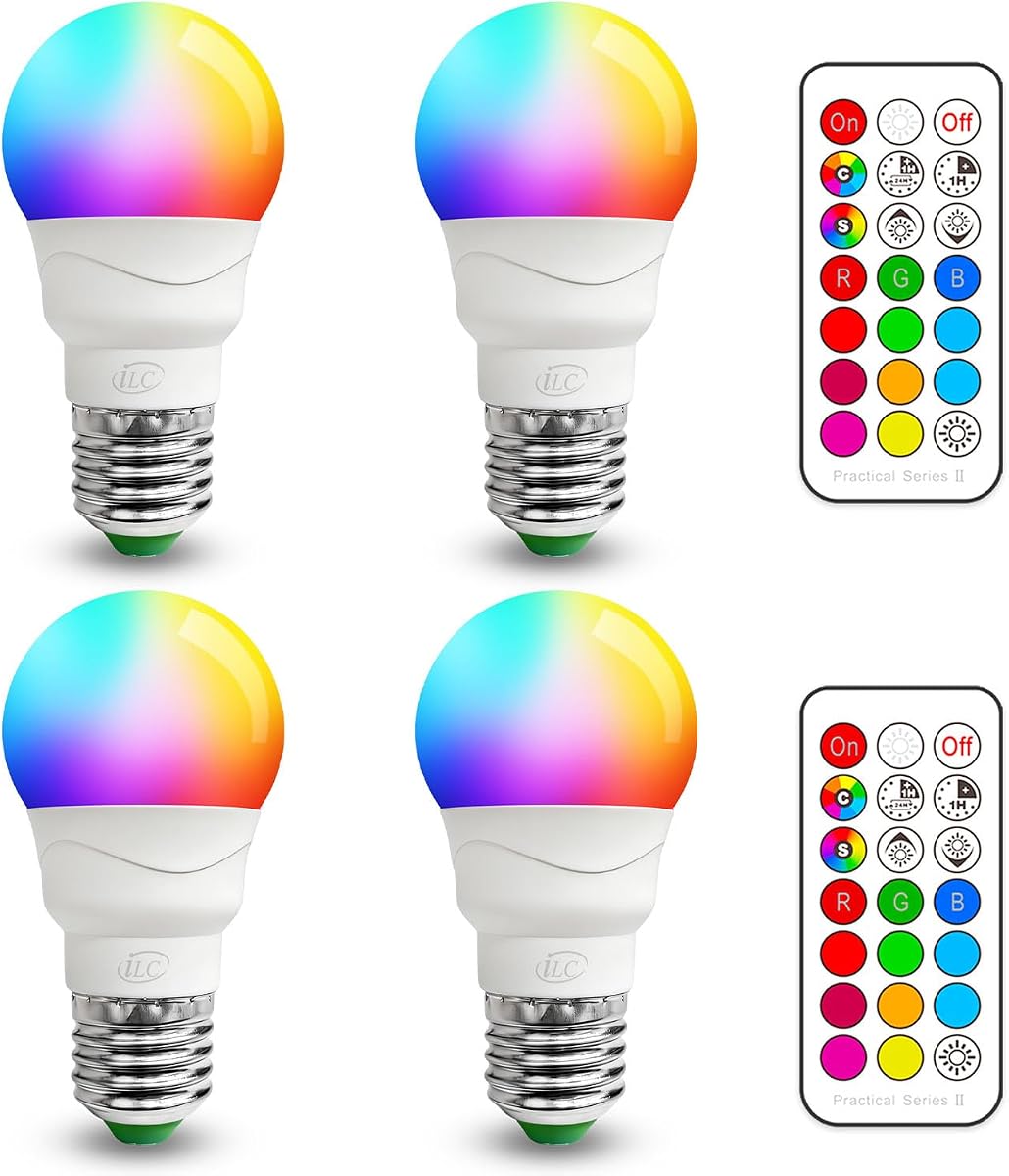
The ILC RGBW bulb is included because the keyword can also surface visible color-changing bulbs with infrared remote controls, but it does not perform the same function as a true security-camera IR illuminator. It produces visible light, offers 12 color choices, and carries a 4.7 customer rating. The set contains four A15-style E26 bulbs with warm-white and RGBW functions.
We may earn a commission when you buy through this link, at no additional cost to you.
Each bulb delivers 450 lumens while consuming 5W, which the listing describes as equivalent to a 40W incandescent bulb. The wide 270-degree beam is intended for accent and ambient applications, and the included infrared remote provides color selection and three brightness levels without requiring a separate wall switch. Users can also select warm white, flash, smooth cycling, or one-button night-light behavior.
Memory and synchronization are useful for chandeliers, ceiling fans, table lamps, and other multi-socket fixtures. The bulbs can retain the last selected color or mode, synchronize their effects, and follow a programmed shutoff cycle. A 24-hour timing option supports repeated daily operation. The remote is not compatible with dimmer switches, so standard on/off control is necessary.
This set is best for decorative lighting, color-changing ambience, or a visible-light fixture that needs remote operation. It should not be selected to illuminate a compatible 940nm surveillance camera, because the listed product does not claim to provide 940nm IR output. For security imaging, choose a purpose-built 850nm, 940nm, or 980nm illuminator instead.
The infrared remote makes color, brightness, mode, and timer adjustments convenient for accent spaces. Because this is visible RGBW lighting, it is better suited to decorative and mood-lighting uses than covert surveillance illumination.
Memory and synchronized modes are useful when several bulbs share a chandelier, fan light, or grouped table-lamp arrangement. Confirm the fixture's bulb size and socket rating before installation, and avoid dimmer switches.
We may earn a commission when you buy through this link, at no additional cost to you.
This 980nm spotlight serves users whose cameras are compatible with the less common 980nm infrared band. It combines three 3W LEDs, a 45-degree irradiation angle, and a stated reach of up to 30 feet in a standard E26 format. Its 4.5 customer rating is among the strongest in the list, adding useful customer-history support to a specialized wavelength option.
We may earn a commission when you buy through this link, at no additional cost to you.
The listing states that the lamp can reach an effective distance of 20 feet with an optimal distance of 15 feet. A polycarbonate diffuser is used to distribute the light more uniformly within the focused beam. This configuration suits a camera monitoring a defined outdoor approach, driveway segment, side path, or other elongated area where directional coverage can be aimed precisely.
The bulb operates in an E26, 120V socket and stays on whenever powered because it has no light sensor. Compatibility must be confirmed before installation: the receiving camera needs to detect 980nm infrared illumination, and an ordinary phone or non-IR camera will not acquire night-vision capability from it. The focused pattern also means placement requires more care than with a 180-degree illuminator.
This is the best option for a compatible 980nm setup that needs greater reach than the standard 940nm choices. It is also a strong alternative to the 850nm leader when both units share a similar physical design, though the wavelength must match the camera. For broad room coverage, select a 180-degree model; for discreet output, verify whether 980nm remains visually undetectable in the intended environment.
The 30-foot headline range makes this spotlight useful for cameras monitoring a defined path or larger exterior zone. Since real performance varies with camera sensitivity and environment, position the lamp where the 15-foot optimal range can cover the most important area.
A camera designed for 850nm or 940nm light may not respond adequately to a 980nm source. Check the camera's specifications or documentation for infrared wavelength support before buying or installing the bulb.
We may earn a commission when you buy through this link, at no additional cost to you.
This product is included to reflect the complete supplied list, but the available data contains only an Amazon ASIN and URL. The title is listed as N/A, and the product description is also N/A. There are no stated wavelength, power, range, beam angle, socket, voltage, installation requirements, or other technical details from which a reliable recommendation can be made.
We may earn a commission when you buy through this link, at no additional cost to you.
The absence of a product title makes it impossible to determine whether the listing concerns a screw-in IR bulb, an individual emitter, a circuit board, or another type of lighting component. It is also not possible to confirm whether it supports 850nm, 940nm, 980nm, or visible light. No customer rating is available, and the supplied product record does not include an image.
IR illuminators are highly dependent on wavelength matching and electrical configuration. Selecting an unspecified product could result in output the camera cannot detect, an incompatible supply requirement, or an installation that does not fit the intended fixture. A lower cost alone would not offset that risk because IR camera performance and equipment compatibility are the primary considerations.
This listing should not be chosen without opening the linked product page and confirming its full specifications, customer feedback, and physical format. It is best treated as an unverified option rather than a recommended IR LED light bulb. Among the fully documented products, the 850nm 3-LED E26 spotlight offers the strongest balance of reach, rating, and ease of installation.
Open the listing and identify the wavelength, electrical requirements, dimensions, and intended application. A clear product title and technical description are essential for comparing an IR source with a security camera.
Do not assume that a generic LED or IR-related listing will improve camera imaging. Compatibility, illumination pattern, and safe power delivery should all be confirmed before installation.
We may earn a commission when you buy through this link, at no additional cost to you.
Choosing an IR LED light bulb for surveillance requires matching the source to the camera while considering wavelength, coverage, electrical design, visibility, and installation. The most important rule is simple: a camera must be able to detect the bulb's infrared wavelength for improved night imagery.
The selected wavelength must be supported by the camera's infrared imaging system. The guide includes common 850nm products, invisible-oriented 940nm products, and a specialized 980nm spotlight. A camera advertised with night vision may still have limitations, so check its specifications for IR sensitivity. An ordinary phone camera, a camera without an IR-capable sensor, or a device designed for a different wavelength may not benefit even from a powerful illuminator.
Choose 850nm when your camera explicitly supports that band and you do not mind a faint red glow. Choose 940nm for discreet indoor placement with a 940nm-sensitive camera. Consider 980nm only when the camera documentation confirms support.
Range specifications help separate broad coverage from narrow, focused illumination. A product claiming a 30-foot reach may provide only a 15-foot optimal range, while a 20-foot headline specification may be more appropriate for a smaller room. The scene's reflective surfaces, camera settings, lens angle, and mounting height all affect how usable the range feels in practice.
For a small indoor room, a 180-degree diffuser can cover more area from one socket. For a long driveway or narrow path, a 45-degree spotlight may deliver more useful concentrated output. Focus on the area that must remain recognizable rather than the largest advertised distance.
Beam angle determines whether illumination is concentrated or spread across a room. The 45-degree models are best treated as focused illuminators, while the 180-degree products favor broad, even coverage. Diffusers can reduce visible LED hot spots and make grayscale footage more consistent, but a wide beam still needs careful placement to avoid reflections, glare, or bright foreground objects.
Match the pattern to the geometry. Use a spotlight for a defined target and a wide-angle model for open rooms, yards, and driveways. Avoid aiming the source directly toward the camera lens, and test with the camera positioned outside the brightest part of the field.
Most 850nm illuminators may show a faint red glow, which is normal because the wavelength is partly perceptible to human vision. Products described as 940nm or invisible are better suited to bedrooms, hallways, and other occupied spaces where a visible source would be distracting. Invisibility claims should still be evaluated under the actual lighting conditions where the bulb will operate.
Choose 940nm for the strongest case for an unseen source, provided the camera supports it. An 850nm option is usually easier to match with compatible equipment and may offer greater stated reach. If discretion is secondary, a 980nm model may be considered after verifying camera support.
Screw-in bulbs offer the simplest installation, but their base and voltage must match the socket. The reviewed E26 products use standard American-style sockets, while the 15W and 9W alternatives also support E27 and a stated 85-265V input range. The 48-LED board requires 12V and appropriate wiring, and the individual 940nm emitter set requires a low-voltage circuit with current limiting.
Choose E26 or E27 for a household socket and quick installation. Choose the board or emitter pack only if you can safely provide the required power and, when applicable, build or modify the housing. Never connect a 12V board directly to household power.
Higher LED output can improve coverage but also increases heat and power use. The 9W model uses an aluminum housing specifically to support heat dissipation, while the 15W unit concentrates more output across a 180-degree field. Quality LEDs and appropriate enclosures can support long service life, but thermal management and ventilation still matter when a bulb operates continuously.
Choose a product whose power and thermal design fit the socket and fixture. Do not cover an operating illuminator with fabric or place it in an enclosed space without adequate heat dissipation. For a continuously active camera, select a model designed for sustained operation rather than an ordinary decorative bulb.
A ready-made E26 or E27 bulb can be moved and replaced without modifying a camera. It may also be visible in the scene, so choose a location outside the camera's frame if appearance matters. Integrated boards and DIY emitter arrays can be concealed within a housing, but they require more technical work and accurate alignment with the lens.
Choose a household bulb for convenience, a board for a compatible camera shell, and a loose emitter pack for custom electronics. In every case, position the source to illuminate the subject rather than the lens, and confirm that wiring, dimensions, and polarity are correct.
Customer ratings can provide a useful signal about consistency and satisfaction, although they do not replace compatibility checks. Products in this guide range from 4.7 to 3.2 where ratings are supplied, while two listings have no numerical feedback. A published rating should be considered alongside clear specifications, warranty information, seller support, and the product's fit for the intended camera.
Favor a product with complete technical documentation and an established feedback history when your needs are conventional. For specialized 940nm or 980nm equipment, use customer reviews to identify recurring installation or wavelength issues rather than relying only on the average score.
Begin by confirming that the security camera supports the bulb's wavelength. For a screw-in model, turn off and disconnect power to the lamp socket, remove any existing bulb, and install the illuminator without forcing it. Keep the source outside the camera's frame when possible, and avoid pointing it directly toward the lens. For board or emitter-based products, follow the appropriate low-voltage wiring diagram and observe polarity requirements.
After installation, restore power and test the camera in darkness. Compare footage with the illuminator switched on and off to determine whether the scene has become clearer, whether reflective surfaces are overexposed, and whether the camera shows glare. Adjust the angle, distance, and camera position rather than assuming the maximum advertised range will produce the best image. A moderate amount of evenly distributed infrared often produces more useful detail than an intense nearby source.
Maintain the fixture by keeping the bulb and diffuser free of dust, insects, and damage. Use a dry or lightly damp cloth, disconnect power before cleaning, and do not spray liquid into the socket or housing. Do not use a dimmer with bulbs that are not marked for dimming, and avoid covering a powered illuminator or enclosing it where heat cannot dissipate. If illumination becomes unstable or image quality declines, check power connections, socket fit, camera compatibility, and the bulb's condition.
No. The camera must contain an infrared-sensitive sensor that can detect the illuminator's wavelength. Ordinary phones and cameras designed only for visible light will not gain usable night vision from an IR bulb. Always check the camera specifications for IR sensitivity and the supported wavelength.
An 850nm bulb commonly produces a faint red glow that some people can see, although its infrared output remains useful to a compatible camera. A 940nm bulb is designed to be invisible to human vision and is often preferred for bedrooms or occupied rooms. The camera must support the chosen wavelength in either case.
Not necessarily. A camera designed for 940nm may not respond well to an 850nm source, and an 850nm-only camera may not detect 940nm illumination. Treat the listed wavelength as a required compatibility check rather than assuming all infrared LEDs work equally well with every night-vision camera.
Yes, if the base, voltage, and wattage are compatible with the socket. Several products use an E26 base, while others support E26 and E27 bases and a wider voltage range. The bulb will operate continuously while powered, so it may be better placed in a less visible or less frequently used fixture.
No. A wide angle can cover more of a room and reduce dark corners, while a narrower beam can provide stronger illumination over a particular path or subject. The best result depends on camera position, scene size, reflective surfaces, and whether the source causes glare.
Some products in this category are not designed for dimmer switches, including the 940nm E26 model that explicitly states dimmer incompatibility. Dimming can also disrupt the intended infrared output or cause unstable operation. Use a standard on/off switch unless the bulb's documentation clearly states that dimming is supported.
They can, provided the camera supports the bulb's wavelength and the illuminator is suitable for outdoor conditions. The 48-LED board is designed for camera housing integration, while several household bulbs specify indoor use. Check the product's environmental limitations, socket rating, and weather exposure before using a bulb outdoors.
The human eye can detect a small portion of 850nm infrared output, which appears as a faint red glow. This is normal for an 850nm illuminator and does not necessarily indicate a fault. If a fully invisible source is required, choose a 940nm bulb and confirm that the camera can detect 940nm light.
The 850nM 3-LED E26 spotlight stands out as the best overall choice because it combines a 4.4 customer rating, three 3W emitters, a stated reach of up to 30 feet, and easy household installation. The CHANZON 100-piece 940nm set is the best budget option for electronics builders, while the 940nM 5-LED E26 illuminator is the best premium choice for discreet, wide-angle infrared coverage.
Prioritize camera wavelength compatibility before considering brightness, range, or appearance. Match the bulb's wavelength to the sensor, then select a beam pattern and power format that suit the installation. A 45-degree spotlight works well for defined areas, a 180-degree diffuser favors broad coverage, and a low-voltage board or emitter set suits a custom build.
Finally, check the current product details, availability, customer feedback, and price before ordering. Technical specifications can change between catalog versions, and a compatible camera remains the deciding factor in whether any IR LED light bulb can produce clearer nighttime surveillance footage.