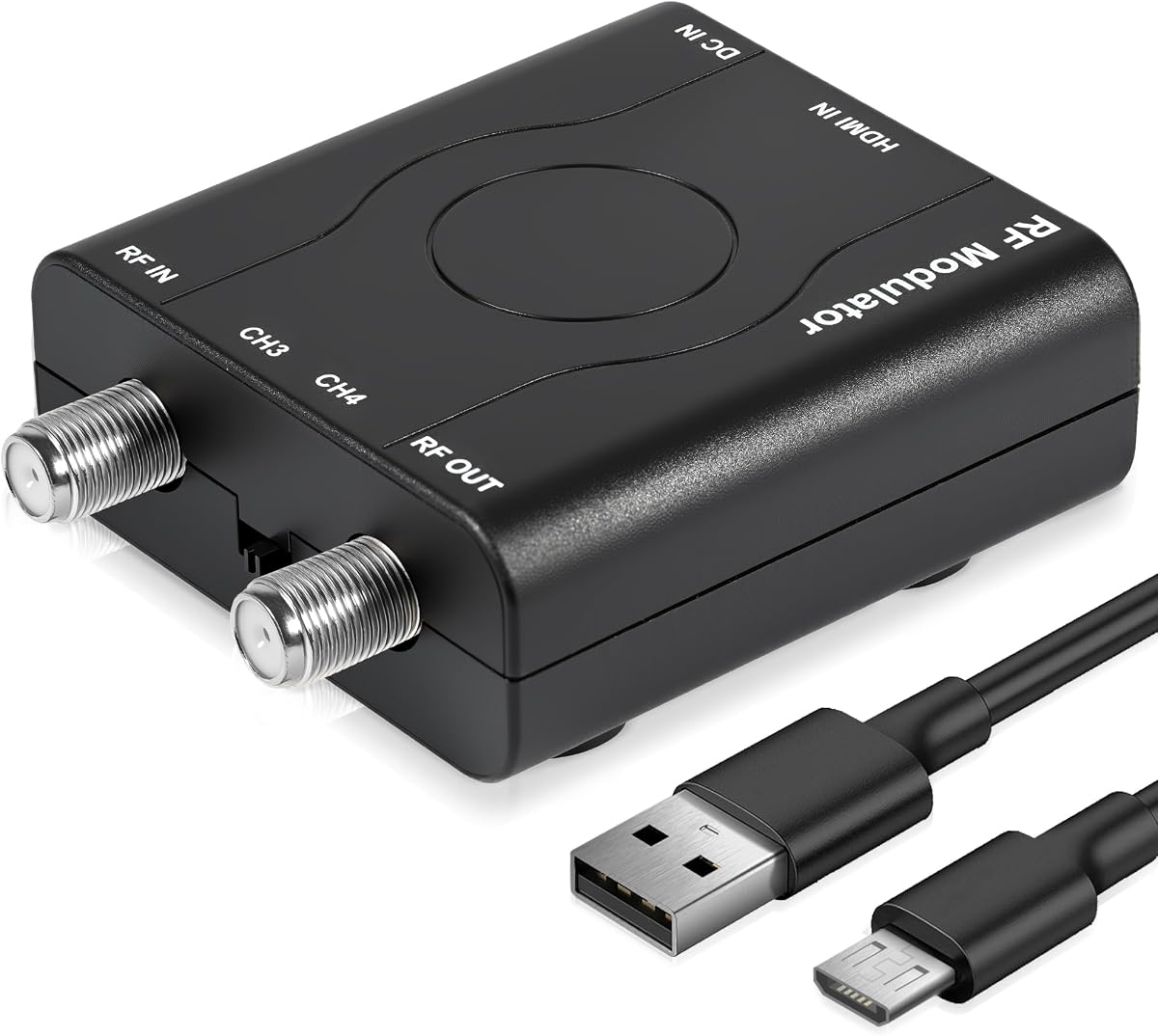
HDM61 HDMI to RF Modulator
4.2Editor score
NTSC CH3 and CH4
1080P input support
No driver installation
Multiple source compatibility
This expert guide compares the top HDMI RF Modulator options by signal format, channel support, input flexibility, installation ease, and overall value.
An HDMI RF modulator connects modern HDMI source devices to older televisions, antenna inputs, and coaxial cable systems. The right model should match your country’s television standard, support the resolutions you need, and provide a stable signal without complicated configuration. This guide covers everything from basic NTSC adapters to professional digital distribution systems.
We compared all ten products using the information supplied for each listing, focusing on signal standards, supported inputs, output frequencies, channel options, installation requirements, and intended use. The comparison includes simple one-way HDMI-to-RF converters as well as networkable QAM, ATSC, DVB-C, DVB-T, and ISDB-T modulators for more advanced installations.
Each review explains where the product fits, highlights its strongest features, and identifies important limitations. The top selections represent a budget-friendly home option, a versatile all-in-one professional unit, and a more specialized digital modulator. Product listings and prices can change, so readers should confirm the current specifications and availability before purchasing.
4.2Editor score

4.7Editor score

4.2Editor score
The table below compares all ten HDMI RF modulators by signal standard, channel flexibility, source support, and practical deployment, making it easier to distinguish simple analog adapters from advanced digital distribution units.


The HDM61 HDMI to RF Modulator is a straightforward one-way converter designed to place modern HDMI sources onto an older television’s RF or antenna input. Its listed rating of 4.2 reflects a generally useful device for a specific compatibility need. It supports NTSC output on CH3 at 61.25 MHz or CH4 at 67.25 MHz, giving users two common analog television options without a complicated network-control interface.
We may earn a commission when you buy through this link, at no additional cost to you.
The main strength is its simple approach. It accepts a broad selection of HDMI sources, including PCs, laptops, game consoles, game switches, cameras, TV boxes, DVD players, CCTV systems, and DVRs. Multiple input resolutions from 480p through 1080P are supported, while PLL control handles the VHF output frequency. Because no driver installation is required, the device is suitable for users who want to connect a source and tune the television rather than navigate complex configuration menus.
Its limitations are equally clear. It produces analog NTSC rather than digital ATSC or QAM, and the fixed CH3/CH4 choice is less flexible than a modulator with a broad frequency range. It is designed for local RF transmission, not managed distribution across a large facility. Buyers should also recognize that support for a 1080P source does not mean the resulting analog RF picture is high definition; the output is constrained by the television system and the NTSC process.
This is a sensible budget choice for connecting one HDMI source to one or more nearby coaxial television displays in an NTSC environment. It is not the right solution for PAL-only regions, modern digital-only televisions, or installations requiring selectable digital channels. For a user with a straightforward legacy-TV compatibility problem, it offers a compact, driver-free way to bridge the gap.
The key benefit is compatibility with televisions that expose a coax antenna input but lack HDMI. Connect the desired source to the modulator, link its RF output to the television or existing coax network, and tune the display to CH3 or CH4. This makes the device useful for retro gaming, video playback, signage, surveillance displays, and other simple analog-video applications.
Compatibility with consoles, computers, cameras, TV boxes, DVD players, and recorders broadens the practical use of the unit. HDMI 1.4 and HDCP 1.4 support also make it suitable for many common source devices, although newer protected streaming services may impose separate restrictions that are not addressed by the product data.
We may earn a commission when you buy through this link, at no additional cost to you.
This HDMI to RF Modulator is a ready-to-install NTSC converter for people connecting streaming devices, game consoles, or disc players to older RF-input televisions. It carries a listed rating of 4.4 and includes a 1.2-meter HDMI cable, power adapter, power cable, and manual. That complete package reduces the number of separate accessories required for a first installation.
We may earn a commission when you buy through this link, at no additional cost to you.
The modulator supports HDMI input resolutions of 1080P, 1080i, 720P, 576P, and 480p. Its built-in PLL control provides a stable VHF output on CH3 at 61.25 MHz or CH4 at 67.25 MHz, with a specified RF level of 80 ± 5 dBµV and NTSC-M audio at 4.5 MHz. The listing clearly notes that 1080P describes the input, not the quality of the analog RF output.
The tradeoff is that this remains a one-way HDMI-to-RF solution, not an RF-to-HMAC converter. Its compatibility list includes Fire TV Stick, Roku, PlayStation 5, PlayStation 4, Xbox One, Nintendo Switch, Switch 2, Apple TV, and Sony Blu-ray DVD players. It is explicitly not compatible with Mac Mini or laptops, a restriction that may matter to computer users. NTSC and two fixed channels also limit its usefulness in some locations.
This is an attractive option for a straightforward home conversion because the necessary cable and power components are included. It is best suited to owners of NTSC televisions who want to use a supported HDMI device without installing a complex network modulator. For regional PAL use, wider channel selection, or professional digital distribution, a more specialized model would be a better fit.
Having the HDMI cable and both power components in the box makes setup more predictable. Users do not need to determine which power cable or source cable to buy first. The included guide is also helpful for identifying the correct input, coax connection, television tuning procedure, and channel-selection steps.
The strongest compatibility comes from modern streaming and gaming ecosystems. A Fire TV Stick, Roku, current game console, or disc player can provide the audio and video, while the modulator carries that signal into a legacy television. Check the television’s supported analog standard and input arrangement before purchasing.
We may earn a commission when you buy through this link, at no additional cost to you.
The SatLink ST-7000 is a digital HDMI RF modulator and encoder intended for distributing a source as a high-definition television channel over coax. Unlike simple analog adapters, it can deliver 1080p HDMI video as an HD ATSC or QAM J.83B channel. That distinction makes it far more relevant to modern digital television systems, hotels, offices, homes with large coax networks, and other organized installations.
We may earn a commission when you buy through this link, at no additional cost to you.
Its ability to accept either HDMI or RCA input provides useful flexibility. The digital output can then travel through coax infrastructure to compatible television sets, eliminating the need for a separate HDMI cable at every viewing location. For users who want a genuine television channel rather than a converted analog signal, this design is substantially more appropriate than a CH3/CH4 NTSC adapter.
The product data is concise and does not describe a full set of control, network, or audio specifications, so buyers should request or verify the complete technical documentation before committing to a project. The listed rating of 4.2 indicates generally favorable customer feedback, although it does not reveal how that feedback was distributed. Installation also requires compatible ATSC or QAM televisions and correctly configured coax distribution.
This is the best premium pick for a user who needs digital, high-definition channel distribution rather than a basic one-room conversion. It is especially relevant to integrators and technically confident buyers who can match the modulator to the television standard used by their displays. For a simple retro console in one NTSC television, the more affordable analog models in this guide will usually be easier to justify.
ATSC and QAM J.83B outputs preserve the concept of a broadcast television channel while carrying digital high-definition content. That makes the unit suitable for installations where multiple televisions need to receive the same source through coax, subject to confirming that every display supports the selected digital standard.
The option to use HDMI or RCA input helps accommodate newer source equipment and legacy audiovisual components. HDMI remains the preferred route for modern computers, media players, and cameras, while RCA provides a practical fallback for equipment that does not produce HDMI.
We may earn a commission when you buy through this link, at no additional cost to you.
This multi-standard HDMI modulator is designed for professional or technically demanding users who need more than one television transmission format. It supports DVB-C digital QAM, ATSC, DVB-T, and ISDB-T from a single device, with dynamic switching between modulation modes. That range can make it easier to deploy in regions or facilities that use different television standards.
We may earn a commission when you buy through this link, at no additional cost to you.
Its source handling extends to 1080p at 60 Hz, and the listed audio capabilities include MPEG Layer 2, AAC, and DD AC3 encoding. Closed captions can enter through analog CVBS using RCA and Line 21. Web-based network management provides a more structured control method than a simple button-controlled consumer adapter, while web-based updates can simplify firmware maintenance.
There is no customer rating shown in the supplied listing, so this product cannot be evaluated from a numerical feedback score. The listing also provides a technical-support number, which may be valuable for a network-oriented device but also suggests that setup may require more expertise than a plug-and-play converter. Compatibility with the source, chosen broadcast standard, television displays, and coax network should be verified before installation.
This modulator is best suited to installers, integrators, and technically capable users who need one unit to support several digital standards. Its low-latency operation of roughly 50 to 100 milliseconds, web controls, and full-HD capability make it more sophisticated than a basic analog adapter. Consumers seeking one simple converter should instead consider a plug-and-play NTSC unit.
DVB-C, ATSC, DVB-T, and ISDB-T support provides unusually broad regional flexibility. The dynamic switching feature also reduces the need to maintain separate modulators for environments where television standards may vary. The correct standard must still be selected for the destination network and display equipment.
Web-based control and update access make this a better fit for managed deployments than a compact consumer converter. A browser-based interface can be more convenient when configuring a device in a rack, equipment cabinet, or remote location. Technical users should still consult the product documentation and confirm network-access requirements.
We may earn a commission when you buy through this link, at no additional cost to you.
The VHF UHF HDMI to RF Modulator is a versatile analog converter for users who need more flexibility than a fixed CH3/CH4 NTSC adapter. It supports both PAL and NTSC formats, VHF and UHF frequencies, and both HDMI and CVBS RCA inputs. This combination makes it useful in mixed environments where different sources and television standards must share a coax-based distribution system.
We may earn a commission when you buy through this link, at no additional cost to you.
The unit accepts common source resolutions ranging from 480p through 1080P and offers an adjustable AV output level. Adjustment can help match the modulator to televisions and other equipment with different input sensitivities. F-female RF connectors provide a conventional coax connection, and the absence of required drivers keeps the physical setup relatively uncomplicated.
Its analog nature is the central limitation. It does not create an ATSC or QAM digital channel, so picture quality will be determined by the analog television standard, source quality, wiring, and any compression or noise in the RF system. The broad format support is valuable, but it does not turn the converted output into a high-definition digital broadcast. The listed 4.1 rating suggests reasonable overall satisfaction without indicating exceptional performance.
Choose this model when PAL/NTSC versatility, VHF/UHF flexibility, and multiple input types matter more than digital channel creation. It is well suited to legacy home displays, instructional environments, and analog coax systems. Users needing modern digital television distribution should choose one of the ATSC or QAM modulators instead.
Supporting both PAL and NTSC reduces the risk of buying a converter that cannot operate in the intended television system. That benefit is especially useful for buyers in regions with mixed equipment or for users who may move a legacy display between locations. Confirm the television’s expected system before tuning the output.
The RCA input provides a route for CVBS composite sources that cannot use HDMI. Combined with adjustable output and broad frequency support, this makes the unit more adaptable than a basic HDMI-only converter. It is a practical middle ground for mixed analog installations.
We may earn a commission when you buy through this link, at no additional cost to you.
The Thor Broadcast HDMI to Coax Modulator is the strongest all-round choice for a serious distribution system. Its listed rating of 4.7 is the highest among the products with published ratings, and its feature set goes well beyond a basic television adapter. The unit combines HD MPEG2 encoding, AC3 Dolby audio, and an internal digital modulator in an all-in-one enclosure.
We may earn a commission when you buy through this link, at no additional cost to you.
Sources can include a set-top box, satellite receiver, HDMI camera, DVD player, or computer. Supported video formats include 720p, 1080i, and 1080p, while output can be delivered as DVB-C, DVB-T, ATSC, or ISDB-T. That flexibility allows an installer to select the appropriate digital television format for the destination system and distribute the source to compatible television sets through RF coax.
Control is handled through Thor Broadcast’s proprietary graphical interface on a connected PC. This is more sophisticated and potentially more precise than a physical button menu, but it also means the device is aimed at users who are comfortable configuring professional equipment. Its networkable design and all-in-one architecture are less relevant to a user who only needs to connect one console to one television.
This is our Editor’s Choice because it balances extensive standards support, integrated encoding, HD source handling, and a practical management interface. It is a strong recommendation for integrators, broadcast-minded users, and organizations distributing a source to multiple televisions. For a single-room analog conversion, choose a simpler and less involved modulator instead.
Combining HD MPEG2 encoding, AC3 Dolby audio, and RF modulation in one unit can streamline a professional installation. Instead of assembling separate encoding and modulation components, the operator can send an HDMI source into a single network-aware appliance and produce a television channel for coax distribution.
DVB-C, DVB-T, ATSC, and ISDB-T outputs make the unit suitable for varied deployments. The selected format should match the televisions and any head-end equipment on the coax network. This flexibility is a major reason to favor the Thor Broadcast model over a fixed-channel analog converter.
We may earn a commission when you buy through this link, at no additional cost to you.
The HDMI RF Coax Converter is an approachable HDMI-to-RF solution for connecting modern devices to older televisions and displays with antenna or coax inputs. Its listed rating of 5.0 is the highest available in this comparison, although ratings should not be treated as proof of independent testing. The practical appeal comes from a straightforward conversion design and a complete package of accessories.
We may earn a commission when you buy through this link, at no additional cost to you.
The box includes the modulator, a four-foot HDMI cable, a power cable, a power adapter, and a user manual with step-by-step instructions. The stated source compatibility covers streaming media players, game consoles, Blu-ray and DVD players, cable boxes, satellite receivers, computers, laptops, cameras, and other HDMI-enabled equipment. This makes it useful for homes, classrooms, hotels, and business environments where coax wiring already exists.
The supplied information focuses on reliable RF output and distribution rather than detailed frequency, resolution, or television-standard specifications. As a result, buyers should consult the product listing, manual, and television requirements before assuming compatibility with a particular channel plan. The product appears designed for a simple local distribution task and may not provide the channel flexibility or management tools found in professional modulators.
This converter is a strong candidate for anyone who wants a complete, accessible kit for coax distribution without assembling separate cables and power components. It is particularly convenient for shared displays in homes and small commercial spaces. Confirm that the connected television accepts the modulator’s RF format and that any existing coax splitters or cabling will not degrade the signal.
Including the HDMI cable, power components, and illustrated setup guide reduces setup friction. Users can connect the source, television, and power in a logical sequence, then tune the display to the appropriate channel. The included support contact also provides a route for resolving setup questions.
Existing coax networks make this type of converter valuable in classrooms, hospitality rooms, and business properties where pulling new HDMI cables would be inconvenient. One source can be made available through the RF distribution system, provided all displays and intermediate hardware are compatible.
We may earn a commission when you buy through this link, at no additional cost to you.
The HDM61 Coax Adapter is a compact one-way converter designed to deliver NTSC RF output on CH3 at 61.25 MHz or CH4 at 67.25 MHz. It accepts HDMI sources at common resolutions from 480p through 1080P and uses PLL control for stable VHF frequency output. Its listed rating of 4.5 indicates strong customer feedback for its intended role.
We may earn a commission when you buy through this link, at no additional cost to you.
The unit is particularly easy to deploy because no drivers or software are required. A USB power cable and user manual are included, and the product is described as suitable for PCs, laptops, consoles, gaming switches, cameras, TV boxes, DVD players, CCTV equipment, and DVR systems. HDMI 1.4 and HDCP 1.4 support make it compatible with many mainstream source devices.
The wording in the listing can cause confusion because the product is sometimes called a coax-to-HDMI adapter, although the listed operation is strictly HDMI-to-RF. It cannot receive an RF cable and produce HDMI for a modern display. It also does not create ATSC, QAM, or other digital channels, and its two-channel NTSC output is less flexible than a full VHF/UHF model.
This is a good choice for a compact, uncomplicated conversion where the destination television supports NTSC and the user needs only CH3 or CH4. It suits one-room setups, retro gaming arrangements, and basic coax distribution. Buyers seeking digital channels, broad frequency selection, or reverse RF-to-HDMI conversion should choose a different product.
The small, driver-free design is helpful when the modulator needs to sit near a television or in a tight equipment area. A user can connect the source and power, connect the coax output, and tune the television without installing an application or learning a complex control system.
The signal path runs from HDMI to RF, not from RF to HDMI. Understanding that distinction prevents an expensive mismatch. Modern source devices use the HDMI input, while the television uses coax and selects the modulator’s assigned channel.
We may earn a commission when you buy through this link, at no additional cost to you.
The HDM61 HDMI to Coax Adapter is a highly focused analog converter for users who need to place an HDMI source onto NTSC-M Channel 3 or Channel 4. It carries a listed rating of 5.0 and emphasizes straightforward setup, stable frequency control, and durable construction. The operating frequencies are fixed at 61.25 MHz for CH3 and 67.25 MHz for CH4.
We may earn a commission when you buy through this link, at no additional cost to you.
HDMI audio and video are accepted at common input resolutions, while the resulting RF output is specified at 480P. This distinction is important: the unit can receive a 1080P-class HDMI source, but it does not transmit that resolution as digital high definition. It creates an analog NTSC-M television channel, whose final picture quality is constrained by the source, analog standard, television, and distribution system.
The product supports HDMI 1.4 and HDCP 1.4, uses PLL frequency control, and requires no extra driver software. Its molded ABS housing is designed for stable daily operation. On the other hand, the fixed two-channel design offers little room for adapting to conflicting channel plans, and the absence of broad VHF/UHF or digital-standard support limits professional applications.
This is a strong pick for a minimal home installation involving one HDMI source and an NTSC television. It removes unnecessary controls and installation complexity, making it easy to understand and operate. For larger installations, alternative television standards, or modern digital displays, choose a modulator with broader output and channel options.
With only CH3 and CH4 to select, the device is easy to configure. The television’s channel or antenna menu can be used to find the converted signal. This limited approach is appropriate when the installation has no need for a custom channel plan or professional broadcast tools.
The molded ABS outer shell and PLL-based frequency control emphasize consistent operation in a permanent installation. Compact dimensions make placement near the television or coax junction easier. Stable construction does not replace good cable connections, so proper fittings and clean connectors remain important.
We may earn a commission when you buy through this link, at no additional cost to you.
The AV/HDMI to RF Modulator is a wide-band analog converter designed for PAL or NTSC television systems and both HDMI and composite AV sources. Its listed rating of 4.6 is among the strongest available, and the combination of VHF/UHF support, a 47–868 MHz range, and adjustable RF output makes it unusually versatile among the consumer-focused options.
We may earn a commission when you buy through this link, at no additional cost to you.
The unit accepts source formats including 1080P, 1080i, 720P, 576P, 576i, and 480p, then produces analog RF output with a stated resolution of 720×480. Its RF output level is adjustable from 80 to 95 dBµV, allowing the signal to be matched more closely to the receiving television or distribution network. An F-female connector provides the coax connection.
A key limitation is that its wide frequency range and flexible inputs do not create a digital television channel. It remains an analog modulator, so viewers need a television capable of receiving the selected PAL or NTSC RF signal. Its 90–240 V power specification and driver-free design simplify deployment, although users should still follow local electrical and equipment instructions.
Choose this model for a mixed analog installation where old and new source equipment must be connected, channel placement is restricted, or output level needs adjustment. Its compact size—listed at 6.14 by 4.09 by 2.08 inches—also makes it easier to position near a display. Those needing ATSC, QAM, or other digital standards should consider a professional digital modulator instead.
The broad 47–868 MHz range and support for VHF and UHF give this unit more placement flexibility than a fixed CH3/CH4 adapter. Adjustable output from 80 to 95 dBµV helps prevent an overly strong or weak signal at the receiving television. The correct final setting depends on the cable run, splitters, and receiving display.
The composite AV input allows the same modulator to handle HDMI equipment and older video sources. This is useful in classrooms, workshops, or repair environments where source equipment varies. The PAL and NTSC choices also make the device more adaptable to different regional television systems.
We may earn a commission when you buy through this link, at no additional cost to you.
Choosing an HDMI RF modulator starts with the television standard and output format required by your displays, followed by input flexibility, channel control, distribution needs, and installation preferences.
The first decision is whether your destination equipment expects analog NTSC, analog PAL, or a digital standard such as ATSC, QAM, DVB-C, DVB-T, or ISDB-T. A modulator cannot safely create a useful output for an incompatible standard. NTSC adapters are common in North American legacy-TV applications, while PAL support is important in many other regions. Professional installations may need to match a hotel, apartment, school, or business television network rather than choosing based on convenience.
Analog converters are usually simpler and suitable for older televisions with antenna or coax inputs. Digital modulators encode the source and transmit it as a broadcast channel, providing a better match for modern ATSC or QAM displays. Digital models are more appropriate for large coax networks, professional distribution, and installations where the receiving equipment no longer supports legacy analog channels. The final picture quality also depends on the source and the digital encoder.
Check the maximum supported HDMI input resolution and refresh rate. Most consumer modulators list common formats from 480p through 1080p, but input capability does not mean the final RF output is high definition. Some fixed analog devices output only 480p-class video. Professional modulators may support 1080p at 60 Hz, while still encoding that image into the selected broadcast format. Confirm the source type, resolution, frame rate, and protection requirements before buying.
Fixed CH3 and CH4 models are easy to use but can conflict with other analog channels or local channel plans. VHF and UHF support offers a broader choice, while professional digital units may permit configurable channel numbers. Consider the television’s tuner range, existing coax equipment, and any other modulators on the network. Adjustable output level can also help when long cable runs or splitters affect signal strength.
A good modulator should accept the equipment you intend to connect, including game consoles, streaming devices, computers, cameras, disc players, cable boxes, and AV equipment. HDMI 1.4 and HDCP 1.4 are common compatibility points, but protected streaming content may introduce separate restrictions. RCA or composite input is valuable in mixed-source environments. For professional units, verify supported audio encoding, especially AC3, AAC, or MPEG audio requirements.
A compact adapter is sufficient for connecting one source to one television or a small coax network. Larger installations may require a networkable modulator with a graphical control interface, web management, remote updates, or a selection of digital standards. A professional unit can make channel planning and maintenance easier, but it also adds setup complexity. Choose the least complicated device that can reliably support the number of displays and future changes you expect.
Some products include an HDMI cable, power adapter, power cord, and manual, while others require these accessories to be purchased separately. Plug-and-play construction means no driver or complex software setup, although professional units may require computer configuration. Check connector types, power requirements, physical dimensions, and whether the device can sit near the television or coax junction. For permanent installations, secure connections and strain-free cables are important.
Retro gaming, classroom display, hotel television distribution, surveillance monitoring, digital signage, and broadcast-style channel creation have different requirements. A basic NTSC adapter works for a console in one legacy room, while a multi-standard digital modulator is more appropriate for professional distribution. Consider whether the setup needs only local viewing, several coax-connected displays, web control, low latency, or a custom channel plan. The best modulator is the one that matches the job without adding unnecessary complexity.
Begin by identifying the television standard, coax connection, and required channel on the receiving display. Connect the HDMI source to the modulator’s HDMI input, or use the RCA input for a compatible composite source. Next, attach the modulator’s RF output to the television or existing coax network. A direct coax connection is often easier for initial testing than routing through splitters, couplers, or long cable runs.
Power the modulator and use the television’s antenna or channel menu to scan for the modulator’s channel. On fixed models, choose CH3 or CH4; on more flexible units, select the configured VHF, UHF, or digital channel. If the image is weak, check the source resolution, cable connections, splitters, and output-level setting. Professional models may require the supplied control software and a correctly configured digital channel before the television can detect it.
For care, keep the unit ventilated and away from moisture, excessive heat, and cramped areas that can trap heat. Do not open the housing because internal components may contain power or signal circuitry. Inspect coax fittings for looseness, corrosion, or damaged shielding, and gently secure connectors rather than forcing them. Periodically retest the source, output level, and all televisions in the network, especially after changing equipment or rewiring the building.
An HDMI RF modulator converts audio and video from an HDMI source into a radio-frequency signal that can travel through a television’s antenna or coax input. This is useful for older televisions, legacy coax networks, classrooms, hospitality rooms, and other installations where running new HDMI cables is inconvenient. It can also create a digital television channel when the selected model supports ATSC, QAM, DVB-C, DVB-T, or ISDB-T.
Most of the consumer modulators in this guide are one-way devices designed only to convert HDMI to RF. They cannot receive a coax television signal and produce HDMI for a modern display. A separate RF-to-HDMI converter is required for that direction, and it may need an active digital tuner or other equipment depending on the incoming signal.
Not necessarily. The stated 1080P capability commonly describes the maximum HDMI signal the modulator can accept, not the resolution of the resulting RF output. Analog NTSC or PAL output is generally limited to standard-definition quality, while professional digital modulators can encode 1080p content into a digital broadcast channel. Buyers should check input and output specifications separately.
Choose the standard used by the receiving television or coax network. NTSC is common in North American analog television systems, while PAL is used in many other regions. A modulator producing the wrong standard may display a picture, but it can appear unstable, distorted, or absent. Products that support both standards offer more flexibility for mixed or changing installations.
Yes, if the modulator’s output is distributed through a compatible coax network and each television supports the selected signal format. The number of displays and the quality of splitters, cables, amplifiers, and other distribution equipment can affect the result. A basic analog adapter may work for a small local network, while professional digital modulators are better suited to managed multi-display installations.
First confirm that the television supports the modulator’s signal standard and is set to antenna or coax input rather than HDMI. Scan for the assigned channel, verify the source is playing, and inspect every cable and connector. Weak signals can also result from long runs, splitters, incorrect output level, or an incompatible channel setting. Professional digital modulators may require additional configuration before scanning.
The basic NTSC and PAL converters listed here generally operate without drivers or dedicated software. Professional digital modulators often require network configuration and control through a computer, especially when channels, encoding, audio, or multiple outputs must be managed. Check the supplied documentation before installation so the expected setup process is clear.
An analog modulator converts HDMI into a legacy NTSC or PAL television signal, usually on a fixed or limited channel range. It is simple and inexpensive but produces standard-definition analog output. A digital modulator encodes the source and distributes it as ATSC, QAM, DVB, or ISDB-T, making it more appropriate for modern television networks and professional installations.
The HDM61 HDMI to RF Modulator is the best budget pick for a straightforward NTSC conversion using CH3 or CH4. The Thor Broadcast HDMI Modulator earns the Editor’s Choice designation because it combines MPEG2 encoding, AC3 audio, multiple digital output standards, and computer-based control in an all-in-one professional design. The SatLink ST-7000 is the best premium choice for distributing 1080p sources as digital ATSC or QAM J.83B channels over coax.
Prioritize the destination television’s standard before considering any other feature. A simple adapter is enough for one NTSC or PAL display, but a professional digital modulator is necessary for modern ATSC or QAM networks, multiple channels, and managed distribution. Input resolution should be evaluated separately from output quality, and the number of channels, source formats, audio needs, and control requirements should all influence the choice.
Before buying, verify connector types, included cables, power requirements, region, television compatibility, and the current product listing. Product specifications and prices can change, and support for streaming services may depend on source-device permissions. Comparing the latest details with the intended installation will help prevent an expensive mismatch and produce a more reliable viewing experience.