
SJoyBring 7-inch QLED
4.3Editor score
Wireless CarPlay and Android Auto
Seven-inch 1280×720 QLED display
Four-channel amplifier and subwoofer outputs
Included rear-view camera
An Android double din car stereo can modernize an older dashboard with smartphone navigation, wireless communication, Bluetooth music, hands-free calling, and a larger display. The best model depends on your vehicle, phone, speakers, camera plan, and appetite for new technology, so fit and feature compatibility deserve careful attention before purchase.
We compared all ten receivers by considering their display size, wireless and wired smartphone integration, audio controls, camera support, outputs, installation requirements, and practical extras. The list covers dedicated Android systems, conventional double din receivers, and premium models from established brands, with a range of options for different budgets and priorities.
Each review explains the strongest features, meaningful limitations, and the driver most likely to benefit from that particular receiver. Ratings and specifications reflect the available product information, while product listings, software capabilities, vehicle fit, and market conditions can change, so confirm the latest details before making a final decision.
4.3Editor score

4.1Editor score

4.4Editor score
As an Amazon Associate we earn from qualifying purchases.
The comparison below highlights the major differences among the ten receivers, including their display formats, smartphone connection methods, sound-control options, camera capabilities, and extra features.


The SJoyBring 7-inch QLED combines a high-resolution display, wireless smartphone integration, multi-channel audio, and an included rear-view camera in one approachable package. Its 4.3 rating reflects a strong balance of useful features, making it a practical choice for drivers who want to modernize a compatible dashboard without selecting every component separately.
We may earn a commission when you buy through this link, at no additional cost to you.
Wireless Apple CarPlay and Android Auto bring navigation, music, messages, and voice assistance to the head unit after the phone is connected through Bluetooth. The 7-inch QLED panel has a stated 1280×720 resolution and supports 1080p video playback, while a custom equalizer and 4.2-channel output arrangement give users room to shape the sound around their front and rear speakers. Two subwoofer outputs can also support a more robust bass setup.
The included rear-view camera is a meaningful advantage for vehicles that do not already have one. It switches on when the vehicle enters reverse according to the product information, and the head unit supports both front and rear camera connections. The trade-offs are installation-related: the specified faceplate size is 6.69 by 3.81 inches, so the dashboard opening must be checked, and some vehicles need a separate dash kit, wiring harness, antenna adapter, or steering-wheel control interface.
This is a compelling choice for a compatible vehicle owner seeking a large screen, wireless connectivity, flexible audio wiring, and a backup camera in one package. Buyers should compare the dimensions and required accessories with their dashboard before ordering. Those checks are more meaningful than a low listing cost because an incompatible faceplate or missing adapter can complicate an otherwise straightforward installation.
The 7-inch QLED screen offers a spacious interface for maps, messages, and music, while wireless CarPlay and Android Auto reduce the need to handle a cable each time you enter the vehicle. First-time users should follow the pairing instructions and confirm that their phone and app versions support the selected functions.
Front and rear speaker outputs, dual subwoofer outputs, and customizable equalizer settings make the receiver more flexible than a basic factory-style radio. The included camera also improves parking awareness, assuming the wiring and reverse-trigger connection are installed correctly.
We may earn a commission when you buy through this link, at no additional cost to you.
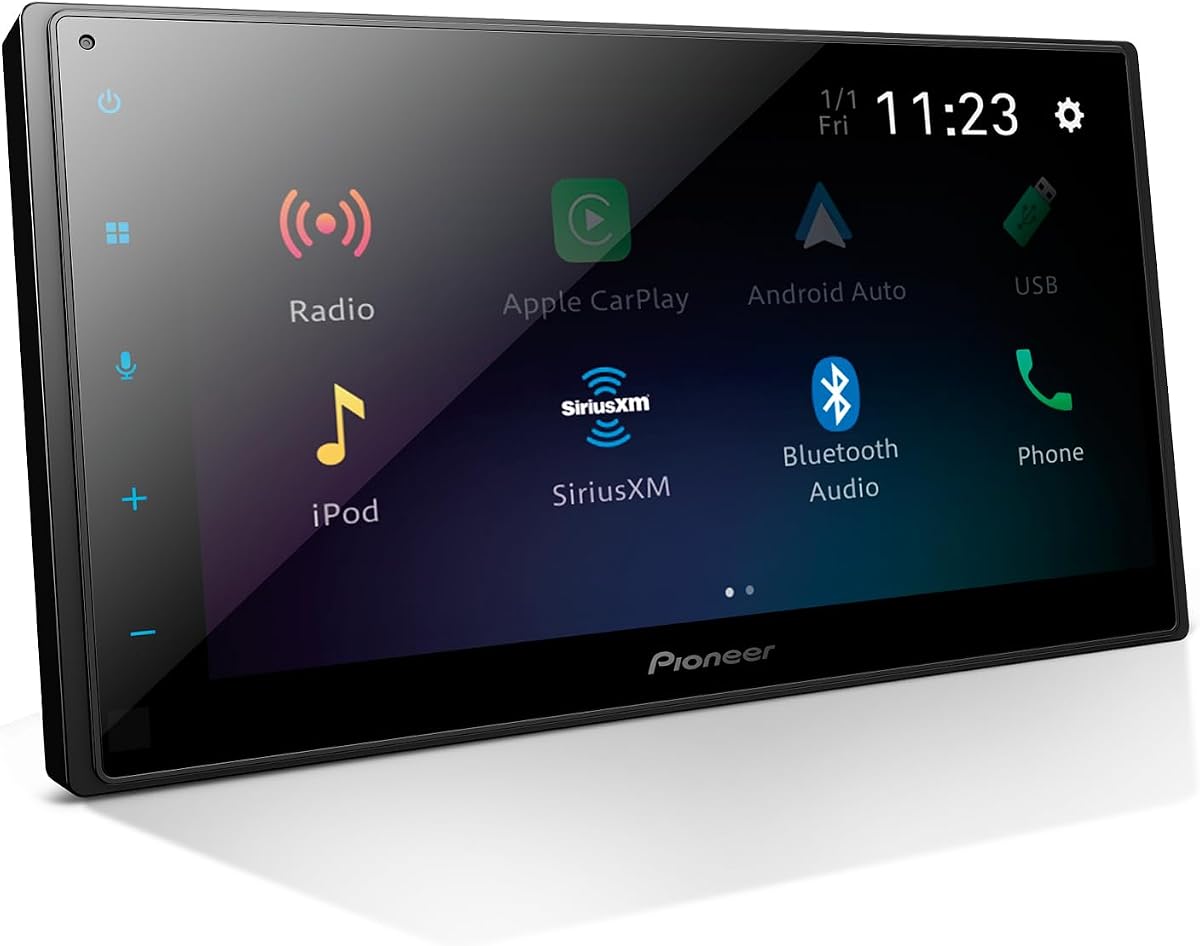
The Pioneer DMH-1600NEX is a conventional 2-din receiver centered on clear smartphone integration, tactile controls, and flexible audio adjustment. Its 4.1 rating makes it a solid all-rounder for drivers who want an established double din format and wired CarPlay or Android Auto rather than a full standalone Android tablet.
We may earn a commission when you buy through this link, at no additional cost to you.
The 6.8-inch WVGA capacitive touchscreen gives Maps, Music, Messages, Calls, Podcasts, and other supported smartphone functions a dedicated home in the dashboard. Bluetooth enables hands-free calling through Pioneer's included external microphone. For sound, a 13-band equalizer and multiple presets allow drivers to adapt the output to the acoustics of their cabin and speaker arrangement without relying on an external processor.
A single-camera input supports a rear-view camera, including customizable parking lines and full-screen display. The limitation is that smartphone integration is wired rather than wireless, and only one camera input is listed. Professional installation is also recommended, which helps reduce the risk of improper wiring but should be considered when comparing the total ownership experience.
The DMH-1600NEX is best for someone who values a conventional receiver design, Pioneer-focused functionality, and a useful equalizer without needing a large open Android app ecosystem. It is especially suitable for a compatible vehicle that can accommodate a standard 2-din dashboard opening and for users who are comfortable connecting a phone with a cable.
Wired Apple CarPlay and Android Auto deliver the familiar smartphone interface on the 6.8-inch screen. Keeping the cable connected may feel less seamless than wireless operation, but it can provide a consistent connection and avoids pairing delays for drivers who prefer dependable physical links.
The 13-band equalizer and preset options make the receiver a good match for standard factory speakers and upgraded component sets alike. Backup-camera support adds everyday usefulness, although owners with a multi-camera plan will need to account for the single-camera limitation.
We may earn a commission when you buy through this link, at no additional cost to you.
The Pioneer DMH-W2770NEX delivers a broad mix of smartphone integration, Bluetooth, voice assistance, and multimedia receiver features. Its 4.0 rating places it among the more established options in this group, particularly for drivers who appreciate a familiar CarPlay and Android Auto interface instead of a fully independent Android system.
We may earn a commission when you buy through this link, at no additional cost to you.
A 6.8-inch capacitive touchscreen provides access to Maps, Music, Messages, Phone, Podcasts, Siri, and other supported functions. Bluetooth supports wireless audio streaming and hands-free communication. The receiver also works with the Vozsis and Weblink applications for Amazon Alexa capability, adding another route for voice commands beyond the phone's native assistant.
Rear-view camera capability makes the unit useful for vehicles that need a display-based parking aid. The main trade-offs are its comparatively modest rating and the fact that the supplied information does not advertise wireless smartphone integration or advanced multi-channel audio processing. As with other double din receivers, vehicle dimensions, wiring, and the selected camera equipment remain essential to a clean installation.
The DMH-W2770NEX is a sensible recommendation for anyone who wants smartphone navigation, streaming, calling, and an established receiver format in one unit. It may be less compelling than the S8L for app flexibility or the KENWOOD for three-camera support, but it serves everyday drivers who prefer a polished phone-projection experience with useful voice features.
Siri, Google voice commands through Android Auto, and Alexa through the companion apps give drivers several ways to request information. This variety can be useful in different phone ecosystems, although availability depends on the apps, devices, and connection methods used.
The combination of Bluetooth audio, a capacitive screen, and rear-camera readiness covers navigation, music, communication, and parking. Drivers seeking extensive camera routing or standalone app installation should examine newer Android-focused alternatives before deciding.
We may earn a commission when you buy through this link, at no additional cost to you.
The BOSS Audio Systems BV9358B combines a seven-inch touchscreen, CarPlay, Android Auto, powerful stated amplification, and several camera and audio connections. Its 4.1 rating reflects a broad feature set that can suit drivers replacing a dated factory radio while retaining meaningful control over speakers, cameras, and steering-wheel functions.
We may earn a commission when you buy through this link, at no additional cost to you.
Both Apple CarPlay and Android Auto are supported, giving compatible iPhone and Android users access to navigation, music, messaging, calls, podcasts, and audiobooks through voice commands or the touchscreen. The receiver includes front and rear camera inputs, an external microphone connection, USB and audio/video inputs, and front, rear, and subwoofer preamp outputs for a flexible speaker arrangement.
Its stated 4×80-watt maximum output gives it more built-in amplification than many competing receivers, while the 800×480 widescreen display is large but not exceptionally sharp. Steering-wheel control requires a separately sold interface module, and BOSS recommends professional installation to support safe and proper functionality.
The BV9358B is a good option for someone who prioritizes screen size, smartphone projection, camera expansion, and amplifier flexibility. It may appeal particularly to drivers with front and rear accessories or plans to use a subwoofer preamp. Buyers who place image clarity or a completely open Android interface at the top of their list should compare those priorities carefully.
Front and rear camera inputs, USB, external microphone, and preamp outputs create several paths for expanding the vehicle system. That makes the receiver adaptable to existing accessories, though the appropriate wiring and vehicle-specific installation materials must be planned before the dashboard is opened.
The rated maximum output provides useful headroom for common door and rear speakers. Drivers pursuing a more elaborate audio build can still use preamp outputs and external amplification, which generally offers finer control than relying only on the receiver's internal amplifier.
We may earn a commission when you buy through this link, at no additional cost to you.
The BOSS Audio Systems BVCP9700A offers a large seven-inch touchscreen alongside Apple CarPlay and Bluetooth functionality. Its 4.1 rating suggests a well-regarded general-purpose receiver, and the model is most attractive to iPhone drivers who want familiar navigation, messaging, and music integrated into an older dashboard.
We may earn a commission when you buy through this link, at no additional cost to you.
CarPlay provides access to Phone, Music, Maps, text messages, Radio, Podcasts, and Audiobooks through the display or Siri. Bluetooth supports hands-free calls and compatible streaming services such as Spotify and Pandora, along with iTunes and Apple Music subscriptions. These features cover the core needs of many daily commuters without requiring a separate standalone Android tablet.
The available product information is less comprehensive than for several rivals, and the listing summary does not explicitly advertise Android Auto. That makes it particularly important for Android users to verify current compatibility, ports, outputs, and camera requirements. Physical fit, wiring, and steering-wheel support should also be confirmed before ordering, as the summary does not spell out every accessory needed for each vehicle.
The BVCP9700A is a practical recommendation for an iPhone owner seeking a sizable CarPlay display and Bluetooth convenience in a double din format. It may be less suitable for a driver who depends on Android Auto, advanced camera routing, extensive equalization, or a full app store. Those requirements point more clearly toward the ATOTO models or feature-rich Pioneer receivers.
The receiver puts common iPhone functions on a large dashboard display and keeps voice interaction central through Siri. That makes navigation, communication, and familiar music apps easy to reach without navigating the phone itself while driving.
Bluetooth calling and streaming provide a useful alternative when the user is not directly relying on CarPlay. For Android owners, however, confirm that Android Auto is supported by the current unit and listing before purchase rather than assuming it from the general product category.
We may earn a commission when you buy through this link, at no additional cost to you.
The Alpine iLX-W670 is a feature-rich digital multimedia receiver with a 4.3 rating and a strong emphasis on sound adjustment. Its 7-inch double din touchscreen, 13-band graphic EQ, six-channel time correction, adjustable crossovers, and expandable amplifier architecture make it particularly attractive to drivers who care more about audio control than open Android apps.
We may earn a commission when you buy through this link, at no additional cost to you.
Apple CarPlay and Android Auto are supported through wired connections, giving compatible users access to apps, calls, texts, and music on the dashboard display. Bluetooth handles hands-free calling, while a customizable home screen, five-color key illumination, and Lighting Link compatibility add visual and functional flexibility. SiriusXM readiness and PowerStack capability make the unit relevant for buyers who plan a staged audio upgrade.
The principal limitation is that smartphone integration is wired rather than wireless. PowerStack is also a platform rather than an automatic upgrade, so compatible Alpine amplifiers and the necessary installation approach must be considered. The receiver does not present itself as a standalone Android tablet with an app store, MirrorLink flexibility, or the broad internet options found in the ATOTO models.
The iLX-W670 is an excellent match for an audio-minded driver with a compatible dashboard who plans to use smartphone navigation while building a better speaker system. It combines familiar Alpine functionality with detailed tuning controls. If wireless freedom and downloadable car apps are the main priorities, an Android-based receiver may be a better fit.
Time correction, a 13-band graphic equalizer, and dedicated crossover controls provide the tools needed to align speakers and shape the frequency response. These features make the receiver useful for daily listening and for a carefully planned speaker upgrade.
The customizable home screen, adjustable key illumination, and Lighting Link support help the unit blend with the vehicle while keeping music controls visible. SiriusXM readiness and PowerStack support create additional paths for expanding the system later.
We may earn a commission when you buy through this link, at no additional cost to you.
The ATOTO A5L brings a genuine Android interface to a 7-inch double din head unit, allowing users to install navigation, entertainment, and vehicle-oriented apps while also using CarPlay or Android Auto. Its 3.9 rating is the lowest in this group, but the product remains distinctive for its combination of app access, flexible internet options, and smartphone integration.
We may earn a commission when you buy through this link, at no additional cost to you.
The system provides 2GB of RAM and 32GB of storage, along with over-the-air updates and access to more than 3,000 listed Play Store apps. Internet connectivity can use a Wi-Fi hotspot, Bluetooth tethering, or USB tethering. Both wired and wireless CarPlay and Android Auto are supported, while MirrorLink can display compatible phone content outside their supported app lists.
Its audio section includes an integrated four-channel amplifier, a 24-band equalizer, nine presets, and a digital signal processor. Multi-device Bluetooth allows a phone and accessories such as an OBD-II scanner or tire-pressure monitor to remain connected at the same time. The limitations include the basic memory configuration, a lower rating than the competing units, and the ongoing need to check app compatibility and driver safety for any nonstandard Android software.
The A5L is best for drivers who want a standalone Android environment at a more accessible level than the S8L. It is particularly useful for navigation tools, music services, and vehicle utilities that are unavailable through CarPlay or Android Auto. Buyers should favor it for app flexibility and connectivity, while the higher-rated S8L offers stronger performance, 4G LTE, and more advanced tuning.
The open Android environment allows compatible navigation, entertainment, and vehicle tools to run directly on the larger display. This creates more flexibility than a conventional receiver, but every installed app should be evaluated for driving usability, updates, and compatibility.
Wi-Fi hotspot, Bluetooth tethering, and USB tethering provide alternatives when a direct connection is inconvenient. The option that works best depends on the phone, carrier coverage, data plan, and whether wireless CarPlay or Android Auto is active.
We may earn a commission when you buy through this link, at no additional cost to you.
The ATOTO S8L is the most technically ambitious receiver in this roundup, combining Android 15, 4GB of RAM, 64GB of storage, built-in 4G LTE, advanced digital signal processing, and an included Bluetooth OBD-II scanner. Its 4.1 rating reflects a powerful feature package, while the cellular connection and vehicle diagnostics distinguish it from conventional double din radios.
We may earn a commission when you buy through this link, at no additional cost to you.
Wireless CarPlay and Android Auto are supported alongside wired Android Auto and MirrorLink. A compatible SIM card can provide internet access independent of a phone hotspot, which is particularly useful when wireless projection occupies the phone's Wi-Fi connection. The 7-inch dual-layer QLED touchscreen has a stated 550-nit brightness, 178-degree viewing angle, optically bonded construction, and a split-screen mode for navigation and media.
Audio tuning is unusually extensive for a double din receiver. It supports six assignable channels, custom 5.1-channel configurations, 32-band EQ, time alignment, adjustable crossovers, a 24-bit DAC, 3V RCA pre-outs, optical S/PDIF, and a subwoofer output. The included AC-4450 Bluetooth OBD scanner can provide fault-code information, tire-pressure data, and other vehicle-health insights through compatible software. The trade-off is complexity: a SIM plan, app setup, firmware updates, and hardware configuration may take more effort.
The S8L is our Editor's Choice for drivers who want more than basic phone projection. It is the strongest recommendation for independent internet, open Android apps, advanced sound tuning, and onboard diagnostics. It is less suitable for someone who wants immediate plug-and-play simplicity or has no interest in managing cellular service, compatible cameras, and a large menu of advanced settings.
Built-in 4G LTE allows the receiver to remain online using a compatible SIM card, avoiding conflicts with phone-based wireless projection. USB tethering is available as a backup, giving owners several network paths for maps, streaming, updates, and other connected features.
The 32-band EQ, time alignment, assignable outputs, digital crossover controls, and high-resolution DAC make the S8L attractive to audio-focused users. The included OBD-II scanner adds a different kind of utility by exposing supported vehicle data, fault codes, and monitoring information directly through the head unit.
We may earn a commission when you buy through this link, at no additional cost to you.
The Pioneer DMH-1800NEX is a refined, conventional double din receiver with a 4.4 rating, tying the highest customer rating among the products compared. It offers wired CarPlay and Android Auto, Bluetooth calling, a 6.8-inch capacitive touchscreen, a 13-band equalizer, and rear-camera support in a recognizable 2-din package.
We may earn a commission when you buy through this link, at no additional cost to you.
The smartphone interface provides access to Maps, Music, Messages, Calls, Podcasts, and other supported functions while the external microphone supports hands-free communication. The equalizer and its presets give users meaningful control over the vehicle's speakers, while the WVGA display offers a responsive interface for common in-car tasks. A camera input provides parking guides and a full-screen view when a compatible rear camera is installed.
Its limitations are clear but manageable. Smartphone integration is wired, and the receiver has one camera input rather than a multi-camera arrangement. Professional installation is recommended unless the installer already understands vehicle wiring. These are meaningful considerations, but they do not undermine the receiver's core strengths in sound control, familiar smartphone functions, and straightforward integration into many compatible dashboards.
The DMH-1800NEX is a strong recommendation for a driver who wants a high-rated, well-rounded receiver with no learning curve associated with a full Android system. It is particularly suitable for a vehicle with a standard double din opening and a simple requirement set: phone navigation, calls, music, sound adjustment, and one rear camera.
Wired CarPlay and Android Auto create a consistent interface that many drivers will already understand. The included external microphone and capacitive display support clear communication and quick access to core phone functions without navigating a separate mobile device.
Thirteen-band equalization and multiple presets make it easier to adapt the receiver to factory or upgraded speakers. The single rear-camera input adds a useful safety-oriented display function, though it does not support the broader camera routing found in some newer models.
We may earn a commission when you buy through this link, at no additional cost to you.
The KENWOOD DMX709S eXcelon combines a 4.4 rating with one of the most complete conventional receiver feature sets in the group. Its 6.8-inch capacitive touchscreen, CarPlay, Android Auto, Bluetooth, HD radio, USB playback, three camera inputs, 13-band EQ, and time alignment make it a premium choice for drivers with broad dashboard and accessory requirements.
We may earn a commission when you buy through this link, at no additional cost to you.
CarPlay and Android Auto support common navigation, communication, and music functions through voice commands and the responsive display. USB media playback can handle music and video, while the receiver supports high-resolution FLAC files, AM/FM radio, and SiriusXM when the optional tuner is added. Android USB mirroring is listed for compatible devices, providing another route to selected phone content.
The most important distinction is the three-camera input arrangement. The rear-view camera input includes adjustable parking guidelines, and the extra connections create options for a front camera or additional view beyond the usual rear camera. Audio tuning is supported by a 13-band graphic EQ and time alignment. The trade-offs are the need for a separate rear camera and optional tuner, plus the fact that a more advanced system is not included here.
The DMX709S eXcelon is our premium recommendation for a driver who wants a mature multimedia receiver with extensive connectivity, flexible camera use, and strong sound controls. It is less suited to someone seeking a standalone Android app store or cellular internet, but for conventional phone integration and broad accessory support, it remains one of the most complete options in the comparison.
A rear camera is the usual starting point, but the additional inputs can support a front-facing view and another camera configuration. Adjustable parking guidelines make the rear display more practical in tight spaces, while owners must source compatible cameras and complete the wiring correctly.
Time alignment helps position the listening experience more effectively within the cabin, while the 13-band EQ provides detailed tonal control. USB playback, FLAC support, HD radio, and SiriusXM readiness make the receiver well suited to listeners who care about source variety and media fidelity.
We may earn a commission when you buy through this link, at no additional cost to you.
A useful double din receiver must fit the dashboard, support your phone, power the intended speaker system, and provide the connectivity features you will actually use. The following factors help narrow the field before installation begins.
Double din describes the general receiver format, not a guarantee that every model fits every dashboard. Compare the unit's faceplate and chassis dimensions with the available opening, paying attention to the depth required behind the trim panel and the location of climate controls, hazard switch, vents, and display screens. A vehicle-specific installation guide or dash kit may be necessary even when the receiver has the correct nominal format.
Measure first, then compare every product. A slightly smaller faceplate can still be unusable if its controls or screen do not align with the dashboard design.
CarPlay and Android Auto can operate through wired or wireless connections on some models. Wireless use is more convenient because the phone can connect after startup, while a wired connection may be more consistent in a vehicle with limited USB placement or a difficult routing path. Conventional Pioneer, Alpine, and KENWOOD models generally advertise wired integration, whereas the SJoyBring and ATOTO models emphasize wireless options.
Choose wireless for convenience or wired for consistency. Confirm the exact connection modes before buying rather than relying on the term smartphone compatible.
A standalone Android receiver can run its own navigation, music, entertainment, and vehicle-utility apps instead of limiting the dashboard to CarPlay or Android Auto. This is useful for specialized tools, but it introduces more responsibility: app compatibility, storage, updates, account access, and driver distraction all need consideration. The A5L provides a more basic platform, while the S8L adds more memory, storage, cellular connectivity, and diagnostic functions.
Choose an open Android system when a specific standalone app matters. Otherwise, a conventional receiver is usually simpler to operate and maintain.
Head-unit power ratings can look impressive while representing maximum rather than continuous output. Compare the amplifier configuration with the number, impedance, and sensitivity of the speakers being driven. A head unit with preamp outputs is often a better foundation for an external amplifier because it separates signal quality from amplification needs. EQ bands, time alignment, crossover controls, and subwoofer outputs should be judged alongside raw power.
Match the receiver to the existing speakers first. Add amplification only when the speaker design and listening goals justify it.
A rear-view camera can make reversing easier, but the number of inputs determines how the system can grow. Single-input receivers suit a straightforward rear installation. Multi-input models can support front and rear cameras or additional viewpoints, requiring more wiring, a compatible switch or interface, and careful dashboard routing. Camera resolution, night performance, wide-angle coverage, guidelines, and live-view functions vary between models.
Count the views you need now and within a year. Ensure that any camera chosen for the receiver supports the intended viewing and recording features.
Screen size makes maps and menus easier to see, while resolution, brightness, viewing angle, and capacitive touch response affect day-to-day usability. Dedicated Android displays may offer high pixel counts and layered construction, while some conventional WVGA screens are sufficient for navigation and control. Consider sunlight visibility, nighttime brightness, camera-view clarity, and whether the physical display feels responsive in gloves.
A larger screen is not automatically a better screen. Prioritize legibility, touch response, and the placement of frequently used controls.
A complete dashboard upgrade may require a dash kit, vehicle-specific wiring harness, antenna adapter, steering-wheel control interface, external microphone, camera, subwoofer, amplifier, or antenna. The SJoyBring explicitly notes separate requirements for some vehicles and for steering-wheel control. Other models may require accessories that are not included even when the basic receiver offers the desired feature.
Build a compatibility checklist before ordering. Include the vehicle, dashboard opening, wiring, antenna, steering controls, cameras, speakers, and phone in that check.
Some receivers function as conventional integrated systems, while open Android models may need internet setup, app permissions, account sign-ins, firmware updates, camera configuration, and network pairing. Vehicle wiring must also be handled safely, especially when connecting steering-wheel controls, amplifiers, or multiple cameras. Several manufacturers recommend professional installation, which can reduce errors and improve the finished result.
Include setup effort in the decision. The best receiver is the one that can be installed correctly and operated comfortably, not merely the one with the longest feature list.
Begin with the installation instructions, vehicle wiring diagram, receiver manual, and any camera or accessory guides. Disconnect the vehicle battery according to the appropriate safety procedure, label factory wires, and avoid routing sharp or pinched cables behind the dashboard. Confirm that the harness, antenna adapter, microphone, cameras, and steering-wheel interface match the vehicle before securing the unit.
Power the receiver in a safe, stationary setting and complete initial configuration before driving. Pair Bluetooth, connect the phone with the intended wired or wireless method, grant only necessary app permissions, set the date and time, select the correct audio outputs, and adjust equalizer or time-alignment settings gradually. Install and test each camera before mounting the trim panel, then confirm that reverse activation and parking guidelines work as expected.
For an open Android receiver, keep the operating system and apps updated, remove unnecessary downloads, and review newly granted permissions. Use a stable connection method and avoid running unfamiliar applications while driving. Clean the touchscreen with a soft, lint-free cloth and a small amount of suitable cleaner, protect the display from prolonged direct sunlight when parked, and periodically inspect connectors, camera mounts, and speaker leads for looseness or damage.
No. The nominal double din format describes a general size category, but opening dimensions, control placement, dashboard depth, and wiring vary by vehicle. Some cars accept a double din receiver directly, while others need a vehicle-specific dash kit, harness, or antenna adapter. Measure the opening and verify the receiver's fitment and installation requirements before purchase.
It depends on the apps you want. A standalone Android head unit can run compatible navigation, entertainment, and vehicle tools directly and can maintain internet access through independent connections. CarPlay and Android Auto usually provide a more standardized, driver-focused interface with strong integration between the phone, vehicle, and selected apps. Compare the required apps and the ease of operating each interface.
Only if the receiver has a compatible camera input and the vehicle's reverse trigger is connected correctly. Single-input units generally support one rear camera, while receivers with multiple inputs may accommodate front and rear views or additional camera arrangements. The camera's connector, voltage, viewing format, and guidance features must also be compatible with the head unit.
A wired connection uses a physical cable and often provides a consistent link between the phone and head unit. Wireless CarPlay uses Bluetooth for initial pairing and Wi-Fi for the main connection, allowing the phone to remain in a pocket or bag. Availability depends on the receiver, vehicle, iPhone, and software, so check current compatibility before choosing a unit.
Not always. A receiver with adequate power may drive common factory or upgraded speakers effectively. An amplifier becomes more useful with higher-power speakers, multiple subwoofers, or a carefully designed system where the head unit handles only signal control. Compare continuous power ratings and use preamp outputs when building a larger, professionally planned installation.
A knowledgeable installer can often complete the job, but safe operation depends on correct wiring, connector orientation, antenna connection, ground quality, and accessory compatibility. Vehicles with integrated controls, complex climate panels, steering-wheel interfaces, multiple cameras, or amplifier systems benefit from professional installation. A retailer or qualified installer can also confirm that the planned equipment matches the dashboard and electrical system.
It depends on the apps and features in use. Basic navigation and phone projection may work comfortably on a basic platform, while standalone apps, video, multitasking, and connected services benefit from additional memory and storage. The A5L offers 2GB of RAM and 32GB of storage, while the S8L increases those figures for heavier Android use and more demanding integration.
It can, particularly by adding a larger display, stronger amplification, better signal control, adjustable equalization, and options for speakers or subwoofers. Improvement is not guaranteed if the factory speakers are severely worn, the cabin is noisy, or the installation introduces electrical problems. Matching the receiver's outputs to the speaker impedance and using correct wiring remain essential.
The SJoyBring 7-inch QLED stands out as the best value-oriented choice, combining wireless phone integration, a high-resolution screen, useful speaker outputs, and an included backup camera. The ATOTO S8L takes the Editor's Choice for drivers who want a more capable Android environment with 4G LTE, advanced DSP controls, and the included OBD-II scanner, while the KENWOOD DMX709S eXcelon is the premium selection for a polished conventional receiver with three camera inputs.
Your priorities should determine which category you choose. Focus on straightforward phone integration and reliable sound for a Pioneer, Alpine, or KENWOOD receiver; choose the SJoyBring when bundled features and a backup camera are especially useful; choose the A5L for a less demanding open Android platform; or choose the S8L when independent internet, deeper customization, and vehicle diagnostics justify a more complex setup.
Before buying, confirm dashboard dimensions, smartphone connection methods, required harnesses, camera compatibility, steering-wheel controls, and speaker wiring. Review the latest listing, manufacturer documentation, and vehicle fitment information at the time of purchase, since product details, software capabilities, and availability can change even when the core hardware remains the same.
