
Scotch TL1302X Thermal Laminator
4.4Editor score
Extra-wide 13-inch input
One-minute warm-up
Automatic shutoff feature
Accepts 5-mil pouches
A thermal laminator machine protects papers, photos, charts, and craft projects by sealing them between heat-activated pouches. A worthwhile model should combine even pressure, reliable temperature control, useful jam handling, and enough entry width for the documents you regularly create. Compact choices suit occasional home use, while larger systems target schools, studios, and offices.
We compared the ten featured machines using their stated specifications, including roller configuration, warm-up time, lamination speed, maximum pouch thickness, supported paper sizes, safety features, and included accessories. The list covers compact 9-inch laminators, 13-inch all-in-one models, cold-and-hot systems, and heavier four-roller machines designed for demanding batch work.
Each review explains where the machine stands out, what trade-offs to consider, and which user it best serves. Ratings and specifications reflect the supplied product information, while practical suitability depends on your typical document size and workload. Product availability and prices change, so compare the current listing and pouch requirements before purchasing.
4.4Editor score

4.7Editor score

4.6Editor score
As an Amazon Associate we earn from qualifying purchases.
The comparison below highlights the major differences among these laminators, including entry width, roller design, warm-up time, supported pouch thickness, and included accessories. It makes it easier to match a machine to a specific home, classroom, office, or wide-format workflow.




The Chilino Heavy-Duty 4-Roller combines a 13-inch entry, four rollers, and a stated 1000 mm/min processing rate, making it a compelling option for busy classrooms, offices, studios, and professional document workflows. Its 4.7 rating reflects a favorable balance of throughput, width, and construction features, although the supplied information does not include hands-on testing details.
We may earn a commission when you buy through this link, at no additional cost to you.
Its defining advantage is the four-roller arrangement: two heating rollers and two pressing rollers provide more contact points than a conventional two-roller system. The manufacturer says this supports more consistent heat and pressure, helping reduce bubbles, wrinkles, and hazy streaks. Compatibility with 3- through 10-mil pouches also expands the range of projects, from photographs and identification cards to sturdier menus, signage, and presentation pieces.
Speed is another major advantage. The machine warms up in 55 seconds and is stated to laminate a 3-mil A4 sheet in about 17 seconds. A smart reverse function rotates the rollers backward to release a misfed sheet, while automatic shutoff after 30 minutes of inactivity and continuous overheating monitoring add protection during long sessions. These are meaningful advantages for institutions that cannot afford frequent jams or long recovery periods.
The trade-off is complexity relative to a small home laminator. Its fast warm-up, high throughput, and four-roller format make it less appropriate for occasional craft work, while the included 30 laminating sheets, paper cutter, corner rounder, hole punch, and binder rings provide a ready-to-use package. Buyers should confirm available space and pouch compatibility before ordering. For sustained, wide-format work, this is the strongest overall recommendation in the roundup.
The two heating and two pressing rollers are designed to distribute heat and pressure more evenly. That configuration is particularly relevant when processing many documents or using thicker pouches.
The one-button reverse function helps eject a stuck pouch without forcing it. It reduces the disruption associated with a jam and is especially useful in high-volume settings.
We may earn a commission when you buy through this link, at no additional cost to you.
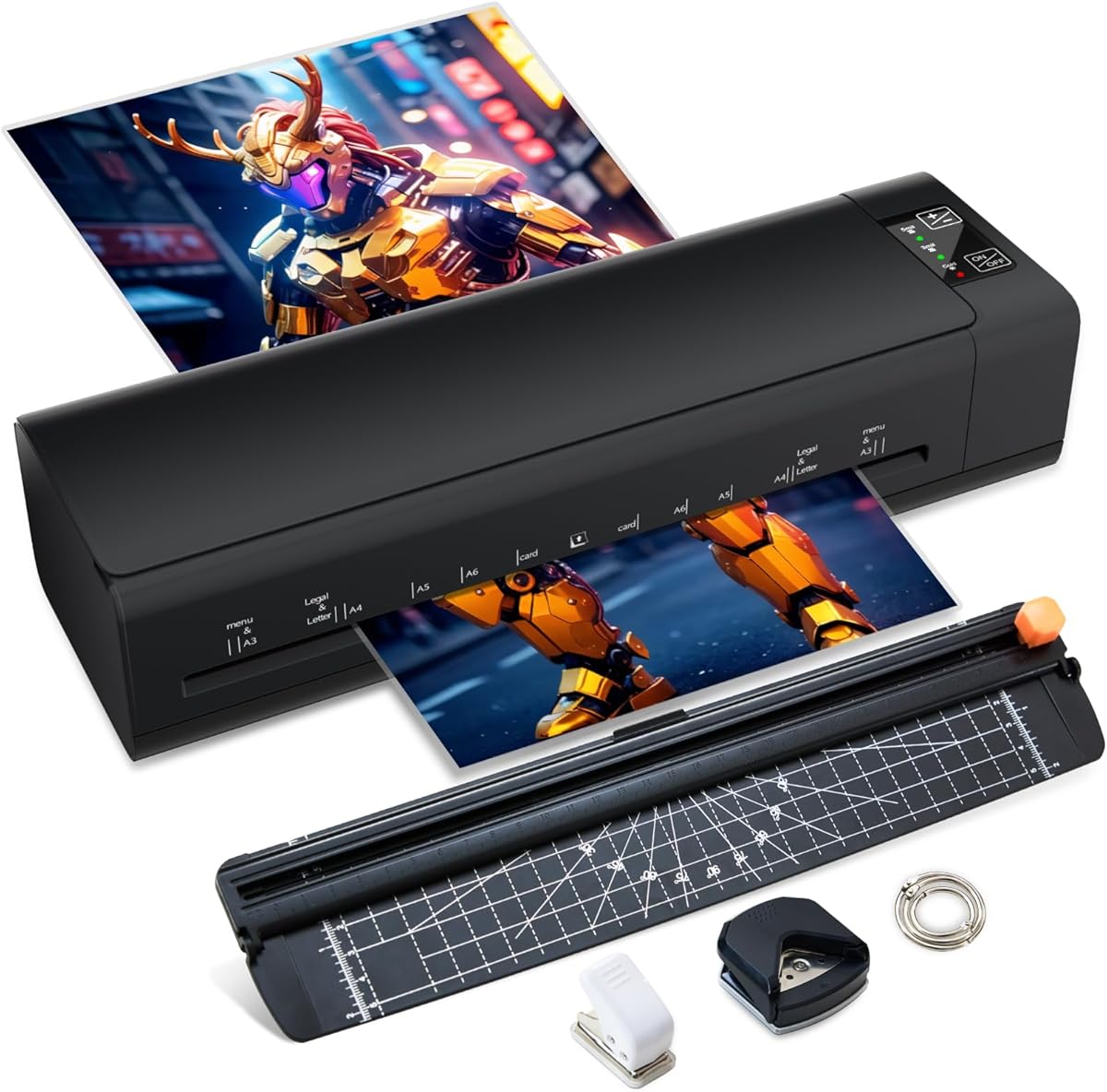
The Chilino 13-inch 9-in-1 is a feature-rich all-in-one laminating station with a 5.0 rating, a 13-inch feed, hot and cold operating modes, and a 60-second warm-up. Its supplied feature list includes a built-in paper cutter, corner rounder, hole punch, three binder rings, and laminating paper, allowing users to trim, round, punch, and bind completed projects without relying on separate tools.
We may earn a commission when you buy through this link, at no additional cost to you.
The machine accepts A3, A4, A5, and A6 materials as well as legal, letter, business-card, and photo-sized documents. It works with 3-mil and 5-mil pouches, and the manufacturer recommends 3- to 5-mil, 80- to 100-micron material. A dual-roll system and intelligent temperature control are intended to produce even pressure, resist wrinkles and blisters, and reduce paper curling.
Its 450 mm/min rating supports efficient batch projects, and the stated 60-second warm-up is much faster than several traditional personal laminators. Hot mode covers ordinary thermal pouch work, while cold mode provides an option for heat-sensitive materials. An ABS jam-release button and automatic shutoff add convenience and safety. The important qualification is that cold mode still requires compatible self-adhesive pouches, so the machine is more versatile but not universally compatible with every pouch style.
This model is a particularly strong option for teachers, crafters, students, and home users who value a bundled toolkit. Its 5.0 rating is the highest listed in this group, though ratings should not be treated as a substitute for evaluating the supplied dimensions, electrical requirements, and pouch workflow. Choose it when the combination of fast warm-up, wide entry, dual modes, and included finishing accessories outweighs the need for 6- to 10-mil compatibility.
The cutter, corner rounder, hole punch, and rings extend the machine beyond simple sealing. This is useful for classroom kits, scrapbooks, badges, and presentation projects.
Hot mode handles conventional thermal pouches, while cold mode offers a path for heat-sensitive items. Users should confirm that their chosen cold-lamination pouches meet the machine's requirements.
We may earn a commission when you buy through this link, at no additional cost to you.
The Chilino Commercial 4-Roller combines a 13-inch feed opening, a four-roller system, support for 3- through 10-mil pouches, and a stated speed of 1000 mm/min. Its 4.5 rating places it among the stronger higher-capacity options here, and the stated ability to process a 3-mil A4 sheet in roughly 17 seconds makes it suited to offices, schools, studios, and production-style workflows.
We may earn a commission when you buy through this link, at no additional cost to you.
Two heating and two pressing rollers are designed to improve heat conduction and pressure consistency compared with a standard two-roller arrangement. The manufacturer positions that structure as a way to limit bubbles, wrinkles, and fogging, which matters when appearance is important on contracts, posters, menus, or photographs. The broad size range accommodates cards, identification badges, legal documents, A3 sheets, and 11×17-inch posters.
The machine offers a 55-second warm-up, smart reverse jam prevention, automatic shutoff after 30 minutes of inactivity, and overheating monitoring. A complete starter package includes 30 pouches in A3, A4, A5, and A6 sizes, plus a corner rounder, cutter, hole punch, and binder rings. These details make it appealing for users who want to begin a large-format workflow immediately.
Compared with lighter personal laminators, its capabilities may be unnecessary if the workload consists of occasional letter-size projects. Large-format users, however, gain meaningful flexibility from the 10-mil ceiling and wide entry. Check room, document dimensions, and available pouch types before purchasing. For a busy operation needing both width and high throughput, this is a strong recommendation.
Supporting 3- to 10-mil pouches allows users to vary protection and rigidity without changing machines. That range covers both delicate images and more durable finished pieces.
The combination of a 55-second warm-up, 1000 mm/min speed, temperature monitoring, and auto-shutoff supports an efficient production rhythm.
We may earn a commission when you buy through this link, at no additional cost to you.
The Scotch TL1302X brings a 13-inch input, a one-minute warm-up, and a stated lamination rate of 11.8 inches per minute to a comparatively straightforward thermal machine. With a 4.4 rating, it offers an accessible way to work with large documents and photos without moving to a heavier four-roller system.
We may earn a commission when you buy through this link, at no additional cost to you.
Its extra-wide entry accepts materials up to 13 inches wide, making it useful for posters, larger charts, and wide-format projects. Two heated rollers are intended to create bubble- and wrinkle-free results, while the quick warm-up allows users to begin sooner than machines requiring several minutes. The machine also includes a carry handle, cord storage, and automatic shutoff, which improve handling and energy management.
The main limitation is pouch thickness. It laminates pouches up to 5 mil, so users who need heavier 6- through 10-mil protection should look elsewhere. It also does not advertise cold-lamination capability. The unit must be connected to a grounded 120-volt outlet and should not be operated with a voltage or outlet converter, an important electrical constraint for offices with unusual power arrangements.
For teachers, home crafters, and small businesses that want the flexibility of a 13-inch entry without the complexity of a commercial four-roller model, this is a compelling choice. The fast warm-up and broad entry create its main value, while the absence of thicker-pouch and cold-mode support keeps the feature set focused. It earns the budget recommendation in this comparison.
The 13-inch entry and one-minute warm-up balance document capacity with convenience. This is useful for workshops where users do not want to wait several minutes before each task.
A carry handle, cord storage, and automatic shutoff make the machine easier to move, store, and leave between occasional uses.
We may earn a commission when you buy through this link, at no additional cost to you.
The 13-Inch 11-in-1 Laminator is organized around teacher and office workflows, with a 13-inch feed, 60-second warm-up, 450 mm/min rated speed, and both hot and cold modes. It carries a 4.6 rating and includes 30 pouches in A3, A4, A5, and A6 sizes, along with a cutter, corner rounder, hole punch, and binder rings.
We may earn a commission when you buy through this link, at no additional cost to you.
One of its most practical features is the built-in storage compartment for accessories. Instead of keeping loose tools around a work area, users can organize the finishing implements in the machine itself. The 13-inch opening supports 11×17-inch A3 documents as well as smaller legal, photo, and card sizes. It works with 3-mil and 5-mil thermal pouches.
Its dual-roller design regulates temperature and pressure to help reduce wrinkles, bubbles, and haze. NTC smart temperature control is included for safety and component protection, while a 45-minute automatic shutoff conserves energy. The ABS jam-release button offers one-touch access when a pouch becomes stuck. Cold mode is intended for heat-sensitive photographs, receipts, and labels, but it requires compatible self-adhesive pouches sold separately.
The product also states that it is backed by a two-year warranty and responsive customer support, which can add confidence for institutional buyers. Its main limitation is that the two-roller configuration is less sophisticated than the four-roller alternatives, and it does not support pouches above 5 mil. For teachers or home users wanting a tidy, broad-purpose station, it remains an excellent fit.
Built-in accessory storage helps keep cutting, rounding, and punching tools together. This is a meaningful advantage in shared classrooms and compact home offices.
Cold mode provides an alternative for heat-sensitive papers and photographs. It requires compatible self-adhesive pouches, which should be planned for separately.
We may earn a commission when you buy through this link, at no additional cost to you.
The Qfun 13-Inch Thermal & Cold Laminator supports a broad range of documents and arrives with a substantial set of tools. Its 4.4 rating reflects a generally capable package, while the 13-inch entry, thermal and cold operation, and one-minute warm-up make it appealing for home, classroom, and office projects.
We may earn a commission when you buy through this link, at no additional cost to you.
The included package contains the laminator, paper cutter, corner rounder, hole puncher, three binder rings, a user manual, and 12 three-mil laminating sheets split among A3, A4, A5, and A6 sizes. The machine accepts compatible three- and five-mil sheets, including legal, letter, business-card, and photo-sized papers. That range covers many school assignments, posters, labels, and crafts.
Its two-roller system is intended to apply consistent heat and pressure, helping prevent wrinkling, bubbling, and hazing. Automatic shutoff helps conserve energy and reduce overheating risk. The product information describes the warm-up and speed as faster than other machines, but the supported specification gives a one-minute warm-up; buyers should focus on the concrete timing rather than comparative promotional language.
As with other hot-and-cold systems, compatibility depends on the appropriate cold-lamination media. The machine is most attractive for users who value the bundled cutter and crafting tools as much as the laminator itself. It does not advertise support beyond five-mil pouches and lacks the four-roller pressure system of premium models. For craft-oriented projects and mixed document sizes, it delivers a versatile package at a practical tier.
The included cutter, corner rounder, hole punch, and rings allow users to finish and organize decorated pieces. This makes the package more attractive for hands-on craft projects.
A one-minute warm-up and support for several paper sizes help users move between letter documents, legal sheets, cards, and photos without changing equipment.
We may earn a commission when you buy through this link, at no additional cost to you.
The YE381 13-Inch Laminator is marketed for home, office, and school use, with a two-roller heating system, hot and cold operation, and a stated 250 mm/min lamination speed. Its 4.3 rating places it in the middle of this group, but the emphasis on low-noise operation and paper trimming gives it a distinctive place in classroom environments.
We may earn a commission when you buy through this link, at no additional cost to you.
The package includes 50 pouches, divided between 25 A4 and 25 A6 sheets, as well as a corner rounder and a three-pattern paper trimmer. The built-in rotary cutter offers straight, perforated, and wave patterns, with guide lines and a removable metal bar. These finishing tools make the machine useful for photo corners, bookmarks, labels, flashcards, and neatly trimmed school displays.
A double-roller design supports smoother, quieter lamination, while intelligent temperature control is intended to avoid excessive heat and protect the machine. If a pouch becomes stuck, the ABS button releases the entry mechanism for paper removal. The stated 250 mm/min speed is lower than the 450 and 1000 mm/min figures offered by several rivals, so it is best suited to moderate rather than intensive production.
This model makes the most sense for teachers and crafters who regularly work with A3, A4, and A6 materials and value the included trimmer. It supports a wide size range from business cards to A3 paper, though the product information does not clearly detail whether the entry accepts 11×17-inch media. For quiet environments and bundled finishing functions, it is a practical choice.
The stated low-noise operation can be valuable in classrooms and offices where constant mechanical noise would be disruptive. The quieter approach is paired with a double-roller system.
Straight, perforated, and wave options allow users to format materials beyond simple rectangular cuts. The corner rounder adds another useful finishing touch for photos.
We may earn a commission when you buy through this link, at no additional cost to you.
The Amazon Basics 9-Inch Thermal Laminator is a compact option for legal- and letter-sized documents, photos, and similar materials. It has a 4.4 rating and focuses on straightforward operation with two heat settings, a 3- to 5-minute warm-up, a ready indicator, and a jam-release lever.
We may earn a commission when you buy through this link, at no additional cost to you.
The 3-mil setting is intended for normal documents, photos, and card stock, while the 5-mil setting is suggested for thinner papers. This explicit guidance helps buyers select compatible pouches and temperature settings. The machine accepts any 3-mil or 5-mil pouch, and the package includes 3-mil pouches measuring 8.9 by 11.4 inches, allowing users to complete a first project without immediately sourcing additional stock.
Its listed dimensions of approximately 13.9 by 2.6 by 4.4 inches make it relatively easy to accommodate on a shelf or desk. A lever provides access when paper needs to be cleared, and the ready indicator prevents operation before warm-up is complete. The manufacturer also advises reading the full user manual before first use and warns against laminating hardware, cloth, wood, foam, foil, and plastic sheets.
This is not the choice for A3 posters or wide-format production, and the warm-up is longer than the one-minute models in this roundup. Nevertheless, it offers a familiar 9-inch format, clear settings, and uncomplicated maintenance for recipe cards, school papers, photographs, and office documents. It is best for personal and light office use where compact dimensions matter more than wide-format capability.
Separate 3-mil and 5-mil settings make it easier to follow the pouch manufacturer's guidance. The ready light also helps prevent premature use.
The stated dimensions suit desks and shelves with limited room. A jam-release lever provides a straightforward recovery path for misfeeds.
We may earn a commission when you buy through this link, at no additional cost to you.
The Scotch TL901X is a compact two-roller laminator designed for school documents, assignments, instruction sheets, photographs, and other frequently handled papers. Its 4.7 rating is among the highest in the roundup, reflecting a favorable user reception for a straightforward machine with professional-looking results.
We may earn a commission when you buy through this link, at no additional cost to you.
Two heated rollers and two temperature settings are designed to produce bubble- and wrinkle-free lamination. The machine accepts both 3-mil and 5-mil pouches up to 9 inches wide. A release lever allows quick pouch removal, while the stated speed of one letter-size page per minute gives users a clear expectation for routine document work.
Its uses extend beyond protection: laminated items can become marker-proof, tear-proof, and spill-proof, making them useful for schedules, to-do lists, diplomas, event flyers, and classroom materials. The machine also handles photos. For best results, the product information recommends pairing it with Scotch Thermal Laminating Pouches, which helps define the intended consumable ecosystem.
The machine does not advertise cold-lamination support or a wide 13-inch entry, so it is better for letter-oriented projects than posters or large-format signage. Even so, its simple controls, two common pouch thicknesses, and professional finish make it a strong choice for homes, offices, and schools. It is especially appealing to users who prefer an uncomplicated traditional laminator without a large accessory ecosystem.
Two temperature settings and support for common pouch thicknesses simplify the process. This makes the machine approachable for occasional users and classroom support staff.
The heated dual-roller system is intended to resist bubbles and wrinkles. It offers a refined finish for documents and photographs without a large-format feed.
We may earn a commission when you buy through this link, at no additional cost to you.
The Scotch PRO TL906 is a portable 9-inch laminator positioned for teachers, home offices, schools, and crafters seeking a professional finish. It has a 4.6 rating, two heated rollers, two temperature settings, and a stated processing rate of 15 inches per minute. It accepts both 3-mil and 5-mil pouches up to 9 inches wide.
We may earn a commission when you buy through this link, at no additional cost to you.
Its professional orientation shows in the intended applications, including recipe cards, precious photos, decorative pieces, signs, flyers, to-do lists, and children's artwork. Laminated projects can become marker-proof, tear-proof, and spill-proof, extending their usefulness in busy settings. Two 8.5-by-11-inch thermal pouches are included for initial use, and Scotch Thermal Laminating Pouches are recommended for best results.
The most notable trade-off is warm-up time. At five to six minutes, it takes considerably longer to become ready than the one-minute and 55-second models in this guide. Once active, however, the 15-inch-per-minute speed is strong for a compact two-roller unit. It does not advertise cold-lamination capability, so buyers seeking heat-sensitive media or heavier pouch support should consider other options.
Despite its premium positioning, the TL906 retains a compact format suited to shared workspaces and portable use. It is a compelling choice for users who value a focused, professional workflow more than fast startup or a wide 13-inch entry. For school supplies, crafts, signs, and everyday document protection, the extra wait before the first project is balanced by a capable running speed and clear professional use case.
The compact 9-inch body and professional roller design make the TL906 suitable for moving between a home office, classroom, or craft area. It focuses on thermal document and photo work.
The stated 15-inch-per-minute processing rate supports efficient batches once the machine is ready. Buyers should plan the longer warm-up around their workflow.
We may earn a commission when you buy through this link, at no additional cost to you.
The right thermal laminator machine depends on document width, expected volume, pouch thickness, and the importance of speed, finishing tools, and jam recovery. Use the following factors to narrow the field before checking the current listing and warranty details.
Summary: Choose 9 inches for standard documents or 13 inches for posters and wide-format projects.
Summary: Pick two rollers for simplicity and four rollers for higher-volume, polished output.
Summary: Prioritize fast warm-up for occasional jobs and high processing speed for repetitive batches.
Summary: Check pouch thickness before buying, especially if you plan to laminate thicker items.
Summary: Choose dual modes for mixed materials and verify the required pouch type in advance.
Summary: Prefer clear jam recovery, temperature monitoring, auto-shutoff, and compatible power requirements.
Summary: Choose accessory-rich kits for craft and classroom workflows, or a simple model for basic sealing.
Summary: Match the footprint and storage plan to your workspace and how often the machine will move.
Before first use, read the manual, confirm that the machine's electrical requirements match the outlet, and clean the work area. Select the correct heat setting for the pouch thickness, insert the pouch while the machine is ready, and allow a small border around the document so adhesive can seal the edges. Do not laminate hardware, cloth, wood, foam, foil, or plastic sheets in a thermal machine.
Feed the sealed edge of the pouch into the entry first and keep the machine stationary while it draws the pouch through. Use the release lever, ABS jam button, or reverse function if the material stops moving; do not pull a partially sealed pouch forcefully from the rollers. Allow thicker or heat-sensitive items to cool before bending, trimming, punching, or stacking.
For care, switch off the machine when finished and unplug it according to the manual. Keep the rollers free of adhesive residue and never use sharp objects near the heating surfaces. Use only compatible pouches, follow the stated warm-up and shutoff procedures, and provide unobstructed space around the entry and exit. Periodically inspect cords, rollers, and storage compartments before the next session.
The mil measurement refers to pouch thickness. Three-mil pouches are thinner and are generally suited to standard documents, photos, and card stock, while five-mil pouches provide more body and durability. Use the heat setting specified for the pouch, and confirm that both thickness and machine compatibility align before starting.
Yes, every machine in this guide is described as suitable for documents and photos. Photo care still matters: use the recommended heat setting, avoid unsupported materials, and let the finished piece cool before handling. Machines with cold mode may offer an additional option for especially heat-sensitive photographs.
A 13-inch machine is better when you regularly laminate A3 or 11×17-inch posters, charts, signs, and large photographs. A 9-inch model is usually more compact and easier to store for letter, legal, card, and standard photo projects. The best choice depends on the largest item in your normal workflow rather than the machine with more features.
Cold lamination does not use the machine's heat to activate ordinary thermal adhesive. Instead, it relies on suitable self-adhesive pouches. Several featured machines advertise hot and cold modes, but cold pouches may need to be purchased separately, so buyers should verify compatibility before relying on that feature.
Common causes include selecting the wrong heat setting, failing to wait for warm-up, using an unsupported thickness, leaving too little border, or feeding the pouch incorrectly. Check that the machine is fully ready, that the pouch size and mil rating are compatible, and that the document is centered inside the sealed area.
Stop the machine and use its designated release lever, ABS button, or reverse control as described in the manual. Do not yank a stuck pouch or push tools into the rollers. If the material will not release, unplug the unit according to the instructions and consult its support resources before operating it again.
The included pouches are generally best treated as starter supplies. Some models include substantial assortments, while others provide only a few sheets. Regular users should plan to purchase compatible pouches in the sizes and thicknesses they use most often, rather than assuming the bundled supply will last.
Machines with a 13-inch entry are better suited to large posters and signs because they can accept A3 or 11×17-inch materials. Check the maximum pouch thickness, machine dimensions, and suitable material type before starting. Very thin thermal pouches and unsupported plastics should not be forced through a thermal laminator.
The Chilino Heavy-Duty 4-Roller is the strongest all-around choice for demanding users because it combines a 13-inch entry, four rollers, 3- through 10-mil compatibility, and a stated 1000 mm/min speed. For complete craft or classroom stations, the Chilino 13-Inch 9-in-1 and the 13-Inch 11-in-1 offer generous accessories, hot-and-cold versatility, and quick warm-ups.
When choosing, prioritize the largest document size you need, the pouch thickness you plan to use, and whether your workload values quick startup or sustained throughput. Compact two-roller models remain appropriate for standard home, school, and office documents, while four-roller systems are better for batch work and consistently polished wide-format results.
Finally, check the current product listing, included accessories, electrical requirements, warranty, and pouch compatibility before purchasing. Ratings and specifications provide a useful starting point, but current availability and prices can change, and consumable costs should be considered alongside the machine itself.