
RIOWOIS Passive Bookshelf Speakers
4.8Editor score
4-inch warm-sounding woofer
Silk dome horn tweeter
Gold-plated flexible terminals
Built-in wall-mount brackets
Our guide compares the 10 best passive speakers for turntable systems, covering sound, power handling, connections, placement, and value for home listening.
A turntable produces a delicate signal, so its companion speakers should reveal detail without exaggerating harshness or overwhelming the room with bass. Good passive speakers for a turntable combine accurate tonality, enough sensitivity for the phono stage, and an amplifier matched to their impedance and power requirements.
The products in this guide were compared by examining their driver configurations, enclosure designs, connectivity, amplification needs, and suitability for stereo music playback. The list includes genuinely passive models, powered alternatives, and one compact Bluetooth-equipped system, allowing shoppers to distinguish direct turntable-ready options from more flexible connected designs.
Each review explains where a model stands out, where compromises appear, and which listeners may prefer it. Ratings and specifications reflect the supplied product information, while practical setup details highlight the importance of phono-stage compatibility, placement, and amplifier selection. Availability and pricing can change at any time.
4.8Editor score
4.6Editor score
4.8Editor score
This side-by-side comparison highlights the major differences in amplification requirements, driver size, connection methods, and physical design, helping identify the most appropriate speakers for a turntable-based stereo system.





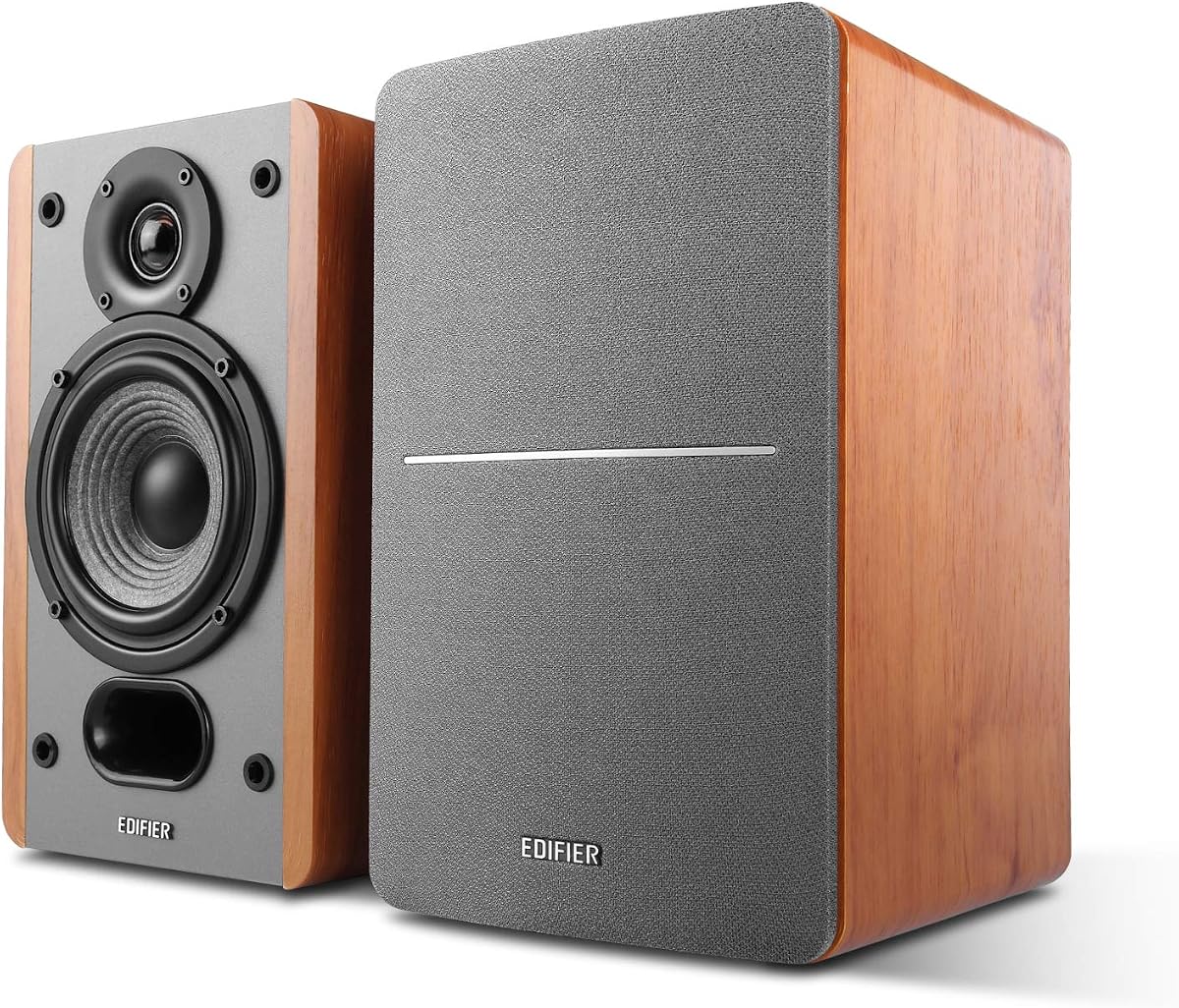
The Edifier P12 combines a straightforward passive design with a 4.6 rating, making it a strong all-around choice for a turntable stereo. Its 19mm silk dome tweeter handles high frequencies, while a 4-inch driver and rear bass-reflex port support a balanced, room-filling presentation. The wood finish also helps it blend naturally into a home listening area.
We may earn a commission when you buy through this link, at no additional cost to you.
One of the P12's most useful qualities is its flexibility. The built-in wall-mount bracket allows the pair to serve as rear or surround speakers, while the compact footprint also works for a small listening shelf. At 6 ohms, the speakers should work with a broad range of conventional stereo amplifiers and receivers. Speaker wires are included, although the amplifier or receiver remains a separate purchase.
The main limitation is that the P12 does not create the deepest bass in this group. Its 4-inch driver is best suited to near-field listening, modest rooms, and systems where vocal clarity and balanced tonality matter more than theatrical low-frequency output. Because the speakers are passive, there is also no built-in Bluetooth, wireless streaming, or volume control. A suitable amplifier is essential.
This is an excellent recommendation for a new turntable owner who already has, or plans to buy, a stereo amplifier with a phono stage. It is also practical for listeners who may later expand the system into a home-theater arrangement. Those wanting deeper bass, wireless functions, or a completely self-contained system should consider larger or powered alternatives.
The two-way layout gives each driver a defined role, allowing the tweeter to reproduce treble while the 4-inch driver handles midrange and bass. This arrangement is well suited to vocals, acoustic instruments, and detailed stereo listening where separation matters more than maximum low-end volume.
Integrated wall-mount brackets make the P12 unusually versatile for a small pair of passive speakers. Owners can position them on a shelf, credenza, or dedicated stands, then relocate them to the wall as rear channels if the system expands.
We may earn a commission when you buy through this link, at no additional cost to you.
The RIOWOIS Passive Bookshelf Speakers hold a 4.8 rating and are a compelling budget-oriented choice for record playback. A 4-inch woofer, silk dome tweeter, and horn loading are designed to produce warm, clear music with a broad soundstage. The result is especially relevant for listeners who want an uncomplicated passive system rather than a collection of wireless features.
We may earn a commission when you buy through this link, at no additional cost to you.
Terminal convenience is a notable strength. The gold-plated zinc-alloy terminals accept banana plugs, U-type terminal connectors, and bare wire, so setup should be familiar to most stereo-system owners. A rear-mounted bass-reflex port supports greater low-end extension and efficiency, while the hand-sanded cabinet edges and built-in mounting bracket improve both appearance and placement flexibility.
The crucial trade-off is that these speakers cannot operate by themselves. A receiver or amplifier is required, and the speaker wires must be purchased separately. There is also no integrated Bluetooth, so a turntable's output must reach the amplifier through a phono stage or line-level input. Listeners without existing amplification may find a powered system more convenient.
RIOWOIS is best for budget-conscious buyers who already own a competent amplifier and value warm, engaging sound with flexible terminal options. The 4.8 rating reinforces the model's strong appeal, but the requirement for external equipment keeps it from being the most turntable-friendly option for a completely new setup.
The supplied design description emphasizes warmth and clarity, characteristics that often complement the rich textures of vinyl playback. Its horn-loaded tweeter can also improve midrange clarity and create a more expansive presentation when the speakers are placed correctly and driven at a sensible level.
Supporting banana plugs, U-type connectors, and bare wire makes this pair practical for new installations as well as established stereo systems. This flexibility reduces the chance that a buyer will need an additional adapter simply to connect the speakers to an amplifier.
We may earn a commission when you buy through this link, at no additional cost to you.
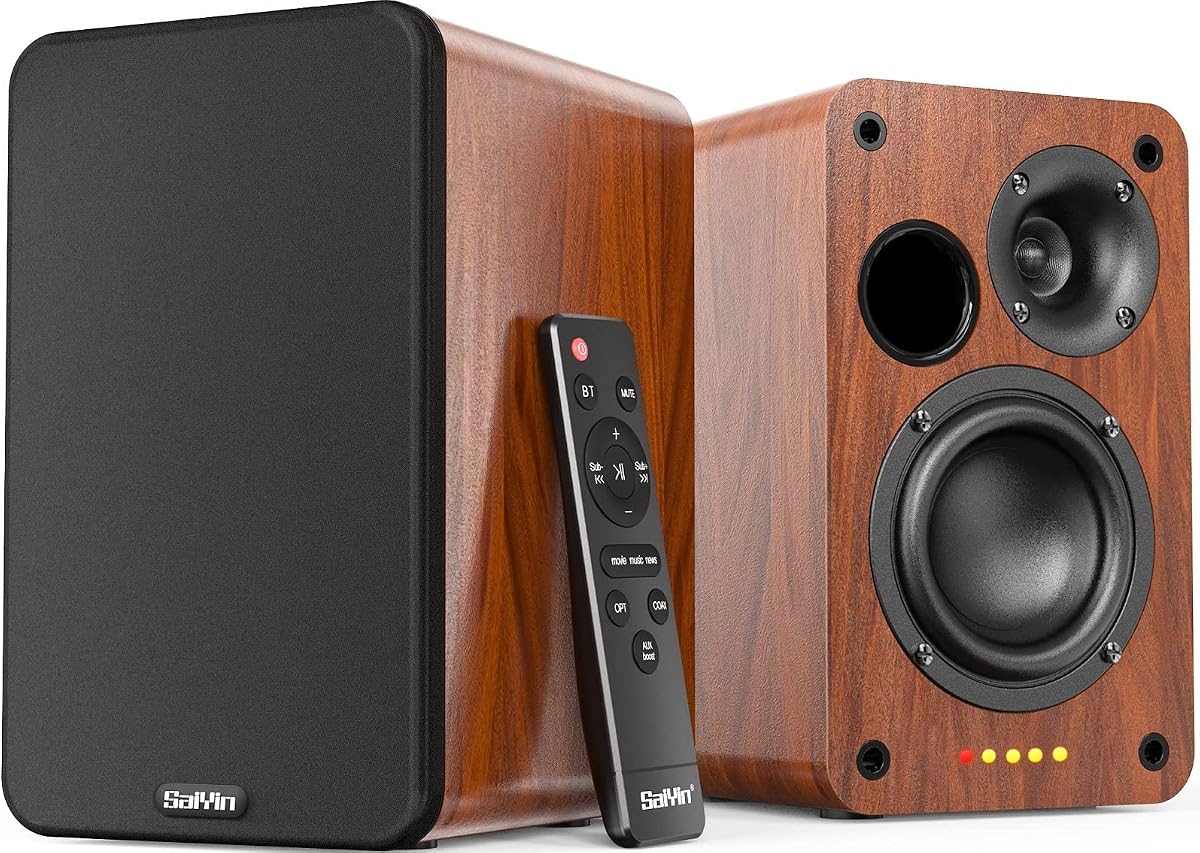
This Saiyin powered system carries a 4.4 rating and offers one of the most flexible ways to connect a turntable. It uses a 4-inch woofer and 0.5-inch silk dome tweeter, but its real distinction is the range of inputs: RCA, optical, coaxial, and Bluetooth can coexist, making it practical for records, television audio, computers, and phones.
We may earn a commission when you buy through this link, at no additional cost to you.
The built-in amplification removes the need for a separate stereo receiver. A remote control handles volume, muting, and input selection, while a subwoofer output allows the system to be expanded with a powered subwoofer. The speakers can connect directly to a turntable's line out, although a turntable with only a phono-level output still requires a preamplifier or built-in phono stage.
This system is not, however, a passive speaker in the strict sense. The product data specifically notes that a turntable must provide a Bluetooth transmitter or output to use Bluetooth playback; a Bluetooth receiver or input inside the turntable does not serve that purpose. The design is also optimized for standard PCM stereo output, so unusual surround formats are not the intended use.
Choose this Saiyin model when simplicity and input flexibility matter most. It is particularly attractive for someone starting a turntable system without a separate amplifier, provided the turntable has a line-level output or the listener adds a phono preamplifier. Vinyl purists seeking a purely passive setup should favor one of the genuinely passive models instead.
RCA, optical, coaxial, and wireless connections allow the pair to serve more than one source without replacing the main system each time. This makes the speakers useful for a turntable, television, laptop, and mobile-device setup in a compact room.
The decisive specification is the turntable's output level. A line-out connection can feed the speakers directly, while a phono-only output needs a preamplifier. Bluetooth is a different matter because the turntable must transmit audio rather than merely receive it.
We may earn a commission when you buy through this link, at no additional cost to you.
The Edifier R1280T is a powered 2.0 system with a 4.6 rating, built for listeners who want straightforward speakers without a separate amplifier. Its 4-inch full-range driver and 13mm silk dome tweeter provide natural sound reproduction, while the active speaker includes volume, bass, and treble adjustment.
We may earn a commission when you buy through this link, at no additional cost to you.
Dual 3.5mm auxiliary inputs are useful for connecting a turntable's line-level output and another analog source at the same time. A remote control handles volume, and the MDF enclosure with wood-effect vinyl gives the system a familiar furniture-friendly appearance. It is particularly straightforward for compact stereo setups where shelf space and simple controls matter.
The R1280T is not passive, so buyers seeking an upgradeable chain of separate components may find its fixed electronics limiting. It also does not list optical, coaxial, or Bluetooth connectivity among its stated features. Most importantly, a turntable with only a phono-level output still needs a phono preamplifier; connecting a phono signal directly to a line input can produce weak, thin, or distorted audio.
The R1280T is a good match for first-time record buyers who want an approachable all-in-one stereo. It also suits anyone who values analog simplicity over streaming features. Users with a line-out turntable can make the connection especially clean, while phono-only owners should budget separately for the required preamplifier.
Side-panel bass and treble controls let listeners adapt the speakers to different rooms and recordings without adding separate EQ hardware. These controls are on the powered speaker, making system changes convenient when the pair is placed on a shelf or desk.
The two auxiliary inputs make it possible to keep a turntable and another analog source connected at the same time. A remote-controlled volume level further reduces the need to reach behind the cabinet during everyday listening.
We may earn a commission when you buy through this link, at no additional cost to you.
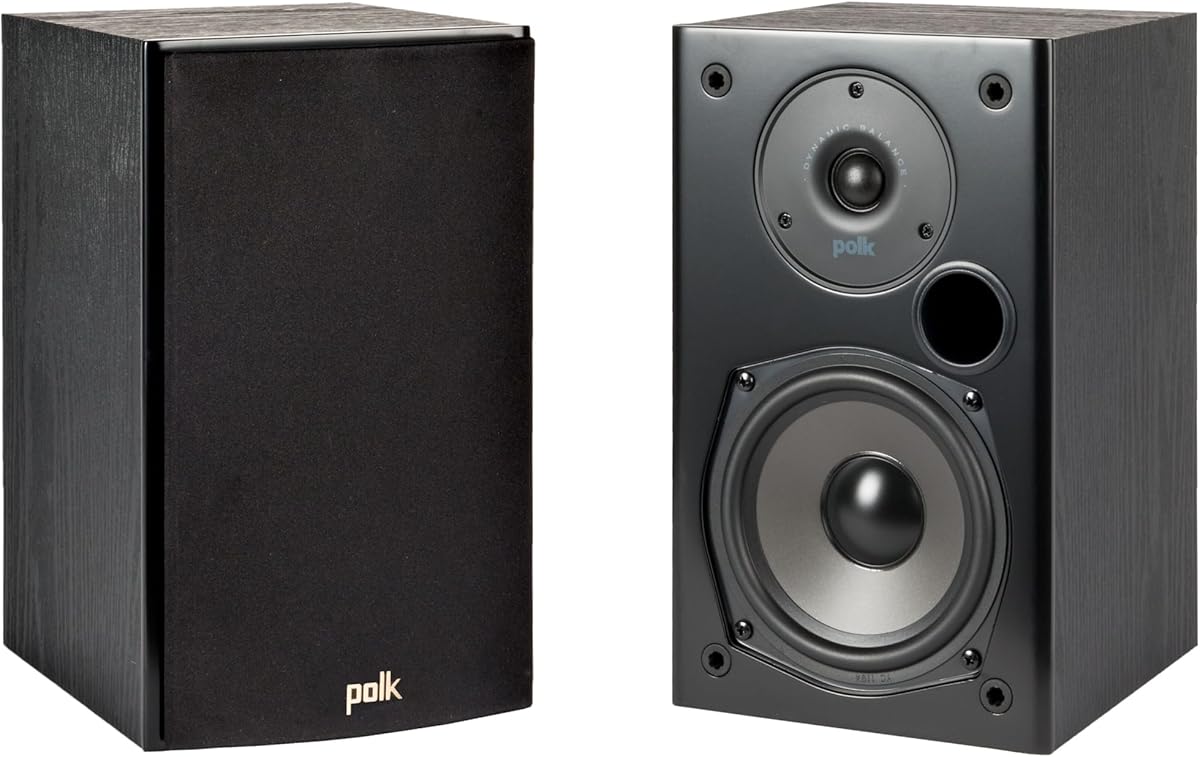
The Polk Audio T15 carries a 4.7 rating and is a practical passive choice for a stereo system that may later become a home theater. Its 0.75-inch tweeter and 5.25-inch Dynamic Balance driver are designed for clear, balanced playback with rich bass, even at lower listening levels.
We may earn a commission when you buy through this link, at no additional cost to you.
The larger mid-bass driver gives the T15 more physical scale than compact 4-inch bookshelf speakers. That makes it well suited to medium-sized rooms, a turntable-focused stereo, or front left and right positions in an expanding surround system. Wall-mounting support adds further placement options, while the straightforward speaker-wire connection keeps setup uncomplicated.
The pair remains fully passive and therefore depends on a capable receiver or amplifier. Its small tweeter may not deliver the same fine treble detail as models with one-inch or larger silk dome units, and there is no wireless or self-contained volume control. Those limitations are less concerning in a traditional home-audio chain built around separate components.
Polk buyers should choose the T15 when they want one pair to handle both records and future surround duties. It is a stronger fit than a miniature desktop system for a living room or dedicated listening area, while still being less demanding in space and complexity than a large floor-standing system.
A 5.25-inch driver can move more air than the compact woofers found in several smaller bookshelf models. That extra physical capacity is valuable for turntable listening because it can improve low-mid extension and produce a fuller presentation without requiring enormous listening levels.
The T15 can function as front or rear channels, allowing owners to introduce matching towers, a center speaker, and a subwoofer as their system evolves. Its straightforward wired design also fits comfortably within a conventional AV receiver setup.
We may earn a commission when you buy through this link, at no additional cost to you.
The Saiyin 3-Way Passive is built around the idea that a dedicated midrange driver can improve vocal and instrument clarity. Its 5.25-inch paper-cone woofer extends down to a stated 48Hz, while a 1-inch elliptical midrange and 20mm silk dome tweeter separately handle voices, instruments, and high-frequency detail.
We may earn a commission when you buy through this link, at no additional cost to you.
This three-way architecture distinguishes the model from ordinary two-way bookshelf speakers. The oval midrange is designed to widen the horizontal soundstage, which may help in a stereo arrangement where the listening position is not perfectly centered. A pair of removable foam plugs also gives users a way to reduce bass output in small rooms or near-wall positions.
The specifications list 4-ohm nominal impedance, an 85dB sound pressure level, and a recommended power range of 5 to 50 watts per speaker. Those figures make the speakers compatible with many home-theater receivers and stereo amplifiers, but careful matching still matters. Speaker wires are not included, and the enclosure measures 12.2 by 7.7 by 6.7 inches per speaker.
This model is best for listeners who value driver specialization and vocal intelligibility over a very compact footprint. It should appeal to fans of classical, jazz, acoustic, and critical listening, provided they already have an amplifier. Those seeking simplicity, wireless playback, or a smaller decorative pair should look elsewhere.
By assigning the midrange to its own driver, the speaker can reduce overlap between the woofer and tweeter. The stated benefit is cleaner vocal reproduction and instruments, particularly when the listening chair is slightly off the center axis.
Removable port plugs let listeners trade bass quantity for control. Leaving the openings exposed supports deeper output in open spaces, while inserting the foam can tame boom in a small room or when the cabinets sit close to a rear wall.
We may earn a commission when you buy through this link, at no additional cost to you.
This second Saiyin powered option is smaller than the company's four-inch model and has a 4.4 rating. It combines a 3.75-inch woofer, 0.5-inch silk dome horn tweeter, and built-in amplification. Optical, coaxial, RCA-style, 3.5mm, and Bluetooth options make it a flexible central speaker for a turntable and other sources.
We may earn a commission when you buy through this link, at no additional cost to you.
The system combines one active speaker with one passive companion, and speaker wire links the pair. A remote control provides volume, mute, and input selection, while top-panel buttons offer another way to operate the system. The stated dimensions are 5.3 by 6.3 by 8.6 inches, making the pair easier to accommodate than a conventional large bookshelf model.
Turntable setup still depends on the source. A line-level output can connect directly, whereas a phono-only turntable needs a preamplifier. Bluetooth will work only if the turntable can transmit audio; a built-in Bluetooth receiver is not equivalent. The product also has less low-end potential than the larger Saiyin powered system or any of the 5.25-inch passive models.
This is a sensible pick for a compact room where one speaker pair must handle vinyl, television audio, and wireless sources. It is also convenient for users who do not want a separate stereo amplifier. Listeners committed to component separation should instead choose a true passive pair and add a suitable receiver.
The smaller enclosure is easier to position on a desk, media console, or narrow shelf. Multiple source inputs make the pair practical for a room where records share space with a television, game system, computer, or phone.
Remote-controlled volume and input switching replace the need for an external amplifier's preamp controls. A phono preamplifier is still necessary for a turntable that offers only a phono-level signal.
We may earn a commission when you buy through this link, at no additional cost to you.
The Audio-Technica AT-SP3X is a compact speaker system with a 4.8 rating and unusually broad connection options for its size. It is designed to deliver full-range audio while supporting both dual RCA wired connections and Bluetooth. Multipoint Bluetooth allows two devices to remain connected, reducing the friction of switching between a phone and computer.
We may earn a commission when you buy through this link, at no additional cost to you.
Operation is straightforward thanks to a power button with an LED indicator, a dedicated volume-control dial, and an included two-meter speaker cable. The package also includes an AC adapter with three international plug adapters, which is useful for travel or relocation. Its compact form makes it more approachable for a desk, office, or secondary listening area than a full-size home-theater pair.
Because this is a powered system, it is not a passive bookshelf model in the conventional audiophile sense. The supplied product information does not detail its internal amplifier, crossover, or individual driver dimensions, so it is best to consider it as a convenient connected speaker rather than a component-based alternative. Turntable compatibility again depends on line-level versus phono-level output.
The AT-SP3X is best for buyers who prioritize compactness and flexible wireless access over upgradeable passive components. A turntable with a line out or a separate phono preamplifier can feed its RCA input, while a turntable with Bluetooth transmission can use the wireless route. Dedicated passive-speaker enthusiasts should treat it as a connected alternative.
Keeping two Bluetooth devices connected at once is useful when music moves between a laptop and a phone. The feature does not change the need for proper turntable output compatibility, but it broadens the system's role within a multi-device household.
The compact enclosure, simple top-panel controls, and included international adapters reduce setup friction. These characteristics suit secondary rooms, offices, and smaller listening areas where large passive speakers and separate components may be inconvenient.
We may earn a commission when you buy through this link, at no additional cost to you.
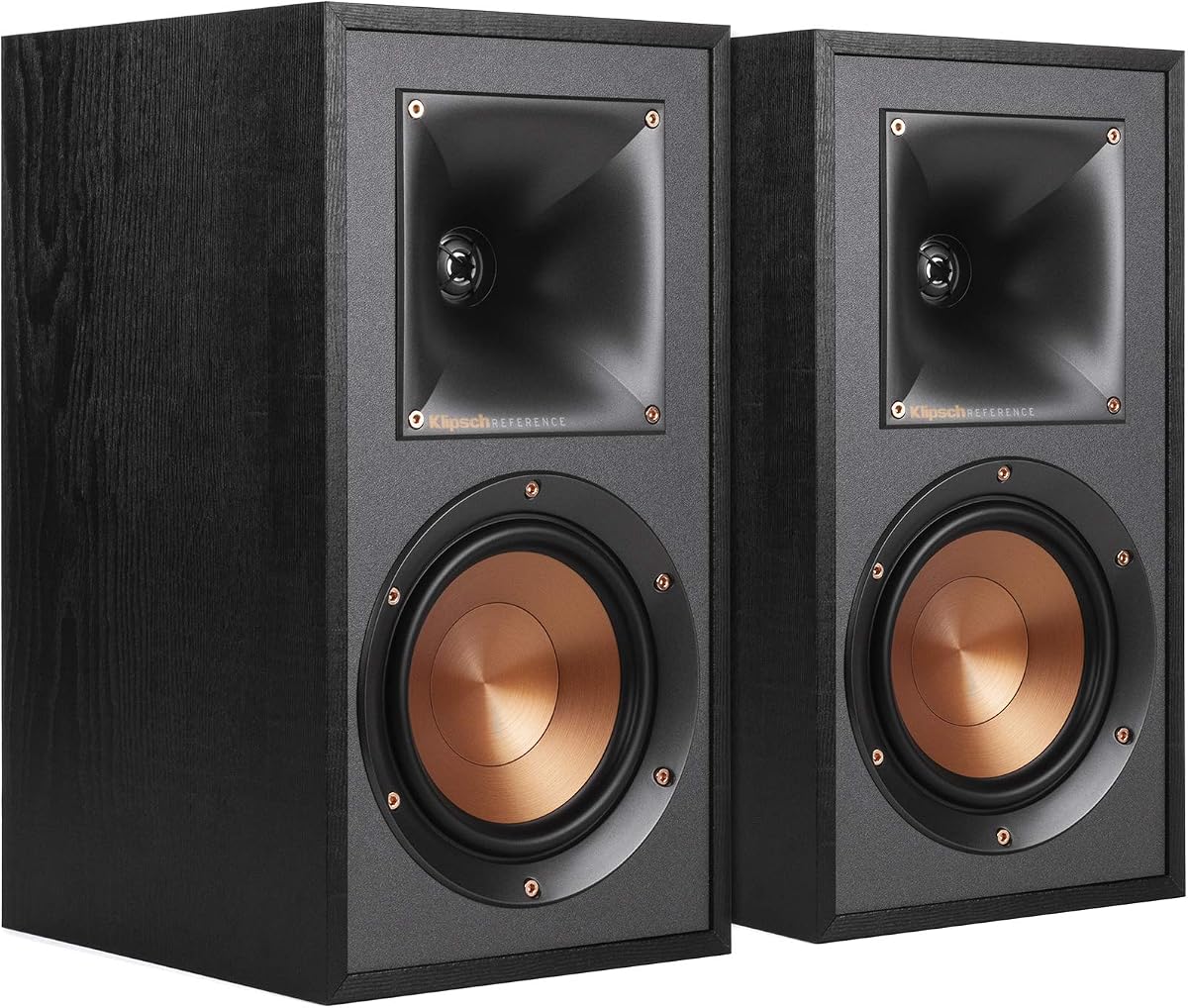
The Klipsch R-51M combines a 4.8 rating with a distinctive high-performance driver layout. A one-inch aluminum LTS tweeter sits inside a 90-by-90-degree Square Tractrix horn, while dual 5.25-inch spun-copper IMG woofers handle low and mid frequencies. The result is a substantial passive bookshelf pair with a strong emphasis on dynamics.
We may earn a commission when you buy through this link, at no additional cost to you.
Horn loading can improve treble efficiency and help the speakers project clearly across a room. That makes the R-51M relevant for vinyl listeners who want vocal articulation, instrumental detail, and greater impact from records with strong transients. The pair also offers enough physical driver area to deliver fuller bass than compact 4-inch bookshelf models.
As a passive design, it depends entirely on a suitable amplifier and receiver. Horn-loaded speakers can produce a more forward or present treble presentation than conventional soft-dome designs, so listeners who prefer relaxed sound should audition the model if possible. The rear-firing bass-reflex port also needs some breathing room behind the cabinet to avoid overly boomy or compressed low-frequency behavior.
The R-51M is a strong premium recommendation for listeners who want a dynamic, high-output passive system and already have a capable amplifier. It works particularly well for rock, jazz, and detailed stereo playback, provided the amplifier can drive the pair and the room placement preserves the clarity the horn design is intended to provide.
The Tractrix horn directs high-frequency energy in a controlled pattern, supporting clear projection and strong efficiency. That can be valuable in a lively room, although the resulting tonal character is less neutral than some conventional dome-tweeter designs.
Two 5.25-inch woofers provide more cone area than a typical compact bookshelf pair. They can support fuller playback at higher levels, making the R-51M well suited to listeners who want their turntable system to handle both intimate albums and energetic records.
We may earn a commission when you buy through this link, at no additional cost to you.
The Polk Signature Elite ES20 is the most substantial passive pair in this guide, combining a 4.8 rating with a 6.5-inch woofer and one-inch Terylene tweeter. Its Dynamically Balanced Acoustic Array and precision crossovers are designed to create a clear, lifelike soundstage, while the high-sensitivity design supports use with a broad range of amplifiers and AV receivers.
We may earn a commission when you buy through this link, at no additional cost to you.
Polk's Power Port Technology is intended to deliver stronger bass than a conventional ported enclosure while minimizing turbulence and distortion. The stated 4- and 8-ohm compatibility makes the pair attractive for both conventional stereo amplifiers and modern home-theater receivers. It can serve as front, rear, or elevation speakers, and screw inserts with keyhole slots support several wall-mounting orientations.
The main compromise is physical scale. Each enclosure has a 6.5-inch woofer and is likely less discreet than the smaller models in the list, while a small room may require careful subwoofer integration and restrained low-frequency settings. The pair also remains passive, so a receiver or amplifier and appropriate wiring are required. Speaker stands are not included.
The ES20 is best for a dedicated stereo or larger home-theater room where full-scale sound and future surround expansion matter. It can serve as an impressive front pair for a turntable setup, offering the capacity to reproduce sustained bass and dynamics with less strain than compact bookshelf models.
High sensitivity can make a speaker easier to drive at useful listening levels. Nevertheless, the amplifier and receiver should still be matched to the stated 4- and 8-ohm compatibility, and the system's own gain and tone controls should be set conservatively at first.
The ES20 can begin as a stereo pair and later become the front or rear channels of a larger surround installation. Its matching-series potential makes it relevant for buyers who want to expand beyond records without changing the visual character of their system.
We may earn a commission when you buy through this link, at no additional cost to you.
The right turntable speakers depend on signal compatibility, amplifier quality, room size, tonal preferences, and whether the system will later expand. These factors help separate genuinely passive models from powered alternatives and avoid costly mismatches.
A passive speaker contains drivers, crossover, and terminals but no built-in power amplifier. It must be connected to a receiver or stereo amplifier that sends power through the speaker wires. This arrangement offers component flexibility, but it also means the amplifier becomes part of the signal and power chain. By contrast, powered bookshelf speakers include an active speaker with amplification and are often easier to operate, although their connections and upgrade paths are more restricted.
A turntable with a line-level output can usually connect directly to an amplifier's line input or suitable powered speakers. A phono-level output is much lower and includes the very low-frequency information associated with record grooves, so it requires a phono stage. That stage may be built into the receiver or amplifier, or it may be a separate preamplifier. Using a phono output as though it were line level can result in weak bass, unclear vocals, and distorted highs, while feeding a line input into a phono input can produce excessive bass and harshness.
The woofer is the largest visible driver and usually governs low-bass potential. The 4-inch drivers in the Edifier P12 and RIOWOIS models are compact and appropriate for small rooms or near-field listening. The 5.25-inch drivers in the Polk T15, Saiyin three-way model, and Klipsch R-51M offer greater scale, while the Polk ES20's 6.5-inch woofer is aimed at fuller output. More cone area does not automatically mean better sound, but it can improve low-frequency extension and dynamic headroom when the enclosure and amplifier are properly matched.
A two-way speaker assigns high frequencies to a tweeter and low-to-mid frequencies to a woofer, making it a simple and widely understood design. A three-way model adds a dedicated midrange driver, which may improve vocal clarity and off-axis consistency. The Saiyin 3-Way Passive includes a 5.25-inch woofer, a 1-inch elliptical midrange, and a 20mm silk dome tweeter. In contrast, the Klipsch R-51M uses a horn-loaded aluminum tweeter, which can provide strong projection and efficiency but may present a more assertive tonal character.
Impedance describes the electrical load the speaker presents to an amplifier. The Edifier P12 is specified at 6 ohms, the Saiyin three-way pair at 4 ohms, and the Polk ES20 as compatible with both 4- and 8-ohm settings. The other passive products do not provide a complete impedance specification in the supplied information. Matching matters because an amplifier that struggles with a low-impedance load may become hot, shut down, or fail to deliver clean volume. If the receiver has selectable speaker impedance, set it to match the manual rather than leaving an older setting in place.
Turntable playback rewards speakers that reveal texture, microdetail, and instrument separation without adding excessive brightness or bass. The supplied descriptions emphasize natural or balanced sound for the Edifier P12, warm and clear reproduction for RIOWOIS, clear vocals for the Saiyin three-way model, and dynamic output for the Klipsch pair. These characterizations are useful starting points, but personal preference and room acoustics remain important. A speaker that sounds detailed on a showroom demonstration may become tiring at home if the room adds excessive brightness or bass buildup.
Bookshelf speakers need room to perform as intended. Leave space behind a rear-firing port, keep the left and right channels symmetrical, and use stands if necessary to bring the tweeters near ear level. Small rooms benefit from restrained bass settings and speakers placed away from corners, while larger rooms may need physically larger drivers or more output. Several models include mounting hardware, but the Edifier P12, RIOWOIS pair, and Polk T15 offer built-in or stated wall-mount support, making them adaptable to shelves, walls, and entertainment layouts.
A two-channel turntable system needs only a pair of speakers and an amplifier with a phono stage. If the same equipment will later support films, consider a receiver, a center channel, surround speakers, and a subwoofer. The Polk T15 and ES20 are explicitly positioned for expansion within home-theater systems, while the Saiyin 3-Way is described as suitable for critical listening and dedicated two-channel setups. Powered systems can serve records and television audio at once, but they may be less useful as part of a fully separated surround chain.
Begin by identifying the turntable's output type. Connect a phono-level output to a phono input on the receiver or amplifier, or route it through a compatible preamplifier. A line-level output can connect to a line input. With passive speakers, power the amplifier off while wiring and check polarity so both channels receive the correct signal. Turn the amplifier to a low level before switching it on, then allow the system to warm up before setting a comfortable listening level.
Position the speakers as a matched left-right pair with enough distance between them to create a stereo image. Keep the left speaker on the left from the listening position, and angle both toward the chair if practical. Leave clearance behind rear-firing ports, avoid placing either speaker directly against a wall, and use isolation pads or stands to reduce vibration. On very low volume, brief bass buildup can be natural, so adjust distance, toe-in, or amplifier settings rather than immediately pushing the volume.
For daily care, keep the cabinets free from moisture, direct sunlight, and excessive heat. Dust the surfaces with a soft, dry cloth, and avoid abrasive cleaners or liquid sprayed directly onto the speaker. Do not push the amplifiers into clipping, and do not connect or disconnect wires while the system is energized. If the turntable is stored for long periods, keep the dust cover closed and ensure the cartridge and tonearm are secured according to the turntable manufacturer's instructions.
Not without an amplifier or receiver between them. Passive speakers need line-level power, while a turntable normally produces either a phono-level or line-level signal. Connect the turntable to the amplifier's phono or line input, then run speaker wire from the amplifier to the passive pair. If the turntable has only a phono output, the amplifier must include a phono stage or you will need a separate preamplifier.
Passive speakers do not contain a built-in power amplifier and must be driven by a receiver or stereo amplifier. Powered speakers include their own amplification and usually provide volume controls and line-level inputs. Passive models are easier to integrate into a component-based home-theater system, while powered models are more convenient for listeners who want fewer boxes and a quicker setup.
Only if the rest of the system lacks a usable phono stage. Many stereo amplifiers and receivers include one, often behind a labeled PHONO input. A turntable with a line-level output does not need additional gain correction for that output. A phono-only turntable does, unless the amplifier has a compatible built-in phono preamplifier.
Only if it includes Bluetooth transmitter or Bluetooth output functionality. Many turntables that support Bluetooth are designed to receive audio from a phone and may not transmit their phono signal to Bluetooth headphones or speakers. Check the product specifications for transmitter or output support, or use a wired line-level connection and a phono preamplifier when wireless transmission is unavailable.
Choose based on the room, desired volume, and bass extension rather than driver size alone. Compact four-inch drivers can sound excellent at near-field listening distances, while five- and six-inch drivers offer greater low-frequency reach for medium and large rooms. Placement, amplifier quality, and source quality can matter more than a small difference in woofer diameter.
They can work well when positioned carefully. Wall mounting saves shelf space and may help direct sound toward the listening area, but it can also emphasize bass if the speakers are too close to a corner. The Edifier P12 and RIOWOIS pair include mounting hardware, while the Polk T15 and ES20 also support wall placement. Keep the speakers symmetrical and use the bass controls or room placement to manage boom.
It depends on the music, room, and main speakers. A subwoofer can add impact for jazz, rock, electronic music, and film soundtracks, but it is not essential for every record collection. Choose a subwoofer that complements the main speakers, avoid using it to mask poorly matched bass, and begin with modest output to prevent the low frequencies from overwhelming the stereo image.
Compare the amplifier's supported speaker impedance with the manufacturer's specification for the speakers. The supplied list includes 6-ohm Edifier P12 speakers, 4-ohm Saiyin 3-Way Passive speakers, and Polk ES20 speakers compatible with 4- and 8-ohm settings. For any model, follow the manual, select the proper receiver impedance setting, and ensure the amplifier can deliver the required continuous power.
The Edifier P12 is the most balanced overall recommendation, combining a natural two-way design, 6-ohm impedance, included wiring, and flexible shelf or wall placement. The RIOWOIS pair stands out as the best budget choice for owners with an existing amplifier, while the Klipsch R-51M offers a premium dynamic option with dual 5.25-inch woofers and an efficient horn-loaded tweeter. Each fulfills a distinct need rather than competing for the same listening style.
Prioritize the signal path before appearance. Confirm whether the turntable offers phono, line, or both outputs; ensure the amplifier has a compatible phono stage; and match its power and impedance handling to the speakers. Then consider the room, driver size, tonal character, and future surround plans. Powered and Bluetooth-equipped products can be excellent turntable companions, but they are not substitutes for a passive system in the strict component sense.
Finally, review the latest specifications, included accessories, and current product availability before ordering, since manufacturer configurations can change. Pricing and promotions also vary over time, so compare the complete system needs rather than focusing on a single discounted component. The right speaker pair should make records easier to enjoy while fitting the room, equipment, and listening habits of its owner.

