
HiLetgo LCR-T4 Multifunction Tester
4.4Editor score
Broad component detection support
128 by 64 LCD
MOSFET threshold and capacitance
Battery or external DC power
This guide compares the best Mosfet Transistor Capacitor Tester options for component identification, fault finding, and routine electronics work.
A Mosfet Transistor Capacitor Tester helps technicians, electronics hobbyists, and repair professionals identify components, inspect transistor characteristics, and diagnose capacitor faults without relying on visual identification alone. A genuinely useful instrument combines clear readings, sensible component detection, safe test procedures, and documentation that helps users interpret each result.
The products in this guide were compared using the supplied specifications and feature descriptions, focusing on component coverage, measurement range, display quality, portability, diagnostic functions, and suitability for bench or field work. The list includes dedicated capacitor meters, general component testers, transistor analyzers, an in-circuit ESR meter, and a kit with test leads and components.
Each pick highlights a different practical route into component testing: a versatile analyzer, a budget multifunction tester, a feature-rich instrument, or a focused diagnostic meter. Ratings, availability, and prices can change, so readers should confirm the current listing and specifications before purchasing for a particular repair workflow.
4.4Editor score

4.8Editor score

4.2Editor score
This side-by-side comparison organizes all ten instruments by their primary testing strengths, supported measurements, display type, and intended work environment, making it easier to match a tester to specific repair needs.


The Velleman DCA55 is a semiconductor analyzer built for users who need more than a simple continuity result. It carries a 4.8 rating and stands out for automatic component identification, automatic connection-pin identification, and recognition of component-specific features such as protection diodes and shunt resistors. That makes it especially compelling for transistor troubleshooting, MOSFET inspection, and semiconductor identification.
We may earn a commission when you buy through this link, at no additional cost to you.
Its measurement coverage is unusually focused. The analyzer can identify bipolar transistors, measure their current gain and leakage current, distinguish silicon and germanium diodes, and measure the threshold voltage of enhancement MOSFETs. It also measures forward voltage across diodes, LEDs, and transistor base-emitter junctions. These functions help answer practical questions about device identity, biasing behavior, and whether a semiconductor is operating within expected parameters.
The trade-off is specialization. The DCA55 is not positioned as a large-component analyzer for scanning bulk capacitors, nor is it presented as a general-purpose LCR bench instrument. Users primarily interested in routine HVAC capacitor checks may find a dedicated capacitance meter more direct. Even so, for semiconductor-focused work, automatic pin identification and detailed device recognition can reduce the ambiguity associated with visually similar packages.
This is the strongest choice for electronics technicians, serious hobbyists, and repairers who regularly work with transistors, MOSFETs, diodes, and LEDs. Its combination of identification and parameter measurement gives it more analytical depth than a simple component detector. For a tool dedicated primarily to semiconductor work, the DCA55 is the most balanced and compelling selection in this guide.
Automatic connection-pin identification is valuable when a component has been removed from a board or its markings are no longer legible. By combining device recognition with measurement functions, the analyzer helps narrow down what the component is and how its terminals behave.
MOSFET threshold voltage, transistor current gain, leakage current, and diode forward voltage can reveal more than binary pass or fail results. These readings are useful when comparing a suspect device with a known-good reference or evaluating whether a component's behavior is consistent with its type.
We may earn a commission when you buy through this link, at no additional cost to you.
The HiLetgo LCR-T4 is a compact multifunction tester aimed at hobbyists and technicians who want broad component coverage without carrying several separate instruments. Its 4.4 rating reflects a practical balance of capability and affordability, while automatic detection supports NPN and PNP transistors, N-channel and P-channel MOSFETs, diodes, triodes, resistors, capacitors, and other devices.
We may earn a commission when you buy through this link, at no additional cost to you.
A 128 by 64 green backlight LCD can show both numerical readings and graphics, helping users interpret the device being tested. The specification also highlights MOSFET gate threshold voltage and gate capacitance measurements, bipolar transistor current amplification factor, and base-emitter threshold voltage. That combination gives the unit meaningful relevance to the keyword while keeping it approachable for general electronics work.
The tester is not designed for instant results in every situation. Its stated detection time is approximately 1.7 seconds for many measurements, but bulk capacitor detection may take about a minute. The 9V battery is not included, although the tester can alternatively use a DC supply from 6.8 to 12 volts. Automatic shutdown and a stated shutdown current of about 20nA help reduce unnecessary power consumption.
The LCR-T4 is best for students, electronics hobbyists, and general repairers who need a portable all-purpose component tester. It is not the first choice for users who exclusively need fast, high-volume capacitor screening, but its component variety, compact display, and MOSFET-specific measurements make it a sensible budget option for a crowded bench.
The breadth of supported devices makes this useful when unknown parts arrive from salvaged boards, hobby inventories, or repair bins. Automatic NPN, PNP, N-channel, and P-channel recognition reduces the need to guess a component's identity before checking its electrical behavior.
The green backlight improves visibility in different working conditions, while battery and external DC options allow the tester to suit a mobile kit or a stationary bench. The stated low shutdown current supports longer intervals between battery replacements, although a replacement battery must be supplied separately.
We may earn a commission when you buy through this link, at no additional cost to you.
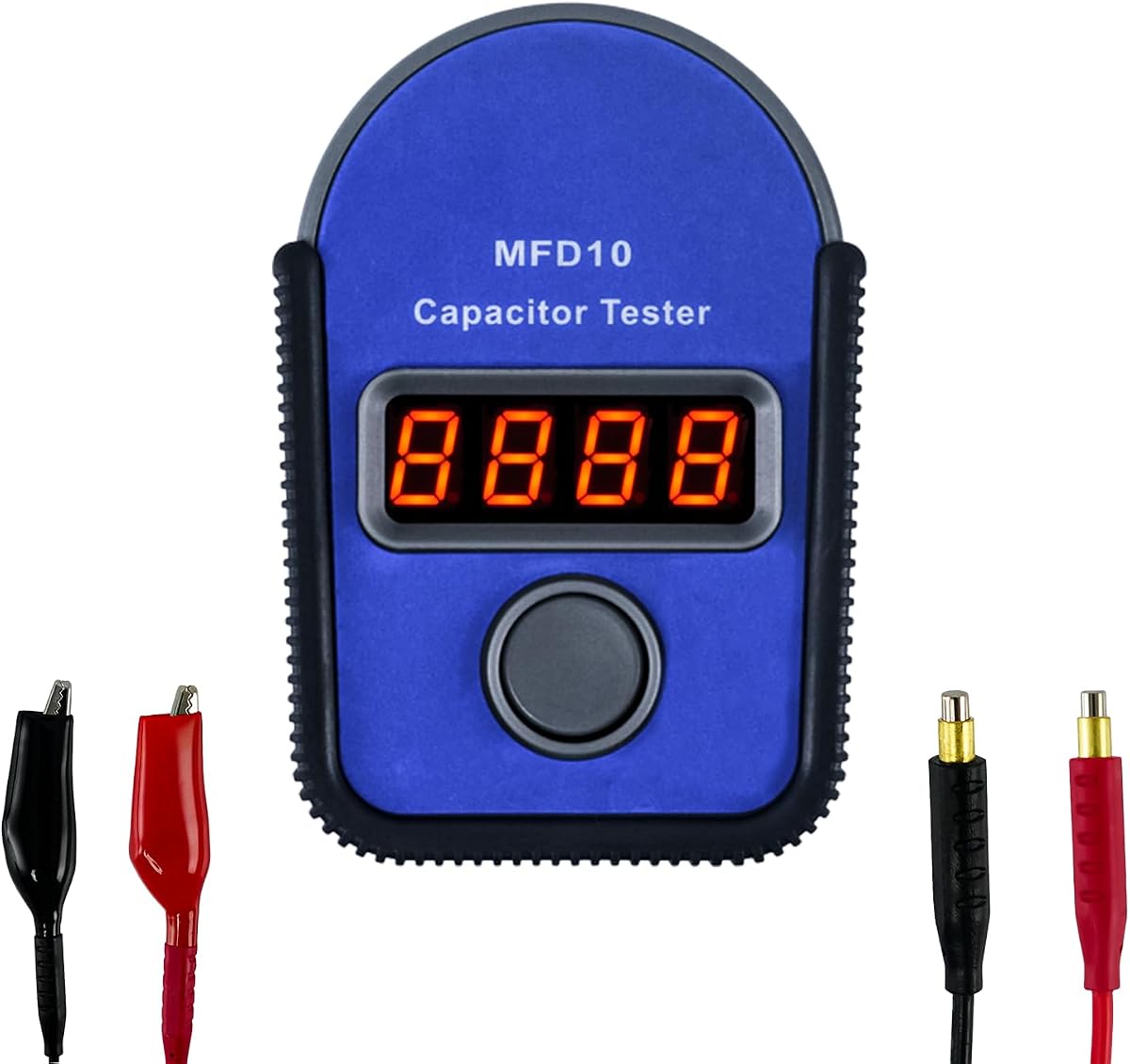
The MFD10 Digital Capacitor Tester with LED Display is a dedicated capacitance instrument with a 4.9 rating, the highest numerical rating among the products listed. Its defining range is 0.001 to 9,999 microfarads, accompanied by a stated accuracy of plus or minus 5 percent. It is built for users who want straightforward capacitor readings without navigating a broad component menu.
We may earn a commission when you buy through this link, at no additional cost to you.
The large LED screen makes the numerical result easy to check in bright or dim working areas. Advanced circuitry is cited for measurement accuracy and stability, while the compact, lightweight housing is described as rugged and suitable for portable use. Its narrow specialization also makes the workflow easy to understand: connect the capacitor, wait for the result, and compare it with the expected value.
The principal limitation is equally important. This is a capacitor tester, not a MOSFET or transistor analyzer, and the supplied description does not list those functions. Buyers searching specifically for a combined Mosfet Transistor Capacitor Tester should treat this model as a specialized option for the capacitance portion of their toolkit rather than a complete semiconductor solution.
It is a strong choice for HVAC maintenance, appliance repair, and bench work centered on start or run capacitors. The combination of a wide measurement range, stated five-percent accuracy, a clear display, and a portable body makes it a focused and practical instrument. For capacitance-only work, it is one of the most attractive options in this comparison.
A 0.001 to 9,999 microfarad range accommodates many common capacitor sizes found in household appliances, HVAC equipment, and electronic assemblies. The broad span also allows users to identify unlabeled parts and check whether a capacitor is behaving as expected.
The large LED display is valuable when the tester is used in a workshop, utility area, or field environment where speed and legibility matter. A dedicated display also avoids the learning curve associated with multifunction analyzers that present several component categories and advanced parameters.
We may earn a commission when you buy through this link, at no additional cost to you.
The T7 Transistor Tester is a feature-rich multifunction instrument with a 4.2 rating. It supports testing across triodes, diodes, resistors, capacitors, inductors, thyristors, field-effect transistors, regulators, LEDs, and other listed functions. Its full-color graphic display gives it a clear visual distinction from simple meters that only present a number on a monochrome screen.
We may earn a commission when you buy through this link, at no additional cost to you.
The supplied specifications highlight automatic diode detection, self-test with automatic calibration, infrared coding support, and an adjustable automatic shutdown timeout. Infrared detection can display both the decoded data and the received waveform after the tester successfully captures the signal. This broadens the instrument beyond basic component identification into a general electronics analysis tool.
Power is supplied by a built-in high-capacity rechargeable lithium-ion battery, and the product includes voltage detection for that battery. The package includes the tester, a USB cable, red, yellow, and green leads, three pins, and two capacitance components. The breadth makes the T7 appealing for users who want one portable instrument to cover many categories.
The T7 is best suited to advanced hobbyists, bench technicians, and repairers who appreciate graphic information and broad testing functions. Its 4.2 rating does not lead the group, and a user who needs only a direct capacitor reading may prefer a simpler dedicated meter. Still, for a visually rich and unusually comprehensive tester, the T7 offers considerable capability.
A full-color screen is especially helpful for tests where a graph or waveform communicates more than a single value. It gives the instrument a more visual workflow for transistor, diode, and infrared inspections without requiring a separate display device.
The internal rechargeable battery removes the need for disposable cells during normal portable use. Battery voltage detection can also help users monitor the power source, while the included USB cable supports routine charging.
We may earn a commission when you buy through this link, at no additional cost to you.
The MFD10 Digital Capacitor Tester is a portable, dedicated meter designed for capacitor inspection, maintenance, and identification. It has a 4.4 rating, a measurement range of 0.001 to 9,999 microfarads, and a stated accuracy of 5 percent. The range supports work involving start capacitors, run capacitors, unlabeled parts, and suspected open or short circuits.
We may earn a commission when you buy through this link, at no additional cost to you.
Its large high-brightness LED display is designed to remain readable in dim or bright surroundings. A sliding door stores the supplied magnetic wires and vise clips, reducing the chance of leaving accessories behind. The combination of magnetic leads and clips is intended to create close terminal connections and stable readings, which is especially helpful when a capacitor is small or difficult to hold.
The package includes the tester, magnetic wire, alligator clips, a soft tool kit, and a user manual. It operates on three AAA batteries, which are not included. Readings may take up to approximately 10 seconds to stabilize, so users should allow time before judging the displayed value. The unit is also described as useful for HVAC, household appliances, and electronic equipment.
This MFD10 is a good choice for maintenance technicians and DIY users who want a focused capacitor kit with organized storage. It does not provide the MOSFET or transistor functions implied by the broader category, but its range, connection accessories, and fault-diagnosis workflow make it a practical addition to an electronics or HVAC tool bag.
Magnetic wires and vise clips help maintain contact across both capacitor terminals while the reading stabilizes. This matters because poor or intermittent contact can make a good capacitor appear inconsistent, and the sliding storage door helps keep the complete lead set together.
The stated ability to identify unlabeled capacitors and check open- and short-circuit conditions addresses common service needs. Its broad range also makes it relevant to HVAC, appliance repair, and general electronic inspection rather than one narrow category of components.
We may earn a commission when you buy through this link, at no additional cost to you.
The 2200-piece Electronic Component Assortment is designed for learning, prototyping, and general repair rather than one narrowly defined measurement. It includes a LCR-T4 transistor, resistance, capacitance, diode, and triode tester alongside resistors, transistors, diodes, Zeners, inductors, ICs, crystal oscillators, PCBs, LEDs, switches, potentiometers, trim pots, light-dependent resistors, headers, and terminals.
We may earn a commission when you buy through this link, at no additional cost to you.
The included tester provides a convenient way to identify and inspect many of the components supplied in the box. That combination is particularly valuable to students and new hobbyists, who can select a part, learn its expected characteristics, and then verify it with the meter. The assortment's 4.6 rating also makes it a strong all-in-one option when the goal is to establish a working electronics inventory.
This kit does not replace a specialized analyzer when exact transistor parameters, detailed MOSFET measurements, or advanced ESR analysis are required. The included components may also exceed what an experienced technician needs, creating unused inventory. Its value comes from access to a variety of parts and a usable tester in one organized package rather than from maximum measurement depth.
Choose this assortment for education, prototyping, electronics classes, or building a parts library for hobby projects. It is less appropriate for a professional repair operation that already has a well-stocked inventory and needs a dedicated field instrument. For beginners, however, the combination of components, storage box, and multifunction tester provides an efficient foundation.
A broad assortment makes it possible to experiment with different component families without sourcing each one separately. Students can compare resistor, diode, transistor, and capacitor readings and relate the results to circuit behavior.
For a new workbench, the included tester and boxed components reduce the need for several separate starter purchases. Experienced users can treat it as a restocking system for common repair parts rather than a complete professional inventory.
We may earn a commission when you buy through this link, at no additional cost to you.
The Supco MFD10 is a dedicated digital capacitor tester with a 4.7 rating. Its stated range extends from 0.01 to 9,999 microfarads, and the title identifies 5 percent accuracy. The device is particularly relevant to HVAC technicians who need to inspect start and run capacitors in air-conditioning and refrigeration systems.
We may earn a commission when you buy through this link, at no additional cost to you.
Operation is straightforward: connect the leads to the capacitor, press the button, and read the result on the bright LED display. Continuity testing adds a useful second diagnostic function for identifying open and short circuits. This makes the meter more than a nominal-value checker and helps narrow down why a component is not functioning as expected.
The meter runs on three AAA batteries, which are not included, and comes with a soft carry case for transport. Its compact size supports field use where a bench instrument would be inconvenient. As with a focused capacitor tester, there is no listed MOSFET or transistor analysis capability, so it should complement rather than replace a semiconductor analyzer.
The Supco MFD10 is a strong recommendation for HVAC service kits and for users who regularly test run capacitors. The combination of a wide range, stated accuracy, quick readings, continuity diagnostics, and portability makes it a focused and convincing tool for its intended application.
Start and run capacitors are common diagnostic targets in refrigeration and air-conditioning equipment. A dedicated meter with a broad microfarad range gives service technicians a direct way to check these parts in the field without carrying a general-purpose laboratory analyzer.
The compact body and included soft case make the tester easier to carry between jobs. Battery operation removes the need for a mains connection, while the bright display helps users read results in varied service environments.
We may earn a commission when you buy through this link, at no additional cost to you.
The GME Professional in-Circuit ESR Capacitor Tester is built around a specific diagnostic task: evaluating equivalent series resistance in or out of circuit. Its 4.3 rating reflects a specialized instrument rather than a general-purpose MOSFET and transistor analyzer. For power-supply, board-level, and service work where ESR is a meaningful health indicator, that focus can be an advantage.
We may earn a commission when you buy through this link, at no additional cost to you.
The meter uses microprocessor-generated 100 kHz output at a low 15 millivolt peak-to-peak test voltage. The low level is intended to avoid turning on solid-state devices during testing, which is important when active components remain on a circuit board. An audible buzzer announces the ESR range, allowing users to check multiple capacitors quickly by listening for the appropriate indication.
Automatic calibration at power-up removes the manual zeroing step found on some competing meters. The tweezer-style probes are gold-plated, connected by an extra-long cable, and non-polarity dependent. The tester also automatically discharges the capacitor under test, an important safety and workflow feature during repeated diagnostic checks.
The GME ESR tester is best for electronics technicians and repair specialists who regularly evaluate suspected deteriorated capacitors, especially in-circuit. It does not substitute for a component analyzer that identifies transistors or MOSFETs. Its appeal lies in controlled ESR measurement, convenient probes, automatic discharge, and a broad stated capacitance range of 0.47 to 2,200 microfarads.
Testing a component while it remains on a board can narrow down the faulty area faster than removing every suspect part. The low-voltage, 100 kHz output and automatic discharge are designed to support that approach while reducing unwanted circuit activation.
One-handed, nonpolarity tweezer probes are useful when probes must touch closely spaced points on a circuit board. The gold-plated tips and long cable support convenient positioning, while polarity independence eliminates one preliminary check.
We may earn a commission when you buy through this link, at no additional cost to you.
The ZT-XT1 combines a transistor tester and digital multimeter in a 2-in-1 design. Its feature list highlights one-button smart switching, a 2.4-inch HD display, automatic recognition of various electronic components, and measurements for resistance, capacitance, inductance, and diodes. It is aimed at users who want a broad general-purpose instrument in a single package.
We may earn a commission when you buy through this link, at no additional cost to you.
A 25,000-count true RMS capability differentiates it from simpler budget meters and may appeal to technicians who want higher displayed resolution across multiple measurement categories. The automatic recognition function is particularly relevant to a transistor and capacitor tester because it is intended to reduce manual configuration and make unknown components easier to identify.
The supplied product information does not provide a numerical customer rating, and it does not detail specific MOSFET threshold, gate-capacitance, or transistor-gain measurements. As a result, buyers with specialized semiconductor-analysis requirements should review the full listing and documentation carefully rather than assuming the same depth as a dedicated analyzer.
The ZT-XT1 is a good fit for a general electronics bench where one instrument must handle routine multimeter work and component testing. It may also appeal to students building a versatile toolkit. Its dual-mode approach, automatic recognition, large display, and high measurement count offer useful flexibility, but specialized users may need more explicit parameter coverage.
Smart switching is intended to simplify operation by reducing the number of menu choices involved in changing measurement modes. This can make the tester more approachable while retaining separate transistor-tester and multimeter functions.
The 25,000-count display and true RMS capability provide useful measurement detail for a combined instrument. These features complement the component-recognition functions when the tester is used for broader electrical diagnostics rather than only semiconductor identification.
We may earn a commission when you buy through this link, at no additional cost to you.
The 4070L is a general-purpose meter dedicated to capacitor, inductance, and resistance testing. It carries a 4.6 rating and covers capacitance from 2,000 picofarads to 200 microfarads, inductance from 20 millihenries to 20 henries, and resistance from 20 ohms to 2,000 megohms. A large LCD, backlight, data hold, and foldable stand support bench and general repair use.
We may earn a commission when you buy through this link, at no additional cost to you.
Its 1999-count display and low-power 9V battery operation balance useful resolution with compactness. The listed applications include selecting capacitance, measuring unknown values, matching capacitors, checking cable capacitance, and measuring switch or PCB capacitance. Transistor hFE testing is also listed, adding a limited semiconductor function to an otherwise measurement-focused design.
The upper capacitance limit is lower than that of the MFD10 and Supco models, so it is less suited to large start or run capacitors. It also lacks the automatic device identification and detailed semiconductor parameters associated with multifunction analyzers. Users should therefore treat the 4070L as a compact measuring tool rather than a complete transistor and MOSFET diagnostic platform.
The 4070L is a useful entry point for students, home repair, and light electronics work. Its wide resistance and inductance ranges, familiar multimeter features, and readable screen make it versatile for general electrical tasks. For larger capacitors or advanced MOSFET analysis, one of the more specialized instruments in this guide would be a better match.
Capacitance, inductance, and resistance coverage broadens the 4070L beyond a single-purpose capacitor check. This makes it useful for matching components, investigating unknown circuits, and handling a wider range of educational or household electrical tasks.
The large LCD, backlight, and data-hold function improve readability and allow a reading to remain visible while probes are repositioned. Its foldable rear stand is also practical for a workbench, while the compact, lightweight body simplifies storage.
We may earn a commission when you buy through this link, at no additional cost to you.
The right tester depends on whether you need general component identification, detailed semiconductor parameters, in-circuit ESR diagnostics, or fast capacitance measurements. Consider the devices you actually service, the readings you need to interpret, and the working environment before choosing.
Begin by listing the components you expect to test. A true multifunction instrument may identify bipolar transistors, N-channel and P-channel MOSFETs, diodes, resistors, capacitors, triodes, SCRs, and other devices. A dedicated capacitor meter covers capacitance but may provide no MOSFET analysis, while an ESR tester may focus almost entirely on equivalent series resistance. Match the instrument to the actual repair mix rather than assuming that every device in the category performs every measurement.
MOSFET threshold voltage, gate capacitance, transistor current gain, leakage current, and diode forward voltage can provide more diagnostic information than simple identification. The Velleman DCA55 specifically lists several of these measurements, while the HiLetgo LCR-T4 supports gate threshold, gate capacitance, current amplification factor, and base-emitter threshold voltage. If your work depends on comparing a suspect part with a reference, inspect these parameters carefully.
Range determines which capacitors fit within the instrument's useful envelope. The dedicated MFD10 products and Supco tester cover up to 9,999 microfarads, while the 4070L reaches 200 microfarads. Small-capacitor users should also consider the lower limit: the MFD10 models begin at 0.001 microfarads, the Supco at 0.01 microfarads, and the 4070L at 2,000 picofarads. Stated accuracy is 5 percent across the MFD10 and Supco listings.
Testing a capacitor while it remains installed can accelerate board-level fault finding. The GME ESR meter supports in-circuit or out-of-circuit ESR measurements from 0.47 to 2,200 microfarads, uses a 100 kHz test signal, and automatically discharges the capacitor after testing. This capability is especially relevant when a general capacitance reading alone does not reveal a degraded component.
A readable display reduces interpretation errors and speeds routine work. The HiLetgo tester uses a 128 by 64 green backlight LCD, the T7 offers a full-color graphic display, and the ZT-XT1 uses a 2.4-inch HD display. Dedicated MFD10 and 4070L meters use large LED or LCD screens suited to direct numerical readings. Graphics and waveforms help with complex devices, while simple screens remain effective for capacitance checks.
Field technicians should consider battery type, included accessories, and whether the unit can be charged. The HiLetgo LCR-T4 accepts a 9V battery or 6.8-to-12-volt DC input, the T7 includes a rechargeable lithium-ion battery and USB cable, and the MFD10 models use AAA batteries. Portable housings, stored test leads, and carry cases make instruments easier to organize and transport.
The best tester is one that can make dependable contact with the component. The MFD10 portable kit includes magnetic wires, alligator clips, a soft tool kit, and a user manual. The GME uses one-handed gold-plated tweezer probes with an extra-long cable. The 2200-piece assortment includes an LCR-T4 and many test components, making it useful for learning and prototyping. Accessory quality can matter as much as the meter itself during repeated work.
The best instrument is the one that fits the user's actual work. A basic hobbyist may want the LCR-T4 as an affordable introduction, while a semiconductor technician may prioritize the DCA55's automatic pin identification and parameter measurements. HVAC workers often value a dedicated meter with a broad microfarad range, board-level repair technicians may prioritize ESR testing, and infrared-focused users may appreciate the T7's decoding and waveform features.
Before testing, identify the component type and determine whether it should be removed from the circuit. For an in-capacitance or ESR measurement, compare the displayed value with the marked value or a known-good reference. For a MOSFET or transistor, ensure the leads are connected to the correct pins because incorrect placement can produce misleading results. Start with an appropriate measurement range and let the reading stabilize before recording it.
Read the instrument's instructions and compare its test method with the component being inspected. The HiLetgo LCR-T4 may take longer for bulk capacitors, the MFD10 portable model may require up to approximately 10 seconds for stabilization, and the GME ESR tester automatically discharges the capacitor under test. When a result seems inconsistent, check lead contact, component orientation where required, battery condition, and nearby circuitry before replacing a part.
Keep the test leads clean, dry, and free from damage, and store magnetic wires or probes in the supplied compartments or case. Use the specified battery type or charging method, replace batteries responsibly, and avoid exposing the instrument to moisture, excessive heat, or impact. Periodic checks against a known component help confirm that the tester remains consistent and that its accessories still provide reliable connections.
Yes, some multifunction testers support all three categories, while focused instruments cover only one or two. The HiLetgo LCR-T4 identifies NPN, PNP, N-channel, and P-channel MOSFETs and measures capacitors, while the Velleman DCA55 focuses on semiconductor identification and parameters. Dedicated MFD10 and Supco meters are primarily capacitance tools, so buyers should check the exact functions rather than relying on the broad category name.
A transistor tester generally provides component detection, pin identification, and basic transistor or MOSFET readings. A semiconductor analyzer may add deeper parameters such as current gain, leakage current, forward voltage, protection-diode detection, and MOSFET threshold voltage. The distinction matters when a simple pass-or-fail check is not enough to distinguish a questionable transistor from a healthy one.
A low voltage reduces the chance of activating nearby solid-state devices while a capacitor is still connected to the board. The GME meter uses a 100 kHz output at a low 15 millivolt peak-to-peak level for this reason. This makes board-level testing more practical and helps the instrument focus on capacitor condition rather than unintended circuit behavior.
The correct range depends on the parts you service. The dedicated MFD10 and Supco models extend to 9,999 microfarads, making them suitable for many HVAC and appliance capacitors. The 4070L reaches 200 microfarads and is better suited to smaller electronics. Also check the lower limit if you routinely test ceramic, film, or other small capacitors.
No. Capacitance describes a component's ability to store charge, while ESR describes resistance in series with the capacitor. A capacitor can display a plausible capacitance while still having elevated ESR, particularly when aged or deteriorated. An ESR-capable meter is therefore valuable for power-supply, board-level, and reliability testing.
Several multifunction models are designed to recognize device types and connection pins automatically. The DCA55 lists automatic component and pin identification, while the LCR-T4 supports automatic detection of bipolar transistors and multiple MOSFET channels. Results should still be checked against expected behavior and the device's documentation, especially in dense circuits where neighboring components may affect a reading.
It depends on the meter and the purpose of the test. A general capacitance reading is often more reliable when the capacitor is disconnected from the board, since parallel paths can distort the result. An ESR tester designed for in-circuit use can provide useful information without removal, but the manufacturer's instructions should determine when desoldering is necessary.
A complete assortment is better for learning, prototyping, and building a parts inventory. A single specialized tester is usually better for a technician who already has parts and needs accurate, repeatable measurements in a defined repair category. The 2200-piece kit includes an LCR-T4 tester and many components, making it especially accessible for students and new hobbyists.
The Velleman DCA55 is the strongest all-around choice for semiconductor work because it combines automatic identification with meaningful MOSFET and transistor measurements. The HiLetgo LCR-T4 offers the most accessible budget route into broad component testing, while the T7 stands out for its full-color interface, broad functions, infrared waveform display, and rechargeable battery. These picks serve different needs, but each brings a clear advantage to the category.
Prioritize the measurements and components that matter in your work. Choose detailed transistor and MOSFET parameters for advanced semiconductor diagnosis, a broad microfarad range for HVAC or appliance capacitors, ESR capability for in-circuit board checks, and automatic recognition when testing unknown parts from salvaged equipment. A simple dedicated capacitance meter can be more effective than a complex analyzer if that is the only measurement you regularly need.
Finally, check the current listing, included accessories, power requirements, and measurement specifications before purchasing. Ratings and product details can change, and availability may vary. Comparing the present listing with the priorities in this guide will help you select a Mosfet Transistor Capacitor Tester that fits your actual workflow.