
HSU Surf Mounts and Accessories for Ski, Snorkeling, Surfing, Wakeboarding
4.4Editor score
Complete board mounting kit
Includes tether and anchors
Broad GoPro camera compatibility
Expert guide comparing Gopro Accessories for Surfing, including float grips, surfboard mounts, mouth mounts, safety tethers, and versatile kits for every setup.
GoPro accessories for surfing can determine whether a session produces smooth, secure footage or a camera left floating, tumbling, or mounted in an awkward position. The most useful equipment protects against water, reduces vibration, improves framing, and keeps the camera attached when waves, wipes, falls, and paddle movements make every setup more demanding.
This guide compares ten accessory options based on the supplied specifications, including camera compatibility, flotation, mounting methods, visibility, stability, and included safety components. The list covers floating grips, board-mounting hardware, mouth mounts, tether-based systems, and broad multi-accessory kits for surfers who want options for changing conditions.
Each pick highlights a particular use case while remaining honest about practical trade-offs. Ratings reflect the product information provided, and the included rating for every item is shown in the comparison. Product listings and prices can change, so readers should confirm current details, compatibility, and availability before buying.
4.4Editor score
4.9Editor score

4.7Editor score
The comparison below organizes all ten options by their core advantage, from dedicated flotation and board attachment to hands-free mounting and multi-sport versatility. It also identifies camera coverage, safety hardware, and the situations in which each accessory is most useful.
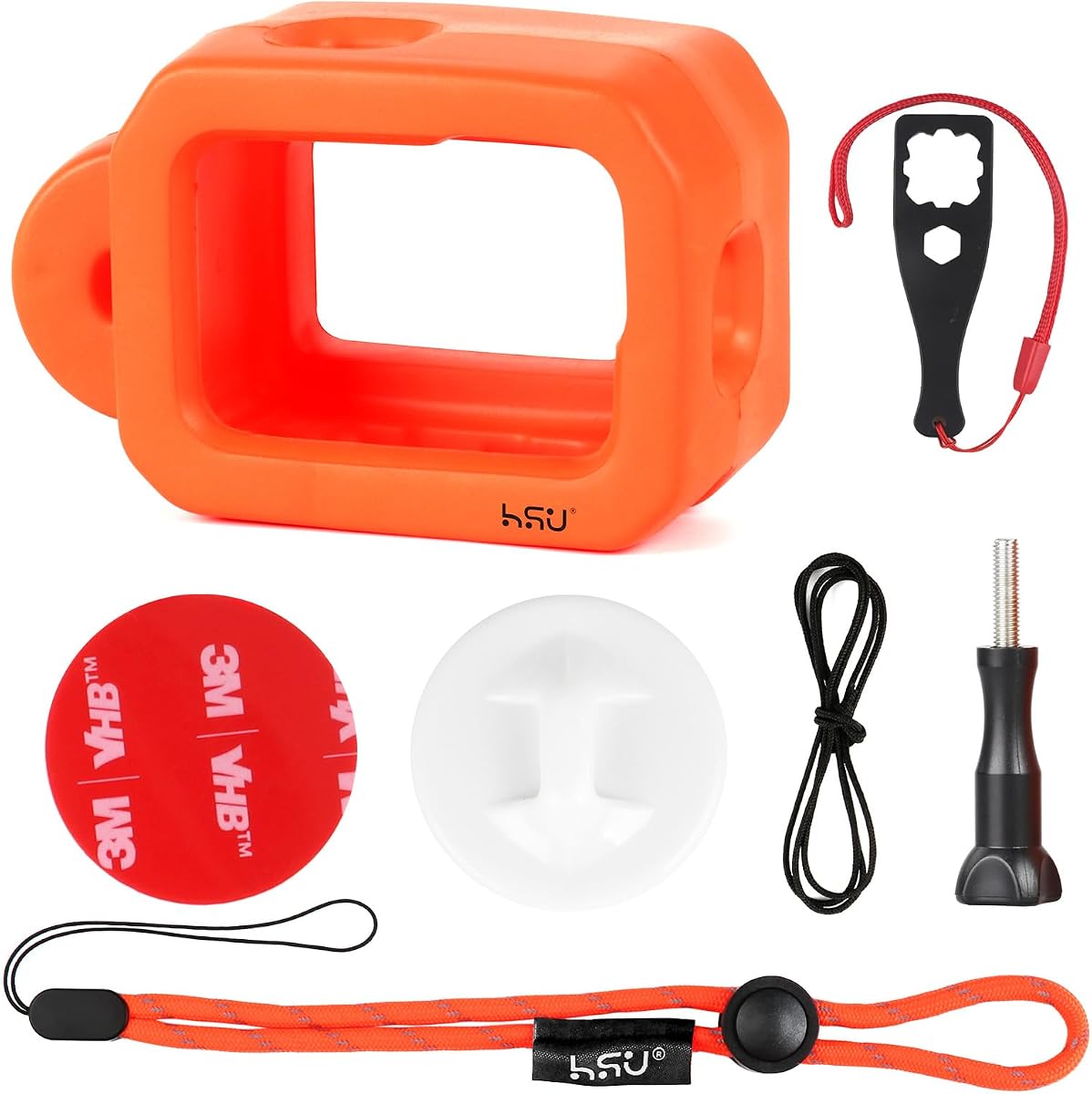


The HSU Floaty Case is a protective housing for GoPro Hero 13, 12, 11, 10, and 9 Black cameras. It carries a 4.5 rating and centers on two essential surf priorities: keeping the camera afloat and making it easier to find after a fall. Its high-visibility orange construction also helps distinguish the camera from the surrounding water.
We may earn a commission when you buy through this link, at no additional cost to you.
The wraparound design protects the camera in all directions while leaving the buttons and touchscreen accessible. That balance matters because surfers often need to start or stop recording without fully removing the camera from its mount. The package also includes a long screw, adhesive anchor, 3M adhesive, tether, wrench, and wrist strap, giving the user several ways to support and secure the setup.
The main limitation is model compatibility. This case is specifically listed for Hero 9 Black through Hero 13, so it is not a universal solution for older cameras or other action-camera brands. It also adds bulk around the camera and may feel less convenient than a simple grip when the camera is already attached to a board or body mount.
This is a strong choice for surfers who prioritize recovery and physical protection over compact handling. It is especially attractive for newer GoPro owners who want a straightforward float case, visible color, control access, and included tethering hardware. Those willing to verify their exact camera model should find it more reassuring than an unidentified universal float sleeve.
The orange case is designed to remain easy to spot while floating. That visibility is especially useful in larger surf, changing light, or crowded water, where a dark camera would be difficult to locate. The surrounding float material provides a recognizable surface around the camera without relying on the camera's own status light.
The wraparound shape provides directional protection while allowing access to the buttons and touchscreen. Surf footage often depends on quickly checking framing or beginning a recording, and the case avoids the inconvenience of removing a fully sealed protective shell every time a control needs to be pressed.
We may earn a commission when you buy through this link, at no additional cost to you.
The Floating Hand Grip is a waterproof monopod that combines camera flotation, one-handed control, and a small storage compartment. Its 4.6 rating reflects a versatile design suited to surfing, swimming, snorkeling, diving, and other water sports. The seven-inch shaft gives the camera additional reach, which can help frame a surfer, board, wave, or nearby paddler.
We may earn a commission when you buy through this link, at no additional cost to you.
The textured EVA grip is intended to remain secure in wet conditions, while the bright lower cup improves visibility if the camera goes into the water. The mount tilts through 180 degrees for different shooting angles, and the hollow chamber can hold small valuables. During underwater use, filling the chamber with water can make the grip hover neutrally rather than rise immediately to the surface.
The included wrist strap and carabiner improve security, but this remains a hand-based system rather than a board mount or mouth mount. The long handle can make ultra-close framing awkward, and the camera must be held rather than left on a board. Compatibility extends across many GoPro generations and some other action cameras, though users should confirm the physical fit of their specific model.
This grip is a compelling all-around choice for surfers who alternate between paddling, filming from a held position, and taking the camera into the water. It suits anyone who wants more camera reach, a stable wet grip, and a visible flotation system in one accessory. Divers and snorkelers may also appreciate the chamber's dual role as dry storage or a buoyancy-adjustment feature.
The nonslip EVA surface is intended to preserve control when the surfer's hands are wet or the grip has been rinsed with seawater. Its compact, lightweight form also makes it easier to keep in a board bag or carry between sessions, while the additional length gives the camera more distance from the user's body.
The watertight compartment can hold small items while keeping them dry, but it also changes how the grip behaves underwater. An empty chamber floats the camera on the surface, whereas a water-filled chamber can create neutral buoyancy. That gives the accessory more flexibility than a basic floating stick.
We may earn a commission when you buy through this link, at no additional cost to you.
The HSU Surf Mounts and Accessories kit is a dedicated board-mounting solution for GoPro cameras. It earns a 4.4 rating and includes surfboard adhesive mounts, adhesive anchors, a quick-release buckle, a rubber locking plug, and camera tethers. The result is a focused package for securing a camera to a surfboard without buying each component separately.
We may earn a commission when you buy through this link, at no additional cost to you.
Its versatility is one of the strongest parts of the kit. The same hardware can be used for snorkeling, scuba diving, wakeboarding, kayaking, paddle-surfing boards, and boat decks. Tethers and adhesive anchors add protection in demanding conditions, while the quick-release buckle allows the camera to be removed after the session without immediately disturbing the base attachment.
Installation is the main responsibility. The board should be clean and dry before the base plate is attached, and the adhesive requires proper placement for a dependable bond. A fixed board position also cannot be repositioned as easily as a camera on a hand grip, and repeated use of adhesive systems can leave residue or require careful surface maintenance.
This is the most budget-conscious pick for a surfer who wants a complete, surf-focused mounting kit rather than one isolated accessory. It is especially practical for beginners building a first setup or riders who also paddle, dive, or travel with other boards. Buyers should confirm that their board surface and camera model suit the included mounting hardware before use.
The kit combines the base attachment, quick-release buckle, locking plug, and tether instead of offering only a single adhesive mount. That grouping makes it easier to create a secure surfboard setup and gives the user more than one way to reinforce the camera during active water conditions.
Although designed around surfing, the components suit several board-based activities. Kayak and paddle-board riders can use the same general mounting approach, while the tethers help maintain a physical connection when the camera is being used in a more active environment.
We may earn a commission when you buy through this link, at no additional cost to you.
The 18-in-1 Surfing Action Camera Accessories kit is the broadest option in this guide, with a 4.5 rating. Its collection includes a chest strap, wrist straps, a remote-control wrist strap, a buoyancy handle, long screws, a J-hook base, and an anti-fog lens. That range allows a surfer to change how the camera is carried and positioned during a session.
We may earn a commission when you buy through this link, at no additional cost to you.
Compatibility is a major strength. The listed camera support includes GoPro Hero 5 through Hero 12, DJI Osmo Action 3, 4, and 5 Pro, AKASO EK7000, Insta360 X2 and X3, and several other action-camera brands. The adjustable chest strap supports first-person footage, while the wrist options are more suitable for surfing and cycling.
A large kit is not automatically the right choice for every rider. Some included pieces may never be used, and the breadth of camera compatibility can make it harder to know whether a particular connector fits without checking both the camera and accessory. The buoyancy handle and anti-fog lens are especially relevant around water, but their value depends on the user's preferred shooting style.
This kit makes the most sense for a new action-camera owner who wants a broad collection of mounting and safety options in one place. It is also useful for riders who switch between chest, wrist, handheld, and board perspectives. Experienced surfers with a carefully built setup may prefer specialized individual accessories, while this bundle is aimed at convenience and flexibility.
The chest strap can produce a hands-free, first-person view, while the wrist straps offer a lighter alternative for moving with the camera. A buoyancy handle provides a floating option, and the J-hook base and screws expand the range of attachment methods. This variety helps users adapt to paddling, wave riding, filming others, and filming themselves.
The included buoyancy handle and anti-fog lens address common problems when an action camera moves from air into water or from a cool environment into a warm one. They are particularly useful for surf sessions that include snorkeling, diving, or repeated transitions between the board and the ocean.
We may earn a commission when you buy through this link, at no additional cost to you.
This Mouth Mount provides a genuinely hands-free way to hold a GoPro, and the supplied information identifies it as a design used by GoPro athletes Kelly Slater and Anthony Walsh. It carries a 4.5 rating and includes a breathable scuba-style mouthpiece, bite supports, a large breathing channel, and a neck lanyard designed to keep the camera close.
We may earn a commission when you buy through this link, at no additional cost to you.
The bite supports are important because they help reduce the movement associated with a loose mount. A dropdown design is also included to improve comfort over longer sessions, while the large airflow channel makes breathing more practical during active movement. The hands-free format can be valuable when paddling, duck diving, or performing maneuvers that make it difficult to hold a grip or manage a board mount.
Comfort remains subjective, and a mouth mount cannot be judged entirely from specifications. Some riders may prefer the freedom of a board or hand setup. The camera and floaty back are sold separately, so the package does not provide complete flotation protection, and the lanyard should not be treated as a substitute for careful equipment handling.
This pick is best for a surfer who wants an immersive first-person perspective and values stable hands-free positioning over easy repositioning. It also makes sense for watersports involving repeated paddling or duck-diving where both hands are needed. Potential buyers should consider fit and breathing comfort before committing to this style of mount.
The accessory is not simply a mouthpiece placed in front of the camera. Its bite supports give the user's teeth a defined position, which helps limit unwanted movement and supports steadier footage. The 180-degree patent cited in the product information also distinguishes it from a basic improvised mount.
A breathable mouthpiece, a larger airflow channel, and a dropdown section are intended to make the mount more practical during sustained activity. The included neck lanyard adds a physical connection between the user and camera, which is useful when the user is moving vigorously or changing position in the water.
We may earn a commission when you buy through this link, at no additional cost to you.
The second Mouth Mount in this guide shares the core benefits of a hands-free GoPro setup, including a breathable mouthpiece, stabilizing bite supports, and a neck lanyard. Its 4.5 rating and listed use by athletes Kelly Slater and Anthony Walsh make it especially relevant to surfers seeking an immersive point of view.
We may earn a commission when you buy through this link, at no additional cost to you.
This version is distinguished in the supplied information by an improved and strengthened 2015 lanyard. The lanyard helps keep the camera close to the user, while the bite supports help the mount remain in a consistent position. These features make it easier to concentrate on paddling and wave riding without continually holding the camera by hand.
The product remains less flexible than a hand grip for changing angles, and individual comfort can vary considerably. The GoPro camera and floaty back are not included, so users need to account for the appropriate housing or float separately. A neck lanyard adds security, but it does not change the need to use the mouth mount correctly and check its fit before entering the water.
This mount is a strong alternative for surfers who want a close, first-person recording angle and want both hands available. It is particularly useful for paddling, duck-diving, and action sequences where keeping the camera in front of the user's face is more important than rapid repositioning. The strengthened lanyard is the clearest distinguishing feature in the provided description.
Because the mount is held in the mouth, the camera remains relatively close to the user's point of view. Bite supports help establish a repeatable position, which is valuable when the body is moving and both hands are occupied. This produces a more involved visual style than a distant board mount.
The strengthened neck lanyard provides a physical link between the wearer and camera. It is a simple safety feature, but an important one in a wet environment where unexpected movement can dislodge a mouth-held accessory. The lanyard complements rather than replaces the mouthpiece's stabilizing bite supports.
We may earn a commission when you buy through this link, at no additional cost to you.
The Surfing FCS Plug Kit is a compact surfboard adapter intended for GoPro Hero 7, 6, 5, and 4 cameras. It has a 4.2 rating and uses an FCS plug format, making it a more specialized alternative to a standard adhesive board mount. The simple plastic design focuses on placing the camera in a familiar surfboard position.
We may earn a commission when you buy through this link, at no additional cost to you.
For riders whose boards already have an FCS-style plug, the adapter can provide a neat mounting solution without placing a large adhesive base over the board's surface. That can leave the deck less cluttered and preserve the board's overall appearance. It is particularly relevant to surfers who want the camera positioned close to the board rather than carried on a stick or grip.
The supplied information is concise and does not detail the complete installation process, included fasteners, tether, or adjustment range. Compatibility is also narrower than several competing options, as the title specifically lists Hero 4 through Hero 7. A surfer with a newer camera would need to confirm that a compatible GoPro adapter and separate attachment are available.
This product is best for a surfer with a compatible older GoPro and a board equipped for an FCS-style plug. It fills a specific niche that broad kits do not address as directly. Buyers who value a clean board setup and already know their camera and board hardware will likely find it more useful than those seeking a universally compatible accessory bundle.
The FCS plug approach places the camera in a designated board location without requiring a large adhesive mounting plate. That can be appealing for riders who prefer minimal deck hardware and already understand the FCS plug system used across surfboard accessories.
The listed support for Hero 4, 5, 6, and 7 cameras makes this a targeted option rather than a universal choice. Owners of newer Hero models should check the camera's physical connector and board setup before purchasing, because the product title provides a narrower compatibility range than the other guides in this list.
We may earn a commission when you buy through this link, at no additional cost to you.
The GoPro The Handler Floating Hand Grip is an official GoPro accessory with a 4.7 rating. It keeps a camera afloat, provides a comfortable nonslip grip, and uses a quick-release base for changing between mounts. Its bright orange cap is easy to spot if the camera enters the water, while the hand-held design helps users aim more deliberately than they can with a fixed board mount.
We may earn a commission when you buy through this link, at no additional cost to you.
Stability is the main advantage. Holding the grip gives the user a larger physical relationship with the camera, making it easier to follow a surfer, pan across a wave, or reposition after a ride. The quick-release base also makes the system more adaptable than a fixed grip, allowing the camera to move into other compatible GoPro mounting configurations.
The most important buying consideration is directly stated in the product title: this is an open-box listing. Buyers should review the seller's condition details carefully, including whether the accessory is complete and what protective or functional guarantees accompany the condition. A floating grip also does not secure a camera on a board while the surfer's hands are occupied.
This pick is well suited to a surfer who wants a recognizable official accessory, strong visibility, and a stable method of carrying the camera through a session. It works particularly well for filming from the water, paddling near other surfers, and switching between hand-held and mounted shots. Buyers comfortable with an open-box condition can gain a well-regarded official system with a strong rating.
The Handler is designed to make hand-held filming more stable. A full-length grip gives the user leverage and a secure point of contact, which can make it easier to hold the camera level while the body reacts to waves. It is especially practical for footage that follows a moving subject.
The quick-release base lets the user move the camera between the grip and other compatible mounts without repeatedly assembling a complicated connection. This versatility is useful for surfers who alternate between a hand-held view, a board view, and a body-mounted perspective during the same outing.
We may earn a commission when you buy through this link, at no additional cost to you.
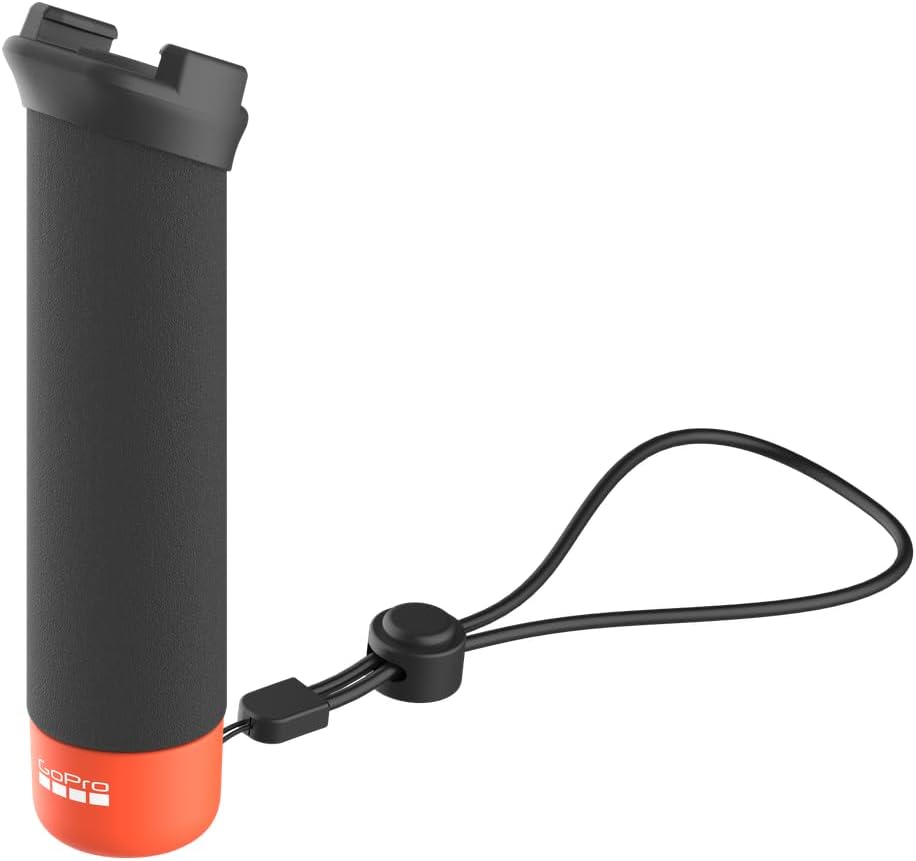
The GoPro The Handler combines a floating hand grip with an official quick-release mounting base. It carries the highest rating in the guide at 4.9, and the supplied information describes it as suitable for surfing, kayaking, wakeboarding, and other water sports. Its combination of flotation, visibility, and stable handling makes it the most complete general-purpose pick here.
We may earn a commission when you buy through this link, at no additional cost to you.
The grip keeps the camera afloat, while the bright color makes a dropped camera easier to locate. Nonslip construction supports a secure hold, and the quick-release base allows the camera to move to other compatible mounts. A wrist strap lanyard is included for an additional physical connection, reducing the chance that a sudden movement separates the camera and grip.
The system still requires the surfer to hold the camera when it is not attached elsewhere. It is therefore less convenient than a hands-free mouth or body mount for duck-diving or situations requiring both hands. Compatibility with the user's preferred GoPro connection and mounting arrangement should also be confirmed before the accessory is put into service.
This is the strongest general recommendation for a surfer who wants one accessory to cover flotation, recovery, stable aiming, and mount flexibility. It is particularly useful when filming from the water or following another surfer because the extended grip can place the camera farther from the user's body. The included wrist strap and official mounting design add practical value to an already versatile tool.
Keeping the camera afloat and making it easy to locate are complementary benefits. A float device protects against sinking, while a bright, visible handle helps a surfer find the camera after a fall. Together they address two separate parts of the recovery problem in the water.
The secure grip provides better control than holding a bare camera, and the quick-release base preserves compatibility with other mounting arrangements. A surfer can use the handle for a tracking shot, then reposition the camera without needing a separate tool-based release. The included wrist strap adds further support during active movement.
We may earn a commission when you buy through this link, at no additional cost to you.
The GoPro Floaty Backdoor is designed to add flotation directly to the back of a compatible housing. It has a 4.6 rating and is marketed for snorkeling, surfing, wakeboarding, and other deep-water activity. The easy-to-spot flotation gives the camera a better chance of remaining visible at the surface if it separates from its main mount.
We may earn a commission when you buy through this link, at no additional cost to you.
The package includes two adhesive anchors and camera tethers for added security in extreme conditions. It also includes spare backdoors for the Standard Housing and Dive Housing, which adds practical replacement value. This combination makes it more than a simple foam insert: it combines flotation, visible recovery, and several secondary safety components.
The accessory attaches to a housing backdoor rather than serving as a grip, board mount, or body harness. That means users must confirm that their camera and housing are compatible with the floaty backdoor system. It is also less useful when the camera remains firmly attached to a board, although it can provide backup flotation for setups that separate more easily.
This is a strong option for surfers who want their camera to float and remain recognizable in the water, particularly when using a housing. The included spare backdoors make it appealing for owners who already have a related GoPro housing setup. Buyers should verify camera and housing compatibility, then use the tethers and anchors to reinforce the main mounting arrangement.
Unlike a floaty case that surrounds the camera, this product attaches directly to the housing's backdoor. For users who shoot in a waterproof housing, that direct approach adds flotation without requiring an entirely separate exterior shell around the camera and its connected accessories.
The easy-to-spot design improves the chance of locating the camera after it falls into the water. Spare backdoors for Standard Housing and Dive Housing add convenience, while the included adhesive anchors and tethers provide additional ways to secure the camera when the conditions are demanding.
We may earn a commission when you buy through this link, at no additional cost to you.
The right surf camera accessory depends on where the camera spends its time, how the surfer moves, and what happens when the board or body separates from it. Buyers should balance flotation, mounting security, camera access, comfort, and compatibility rather than choosing an accessory solely by the number of features advertised.
Compatibility is the first filter because action-camera mounting systems and physical dimensions can vary between models and brands. The products in this guide cover different ranges: some explicitly support recent GoPro Hero 9 through 13 cameras, while the FCS plug adapter is listed for Hero 4 through 7. The floating hand grip and the 18-in-1 kit advertise wider support across GoPro and several competing action-camera brands. Always check the exact camera model, connector style, housing, and any required adapter rather than relying on a general statement that a product works with action cameras.
Flotation is valuable whenever a camera can enter deep water, and visibility determines how quickly it can be recovered. A floaty case, floating hand grip, The Handler, and the Floaty Backdoor all provide a way to keep the camera at or near the surface. Their high-visibility colors make a submerged or wave-obscured camera easier to identify. Consider whether the flotation mechanism is built into a grip, a protective case, or the housing, because that determines how the accessory can be combined with other mounts.
Different mounting positions produce radically different footage. A board mount places the camera near the surfer's feet and offers a close view of turns and board movement. A floating grip extends the camera away from the body and works well for following a subject. Mouth and chest mounts create first-person perspectives, while the FCS plug adapter keeps the camera in a conventional board location. Choose according to the angle you want and the amount of repositioning you expect to do rather than selecting the most elaborate mounting option available.
Waves, falls, wipeouts, and duck-dives can put considerable force on a camera connection. Tethers, wrist straps, and neck lanyards provide a secondary physical connection when the primary mount opens or shifts. The HSU Floaty Case, Surf Mounts Kit, and Floaty Backdoor include tether-related hardware, while The Handler includes a wrist strap and the mouth mounts include neck lanyards. These secondary safeguards are especially important when filming aggressively or using a board position that may be difficult to recover from after a fall.
A camera that is secure but difficult to operate is not always a good surf accessory. The HSU Floaty Case uses a wraparound design that leaves the camera buttons and touchscreen accessible while protecting it in all directions. Other systems prioritize stability and may require the camera to be stopped or removed before a control can be pressed. Think about whether recordings are started before entering the water, whether settings need to be changed between rides, and whether direct control is important to your filming style.
Comfort becomes especially important when a mount remains in place for a full session. Hand grips benefit from nonslip surfaces, mouth mounts require a secure and comfortable fit, and chest or wrist straps need to remain comfortable over wet clothing. A floaty case adds bulk around the camera, while a long hand grip changes leverage. None of these features is automatically superior, so the best choice is the one a surfer can use consistently without distracting from balance, breathing, or paddling.
A large kit can provide convenience by placing mounts, straps, tethers, and flotation tools in one package. The 18-in-1 set is the clearest example, offering 18 components for changing shooting styles. A specialized product, such as the HSU Surf Mounts Kit or FCS plug adapter, may instead solve one mounting problem more directly. Compare how many accessories you will realistically use with the importance of dependable individual parts. A focused setup can be easier to organize, while a broad kit can be valuable for experimenting.
Floaty devices are not the same as waterproof protection. A camera that floats can still be vulnerable to impact, salt, sand, and water entering its housing or ports. Each accessory should be rinsed with fresh water after use, and cameras should be handled according to their own water-resistance guidance. Adhesive mounts need clean, dry board surfaces, while tethers and lanyards should be checked for stretching or wear. A floating accessory can improve recovery, but it does not remove the need for sound housing care and responsible equipment handling.
Begin by fitting the accessory to the correct camera and housing, then confirm that every screw, buckle, clip, strap, or adhesive connection is secure before entering the water. For board mounts, clean and dry the surface thoroughly and follow the installation instructions. For hand and mouth mounts, check the camera's movement, the grip's position, and the attached strap before paddling into stronger conditions.
Use the mounting method that matches the shot rather than forcing one setup to handle every perspective. Test the angle on land, confirm that important controls are accessible, and check that the camera does not interfere with paddling, balance, or breathing. When using flotation, tethers, or anchors, make sure they are correctly positioned and cannot tighten awkwardly during movement.
After the session, rinse mounts, grips, adapters, and tethers with fresh water and remove sand before drying every component. Inspect adhesive bases for looseness, check straps for wear, and examine screws and buckles for salt or movement. Allow parts to dry fully before storage, and replace weakened tethers or loose mounting hardware before the next ocean trip.
The most useful accessory depends on the filming style. A floating hand grip is ideal for stable hand-held shots and camera recovery, while a surfboard mount is better for hands-free footage of turns and board movement. Mouth and chest mounts provide first-person perspectives, and a floaty case or backdoor adds protection and visibility when the camera enters the water.
A surf accessory being waterproof does not automatically make the entire camera setup waterproof. Floaty cases, grips, and backdoors can provide flotation or water resistance, but the camera housing and its ports must be correctly closed and rated for the intended activity. Always follow the camera and housing instructions, inspect seals, and rinse equipment with fresh water after exposure to salt water.
Use a board mount when you want stable, hands-free footage and can position the camera securely on the deck. Choose a floating hand grip when you want to frame a surfer, extend the camera away from your body, or quickly change between hand-held and mounted shots. A tether can add security to either approach in rough conditions.
Start with a high-visibility floating accessory, such as a bright floaty case, floating grip, or The Handler, and connect the camera to a mount that can withstand active movement. Add a tether, wrist strap, or secondary anchor when appropriate. Bright colors help with recovery, but they do not replace careful installation and a physical backup connection.
Many options in this guide also suit swimming, snorkeling, diving, kayaking, wakeboarding, skiing, or cycling. The 18-in-1 kit is particularly broad because it includes buoyancy, anti-fog, chest, wrist, and mounting components. For specialized activities, check that the selected accessory is rated and physically appropriate for the conditions before taking it into the water.
Clean and dry the board before applying any adhesive base, then place it where the camera will not interfere with paddling, stance, or other board hardware. Secure the camera with the appropriate buckle, plug, or screw and add a tether when appropriate. If the adhesive is lifted, the base is loose, or the board surface is wet, reinstall the mount before filming.
Comfort depends on the fit and the rider's preferences. Mouth mounts with bite supports, a breathable mouthpiece, an airflow channel, and a neck lanyard are designed to improve stability and usability, but they still place the camera in a sensitive position. A surfer who cannot speak, breathe, or paddle comfortably with the mount should choose a hand, chest, or board setup instead.
Confirm that the accessory supports your exact camera model and whether a housing or additional adapter is required. Also consider flotation, visibility, tether options, mounting position, control access, and comfort. Read the listing for included parts and any condition details, especially for open-box products, then verify the latest information before ordering.
The strongest overall choice is the GoPro The Handler because it combines flotation, high visibility, a nonslip grip, a quick-release base, and an included wrist strap. The HSU Surf Mounts Kit is the most budget-focused board option, while the open-box GoPro Handler provides an official floating grip system for buyers comfortable with that condition. Dedicated float cases, broad accessory kits, mouth mounts, and the FCS plug adapter cover more specialized needs.
Prioritize the way you actually film. Board riders should focus on secure attachment and clean positioning, while handheld and first-person shooters should compare grip stability, control access, comfort, and tethering. Whichever option you choose, confirm camera compatibility, use a secondary connection in active conditions, and treat flotation as a recovery aid rather than a substitute for careful mounting and housing care.
Product details, availability, and prices can change, so check the current listing before purchasing. Confirm the included components, model compatibility, seller condition, and any required adapters. Reading current customer feedback alongside the specifications can also help identify practical concerns that may not be obvious from the product title alone.
