
KK 2.1.5 Flight Control Board
5.0Editor score
Dedicated VTOL and V-tail support
Self-leveling and acrobatic modes
Designed for hobbyist experimentation
Flight controllers for hybrid VTOL and VTOL drones compared by firmware support, ports, mounting options, and build flexibility for builders.
Flight controllers for hybrid VTOL and VTOL drones must manage the transition between vertical flight and efficient forward travel without compromising stability. A capable controller coordinates sensors, motors, servos, receivers, navigation equipment, and optional payloads. The right choice depends heavily on airframe design, firmware familiarity, required outputs, and the builder’s comfort with advanced configuration.
This guide compares ten flight controllers using the supplied specifications, focusing on VTOL relevance, supported firmware, sensor integration, receiver and GPS connectivity, PWM outputs, dimensions, and expansion options. It includes dedicated VTOL boards, multi-purpose Pixhawk-family controllers, fixed-wing-capable F405 systems, and compact flight controller and ESC stacks commonly considered for custom aircraft.
The selections show how simpler hobby-oriented controllers differ from research-grade autopilot platforms and all-in-one stacks for custom builds. Ratings are included when available, while unrated products are identified accordingly. Product availability and prices can change, so readers should verify current listings, package contents, firmware requirements, and hardware compatibility before purchasing.
5.0Editor score

4.8Editor score
The comparison covers dedicated VTOL controllers, open-source autopilot platforms, fixed-wing-oriented boards, and integrated flight controller and ESC stacks. Key distinctions include firmware ecosystem, sensor redundancy, available serial and control connections, power configuration, mounting pattern, and the degree of support for autonomous or custom aircraft development.



The KK 2.1.5 stands apart from the other entries because it is explicitly positioned for VTOL and V-tail aircraft rather than being a general multirotor board adapted for hybrid use. Its supplied listing describes a controller intended for model aircraft competitions, aerial photography, flight-skill demonstrations, and customizable hobby projects. It carries a 5.0 rating, making it the only product in this roundup with a perfect published score, although ratings alone do not establish compatibility with every modern VTOL airframe.
We may earn a commission when you buy through this link, at no additional cost to you.
Its primary strengths are closely tied to the advertised use case. The board is described as supporting vertical takeoff and landing, V-tail aircraft, self-leveling, and acrobatic flight. That combination can make it appealing to builders who want a controller dedicated to the flying characteristics of VTOL models rather than assembling their requirements around a general-purpose autopilot. It also appears intended for experimentation with flight-control behavior and challenging maneuvers, which may benefit builders learning how control behavior changes between flight modes.
The tradeoff is that the supplied information does not describe a broad sensor suite, named autopilot platform, detailed connector layout, or extensive expansion options. Those omissions matter for advanced autonomous projects, GPS-denied precision flight, redundant telemetry, or custom payload communications. The KK 2.1.5 is therefore most compelling when VTOL-specific orientation and manageable feature complexity are priorities rather than a large documented I/O ecosystem.
This is a sensible choice for hobbyists working on VTOL or V-tail aircraft who want a controller marketed directly for those applications and value self-leveling and aerobatic capability. Before ordering, confirm the receiver, motor, servo, battery, and signal-routing requirements for the planned airframe. It is our top budget-oriented recommendation for dedicated VTOL experimentation, while builders needing research-grade integration should examine the more fully specified Pixhawk alternatives.
The board’s strongest advantage is its direct VTOL and V-tail positioning. Builders can choose it without adapting a controller whose primary identity is FPV racing, fixed-wing cruising, or general autonomous development.
Self-leveling and acrobatic modes support both stable maneuvering and more expressive flying. That mix is useful for pilots who want to explore control response while retaining a manageable degree of automation.
We may earn a commission when you buy through this link, at no additional cost to you.
The COREWING F405 V2 is a compact-looking option for builders pairing a controller with an RC airplane or drone project. Its supplied listing identifies it as a flight controller for those two broad categories, which makes it relevant to fixed-wing and VTOL experimentation even though the description does not explicitly enumerate VTOL-specific features. No customer rating is provided, so its shortlist position should be understood as a result of the available product fit rather than an established performance history.
We may earn a commission when you buy through this link, at no additional cost to you.
The F405 platform is the central technical detail in the listing. A controller based on this processor family can suit custom aircraft projects, provided the required serial protocols, receiver interfaces, motor or servo outputs, and firmware configuration are verified. For a hybrid VTOL craft, the important issue is whether the board can operate the necessary flight surfaces, control the transition sequence, and communicate with the selected receiver and navigation hardware in the intended configuration.
The main limitation is the extremely limited supplied specification. There are no stated dimensions, mounting measurements, sensor descriptions, output counts, supported firmware platforms, or included accessories. Those omissions make direct comparison with the well-documented PIX 2-12S, Pixhawk 2.4.8, and Pixhawk 6C difficult. A prospective buyer should seek the full board layout, pinout, firmware instructions, and connector details before committing to a build.
The COREWING F405 V2 is best considered by builders who already understand the controller ecosystem and can validate its connections independently. It may be useful for a lightweight RC airplane-derived VTOL experiment, but it is not the clearest recommendation for a first autonomous hybrid aircraft. Its potential value lies in flexibility, while the lack of published detail places the verification burden on the purchaser.
Explicit RC airplane compatibility makes the board relevant to fixed-wing-derived projects. It may be especially useful when a builder is translating proven control-surface layouts into a VTOL configuration.
Because the supplied data does not list connectors or outputs, checking the pinout is essential. Receiver protocol, servo count, telemetry, and GPS connections all need to match the planned aircraft.
We may earn a commission when you buy through this link, at no additional cost to you.
The PIX 2-12S is one of the most clearly specified conventional flight controllers in the guide. It is designed around the STM32F405VGT6 processor and integrates an MPU6500 gyroscope, VCM5883L magnetometer, and LPS22HB barometer. That sensor combination gives a hybrid VTOL builder the core measurements normally needed for stable control, while the six-channel PWM output provides room for aircraft control surfaces or other configured peripherals.
We may earn a commission when you buy through this link, at no additional cost to you.
Connectivity is a major strength. The board uses a GH1.25 connector for GPS, SBUS, PPM, and CRSF receivers, and the listing specifically calls out Mavlink compatibility. Its power supply accepts two through twelve cells, a notably broad range for custom aircraft. This makes the board attractive when the build may move from a small multirotor experiment to a larger fixed-wing VTOL platform with different voltage requirements.
Mechanical integration is also unusually transparent. The board measures 39 by 39 by 12 millimeters and weighs approximately 15 grams, or about 86 grams with cables. Its mounting holes are spaced 30.5 by 30.5 millimeters, a common layout for multirotor and custom drone frames. The package includes the motherboard, ribbon cable, and basic wiring, but the ESC is excluded, so builders must account for propulsion hardware separately.
This is a strong recommendation for a builder who values protocol flexibility, documented dimensions, and broad battery compatibility. The absence of a published rating means buyers cannot use customer feedback to supplement the specifications, and the excluded ESC may complicate a first build. Still, the PIX 2-12S addresses VTOL multirotor use directly and offers one of the clearest integration packages in this roundup.
Support for SBUS, PPM, CRSF, and Mavlink gives builders several ways to connect control and communication equipment. That flexibility is valuable when retaining a receiver from another aircraft or working within a mixed avionics ecosystem.
The two-to-twelve-cell input range accommodates a broader set of custom airframes than a controller designed only for small multirotors. The selected battery system, ESC ratings, and wiring must still be designed as a matched set.
The ESC is not included. Builders should select propulsion hardware separately and ensure that its protocol, voltage handling, and current requirements align with the airframe and flight controller.
We may earn a commission when you buy through this link, at no additional cost to you.
The Pixhawk 2.4.8 PX4 is the most balanced general recommendation in this roundup. Its 4.8 rating reflects strong customer reception, while its open-source design and ability to serve as a master controller for fixed-wing, multirotor, helicopter, boat, and car platforms make it especially practical for a hybrid VTOL project. The combo package includes GPS, which removes one major standalone purchase from a basic autonomous aircraft build.
We may earn a commission when you buy through this link, at no additional cost to you.
The controller uses an advanced 32F427 ARM Cortex-M4 processor along with a 32-bit fail-safe co-processor and an MPU6000 three-axis accelerometer. That independent fail-safe element is meaningful for safety-focused aircraft. The board is also positioned for secondary development, giving hobbyists, researchers, and developers a platform on which they can build custom behaviors rather than treating the controller as a closed appliance.
Its trade-off is that it represents an older hardware generation compared with the H743-based boards and Pixhawk 6C. Although the Pixhawk platform remains relevant because of its established open-source character, builders should confirm the availability and compatibility of specific modules, firmware versions, and peripherals for their particular aircraft. The listing also mentions a quick-start guide and a three-month quality-assurance period for qualifying quality problems.
The Pixhawk 2.4.8 is our top general choice for builders who want an established open-source ecosystem, flexible vehicle support, and a GPS-equipped package. It is particularly suitable for hybrid VTOL experiments involving autonomous flight, sensor integration, and custom development. A first-time pilot should still follow the supplied assembly and calibration guidance carefully and verify that every connected module supports the selected PX4 configuration.
Independent open-source development gives builders the ability to inspect, adapt, and extend the controller. That makes the platform attractive for research, custom mission logic, and aircraft-specific behavior.
A dedicated 32-bit fail-safe co-processor strengthens the board’s safety architecture. It is especially relevant when an aircraft depends on predictable behavior during sensor, receiver, or control-system abnormalities.
The GPS combo and quick-start guidance make the package more approachable for a first build. Builders still need to match motors, ESCs, receiver, telemetry, and airframe dimensions to the controller.
We may earn a commission when you buy through this link, at no additional cost to you.
The F405 Wing Flight Controller is designed specifically around fixed-wing drones with VTOL capabilities, making its core positioning unusually direct. It supports ArduPilot firmware for customization and performance tuning, while a smartphone app allows users to configure and monitor flight parameters. For builders who want a wing-oriented controller without beginning with a fully generalized multirotor platform, that combination is appealing.
We may earn a commission when you buy through this link, at no additional cost to you.
The F405 processor is presented as the source of fast and stable operation, while the lightweight, compact enclosure is intended to minimize the mass added to an aircraft. The listing also states compatibility with various fixed-wing models, allowing the controller to serve different VTOL layouts. It is described as suitable for both beginners and experienced pilots because of its user-friendly setup and extensive features.
The missing information is significant. The supplied description does not provide a pinout, PWM or serial output count, physical dimensions, sensor inventory, mounting pattern, battery range, or connector types. Those details are essential when deciding whether the board can operate a specific set of VTOL motors, control servos, GPS, telemetry, and receiver hardware. No customer rating is available either, so the user-friendly characterization should be evaluated against current buyer feedback when possible.
This controller is a compelling candidate for a fixed-wing-centered hybrid VTOL project that uses ArduPilot and values app-assisted configuration. It may reduce the learning curve for builders who want mobile parameter access. However, it should be shortlisted only after the complete hardware interface has been checked, especially for projects requiring advanced payload control, redundant sensors, or extensive autonomous routing.
The board is explicitly tailored to fixed-wing drones with VTOL capability. This focus may align more naturally with long-wing airframes and transition-oriented control arrangements than a general racing-oriented stack.
ArduPilot support and smartphone monitoring combine a customizable firmware environment with accessible configuration. The approach can help builders adjust parameters without relying entirely on command-line workflows.
A compact, lightweight design helps limit the controller’s impact on payload capacity and flight characteristics. Exact weight and mounting information should still be confirmed before the layout is finalized.
We may earn a commission when you buy through this link, at no additional cost to you.
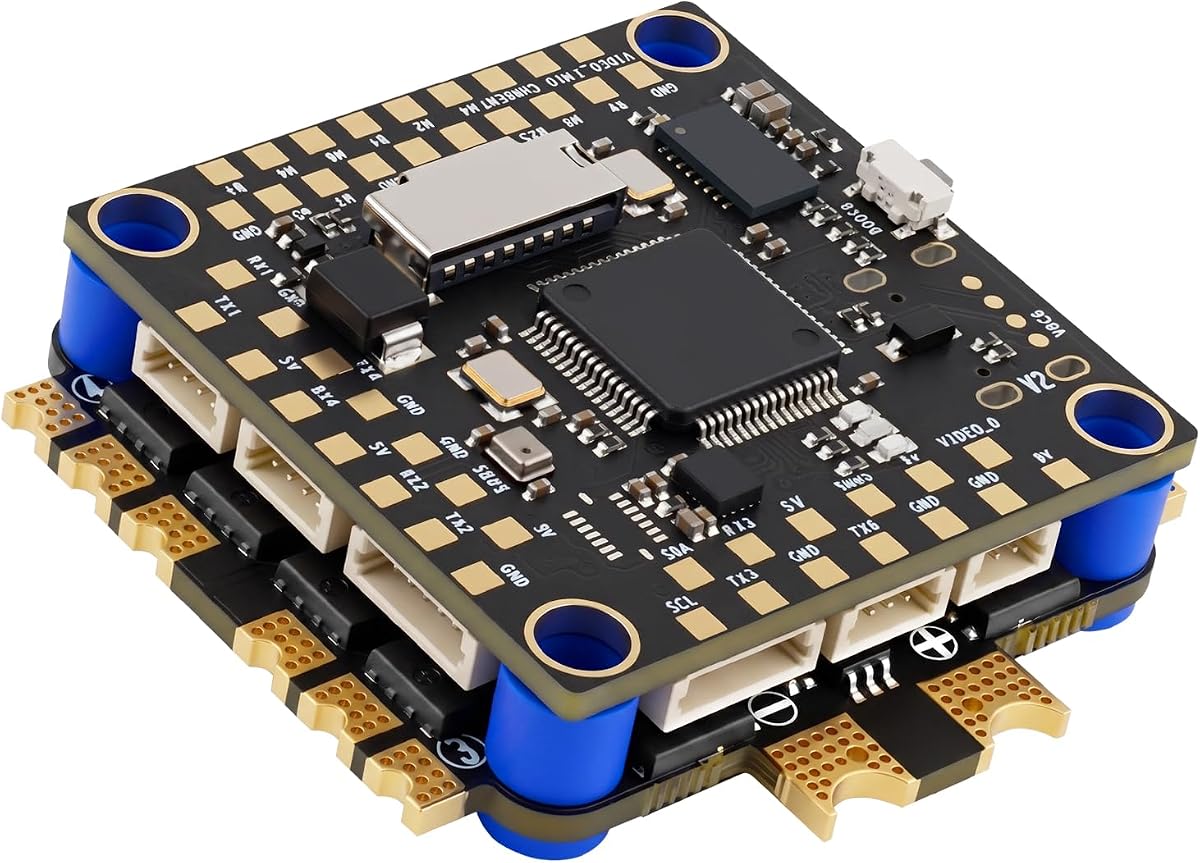
The CORVON H743 60A combines an STM32H743 flight controller with a 32-bit 60A four-in-one ESC in a compact 30 by 30 millimeter mounting arrangement. The H743 processor operates at 480MHz, and the controller uses dual BMI088 and BMI270 inertial sensors. The result is a high-processing, motor-control package that is more naturally associated with FPV or racing frames than a conventional servo-equipped VTOL aircraft.
We may earn a commission when you buy through this link, at no additional cost to you.
Its connection options are extensive. The flight controller offers seven UART ports, ten PWM outputs, CAN, I2C, and OSD support, giving custom builders room for GPS, telemetry, cameras, and other peripherals. It is compatible with Betaflight, INAV, PX4, and ArduPilot. Those firmware options mean the stack can serve different project goals, although pilots must correctly configure the airframe class and control outputs for a VTOL build.
The 32-bit ESC supports two-to-eight-cell lithium-polymer batteries, delivers 60 amps continuously per channel, and is described as capable of more than 80-amp bursts. That is strong motor-control performance for a compact multirotor. The limitation for hybrid VTOL use is the architecture: a wing with multiple control servos, a transition system, or separate forward and lift motors may require a different output arrangement and a more deliberate wiring plan than a standard racing stack provides.
The CORVON H743 60A is best for an experimental VTOL design derived from a multirotor frame, particularly when four ESC channels and ten PWM outputs are sufficient. It offers strong compute, broad firmware support, and expansion capacity in a compact package. Builders working from a larger fixed-wing airframe should verify propulsion and servo wiring before selecting it over a dedicated Pixhawk or wing-oriented board.
The 480MHz STM32H743 provides substantial processing capacity for sensor fusion, control loops, telemetry, and firmware features. It is a strong foundation for compact multirotor-derived experiments.
The included 60A 32-bit ESC provides high-frequency motor control for responsive performance. Its current capability is particularly relevant to compact FPV-style propulsion rather than heavy VTOL payloads.
Seven UART ports, ten PWM outputs, CAN, I2C, and OSD support create ample room for custom avionics. Each interface must still be mapped carefully to avoid conflicts with the selected firmware.
We may earn a commission when you buy through this link, at no additional cost to you.
The CORVON H743 50A offers the same STM32H743 flight-controller platform and dual-imu approach as the 60A version, but pairs it with an eight-bit 50A four-in-one ESC. It supports two-to-six-cell lithium-polymer batteries and a 30.5 by 30.5 millimeter mounting pattern. The complete stack is listed at 21.5 grams, making it a compact option for custom multirotor or racing-oriented builds.
We may earn a commission when you buy through this link, at no additional cost to you.
The flight controller runs the STM32H743 at 480MHz with 2MB of flash memory and uses BMI088 and BMI270 inertial sensors. It provides seven UART ports, ten PWM outputs, CAN, I2C, and OSD support. Betaflight, INAV, PX4, and ArduPilot are all listed as compatible, allowing the same physical platform to support recreational tuning, navigation, and experimental autonomous flight configurations.
Its ESC supports high-frequency PWM, DSHOT, and ONESHOT protocols with 50 amps of continuous current per channel. This is meaningful for responsive motor control, although the eight-bit processor in the ESC is a step below the 32-bit ESC option elsewhere in the guide. The two-to-six-cell range is also narrower, and the 50A rating is lower than the 60A alternative, so the correct stack depends on the propulsion load and battery architecture.
For a compact VTOL experiment based on a small multirotor frame, this stack provides more than enough stated processing and connectivity. The 50A ESC is best matched to lighter builds and moderate motor demands, while the six-cell ceiling makes battery selection more restrictive. The main benefit over a conventional fixed-wing controller is the combination of H743 processing, multiple firmware choices, and a propulsion package in one small unit.
The 480MHz processor and 2MB of flash provide ample capability for sensor fusion and firmware operation. It gives the stack a strong base even though the accompanying ESC uses older processing.
Support for high-frequency PWM, DSHOT, and ONESHOT allows the motor system to work with several modern control approaches. Firmware and ESC configuration must be matched for clean operation.
The two-to-six-cell range keeps the propulsion architecture straightforward for smaller builds. Its 21.5-gram combined weight and common mounting pattern simplify integration into compact frames.
We may earn a commission when you buy through this link, at no additional cost to you.
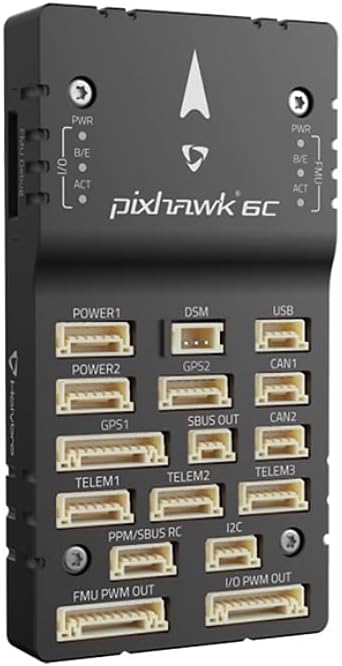
The Pixhawk 6C is the most advanced dedicated autopilot platform in the guide, combining a 480MHz STM32H743 Cortex-M7 processor with 2MB of flash and 1MB of RAM. It comes with PX4 Autopilot pre-installed and also supports ArduPilot when the appropriate firmware and GPS requirements are met. For a hybrid VTOL aircraft used in research, development, or demanding autonomous work, the processing power and platform design offer a strong foundation.
We may earn a commission when you buy through this link, at no additional cost to you.
Sensor redundancy is its standout feature. The board uses Bosch BMI055 and InvenSense ICM-42688-P inertial sensors, and onboard heating resistors help maintain operating temperature for consistent performance. Its integrated vibration-isolation system is designed to reduce high-frequency vibration and sensor noise. These details can improve control reliability on a multirotor-derived VTOL craft, where vibration and rapid attitude changes place meaningful demands on the inertial measurement system.
The controller also provides flexible output configuration. A hardware switch allows the PWM signal mode to move between 3.3 and 5 volts when the case is opened, allowing it to support a wider range of peripherals. The supplied configuration lists a low-profile 84.8 by 44 by 12.4 millimeter plastic case weighing 34.6 grams, with an aluminum alternative listed at 59.3 grams. That range makes the platform usable in compact research aircraft where added mass matters.
The primary caution is software compatibility rather than a weakness in the hardware. ArduPilot support requires version 4.3 or later for the specified M10 GPS, while the pre-installed PX4 configuration offers a convenient start. No published rating is available, so buyers should evaluate current owner feedback and documentation. Overall, the 6C is the premium choice for builders prioritizing redundant sensing, vibration control, modern processing, and an established research-oriented autopilot architecture.
Two different inertial sensor families provide a meaningful redundancy layer. A comparison system can use the second sensor when readings diverge, improving resilience against individual sensor problems.
Integrated heating and vibration isolation help maintain stable measurements. These features are especially useful on compact VTOL aircraft where propellers and airframe structure can transmit persistent vibration.
The H7 processor, PX4 installation, and broad hardware support suit academic and commercial development. The low-profile plastic enclosure helps control mass while retaining access to advanced flight-controller features.
We may earn a commission when you buy through this link, at no additional cost to you.
The AERO SELFIE F405NC differentiates itself through its O3 and O4 AIR interface compatibility, making it a compelling option for builders working with digital FPV video systems. The stack combines an STM32F405 flight controller running at 168MHz with dual BMI42688 inertial sensors, a DPS310 barometer, and a four-in-one ESC. It supports two-to-six-cell lithium-polymer batteries and carries a published 4.4 rating.
We may earn a commission when you buy through this link, at no additional cost to you.
The flight controller includes six UART ports, ten PWM outputs, I2C, and OSD support. Betaflight, INAV, and ArduPilot are listed as compatible, so it can be used for recreational FPV tuning, navigation, or experimental autonomous configurations. The 30.5 by 30.5 millimeter mounting pattern and stated combined weight of 23.2 grams make it straightforward to fit into standard compact multirotor layouts.
The included ESC description has an internal naming inconsistency: the product title calls it a 60A stack, while the supplied bullet points identify a 45A four-in-one 8-bit ESC and also refer to a 60A four-in-one ESC. Buyers should resolve that discrepancy with the seller and verify the exact continuous current rating before connecting motors. The 2S to 6S range and eight-bit ESC design also make the package more naturally suited to light multirotor platforms than payload-heavy VTOL aircraft.
The AERO SELFIE F405NC is worth considering when an existing project uses O3 or O4 AIR video hardware and needs a compact stack with dual inertial sensors. It is less compelling for a large fixed-wing hybrid unless the propulsion arrangement remains within the ESC’s intended scale. Its published rating provides a useful customer-confidence signal, but careful current and connector verification is essential.
The stated O3 and O4 AIR interface support is the stack’s clearest specialty. It can simplify integration for builders using compatible DJI digital FPV equipment.
Two BMI42688 sensors provide redundant inertial measurements and support stable control-loop operation. Correct vibration isolation and calibration remain essential for realizing their potential.
The supplied listing contains different current descriptions for the ESC. Confirming the actual rating and battery limits before assembly helps prevent an overpowered or undersized propulsion setup.
We may earn a commission when you buy through this link, at no additional cost to you.
The AERO SELFIE H743 combines modern flight-controller processing with a high-current 32-bit ESC in a standard 30 by 30 millimeter format. The STM32H743 processor runs at 480MHz, and the board uses dual BMI088 and BMI270 inertial sensors. It also includes compass and barometer support, while offering compatibility with Betaflight, INAV, PX4, and ArduPilot for a broad range of firmware workflows.
We may earn a commission when you buy through this link, at no additional cost to you.
Connectivity includes seven UART ports, ten PWM outputs, CAN, I2C, and OSD support. The ESC supports two-to-six-cell lithium-polymer batteries, provides 60 amps of continuous current per channel, and is described as delivering more than 80-amp bursts. The flight controller and ESC together weigh 23.2 grams, so the stack remains compact despite its substantial connection count and motor-control capability.
The published 3.7 rating is the lowest among products with a numerical score in the guide. That does not disqualify the hardware, but it makes customer feedback and careful configuration more important. A VTOL builder should pay particular attention to output assignment, transition behavior, and how the selected firmware handles a mixed propulsion system. The compact racing-oriented stack is best suited to a small multirotor-derived VTOL rather than a large wing requiring numerous control surfaces.
This is a capable option for a builder who wants H743 performance, modern 32-bit ESC control, and PX4 compatibility in a single package. It may also suit experimental autonomous or FPV projects where many serial devices need support. The lower rating and six-cell ESC ceiling warrant additional due diligence, but the stated hardware specifications position it as a flexible, compact foundation for appropriate custom airframes.
Pairing a 480MHz H743 processor with a 32-bit ESC creates a responsive foundation for compact custom aircraft. The combination is useful where processing demands exceed those of a conventional lightweight stack.
Support for Betaflight, INAV, PX4, and ArduPilot lets the builder choose between FPV tuning, navigation, and autonomous workflows. The controller must still be configured correctly for the VTOL airframe.
Seven UART ports and ten PWM outputs provide room for GPS, telemetry, cameras, and control peripherals. CAN and I2C add further scope for projects requiring custom sensor networks.
We may earn a commission when you buy through this link, at no additional cost to you.
Selecting a flight controller for a hybrid VTOL aircraft requires matching the controller to the airframe, propulsion system, firmware workflow, and required avionics. Start with the number and type of motors, control surfaces, sensors, and communication links, then confirm that the physical layout and electrical limits are compatible.
A hybrid VTOL aircraft may use separate lift motors and forward-flight motors, a tilting rotor mechanism, or another transition arrangement. The controller must provide enough motor and servo outputs for that exact layout, including any control surfaces needed during hover, transition, cruise, and landing. A compact four-channel ESC stack can be appropriate for a small quad-style design, while a conventional wing with ailerons, elevator, rudder, and transition control usually demands more flexible output assignments. Verify output count and firmware mixing before buying.
In short, choose outputs that match your airframe rather than the VTOL label alone.
Firmware choice shapes how a controller handles navigation, failsafes, mission logic, tuning, and custom behavior. PX4 and ArduPilot are prominent choices for autonomous aircraft, while Betaflight and INAV are common in compact FPV-oriented systems. Builders should select a platform they understand or are prepared to learn deeply. The availability of tutorials, parameter references, community support, and compatible ground-control software can be as important as the processor specification.
Prioritize the firmware ecosystem you can configure confidently and support reliably.
Stable flight depends on accurate inertial measurements, pressure sensing, and often magnetic heading data. A VTOL aircraft changes attitude and acceleration during transition, making sensor quality and vibration control particularly important. Redundant inertial sensors can help detect inconsistent readings, while temperature control and vibration isolation can improve measurement consistency. GPS, barometer, and compass support should also be considered if the aircraft requires navigation, position hold, mission execution, or autonomous recovery behavior.
Give priority to reliable sensing, appropriate redundancy, and vibration isolation.
The controller must communicate with the selected receiver using a supported protocol and connector arrangement. Options in this guide include SBUS, PPM, CRSF, and Mavlink-related connectivity. GPS, telemetry, radio, companion computers, cameras, and OSD equipment can each occupy serial or bus resources, so count the required ports before choosing a board. Connector type also matters because a controller with the correct protocol but an inconvenient or unavailable connector may require adapters or additional wiring.
Map every receiver, GPS, telemetry, and payload connection before ordering.
The flight controller, ESC, battery, and motors must operate within a consistent electrical system. Check the permitted battery-cell range, continuous and burst current, signal protocols, and whether an ESC is included. A 32-bit ESC may offer more precise motor control than an 8-bit model, while a higher current rating supports greater propulsion demand but should be matched to the motors rather than treated as a reason to install oversized hardware. VTOL craft also need careful consideration of total current demand during simultaneous lift and forward operation.
Match battery, ESC, motors, and controller as one power system.
The controller must fit the airframe’s central stack, electronics tray, or custom mounting point. The PIX 2-12S and the 30-by-30-millimeter stacks use a 30.5-by-30.5-millimeter mounting pattern, which is convenient for many multirotor frames, while the Pixhawk 2.4.8 and Pixhawk 6C have different layouts. Account for cable clearance, airflow, vibration isolation, wire routing, and connector access. A board with abundant ports can still be difficult to install if its connectors or cable exits conflict with the airframe structure.
Check the full footprint and cable path, not just hole spacing.
The difference between a bare controller and a usable bundle can be substantial. The Pixhawk 2.4.8 is supplied as a combo with GPS, while the PIX 2-12S includes a motherboard, ribbon cable, and basic wiring but excludes the ESC. Integrated stacks include an ESC, reducing the number of separate propulsion components. A quick-start guide can also help new builders, although it does not replace airframe-specific configuration, radio setup, and careful bench testing.
Inventory the included parts and plan for every missing essential.
Advanced VTOL missions may require GPS-denied navigation, waypoints, geofencing, terrain awareness, companion-computer communication, or custom control laws. Developers should examine processing capacity, RAM and flash, bus support, serial expansion, and secondary-development capability. The Pixhawk 2.4.8 is explicitly positioned for secondary development, while the Pixhawk 6C offers high-performance processing, redundant sensing, and broad research relevance. Less-documented boards may be perfectly capable, but require more independent verification.
Choose expandability and documentation appropriate to your development ambitions.
Before installing the controller, create a complete wiring diagram that identifies power, ESC, receiver, GPS, telemetry, compass, control surfaces, and any payload connections. Mount the board securely on vibration-isolating supports, keep it away from motor wires and high-current paths, and verify that every connector has the correct orientation. Connect the receiver and essential sensors before the motors, then follow the selected firmware’s calibration and configuration instructions without skipping individual steps.
Perform all setup on a bench with propellers removed or motors otherwise prevented from turning. Confirm receiver channel movement, sensor orientation, compass behavior, output assignments, motor direction, and failsafe responses. For VTOL craft, test hover, transition, forward-flight, and landing behavior in a controlled sequence. Use the manufacturer’s recommended firmware version, avoid mixing configuration files from unrelated airframes, and make a backup of the final parameters once the aircraft is tuned.
During operation, inspect vibration, sensor warnings, current draw, and radio telemetry before extending the flight envelope. Keep the controller dry, protected from impact, and away from condensation or excessive heat. Recalibrate the compass after significant airframe changes, check mounting hardware and connector security, and update firmware only with a tested configuration backup. If a VTOL behaves inconsistently, power down and investigate the control mix, sensor data, motor timing, transition sequence, and vibration before making repeated parameter changes.
A Pixhawk platform is often well suited to hybrid VTOL projects that require GPS, telemetry, autonomous routes, or custom development. The Pixhawk 2.4.8 offers an open-source PX4 package with GPS, while the Pixhawk 6C provides newer processing, redundant inertial sensors, and vibration isolation. The better choice still depends on output requirements, module compatibility, weight, and the builder’s familiarity with the chosen firmware.
Yes, if its outputs, firmware, and physical layout support the intended propulsion and control arrangement. Compact stacks with ten PWM outputs can provide useful flexibility, but four ESC channels and limited servo behavior may not suit a conventional wing. A multirotor-derived VTOL is generally a more natural match than a large fixed-wing aircraft.
PX4 and ArduPilot are the principal options highlighted for autonomous or advanced VTOL work in this guide. Betaflight and INAV can suit lighter, FPV-oriented builds that do not require extensive mission planning. The right firmware depends on your experience, airframe features, navigation requirements, and the availability of compatible modules and accessories.
Redundant IMUs are not mandatory for every recreational build, but they can improve reliability and help detect inconsistent sensor data. Their value increases with larger aircraft, autonomous missions, expensive payloads, or operations where a sensor failure would be costly. Vibration isolation, correct mounting, calibration, and environmental control remain important even with redundant sensors.
The required number depends on the aircraft. A lift-motor or tilting-rotor configuration may need several motor channels plus outputs for control surfaces, while a conventional wing may require dedicated channels for ailerons, elevator, rudder, and transition mechanisms. Count every output, including optional camera or accessory controls, and confirm that the selected firmware can map them correctly.
It depends on the product. The PIX 2-12S explicitly excludes the ESC, while several 30-by-30-millimeter products combine a flight controller with a four-in-one ESC. The Pixhawk 2.4.8 is a controller package rather than a propulsion bundle. Always check the package contents, battery range, current rating, and required protocols before planning the power system.
Match the permitted range to the battery system and ESC architecture rather than choosing the widest available specification. Some compact boards support only two to six cells, while the PIX 2-12S accepts two to twelve cells. The motor, ESC, wiring, and airframe power budget must all agree with the selected voltage and expected current.
Start with the motors disabled and verify receiver channels, sensor orientation, compass behavior, failsafe, and output assignments on a bench. Then test individual motors and control surfaces, configure the transition sequence, and validate emergency and low-voltage behavior. Only after these steps should the aircraft be moved to progressively broader flight tests in a safe area.
The Pixhawk 2.4.8 PX4 is the strongest all-around choice for builders who want an open-source platform, GPS integration, broad vehicle support, and secondary-development potential. The Pixhawk 6C is the premium option for advanced work requiring modern processing, redundant inertial sensors, temperature control, and vibration isolation. For a simpler dedicated VTOL project, the KK 2.1.5 offers the most directly focused positioning, while the PIX 2-12S provides strong documentation and receiver flexibility.
The remaining products are most compelling when their architecture matches the aircraft. The F405 Wing controller favors fixed-wing VTOL projects with ArduPilot and app-based configuration, while the H743 and F405 stacks suit compact multirotor-derived designs. Before purchasing, verify outputs, mounting dimensions, sensor packages, battery limits, receiver protocols, and included accessories rather than selecting solely by processor or ESC specifications.
Prices, ratings, package contents, and product availability can change, so check the current listing before buying. Confirm that the controller supports the selected firmware version, that every required module is included or budgeted, and that the wiring plan matches the airframe. Careful bench testing and a proper transition configuration remain just as important as choosing the right hardware.