
8-Ch ESP32-S3 WiFi Relay Module
4.8Editor score
Ethernet, Wi-Fi, and Bluetooth
Eight relay channels
Onboard RS485 interface
PoE network-and-power support
Arduino IDE support
Our Ethernet Relay Module guide compares 10 options by channel count, protocols, PoE, inputs, isolation, connectivity, installation, and control features.
An Ethernet relay module connects networked commands to high-voltage or high-current equipment, making it useful for home automation, industrial control, agriculture, building management, and remote monitoring. A strong choice should combine dependable networking, flexible power options, clear protection features, and enough relay channels for the intended installation.
This guide compares ten Ethernet relay modules based on the supplied specifications, including channel count, Modbus support, PoE, digital inputs, RS485, wireless control, isolation circuits, enclosure design, configuration methods, and protection features. The list covers compact two-channel boards, enclosed eight-channel units, wireless-capable controllers, and a 30-channel industrial model.
The top selections represent different priorities: one stands out for broad wired functionality, another combines Ethernet with Wi-Fi and Bluetooth, and a compact option offers a more space-conscious solution. Ratings reflect the supplied marketplace information, while features and trade-offs are explained from the documented specifications. Availability and configurations may change.
4.8Editor score

4.9Editor score

4.8Editor score
This side-by-side comparison highlights the major differences in output count, supported control methods, power options, feedback inputs, isolation, wireless capabilities, and physical installation style.


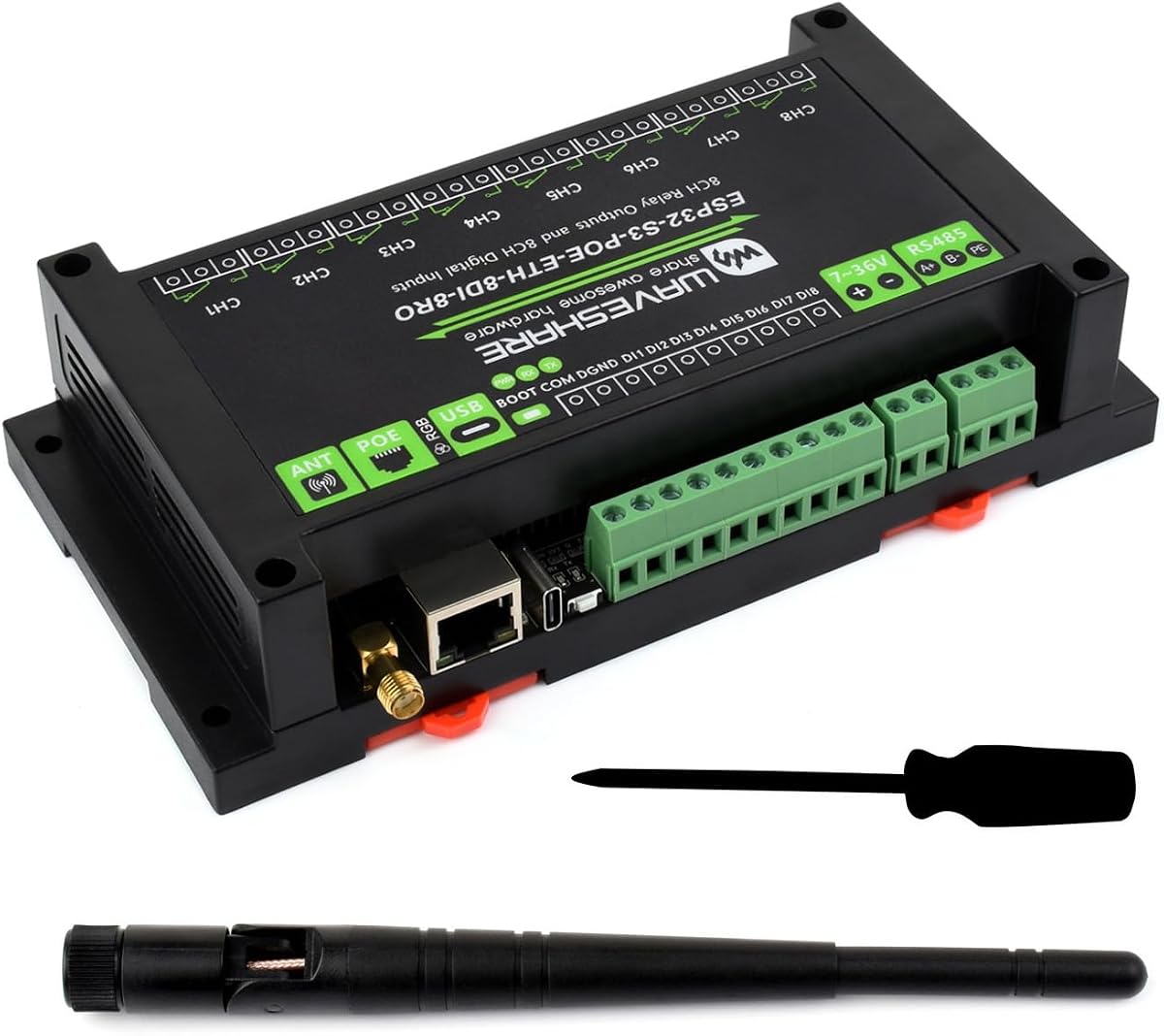
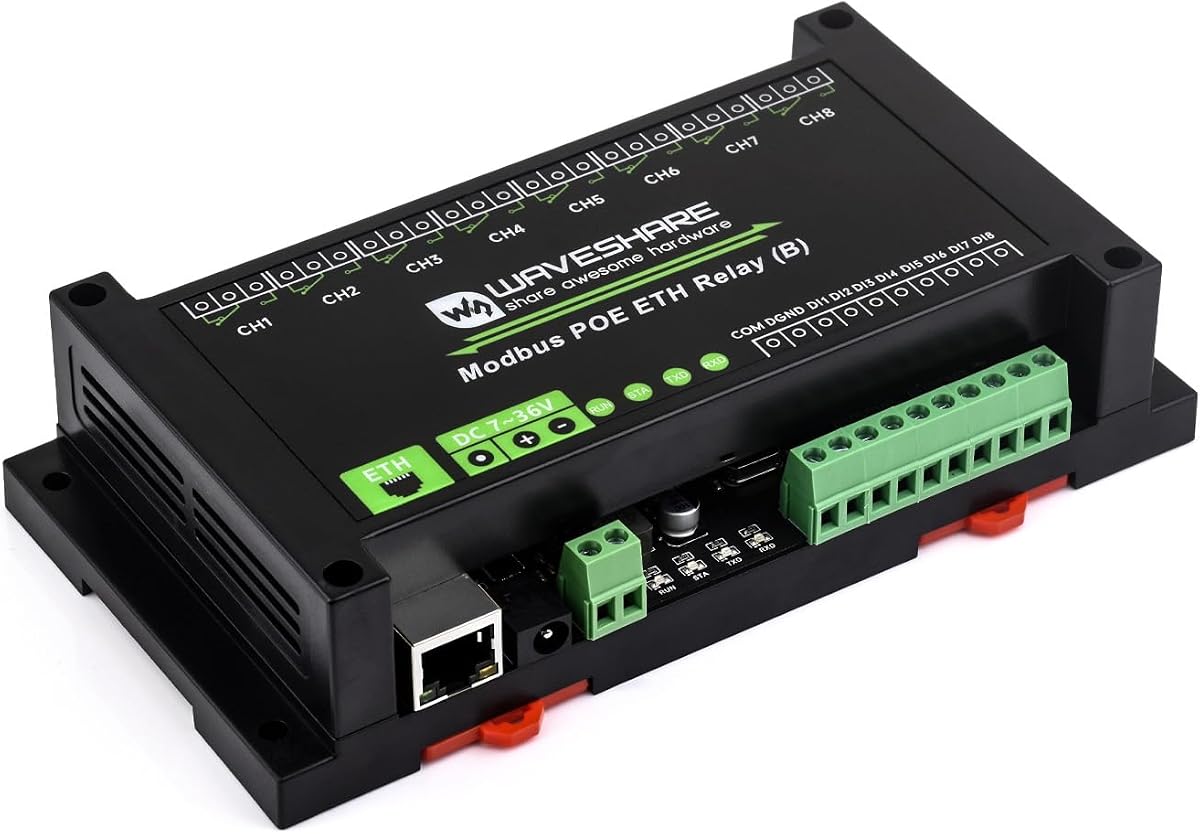

This 8-CH Ethernet Relay Module (B) carries a 4.9 rating, the highest among the supplied products, and offers one of the most comprehensive combinations of control and feedback in the roundup. Its eight relays can switch connected loads, while eight digital inputs let the module receive external status signals. The result is a useful fit for automation systems that need to control equipment and monitor whether it is operating.
We may earn a commission when you buy through this link, at no additional cost to you.
Connectivity is one of the module's strongest attributes. It supports TCP Server, TCP Client, UDP, UDP Multicast, HTTP, and MQTT while handling both Modbus RTU and Modbus TCP commands over Ethernet. Configuration is available through software or a web browser, with DHCP for obtaining a dynamic IP address and DNS support for connecting through a domain-name server. PoE is IEEE 802.3af compliant, and a screw-terminal supply accepts DC 7–36V.
The trade-offs are mainly about installation complexity and the learning curve associated with a feature-rich industrial controller. Users must understand relay contacts, Modbus commands, network addressing, and the distinction between dry-contact and wet-contact inputs. The module also handles loads rated up to 10A at 250VAC or 30VDC, so appropriate circuit protection and safe wiring procedures remain essential.
This is the strongest overall recommendation for installers who want extensive wired communication methods, dedicated input channels, and flexible configuration. It is less suitable for someone wanting a simple plug-and-play board with only two outputs. For industrial control, greenhouse automation, equipment control, or centralized smart-home projects, however, the documented capabilities make it a well-rounded choice.
The range of TCP, UDP, HTTP, MQTT, and Modbus modes allows the module to fit both direct control setups and broader network architectures. This flexibility is especially valuable when a project must connect to a supervisory system, a local controller, or cloud-oriented messaging infrastructure.
Eight digital inputs support both passive dry contacts and active wet contacts through bi-directional optocoupler isolation. PoE can simplify network deployments by carrying data and power together, while the wide-voltage DC terminal provides a useful alternative.
We may earn a commission when you buy through this link, at no additional cost to you.
This 8-CH Ethernet Relay Module has a 3.4 rating and focuses on a relatively direct industrial feature set. It controls eight channels over Ethernet, supports Modbus RTU and Modbus TCP, and includes MQTT control capability. The enclosure is a practical addition for installations where an exposed circuit board would be less convenient or less suitable.
We may earn a commission when you buy through this link, at no additional cost to you.
Its power flexibility is notable. The module accepts DC 7–36V through a wide range and can also receive PoE, allowing installers to select the most practical delivery method for their network. A flash-on, flash-off command lets the controller energize a relay for a specified interval and then switch it off, which can support timed or pulsed operations.
Protection features include onboard optocoupler isolation, reverse-proof circuitry, and relays with a contact rating of up to 10A at 250VAC or 30VDC. These are meaningful safeguards, although the product's rating is lower than the ratings supplied for the other products in the list. The available documentation also provides fewer details about digital feedback inputs and communication modes than the leading selection.
Buyers who specifically need eight wired relay outputs, Modbus, MQTT, PoE, and a rail-mounted enclosure can consider this option. It is best suited to straightforward industrial or automation projects where operators already understand Ethernet relay commands. For a broader set of protocols or eight dedicated digital inputs, the 8-CH Ethernet Relay Module (B) offers clearer documentation and stronger user feedback.
The flash-on and flash-off function accepts command arguments that specify how long a relay should remain active. That is useful for pumps, indicators, alarms, and other equipment that should operate for a defined interval rather than remain switched indefinitely.
The ABS rail-mount case is designed for more practical permanent installation than a bare board. Optocoupler isolation and reverse-proof circuitry add protection, but the contact rating still needs to be checked against the load being controlled.
We may earn a commission when you buy through this link, at no additional cost to you.
The Waveshare 8-Ch Ethernet Relay Module has a 4.1 rating and presents a balanced eight-channel option for industrial Ethernet control. It supports Modbus RTU and Modbus TCP, allows MQTT-based relay control, and includes an Alibaba Cloud MQTT application demo. PoE support and a DC 7–36V range provide two practical ways to supply the module.
We may earn a commission when you buy through this link, at no additional cost to you.
The enclosure is an industrial-grade rail-mount ABS case, making the unit better suited to fixed installations than a simple exposed relay board. Four LEDs and network indicators show microcontroller and signal-transceiving status, which can simplify diagnosis during commissioning. The relay contacts are rated up to 10A at 250VAC or 30VDC.
The main limitation is that the supplied specifications do not identify dedicated digital inputs or the wider TCP, UDP, HTTP, and MQTT mode selection documented for the rank-one module. It therefore presents fewer clearly stated monitoring features. As with every switching device, the relay rating is a maximum capability rather than a guarantee that every connected load is appropriate.
This module is a solid choice for users who prioritize Modbus, MQTT, PoE, and a permanent enclosed installation. It fits greenhouse control, equipment automation, smart agriculture, and general industrial switching. Installers who require dedicated feedback inputs should compare the stated capabilities of the other 8-CH Ethernet Relay Module (B) before making a final choice.
Four LEDs and separate network indicators provide visible feedback for microcontroller status and signal transmission. This is a small but useful feature when validating network communication or checking whether a command is reaching the module.
Power over Ethernet can reduce the number of separate cables required at the controller. The alternative DC input remains useful in installations where a suitable PoE source is unavailable or where a local supply is more convenient.
We may earn a commission when you buy through this link, at no additional cost to you.
This ESP32-S3-based module has a 4.8 rating and is the most connected product in the roundup. It combines an Ethernet port with 2.4GHz Wi-Fi and Bluetooth LE, giving users several routes for remote control. The ESP32-S3 uses a 32-bit LX7 dual-core processor operating up to 240MHz and supports the Arduino IDE.
We may earn a commission when you buy through this link, at no additional cost to you.
Eight relays and eight digital inputs create a balanced control-and-feedback platform. Inputs support passive dry contacts and active wet contacts with bi-directional optocoupler isolation. The onboard RS485 interface expands the module's usefulness for Modbus-oriented industrial sensors and devices, while a built-in PoE module carries both network connectivity and power over one cable.
Its additional feature set introduces more responsibility than a straightforward Modbus relay. Users may need to choose between Ethernet, Wi-Fi, and Bluetooth, configure an RS485 network, decide how inputs should interact with outputs, and prepare firmware or Arduino-based control logic. The stated relay contact rating reaches 10A at 250VAC or 30VDC, but the exact load profile still requires proper assessment.
This is the best premium pick for builders who want Ethernet plus wireless flexibility, a fieldbus interface, and programmability in one unit. It is particularly appealing for advanced home automation, mixed industrial environments, and custom projects where a standard Modbus-only controller would be restrictive. Users seeking a ready-made Ethernet controller with simpler configuration may prefer the rank-one model.
Ethernet supports stable wired network integration, while Wi-Fi and Bluetooth LE provide alternatives for setup, mobile access, or locations where running a network cable is inconvenient. Having all three options makes the module adaptable to changing deployment requirements.
The combination of RS485, eight digital inputs, and eight relays allows the unit to gather field status and control multiple outputs. Bi-directional optocoupler isolation improves separation between input circuits and the controller, while PoE reduces cabling requirements.
We may earn a commission when you buy through this link, at no additional cost to you.
This 8-Ch ESP32-S3 Ethernet and WiFi Relay Module carries a 4.6 rating and is designed for flexible, software-driven automation. It provides eight relay outputs, eight digital inputs, Ethernet, Wi-Fi, Bluetooth LE, and an RS485 interface. The ESP32-S3 controller includes a 32-bit LX7 dual-core processor capable of operating up to 240MHz.
We may earn a commission when you buy through this link, at no additional cost to you.
The digital inputs handle both passive and active signals through bi-directional optocoupler isolation. Power isolation and optocoupler isolation are also present, adding separation between sensitive circuitry and connected equipment. The module supports Arduino IDE development, and the supplied information states that an SDK, tutorials, technical support, and online development resources are available.
Compared with the similar PoE ESP32-S3 model, this version's documentation does not explicitly identify a built-in PoE module. That distinction may matter because a separate Ethernet connection and power feed could be required. The module is otherwise highly attractive for custom projects, but its programmability also places more responsibility on the user to create and maintain the control application.
Choose this unit when a project benefits from Ethernet, wireless access, RS485, and custom code within one controller. It is well suited to advanced automation prototypes and permanent installations that can accommodate firmware management. For a user who wants similar interfaces but an explicitly documented PoE connection, the related ESP32-S3 PoE option is the more direct comparison.
Arduino IDE support allows the module to fit into a custom firmware workflow rather than relying only on a fixed command set. The supplied SDK, tutorials, online resources, and technical support can shorten the learning curve for developers creating bespoke automation logic.
Ethernet and RS485 support structured equipment networks, while Wi-Fi and Bluetooth add flexible access paths. This combination is valuable in installations where the module must communicate with both networked controllers and wired field devices.
We may earn a commission when you buy through this link, at no additional cost to you.
The Waveshare 30-Ch Ethernet Relay Module has a 4.2 rating and stands apart by controlling thirty channels from one Ethernet unit. It is intended for industrial control, smart-home, smart-agriculture, and farming applications where consolidating many discrete outputs into one networked controller simplifies system architecture.
We may earn a commission when you buy through this link, at no additional cost to you.
Communication follows the familiar Modbus RTU and Modbus TCP pattern, with MQTT control support and an Alibaba Cloud MQTT application demo. PoE and DC 7–36V input give the installer flexible power choices. A flash-on, flash-off function supports commands that energize a channel for a specified time and then turn it off.
The module employs a dedicated relay driver chip with built-in flyback diode protection, intended to improve driving strength and stability. Reverse-proof circuitry, optocoupler isolation, and a contact rating of up to 10A at 250VAC or 30VDC are also documented. Its large number of channels nevertheless requires careful circuit planning, labeling, and load distribution.
This is the right choice when thirty independently controlled outputs materially simplify a project and a smaller eight-channel unit would create unnecessary complexity. It is less appropriate for a small installation, a compact enclosure, or a system requiring documented digital feedback inputs. The main criterion is channel count: when those outputs are genuinely needed, the 30-channel design is a significant advantage.
Thirty channels can replace many separate relay controllers, reducing duplicated networking and power arrangements. That consolidation is especially helpful in agriculture, building control, and industrial systems with numerous independent loads.
The dedicated driver chip and built-in flyback diode protection are designed to support more stable relay operation. Reverse-proof circuitry adds another layer of protection, although correct wiring and appropriate load protection remain the installer's responsibility.
We may earn a commission when you buy through this link, at no additional cost to you.
This Waveshare ESP32-S3 PoE relay module has a 4.7 rating and combines a high-performance microcontroller with extensive connectivity and monitoring. Its Xtensa 32-bit LX7 dual-core processor runs up to 240MHz, while integrated 2.4GHz Wi-Fi and Bluetooth LE provide wireless options alongside the PoE Ethernet connection.
We may earn a commission when you buy through this link, at no additional cost to you.
It includes eight relays and eight digital inputs, with both passive and active input types supported through bi-directional optocoupler isolation. The isolated RS485 interface can connect Modbus industrial modules and sensors. A relay contact rating of up to 10A at 250VAC or 30VDC is documented, along with linkage control for input-driven behavior.
Several management features distinguish it from simpler controllers. A USB Type-C port supports power, debugging, and firmware downloading, and the unit accepts a wide 7–36V input. An RTC chip enables scheduled tasks, while built-in indicators provide visible monitoring of device status. The supplied information also mentions official Wiki resources for setup and development.
This model is a strong choice for a technically capable user who wants Wi-Fi, Ethernet, RS485, input feedback, scheduling, and custom firmware support. It is more versatile than a fixed-function Modbus relay, but that versatility can also be unnecessary for a simple two-output or eight-output task. Choose it when the control platform and future expansion matter more than minimal setup.
The RTC chip supports scheduled tasks, allowing relay actions to be tied to time-based automation. Built-in indicators make it easier to check operating state during installation and routine maintenance.
The USB Type-C connection provides a practical route for power, debugging, and firmware downloads. This is valuable for developers who intend to customize behavior rather than rely entirely on a fixed control protocol.
We may earn a commission when you buy through this link, at no additional cost to you.
This Waveshare 8-CH Ethernet Relay Module (B) has a 4.2 rating and emphasizes responsive input-driven automation. It supports passive dry-contact and active wet-contact digital inputs with bi-directional optocoupler isolation, plus a debouncing algorithm. The relay can respond through digital-input linkage or operate in a toggle mode.
We may earn a commission when you buy through this link, at no additional cost to you.
Modbus RTU and Modbus TCP are supported, and MQTT control is available with an Alibaba Cloud MQTT application demo. PoE and DC 7–36V input offer flexible installation methods. Four LEDs and network indicators report microcontroller status and signal-transmitting status, making commissioning and troubleshooting more transparent.
A dedicated relay driver chip with flyback diode protection is intended to provide stronger and more stable relay drive capability. Reverse-proof circuitry helps guard against accidental connection errors, and the contacts are rated up to 10A at 250VAC or 30VDC. The rail-mounted ABS enclosure supports safer, neater permanent installation.
This model is especially attractive for users who want an input to trigger a relay automatically rather than sending every command manually. It can suit access control, interlocks, industrial sensing, and status-driven equipment control. The supplied information does not state the number of digital inputs or list the complete set of communication modes, so buyers needing those details should confirm them with the seller before installation.
Digital-input linkage lets a changing input state trigger relay behavior, reducing the need for constant central commands. Toggle control provides an alternative operating pattern for installations where a maintained state is more appropriate.
A dedicated driver and flyback diode protection support consistent switching. Reverse-proof circuitry adds an installation safeguard, although the module still requires correct terminal connections and suitable circuit protection.
We may earn a commission when you buy through this link, at no additional cost to you.
The Pinhaijing LAN Ethernet 2-Way Relay Board has a 4.8 rating and offers a compact, approachable alternative to the larger industrial modules. It controls two relay outputs through a local Ethernet connection and can be operated through a web server. TCP and UDP control modes provide useful flexibility for simple network integration.
We may earn a commission when you buy through this link, at no additional cost to you.
Its STC microcontroller and local password protection support controlled remote access. The board accepts either 5V or 9–24V input, making it adaptable to common low-voltage installations. A 1.6mm-thick FR-4 PCB measures 6.8 by 4.8 centimeters and includes mounting holes, while a power indicator and per-relay status lights show operating conditions.
The compact bare-board format is both its main advantage and its main limitation. It is easy to place in a small control enclosure, but unlike the rail-mounted models, it does not arrive with a complete industrial housing. It also lacks the documented Modbus, MQTT, PoE, digital-input, and isolation features found in several higher-capacity alternatives.
This is the best pick for a straightforward project that needs only two Ethernet-controlled outputs, especially when space is limited. A homeowner, educator, or maker can use it for a small appliance controller, demonstration system, or basic remote switch. Users should install the board inside a suitable enclosure and follow appropriate low-voltage and mains wiring practices.
The 6.8 by 4.8 centimeter PCB fits where a full rail-mounted industrial controller would be excessive. Mounting holes make it easier to secure inside a project box or custom enclosure.
The integrated web server provides a straightforward way to access the module over the local network. TCP and UDP options add control-path flexibility, while password protection helps prevent unauthorized operation.
We may earn a commission when you buy through this link, at no additional cost to you.
This 8-CH Ethernet Relay Module has a 4.0 rating and provides a broad set of network communication choices. It can operate as a TCP Server or TCP Client, use UDP or UDP Multicast, and support HTTP and MQTT. Both Modbus RTU and Modbus TCP commands can be sent through Ethernet to control relays and other connected devices.
We may earn a commission when you buy through this link, at no additional cost to you.
The module supports configuration through software or a web browser. It can obtain a dynamic IP address through DHCP and connect to a domain-name server via DNS. Power can arrive through a DC power plug, a screw terminal accepting DC 7–36V, or an IEEE 802.3af-compliant PoE port, giving installers meaningful flexibility.
Its industrial-grade rail-mount ABS enclosure and optocoupler isolation make it more appropriate for permanent control cabinets than a simple board. Flash-on, flash-off commands support timed relay operation. The 4.0 rating is lower than the ratings of the other nine products, and the supplied specifications do not mention dedicated digital inputs.
This module is best for installers who need several communication modes and flexible configuration but do not require the higher-rated or input-equipped alternatives. It suits Modbus systems, network-connected equipment control, and automation panels. Buyers prioritizing feedback inputs, wireless access, or the highest supplied rating should consider one of the leading selections instead.
TCP Server, TCP Client, UDP, UDP Multicast, HTTP, and MQTT cover several common control patterns. This allows the module to participate in direct controller relationships, broadcast-style networks, browser access, and messaging systems.
A dedicated DC plug, a wide-range screw terminal, and IEEE 802.3af PoE make the module adaptable to different cabinet power arrangements. Choosing the most appropriate method can simplify installation and reduce unnecessary cabling.
We may earn a commission when you buy through this link, at no additional cost to you.
Choosing an Ethernet relay module requires matching channel count, network protocols, power method, feedback needs, and safety features to the equipment being controlled. The most important step is to define the installation before comparing modules.
Begin with the number of independent loads that must be switched. An eight-channel module is common for rooms, equipment racks, irrigation zones, and distributed control panels, while a two-channel board suits smaller appliances or demonstrations. A 30-channel module makes sense only when consolidating a large array of outputs materially reduces wiring and controllers. Count outputs rather than total connected devices, because one relay may switch a group while another may control a single circuit. Also leave room for future expansion if the control panel is likely to change.
In short, choose a channel count that meets present needs without creating unnecessary size, complexity, or wiring work.
A module that supports Ethernet may still expect a particular command style. Modbus TCP and Modbus RTU are common in industrial environments, while TCP, UDP, HTTP, and MQTT can be useful for direct control, browser-based management, and messaging integrations. If the module must interoperate with a particular PLC, sensor, software platform, or cloud workflow, verify that the required protocol and operating mode are documented. Mixed support is advantageous, but it can also make initial configuration more complicated.
The key is to select the exact protocol and role your controller expects, whether that means server, client, UDP, HTTP, or MQTT operation.
PoE can simplify deployment by carrying network data and power through one Ethernet connection, provided the network switch or injector supplies compatible PoE. A wide-range DC input offers more flexibility for installations with a local supply. Modules with both options are especially useful because the installer can choose the most practical infrastructure. Verify connector type, terminal arrangement, and supported voltage range before purchase, and account for startup and relay-load demands when selecting the supply.
Choose PoE for cleaner cabling, wide-voltage DC for local power flexibility, or a combination of both when installation conditions may change.
Digital inputs allow a controller to learn about external conditions such as door contacts, switches, sensors, or equipment status. Passive dry contacts require the module to source or interpret a closed circuit, while active wet contacts present an external voltage. Bi-directional optocoupler isolation is a valuable feature for separating field signals from the controller. Users who need reliable feedback should prioritize a model with a clearly stated number and type of inputs over one that only mentions generic relay control.
If feedback, interlocks, or automatic input-to-output linkage is essential, confirm input count, contact type, isolation, and debounce behavior before buying.
RS485 expands a module beyond ordinary Ethernet control by supporting wired fieldbus communication with industrial sensors and other Modbus devices. Wi-Fi and Bluetooth LE can simplify initial setup, provide alternate control paths, or enable mobile access where running Ethernet is difficult. ESP32-S3-based modules are particularly attractive when custom firmware and Arduino IDE development are part of the plan. These capabilities increase flexibility, but they also require greater attention to network security, device provisioning, and firmware maintenance.
Add RS485 for industrial fieldbus integration and wireless control for flexible access, recognizing that programmable connectivity requires more configuration and maintenance.
Optocoupler isolation, power isolation, reverse-proof circuits, and flyback diode protection can reduce the likelihood that field wiring, switching transients, or accidental connections damage the controller. These features are especially important around mains-powered equipment and long field cables. They do not replace correct wiring, circuit fusing, grounding, enclosure design, or safe isolation procedures. Review the documented protections as part of the overall design rather than treating them as a guarantee against every electrical fault.
Prioritize documented isolation and reverse or flyback protection, but continue to use correct wiring, grounding, fusing, and safe installation practices.
The stated maximum contact rating indicates the upper capability of the relay under specified conditions; it does not mean every load can be switched indefinitely at that level. Motor starts, incandescent lamps, heating elements, and capacitive loads can produce inrush or surge behavior different from a steady resistive load. Compare voltage, current, and load type requirements, and use an appropriately rated interface or interposing relay when necessary. The 10A at 250VAC or 30VDC figure should be treated as a documented ceiling, not a universal operating target.
Match voltage, current, and load characteristics carefully, and add interposing relays when startup surges or specialized loads exceed safe operating conditions.
A rail-mount ABS enclosure generally suits permanent installation in an industrial or automation cabinet, while a bare PCB offers flexibility for small custom projects but requires a protective enclosure. Consider available space, DIN-rail availability, terminal accessibility, cable routing, ventilation, and whether status indicators will be visible during maintenance. A larger channel count also means more output wiring, so accurate labels and a clear terminal plan are important. The physical package should be selected alongside the electronics rather than after installation begins.
Choose a rail-mounted enclosure for organized permanent systems or a compact board for space-constrained custom builds, while planning cable routing and service access.
Begin by documenting every load, relay channel, input, and power requirement before wiring the module. Confirm that the voltage and current remain within the documented relay rating, and use separate fusing or circuit protection as appropriate. Connect the network and power in the arrangement supported by the chosen model, then configure the IP address, protocol, and operating mode. A staged setup is safer: test one relay with a low-risk load before connecting additional equipment.
After basic control is confirmed, configure timing, MQTT, Modbus, or other advanced functions one at a time. For models with digital inputs, verify both active and passive signal behavior and make sure input-to-output linkage behaves as intended. Label both Ethernet and terminal wiring, save the configuration where applicable, and record the device address. For Wi-Fi or Bluetooth-capable units, use unique credentials and avoid exposing management interfaces to untrusted networks without appropriate security controls.
Care for the module by keeping the enclosure dry, dust-free, and free from conductive debris. Periodically check terminals for looseness, discoloration, or signs of overheating, and inspect relays, wiring, and protection devices for wear. Firmware-based products should be updated through the documented development or configuration process, with a backup of custom code and settings. If a relay behaves inconsistently, disconnect the load safely and investigate the load type, wiring, network commands, and protection circuit before repeatedly cycling the output.
An Ethernet relay module lets a computer, controller, or network service switch electrical loads through commands sent over Ethernet. It is commonly used for industrial equipment, pumps, lighting, irrigation, access systems, and smart-home projects. The module can provide scheduled, remote, sensor-triggered, or manually controlled operation depending on its supported features.
No. Several products in this roundup support both Modbus RTU and Modbus TCP, but the compact two-channel board and the ESP32-based modules are not listed with the same Modbus-focused feature set. Check the exact protocol documentation before buying, especially if the module must communicate with a PLC or existing Modbus supervisory system.
PoE is not universally required, but it can reduce cabling by delivering network data and power through one connection. A module with DC 7–36V input may be more suitable when a local supply is already available. Confirm that the injector, switch, or controller supports the required PoE standard before relying on that power path.
A passive dry-contact input is switched by another circuit and generally does not provide its own sensing voltage. An active wet-contact input presents a voltage that the module detects directly. Several products support both types, which makes them easier to use with different switches, sensors, and field devices.
The documented relay contact ratings indicate that some models can switch 250VAC loads up to 10A, but that is a maximum rating under specified conditions. Motor, heating, lighting, and capacitive loads may create surge behavior that requires protection or an interposing relay. Safe enclosure design, correct grounding, fusing, and local electrical requirements are still essential.
A standard Modbus relay is often easier to deploy in an existing industrial network because it uses a defined command set. An ESP32-S3 module offers Wi-Fi, Bluetooth LE, RS485, and custom programming, making it better for flexible or bespoke projects. Choose the simpler controller for conventional remote I/O and the programmable model when custom logic or multiple connection methods are important.
Count the number of independently switched loads in your installation. A two-channel board can handle a small control point, while eight channels cover common rooms and equipment groups. A 30-channel model is intended for larger arrays where consolidating outputs reduces the number of separate controllers and simplifies network management.
Rail-mounted models already include an industrial-style ABS enclosure and are intended for permanent installation. A bare board should be placed inside a suitably rated project enclosure to protect it from dust, moisture, accidental contact, and mechanical damage. The enclosure should also provide safe access to terminals without exposing live connections.
The leading recommendation is the 8-CH Ethernet Relay Module (B), which pairs eight outputs and eight digital inputs with Modbus, HTTP, MQTT, TCP, UDP, PoE, wide-voltage DC input, and web-based configuration. The ESP32-S3 PoE WiFi Relay earns the premium selection for projects that need Ethernet, Wi-Fi, Bluetooth, RS485, and custom programmability, while the Pinhaijing 2-Way Relay Board offers a compact solution for simpler two-output control.
Before ordering, prioritize the protocol your controller already understands, then confirm channel count, power delivery, input feedback, isolation, protection, and physical space. Wire simplicity favors PoE, established industrial integration favors Modbus, and custom behavior favors the ESP32-S3 platform. Always check the documentation for the exact model, especially when a project depends on a particular protocol or input configuration.
Marketplace ratings and product configurations can change, so verify the current listing, documentation, and compatibility before purchasing. Treat the relay rating as a maximum rather than a blanket permission to switch any load, and plan safe wiring, fusing, grounding, and enclosure measures before energizing the system.