TESMEN TLP-123A
4.5Editor score
RJ45 and RJ11 testing
Detachable remote unit
Clear LED fault indicators
Shielding status detection
Our Ethernet Cable Tester guide compares ten models for wire mapping, fault detection, cable tracing, length measurement, and professional use.
An Ethernet cable tester helps technicians identify wiring faults, confirm pin-to-pin continuity, and verify network cables before troubleshooting becomes guesswork. The right model can distinguish opens, shorts, miswires, split pairs, and shielding problems while adding cable tracing, length measurement, or port testing when needed.
We compared ten testers based on supported connectors, fault detection, display clarity, tracing functions, portability, and suitability for home repairs or professional network maintenance. The list includes simple LED continuity tools, feature-rich wire map testers, and advanced kits designed for cable installation and structured cabling work.
Each review explains the standout capabilities, practical limitations, and ideal user for every product. Ratings come from the supplied product data, while feature details reflect the listed specifications. Availability and configurations can change, so confirm the current listing before purchasing.
4.5Editor score

4.8Editor score

4.5Editor score
This side-by-side comparison highlights each tester's supported media, fault-finding capabilities, tracing functions, display type, and most practical use. It helps reveal whether a basic LED tester is enough or whether advanced diagnostics are warranted.


The Klein Tools VDV526-200 is the strongest all-around choice in this guide, earning a 4.8 rating in the supplied data. It is designed for testing RJ45-terminated data cables and patch cords, with a backlit LCD that presents pin-to-pin results clearly even in dim workspaces. Its combination of diagnostic detail, straightforward controls, and portability makes it well suited to installers, IT technicians, and serious home users.
We may earn a commission when you buy through this link, at no additional cost to you.
Its diagnostic coverage is the product's defining advantage. The tester identifies open circuits, shorts, miswires, split pairs, cross-overs, and shield conditions, allowing a user to move beyond a simple pass-or-fail judgment. The three-button interface keeps operation approachable, while the large display reduces the need to squint at a row of LEDs. Tone generation can target one wire, a wire pair, or all eight conductors in solid or warble style.
There are two important limitations to consider. The analog probe identified as Cat. No. VDV500-123 is sold separately, so the full tone-tracing workflow is not available without that additional accessory. The listed features also do not include cable-length measurement, and the unit focuses on RJ45 data cables rather than voice or coax media. Those omissions make it less comprehensive than some higher-end models in the list.
Despite those constraints, the VDV526-200 is an excellent recommendation for anyone who wants clear fault identification without carrying a large professional kit. Its backlit wiremap, broad fault detection, and automatic power-off provide a strong balance of capability and convenience. Choose it when dependable Ethernet diagnostics and simple tone generation matter more than length measurement, PoE checks, or multi-media support.
The backlit display shows the wiremap in a format that is easier to interpret than a bank of individual LEDs. This is particularly useful when a failed installation contains several possible faults rather than one obvious break.
The tone generator can signal a single conductor, a pair, or all eight wires, helping narrow down a route in a bundle. A compatible analog probe is still required to follow the generated signal.
We may earn a commission when you buy through this link, at no additional cost to you.
The Klein Tools VDV501-851 Scout Pro 3 Starter Set combines Ethernet testing with voice and coax support in a compact package. Its 4.7 rating reflects a capable general-purpose tool for technicians who regularly encounter more than one type of terminated cable. The backlit LCD gives the unit a professional presentation and displays wiremap, cable length, cable ID, and test results together.
We may earn a commission when you buy through this link, at no additional cost to you.
Its standout advantage is extended cable-length measurement up to 2,000 feet, or 610 meters. That capability goes well beyond basic continuity checks and can help a technician determine whether a run is present, estimate its length, and distinguish a terminated cable from a disconnected or improperly mapped route. The unit also detects opens, shorts, miswires, and split pairs across RJ11, RJ12, RJ45, and F-connector terminated lines.
Tone generation adds another layer of usefulness for identifying cables, wire pairs, or individual conductors, although the required analog probe, Cat. No. VDV500-123, is not included. The unit is also explicitly not designed to test PoE. Users who need to verify powered Ethernet should choose a model with dedicated PoE voltage and polarity information.
This is a compelling option for network installers, facilities teams, and service technicians who want more than an LED continuity tester without moving directly to a full professional kit. It handles several media types, provides precise length information, and remains portable. It is best suited to unenergized Ethernet cables and general voice or coax installation work.
Supporting RJ11, RJ12, RJ45, and F-connector connections means one unit can handle common voice, data, and coax runs. That versatility is useful for technicians moving between communications, network, and audiovisual wiring tasks.
The ability to measure up to 2,000 feet makes this tester more useful for structured cabling and larger installations. It helps users estimate cable distance and investigate missing or incorrectly terminated runs.
We may earn a commission when you buy through this link, at no additional cost to you.
The Klein Tools VDV526-100 offers a straightforward way to check common voice and Ethernet cables. It carries a 4.7 rating and supports RJ11, RJ12, and RJ45 terminations across CAT3, CAT5e, CAT6, and CAT6A cable. A single-button design and a set of fast LED indicators make it approachable for homeowners, installers, and field technicians who need immediate pass-or-fault feedback.
We may earn a commission when you buy through this link, at no additional cost to you.
The LEDs report Pass, Miswire, Open-Fault, Short-Fault, and Shield conditions, covering the common issues encountered during installation and maintenance. The remote unit stores securely inside the main tester, which reduces the chance of losing a small but essential component. A low-battery indicator and automatic power-off add practical protection for routine use.
This model does not provide the detailed textual wiremap or length information available from larger LCD-equipped products. It is therefore best for fast pass-or-fail confirmation and identifying a broadly faulty cable rather than documenting every pin in a complex run. Its pocket-friendly form is a meaningful advantage for users who want a tester that stays out of the way until needed.
For basic troubleshooting, the VDV526-100 is hard to overcomplicate. It is a good fit for checking recently crimped patch cords, identifying an open or short, and confirming whether a cable supports standard Ethernet categories. Choose it when simplicity, portability, and immediate LED results take priority over detailed mapping or advanced measurements.
Dedicated indicators for miswire, opens, shorts, and shield faults make the result easy to classify. Users can quickly determine whether a cable is usable or needs further investigation.
The compact body stores the remote inside the tester, preventing separated parts from being misplaced. That makes the kit convenient to carry between a wall outlet, a patch panel, and a workbench.
We may earn a commission when you buy through this link, at no additional cost to you.
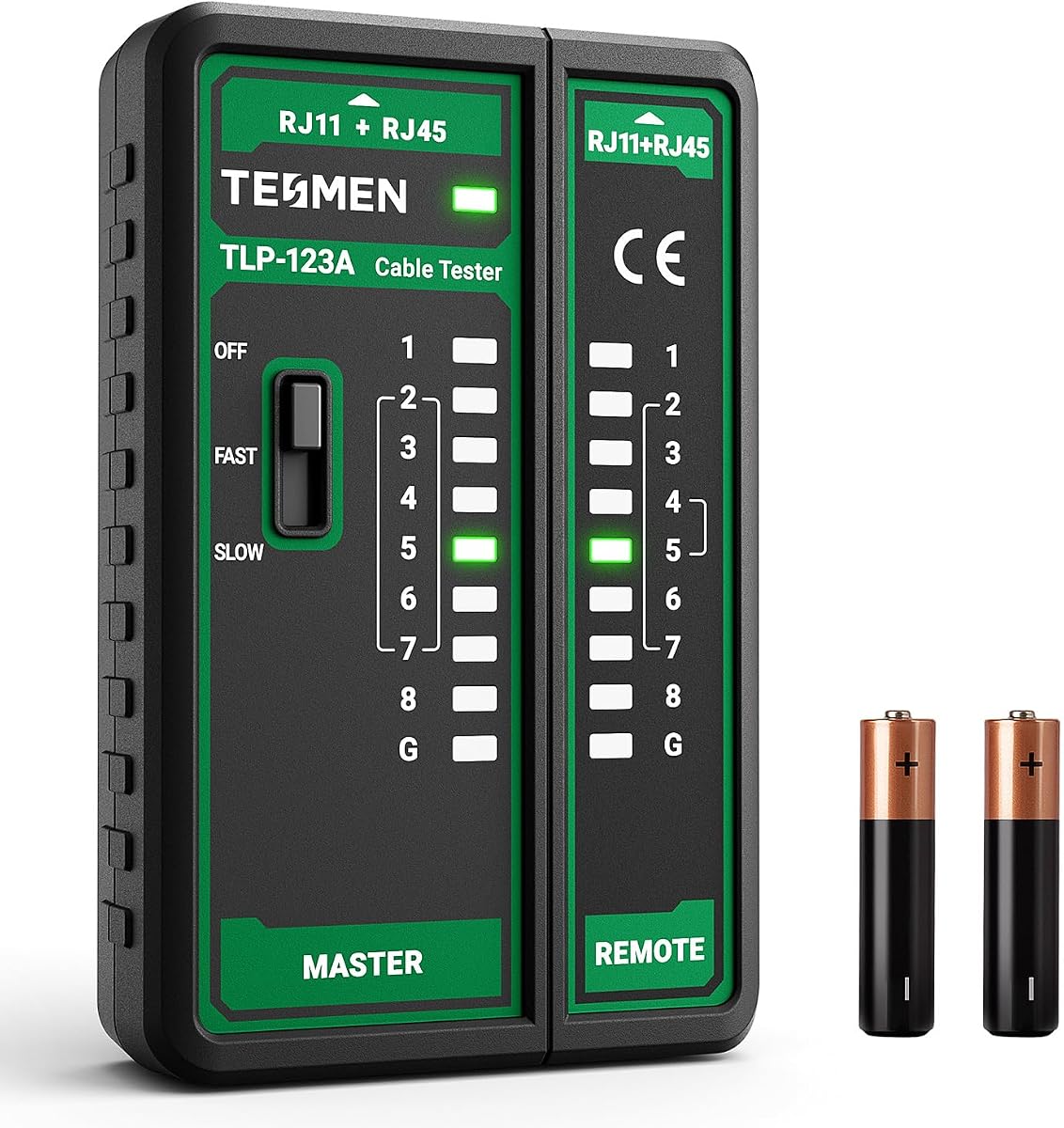
The TESMEN TLP-123A is an economical, general-purpose option for checking Ethernet and telephone wiring, and it carries a 4.5 rating. It supports RJ45 and RJ11 connections, with compatibility listed for CAT5, CAT5e, CAT6, CAT6A, CAT7, UTP, and STP cables. That broad connector and category support makes it useful for home networking, office wiring, and routine maintenance.
We may earn a commission when you buy through this link, at no additional cost to you.
Its one-button operation and clear LED indicators simplify the test process. The main unit includes a speed-adjustment control, while the LEDs reveal connectivity, shorts, opens, miswiring, and shielding status. The detachable remote is particularly useful when the two ends of a cable terminate in different locations, such as a wall-mounted jack and a distribution panel.
The trade-offs are equally clear. There is no cable-length measurement, port flash function, PoE analysis, or tone generator listed. Users needing those features will need a more specialized model. The LEDs also provide less detailed documentation than a screen-based wiremap, although they are adequate for confirming common installation problems.
For a straightforward continuity and fault check, the TLP-123A is a strong recommendation. It is particularly suitable for DIY users who need to test both ends of a long cable and technicians who want a lightweight tool for routine troubleshooting. Its detachable construction and wide cable compatibility offer more practical value than a permanently attached, fixed-cord design.
Separating the master and remote units allows the tester to reach cables installed across separate rooms or across a structured cabling environment. The parts can also be used independently when that makes a particular test easier.
The tester identifies line connectivity, short circuits, open circuits, miswiring, and shield status. Those categories cover common causes of failed Ethernet patch cords and installed network cables.
We may earn a commission when you buy through this link, at no additional cost to you.
The HT812A Network Tester is a compact option focused on quick Ethernet and telephone-line diagnosis. Its 4.6 rating reflects a useful feature set for home repair and basic professional maintenance. It supports RJ45 cables from CAT5 through CAT7, along with RJ11 telephone lines, and tests both shielded and unshielded configurations.
We may earn a commission when you buy through this link, at no additional cost to you.
One of the product's more distinctive conveniences is the ability to switch between fast and slow scanning modes. LEDs on the master and remote units show wire order, helping users identify open pairs or misaligned pins. The G light identifies shielded FTP or STP wiring versus unshielded UTP, while a simple one-button workflow keeps operation uncomplicated.
The split master and remote design supports cables whose ends are in different rooms or at different points in a structured wiring system. Its compact ABS housing makes it easy to carry, but the tool lacks more advanced functions such as numerical cable-length measurement, port flashing, PoE analysis, and detailed tone tracing.
The HT812A is a good choice for electricians, home users, and field technicians who need a rapid wire-order and fault check. It is particularly attractive when a user wants selectable scan speeds and shielding recognition without carrying a more complex display unit. For basic continuity work, it delivers the essentials with a particularly manageable interface.
Fast mode suits routine confirmation, while slow mode gives users more time to observe individual wire indications. This is useful when a fault is intermittent or when a more exact pin-by-pin review is needed.
The two detachable ends make the tester practical for wall-mounted ports, long cable runs, and cabinets where both ends are not conveniently accessible. A dedicated shield indicator helps distinguish UTP from FTP or STP.
We may earn a commission when you buy through this link, at no additional cost to you.
The Klein Tools VDV501-852 is a comprehensive kit for installers who need to test, map, and identify multiple cable runs. Its 4.7 rating is supported by a broad feature set spanning RJ11, RJ12, RJ45, and F-connector connections, plus PoE testing, cable length measurement, and location-mapping remotes. It is one of the most installation-oriented products in this roundup.
We may earn a commission when you buy through this link, at no additional cost to you.
The Test + Map Remote can test, map, and identify a run in a single step, reducing the number of separate procedures needed during installation. Eighteen RJ45 and 18 F-coax locator remotes support multi-run identification, while the included jumper cables and barrel adaptors help connect varied ports. Cable length can be measured up to 2,000 feet, and the display provides an effective basis for documenting structured cabling work.
PoE testing is a major addition because it displays wire and voltage information rather than treating powered Ethernet as a basic continuity test. Tone generation can trace cables, pairs, and individual conductors, but the compatible analog probe, Cat. No. VDV500-123, remains a separate purchase. The extensive kit may also occupy more space than a compact two-piece tester.
This is the model to consider for professional structured-cabling installations, facility networks, or a large collection of runs that must be labeled and tracked. It offers a more complete workflow than ordinary continuity testers, particularly through mapping remotes and PoE diagnostics. For smaller projects, its collection of accessories may be more than the task requires.
Location-mapping remotes make it possible to associate a specific cable with its intended connection point. Eighteen remotes for both RJ45 and coax support larger installations where many routes need to be distinguished.
PoE wire and voltage information helps troubleshoot network runs that use power over Ethernet. This is valuable where a simple pass result cannot explain an issue involving powered devices or a PoE switch.
We may earn a commission when you buy through this link, at no additional cost to you.
The NOYAFA NF-8209 is built for technicians who need more than wire continuity. It carries a 4.3 rating and combines digital cable tracing, PoE diagnostics, port flash and link testing, fault detection, length measurement, and non-contact voltage detection. The result is a versatile tool for network installation, active-port investigation, and general electrical troubleshooting.
We may earn a commission when you buy through this link, at no additional cost to you.
Digital decoding and Normal, Anti-Interference, and PoE modes support live cable tracing up to 600 meters. The included NCV pen can detect AC without direct contact, while the remote adapter supports one-to-one continuity checks on RJ45 shielded and unshielded cables. Fault detection covers shorts, opens, miswiring, and normal connections for eight-pin network and nine-pin shielded cables.
PoE testing is particularly detailed, showing power method, voltage, and polarity for standard and non-standard 5-to-60-volt power, including IEEE 802.3af and 802.3at. The unit also flashes 10M, 100M, and 1000M ports and performs link tests. Length measurements apply to twisted pairs from 2.5 to 200 meters and can be displayed in metric or imperial units.
The NF-8209 is a strong fit for network technicians, security installers, and advanced home users who need tracing and active-network functions in one kit. Its multi-component design and rechargeable transmitter are less convenient for minimal cable checks, but the breadth is substantial. Users should confirm that their specific fault, tracing, and power-testing requirements align with the listed functions.
The digital tracing system can follow cables over long distances and offers anti-interference and PoE modes. This expands the tool beyond basic termination checks into locating routes through walls, ceilings, or equipment areas.
Showing power method, voltage, and polarity helps distinguish several types of PoE failure. Port flash and link functions add practical ways to identify active connections and confirm network status.
We may earn a commission when you buy through this link, at no additional cost to you.
The NOYAFA NF-468CS provides a broad combination of continuity, fault, PoE, and length testing in a rechargeable format. It holds a 4.7 rating and supports RJ45, RJ11, and RJ12 terminations, including RJ11 configurations listed as 6P2C, 6P4C, and 6P6C. It is a practical choice for users who need to inspect both network and telephone cables.
We may earn a commission when you buy through this link, at no additional cost to you.
The single-button test workflow reports opens, crosses, straight-through connections, and shorts, while the remote allows results to be viewed from the other end of a cable. Its stated maximum test distance of 1,000 meters is useful for large structured-cabling environments. A dedicated QC function can also check plug crimping, and shielded network cables are supported.
PoE testing can identify the type and state of power supplied by a PoE switch, with support for power tests up to 60 volts. The lithium battery uses Type-C charging, and an automatic shutdown after 15 minutes helps conserve energy. There is no listed tone generator or port-flash function, so live tracing and active-port identification are outside its core feature set.
The NF-468CS is a good recommendation for network installers and service technicians who want detailed fault testing, long-distance measurement, and PoE information without a large specialty kit. Its rechargeable design reduces recurring battery replacement, while remote testing supports installed runs. Choose it for cable diagnostics and PoE checks rather than as a dedicated port tracer.
The lithium battery and Type-C charging interface make routine use simpler than managing disposable cells. Automatic shutdown further reduces unnecessary power consumption when the tester is left idle.
The QC function can inspect plug crimping in addition to detecting opens, shorts, crosses, and straight-through wiring. PoE power-state and type information adds another layer of network-specific diagnosis.
We may earn a commission when you buy through this link, at no additional cost to you.
The NOYAFA NF-8508 is unusual because it combines copper-cable diagnostics with optical power measurement and a visual fault locator. Its 4.2 rating reflects a feature-rich device aimed at engineering cabling, network equipment maintenance, and mixed copper-and-fiber environments. Nine core functions cover continuity, scanning, port flash, length measurement, PoE, QC, optical power, visual fault location, and non-contact voltage detection.
We may earn a commission when you buy through this link, at no additional cost to you.
The optical meter measures seven wavelengths at 850, 1300, 1310, 1490, 1550, 1625, and 1650 nanometers, with a listed power range from -70 to +10 dBm. It supports FC, SC, and ST connectors. A built-in visual fault locator emits at 650 nanometers to help identify fiber breakpoints, poor connections, bending, or cracking, with fast and slow flashing options and self-calibration.
For copper networks, the tester performs PoE tests, port flashing, link checks, length measurement up to 200 meters, and fault detection. The rechargeable 1,500mAh lithium battery is listed for up to 10 hours of use and supports Type-C charging. The breadth makes the device more complex than a basic wiremap tester and requires appropriate adapters for the fiber being examined.
The NF-8508 is most compelling for technicians who maintain both copper and fiber infrastructure. It can verify optical signal strength while also identifying visible fiber damage, reducing the need for separate tools for those tasks. Users working only on conventional Ethernet patch cords may find a simpler model easier to operate, but this device offers the broadest mixed-media capability in the list.
Seven-wavelength measurement helps assess fiber signal strength across common optical bands. The broad -70 to +10 dBm range supports installation checks and troubleshooting of attenuation-related concerns.
The 650-nanometer visual fault locator helps reveal breaks, cracks, poor connections, and tight bends. Different flash rates make it easier to observe the signal while working around a fiber route.
We may earn a commission when you buy through this link, at no additional cost to you.
The Fluke Networks MS2-100 MicroScanner2 is a premium copper-cable verifier with a 4.5 rating. It supports RJ11, RJ45, and coax connections, along with 10, 100, and 1000Base-T networks and VoIP-related testing. Its defining advantage is the ability to display cable length, wiremap, cable ID, and distance to fault together on one screen.
We may earn a commission when you buy through this link, at no additional cost to you.
Combining these measurements provides a more complete view of a failed installation. A technician can not only determine that a cable has a fault but also see its wiring condition, identify the cable, and judge how far the fault lies from the tester. The built-in IntelliTone feature adds tone generation without relying on a separate tone generator for the core workflow.
As a professional verifier, it is more specialized than simple LED continuity tools. The user must interpret multiple cable types, network standards, and diagnostic outputs, so beginners may need to learn the display conventions. Its extensive capability may also be unnecessary for someone who only wants to confirm whether a short patch cord works.
The MS2-100 is a strong recommendation for network professionals, service technicians, and installation teams that need a recognized professional diagnostic platform. The consolidated screen reduces the need to move among several tools, while fault-distance information can shorten diagnosis. Choose it when dependable, comprehensive copper testing justifies investing in a premium instrument.
Length, wiremap, cable identification, and distance to fault appear together, giving users a broad view of the installation. Consolidating these results helps reduce repeated testing and makes cable records easier to manage.
Built-in IntelliTone supports cable identification without adding a separate generator. That integration fits a professional workflow in which a technician may need both electrical results and physical route identification.
We may earn a commission when you buy through this link, at no additional cost to you.
Choose an Ethernet cable tester by matching connector support, diagnostic depth, and portability to the work you perform. Basic users need continuity and fault alerts, while installers benefit from length measurement, tone tracing, PoE checks, and remote mapping.
Begin with the connectors and cable types you actually use. A dedicated Ethernet tester must support RJ45 and the category of cable installed in your environment, while technicians working across departments may also need RJ11, RJ12, coax, or fiber support. The TESMEN TLP-123A covers a wide range of copper categories through CAT7 and both UTP and STP configurations. The Fluke MS2-100 supports RJ45, RJ11, and coax, while the NOYAFA NF-8508 adds optical measurement and visual fault location. Checking compatibility before purchase prevents a tester from becoming an expensive mismatch.
Continuity is only the starting point. A useful tester should identify common installation failures such as opens, shorts, miswires, split pairs, and cross-overs. Some products also report shield status, helping distinguish an unshielded cable from an FTP or STP run. Displayed wiremaps make pin-to-pin problems easier to diagnose than a single pass indicator. The Klein VDV526-200 is especially strong in this category because it combines several fault types with a backlit LCD, while the HT812A and TESMEN TLP-123A use LEDs for faster, less detailed readings.
Decide how much interpretation you want. LED testers are fast, compact, and often sufficient for checking patch cords or basic wall drops. LCD models provide a clearer wiremap, fault labels, and additional measurements, which is valuable when multiple conductors are involved. A backlit display improves readability in basements, racks, and other poorly lit areas. The Klein VDV501-851 and VDV501-852 combine screens with cable ID and length information, while the Fluke MS2-100 places several professional diagnostics together on one display.
Length measurement can confirm that a cable or installed run is present and help locate where it terminates. Ranges differ substantially, so consider the scale of your installation. The Klein VDV501-851 and VDV501-852 measure up to 2,000 feet, the NOYAFA NF-468CS lists a 1,000-meter maximum, and the NF-8209 supports 2.5-to-200-meter twisted-pair measurements. The Fluke MS2-100 also displays cable length and distance to fault. Remember that the most useful feature is the one that matches your actual cable runs rather than an arbitrary maximum.
A wiremap tells you how a cable is wired, but tracing helps you find the physical route. Tone generators can identify cables, pairs, or individual conductors, while mapping remotes associate a particular run with a wall port or patch-panel location. The Klein VDV526-200 offers several tone styles, and the VDV501-851 supports tracing across multiple media. The VDV501-852 includes 18 RJ45 and 18 coax remotes for larger installations. The NOYAFA NF-8209 offers digital live tracing up to 600 meters. Some Klein tone functions require a separate analog probe.
PoE-capable testers can evaluate power-over-Ethernet wiring, voltage, polarity, power method, and switch status. These readings are more useful than continuity alone when powered devices fail to come online. The Klein VDV501-852 displays PoE wire and voltage information, while the NOYAFA NF-8209 adds power method, polarity, IEEE 802.3af and 802.3at identification, and port flash or link testing. The NF-468CS also checks PoE power state and type, while the NF-8508 includes PoE and port-flash functions. Confirm that the tester is intended for the exact power standard used in your network.
Consider where the tester will be used and how often. A pocket-sized unit with an integrated remote is convenient for home repairs and quick calls, while a professional kit may be better organized in a carrying case. Some models use replaceable batteries, whereas the NOYAFA NF-468CS and NF-8508 use rechargeable lithium batteries with Type-C charging. Automatic power-off helps conserve energy. Also check the included components, because jumper cables, adaptors, probes, remotes, and batteries can materially affect the complete workflow.
Mixed-network technicians should consider whether optical testing is worth the added complexity. The NOYAFA NF-8508 measures optical power across seven wavelengths, supports FC, SC, and ST connectors, and incorporates a 650-nanometer visual fault locator. This allows it to check signal strength and find visible breaks, bends, or poor connections. If the work is limited to copper Ethernet, a simpler copper tester will usually be easier to carry and operate. Fiber-aware equipment makes the most sense when optical links are installed, maintained, or regularly troubleshot.
Start by identifying the cable, connector type, and service to be tested. Disconnect the cable from active network equipment unless the specific model and task explicitly support live testing. Connect the main tester and remote to opposite ends, switch on the unit, and select the appropriate test mode. For an installed run, keep the remote accessible at the termination point and avoid sharply bending or disturbing connectors during the test.
Read the complete result rather than relying only on a pass indication. A tester may identify opens, shorts, miswiring, split pairs, cross-overs, or shield problems, and each fault calls for a different correction. If tracing a route, connect the appropriate probe, activate the required tone style, and follow the signal carefully. For length, PoE, port-flash, or optical measurements, allow the tester to stabilize and compare the displayed information with the expected installation record.
After use, switch the tester off and disconnect the remote and any probes. Replace batteries according to the manufacturer's guidance, or recharge a model with a lithium battery as directed. Keep the tester in its case or in a dry, protected area away from moisture, extreme heat, and heavy impact. Clean connectors gently and inspect them for bent pins or debris. A periodic self-test with a known-good cable can help confirm that the unit and accessories remain ready for the next job.
An Ethernet cable tester checks whether terminated network cables have correct continuity and wiring. It can reveal opens, shorts, miswires, split pairs, and related installation faults. More advanced models also measure length, trace cables, test PoE, flash ports, or inspect fiber links.
Yes, provided both ends are accessible and the cable is disconnected from active equipment. A two-piece tester connects the main unit at one termination and the remote at the other. This is ideal for wall outlets, patch-panel connections, and long cable runs.
PoE testing is useful if your network powers devices over Ethernet. It can reveal wiring, voltage, polarity, power method, or switch-state problems that basic continuity checks cannot explain. If the cable only carries data, the added function may not be necessary.
Continuity testing asks whether a conductive path exists between conductors. A wiremap also shows which connector pins connect to which conductors and can identify crossed or incorrectly terminated wiring. For troubleshooting a new installation, a detailed wiremap generally provides more useful information than a simple pass light.
Ethernet-focused testers are designed for RJ45 and sometimes RJ11 or coax terminations. USB cable testing requires a tester with the appropriate USB connector interface. Check the listed connector support carefully, because an Ethernet tester does not automatically become a USB tester.
A tone generator is not necessary to determine basic wire continuity, but it is valuable for identifying the physical route of a cable through a wall, ceiling, or bundle. Some models include tone generation, while others require a compatible probe sold separately, so verify the complete kit before buying.
Most basic testers are intended for unenergized or disconnected cables, and connecting energized equipment may produce misleading results or create safety concerns. Use live-port functions only if the product specifically supports them. For routine wiremap and fault testing, disconnect both ends first.
Professional installers often value detailed wiremaps, fault distance, length measurement, tone tracing, PoE testing, and remote mapping. The number of termination points also matters because locator remotes help distinguish many runs. A screen-based tester is generally more useful for documentation, while a compact LED model remains convenient for quick field checks.
The Klein Tools VDV526-200 is the leading all-around recommendation because it combines a backlit wiremap with comprehensive fault detection in a portable format. The TESMEN TLP-123A is the practical budget choice, offering broad copper-cable compatibility, clear LEDs, and a detachable remote. For advanced copper diagnostics, the Fluke MS2-100 provides length, wiremap, cable ID, fault distance, and integrated tone generation.
Match the tool to the job rather than choosing on feature count alone. Home users and quick repairs may need nothing more than reliable continuity and fault alerts, while professionals should consider length measurement, cable tracing, PoE information, port flashing, and mapping remotes. Mixed copper-and-fiber work may justify the optical capabilities of the NOYAFA NF-8508, and large installations benefit from the extensive remote kit in the Klein VDV501-852.
Before purchasing, verify the exact connectors, cable categories, required accessories, and power specifications listed by the manufacturer. Confirm that optional probes, remotes, adaptors, or cables needed for your workflow are included or available separately. Current availability and listing details can change, so review the latest product page to ensure the configuration matches your installation requirements.
