
Sky-Watcher Heritage 130mm Tabletop Dobsonian
4.5Editor score
130mm aperture offers useful capability
Collapsible tabletop package stores easily
Two eyepieces and finder included
Dobsonian telescopes combine a Newtonian optical design with a smooth, intuitive altazimuth mount, making them among the most approachable ways to explore the night sky. The best models balance aperture, portability, construction, and ease of use, while offering enough optical capability for lunar details, planets, and brighter deep-sky objects.
We compared the ten supplied models by examining aperture, focal length, optical coatings, mount design, portability, included accessories, app-assisted navigation, tracking features, and suitability for beginners. The list covers compact tabletop instruments, larger traditional and collapsible Dobsonians, and computerized telescopes included to illustrate how guided navigation differs from manual observing.
Each review explains who benefits most from the telescope, along with its practical strengths and trade-offs. Ratings and product details reflect the supplied listings, while prices and promotional terms can change at any time, so readers should confirm current availability and cost before making a purchase.
4.5Editor score

4.4Editor score

4.4Editor score
As an Amazon Associate we earn from qualifying purchases.
This side-by-side overview highlights the major differences in aperture, optical design, mount configuration, navigation, and portability, including one Schmidt-Cassegrain telescope that provides a useful computerized alternative rather than a traditional Dobsonian platform.




The Celestron StarSense Explorer 10" App-Enabled Dobsonian Telescope is the strongest all-around option in this guide, combining a generous 254mm Newtonian reflector with app-assisted navigation and a stable altazimuth platform. Its 4.4 rating reflects a favorable balance of capability, convenience, and customer support, although the physical demands of a 10-inch instrument should be considered before buying.
We may earn a commission when you buy through this link, at no additional cost to you.
The largest advantage is aperture. A 254mm mirror gathers substantially more light than the 114mm, 130mm, and 150mm instruments in the group, improving the visibility of lunar features, planetary detail, and brighter deep-sky targets. The listed XLT coatings support brighter, more vivid images, while the ultra-stable manual base makes it practical to move between targets without the complexity of a fully computerized equatorial mount.
StarSense technology gives the telescope a meaningful advantage for beginners and anyone who finds star hopping frustrating. The app analyzes recognizable star patterns overhead, helps identify the telescope's position, and generates a list of suitable targets for the current time and location. That turns a large telescope into a much more approachable instrument without taking motor control away from the observer.
The trade-off is size and handling. A 10-inch Dobsonian requires a stable observing area and is less convenient to carry than a tabletop model, while the assisted setup introduces a learning curve and dependence on a compatible phone. Even so, it is the most persuasive choice for a buyer who wants meaningful aperture and smart guidance without carrying a permanently mounted computerized telescope.
The 254mm aperture is the decisive specification for observers who want to progress beyond the Moon and the brightest planets. It provides a meaningful light-gathering advantage over compact models, helping reveal subtler lunar shadows, planetary structure, and selected deep-sky objects under suitable conditions.
StarSense assists with locating targets while the telescope itself remains on a manual altazimuth base. This preserves the simple, intuitive character of a Dobsonian and allows observers to make fine adjustments manually while still benefiting from modern celestial recognition.
We may earn a commission when you buy through this link, at no additional cost to you.
The Celestron StarSense Explorer 114AZ App-Enabled Tabletop Dobsonian Telescope is an especially attractive choice for beginners who want modern guidance in a manageable package. It receives a 4.4 rating and uses a 4.5-inch, or 114mm, Newtonian reflector with high-reflectivity coatings to produce sharp views of the Moon, planets, and prominent deep-sky objects.
We may earn a commission when you buy through this link, at no additional cost to you.
Its defining feature is the StarSense Explorer app. Rather than merely displaying a static list of targets, the application uses sky recognition to analyze the overhead star field and help determine where the telescope is pointing. That process makes it possible for a new observer to locate targets without first learning a complicated coordinate system or memorizing the sky.
The tabletop altazimuth base is intuitive once the phone has helped identify the first target. Movement is controlled manually, and the app turns green when the object reaches the center of the view. Because this is a tabletop design, it also works well for balcony, patio, or backyard sessions where a larger full-size Dobsonian would be inconvenient to position.
Compared with an 8-inch Dobsonian, the 114AZ collects less light and resolves less fine detail, but it offers a more compact and guided introduction to the hobby. It is best for buyers who prioritize convenience, compact storage, and immediate access to targets over the deepest possible visual performance.
The app's recognition-based guidance addresses one of the largest obstacles for new telescope owners: knowing where to point. Following the on-screen arrows and waiting for the bullseye to become green makes the first observing session less intimidating and more likely to produce a successful result.
Although the 114mm aperture cannot match the light grasp of an 8-inch model, it is still capable of satisfying views of lunar craters, planetary belts and rings, bright nebulae, and prominent galaxies. Its compact form also makes it easier to bring the same telescope to multiple observing locations.
We may earn a commission when you buy through this link, at no additional cost to you.
The Sky-Watcher Heritage 130mm Tabletop Dobsonian is the value leader in this group, pairing a 130mm aperture with a fully assembled, collapsible tabletop design. Its 4.5 rating is the highest among the supplied products, and the included 10mm and 25mm eyepieces plus a starpointer finderscope make it a ready-to-use package for a new observer.
We may earn a commission when you buy through this link, at no additional cost to you.
The telescope's 130mm reflector provides enough light for rewarding views of the Moon, the planets, and several bright deep-sky favorites. Its compact format does not sacrifice aperture to the smallest tabletop size available here, which helps it deliver a more useful observing experience without requiring a full-size base or difficult transport.
Convenience extends to setup and storage. The optical tube and base combine into one tabletop package, and the listing states that no assembly is required. The collapsible concept also makes it easier to place the instrument on a suitable surface without leaving a large, fully assembled Dobsonian occupying the room.
Unlike the StarSense models, it does not guide users toward celestial targets with a smartphone. Buyers must be willing to learn basic star hopping or use the supplied finder, but that manual experience is traditional, educational, and free of app-related compatibility concerns. For value-conscious beginners, it is a particularly well-rounded choice.
The package includes 10mm and 25mm eyepieces along with a starpointer finderscope. That means a new owner can begin locating and magnifying targets without separately researching the most basic accessories needed for a productive first session.
A 130mm mirror offers a meaningful step up from very compact tabletop scopes, while the all-in-one construction remains easier to manage than a large traditional Dobsonian. It is a sensible middle ground for apartments, patios, and beginner observing sessions.
We may earn a commission when you buy through this link, at no additional cost to you.
The Sky-Watcher Classic 200 Dobsonian 8-inch Telescope represents the traditional full-size end of this category. Its 3.9 rating is the lowest listed, but that figure should be considered alongside the instrument's major attraction: an 8-inch aperture capable of delivering bright, bold views of the Moon, planets, and deep-sky targets.
We may earn a commission when you buy through this link, at no additional cost to you.
The solid tube provides a straightforward, durable-looking design, while patented tension-control handles reduce the need for perfect balance while moving the telescope. Teflon bearings support smooth azimuth movement, and the 45-pound assembled weight gives the system a reassuring sense of stability when it is being used on level ground.
The accessory package is unusually complete for an 8-inch Dobsonian. It includes a 2-inch Crayford-style focuser with a 1.25-inch adapter, 25mm and 10mm super wide-angle eyepieces, and a 9×50 straight-through finder. Multi-coated borosilicate mirrors are rated at 94 percent reflectivity in the supplied details, with a listed faintest stellar magnitude of 14.2.
This is a strong choice for observers with a permanent observing area who prioritize aperture over portability. Its 3.9 rating and fixed full-size construction are the main reasons it does not lead the list, but for a buyer who wants the classic Dobsonian experience and a large optical tube, it remains a serious instrument.
The 8-inch primary mirror creates the largest light-gathering advantage in this roundup, making the Classic 200 suitable for observers who want to inspect finer lunar relief, planetary bands, and brighter clusters and galaxies. More aperture also makes stable seeing conditions and careful collimation more important.
Teflon bearings and tension-control handles support controlled movement across the sky. This keeps the observing process manual and tactile, which many traditional Dobsonian users prefer, while reducing the need to perfectly balance the tube during every adjustment.
We may earn a commission when you buy through this link, at no additional cost to you.
The Celestron StarSense Explorer LT 114AZ Newtonian Smartphone Guided Telescope combines a 114mm reflector with app-based sky recognition and a conventional manual altazimuth mount. Its 4.1 rating places it in the middle of the group, but its smartphone guidance and altitude slow-motion control distinguish it from a basic tabletop Dobsonian.
We may earn a commission when you buy through this link, at no additional cost to you.
The StarSense app analyzes the sky and helps identify the telescope's orientation, then offers a curated list of suitable objects for the current time and location. This is particularly valuable for new observers who would rather begin with a reliable target list than navigate the entire sky unaided.
Its mount includes altitude slow motion through a sliding rod, allowing more controlled elevation adjustments than a simple friction knob. The telescope remains manually positioned and does not automatically slew or track, which preserves affordability and straightforward operation but may frustrate observers who want fully automatic pointing.
Optically, the 4.5-inch Newtonian with high-reflectivity coatings is intended for sharp views of the Moon, Jupiter, Saturn, the Orion Nebula, and Andromeda. It is a good fit for a backyard setup where the mount can remain in place and a phone is available for guidance.
The app's celestial recognition function is more useful than a conventional finder alone when a beginner is unsure where to point. By comparing overhead stars with recognized patterns, it helps the observer orient the telescope and select an attainable target.
The sliding-rod altitude adjustment provides a measured way to change the telescope's height. Tracking remains manual, but the control can make it easier to keep a moving planet centered while learning how the mount responds.
We may earn a commission when you buy through this link, at no additional cost to you.
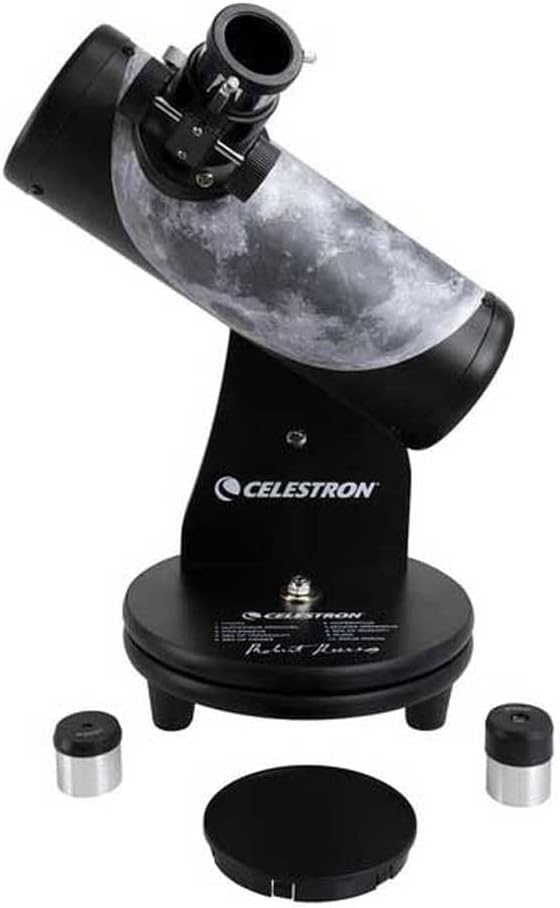
The Celestron FirstScope Signature Series Moon Tabletop Dobsonian Telescope is designed as a simple entry into visual astronomy. It carries a 4.3 rating and focuses on the essentials: a compact tabletop format, manual altazimuth operation, and support from an established telescope manufacturer.
We may earn a commission when you buy through this link, at no additional cost to you.
Its main advantage is accessibility. A tabletop Dobsonian removes the need to assemble a tall stand or carefully balance a large optical tube, allowing the instrument to be set on a table and used almost immediately. That convenience can be especially valuable for children, casual observers, and anyone interested in the Moon as a first observing target.
The supplied information is deliberately limited, and it does not identify the aperture or detailed optical specifications. As a result, prospective buyers should examine the current listing and package contents for exact dimensions, included eyepieces, and finder details before deciding whether the instrument fits their observing goals.
It is best viewed as an accessible introduction rather than a deep-sky specialist. The two-year US warranty and unlimited support from US-based experts add confidence, but a buyer with ambitious planetary and nebula plans may find that a larger aperture offers a more satisfying long-term experience.
A tabletop layout makes this telescope straightforward to place beside a window, on a patio table, or at another convenient observing spot. The compact format also reduces the storage burden associated with a full-size Dobsonian and its separate base.
The FirstScope is best suited to learning the basic motions of a telescope and becoming comfortable with lunar viewing. It provides a lower-complexity entry point than guided or computerized models, which can make early observing sessions less intimidating.
We may earn a commission when you buy through this link, at no additional cost to you.
The Sky-Watcher Flextube 200 Dobsonian solves one of the most common complaints about large Dobsonians: how to transport an 8-inch telescope without treating it as a bulky permanent installation. Its 4.0 rating reflects a generally favorable but less emphatic result, while the collapsible tube distinguishes it clearly from the solid-tube Classic 200.
We may earn a commission when you buy through this link, at no additional cost to you.
The unique strut design lets the optical tube collapse for storage and transport while retaining collimation. This makes the Flextube a practical choice for observers who want substantial aperture but may need to move the instrument between a garage, vehicle, storage area, and open observing site.
Optical specifications are strong for visual observing. Fully multi-coated borosilicate primary and secondary mirrors are listed at 94 percent reflectivity, and the telescope includes a 2-inch Crayford-style focuser with a 1.25-inch adapter, 25mm and 10mm eyepieces, and an 8×50 right-angle finder scope. Tension-control handles and Teflon bearings support smooth manual movement.
The trade-off is that the assembled instrument still weighs 40 pounds, divided between the 24-pound tube and 26-pound base. It is therefore more portable than a solid 8-inch Dobsonian, but not nearly as convenient as the Heritage tabletop models. The Flextube is ideal for dedicated observers who need large aperture and occasional transport.
The collapsible strut system preserves the optical alignment of a larger tube while reducing its storage volume. That combination is especially useful for owners with limited space or those who regularly observe away from a permanent setup.
The supplied 2-inch focuser, 1.25-inch adapter, two eyepieces, and right-angle finder cover the essentials for visual observing. The 8-inch mirror provides a substantial brightness and resolution advantage over the compact models in the guide.
We may earn a commission when you buy through this link, at no additional cost to you.
The Sky-Watcher Virtuoso GTI 150P combines a 150mm tabletop telescope with motorized GoTo pointing and Wi-Fi control through the SynScan Pro app. Its 4.3 rating makes it one of the stronger listings in the group, particularly for observers who want the portability of a tabletop Dobsonian without giving up automatic target selection.
We may earn a commission when you buy through this link, at no additional cost to you.
The 150mm aperture is a meaningful middle ground between the compact 114mm and 130mm models and the full-size 8-inch instruments. A fast f/5 optical design produces a 750mm focal length, giving the telescope useful wide-field characteristics for the Moon, planets, galaxies, and nebulae.
Its Freedom Find technology uses dual encoders to preserve manual control even after GoTo alignment. That means the user can let the telescope move to a cataloged object, then adjust it by hand without discarding the mount's alignment. The result is more flexibility than a conventional fully motorized setup and more automation than a standard manual Dobsonian.
The trade-off is dependence on a powered, connected workflow. Buyers should be comfortable using the SynScan Pro app and keeping the telescope's batteries charged. For those who embrace that ecosystem, the combination of automation, manual flexibility, and a collapsible 150mm design is unusually attractive.
GoTo positioning reduces the need to locate faint cataloged objects manually, which can be especially helpful at a dark site. Dual encoders ensure that manual corrections remain possible, allowing the observer to refine a target without restarting the entire alignment process.
The f/5, 750mm focal-length design is suited to broad views of star fields, nebulae, and galaxies. Combined with a 150mm aperture, it offers a capable visual platform in a package that can be collapsed and moved more easily than a traditional 8-inch Dobsonian.
We may earn a commission when you buy through this link, at no additional cost to you.
The Celestron NexStar 8SE is not a Dobsonian, and it is included because it represents the most technically advanced telescope in the supplied group. Its 4.3 rating is competitive, while the 8-inch Schmidt-Cassegrain optics, computerized GoTo mount, automatic tracking, and database-driven pointing offer a distinctly different experience.
We may earn a commission when you buy through this link, at no additional cost to you.
The NexStar+ hand control allows users to choose among more than 40,000 cataloged objects. Once aligned, the mount automatically slews to the selected target and tracks it, reducing the need for star charts and repeated manual adjustments. That automation is particularly valuable for planetary observing, where apparent movement can otherwise make tracking inconvenient.
SkyAlign further simplifies setup. The user centers three bright stars or planets without needing to know their names, and the system calculates the mount's position and establishes alignment. The telescope's 8-inch aperture can reveal fine lunar details, Jupiter's cloud bands, galaxies, and globular clusters in a compact overall format.
This option costs more conceptually because it adds electronics, alignment procedures, power requirements, and a more complex user interface. It also sacrifices the direct, hands-on character of a manual Dobsonian. Buyers who want effortless target acquisition and automated tracking will find it compelling, while traditionalists may prefer a simpler altazimuth mount.
The computerized mount compensates for Earth's rotation, allowing a planet to remain centered with far less manual intervention. This is the clearest advantage over a standard Dobsonian and makes longer planetary sessions more comfortable.
The 8-inch Schmidt-Cassegrain design combines substantial aperture with a shorter physical tube than many Newtonian Dobsonians. It therefore offers strong visual capability without requiring the same full-size, vertically oriented tube found in traditional 8-inch models.
We may earn a commission when you buy through this link, at no additional cost to you.
The Sky-Watcher Heritage 150 Tabletop Dobsonian Telescope offers an appealing balance of aperture, speed, and portability. Its 4.2 rating supports its position as a versatile compact instrument, while the 150mm primary mirror and f/5 design give it more visual potential than many of the smaller tabletop telescopes in the roundup.
We may earn a commission when you buy through this link, at no additional cost to you.
The listed 750mm focal length and fast f/5 ratio are well suited to wide views of the Moon, planets, galaxies, and nebulae. A borosilicate parabolic primary mirror with Sky-Watcher's Radiant Aluminum Quartz treatment supports sharp, contrast-rich views, although exact accessory details are limited in the supplied listing and should be verified before purchase.
Portability is handled unusually well. The collapsible tube design is intended to retain collimation while reducing the space needed for storage, and the tabletop base uses rubber feet to minimize vibration and increase stability. A 1.25-inch helical focuser provides a simple focusing mechanism without adding unnecessary complexity.
The telescope is best suited to beginners who want a meaningful aperture but do not need an 8-inch tube or motorized guidance. Its manual operation requires learning to find targets, yet that makes it a straightforward and durable first instrument. Buyers prioritizing guided navigation may prefer one of the Celestron StarSense models instead.
The 150mm mirror provides a stronger light-gathering platform than the 114mm and 130mm tabletop models, yet the collapsible package remains much easier to store and carry. This makes it a good middle option for observers who want capability on the move.
Rubber feet help reduce vibration, and the helical focuser keeps adjustment straightforward. These details support a telescope that can be placed on a suitable table, moved to another location, and put into service without learning a complicated motorized control system.
We may earn a commission when you buy through this link, at no additional cost to you.
A good Dobsonian should match your available space, observing experience, and target interests. Aperture is the leading optical consideration, but portability, navigation, stability, and accessory support can matter just as much to a new observer.
Aperture is the diameter of the primary mirror and the most important factor affecting brightness, resolution, and the visibility of faint targets. The models here range from compact tabletop apertures to full 8-inch mirrors, with the Celestron StarSense Explorer 10" and the two Sky-Watcher 8-inch Dobsonians offering the greatest light-gathering capability. A larger aperture generally reveals subtler lunar terrain, planetary detail, and brighter deep-sky objects, but it also increases weight, size, sensitivity to vibration, and the importance of collimation. Smaller tabletop models remain more practical for frequent setup and transport, especially for beginners who will spend much of their time observing the Moon and brighter planets.
Aperture ratio describes the relationship between focal length and aperture. A fast design such as the 150mm Heritage's f/5 ratio produces a wide field of view, which can make extended objects easier to frame and reduce the effect of field curvature. Longer focal ratios generally produce narrower views but may offer somewhat different image characteristics and are often easier to keep a conventional eyepiece set in reasonable condition. The supplied Classic 200 lists a 1200mm maximum focal length, while the Heritage 150 and Virtuoso GTI 150P use 750mm focal lengths. Optical coatings also matter because they influence how efficiently light is transmitted and how much contrast is retained against the background sky.
The practical difference between a tabletop Dobsonian and a full-size model extends beyond aperture. Tabletop instruments are quick to place on a table, simple to carry, and compact to store, making them ideal for patios, balconies, and frequent mobile use. Full-size Dobsonians provide stability and room for larger optics, but they require more space and effort to move. Collapsible designs, such as the Flextube 200 and Heritage 150, attempt to combine a larger tube with reduced storage volume. The deciding question is where and how often the telescope will be used: permanent space favors larger instruments, while limited storage and frequent transport favor compact or collapsible models.
A manual Dobsonian asks the observer to locate objects using a finder, charts, or prior sky knowledge. This is simple, direct, and educational, but it can be challenging for a first-time owner. StarSense models use smartphone sky recognition to help identify positions and suggest attainable targets, while the Virtuoso GTI 150P adds motorized GoTo positioning through Wi-Fi and the SynScan Pro app. The NexStar 8SE goes further with automatic slewing and tracking. Guided and computerized systems reduce the learning burden, but they also add apps, batteries, alignment procedures, and more points of possible technical difficulty. Manual operation remains appropriate for observers who enjoy learning the sky rather than relying on electronics.
Portability means more than whether a telescope fits in a vehicle. Consider the entire observing session: carrying the instrument outside, assembling or positioning it, moving it between rooms, and returning it to storage. The 114mm Celestron tabletop model and the Heritage 130mm are among the easiest choices, while the 10-inch Celestron and both 8-inch Sky-Watcher Dobsonians require considerably more effort. The Flextube reduces storage volume through its collapsing tube, and the Virtuoso GTI 150P uses a collapsible tabletop format. Weight specifications supplied for the Sky-Watcher models can help buyers judge whether another adult can help, especially around stairs, uneven ground, or a dark site away from a vehicle.
A Dobsonian mount should move smoothly enough to center an object but remain firm enough to resist vibration. The Heritage 150 uses rubber feet to minimize movement, while the Classic 200 and Flextube use Teflon bearings and tension-control handles. The Celestron 10" has an ultra-stable manual base, and the StarSense 114AZ uses a tabletop base designed for smooth guided positioning. Larger instruments generally feel more solid because of their mass, but they are harder to reposition. A smaller tabletop model may move more readily, so its feet and table surface should be stable and level. Observers should also consider whether the mount offers fine altitude control, as seen in the StarSense LT 114AZ, or a straightforward friction-based system.
Eyepieces determine the field of view and magnification available from a telescope, while a finder helps locate distant targets. The Heritage 130mm includes 10mm and 25mm eyepieces plus a starpointer finderscope. The Classic 200 provides 25mm and 10mm super wide-angle eyepieces and a 9×50 finder, and the Flextube includes 25mm and 10mm eyepieces with an 8×50 right-angle finder. The larger focusers accept 2-inch accessories, with a 1.25-inch adapter on the 8-inch models, offering broader accessory compatibility. For other products, confirm the current package contents because the supplied information does not always list included eyepieces or finders. Starting with a usable range of magnifications is more valuable than accumulating many inexpensive accessories.
Manufacturer support can be an important long-term factor because collimation, accessories, and product questions arise throughout a telescope's life. Both Celestron selections in the guide include a two-year US warranty and unlimited support from US-based experts, while the Sky-Watcher Heritage 130mm also carries a two-year warranty. Consider whether the chosen model can grow with your interests: a guided tabletop telescope may be a better first step toward automation, while an 8-inch Dobsonian can remain the primary visual instrument for years. The NexStar 8SE supports expansion with Celestron accessories, and the Virtuoso GTI 150P provides an established app-based platform. A buyer should balance present interest with the type of observing they realistically expect to continue.
Set the telescope on a level, stable surface before observing. Avoid placing it where people, pets, or wind may disturb it, and give a full-size Dobsonian enough room to rotate without hitting nearby objects. Remove the lens caps, check that the finder and eyepieces are secure, and perform a brief alignment or collimation check according to the telescope's instructions. The collapsible Heritage models and the Flextube are designed to retain collimation when collapsed, but a quick check is still sensible after long storage or transport.
Begin with the Moon or a bright planet, since familiar targets make focusing and movement easier to understand. Use a low-power eyepiece first, locate the object with the finder, and then make small, controlled movements in altitude and azimuth. Refocus after changing eyepieces, keep both eyes open when possible, and let your eyes adapt to darkness. Avoid sweeping rapidly across the sky, which can make small objects difficult to recognize and may put avoidable strain on the mount.
Protect the optics and finish by using the supplied caps, keeping the instrument dry, and storing it in a clean, temperature-stable location. Never clean a mirror with ordinary household glass cleaner, and avoid placing fingers on the mirror surface. If cleaning is necessary, follow the manufacturer's instructions or use equipment and methods specifically intended for telescope coatings. Collimate the telescope as described in its manual if views seem uneven, and periodically check that the base, knobs, and finder remain secure.
A 114mm to 130mm tabletop Dobsonian is often the easiest starting point because it balances useful performance with simple storage and transport. A 150mm model offers more light and detail while remaining compact. If you have a permanent observing space and want brighter, sharper images of faint objects, an 8-inch model is the stronger long-term choice.
Yes. Their simple altazimuth mounts, direct manual pointing, and straightforward construction make them approachable for new observers. Tabletop versions are particularly easy to set up, while StarSense and GoTo models can help users locate targets when they are not ready to learn star hopping.
Choose a tabletop Dobsonian if storage space is limited, you want to move the telescope frequently, or you will observe from a patio or balcony. Choose a full-size model if you have room for a stable setup and want maximum light-gathering power. A collapsible 8-inch design is a useful compromise for buyers who need both capability and transportability.
No. A traditional Dobsonian can be used with a finder, a star chart, or knowledge of the sky. Smartphone guidance is simply a helpful shortcut that can reduce frustration for new observers, particularly when faint deep-sky objects are difficult to locate manually.
A Dobsonian is primarily designed for visual observing, and its altazimuth mount does not automatically track the sky. Some modern GoTo models may support limited imaging workflows, but a conventional manual Dobsonian is generally less convenient for long-exposure photography than a dedicated tracking mount. Confirm the specific model's electronics and manufacturer guidance before attempting imaging.
A well-aligned telescope may need only a periodic check, while bumps, temperature changes, and repeated transport can require more frequent adjustment. Models with collapsible or retained-collimation designs may be especially convenient in this respect. If star images look uneven or elongated, check the focuser and secondary alignment before assuming the primary mirror is misaligned.
No. A larger aperture gathers more light and resolves finer detail, but it also requires more space, transport effort, and careful handling. If you will use the telescope only a few times, a compact model may be used more often and provide a better overall experience. Choose a larger model when observing capability is your top priority.
A Dobsonian uses a Newtonian reflector on a simple manual altazimuth base, while the NexStar 8SE uses Schmidt-Cassegrain optics on a computerized mount that can slew and track automatically. The NexStar offers advanced guidance and compact optics, but the traditional Dobsonians are generally simpler and less dependent on electronics.
The Celestron StarSense Explorer 10" is the strongest overall choice for buyers who want large aperture without sacrificing app-assisted navigation, while the Sky-Watcher Heritage 130mm offers the best value and a particularly approachable tabletop experience. The Celestron StarSense Explorer 114AZ is a strong guided compact option for beginners who prioritize convenience, compact storage, and modern target suggestions.
Beyond those top choices, the right telescope depends on how you will observe. The Classic 200 and Flextube deliver 8-inch light grasp for serious visual work, with the Flextube offering greater portability. The Virtuoso GTI 150P serves buyers who want both GoTo automation and manual freedom, while the StarSense LT 114AZ suits those who prefer a conventional mount with smartphone guidance. The NexStar 8SE is the automated, non-Dobsonian alternative in the group.
Before ordering, confirm aperture, focal length, package contents, current dimensions, compatibility, warranty terms, and the most recent customer feedback. Prices, discounts, availability, and featured details can change over time, so checking the current listing can prevent surprises. Prioritize the instrument you will actually use often, provide it with a stable setup, and allow time to learn the sky rather than expecting every target to appear instantly.