
Wixey Mini Digital Height Gauge for Router Table & Table Saw Measuring Tool
4.4Editor score
Compact 3.2-inch range
Magnetic self-standing base
Fractional or metric readout
A digital height gauge turns tricky vertical measurements into clear, repeatable readings, making it especially useful for setting saw blades, router cutters, fences, and other shop equipment. The right model combines a stable base, intuitive controls, useful resolution, and enough range for your projects without unnecessary complexity.
We compared ten digital height gauges using the specifications and features supplied for each product. The list covers compact tools for router tables, larger gauges for inspection and workshop use, fractional and metric displays, magnetic bases, absolute encoders, and models designed specifically for woodworking.
Each selection below highlights the measurements and design choices that distinguish it from the alternatives, along with relevant trade-offs for shop, laboratory, or DIY use. Product configurations and availability can change, so readers should verify current specifications and prices before making a purchase.
4.4Editor score

4.6Editor score

4.6Editor score
As an Amazon Associate we earn from qualifying purchases.
This side-by-side comparison organizes all ten digital height gauges by range, resolution, accuracy, base design, and intended application, making it easier to identify the right combination of precision and portability.



The iGaging Digital Electronic Height Gauge with Magnetic Base is a well-balanced six-inch option for workshops that need clear vertical measurements without a large footprint. Its 4.5 rating reflects a favorable balance of practical capacity, fine resolution, and a magnetic base that helps keep the tool in position while adjustments are made.
We may earn a commission when you buy through this link, at no additional cost to you.
The headline strength is the combination of a 0.0005-inch increment and fractional readings. That level of display detail is useful when setting a router bit, aligning a table saw blade, checking a fence, or comparing a measured depth with a marked reference. The magnetic base provides an additional layer of convenience by reducing the need to hold the gauge upright with one hand while operating shop equipment with the other.
Its main limitation is that it remains confined to a six-inch range, which is adequate for common woodworking tasks but may not suit taller assemblies or inspection work. The supplied information also does not mention absolute zero memory or a protective ingress rating. Buyers seeking automatic zero retention or greater resistance to workshop dust and moisture should look at the more specialized iGAGING models later in the guide.
This gauge is best for DIY woodworkers, furniture makers, and small-shop operators who want a magnetic, fractional readout in a practical six-inch format. It offers a straightforward way to improve setup consistency without moving to a larger premium instrument, making it a versatile middle-of-the-road choice for routine height measurements.
Six inches covers many common woodworking adjustments, including table saw blade height, router-table cutter position, and fence-related references. The compact span also makes the gauge easier to carry and store than a full twelve-inch instrument.
The magnetic base lets the gauge remain attached to a suitable ferrous surface while the user focuses on the machine adjustment. That hands-free positioning is particularly helpful when fine, repeatable setup matters more than taking a single measurement.
We may earn a commission when you buy through this link, at no additional cost to you.
The Shars 12-Inch Electronic Height Gage 303-4460 R combines a broad twelve-inch measuring range with a steel construction intended to resist shop wear. It holds a 4.5 rating and is a natural fit for woodworkers, machinists, and inspectors who need metric and inch measurements from one instrument.
We may earn a commission when you buy through this link, at no additional cost to you.
Its resolution is 0.0005 inch or 0.01 millimeter, while stated accuracy is ±0.0016 inch or 0.04 millimeter. The switchable high-contrast LCD supports both unit systems, and the fine-adjustment mechanism helps users make controlled changes rather than relying entirely on the carriage movement. A carbide-tipped scriber is also included for transferring measurements onto a workpiece.
The base is made from hardened steel that has been precisely ground and microlapped, a detail that should appeal to users who value stable contact and repeatable readings. In exchange, this is a more substantial instrument than the mini or compact gauges in the list. Its size may be less convenient for a small toolbox, and the listed features do not include absolute encoding or automatic zero retention.
Choose this model when a twelve-inch range and rigid steel construction matter more than portability. It is especially appropriate for general machine setup, dimensional checks, and production-style work where an operator wants inch or metric output without changing tools.
The precisely ground and microlapped steel base is designed to provide a consistent reference surface. Stable contact is essential because movement at the base can introduce error before the carriage and display are even considered.
The included carbide-tipped scriber allows a measured point to be marked directly on the workpiece. That feature helps carry a setup value into the next cutting or assembly operation without relying on a separate marking tool.
We may earn a commission when you buy through this link, at no additional cost to you.
The Wixey WR25 is the most compact and purpose-specific selection in this roundup. Designed for router tables, table saws, and other woodworking situations, it combines a 0-to-3.2-inch range with fractional or millimeter readout and a 4.4 rating.
We may earn a commission when you buy through this link, at no additional cost to you.
Its magnetic feet allow the gauge to stand against suitable metal surfaces while the user adjusts a router cutter or saw blade. A locking rule feature supports repeatability, while ABS and INC modes allow users to work with a preset origin or establish a new zero. The fractional display is particularly useful for comparing blade projection or cutter height against a marked reference.
The trade-off is range. A maximum of 3.2 inches is sufficient for many common woodworking adjustments but cannot handle taller setups that require a twelve-inch gauge. The unit is also powered by a single included CR2032 wafer battery, so owners should keep a spare on hand if a dead battery could interrupt a critical setup.
This is the best budget choice for a woodworker who mainly needs a small, self-standing gauge for router tables and table saws. Its focused feature set, compact dimensions, and magnetic positioning make it easier to use for routine jobs than a full inspection gauge.
The low-profile magnetic format is designed to remain stable in situations where a woodworker needs both hands for a machine adjustment. Its compact body is easier to position around fences, blades, and cutter assemblies than a long vertical gauge.
The locking rule and ABS/INC choices make it easier to establish and preserve a reference point. That repeatability is useful when the goal is to move a cutter by a small, controlled amount rather than search for an absolute height.
We may earn a commission when you buy through this link, at no additional cost to you.
The iGAGING #35-629 stands out as the most complete general-purpose six-inch gauge in the roundup. Its 4.6 rating, absolute encoding, fractional reading, magnetic base, and IP54 protection create a strong package for workshops, laboratories, inspection work, and general measurement tasks.
We may earn a commission when you buy through this link, at no additional cost to you.
Absolute encoding allows the gauge to memorize its origin zero, reducing the need to reset the reference every time it is switched on. Resolution is 0.0005 inch, 0.01 millimeter, or 1/128 inch, and stated accuracy is 0.001 inch. The CNC-machined magnetic base is intended to provide flatness, while an attachable carbide-tipped scriber supports marking measured positions.
Its IP54 rating adds useful protection against dust and moisture, a meaningful advantage in an active shop where a bare LCD and precision movement can encounter airborne debris. A protective case is also included for storage and transport. The limitation is that the six-inch range is not as accommodating for tall assemblies, and the supplied feature list does not mention digital data output.
This is the editor's choice for readers who want a balanced gauge with retained zero, strong environmental protection, and broad unit support. It suits experienced users who will use fractional readings regularly and need a dependable reference that survives power cycles.
Because the gauge can retain its absolute origin, it is less dependent on repeated manual zeroing. That convenience supports faster checks and reduces the chance of comparing against a reference that was not restored properly.
The IP54 rating indicates resistance to dust and moisture. While no measurement instrument should be exposed to deliberate flooding or severe contamination, this rating makes the gauge better suited to routine workshop conditions than an unprotected electronics-first design.
We may earn a commission when you buy through this link, at no additional cost to you.
The iGAGING EZ-Check is a compact five-inch gauge aimed at woodworkers who regularly adjust routers and table saws. Its 4.6 rating reflects a focused design that combines a magnetic base, anodized aluminum body, fractional readout, and setup conveniences without the larger dimensions of a full inspection instrument.
We may earn a commission when you buy through this link, at no additional cost to you.
The measuring range extends from zero to five inches, with 0.0005-inch or 0.01-millimeter resolution and stated accuracy of 0.0015 inch. A hold function helps preserve a reading while the user moves away from the display. Most distinctively, the base includes center steps for common router shank diameters of 1/2 inch, 3/8 inch, and 1/4 inch, along with a narrow hardend scriber.
These features make the EZ-Check especially convenient for repeatable cutter-height setup. Users can reference a shank center step without improvising a temporary spacer. The trade-off is a five-inch limit, which is shorter than the six- and twelve-inch models in the list. The supplied information also does not identify absolute zero memory or an environmental protection rating.
This gauge is best for a dedicated woodworking setup where portability and router-specific conveniences matter more than a long range. Choose it when the equipment being measured stays within five inches and quick, repeatable readings are the priority.
Built-in center steps for three common shank sizes give the gauge a useful starting reference. That saves the user from estimating where a cutter center should sit relative to the base.
The hold feature preserves the displayed value, allowing the user to check a setting without trying to watch the screen while handling the machine. It is a small convenience that can improve setup ergonomics.
We may earn a commission when you buy through this link, at no additional cost to you.
The CME Dual Beam Digital Height Gauge is the premium choice in this list, combining a twelve-inch range with an absolute encoder and a rigid dual-beam frame. Its 4.6 rating and stated ±0.0015-inch accuracy position it as a serious choice for users who value construction and repeatability over compact size.
We may earn a commission when you buy through this link, at no additional cost to you.
The cast-iron base and chrome-plated steel beams are designed to improve stability and reduce potential measurement error. The dual-beam format supports a rigid structure over the full measuring span, while the built-in ABS encoder retains the zero position through power cycles. Resolution is 0.0005 inch, giving the display fine detail for precise setup.
A carbide-tipped scribing tool is included for marking measured positions, and the gauge comes in a plastic case. The principal disadvantage is size: a twelve-inch instrument with a heavy base is less convenient to carry than the Wixey, Trend, or other compact options. It is also more specialized, so users who only need a small woodworking gauge may find the larger format excessive.
This is the best premium option for machinists, inspectors, woodworkers, and laboratory users who want a long range, retained zero, and a stable frame. It is especially suitable when equipment positioning must remain consistent across repeated power cycles.
Two steel beams and a substantial base create a rigid measuring structure. That architecture is valuable when a twelve-inch reach would otherwise introduce more flex or vibration than a compact gauge.
Retaining zero through power cycles reduces setup time and supports consistent comparison. Users can power the instrument without rebuilding its reference after every restart.
We may earn a commission when you buy through this link, at no additional cost to you.
The Starrett Electronic Height Gage is a portable six-inch instrument designed around a large, readable LCD and a hardened stainless steel bar. Its 4.3 rating is the lowest among the models in the top half of the list, but its specifications remain attractive for users who value simple operation and durable construction.
We may earn a commission when you buy through this link, at no additional cost to you.
The 0.932-inch-high display characters are intended to make readings easy to see without squinting, which is useful during machine setup. A manual on/off control is supplemented by an automatic shutdown after five minutes of nonuse, helping preserve battery life. The hardened, ground, and lapped base includes finger grooves for easier movement, while the vertical bar is positioned back from the nose for stability.
The main uncertainty is display detail. The supplied information specifies 0.0005-inch resolution but does not confirm fractional or metric output, so buyers who require those functions should verify them before purchase. The instrument also lacks the absolute zero memory, protective rating, and included case described for some competing models.
This Starrett model is a sensible choice for users who prioritize a durable frame, large digits, and uncomplicated operation over data export or absolute encoding. It suits portable vertical measurements in a shop or general professional environment where six inches is sufficient.
Large LCD characters make the gauge easier to read at a glance or from a slightly different working position. Clear visibility is particularly valuable when both hands are occupied near a machine.
The five-minute automatic off function helps prevent unnecessary battery drain. A manual on/off control gives users an immediate way to shut the instrument down when moving between tasks.
We may earn a commission when you buy through this link, at no additional cost to you.
The Trend GAUGE/D60 is a digital depth gauge rather than a conventional vertical height gauge, but its wide aperture makes it unusually practical for router-table work. It has a 4.4 rating and a design centered on measuring rebates, grooves, fence offsets, and other setup dimensions.
We may earn a commission when you buy through this link, at no additional cost to you.
Its jaw opening spans 2-23/64 inches, allowing it to bridge larger router base openings and fence cheeks. Accuracy is stated at 0.003 inch, and the digital readout registers in 0.002-inch increments. Magnetic feet hold the tool to metal surfaces, while a locking option preserves measurements that need to be transferred to another part of the setup.
A clip-on pointer can check holes, mortises, or slots up to two inches deep, extending the tool beyond its primary depth-reading role. The maximum range is 3-5/32 inches. Compared with dedicated height gauges, its 0.002-inch increment is coarser, so it is better suited to setup depth and backset than exceptionally fine vertical resolution.
This is the best fit for woodworkers who regularly set grooves and rebates and need to bridge broad openings. It should not be mistaken for a general 3/8-inch-capacity inspection gauge, but its specialized aperture can solve problems that a conventional height gauge cannot.
The broad jaw can span fence cheeks and larger router-base openings. This geometry gives the gauge an advantage when the measurement surface is interrupted by substantial machine components.
Magnetic attachment holds the gauge in position while the user operates the machine or changes an adjustment. The locking control helps preserve a reading when transferring it to the workpiece.
We may earn a commission when you buy through this link, at no additional cost to you.
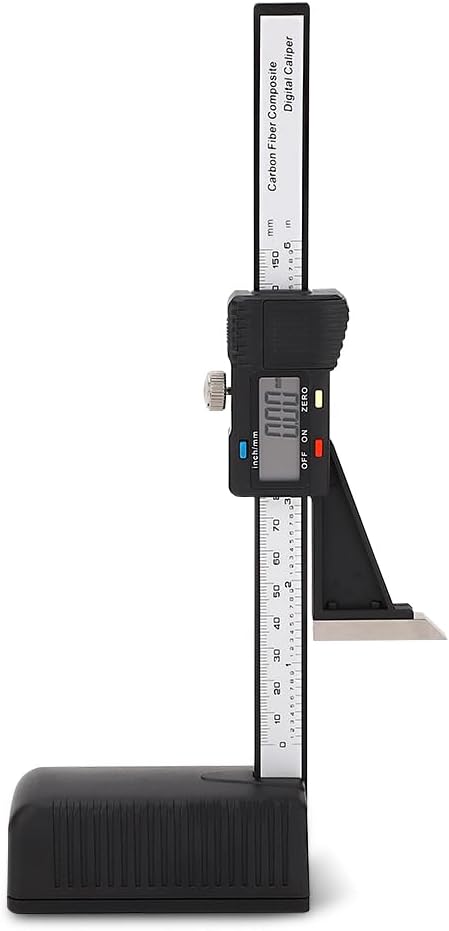
The Ejoyous 0-150mm Digital Height Caliper is a compact, lightweight option intended primarily for woodworking and saw-blade height settings. Its 3.8 rating is the lowest in this roundup, so buyers should pay particularly close attention to the stated construction and included accessories.
We may earn a commission when you buy through this link, at no additional cost to you.
The gauge measures from zero to 150 millimeters and displays values in inches or metric units. A reset button enables relative measuring, while the magnetic base holds the tool firmly against a ferromagnetic surface. These features make it convenient for measuring from a movable reference rather than only from a fixed zero.
Its engineering-plastic body is described as wear resistant, but it does not offer the rigidity of the steel, cast-iron, or dual-beam instruments in this guide. The 3-volt button cell is not included, which means the tool cannot be used immediately unless the user already has an appropriate battery. The supplied information does not specify numerical accuracy or resolution for this model.
This gauge is best for a lightweight woodworking setup where relative measurements and magnetic positioning are enough. Buyers should confirm the current battery requirement and verify the measurement specifications before relying on it for critical production work.
The reset function allows the user to establish a new zero from the current position. That is useful when comparing a tool, blade, or component with an accessible reference surface.
The compact body and low weight make the gauge easy to move around a workshop and store between tasks. It is a straightforward option for routine saw-blade height checks rather than a heavy laboratory instrument.
We may earn a commission when you buy through this link, at no additional cost to you.
The iGAGING #35-630 brings together a twelve-inch range, absolute encoding, fractional display, and IP54 protection. Its feature set is extensive, but its 2.8 rating is the lowest in the roundup and deserves careful consideration for anyone considering it as a primary measuring instrument.
We may earn a commission when you buy through this link, at no additional cost to you.
Resolution is 0.0005 inch, 0.01 millimeter, or 1/128 inch. Absolute encoding memorizes the origin zero, while a precision-lapped steel base and counterweight support stability across the longer measuring span. The stated accuracy is 0.001 inch through six inches and 0.002 inch through twelve inches, so users should account for the selected range.
The gauge includes an attachable carbide-tipped scriber and a protective case. It also has a micro USB data output port for use with a separate available data output kit, but that kit is not included. The low customer rating may reflect issues not captured in the feature list, making recent customer feedback particularly important during the buying decision.
This model makes the most sense for users who need the combination of long range, retained zero, and possible data integration. It is less compelling for straightforward woodworking tasks because lighter-duty models cover those needs with less complexity.
The twelve-inch capacity and absolute origin memory support measurements across larger assemblies. This combination can reduce the need to reposition or re-zero a conventional six-inch instrument.
A dedicated micro USB output port supports a separate data kit, creating a path toward recording or transferring measurements. Because the adapter is optional and not included, buyers should treat this as a future-compatible feature rather than an out-of-box capability.
We may earn a commission when you buy through this link, at no additional cost to you.
Choose a digital height gauge by matching its measuring range, precision, base stability, display format, and intended environment to the equipment and measurements you perform most often.
Choose enough capacity for real tasks without paying for dimensions you will never use.
Prioritize documented accuracy over display digits alone.
Favor a stable, flat base that suits the surface where you measure.
Select the unit and character format that match your normal measurements.
Choose a zero system that matches how often and where you measure.
Match specialized geometry and features to the machine setup you use most.
Balance structural rigidity with the need to move the tool regularly.
Confirm that the case, scriber, protection, and data options meet your needs.
Begin by cleaning the measuring surfaces and the machine surface where the gauge will sit. Place the base squarely against a firm, flat reference and confirm that the carriage or measuring element is not obstructed. Power on the instrument, select the required unit, and verify the display responds normally before making a setup-critical measurement.
Zero the gauge according to the task. For a relative or incremental measurement, establish the reference at the surface used by the machine. For absolute encoding models, set the intended origin and allow the instrument to memorize it when supported. Attach a scriber when the measured position must be transferred to the workpiece, then move the machine in small increments while watching the display.
After use, remove the gauge from ferrous surfaces and retract or secure the moving carriage as appropriate. Wipe the base, beam, and display with a clean, dry cloth, and avoid abrasive cleaners or moisture around the electronics. Store the instrument in its case when one is supplied, replace the battery before a prolonged period of inactivity, and verify accuracy or zero behavior if it has been dropped or stored in poor conditions.
A resolution of 0.0005 inch is a useful target for detailed woodworking setup because it provides fine numerical increments. Resolution is not the same as accuracy, however, so buyers should also review the stated accuracy specification. A gauge that supports fractional readings may be easier to interpret when matching common workshop fractions.
A magnetic base is useful when the gauge must remain attached to a metal machine while the user adjusts a control. It improves positioning and can reduce the need to hold the tool upright with one hand. The base still needs a flat, stable surface, and magnetic holding strength should not replace careful placement against the reference.
A relative reading uses a user-selected zero and reports the distance from that point. An absolute encoder preserves a reference tied to the gauge's own scale, and some models retain it through power cycles. Absolute readings can simplify repeated checks, while relative readings are often more convenient for transferring one component's position to another.
Many models in this roundup support both inch and metric displays, although not every product explicitly confirms that feature. Buyers should verify the unit controls and fractional-readout capability in the current listing. Choosing a model that matches your normal workflow prevents inconvenient manual conversions during machine setup.
A twelve-inch gauge is better when the required vertical travel exceeds six inches or when measurements involve tall assemblies. A six-inch model is usually more compact and may be sufficient for common router tables, saw blades, and fences. The best choice is determined by the largest measurement you routinely need rather than by maximum range alone.
IP54 indicates protection against dust and water spray under the specified testing conditions. It makes an instrument better suited to typical workshop dust and occasional moisture exposure than an unprotected design. It does not make the gauge waterproof, so it should still be protected from flooding, immersion, and direct heavy spray.
The listed digital models are electronic instruments and therefore require power for their displays. The Wixey includes a CR2032 battery, while the Ejoyous requires a three-volt button cell that is not listed as included. Keeping a compatible spare battery is useful for preventing an interrupted setup, and the user manual should identify the approved battery type.
Use the scriber or marking point while the gauge holds the measured position. Several models include an attachable carbide-tipped or hardend scriber for this purpose. Mark carefully against the edge or reference defined by the gauge, and consider whether the material will accept the mark before making final adjustments.
The Wixey WR25 is the best budget selection for compact woodworking and router-table work, while the iGAGING #35-629 is the editor's choice for a more complete general-purpose package. The CME Dual Beam is the best premium option, combining a twelve-inch range, retained absolute zero, and a rigid cast-iron and steel-beam construction.
Prioritize the range your tasks actually require, then examine base stability, documented accuracy, unit format, and zeroing behavior. A compact gauge can be more convenient than a premium instrument, while a premium frame may be worthwhile when repeatability, larger travel, or data retention is central to the work.
Before buying, verify the current specifications, included accessories, battery requirements, and customer feedback. Product configurations and prices can change, so checking the live listing ensures that the selected digital height gauge still matches your measurement range and working environment.