
Delamu Cord Hider
4.5Editor score
Cuttable paintable wall channel
UL94 V-0 rated material
Snap-together installation system
Cord hiding tubes make loose cables safer, tidier, and less distracting around homes, offices, desks, entertainment centers, and vehicles. The right product depends on the cable route, number of cords, available space, surface type, and whether you need a flexible sleeve or a wall-mounted raceway.
This guide compares ten options using the supplied product specifications, including dimensions, construction, installation method, cable capacity, temperature range, and intended applications. It covers split woven sleeves, self-closing flexible tubes, silicone channels, and paintable wall raceways for different cord-hiding needs.
Each review explains the standout features, practical limitations, and ideal use case for every product. The top selections represent the strongest options for different priorities, while prices and availability can change, so readers should verify current details before purchasing.
4.5Editor score
4.7Editor score

4.6Editor score
As an Amazon Associate we earn from qualifying purchases.
The comparison below highlights the different installation styles, cable capacities, dimensions, and material benefits offered by each cord hiding tube and wall raceway.


The Alex Tech Cord Protector is a 10-foot split sleeve with a 1/2-inch diameter and a 4.7 rating, making it one of the most versatile options in this guide. Its woven construction combines a tidy appearance with a practical way to gather USB, power, audio, and video cables into one protected bundle.
We may earn a commission when you buy through this link, at no additional cost to you.
The split opening is particularly useful because installers do not have to thread every connector through a closed end. Once cables are placed inside, the sleeve closes around them, creating a more uniform route. A stated operating range of -103 to 257 degrees Fahrenheit and a melt temperature of 446 degrees also give it broader relevance for automotive and equipment wiring than a basic fabric sleeve would offer.
The trade-off is that it is a sleeve rather than a wall raceway, so it cannot conceal a cable against a wall by itself. Its half-inch diameter also offers less room than the larger AGPTEK option. For protecting exposed runs, reducing visual clutter, and discouraging cats from chewing accessible cords, however, those limitations are generally acceptable.
This is a strong all-around recommendation for a homeowner, office user, or vehicle owner who wants a reusable cable-management sleeve without installing hardware. Choose it when the goal is grouping and protecting cords along furniture, desks, or equipment rather than building a permanent decorative channel.
The open seam makes installation straightforward: lift the sleeve, position the cables, and allow the woven material to close around them. This is especially useful when cables have bulky plugs or when adding a cord to an existing bundle later.
With a -103 to 257-degree Fahrenheit operating range, the sleeve is suited to far more environments than a purely decorative organizer. The stated UL recognition and protective construction also distinguish it from inexpensive soft cloth wraps.
We may earn a commission when you buy through this link, at no additional cost to you.
The Delamu Cord Hider is a 157-inch wall-mounted raceway rated 4.5 by customers. It is the most comprehensive decorative solution in the group, designed to conceal two to four wires behind a 0.95-inch-wide by 0.55-inch-high channel while giving wall-mounted televisions and other electronics a cleaner appearance.
We may earn a commission when you buy through this link, at no additional cost to you.
Its upgraded snap structure allows sections to open and close during installation. The kit is pre-sectioned with matching connectors, so users can form straight runs and turns without building a channel from scratch. The material carries a stated UL94 V-0 rating, and the fact that the raceway can be cut and painted gives it an advantage over rigid one-piece covers.
The main drawback is installation permanence. Although the raceway can conceal several cables and blend into a light wall, the adhesive mounting is not intended for frequent repositioning. It is also bulkier than the small one-cord silicone options, which may be easier to integrate beside compact monitors or single charging leads.
Choose the Delamu when a visible TV cord run needs a polished, nearly permanent solution. It is particularly attractive for users who want multiple cables organized in one channel and plan to paint the raceway to match the surrounding wall.
The white channel has a minimalist profile and can be trimmed and painted. That gives it a more finished appearance than a loose sleeve while keeping the cords physically separated from view and reach.
The raceway accommodates two to four wires, and the supplied connectors support a coordinated installation. This makes it easier to manage a television bundle than using a narrow channel designed exclusively for one cable.
We may earn a commission when you buy through this link, at no additional cost to you.
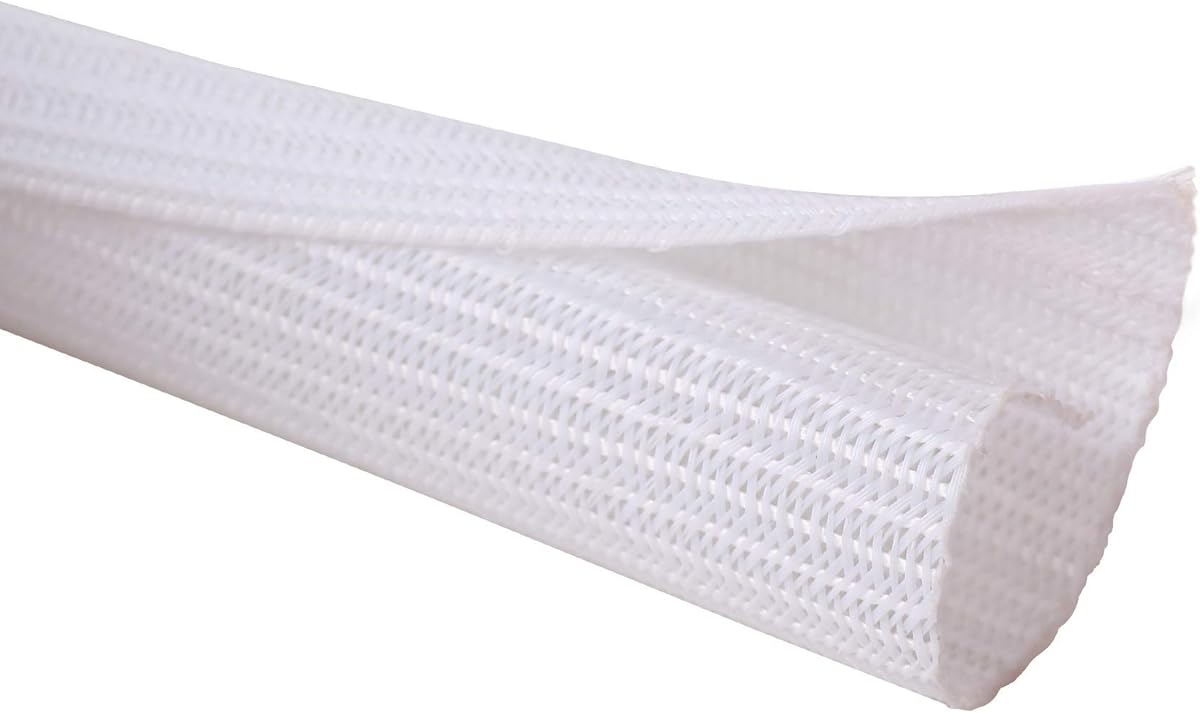
The 6.6ft White Cable Sleeve is a 4/5-inch-diameter self-wrapping sleeve with a 4.6 rating. It is designed to hold between four and eight cables, giving it more capacity than many narrow wire wraps while remaining compact enough for a desk, computer area, or television station.
We may earn a commission when you buy through this link, at no additional cost to you.
Its self-wrap design lets users open the braid, place cables inside, and let it close around the bundle. Scissors are sufficient for shortening it, which means the sleeve can be adapted to local cable runs without special tools. The polyethylene construction is described as thermostable and flame-retarding, with a -40 to 302-degree Fahrenheit operating range.
Those properties also broaden its use beyond ordinary home electronics. The listed applications include offices, automotive and marine settings, and industrial environments, although suitability for a specific application should always be confirmed against local electrical and material requirements. Like other sleeves, it does not solve the appearance of cables running vertically against a wall.
This is an appealing choice for grouping a larger collection of desk, PC, or TV leads without purchasing a multi-piece raceway. It combines a useful cable capacity, simple installation, and a 4.6 rating, making it a practical everyday organizer.
Holding four to eight cables makes this sleeve well suited to computer workstations and entertainment centers. The larger diameter also reduces the need to create several separate bundles around the same device.
Because the braid can be cut with scissors, users can fit it closely to a desk leg, media shelf, or equipment run. The material remains flexible rather than becoming a rigid raceway attached to the wall.
We may earn a commission when you buy through this link, at no additional cost to you.
The 39-inch Silicone Cord Hider offers a compact 4.6-rated solution for routing a single small cable along a wall. Its flexible silicone body, side-opening buckle, and self-adhesive backing distinguish it from conventional rigid raceways that require a more permanent installation.
We may earn a commission when you buy through this link, at no additional cost to you.
Opening the buckle makes it convenient to add, remove, or adjust a cord after installation. The channel accepts cables up to 1/4 inch in diameter and can be used in homes, offices, garages, or warehouses. Its stated waterproof and flame-retardant characteristics also make it more versatile than a simple plastic clip in damp or variable locations.
Surface preparation is important. The instructions call for cleaning and drying the wall, removing the oil-proof film, and pressing the channel firmly into place. A 12-hour waiting period is recommended before inserting the wire, and the product is not intended for dusty or textured surfaces. Removing it may also require slow peeling or careful use of a thin blade.
This is a good fit for a single thin television, lamp, charging, or network cable that needs to disappear neatly against a smooth wall. Choose a larger multi-wire raceway if the cable is thicker or if several connections need to share the same route.
The buckle keeps the cable enclosed while allowing quick access when a connection changes. This is a meaningful convenience in areas where equipment is moved, plugged into different outlets, or serviced regularly.
The installation is straightforward on clean, smooth walls, but the adhesive is not suitable for textured or dusty surfaces. Measuring and positioning the full route before pressing it down can prevent an uneven result.
We may earn a commission when you buy through this link, at no additional cost to you.
The YesBes Cord Hider Kit is a 116-inch raceway system with a 4.4 rating. It combines a main cable channel with six couplings, two L-shaped elbows, a T-fitting, and instructions, giving users the pieces needed to create a more flexible wall-mounted cable layout.
We may earn a commission when you buy through this link, at no additional cost to you.
The 0.96-inch width and 0.57-inch inner height are intended for groups of two to four cables. Installation relies on strong adhesive rather than screws or drilling. The channel can be cut with scissors or a saw and painted to match the wall, while the stated UL94 V-0 flame-retardancy rating supports its use around household electronics.
The primary limitation is surface compatibility. The manufacturer specifically advises against using the tape on textured walls, and adhesive-backed raceways can be difficult to remove without potentially damaging paint or drywall. The included fittings add convenience, but buyers who only need one short straight run may find the full kit more elaborate than necessary.
Choose the YesBes kit for a television installation that requires straight sections, corners, or a branch. It offers more layout flexibility than a single flexible channel and is especially useful when the cable path extends around furniture or changes direction near a wall.
The couplings, elbows, and T-fitting make it possible to build around corners and create a junction without improvising with unrelated pieces. This is the kit's strongest feature for permanent television cable routes.
The raceway can be trimmed and painted to blend with a wall. That makes it especially suitable when visual continuity matters more than the quick removal offered by a reusable woven sleeve.
We may earn a commission when you buy through this link, at no additional cost to you.
The One-Cord Silicone Raceway is a 39-inch channel built for a single cable and carries a 4.4 rating. Its 0.55-inch width and 0.39-inch height create one of the slimmer wall profiles in this guide, making it appropriate for a single television lead, lamp cord, or other narrow wire.
We may earn a commission when you buy through this link, at no additional cost to you.
Flexible silicone construction allows the channel to be cut to length and conform to the intended route. A side buckle provides access when the cable needs to be added or removed, while pre-applied adhesive eliminates screws and drilling. The result is a fast installation for users who want to reduce a visible cable without installing a full multi-piece raceway system.
Its narrow capacity is intentional but important to note. It is not intended to conceal a bundle of two to four cables, and a thicker power lead may not sit comfortably within the profile. The strong adhesive also calls for careful planning; repositioning after installation is best done by peeling slowly or using a knife to lift the edge.
This product is a good match for a minimal, single-cable television installation. It provides a cleaner appearance than leaving a cord hanging and a smaller footprint than the larger wall raceways, making it particularly effective in visible living spaces.
The narrow 0.55-inch by 0.39-inch profile is designed around one cable rather than a television bundle. It works well when visual minimalism and a compact wall route are more important than multi-cord capacity.
The pre-applied tape and flexible body allow installation without tools or drilled holes. Cutting the channel to fit before mounting helps preserve the adhesive's contact with the wall.
We may earn a commission when you buy through this link, at no additional cost to you.
The Side-Open One Cord Hider is a 39-inch silicone channel intended for cables up to 1/4 inch in diameter. Its 4.4 rating reflects a product focused on a narrow but common need: concealing a single thin wire around a wall-mounted television or other low-profile installation.
We may earn a commission when you buy through this link, at no additional cost to you.
The upgraded side opening lets users add or remove a line without dismantling the channel. Once closed, the snap design helps keep the cable from falling out. A broad list of compatible applications includes television, lamp, monitoring, telephone, network, charging, and speaker cables, although the stated size limit should always be checked.
The flexible silicone is flame retardant, easy to clean, and can be cut to the desired shape. Corners may be cut at 45 degrees for splicing. It does not support painting, so users wanting to match a wall color will need to accept the original finish or choose a paintable channel instead.
The installation instructions call for a clean, dry wall, cutting the length, pressing the channel into place, waiting one hour, and then loading the wire. Textured or rough surfaces are not suitable for the adhesive. This is a practical option for a single thin cable in a frequently viewed area.
The side-opening construction is the defining feature. It provides a practical balance between an enclosed appearance and the ability to swap or reposition a cable without replacing the entire channel.
The quarter-inch limit keeps the channel slim but means thicker power cords are outside its stated range. Measure the cable before installation to avoid forcing it into an undersized profile.
We may earn a commission when you buy through this link, at no additional cost to you.
The AGPTEK Cable Management Sleeve is a two-pack of five-foot sleeves with a 4.6 rating. Its 1.2-inch diameter is the largest among the flexible sleeves here, allowing it to accommodate substantially more or thicker cables than the half-inch and four-fifths-inch alternatives.
We may earn a commission when you buy through this link, at no additional cost to you.
The self-closing design makes the sleeve easy to bundle around computer lines, vehicle wiring, automation equipment, and office leads. The listed operating range is -50 to 150 degrees Celsius, and the flame-protection class is stated as UL94 V-2. The material is also described as robust, flexible, non-toxic, and free from a strong chemical smell.
One practical consideration is the 1.2-inch size. A large sleeve can look bulky when only a few thin cords need protection, and its wood color is primarily decorative rather than a neutral match for every office. The manufacturer also recommends treating a cut end with fire to help prevent fraying, which is an extra step compared with simply trimming a plastic raceway.
Choose this option for a sizable cable bundle, vehicle electronics, or a setup where a large capacity sleeve is more useful than a minimal profile. The two-pack also provides spare length or lets users organize two separate routes.
The 1.2-inch diameter makes this sleeve useful for a group of power, computer, and signal cables that would overwhelm a narrow loom. It is particularly practical beneath a desk, behind a console, or around vehicle equipment.
A tougher outer layer can discourage pets from chewing exposed wiring, while the stated temperature range supports use in more demanding environments. The protective sleeve should still be installed so no vulnerable cable sections remain unnecessarily exposed.
We may earn a commission when you buy through this link, at no additional cost to you.
The Yecaye Cord Hider is a 113-inch, one-cord raceway system with a 4.5 rating. Its eight channel sections and included mounting hardware provide a modular way to distribute a single cable around a wall, desk, or entertainment area without relying on one oversized piece.
We may earn a commission when you buy through this link, at no additional cost to you.
The 0.59-inch width and 0.4-inch height suit low-voltage wires and individual power, Cat5, speaker, or lamp cords. Strong adhesive tape provides the mounting method, which avoids screws and helps the low-profile channel sit close to the surface. The modular layout also makes it easier to follow a route that extends across several sections.
The one-cord focus is both its main advantage and its main constraint. It keeps the profile narrow and visually clean, but it does not offer the multi-wire capacity of the Delamu or YesBes raceways. As with other adhesive-mounted products, careful measurement is important because removal can be difficult and may affect the wall finish.
This is a solid choice for a residence or office where one cable needs to travel across a fairly long distance. It provides more installation flexibility than a single strip while remaining less bulky than a television raceway designed for an entire wire bundle.
Eight sections can be placed sequentially to follow a longer path. This makes the kit useful for runs that begin near a wall-mounted screen and continue toward an outlet, desk, or entertainment unit.
Keeping the channel narrow preserves the appearance of the wall. It is a better fit for one cable than a bulky raceway, provided the cable diameter is compatible with the specified internal dimensions.
We may earn a commission when you buy through this link, at no additional cost to you.
The ESUFEIR Cord Hider is a compact wall cover offered in small and medium configurations, with a 4.5 rating. The small model is intended for a single wire under 5/16 inch in diameter, while the medium version can manage two or three wires in parallel.
We may earn a commission when you buy through this link, at no additional cost to you.
A side-opening buckle gives users convenient access to add, remove, or adjust cables. The semi-circular body is made from flame-retardant silicone compliant with the stated UL94 V-0 standard, combining a discreet decorative profile with a protective material. This makes it useful where a narrow angular raceway might look visually harsh.
The choice between models is important because their capacities differ. The product also requires a clean, smooth surface. After removing the oil-proof film and pressing the cover into place, users should wait 12 hours before routing the wires. Rough or powdery walls are not recommended, and removal may require peeling slowly or using a thin-blade tool.
This is a versatile final recommendation for users who need either a single thin cable or a small parallel group. Select the small model for one fine wire and the medium model for two or three, then verify the route and wall condition before mounting.
The small model is intended for one wire under 5/16 inch, while the medium model supports two or three wires. Matching the model to the cable bundle prevents an installation that is too narrow or unnecessarily bulky.
The rounded silicone body blends more softly with a wall than many square channels. Its stated UL94 V-0 compliance adds a material-safety consideration for areas near household electronics.
We may earn a commission when you buy through this link, at no additional cost to you.
The best cord hiding tube depends on whether you need a flexible sleeve, a decorative wall channel, or protection for a visible cable bundle. Consider cable size, routing method, surface condition, access requirements, and the appearance of the finished installation before choosing.
A flexible sleeve is best when cords need to be bundled around furniture, desk legs, equipment, or vehicle interiors. A wall raceway is better when a single wire hangs visibly beneath a television or runs across a wall. Sleeves are generally easier to reposition, while raceways create a more permanent and decorative concealment.
Choose a sleeve for portable cable organization and a raceway for a clean, fixed wall route.
Measure the cable bundle rather than judging capacity by the product name alone. The listed sleeves range from a 1/2-inch diameter to 1.2 inches, while most wall channels are designed for one thin wire or a group of two to four. A channel that appears large can still restrict a bundle if the internal profile is shallow.
Match the product to the widest cable and the total number of leads that need to pass through the route.
Adhesive-backed products perform best on clean, dry, smooth walls. Textured, dusty, rough, or powdery surfaces can prevent full contact and weaken the bond. The supplied instructions repeatedly emphasize wall preparation, and some products recommend waiting several hours before inserting a cable. A sleeve avoids these surface restrictions entirely.
Clean and smooth the mounting area before applying any adhesive channel, or choose a flexible sleeve instead.
A side buckle or split opening is valuable when cords are connected and disconnected regularly. Fully enclosed raceways can look cleaner but may require removing a section or cutting the channel to access a plug. Self-closing woven sleeves balance enclosure with the ability to add or remove cables without dismantling anything.
Prioritize an accessible opening when equipment moves or connections change frequently.
The products use woven polyethylene, braided fabric, PVC, and silicone constructions with different stated temperature limits and flame classifications. Home users may prioritize flexibility and appearance, while automotive, marine, garage, or industrial users may need a product explicitly listed for those environments. Verify every specification before using a sleeve near heat or in a demanding location.
Select materials that match the environment rather than assuming every decorative sleeve is equally heat resistant.
Long sleeves are useful for gathering extensive cable runs, while modular raceways let users follow a complicated path in sections. A 39-inch channel may suit one television, whereas a 113-inch or 157-inch system can cover a longer installation. Cutting is common, but extra pieces can be valuable when turns, corners, or branches are required.
Measure the entire route before ordering, including corners and any cable that must remain accessible.
White channels blend with many light walls, and paintable raceways can match a specific color more closely. Flexible sleeves may be white, braided, or wood-toned, which can complement furniture but look less neutral against other decor. Silicone channels often use a rounded profile that appears softer and less industrial than square plastic covers.
Consider the surrounding furniture and wall finish, not just whether the product is described as discreet.
A sleeve can make cords less accessible to chewing pets, while a closed wall channel can place wiring entirely out of reach. Neither replaces safe electrical practices or inspection for damaged insulation. Position the cover so it conceals the full vulnerable section and does not create a loose loop elsewhere.
Use the covering as one part of a broader safety plan, including cable inspection and proper electrical connections.
Begin by tracing the complete cable path and measuring the required length. For a wall raceway, clean and dry the surface, mark the route, and check for obstructions. For a sleeve, gather the cables, open the split seam, and place the bundle inside before allowing the sleeve to close around it.
Install wall-mounted channels only on compatible surfaces. Remove the protective film, align the channel carefully, and press repeatedly along its length to establish adhesion. Follow the product-specific waiting period before inserting wires. If a turn is needed, use the supplied elbows or cut the channel at the appropriate angle without damaging the cable space.
Load the cables without forcing sharp bends or pinched plugs into the channel. Check that connectors remain accessible and that the cover is closed over the vulnerable sections. Periodically inspect adhesive-mounted channels, remove dust from flexible sleeves, and trim or replace any covering that becomes cracked, loose, worn, or difficult to open.
A cord hiding tube is a flexible sleeve that bundles cables around furniture, equipment, or other surfaces. A wall raceway is an adhesive-mounted channel that follows a wall and conceals one or more cables behind a rigid or semi-rigid cover. Sleeves are easier to move, while raceways generally create a cleaner fixed installation.
Most of the listed sleeves can be cut with scissors, and the wall channels are also designed to be trimmed to length. Use a sharp blade or appropriate saw for rigid plastic raceways. For braided sleeves, the AGPTEK manufacturer recommends treating the cut position with fire to help prevent fraying, so exercise care when doing so.
Most of the adhesive-backed options are intended for smooth, clean, dry surfaces. The YesBes, ESUFEIR, and Side-Open One Cord Hider information specifically warns against textured or rough walls. Dust and texture can reduce contact area, causing the channel to lift or separate over time.
Measure both the individual cable and the entire bundle, then compare both with the product's stated limits. Some channels accept only one wire under 1/4 inch, while others handle two to four wires. The flexible sleeves range from 1/2 inch to 1.2 inches in diameter, so bundle size is another important factor.
The Delamu and YesBes wall raceways are specifically described as paintable. The Side-Open One Cord Hider explicitly does not support painting, and the product information for the other options does not establish that they can be painted. Check the finish and manufacturer guidance before applying coatings.
Several products list automotive, marine, industrial, garage, or outdoor applications, and some include wide operating temperature ranges. However, those claims should be checked against the exact environment, including heat, moisture, abrasion, and nearby ignition sources. Choose a product whose stated specifications explicitly match your intended location.
They can make cords less accessible and add a protective barrier around accessible sections, but they cannot guarantee that an animal will not chew. The Alex Tech and AGPTEK sleeves explicitly emphasize pet protection. The cover should still fit securely, and damaged or exposed wiring should be removed from use and inspected.
The waiting time depends on the product. The 39-inch Silicone Cord Hider and ESUFEIR model recommend waiting 12 hours, while the Side-Open One Cord Hider specifies one hour. Following the individual instructions gives the adhesive the best chance to establish a secure bond before it is loaded.
The Alex Tech Cord Protector is the strongest all-around flexible sleeve, combining a 10-foot length, split self-closing construction, and broad temperature range. The Delamu Cord Hider is the most complete decorative wall solution, while the 6.6ft White Cable Sleeve offers useful multi-cable capacity in a simple, adaptable format.
Before choosing, decide whether the cable should be bundled in a sleeve or hidden in a wall raceway. Measure the cable bundle, inspect the wall surface, consider how often the cable will be accessed, and choose a material appropriate for the location. Single-cord channels are best for thin wires, whereas multi-cord raceways suit television bundles.
Product details, ratings, availability, and prices can change over time, so check the current listing before purchasing. The selection should ultimately be based on fit, installation conditions, and the specific cables you need to organize rather than on a single headline feature.