
BESTEK 400W Power Inverter
4.6Editor score
400W continuous inverter output
Dual 110V AC sockets
USB-C and USB-A ports
ETL-certified construction
Our car powered laptop charger guide compares 10 inverters and USB-C car chargers for laptop power, compatibility, safety, portability, and reliable travel use.
A car powered laptop charger can turn a vehicle’s cigarette lighter outlet into a convenient source of power for laptops, phones, tablets, cameras, and other travel essentials. The best options differ in output, connector type, compatibility, and safety features, so choosing carefully matters.
This guide compares 10 car powered laptop charging products, including conventional power inverters and direct USB-C adapters. We considered continuous power, supported devices, input range, protection features, portability, and the practical usefulness of each outlet and port.
The selections show which products suit road trips, camping, mobile work, and high-powered laptop use, with the top three highlighted separately. Product availability, promotions, and technical details may change, so readers should verify current specifications and compatibility before buying.
4.6Editor score

4.5Editor score
4.6Editor score
The comparison below highlights each charger’s power approach, laptop connection method, outlet count, and intended travel use, helping readers distinguish full-size inverters from direct USB-C alternatives.


The BESTEK 300W Power Inverter is a general-purpose vehicle inverter with a 4.5 customer rating. It converts a 12V to 17V cigarette lighter input into 110V AC power, making it suitable for laptops and other travel devices that use a standard wall plug.
We may earn a commission when you buy through this link, at no additional cost to you.
Its primary strength is flexibility. The inverter provides 300 watts of continuous power and 700 watts of instantaneous power, while two AC outlets allow more than one compatible device to be connected. Two USB ports add a convenient way to charge phones, tablets, and other USB-compatible accessories at the same time.
Safety is another reason this model stands out. A built-in 40-amp fuse helps protect connected equipment, while the inverter includes protection against overheating, undervoltage, overvoltage, and short circuits. The aluminum housing is designed to resist drops and bumps, and the cooling fan speeds up when the device becomes warm or output exceeds 70 watts.
This is a strong all-purpose choice for road trips, camping, business travel, and mobile work. It may be less attractive than a direct USB-C adapter when the laptop accepts USB-C Power Delivery, but the AC outlets make it substantially broader. The five-year replacement warranty and round-the-clock support offer added reassurance for extended ownership.
Two AC outlets and two USB ports let travelers support laptops alongside smaller electronics without carrying several separate adapters. The 300W continuous rating also provides useful headroom for many common travel appliances, although heavy loads should remain within the stated limit.
The protected aluminum housing, built-in fuse, multi-voltage safeguards, and responsive cooling system make the inverter a practical long-duration travel accessory. Its approximately iPhone-sized form also reduces the space required in a glove box, console, or travel bag.
We may earn a commission when you buy through this link, at no additional cost to you.
The PiSFAU 200W Car Power Inverter earns a 4.4 rating and emphasizes a high connection count in a compact package. It is designed for travelers who want to charge a laptop and several smaller devices at the same time.
We may earn a commission when you buy through this link, at no additional cost to you.
Its two US-standard AC outlets provide conventional household power, while four USB ports create additional charging positions. The product description specifically identifies laptops, tablets, cell phones, holiday decorations, and string lights as suitable uses. Its efficient circuit and heat-dissipation design are intended to reduce energy consumption and operating noise.
The enclosure uses fully insulated ABS, and the listed safeguards cover overheating, undervoltage, overvoltage, overload, and short circuiting. At 2.7 by 1.4 by 5 inches and 8.5 ounces, the adapter is easy to carry and should not dominate a center-console storage area.
This model makes sense for families or mobile offices carrying several phones, tablets, and one or two laptops. The 200W ceiling is less generous than that of higher-capacity inverters, and a laptop with a USB-C-only charging system still benefits from a suitable USB charging cable and protocol support. Its many ports are the defining advantage.
The combination of two AC sockets and four USB ports is unusual at this size. It allows a road trip to carry fewer wall adapters while keeping frequently used devices connected around the vehicle.
The insulated housing, multi-protection circuitry, and efficient thermal design suit frequent use in a passenger compartment. A light weight and narrow footprint also make the unit easier to move between vehicles or pack for camping.
We may earn a commission when you buy through this link, at no additional cost to you.
The PWR+ USB-C Laptop Car Charger provides a direct alternative to a conventional inverter. It has a 4.4 rating and is intended for owners of compatible USB-C laptops who want a simpler connection method.
We may earn a commission when you buy through this link, at no additional cost to you.
Its output profiles include 5V, 9V, 12V, 15V, and 20V, with maximum power listed as 90W. A 12V to 24V input range allows use in cars, trucks, buses, vans, campers, and motorcycles, depending on their available outlet and electrical system. The attached cable is 10 feet long.
Compatibility is the major attraction. The listing names Dell Latitude, XPS, and Precision models; Lenovo ThinkPad, Yoga, IdeaPad, and Legion systems; selected MacBook Pro and Air models; HP machines; Razer Blade Stealth; Microsoft Surface Go; Google Pixelbook; Samsung Chromebook models; Acer devices; and ASUS systems.
This charger is a good fit when a laptop uses a compatible USB-C port and the traveler wants to avoid carrying a separate AC adapter or full-size inverter. It will not suit a laptop requiring another connector, and buyers should check the specific model and power requirement. The ten-foot cable provides useful reach, though it takes more space than a short cable.
A direct USB-C power path removes the need for a vehicle inverter and the laptop's original AC brick. The result is a simpler setup for compatible systems, particularly during mobile work or extended travel.
The extensive compatibility list covers many popular business, education, gaming, and Chromebook families. Because USB-C implementations can differ, consumers should verify their exact laptop model and required wattage before ordering.
We may earn a commission when you buy through this link, at no additional cost to you.
The 300W Portable Car Power Inverter has a 4.4 rating and targets travelers who want both household-style outlets and numerous USB connections. It is especially relevant to camping and mobile-office setups that involve several electronic devices.
We may earn a commission when you buy through this link, at no additional cost to you.
Two 110V AC outlets provide up to 300W of total inverter output. Four USB-A and two USB-C ports expand the charging options, with the USB-C ports supporting up to 24W each. The stated device range includes phones, cameras, laptops, breast pumps, nebulizers, game consoles, Kindles, televisions, and DVD players.
An upgraded intelligent cooling fan is designed for stable, quiet operation during prolonged use. The unit measures 5.4 by 2.75 by 1.4 inches and weighs 9.17 ounces, making it compact enough for a vehicle, camp bag, or mobile work kit.
The main limitation is its 12V-only design. It should not be connected to 24V electrical systems, and the description warns against using high-power equipment such as hair dryers and electric heaters. Within those limits, it is a flexible choice for travelers who value port variety and useful AC power.
Six charging outputs make the inverter useful when several travelers need power at once. USB-C, USB-A, and AC options allow a single vehicle to support different device families without requiring a wall outlet.
The intelligent fan is intended to manage heat without excessive noise during extended operation. This is particularly helpful in a sleeping area, enclosed vehicle, or campsite where every bit of sound reduction matters.
We may earn a commission when you buy through this link, at no additional cost to you.
The 100W USB-C Laptop Car Charger is built for users who want direct charging power without operating a full inverter. Its 4.5 rating reflects a versatile 100W maximum output and compatibility with a broad collection of laptop and mobile devices.
We may earn a commission when you buy through this link, at no additional cost to you.
Input is rated from 12V to 24V at up to 12 amps, allowing use in many common vehicles, trucks, RVs, buses, vans, campers, and motorcycles. Output modes span multiple voltages, including 20.3V, 20.5V, and 20V, so the charger can negotiate a suitable mode with many USB-C devices.
The attached USB-C cable measures 1.8 meters and is described as wear-resistant and resistant to bending. Compatibility information covers many Dell Latitude, XPS, and Precision models; MacBook Pro and Air models; HP Spectre, EliteBook, Pavilion, and Envy systems; Lenovo ThinkPad, Yoga, and IdeaPad lines; and numerous Samsung, Acer, ASUS, Google, and Toshiba devices.
For a compatible high-power laptop, this is a clean and convenient option. It is less versatile than an inverter because it does not create standard AC outlets, and buyers should confirm both the connector and the laptop's power requirement. The two-year warranty adds confidence for regular travel use.
A 100W ceiling provides useful capacity for demanding compatible laptops and power-hungry mobile devices. Multiple voltage outputs increase the chance of negotiating an appropriate charging mode across a broad hardware mix.
The 12V to 24V input range makes the charger suitable for many road-going environments. The long cable reaches into a passenger area, campsite, or vehicle-mounted work surface while maintaining a direct connection.
We may earn a commission when you buy through this link, at no additional cost to you.
The FOVAL 200W Car Power Inverter combines a compact enclosure with six charging locations. It has a 4.5 rating and is designed for common road-trip electronics that need either household AC power or USB charging.
We may earn a commission when you buy through this link, at no additional cost to you.
The inverter provides two US-standard AC sockets and four USB ports. Its description states that the DC 12V to 110V AC converter can provide up to 180W, which makes it suitable for laptops, tablets, phones, breast pumps, CPAP machines, nebulizers, game consoles, Kindles, and smaller travel appliances.
Protection features include a built-in fuse and safeguards for short circuits, low voltage, overcharging, overvoltage, overload, and excessive temperature. A smart cooling fan runs quietly under ordinary conditions and increases speed as the unit warms.
At 3.2 by 2.5 by 1.5 inches and just over eight ounces, the inverter is easy to store and carry. It is restricted to 12V vehicle systems and should not be used with high-power heating equipment. For travelers seeking a small, multiport AC solution without a large power budget, it remains highly practical.
The credit-card-sized housing makes the inverter easy to keep available without cluttering the cabin. It suits glove-box storage, a center console, or a carry-on bag used for road trips and camping.
Two AC outlets and four USB ports cover both larger and smaller devices. A fuse, thermal monitoring, and multiple electrical protections help create a safer alternative to an unprotected travel power adapter.
We may earn a commission when you buy through this link, at no additional cost to you.
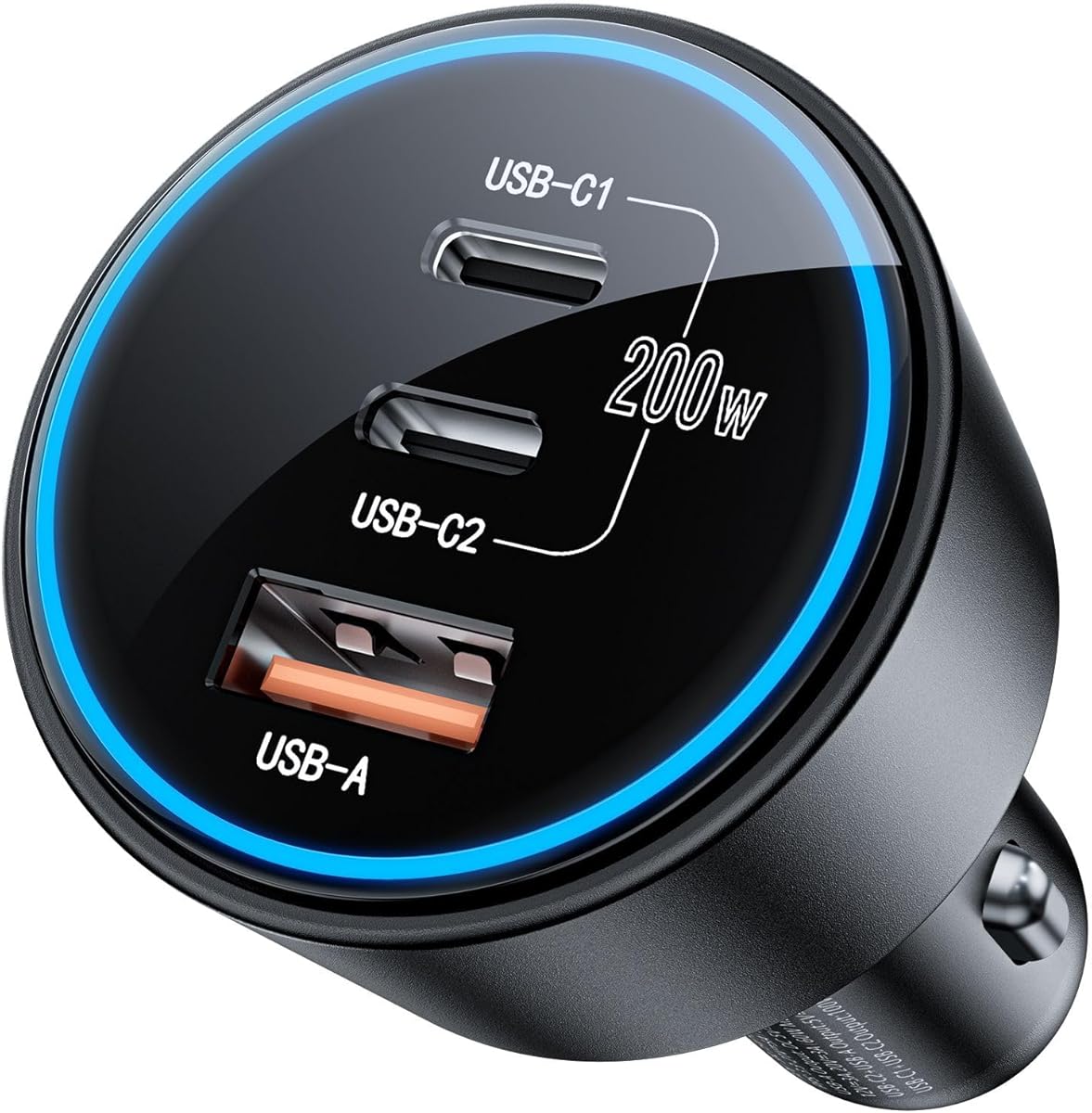
The ROADRESS 200W USB-C Car Charger combines a 4.6 rating with direct high-output USB charging. It is a strong budget-oriented option for travelers whose devices use USB-C or USB-A and do not need conventional wall outlets.
We may earn a commission when you buy through this link, at no additional cost to you.
Two Type-C ports can deliver up to 100W each, while the USB-A port is listed at up to 60W, with a combined maximum of 200W. The charger supports QC4.0, QC3.0, PD3.0, PPS, SCP/FCP, and AFC fast-charging protocols, improving its usefulness across phones, tablets, laptops, and portable gaming devices.
Safety features include over-current, over-voltage, and over-temperature protection. The description also mentions a trickle mode intended to avoid overcharging phones. An ice-blue ambient LED ring makes the connection easier to locate at night, while a new heat-dissipation process is designed to maintain cooler operation.
The charger works with a 12V to 24V input range and is listed for MacBook Pro and Air, notebooks, iPad Pro, several iPhone models, AirPods Pro, Steam Deck, Nintendo Switch, and Galaxy devices. It is a compelling choice for USB-C-centric travel kits, though owners of wall-plug-only laptops will need an inverter.
A 100W USB-C port can serve demanding compatible laptops, while the second Type-C port and 60W USB-A output handle additional devices. This makes the charger more than a basic phone adapter.
Compatibility with several major fast-charging protocols means the charger can negotiate suitable output for more device types. That broad support is valuable for mixed travel kits containing phones, tablets, handhelds, and notebooks.
We may earn a commission when you buy through this link, at no additional cost to you.
The BESTEK 400W Car Power Inverter is the highest-capacity conventional inverter in this guide and carries a 4.6 rating. It is intended for travelers who need more headroom than a compact 150W or 200W model can provide.
We may earn a commission when you buy through this link, at no additional cost to you.
Its 400W DC-to-AC output feeds two 110V AC outlets, while a 30W USB-C Power Delivery port and a Quick Charge 3.0 USB-A port support smaller devices. The product information identifies laptops, breast pumps, DVD players, bottle warmers, smartphones, tablets, and cameras among compatible loads.
Safety features include an ETL certification, a built-in 40-amp fuse, and protection against overheating, overvoltage, undervoltage, and short circuits. The enclosure is designed around an iPhone-sized format, and the 32-pin cigarette lighter plug is intended to fit a broad range of vehicles.
This model is a good recommendation for mobile professionals, families, and campers who want standard AC outlets plus modern USB connections. Buyers must still respect the output ceiling, keep the unit in a ventilated location, and avoid loads beyond its rating. The 12-month product replacement warranty provides direct manufacturer support.
A 400W continuous rating creates more flexibility for compatible laptops and household-style travel devices. The additional capacity can also reduce strain compared with using the maximum allowance of a much smaller inverter.
Two AC outlets serve wall-plug accessories, while USB-C and Quick Charge USB-A ports support contemporary mobile devices. Combining these output types reduces the number of separate adapters required during a journey.
We may earn a commission when you buy through this link, at no additional cost to you.
The Pro Chaser 400W Power Inverter has a 4.5 rating and focuses on high output with flexible placement. It provides 400 watts of continuous DC-to-AC power and an 800-watt peak rating.
We may earn a commission when you buy through this link, at no additional cost to you.
Two 110V AC sockets support conventional wall-plug devices, including laptops, breast pumps, DVD players, and bottle warmers. Two 3.1A USB ports handle phones, tablets, and cameras. The main physical advantage is the included 30-inch, or 75-centimeter, cord, which provides more freedom in positioning the inverter.
Protections cover overloads, voltage issues, and overheating. A smart cooling fan activates at 113 degrees Fahrenheit, helping the unit maintain stable operation. The product is intended for use in a cool, dry environment, and its safety notice appropriately emphasizes that the AC output should be handled with care.
The Pro Chaser is a good fit for road trips, outdoor work, and mobile setups where placement flexibility matters. Its cord makes it easier to keep the socket in reach or place the inverter somewhere with better ventilation. As with any high-output vehicle inverter, users should respect the continuous limit, monitor heat, and avoid unsupported high-draw appliances.
The extended cord allows the main body to remain near the cigarette lighter outlet while the AC sockets reach a passenger or work area. That separation can make laptop charging more convenient during long journeys.
The cooling system is designed to activate as temperature rises, while overload and voltage protections address common electrical risks. Keeping the inverter cool and dry remains the user's responsibility.
We may earn a commission when you buy through this link, at no additional cost to you.
The FOVAL 150W Car Power Inverter is a compact solution for lighter laptop and travel-device use. It has a 4.5 rating and provides 150 watts of continuous 12V DC to 110V AC output.
We may earn a commission when you buy through this link, at no additional cost to you.
A single AC outlet supports a compatible laptop or other wall-powered accessory. Two USB ports can charge most phones and tablets simultaneously with a maximum total output of 3.1A. The product information also lists breast pumps, CPAP machines, nebulizers, game consoles, Kindles, televisions, DVD players, lights, and iPads among possible uses.
The aluminum housing measures 3.2 by 2.5 by 1.5 inches and weighs just over eight ounces, making it easy to carry. A built-in fuse and protections against overheating, undervoltage, overvoltage, short circuits, overload, and overcharging strengthen its safety proposition. An integrated cooling fan is designed to reduce heat and support quiet operation.
This inverter is best for a traveler with one laptop and a couple of small devices rather than a household of power-hungry electronics. The 150W limit is the decisive factor: it should only be used with compatible loads that remain comfortably within its output. Its small size, simple layout, and durable shell make it a sensible lightweight option.
The credit-card-sized body and lightweight aluminum shell help the inverter fit into tight storage spaces. Its uncomplicated outlet arrangement also makes it approachable for occasional travelers.
Despite its small size, the inverter includes a fuse, thermal safeguards, voltage protection, overload protection, and a cooling fan. Those features add confidence when charging sensitive electronics on the road.
We may earn a commission when you buy through this link, at no additional cost to you.
Choosing a vehicle laptop charger starts with the laptop's power requirements and connector. Output capacity, charging protocols, vehicle input, protection features, cable design, and intended use should all influence the final decision.
A power inverter converts the vehicle's 12V DC supply into conventional 110V AC power, allowing a laptop's normal wall charger to be used. This is the broadest approach and also supports other AC-powered travel equipment. A direct USB-C car charger is simpler, more compact, and often more efficient for compatible USB-C laptops, but it does not provide household outlets.
Choose an inverter when the laptop or accessory needs a standard plug. Choose direct USB-C when the computer supports the charger's voltage profiles and connector, especially when minimizing the number of adapters is the priority.
The continuous power rating is the more important number to check because a laptop may draw sustained power while working. Products in this guide range from 150W to 400W for conventional inverters, while direct chargers offer different maximum outputs. A higher inverter capacity provides more headroom, but it should never be treated as permission to exceed the connected load.
Match the charger to the device rather than buying only for the largest advertised number. Verify the laptop adapter's input requirement and leave sensible headroom for travel devices that may share the inverter.
A connector that physically fits is not enough for USB-C charging. The charger and laptop must support compatible power-delivery profiles and negotiate a safe voltage and current. Relevant protocols in this selection include USB-C Power Delivery, PD3.0, PPS, QC3.0, QC4.0, SCP/FCP, and AFC. Output information should also be checked against the exact laptop model.
For broad compatibility, look for multiple voltage outputs and broad protocol support. If the laptop is not listed, confirm its charging specification and connector before purchase, because USB-C implementations can vary even among similar-looking ports.
Most passenger-vehicle inverters require a 12V DC cigarette lighter outlet, and several products explicitly exclude 24V systems. Direct USB-C chargers may accept a wider 12V to 24V input range, making them useful in a broader mix of cars, trucks, buses, campers, and motorcycles. Always check the vehicle voltage and socket format before buying.
Avoid assuming that a plug fits means the charger is electrically compatible. Review the input range, maximum input current, connector type, and any stated restrictions on the vehicle or use environment.
A useful vehicle charger should include protection against overheating, overvoltage, undervoltage, overload, and short circuits. A built-in fuse adds another layer of defense, while temperature-responsive cooling can help maintain performance during extended use. Some models also carry ETL, UL, CE, FCC, or RoHS credentials, which can provide useful evidence of design and compliance standards.
Prioritize products with multiple safeguards rather than relying on a single protection feature. Protection does not excuse improper loads, so the device's power limit, ventilation needs, and manufacturer instructions must still be followed.
The number of outputs determines how easily a travel group can stay connected. Two AC outlets support more than one wall-powered device, while four USB ports reduce the need for separate phone and tablet adapters. Direct chargers can be especially efficient for travelers who carry several USB-C devices and already own suitable cables.
Count the device types and realistic simultaneous loads before choosing. A large port count is beneficial only if the adapter supports those devices and the combined draw remains within the electrical limits.
Cable design affects both convenience and storage. The PWR+ direct charger has a ten-foot cord, the 100W USB-C model includes a 1.8-meter cable, and the Pro Chaser inverter uses a 30-inch cord. A longer cable can place power within reach, but it also takes more space. Inverters without extended cords are easiest to plug directly into the front console.
Consider where the adapter will live in the vehicle and how far the laptop must sit from the outlet. Compact, lightweight designs are generally easier to carry between vehicles or pack for camping.
Passenger cars, vans, RVs, motorcycles, and other vehicles offer different socket access, electrical systems, and ventilation. Camping may call for multiple outputs and quiet cooling, while mobile office use may favor a long cable and dependable laptop charging. Hot vehicles also require attention to placement and airflow because heat reduces the safe operating margin.
Match the charger to the environment rather than selecting solely by output wattage. Consider the length of each trip, the number of travelers, likely device loads, and whether the adapter must remain unattended.
Before connecting the charger, confirm that the vehicle electrical system matches its input requirement. Start the vehicle if needed to maintain a stable battery supply, plug the adapter firmly into the cigarette lighter outlet or 12V accessory socket, and check that the power LED or indicator is operating before connecting a laptop.
Connect the laptop or other device and monitor the initial charging behavior. Do not exceed the continuous output rating, avoid high-power heating appliances, and do not use an inverter designed for 12V systems with a 24V source. If the charger becomes unusually hot, smells unusual, stops working, or shows a fault indication, disconnect it and inspect the setup.
Keep the unit ventilated and away from direct sun, dampness, and combustible materials. Use the supplied cable or a properly rated cable when the charger relies on USB connections, and avoid bending the attached lead sharply. Unplug the adapter before changing vehicles, storing it for long periods, or performing any inspection.
A standard vehicle USB port usually does not provide enough power for most laptops. A dedicated USB-C car charger draws from the 12V accessory socket and uses Power Delivery to negotiate a suitable charging rate. A full-size car inverter is another option when the laptop requires a conventional 110V wall plug.
For most laptops, a 300W inverter provides ample capacity because typical laptop chargers consume far less than the inverter's maximum continuous output. The laptop's power brick and any devices sharing the inverter must remain within the limit. Do not use the inverter for hair dryers, electric heaters, or other high-draw appliances.
Not necessarily. A compatible 100W USB-C car charger can often charge a USB-C laptop more simply and with fewer components than an inverter. Check the exact laptop model, required voltage, maximum wattage, and supported Power Delivery profiles before choosing the direct charger.
Continuous power is the level the inverter can sustain during normal operation. Peak power is a short-term maximum intended for brief surges and should not be used as a target for sustained loads. A laptop and its peripherals should be evaluated against the continuous rating, with reasonable headroom left.
It depends on the charger. Several conventional inverters in this guide are restricted to 12V systems, while some direct USB-C adapters accept 12V to 24V input. Read the specifications carefully and confirm the vehicle's electrical system. Never connect a 12V-only inverter to a 24V socket.
Cooling fans typically accelerate as internal temperature rises or as output demand increases. A louder fan during heavy use can be normal, especially in a hot vehicle. Persistent unusual noise, excessive heat, or a burning smell is not normal and calls for disconnecting the device and checking the load, ventilation, and connection.
That depends on the charger and the combined load. The PiSFAU and FOVAL 200W models each offer two AC outlets and four USB ports, while the 300W vehicle inverter includes two AC outlets plus four USB-A and two USB-C ports. More ports do not mean unlimited output, so verify each device's power requirements.
An inverter draws power from the vehicle and can contribute to battery drain if it operates for a long time with the engine off. The effect depends on the output load and the vehicle's battery condition. For extended use, running the engine and monitoring the electrical system is the safer approach, while avoiding high-power loads.
The BESTEK 300W inverter stands out as the most versatile general recommendation because it combines two AC outlets, two USB ports, strong safety features, and a generous warranty. For maximum conventional inverter capacity, the BESTEK 400W model adds power and modern USB-C charging, while the ROADRESS 200W charger is a streamlined choice for USB-C-centric travel kits.
Before buying, prioritize the connector your laptop actually uses, then confirm output, supported voltage profiles, vehicle input, and simultaneous device load. Direct USB-C chargers are ideal for compatible modern notebooks, while inverters make more sense when a standard wall plug or a broader mix of travel electronics is required.
Prices, availability, and product details can change, so readers should review the current listing before ordering. Checking the exact laptop model, charger requirements, and manufacturer guidance is especially important because compatibility claims cannot replace a direct match to the device's power specification.

