
Denon AVR-X4800H
4.5Editor score
Nine powered channels
Ten HDMI connections
Dolby Atmos and DTS:X Pro
Our expert guide compares 10 AV Receiver for 4 Ohm Speakers, comparing channel power, connectivity, surround formats, setup, and control for home theaters.
An AV receiver for 4 Ohm speakers must do more than deliver enough current on each channel. It also needs compatible amplification, clean surround processing, flexible source switching, and controls that make everyday listening easier. The right model can anchor a compact theater, serve a larger media room, or provide a practical path toward multichannel and immersive audio.
We compared all 10 products using the supplied specifications, focusing on channel configuration, stated speaker-impedance support, power claims, video and audio formats, connectivity, calibration tools, streaming functions, and physical control options. The list includes dedicated home-theater receivers, stereo receivers, and multi-channel amplifiers with different levels of home cinema capability.
Each pick reveals what it is best suited for, while the ratings and feature summaries provide a quick way to narrow the field. Specifications can vary by channel configuration and operating mode, so check your speaker impedance and the receiver manual before connecting equipment. Prices and availability also change, making current listing details worth confirming before purchase.
4.5Editor score

4.2Editor score

4.5Editor score
The comparison below places the ten receivers by channel layout, amplification, connectivity, and practical theater features, showing why 4 Ohm suitability depends on the stated impedance range, output configuration, and intended use.




The Denon AVR-S570BT combines a conventional 5.2-channel home-theater layout with four HDMI 2.1 inputs, 8K video support, gaming-oriented features, and wireless music streaming. Its 4.2 rating reflects a capable general-purpose receiver, but its strongest appeal is the combination of modern video handling and an approachable setup process. It is particularly relevant for buyers assembling a 5.1 system around nominally 4 Ohm speakers.
We may earn a commission when you buy through this link, at no additional cost to you.
The stated amplification is 70 watts per channel, with five channels of power, while HDMI connectivity includes four 8K inputs and one output. The supplied feature list also identifies eARC, HDR, HLG, Dolby Vision, HDR10+, Dynamic HDR, VRR, and Quick Frame Transport. For speakers, this makes the receiver much more of a modern theater hub than a simple stereo amplifier. It also supports DTS HD Master, Dolby TrueHD, and 5.1 surround sound.
Its key compromise is that the 5.2 configuration provides fewer powered channels than larger surround receivers. A subwoofer is supported, but buyers planning for 7.1 or height channels should not treat this model as a direct substitute for a 9-channel receiver. The supplied data does not state the AVR-S570BT's minimum speaker impedance, so anyone with 4 Ohm speakers should verify the manual and individual speaker requirements before connecting all channels.
The on-screen setup assistant, specific equalization settings, Smart TV remote integration, and Denon Remote App make it a strong recommendation for a new home-theater system. It is especially useful for buyers who want 8K and gaming support without moving to a large premium chassis. Music playback also benefits from Bluetooth and streaming-service access, allowing the receiver to serve double duty for movies, television, and casual listening.
Overall, the AVR-S570BT is the most balanced option in this list for a conventional 5.1 theater with 4 Ohm speakers. Its modern HDMI feature set, guided configuration, and useful streaming functions outweigh the limitation of five amplified channels, provided the buyer confirms electrical compatibility.
Four HDMI 2.1 inputs, 8K pass-through, eARC, VRR, and Quick Frame Transport create a current-looking foundation for a television, game console, media player, and streaming device. That makes the receiver especially relevant when the priority is a capable but relatively conventional home cinema.
The on-screen HD Setup Assistant provides step-by-step connection guidance, while equalization settings help optimize surround playback. Smart TV remote support and the Denon Remote App add practical control options for daily use.
We may earn a commission when you buy through this link, at no additional cost to you.
The Sony STRDH190 is a two-channel home stereo receiver with 100 watts per channel, Bluetooth, a phono input, flexible analog connections, and support for as many as four speakers through A/B switching. Its 4.5 rating and strong amplification specification make it an appealing music-first option, although its stated 6–16 ohm range means it is not a conventional match for 4 Ohm speakers.
We may earn a commission when you buy through this link, at no additional cost to you.
Its headline strength is clean, direct stereo amplification. The receiver includes four stereo RCA audio inputs, a 3.5 millimeter input, stereo RCA output, FM radio with 30 presets, a full-size headphone jack, and a large-capacity power transformer. Bluetooth adds convenient streaming for music, podcasts, and other compatible content, while high-resolution audio support is highlighted for listeners who want more detail from digital sources.
The impedance limitation is the most important consideration. Although 4 Ohm speakers are common in home audio, the supplied specification lists speaker impedance as 6–16 ohms. Buyers should not assume that the receiver can safely drive 4 Ohm loads merely because its power output is sufficient. The manufacturer guidance should be checked for any permitted exception, and an external amplifier may be needed if the manual does not approve 4 Ohm operation.
This is a strong recommendation for a two-channel music system, a secondary listening area, or a setup where separate powered speakers handle the surround channels. Its A/B switching can operate pairs together or in separate zones, and the low-profile 5.25-inch chassis is convenient for conventional AV cabinets. It is best for users who do not need movie soundtracks decoded into multichannel surround.
For the exact search topic, the STRDH190 is a budget-capable stereo receiver but not the safest 4 Ohm match among these products. Its inclusion highlights an important distinction: adequate power alone does not override impedance requirements. Confirm compatibility first, then consider it for strong stereo playback, phono use, and flexible speaker-zone control.
The rated 100 watts per channel makes the STRDH190 suitable for a dedicated stereo system, particularly when paired with room-appropriate speakers. Its power transformer and high-resolution audio emphasis target music playback rather than surround-sound processing.
A/B switching allows two speaker pairs to play together or in separate zones. Phono, stereo RCA, 3.5 millimeter, Bluetooth, and FM functions cover many common listening sources in a compact package.
We may earn a commission when you buy through this link, at no additional cost to you.
The Sony STRDH590 is a 5.2-channel surround receiver aimed at accessible home-theater setups. It combines a 725-watt total power claim, four HDMI inputs and one output, 4K HDR pass-through, Bluetooth, radio, and virtual front surround processing. Its 4.3 rating reflects a versatile middle ground, but the supplied 6 ohm specification prevents a direct recommendation for standard 4 Ohm loads.
We may earn a commission when you buy through this link, at no additional cost to you.
For listeners with fewer physical speakers, S Force PRO can create virtual front surround effects from a two-speaker setup. A full 5.1 arrangement with a subwoofer remains the more natural use for its powered channels. Video support includes 4K HDR and HDCP 2.2, while Audio Return Channel permits a connected television to send sound back to the receiver.
Connectivity is varied for a midrange-style receiver: four stereo RCA audio inputs, one optical digital input, one coaxial digital input, Bluetooth, an FM tuner, and a quarter-inch headphone jack. Bluetooth Standby can turn the receiver on from a connected phone. These features make it useful beyond movies, although the supplied data does not describe the same broad smart-home streaming platform offered by the newer Denon models.
The main caveat is impedance. A stated 6 ohm specification means buyers with 4 Ohm speakers should verify the manual before operation. One possible explanation is that the unit is rated for 6 Ohm speakers under certain configurations, but the list does not provide enough detail to claim safe 4 Ohm support. A separate amplifier or a different receiver with a lower stated minimum would be the more conservative path.
The STRDH590 remains a good fit for buyers who value a native surround receiver, 4K video, and flexible source options at a straightforward level. It is also useful for smaller systems where virtual surround provides a shortcut. For a 4 Ohm speaker set, however, impedance compatibility must be confirmed before it becomes the primary recommendation.
S Force PRO offers a way to simulate front surround effects with only two speakers. This is useful when a full five-speaker arrangement is impractical, although a properly configured 5.1 system remains preferable for cinema.
Four HDMI inputs, optical and coaxial digital audio, stereo RCA, Bluetooth, and an FM tuner provide several paths for movies, television, games, and music. Audio Return Channel also simplifies television-based listening.
We may earn a commission when you buy through this link, at no additional cost to you.
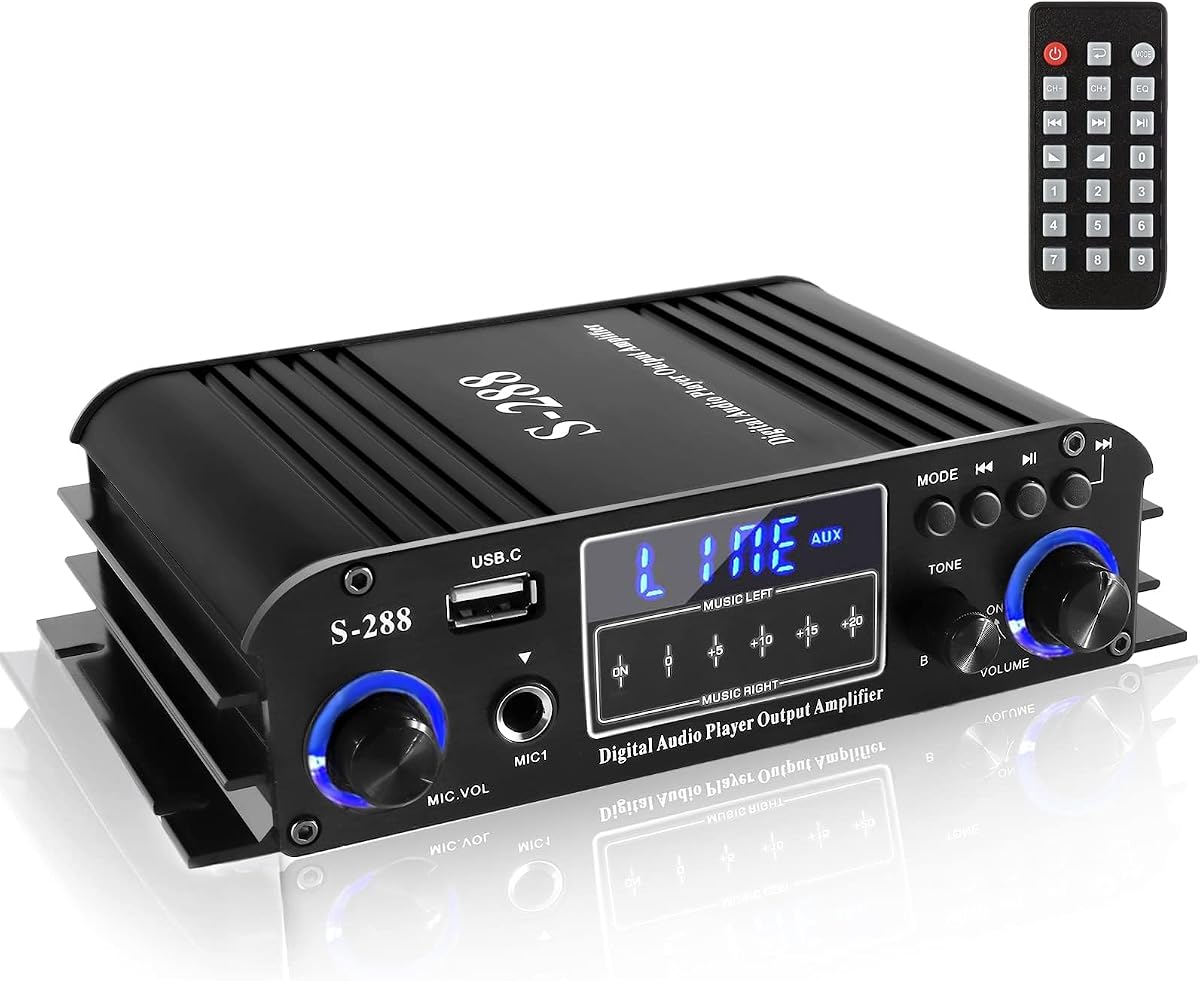
The Pyle PDA77BU is a four-channel Bluetooth amplifier with an 800-watt peak-power claim, USB and SD playback, FM radio, several analog inputs, RCA output, and dedicated karaoke functions. Its 4.2 rating makes it a practical choice for mixed-use rooms, but it lacks the detailed theater processing and explicit impedance information found on several conventional AV receivers.
We may earn a commission when you buy through this link, at no additional cost to you.
Four channels provide more flexibility than a basic stereo receiver. Bluetooth 5.0 supports streaming from phones, tablets, and laptops, while USB, SD card, AUX, RCA, and 3.5 millimeter connections cover local and legacy sources. A front LED display and physical control panel make the operating state visible without relying entirely on a phone or television menu.
Its two quarter-inch microphone inputs are notable. Independent microphone controls, microphone volume, reverb, and delay make the PDA77BU well suited to karaoke, presentations, or small events. These functions are less central to a conventional living-room home theater, but they provide a distinct reason to choose it over a standard surround receiver.
The specifications list 800 watts as peak power rather than continuous RMS output, so the figure should not be compared directly with the 70-watts-per-channel and 100-watts-per-channel ratings of the Denon and Sony models. Speaker impedance is not stated in the supplied information. Buyers with 4 Ohm speakers should therefore seek manufacturer confirmation and avoid judging suitability from peak wattage alone.
This receiver is a good recommendation for someone who wants one compact unit to handle music, a television, external playback devices, and karaoke functions. It is less convincing as a dedicated cinema processor because the supplied data does not mention surround decoding, HDMI, or room calibration. Its strengths lie in source variety, event-friendly features, and straightforward operation.
Two microphone inputs with independent volume, reverb, and delay controls make this model useful beyond conventional home audio. These controls are especially helpful for parties, small gatherings, and presentations.
Bluetooth 5.0, USB, SD, AUX, RCA, 3.5 millimeter, and FM functions allow content to come from modern and traditional sources. The front-panel display provides clear status feedback for everyday operation.
We may earn a commission when you buy through this link, at no additional cost to you.
The Romicta 50Wx4 is a compact four-channel Class D amplifier that can power up to four passive speakers simultaneously. Its 50-watt RMS per channel rating is more useful for comparison than the separate 1200-watt peak-power claim. With Bluetooth 5.0, USB, SD, AUX, microphone input, and FM radio, it targets flexible home audio rather than a fully equipped cinema processor.
We may earn a commission when you buy through this link, at no additional cost to you.
The stated harmonic distortion of 0.04 percent and high-capacity transformer position the device as a hi-fi-oriented amplifier. Bass and treble controls offer basic tonal adjustment, while the included remote handles volume and settings from across the room. Its aluminum casing and bright LED display add a more robust physical design than many basic karaoke-style amplifiers.
Four independently amplified channels are useful for a modest surround arrangement, desktop theater, multi-room music setup, or paired zone system. However, the supplied information does not list Dolby or DTS decoding, room correction, advanced HDMI switching, or a specific supported impedance range. That limits its usefulness for buyers expecting automatic surround processing and calibrated theater sound.
For 4 Ohm speakers, the conservative conclusion is that compatibility must be checked with the manufacturer or manual. The 50-watt RMS figure indicates meaningful continuous power, but it does not by itself establish that the output stage is designed for a 4 Ohm load. Users should also avoid confusing the 1200-watt peak claim with the model's usable output under continuous multi-channel operation.
The Romicta is a worthy option for compact, flexible systems where four passive speakers and straightforward source control matter more than advanced surround formats. It is particularly suitable for casual music, television, small gatherings, and karaoke. A dedicated AV receiver is the better choice when home-theater processing, HDMI features, and room setup guidance are priorities.
The amplifier can run up to four passive speakers at once, making it practical for small surround layouts and separate audio zones. Its stated 50-watt RMS output provides a clearer basis for comparison than peak wattage.
Bluetooth, USB, SD, AUX, FM radio, microphone input, and remote control cover many listening and event uses. The aluminum enclosure and LED display suit a compact entertainment setup.
We may earn a commission when you buy through this link, at no additional cost to you.
The Pyle PT796BT.5 is a 7.1-channel integrated amplifier with a stated 4–16 ohm speaker-impedance range, making it one of the clearest matches for the 4 Ohm speaker focus of this guide. It also provides 4K UHD, 3D, and Blu-ray pass-through, a dedicated RCA subwoofer output, HDMI, Bluetooth, radio, USB, and dual microphone inputs.
We may earn a commission when you buy through this link, at no additional cost to you.
Its seven-channel configuration gives it more theater potential than the 5.2 models in the list. The dedicated subwoofer output is useful for adding bass, while the supplied 4–16 ohm range provides a documented starting point for 4 Ohm speakers. Digital signal processing, echo, bass, treble, microphone, and volume controls add further adjustment options.
The 2,000-watt figure is described as peak power, so it should not be treated as a precise continuous output rating for every channel. The product also sits within a broad home-theater amplifier format rather than the more refined Denon and Sony receiver designs. Its 3.4 rating is the lowest in this collection and suggests that buyers should examine the full listing and current customer feedback carefully.
Despite that lower rating, the combination of 7.1 channels, 4 Ohm compatibility, 4K video, and multiple source inputs is unusually relevant to the search topic. The main practical caution is that the supplied data does not mention room calibration, detailed surround decoders, or advanced gaming features. Users seeking polished theatrical processing may find a more specialized receiver preferable.
The PT796BT.5 is a reasonable value-oriented choice for a larger speaker installation that includes 4 Ohm speakers, particularly when a 7.1 layout, subwoofer, and 4K television are desired. Its lower rating and peak-power marketing warrant care, but the explicit 4–16 ohm support makes it easier to shortlist than units without a published impedance range.
The supplied 4–16 ohm range directly supports 4 Ohm speaker use. This clear specification is a major advantage over models that omit impedance information, although buyers should still follow the manual's connection and configuration guidance.
HDMI, optical and coaxial digital audio, RCA, USB, and a dedicated subwoofer output support a broad source system. The 4K UHD, 3D, and Blu-ray pass-through features suit a modern television-centered installation.
We may earn a commission when you buy through this link, at no additional cost to you.
The Pyle 4-Channel Audio Amplifier is a 500-watt peak-power home and commercial amplifier with a stated 4–8 ohm impedance range. Its 4.0 rating, four powered channels, and broad input selection make it a practical option for 4 Ohm speakers, particularly in multi-room, commercial, or karaoke-style installations.
We may earn a commission when you buy through this link, at no additional cost to you.
The source list includes USB, microSD, AUX, audio input and recording, built-in FM radio, and RCA subwoofer output. Two quarter-inch microphone inputs support echo and independent adjustments, while a talk-over button temporarily reduces the playing audio for paging, announcements, or spoken content. The included remote adds convenient distant control.
Compared with the Denon AVR-S570BT or Sony STRDH590, this amplifier is less focused on cinema processing and modern HDMI switching. It is designed more as a versatile power and source hub. That makes it useful for parties, presentations, background music, and simple home theater arrangements, but less suitable for a buyer who prioritizes Dolby decoding, advanced gaming features, or a formal calibration process.
Its 500-watt peak-power claim needs careful interpretation because the specification does not give a continuous RMS rating. A 4 Ohm speaker set falls within the stated range, but channel loading and power availability may vary with the number of connected speakers and operating mode. The included subwoofer output is a bonus for bass, although it is a single RCA connection rather than the more specialized subwoofer arrangements found on higher-end cinema receivers.
The amplifier earns its place as a straightforward 4–8 ohm model with genuinely useful event and announcement controls. It is best for users who need several speakers, varied sources, and a talk-over feature more than elaborate home-theater processing. For dedicated movie use, confirm the video routing requirements and choose a receiver with suitable HDMI switching.
Dual microphone inputs, echo, and talk-over functionality extend beyond ordinary home listening. These controls make the amplifier useful for announcements, paging, presentations, and karaoke.
The stated 4–8 ohm range directly accommodates nominal 4 Ohm speakers. Its four-channel design also allows more than a conventional stereo pair, provided the system is configured within the manufacturer's guidance.
We may earn a commission when you buy through this link, at no additional cost to you.
The Denon AVR-X4800H is the most capable premium receiver in the list, combining nine amplified channels at 125 watts each with extensive 8K and 4K/120 HDMI support. Its 4.5 rating is joined by a broad format list that includes Dolby Atmos, DTS:X Pro, IMAX Enhanced, Auro 3D, Dolby Height Virtualization, and DTS Virtual:X.
We may earn a commission when you buy through this link, at no additional cost to you.
Ten HDMI ports—seven inputs and three outputs—provide exceptional routing flexibility. HDCP 2.3, eARC, HLG, Dolby Vision, HDR10+, and Dynamic HDR pass-through support contemporary displays. Analog and digital inputs, a phono input, and four RCA or XLR subwoofer outputs make the system adaptable to varied source and bass arrangements.
The nine-channel amplifier can support a large surround arrangement and add height-based effects. Virtualization can create overhead sound in 7.1, 5.1, or 2.1 arrangements when physical height speakers are absent. Four RCA or XLR subwoofer outputs provide particularly strong integration for demanding bass setups.
As with the smaller Denon AVR-S570BT, the supplied data does not state a minimum speaker impedance. That omission should be checked against the manual when using 4 Ohm speakers. The receiver's scale also introduces practical trade-offs: a more complex setup, more demanding room requirements, and a likely larger physical footprint. Buyers should match the channel count and processing capability to their actual room rather than simply selecting the most elaborate model.
For a serious home theater with 4 Ohm speakers, the AVR-X4800H is the premium recommendation because its nine channels, 125-watt output, extensive HDMI routing, and broad surround-format support create considerable long-term flexibility. It is especially persuasive for owners who intend to build beyond a modest 5.1 system and value advanced processing and multi-room audio.
Nine amplified channels provide room to build a larger theater system while retaining flexibility for height speakers. Virtual processing options make the receiver useful even when the installed layout is limited to 7.1, 5.1, or 2.1.
Seven HDMI inputs and three outputs support multiple source devices, displays, and zone arrangements. 8K, 4K/120, eARC, HDCP 2.3, and major HDR formats make this a strong platform for a modern media room.
Built-in HEOS Wi-Fi enables streaming services such as Pandora, Spotify, and TIDAL, with the goal of extending hi-fi audio throughout the home. The receiver can therefore function as both a cinema hub and a networked music component.
We may earn a commission when you buy through this link, at no additional cost to you.
The Pyle PT796BT is a 7.1-channel Bluetooth home-theater amplifier with a stated 4–16 ohm impedance range, 2,000-watt peak-power claim, 4K UHD support, and a broad selection of analog and digital inputs. Its 3.6 rating is the second-lowest in the list, so the technical feature set should be weighed carefully against current customer feedback.
We may earn a commission when you buy through this link, at no additional cost to you.
The receiver supports HDMI, USB, RCA, optical, and coaxial digital audio, along with a dedicated RCA subwoofer output. Bluetooth allows convenient streaming from phones, tablets, and computers. The supplied data does not identify supported HDMI input or output counts, which is a meaningful limitation for buyers who want to compare source-switching flexibility directly with the Denon models.
Its 4–16 ohm range makes it a documented match for nominal 4 Ohm speakers. The seven-channel layout can support a complete surround arrangement, and digital signal processing offers controls for echo, bass, treble, microphone, and volume. Overcurrent, short-circuit, and overvoltage protection are also listed as built-in safeguards.
The 2,000-watt maximum is a peak-power statement, so it should not be compared with a continuous per-channel output specification. The relatively low rating may reflect concerns not visible in the concise feature data, such as real-world performance, feature quality, or overall value. A potential buyer should review the current product page and user feedback for those details.
The PT796BT is a practical option when 4 Ohm compatibility, 7.1 channels, and numerous source connections are the priorities. It is less suitable for a buyer who prioritizes detailed surround decoding, advanced room calibration, extensive HDMI routing, or refined premium construction. Within that narrower brief, it offers substantial connection flexibility.
The 7.1-channel configuration provides more powered speaker positions than a 5.2 receiver. Combined with a dedicated subwoofer output, it can support a conventional full-size surround installation.
HDMI, optical, coaxial, RCA, USB, and Bluetooth cover current and legacy sources. The digital VFD, front controls, included remote, and protection circuitry support convenient operation and system safeguards.
We may earn a commission when you buy through this link, at no additional cost to you.
The Pyle 5.2 Receiver is a surround amplifier for buyers seeking a conventional five-speaker-and-subwoofer layout with 4K Ultra HD pass-through and Bluetooth streaming. Its 4.0 rating reflects a straightforward alternative to more specialized cinema receivers, while its 1,000-watt maximum power claim requires careful comparison with continuous output specifications.
We may earn a commission when you buy through this link, at no additional cost to you.
The five powered channels align closely with a standard 5.1 setup, and the subwoofer channel provides dedicated low-frequency support. A digital audio interface allows a computer's digital signal to be connected, while USB, MP3 playback, and Bluetooth add convenient local and wireless sources. The stated goal is an immersive home-audio experience without requiring a large feature list.
For 4 Ohm speakers, the supplied data does not include a published impedance range. As a result, it should not be assumed that every 4 Ohm configuration is supported, particularly when multiple channels are under load. Confirmation from the manual or manufacturer is important. Likewise, the 1,000-watt maximum figure is not directly comparable with the per-channel or RMS ratings listed for other models.
The receiver's strongest points are its familiar channel configuration, modern 4K video support, flexible digital connections, and built-in overcurrent, short-circuit, and overvoltage protection. The supplied description does not mention room correction, surround format decoders, advanced HDMI routing, or smart-home streaming, so it is best viewed as an approachable theater amplifier rather than a fully featured cinematic processor.
The Pyle 5.2 Receiver is a reasonable candidate for a basic home theater where a 5.1 layout and modern television are the main requirements. Its 4.0 rating and limited published detail make careful research important, but the core configuration is intuitive. Confirm impedance support and the available video inputs before finalizing the purchase.
Five main channels and a dedicated subwoofer position map directly to a familiar 5.1 home-theater arrangement. This makes the model easier to integrate into rooms where a larger 7.1 or 9.4 system is unnecessary.
4K Ultra HD pass-through supports compatible television setups, while the DAC interface enables digital audio connection from a computer. USB, MP3, and Bluetooth playback broaden the available source options.
We may earn a commission when you buy through this link, at no additional cost to you.
The right receiver depends on channel count, impedance compatibility, source connectivity, and the room you actually want to fill. Reviewing these factors before comparing features prevents a powerful amplifier from being paired with speakers or functions it cannot properly support.
A receiver rated for 4 Ohm speakers should explicitly state that support, or provide manufacturer instructions confirming it under the intended configuration. A low nominal speaker impedance places more demand on the amplifier's output stage, so power ratings alone cannot establish compatibility. Some products list 4–8, 4–16, or 6–16 ohm ranges, and those differences are material. Verify the manual for restrictions involving speaker pairs, subwoofers, or all channels operating simultaneously.
Bottom line: treat a published 4 Ohm range as essential, and never infer safety from wattage alone.
A 2.1 or stereo receiver works well for music and compact listening, while 5.2 models fit conventional home theaters with five main speakers and a subwoofer. A 7.1 receiver adds rear surround options, and a 9.4-channel model supports larger installations and more flexible subwoofer routing. Virtual surround and height virtualization can create effects from fewer physical speakers, but they do not reproduce the exact experience of a complete speaker layout.
Bottom line: choose the smallest channel configuration that comfortably covers your intended room and future plans.
Per-channel RMS or continuous output is generally more informative than a broad maximum or peak-power claim. A receiver that states 70 or 100 watts per channel can be compared more meaningfully across models than one advertising 500, 1,000, or 2,000 watts in aggregate. Manufacturer test conditions, channel loading, and distortion limits can also affect real-world output. Use peak figures to understand marketing claims, not to assume equivalent listening performance.
Bottom line: prioritize clean, documented continuous output and consider how many speakers will operate at once.
Dedicated AV receivers are more likely than generic amplifiers to include surround decoding, HDMI switching, equalization, and room setup tools. The Denon AVR-S570BT offers guided setup and gaming-oriented video features, while the AVR-X4800H adds major immersive formats, height virtualization, and extensive subwoofer outputs. If movie sound is central, these processing and calibration functions can matter more than a large headline power number.
Bottom line: prioritize surround formats, calibration, and source switching for cinema; prioritize clean stereo control for music.
Count the source devices you will connect and the number of displays or zones you expect to use. Four HDMI inputs may suit a modest system, while the AVR-X4800H's seven inputs and three outputs provide much more flexibility. Also verify supported video features, including eARC, 4K or 8K pass-through, 4K/120, VRR, and HDR formats. A receiver that cannot accept the required digital video signal is not a complete solution even if its amplifier is capable.
Bottom line: make a simple source-and-display map, then confirm every required connection and feature.
A good receiver should be understandable after installation. The AVR-S570BT includes an on-screen setup assistant, specific EQ settings, Smart TV remote integration, and a mobile app. Some amplifiers emphasize front-panel controls and included remotes instead, while karaoke-oriented models add microphone volume, echo, delay, and talk-over functions. Consider how often you will change sources, whether family members need direct access, and whether a phone or television is your preferred control surface.
Bottom line: favor clear menus, useful calibration, and a control method that matches your household habits.
A home-theater receiver may also serve as the central music component. Bluetooth is common across the list, while the Denon models also support streaming services through HEOS Wi-Fi. The Sony STRDH190 adds a phono input, FM radio, and high-resolution audio emphasis for a two-channel system. Inputs for computers, turntables, USB storage, and SD cards broaden the experience for listeners who want more than movie and television playback.
Bottom line: ensure the receiver supports the music sources and analog components you already own.
Consider cabinet dimensions, heat clearance, speaker-terminal access, and the number of connections required. Low-profile designs such as the Sony STRDH190 fit conventional AV furniture, while large nine-channel receivers may need a dedicated shelf or cabinet. Microphone-equipped amplifiers can support parties and announcements but may add controls that have little value in a daily theater. Decide which room, source, and presentation features you will actually use.
Bottom line: account for physical space, ventilation, and useful features before finalizing a receiver.
Begin by reading the receiver's manual and checking the manufacturer requirements for speaker impedance, speaker pairs, and power limits. Connect one speaker to each channel and confirm that every wire is attached to the correct terminal. Do not use the supplied speaker-impedance range as a substitute for the manual's specific instructions, particularly when a subwoofer or additional speaker pair is involved.
Use the setup assistant, menus, or calibration tools to identify the channels, assign speaker positions, set subwoofer levels, and choose appropriate crossover and effect settings. Keep the listening level moderate while making adjustments, and allow time to evaluate tonal balance and dialogue clarity. For gaming, television, and music, make sure the selected input, output resolution, HDR mode, and sound field match the source device.
Keep the ventilation area clear, avoid placing the receiver inside a tightly enclosed cabinet unless the manufacturer permits it, and use a surge-protection device appropriate for the installation. Firmware updates can improve compatibility and source handling, so check the manufacturer's support resources periodically. When cleaning the unit, switch it off, disconnect power, use a soft dry cloth, and avoid liquids or abrasive materials around vents and controls.
Yes, but only when its manual or published specifications approve 4 Ohm loads. The products in this guide include models with stated 4–8 and 4–16 ohm ranges, as well as units that list 6 ohm or 6–16 ohm requirements. Check the exact model and intended channel configuration before connecting speakers. Adequate power by itself does not establish electrical compatibility.
The receiver may run hotter, clip more readily, or enter protection, particularly when several channels are active. Some manufacturers permit a limited exception for one connected speaker, but that must be confirmed in the manual. Do not assume an exception is safe. If approval is absent, use the receiver only within its specified range or add a properly rated external amplifier.
A 5.2 receiver is a common choice for a home theater with five main speakers and a subwoofer. It can provide a conventional surround presentation for movies, television, and games. Models such as the Denon AVR-S570BT add modern HDMI, gaming, and setup features, while the Pyle 5.2 Receiver provides a more basic amplification platform. Choose 7.1 or 9.4 channels if you need more physical surround or height-speaker positions.
Not necessarily. A per-channel wattage figure and an aggregate peak-power claim describe different things. Continuous or RMS output is usually more useful for comparing amplifier capability, but room size, speaker sensitivity, distortion, and measured performance also matter. A cleaner 100-watt-per-channel receiver may be preferable to a product whose large headline figure primarily represents peak power.
The speaker impedance and HDMI capability are separate issues. A receiver can be electrically compatible with 4 Ohm speakers yet lack the HDMI switching or video formats required by a modern television system. For convenient television audio, eARC is useful, while multiple HDMI inputs allow a game console, media player, and streaming device to be connected. Match the video features to the display and source equipment independently of the speakers.
Not automatically. A four-channel amplifier is valuable when additional speaker zones or a compact surround layout are needed, but stereo receivers often emphasize traditional two-channel control and music-focused features. The Sony STRDH190 includes A/B switching, phono input, Bluetooth, and FM radio for that role. A four-channel unit such as the Romicta 50Wx4 is more useful when multiple passive speakers are the priority.
Often, yes, because a subwoofer normally has its own amplifier and presents a different load to the receiver. Use the receiver's dedicated subwoofer output when available, and do not connect a passive subwoofer as though it were a regular speaker unless the manual explicitly instructs you to do so. Products such as the Pyle PT796BT.5 and AVR-X4800H provide dedicated or extensive subwoofer outputs.
The correct amount depends on speaker sensitivity, room size, listening distance, and how many channels will operate. More power improves headroom and dynamic control, but compatibility still depends on the receiver's approved impedance range. Use the speaker manufacturer's recommended power range as a starting point, then confirm that the receiver's per-channel output and configuration meet those recommendations.
The Denon AVR-S570BT is the strongest balanced choice for a modern 5.1 theater, combining 8K HDMI support, gaming features, guided setup, and wireless music functions. The Denon AVR-X4800H is the premium selection for larger, more ambitious rooms with nine channels, extensive HDMI routing, and advanced immersive processing. The Sony STRDH190 is the practical music-focused budget option, although its 6–16 ohm specification means it is not a direct 4 Ohm match without confirmation.
Prioritize verified impedance support before comparing wattage, channel count, or decorative features. The Pyle PT796BT.5 and PT796BT explicitly list 4–16 ohm support, while the Pyle 4-Channel Audio Amplifier lists 4–8 ohms. For models without a published range, check the manual carefully. After that, choose the channel layout and processing features that suit the room, sources, and viewing habits rather than the largest specification sheet.
Current prices, availability, manufacturer guidance, and product revisions can change over time. Before buying, confirm the exact receiver's impedance requirements, inspect the latest listing details, and ensure that its inputs support the television, game console, media player, and speakers already in the room. That final compatibility check is essential for a safe and satisfying installation.