
Anker SOLIX C300 Portable Power Station
4.6Editor score
288Wh compact capacity
300W continuous output
Eight versatile charging ports
80 percent recharge in 50 minutes
Anker Power Stations compared by battery capacity, continuous output, charging speed, port selection, expandability, and durability, with expert picks for
Anker power stations combine battery storage, inverters, and multiple charging outputs in portable packages suited to camping, road trips, remote work, and emergency backup. A useful model balances usable capacity, continuous output, charging speed, port variety, weight, and long-term durability rather than relying on one headline specification.
This guide compares ten Anker SOLIX models ranging from compact 288Wh units to expandable 3.84kWh systems for serious household backup. We evaluated the supplied specifications for capacity, wattage, recharge methods, UPS behavior, expansion options, safety features, and practical portability, while recognizing that real runtime depends on the connected loads.
The picks reveal how Anker approaches different needs: the C300 DC is built around portable USB-C charging, the C1000 Gen 2 balances output and capacity, and the S2000 targets higher-energy backup. Larger F-series models add 120V and 240V support, expansion, and EV charging. Prices and configurations can change, so verify current listings before purchasing.
4.6Editor score
4.7Editor score
4.7Editor score
The table below places all ten Anker SOLIX models side by side, emphasizing the differences that most affect portability, device compatibility, charging flexibility, and outage coverage.


The Anker SOLIX C1000 Gen 2 stands out as the most balanced model in this guide, earning a 4.7 rating among buyers while combining a 1,024Wh battery with 2,000W of continuous output. It is large enough for meaningful backup yet positioned as a portable option for RVs, campsites, van trips, and temporary home-office use. The 3,000W peak rating also gives it more headroom for appliances with startup surges.
We may earn a commission when you buy through this link, at no additional cost to you.
Charging speed is one of its clearest advantages. With upgraded HyperFlash technology and the appropriate app setting, the unit can fully recharge at 1,600W in 49 minutes. Solar input of up to 600W provides another route to replenishment, with the supplied specification citing a 1.8-hour recharge under the specified 60V maximum setup. Ten output ports reduce adapter clutter, while TOU mode helps users manage consumption around peak electricity periods.
There are trade-offs. The 1,024Wh capacity remains modest for extended refrigerator, heating, or medical-equipment loads, and the 1,600W wall input does not match the aggressive 6,000W input available on the F3000. The data also does not identify a dedicated expansion battery, so buyers needing substantially more reserve power should consider a larger SOLIX system rather than assuming future expansion is available.
This is the strongest general recommendation for travelers and households that want one station capable of charging many device types without moving into heavy backup-station territory. The fast recharge is particularly valuable when the unit must be replenished between uses. For people needing more than 1kWh, 120/240V circuits, or expansion, the S2000 or F-series is the more logical next step.
A full wall recharge in 49 minutes makes the C1000 Gen 2 easy to keep ready without dedicating an overnight charging window. Users must enable UltraFast recharging in the Anker app, and actual results will depend on compatible input, operating conditions, and the selected settings.
The advertised under 10ms switchover is appropriate for keeping compatible laptops, networking equipment, and CPAP machines running during brief utility interruptions. UPS behavior still depends on the connected device, outlet configuration, and supported operating modes.
We may earn a commission when you buy through this link, at no additional cost to you.
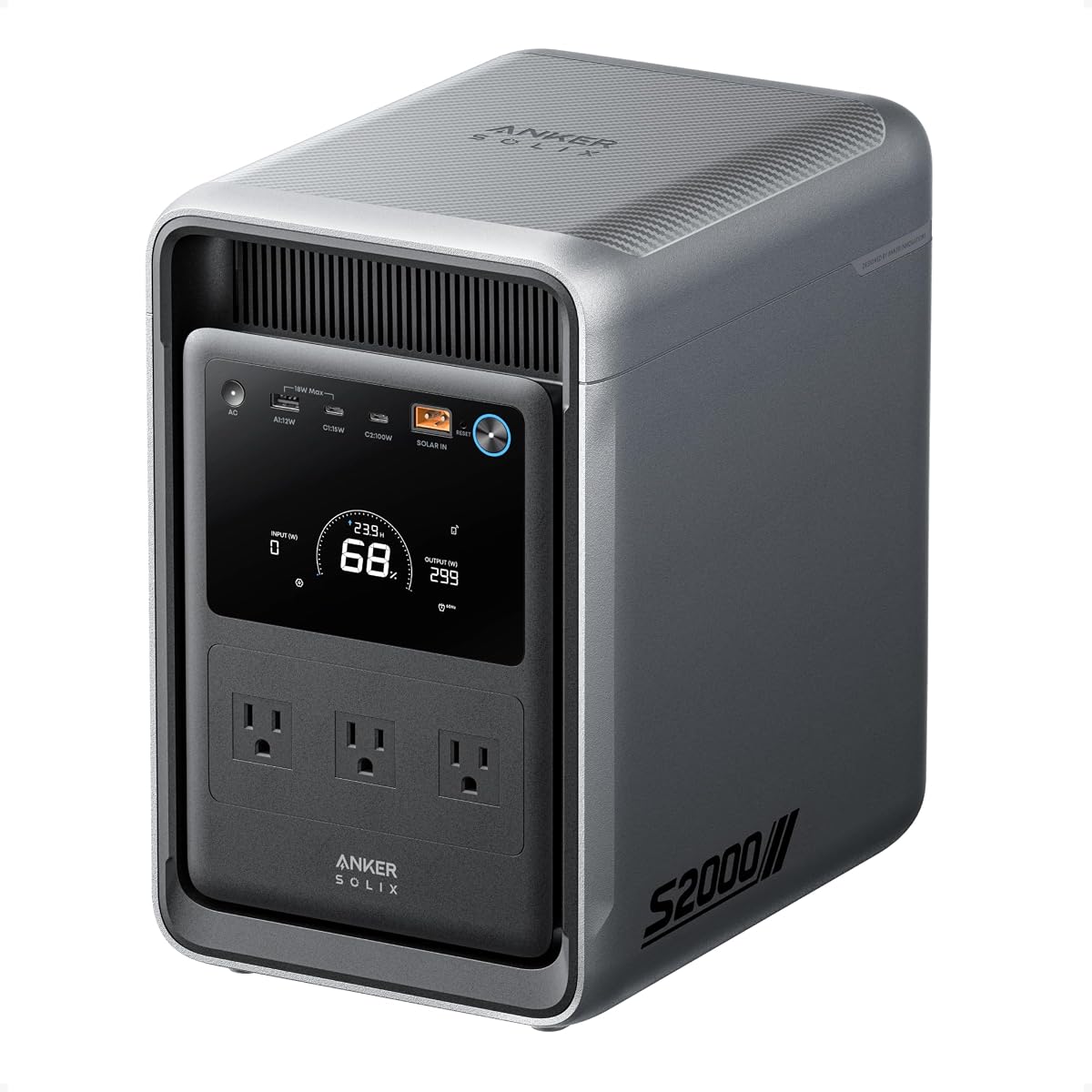
The Anker SOLIX S2000 is a compelling upper-middleweight option, holding a 4.7 rating while providing nearly twice the capacity of the C1000 Gen 2. Its 2,010Wh battery, 1,500W continuous output, and 3,000W peak capability make it appropriate for overnight essentials, extended camping, mobile workshops, and keeping a refrigerator or small medical device operating for a meaningful period.
We may earn a commission when you buy through this link, at no additional cost to you.
Efficiency is central to the S2000's design. The listed 6W idle draw and claimed 20 percent runtime improvement over other 2kWh systems support a rated fridge runtime of up to 35 hours, although actual results vary with refrigerator model, usage habits, and ambient temperature. Its 314Ah LFP cells are specified for a 15-year lifespan, equivalent to 10,000 charge cycles, offering a strong durability proposition for regular use.
The physical design is another strength. At 8.2 by 11.1 by 12.7 inches and 35.7 pounds, the unit is stated to be 30 percent smaller and 25 percent lighter than the industry average used in its comparison. It can recharge through AC, solar, a generator, an alternator charger, or a car outlet, with simultaneous AC and solar charging supported. The lack of a 12V DC socket is the main interface compromise.
Choose the S2000 when you need a true 2kWh-class battery but do not require a full 6,000W home-backup system. Its manageable weight, strong customer rating, and efficient standby design make it a particularly attractive middle ground. Users running many high-wattage appliances simultaneously should move up to the F-series, while people prioritizing USB-C charging can find a less costly portable alternative among the C300 models.
Low idle consumption can make a major difference when a power station spends long periods maintaining a refrigerator rather than actively powering electronics. The listed 35-hour figure is a useful planning reference, but users should account for compressor cycles, door openings, ambient heat, and refrigerator condition.
Six recharging options allow owners to use wall power, compatible solar, a generator, a car connection, an alternator charger, or combined AC and solar input. This range is especially useful for people whose access to grid power changes regularly.
We may earn a commission when you buy through this link, at no additional cost to you.
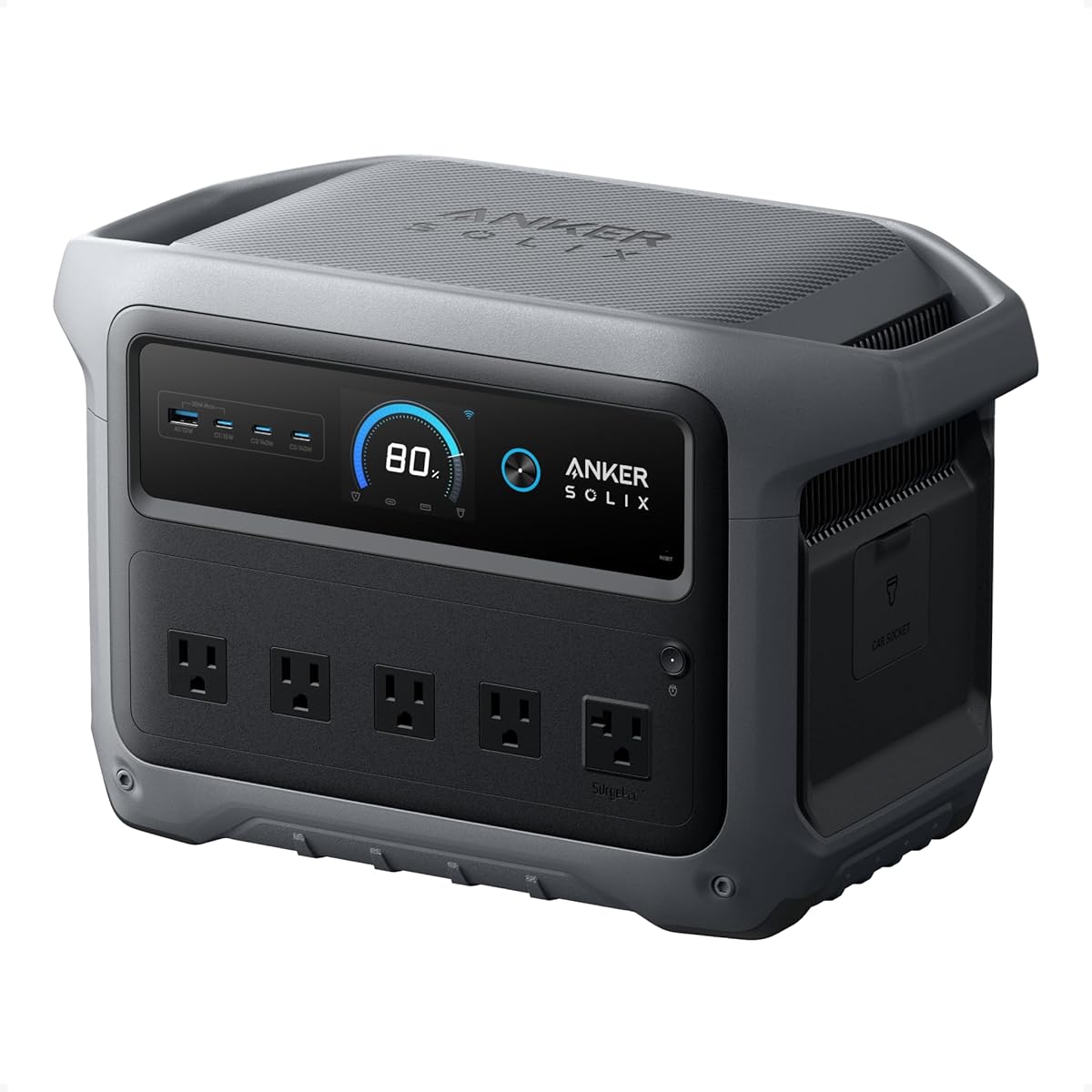
The Anker SOLIX C300 is the more versatile of the two compact 288Wh models in this roundup, earning a 4.6 rating and offering three AC outlets alongside five USB ports. Its 300W continuous output and 600W surge rating are sufficient for phones, cameras, laptops, drones, lights, and many small travel appliances, making it well suited to weekend camping and mobile work.
We may earn a commission when you buy through this link, at no additional cost to you.
Its charging design is especially convenient. Two USB-C ports support up to 140W each, while the 100W solar option replenishes the battery during suitable outdoor conditions. A wall outlet can restore 80 percent of the capacity in 50 minutes, and the car socket offers another recharging route. A one-year warranty and three-year cycle design support long-term confidence.
The compromises are inherent to its size. A 288Wh battery offers less than one-third of the S2000's capacity, so it is better suited to intermittent charging than all-day refrigerator operation or extended high-load use. The shoulder strap is not included, and the station is not compatible with several other Anker solar panel models, so panel pairing should be checked before purchase.
Among portable Anker options, the C300 is the better all-round travel choice because AC outlets and a car socket broaden what it can power. It suits campers who want to charge several modern devices without carrying a larger station. Buyers whose loads are exclusively USB-C and who prioritize the lowest weight may prefer the C300 DC instead.
Three AC outlets, two 140W USB-C ports, one lower-power USB-C port, one USB-A port, and a 120W car socket cover most common travel devices. That breadth lets a group charge multiple phones, cameras, laptops, and small appliances from one compact unit.
The listed 25dB output measured at 3.3 feet makes the C300 suitable for use near sleeping areas and quiet outdoor workspaces. Actual sound can vary with load level, fan speed, and ambient conditions.
We may earn a commission when you buy through this link, at no additional cost to you.
The Anker SOLIX F3000 combines 3,072Wh of starting capacity with 6,000W of output, giving it substantially more power than the C and S-series models. Its 4.5 rating reflects strong appliance compatibility and advanced recharge options, but the scale and likely weight make it better suited to home backup, mobile workshops, and serious off-grid installations than lightweight recreation.
We may earn a commission when you buy through this link, at no additional cost to you.
The F3000 supports 120V and 240V output and can be paired with another compatible station to create a 240V system. It also offers 3,600W pass-through charging, allowing supported appliances to continue operating while the battery recharges from a 120V generator. That feature is valuable for users who cannot tolerate unnecessary interruptions during a prolonged outage.
Recharging is another major strength. Solar input can reach 2,400W, while combining a fuel generator and solar supports a stated 6,000W input. The battery can expand to 24kWh, and the claimed 125 hours of AC idle standby or 42 hours for a 190W refrigerator illustrate the value of low standby consumption. Runtime will still depend on the load, temperature, and battery condition.
The F3000 is best for households or professionals who need many high-wattage appliances operating at once and have space for a stationary system. Its 240V capability, expansion capability, and generator integration are beyond what most portable users need. People seeking a simpler emergency reserve should consider the F1500 or S2000 instead.
The 3,600W pass-through function allows supported equipment to operate while the station is replenished by a compatible generator. Users should confirm appliance requirements and generator behavior before relying on it for critical loads.
Expansion from 3,072Wh to as much as 24kWh changes the F3000 from a portable reserve into a semi-permanent energy system. That makes it attractive for essential circuits, but the added modules increase space, weight, charging demands, and setup complexity.
We may earn a commission when you buy through this link, at no additional cost to you.
The Anker SOLIX F3800 is a substantial 3,840Wh system designed for users who want more than a few hours of emergency power. With a 4.5 rating, it emphasizes 120V and 240V output, 6,000W continuous AC capability, and expansion to 26.9kWh. It can also serve as the foundation for a larger two-week system when paired with another F3800 and twelve expansion batteries.
We may earn a commission when you buy through this link, at no additional cost to you.
The Smart Generator 5500 compatibility adds automatic start-stop operation, potentially reducing generator runtime when the battery can carry lighter loads. The F3800 can charge an EV through its NEMA 14-50 port at up to 6,000W and power an RV through NEMA 14-50 or L14-30 connections, broadening its usefulness beyond ordinary household outlets.
App-based controls and monitoring provide visibility into power sources and consumption. Its EV-class LFP battery, smart temperature system, impact-resistant construction, and 10-year longevity claim support long-term use. Nevertheless, the large capacity, high output, and broad connection set make this a more technical product than a conventional camping station.
The F3800 is best for households seeking comprehensive outage resilience, especially where an EV, large RV, or essential 240V appliances are involved. Users with modest backup needs may find the F3000 or even S2000 easier to manage. Any installation should follow local electrical requirements, and pairing two units introduces additional compatibility and setup considerations.
The NEMA 14-50 connection can deliver up to 6,000W to a compatible EV, while RV users can power appliances through NEMA 14-50 or L14-30 connections. Vehicle compatibility, charging protocols, and electrical ratings should be confirmed before use.
Up to six expansion batteries raise the F3800 to 26.9kWh, and a paired configuration can support much larger reserves. This scalability is ideal for extended outages, although owners must account for the physical footprint and charging time of the complete system.
We may earn a commission when you buy through this link, at no additional cost to you.
The Anker SOLIX C300 DC is purpose-built for travelers who charge modern electronics through USB rather than relying on AC wall sockets. It provides 288Wh of capacity, a 300W maximum output, and seven ports, with a 4.5 customer rating. Its compact form and emphasis on high-power USB-C make it particularly attractive for phones, tablets, laptops, cameras, and other travel gear.
We may earn a commission when you buy through this link, at no additional cost to you.
Two USB-C ports can deliver up to 140W, while a third supports 100W and another 15W. Two USB-A ports and a 120W car socket round out the selection. The unit can restore 80 percent of its capacity in about an hour through dual PD 3.1 USB-C input, and it also supports compatible solar-panel and car recharging.
There is one important operational detail: first use requires recharging with an 18W or higher USB-C wall charger, and only the designated USB-C2 and USB-C3 inputs are used for that initial activation. The product does not include AC outlets, so it cannot directly power a conventional lamp, small heater, or other wall-powered appliance. Its shoulder strap is also sold separately.
Choose the C300 DC for minimalism: it provides the same 288Wh class of storage as the C300 but in a USB-C-focused package. That makes it easy to recommend to travelers whose devices use modern charging standards. People who need broader appliance support should select the standard C300, which includes three AC outlets.
With USB-C outputs reaching 140W, 100W, and 15W, the C300 DC can serve demanding laptops alongside smaller devices. Output behavior may vary by device, cable, and power negotiation, so the included 140W USB-C-to-C cable is a useful starting point.
Removing AC outlets reduces bulk and simplifies the interface, but it also narrows the range of supported products. This is a feature for a device-first travel kit and a limitation for anyone expecting to run ordinary household appliances.
We may earn a commission when you buy through this link, at no additional cost to you.
The Anker SOLIX C1000 remains a strong mid-size option with a 4.7 rating, offering 1,056Wh of capacity, 11 ports, and a substantial 2,400W surge output. It is particularly appealing to buyers who value fast wall recharging and broad device compatibility, especially since a car charging cable is included in the box.
We may earn a commission when you buy through this link, at no additional cost to you.
The unit can reach 80 percent charge in 43 minutes and complete a full charge in under an hour when UltraFast recharging is enabled through the app. These figures apply under the stated 68–122°F operating range and compatible charging conditions. Solar recharging at up to 600W is also possible, with a full recharge cited at 1.8 hours in the specified setup.
The 11-port arrangement makes it useful for RV travel and group outings where several people need to charge at once. Its LiFePO4 battery is specified for 3,000 cycles over a 10-year lifespan. Compared with the C1000 Gen 2, however, this model offers a slightly larger stated capacity and different output wording, while the newer generation emphasizes 2,000W continuous output and a 49-minute full recharge.
The C1000 is a worthwhile pick for someone who prefers a proven-style package with numerous ports and rapid charging. The C1000 Gen 2 may be the more compelling choice for new shoppers because it introduces updated charging technology and explicitly lists continuous output. Compare current listings carefully, particularly if the headline surge rating is being mistaken for continuous capacity.
The ability to reach 80 percent in 43 minutes is valuable when a station is needed for several short periods rather than one prolonged event. The app requirement and temperature range should be considered so the fastest mode is used as intended.
Eleven ports reduce the need to carry a large collection of wall adapters and charging cables. Exact port types and combined output limits should be checked in the current product listing before planning simultaneous high-power charging.
We may earn a commission when you buy through this link, at no additional cost to you.
The Anker SOLIX F3800 Plus is built around serious whole-home energy management, with 3,840Wh of starting capacity, 6,000W output, 120V and 240V support, and expansion to 26.9kWh. Its 4.3 rating places it behind several smaller models, but its specification sheet is aimed at a different category of buyer: one with substantial critical loads and access to powerful solar arrays.
We may earn a commission when you buy through this link, at no additional cost to you.
The defining feature is 3,200W of solar input. Users can recharge through solar, a generator, a home power panel, or an AC outlet, with an advertised 63-minute outage-ready recharge using solar and a generator. A 6,000W bypass allows a compatible 240V gas generator to support recharging while the station provides backup power.
Two F3800 Plus systems can be paired for up to 12,000W of maximum AC output, and six expansion batteries can bring a single unit to 26.9kWh. The 10-year longevity claim is supported by EV-grade LFP cells, InfiniPower technology, temperature management, and impact-resistant construction.
This model makes the most sense for buyers who want to maximize solar recharging or build a large expandable platform. Those needing a smaller emergency reserve may find the standard F3800 or F3000 easier to justify. Because high-voltage systems involve more setup, compatible accessories, and installation considerations, current technical documentation should be reviewed before installation.
The 3,200W solar input is the clearest distinction between the F3800 Plus and conventional portable stations. It can shorten recharge time when a large compatible array and strong sunlight are available, though real charging speed depends on panel configuration and conditions.
Expansion and pairing provide a path from 3.84kWh to 26.9kWh or beyond. This supports longer outages, but expansion changes the system's capacity, physical footprint, and recharging requirements, so it should be planned before the initial purchase.
We may earn a commission when you buy through this link, at no additional cost to you.
The Anker SOLIX F2600 occupies a useful middle ground between compact camping stations and high-output home systems. It combines 2,560Wh of capacity with 2,400W continuous output and 3,600W surge protection, earning a 4.4 rating. That combination allows it to run many moderate-load appliances at once while retaining enough reserve for an extended weekend or a defined outage period.
We may earn a commission when you buy through this link, at no additional cost to you.
Recharging choices include wall power, solar, and a car connection, with the included package containing an AC cable, car cable, solar cable, and accessory bag. The stated 80-percent solar recharge in two hours is convenient, while HyperFlash charging is said to reach 80 percent in one hour and 40 minutes. Actual timing varies with the input source, temperature, and operating mode.
The 10-year durability positioning comes from LiFePO4 chemistry, smart temperature control, industrial-grade components, and impact resistance. App support through Bluetooth or Wi-Fi adds low-battery alerts, discharge-limit customization, and recharging-speed controls. Those functions are useful for owners who want to preserve capacity or manage energy around peak periods.
The F2600 is a good fit for campers, tradespeople, and homeowners seeking more output than the S2000 without moving to a 6,000W station. Its limitations become apparent when compared with the latest C1000 Gen 2, which advertises faster wall charging, or with F-series systems offering 120/240V circuits. Choose it primarily for its balanced capacity, continuous output, and app-managed control.
With 2,400W of continuous output, the F2600 can support more household devices than a typical 1kWh camping station. It remains far more manageable than a large 120/240V system, making it useful for workshops, vans, and selective household backup.
Custom discharge limits and low-battery alerts help owners avoid unnecessary deep discharge and monitor unattended reserves. Recharging speed can also be tailored to the situation, though remote monitoring requires compatible Wi-Fi or Bluetooth connectivity.
We may earn a commission when you buy through this link, at no additional cost to you.
The Anker SOLIX F1500 delivers 1,536Wh of capacity and 1,800W of output, occupying a practical tier for home backup and camping users who need more than a compact station. Its listed 4.3 rating reflects a capable design, while the ability to power up to 13 devices makes it especially useful for mixed phone, laptop, appliance, and accessory loads.
We may earn a commission when you buy through this link, at no additional cost to you.
The port selection includes six AC outlets, four USB-A ports, and a car outlet. Solar input of up to 600W supports an advertised 80-percent recharge in 1.4 hours with the specified panel. That makes the station useful for both grid and solar-oriented users, while the included AC, car, and solar cables provide several charging paths out of the box.
Longevity is another selling point. The product is described as using Anker InfiniPower technology to remain dependable for more than a decade, and it includes a five-year full-device warranty. Nevertheless, buyers comparing newer models should consider recharge speed, continuous output, expansion, app features, and warranty coverage because these features can materially affect long-term usefulness.
The F1500 is best for a household that wants to keep several essential devices running during an outage or support a demanding camping setup. It is less appropriate for large 240V appliances or systems requiring expandable multi-day energy. Compared with the C1000 models, it offers more capacity and simultaneous device support, but it may not deliver the same fast wall-recharge experience.
The combination of six AC outlets, four USB-A ports, and a car outlet can serve a broad collection of devices without requiring multiple adapters. Users should observe the station's aggregate output limit when operating several high-wattage loads at once.
A five-year full-device warranty provides useful coverage for a product intended for regular backup and outdoor use. The stated decade-long design life is separate from warranty duration, so buyers should retain documentation and understand the support terms.
We may earn a commission when you buy through this link, at no additional cost to you.
The right Anker power station depends on the devices you need to run, how long they must remain online, where the unit will be stored, and how quickly you can recharge it. Capacity, continuous output, interface, expandability, and portability should be evaluated together.
Capacity determines the total energy available for charging and appliance use, while wattage determines instantaneous output. A unit may have enough energy to run a refrigerator for many hours but lack the output to start a heavier appliance. Compare watt-hours when estimating how many phone charges, laptop cycles, lighting hours, or appliance hours the battery can support. Actual runtime is rarely equal to a simple division because conversion losses, battery age, temperature, and appliance cycling all affect results.
Continuous output is the sustained level the inverter can deliver, while peak or surge output covers brief startup demands. Always check the continuous rating against the largest appliance, especially for pumps, refrigerators, tools, heaters, and medical equipment. The C300 supports 300W continuously, the C1000 Gen 2 provides 2,000W, and larger F-series models reach 6,000W. A peak rating should not be mistaken for the level the station can sustain.
Fast input is valuable when a station must be ready between outages or trips. The C1000 Gen 2 supports 1,600W wall input and a cited 49-minute full recharge, while the F3000 can accept up to 6,000W from combined sources. Solar input ranges from 100W on the compact C300 to 3,200W on the F3800 Plus. Consider wall, solar, car, generator, and alternator availability, but also check connector types, operating temperatures, and app settings.
AC outlets support conventional appliances, USB-C handles many modern phones and laptops, USB-A serves older accessories, and the car socket is useful for 12V gear. The C300 and C1000 offer broad mixed selections, while the C300 DC deliberately omits AC outlets. Check port wattages, aggregate output limits, supported protocols, and the number of devices that can charge simultaneously. A station with many ports is not automatically suitable for several high-power laptops.
For outages, switchover speed can determine whether sensitive electronics continue operating without resetting. The C1000 Gen 2 advertises under 10ms UPS switching, which is useful for compatible laptops, routers, and CPAP equipment. UPS support does not guarantee that every appliance or medical device will behave exactly as expected. Test the intended combination in advance, confirm the station and device agree on voltage and power, and keep a conventional backup plan for critical needs.
Compact models such as the 288Wh C300 products are easier to carry and store, while 2kWh systems and 3.84kWh F-series units become stationary or vehicle-based installations. Consider dimensions, carrying weight, outlet access, ventilation, and where the battery will live between uses. A larger battery is not automatically easier to use if it cannot be moved safely or positioned close to the equipment it serves.
Expansion can extend runtime dramatically, but it is a system-level decision rather than a simple accessory purchase. The F3000 can grow from 3,072Wh to 24kWh, while the F3800 and F3800 Plus reach 26.9kWh with expansion batteries and can be paired for greater output. Verify compatible modules, space, charging speed, and required accessories. Users who only need occasional phone and laptop charging may gain little from paying for an expandable platform.
LiFePO4 chemistry is used across this lineup and is associated with favorable cycle life and thermal stability. Cycle figures vary by model, while stated design-life periods should not be confused with warranty terms. Review temperature management, impact resistance, included cables, warranty coverage, and app visibility. Responsible charging, ventilation, and regular maintenance can help preserve usable capacity and reduce avoidable stress on the battery.
Before first use, read the included guide and identify the correct inputs, supported charging protocols, operating temperature, and output limits. New units may need an initial wall charge; the C300 DC specifically requires an 18W or higher USB-C charger and uses only the specified USB-C2 and USB-C3 ports. For models with app-controlled charging, complete setup before enabling faster charging modes. Confirm that every attached cable and device supports the intended wattage.
Treat the power station as an energy source rather than a general-purpose extension cord. Connect loads within the continuous and surge ratings, avoid exceeding individual or aggregate port limits, and use a proper AC source for UPS-supported equipment. Keep ventilation paths clear, operate the unit on a stable dry surface, and avoid exposing it to rain, excessive heat, or combustible materials. For a generator, follow both the generator and power station manuals and confirm voltage, frequency, and connection requirements.
To maintain the battery, use the app to set sensible discharge limits when the unit is not handling critical loads, and avoid unnecessary deep discharges. Keep the case, vents, and temperature sensors clear of dust and debris. Recharge periodically according to the current manual, inspect cables for damage, and stop using the station if it shows swelling, unusual heat, leakage, or damaged connectors. Expansion batteries, solar cables, and other accessories should follow their own compatibility and storage instructions.
For lightweight camping, the C300 DC is a strong choice when travelers mainly charge USB-C devices. The standard C300 adds three AC outlets, a 120W car socket, and the same 300W output, making it more versatile for conventional camping appliances. Larger users who need to run a coffee maker, power tools, or multiple devices for extended periods may prefer the F2600 or S2000 despite the additional weight.
Runtime depends on the refrigerator's compressor cycle, power draw, ambient temperature, battery condition, and conversion efficiency. The S2000 is listed for up to 35 hours with a refrigerator, while the F3000 cites 42 hours with a 190W fridge, but those figures are not universal. Estimate the average load and allow margin for high-draw periods, especially during compressor startup.
The C1000 Gen 2 specifies under 10ms UPS switchover and names CPAP machines among possible supported equipment. Compatibility still depends on the device's power requirements and the station's operating mode. Test the CPAP machine, power supply, and station together before an emergency, and maintain any manufacturer-recommended backup battery or alternative power source.
Both provide 288Wh of capacity and a 300W output class, but the standard C300 includes three AC outlets, two 140W USB-C ports, a 15W USB-C port, a 12W USB-A port, and a 120W car socket. The C300 DC omits AC outlets, emphasizes USB-C charging, and includes seven ports in total. Choose the standard C300 for broader appliance support or the DC version for a smaller, device-focused travel kit.
Most models support solar charging, but connector type, voltage, and maximum input vary. The compact C300 products recommend 60W or 100W Anker solar panels and are not compatible with the PS30, PS200, or PS400 models listed in their specifications. Larger systems accept higher solar inputs, with the F3800 Plus reaching 3,200W. Always check the current manual before connecting a panel.
No. A larger battery provides more energy but can be unnecessary if the intended loads are small, and it usually adds weight, charging time, and expense. Start by listing essential appliances, their running and startup power, and the outage duration you need to cover. A 1kWh model may suit electronics and a refrigerator briefly, while 3.84kWh expandable systems make more sense for daily household use or prolonged outages.
Divide usable battery capacity by the average device wattage, then allow for conversion losses and variable appliance demand. For example, a 1,000Wh battery running a 100W continuous load might theoretically provide 10 hours before losses, while a refrigerator's compressor cycle requires a more nuanced estimate. Start-up surges also determine whether the station can run the appliance even if its energy consumption appears manageable.
Continuous output is the power the inverter can supply steadily, while peak output is a short-duration allowance for startup or brief surges. An appliance drawing 1,800W may need more than 1,800W momentarily when its compressor or motor starts. Choose a station whose continuous rating covers the running load and whose surge rating comfortably covers startup behavior, rather than relying on the higher peak figure alone.
The Anker SOLIX C1000 Gen 2 is the most balanced overall pick because it combines 1,024Wh of capacity, 2,000W of continuous output, ten ports, rapid wall charging, and under 10ms UPS switching. The C300 is the leading compact option, while the S2000 provides the most attractive combination of substantial 2kWh capacity, manageable weight, and efficient standby performance for users who want more endurance without a 6,000W home system.
Prioritize continuous output first, then select enough capacity for realistic outage or trip duration. Add fast solar input if a compatible array is part of the plan, expansion if long-duration energy is essential, and dual-voltage support if the loads include large household equipment. For a travel kit centered on USB-C, the C300 DC is more focused than the standard C300 and avoids carrying unused AC hardware.
Finally, check the current Amazon listing, included accessories, warranty terms, and updated manual before ordering. Product configurations and promotional conditions can change, and runtime depends on the connected loads and environment. The right Anker power station is the one whose capacity, output, recharge methods, and portability align with how you actually intend to use it.