
Sonic Bomb Dual Extra Loud Alarm Clock with Bed Shaker
4.5Editor score
113dB adjustable alarm
Powerful removable bed shaker
Flashing red alert lights
Compare 10 Alarms for Deep Sleepers, with key specifications, product ratings, pros and cons to help you choose.
Alarms for deep sleepers need more than a conventional phone chime. The most useful models combine unusually loud audio, physical vibration, bright visual prompts, or a wearable alert so a missed sound does not become a missed morning. The right choice depends on your hearing, bedroom setup, sleep habits, and sensitivity to noise.
This guide compares ten alarm clocks and wearable options using their documented alarm output, vibration modes, display features, power options, scheduling functions, and customer ratings. It covers bedside units with separate shakers, clocks with built-in motors, silent wrist devices, and classic mechanical alarms for people who want simplicity without screens.
Each review explains the strongest reasons to consider a particular model, along with practical limitations that may affect your choice. Ratings reflect the supplied product information, while feature availability and design priorities differ considerably. Current prices, promotions, and availability can change, so compare the latest listing details before purchasing.
4.5Editor score

4.4Editor score

4.5Editor score
The comparison below highlights the alert methods, maximum documented sound output, scheduling options, and power features of each model. These distinctions help separate loud bedside alarms, vibration-assisted units, silent wearables, and screen-free analog options.



The ANJANK Extra Loud Alarm Clock with Wireless Bed Shaker has a 4.4 rating and combines a 112dB front-facing alarm, a rechargeable wireless shaker, and a colorful display. That combination makes it the most versatile model in this guide for someone who has learned to sleep through ordinary phone alarms but still responds to a strong physical cue.
We may earn a commission when you buy through this link, at no additional cost to you.
The wireless shaker is the standout feature. It reaches up to 32.8 feet and offers high, medium, and low vibration intensities, allowing placement beneath a pillow, beside the mattress, or elsewhere within range. Its 1500mAh rechargeable battery is advertised as lasting up to a month on one charge, and it supports magnetic or Type-C charging. Meanwhile, the main unit provides two independent alarms, eight gradual sounds, ten-level volume control, and a maximum output of 112dB.
Visual options make the clock useful for people who prefer light cues or share a bedroom. The display supports white, red, blue, and RGB gradients, while the night light offers nine colors, an off mode, and six brightness levels. The main unit also has a Type-C charging output for a phone. These extras require setup, though, and the clock itself has no battery backup, so a power outage could leave the bedside unit unavailable.
Choose this model if you want one system to cover sound, vibration, and light without assembling several separate devices. It is particularly compelling for couples where one person needs a gentler wake-up method, or for heavy sleepers who live alone and can position the shaker directly under a pillow. Buy it only if you are comfortable connecting and charging two components and setting the unit while groggy. For most users seeking the broadest range of wake-up cues, it is the strongest all-around choice here.
The wireless bed shaker removes the cable-management problem that affects many traditional vibration alarms. Its documented 32.8-foot range also makes it practical for bedrooms where the clock must sit where it is visible while the shaker goes under a pillow or beside the sleeper.
The adjustable night light and broad color choices create a visual fallback for users who do not consistently hear the alarm. The dimmer range and off mode make it possible to preserve a dark room while retaining a glowing clock face.
We may earn a commission when you buy through this link, at no additional cost to you.
The Acedeck Super Loud Alarm Clock has a 4.5 rating and focuses on a straightforward formula: very loud sound, two schedules, adjustable display brightness, and protection against forgotten settings during a power interruption. It is a strong value-oriented choice for deep sleepers who do not specifically need a physical shaker.
We may earn a commission when you buy through this link, at no additional cost to you.
Its maximum documented output of 115dB is the highest figure listed in this comparison, and users can select from six alarm sounds. Two separate alarms support different schedules, while the built-in snooze function provides a short delay when needed. The 4.2-inch LED display is large enough for typical bedside viewing and can be dimmed for nighttime use.
The most reassuring feature is the alarm memory system. AAA batteries preserve settings and permit outage alarms, although the batteries are used only for backup and are not charged by the clock. External power remains necessary for normal operation. A built-in USB port also permits overnight phone charging, although this model does not offer the richer RGB light treatment or physical vibration found in some higher-feature alternatives.
This alarm suits students, shift workers, couples, and light sleepers who mainly need a very loud and reliable bedside sound. It is less suitable if your failure to wake is primarily tactile rather than auditory, since there is no included bed shaker. Its straightforward layout and strong backup system nevertheless make it an excellent entry point for a deep sleeper who wants dependable alarms without a complicated wearable or multi-component kit.
With six tones, ten alarm cycles implied by its dual scheduling, and a documented 115dB maximum, this clock concentrates on making an audible alert difficult to ignore. It is a sensible first upgrade from a standard digital alarm.
The AAA backup system preserves alarm programming and supports alarms during power loss. Users should remember that backup batteries are not rechargeable and that the clock remains designed to operate on external power.
We may earn a commission when you buy through this link, at no additional cost to you.
The Sonic Bomb Dual Extra Loud Alarm Clock has a 4.5 rating and is built around an established bedside-alert format: a 113dB adjustable alarm, a separate powerful bed shaker, and flashing red alert lights. The supplied information positions Sonic Alert as a specialist in notification products for people who are hard to wake, deaf, elderly, or otherwise in need of a persistent alert.
We may earn a commission when you buy through this link, at no additional cost to you.
Its standout strength is control over the alarm cycle. The sound duration can be set from one to 59 minutes, while snooze intervals range from one to 30 minutes. The bed shaker operates in vibration-only, buzz-only, or combined vibration-and-buzz modes. These options allow the user to decide whether the alarm should be persistent, brief, audible, or primarily tactile.
The tradeoff is a more traditional design. It does not provide the RGB display, expansive night-light controls, or modern phone-charging convenience found on newer digital models. The separate shaker also has to be positioned correctly, and mattress construction can influence how the vibration feels. Even so, its combination of loud sound, flashing lights, adjustable timing, and battery backup remains unusually comprehensive.
This is the pick for a deep sleeper who has tried ordinary alarms and needs a dedicated system capable of escalating across senses. It is also appropriate for households where a child or another family member needs a persistent wake-up call. Choose it when reliability and adjustable physical vibration matter more than color customization or compact modern styling.
The unusually broad duration and snooze ranges let users build around real morning routines instead of accepting a fixed interval. Someone who needs a short nudge can keep it brief, while someone who regularly sleeps through a first prompt can extend the alert.
Combining vibration, buzz, and flashing light means the device does not rely on hearing alone. It is a more inclusive choice for shared homes and users who may not register an audible cue immediately upon waking.
We may earn a commission when you buy through this link, at no additional cost to you.
The Alarm Clock with Bed Shaker has a 4.2 rating and offers three alert modes: sound only, bed shaker only, or both. Its seven-inch LED face, eight brightness levels, dual alarms, and USB charging port make it a broad bedside option for users who want both visual and physical wake-up options.
We may earn a commission when you buy through this link, at no additional cost to you.
The clock offers a large snooze button and a pause function that silences alarms for the next 24 hours without deleting saved settings. Alarm pause is easy to confuse with a complete cancellation, so it deserves attention during setup. The display remains visible whenever the clock is powered, even though its brightness can be reduced substantially.
Power handling is more comprehensive than many basic digital alarms. The unit runs on AC power, while two AAA batteries provide memory backup and preserve the alarm during an outage. The screen turns off during backup operation to conserve power. A 5V/1A USB port supports phone or small-device charging. The main limitations are the wired shaker and the product's own warning that its adjustable buzzer may not meet expectations for extremely loud alarms.
Choose this model if you want a large display, several control options, and the ability to wake through vibration without buying a wearable. It is less attractive for a bed where cable management matters or for someone who requires a truly deafening sound level. For most users, the adjustable dual alerts and outage memory outweigh those compromises.
The 24-hour pause is useful when an alarm needs to be silenced temporarily without rebuilding a recurring schedule. Understanding the distinction between pause and complete cancellation is essential to avoid accidental schedule changes.
Large numerals and eight brightness levels make the seven-inch display easy to check from across a room while still allowing a dim nighttime setting. Since the screen remains illuminated, light-sensitive users may need to place it carefully.
We may earn a commission when you buy through this link, at no additional cost to you.
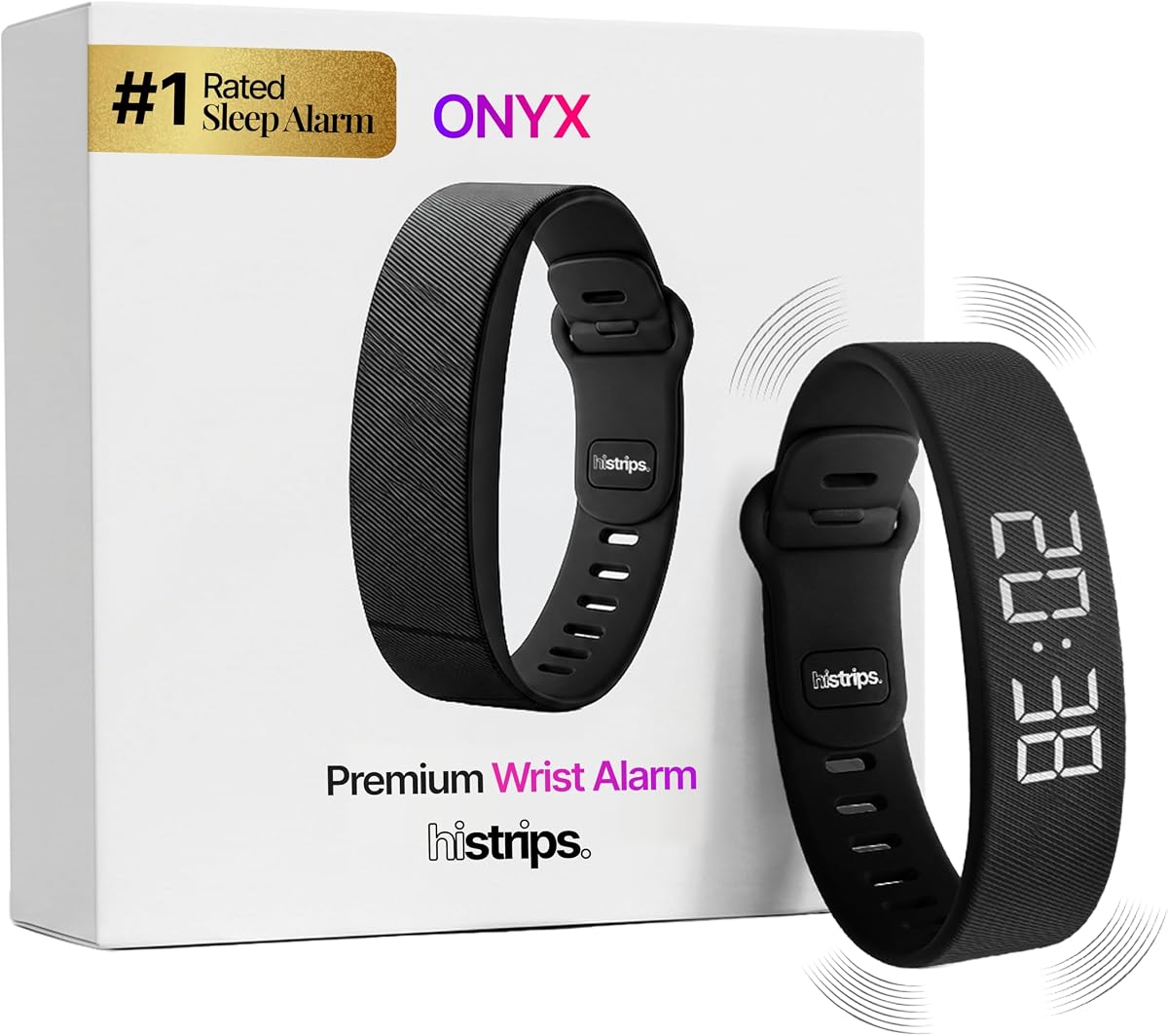
The Onyx Vibration Alarm has a 2.4 rating and takes a different approach from bedside clocks. It is a silent wrist device designed to escalate from gentle to stronger vibration through two intensity levels, providing a personal wake cue without producing audible alarm noise.
We may earn a commission when you buy through this link, at no additional cost to you.
The product information highlights a food-grade silicone strap, direct skin contact, and a design intended to remain comfortable through the night. It supports up to three alarms and fast charging, with the stated battery life reaching 14 days on one charge. Because only the wearer feels the alert, it is suited to couples, roommates, dorm residents, shift workers, and travelers who cannot safely use a loud bedside alarm.
Its low rating is the most important consideration. A wrist alarm depends on consistent wear, comfortable fit, and a wearer who responds to tactile sensation. It cannot provide the across-the-room urgency of a 113dB clock or a shaker placed under a mattress. The absence of audible alerts may also make it less useful for someone who is physically capable of hearing but simply habitually ignores sound.
Consider the Onyx when quiet operation is the overriding priority and you are willing to establish a nightly wearing routine. It is best for light to medium sleepers who can be awakened by vibration, rather than for someone whose primary difficulty is extreme sleep inertia. Its silent design and adjustable comfort are appealing, but the 2.4 rating calls for more caution than the higher-rated bedside models.
A wrist vibration avoids waking a partner, roommate, or child simply because an audible alarm begins. This makes the format particularly attractive in small rooms where the bed shaker's movement could also disturb others.
The device must be worn securely enough to maintain skin contact. Users who remove accessories at night or have difficulty noticing gentle vibration should not rely on this option as their sole wake-up system.
We may earn a commission when you buy through this link, at no additional cost to you.
The Vibrating Alarm Clock Watch has a 3.6 rating and is a non-audible wristband intended for people who sleep through conventional alarms. Its central advantage is discretion: only the wearer is notified, which supports shared bedrooms, dorms, and homes with children or differently scheduled partners.
We may earn a commission when you buy through this link, at no additional cost to you.
The product supports multiple customizable vibration alarms and uses a strong tactile mechanism designed to rouse a heavy sleeper. An IP68 water-resistance rating provides protection against sweat, rain, and everyday spills. These features make it more practical for travel, exercise, and irregular schedules than a delicate jewelry-style wearable might otherwise be.
A wrist-only design has clear limitations. The device cannot wake someone who has removed it, and a moderate 3.6 rating suggests that not every user finds the vibration compelling enough. There is also no documented audible or visual backup, so users with severe sleep inertia may need to pair it with a separate bedside alarm rather than depend on it alone.
This watch is best for a shared sleeping environment where a conventional alarm would be disruptive, or for a user who already knows that vibration reliably wakes them. It is a reasonable companion device for travel and shift work, but not the safest solo choice for someone who rarely responds to touch. Pair it with a loud bedside clock if missing the morning would carry serious consequences.
The IP68 rating makes the wristband better suited to perspiration, rain, and spills than a basic jewelry-style device. That durability supports everyday use, although proper care instructions should still be followed.
Because the alarm is felt only by the wearer, one person can use an early schedule without broadcasting it throughout the room. This is especially useful when partners or roommates keep different wake-up times.
We may earn a commission when you buy through this link, at no additional cost to you.
The REACHER Super Loud Vibrating Alarm Clock has a 4.1 rating and uses a built-in vibration motor instead of a separate wired bed shaker. That design allows the entire unit to slide under a pillow and keeps the bedside setup visually cleaner while still offering a 110dB audible alarm.
We may earn a commission when you buy through this link, at no additional cost to you.
Three wake-up modes and five vibration levels let users choose between gentler reminders, stronger physical alerts, and combined sound-and-vibration output. The alarm can continue for as long as an hour, and unlimited snooze cycles provide additional flexibility. Automatic brightness adjusts the digital display to surrounding room light, reducing the need to change settings between daytime and nighttime.
Its charging dock doubles as a stand, making it easy to return the clock to its base after waking and check the display during the day. Raised tactile points on the alarm-off and snooze buttons help users identify key controls while drowsy. The principal drawback is dependence on the dock for charging, with no documented battery backup for a power outage.
This model is a good fit for people who want to tuck the whole alarm beneath a pillow instead of managing a separate wired shaker. It also suits users who alternate between audible and tactile alarms. Choose it if cordless placement and easy nighttime controls outweigh the value of a dedicated external bed shaker or extensive outage protection.
The integrated motor eliminates a cable running from the bedside clock to the mattress. Users can move the cordless unit under a pillow or another comfortable location without routing a cord across the bed.
Raised points on the snooze and alarm-off buttons provide tactile landmarks when it is difficult to read the display. This is a practical feature in products intended for the moment before full wakefulness.
We may earn a commission when you buy through this link, at no additional cost to you.
The DreamSky Vibrating Alarm Clock has a 4.4 rating and is a portable alarm designed to be placed under a pillow, on a mattress, near a nightstand, or even on a desk. Its wireless construction avoids the loose-connection problems associated with some wired vibration clocks, while a supplied rope can tether it to furniture when needed.
We may earn a commission when you buy through this link, at no additional cost to you.
Vibration intensity is adjustable across five levels, and the alert can operate through vibration alone or through both beeping and vibration. The rechargeable battery includes a power indicator and low-battery reminder. The power adapter is supplied, and automatic daylight saving adjustment reduces the need to manually reset the clock after seasonal clock changes.
The unit vibrates for five minutes when an alarm begins, and a dedicated snooze button adds nine minutes. A separate shake-off control stops the current day's alert while preserving the next day's recurrence. Its 15-second button-activated backlight is designed for brief nighttime checks rather than continuous illumination. Regular charging is required because there is no stated plug-in operation or backup battery.
Choose the DreamSky if you want direct pillow-level vibration without a cable and value flexible placement. Its five intensity steps and dual audio-tactile modes make it particularly adaptable. It is less convenient for someone who wants a permanently powered clock or an uninterruptible outage alarm, but for nightly rechargeable use it offers a portable and thoughtful approach.
The portable unit can be placed directly beneath a pillow or quilt, where its vibration may feel more noticeable than a distant speaker. The included tether offers insurance against the clock being lost or moved during sleep.
After initial setup, automatic daylight saving handling and selectable 12- or 24-hour formats reduce recurring clock adjustments. The brief illuminated backlight helps confirm the time without leaving the display glowing all night.
We may earn a commission when you buy through this link, at no additional cost to you.
The Peakeep Loud Alarm Clock has a 4.4 rating and offers a deliberately traditional alternative to digital screens and wrist devices. Its twin-bell mechanism can ring for up to 50 minutes, giving heavy sleepers a persistent mechanical alarm rather than a brief electronic tone.
We may earn a commission when you buy through this link, at no additional cost to you.
The four-inch clock has a metal exterior and reading face, apart from the rear setting board. A high-quality quartz sweep movement provides timekeeping without the familiar tick-tick sound of a mechanical clock. Separate alarm and simple setting dials reduce operational complexity, while the rear light button illuminates the face only when requested.
One AA battery is required, although it is not included in the box. The product information states that a fresh battery can run the clock for eight months or longer. This creates a maintenance schedule, but it also means the unit does not require daily charging or connection to a wall. The limited feature set includes no snooze, dual alarms, bed shaker, RGB display, or phone charging.
Choose this clock if you dislike glowing screens, want a visible physical alarm, and prefer uncomplicated controls. It is also a useful secondary alarm because its mechanical sound differs from the tonal cues of a phone or digital clock. It is less appropriate for couples with different schedules or for users who need a tactile alarm. Within those constraints, it is an attractive and dependable screen-free option.
There is no app, menu hierarchy, or display to configure. The separate alarm switch and straightforward dials make this model approachable for anyone who prefers an analog alarm to modern electronics.
The clock does not require a continuously illuminated display. Its rear light button provides on-demand visibility, making it easier to maintain a fully dark bedroom while still checking the time when necessary.
We may earn a commission when you buy through this link, at no additional cost to you.
The Netzu Loud Alarm Clock has a 4.4 rating and combines a documented 115dB maximum output with a vibrator, an RGB screen, and two independent alarm settings. It offers ring-only, vibration-plus-ring, and vibration-only modes, giving users several ways to wake without requiring a separate wearable.
We may earn a commission when you buy through this link, at no additional cost to you.
The RGB display adds a visual dimension that can be customized for individual preferences. Five brightness levels allow the screen to be softened at night, and the display can be turned off completely when its visual features are not needed. Two alarm settings are useful for households with different schedules, while the 12- and 24-hour format can be selected through the controls.
Setup uses a straightforward process involving the Set and plus-or-minus buttons, although users should confirm each value before leaving it beside the bed. The supplied information does not describe battery backup or long-term battery operation, so it is important to review the current manual and power requirements. As with every bed vibration, the sensation varies with mattress type and placement.
Choose the Netzu when you want loud sound, built-in vibration, and colorful display customization in one relatively compact bedside unit. It is a good middle ground between a conventional digital alarm and a full sleep-tracking device. Users needing verified outage protection should look for a model that explicitly documents it, while most others will appreciate the combination of 115dB output and flexible alert modes.
The RGB screen can provide a bright visual alert that differs from the usual red clock numerals. Users can select a color they notice readily while retaining five brightness levels for nighttime control.
The integrated vibrator offers three alert arrangements, including vibration-only operation for quieter mornings. Placement near the sleeper will influence how clearly the physical signal is felt, so it should be adjusted after the first use.
We may earn a commission when you buy through this link, at no additional cost to you.
Choosing an alarm for a deep sleeper is about matching the alert to the reason a normal alarm fails. Consider hearing, sleep inertia, bedroom configuration, power needs, and the importance of waking without disturbing anyone else.
Documented sound levels give a more useful starting point than vague descriptions such as extra loud. The models in this guide range from a classic twin-bell mechanism to digital alarms advertised at 110dB, 112dB, 113dB, or 115dB. Volume is only one part of the experience: sound placement, frequency, mattress noise, earplugs, and the sleeper's ability to wake can affect whether maximum output actually succeeds.
Prioritize an alarm with strong, directional sound and settings that remain obvious. Do not assume the largest stated decibel figure will awaken every sleeper, particularly if sound is blocked by pillows or muffled by bedding.
A bed shaker can wake someone who does not respond to sound, but effectiveness depends on intensity and placement. Wired models need careful cable routing, while wireless or integrated-motor designs are easier to position beneath a pillow. Look for multiple intensity levels and vibration-only operation if a partner or roommate should not be disturbed.
Test the shaker on the actual mattress. Soft, thick bedding may absorb or disguise vibration, while a hard surface can make the motor feel stronger. Consider whether the device must remain in direct contact with skin to deliver a noticeable cue.
The strongest alarm designs do not rely on one sensory channel. Combining a loud tone with a shaker and flashing light creates redundancy, which is valuable for users with hearing loss or particularly heavy sleep. Wrist wearables invert that idea by using only a personal tactile cue, making them quieter but dependent on consistent wear.
Choose a unit with several modes if your schedule or hearing needs change. A user may prefer vibration on weekdays and an audible alarm on weekends, or may need one alert for themselves and another for a partner.
Power specifications determine whether an alarm remains available during an outage or after a long sleep. AC-powered clocks with AAA memory backup can preserve settings and continue alarming, whereas rechargeable wearables and portable clocks require routine charging. The ANJANK main clock, for example, explicitly has no battery backup, while the Acedeck and Alarm Clock with Bed Shaker include backup cells.
For anyone with a demanding schedule, backup power should be treated as a safety feature rather than an optional convenience. Confirm whether backup batteries are included, whether they are rechargeable, and whether the display or bed shaker remains active during an outage.
A bright clock face is useful for people who cannot easily read a dim display, but it can undermine sleep in a dark bedroom. Adjustable brightness, complete display-off modes, on-demand backlights, and separate night lights provide more control. RGB screens add visual interest and can serve as a prominent wake cue, although a bright colored display may be less suitable for light-sensitive sleepers.
Match the lighting behavior to your room rather than simply selecting the brightest option. Consider where the device can be seen without shining directly into the eyes and whether its light is likely to disturb someone nearby.
Dual alarms are useful for different workdays, weekends, couples, or roommates. Snooze functions vary considerably: some add a fixed period, while others permit longer or unlimited cycles. Pause controls may silence an alarm temporarily without erasing its schedule, a distinction that should be understood before setup.
Choose intervals that create a genuine fallback without allowing an alarm to be postponed indefinitely. For someone who uses snooze repeatedly, a long continuous alarm duration may be more useful than many short repetitions.
A wearable must remain comfortable and secure through the night. Adjustable silicone bands, skin contact, and low-profile designs are relevant considerations for vibration strength and skin comfort. Bedside devices need their own placement strategy: speakers should have an unobstructed path to the sleeper, while shakers often work best under a pillow.
If someone else shares the bed, vibration-only operation can prevent the need for a room-filling alarm. Conversely, a wearable may be quieter but alert only its wearer, making it ideal for separate sleep schedules.
The easiest alarm is the one the user can configure correctly and recharge consistently. A basic analog clock requires fewer settings, while feature-rich digital units offer stronger alerts but involve more buttons, brightness levels, alarm modes, and charging routines. Wearables demand the consistent habit of wearing the device every night.
Balance capability with your tolerance for setup. Choose several adjustable modes if they solve a real problem, but avoid paying for features that will only create confusion. Read the current instructions, inspect the controls, and complete a full test before relying on it for an early morning.
Begin by charging the unit fully, installing backup batteries if the model supports them, and setting the correct date, time, and 12- or 24-hour format. Configure every alarm, sound, vibration level, display brightness, and snooze option while you are fully awake. Place the clock where you can hear and see it, then position any shaker under a pillow, against the mattress, or on a hard surface where its vibration will be noticeable.
Run a realistic test for several nights. Start with a moderate alarm setting so you can find the shaker without accidentally stressing neighboring sleepers. Confirm that the sound reaches you at the intended volume, the vibration is perceptible through your usual bedding, and the controls are easy to identify while your eyes are closed. If you use a wearable, check the fit every night and confirm that the alert is felt without waking anyone nearby.
Clean the clock and wearable according to the manufacturer's instructions, and keep charging contacts and shaker surfaces free of dust. Check the battery indicator regularly, replace backup cells on a predictable schedule, and never ignore a low-power warning. Test the alarm after a power interruption, daylight-saving change, firmware or setting update, or prolonged period away from home so that a failed alert is discovered before an important morning.
A bed shaker or wearable vibration is often more appropriate than sound alone. Place a shaker under a pillow or use a wrist device that remains in direct contact with your skin. You can also combine both methods with a loud alarm and flashing light for greater redundancy.
They should be loud enough to be difficult to ignore, but loudness is not the only useful measure. Alert type, mattress placement, ear protection, and sleep inertia all affect performance. Models advertising outputs above 110dB are designed for maximum audibility, yet a correctly placed vibration cue may work better for some sleepers.
Yes, because vibration does not depend on hearing. A person still needs to feel the signal, so the shaker or wearable should be positioned correctly and set to an appropriate intensity. A visual alarm can provide another accessible backup for users with hearing loss.
Wearables are quieter and alert only the wearer, making them useful for shared rooms and travel. Bed shakers can produce a stronger, more mattress-directed cue but may disturb a partner and require more careful placement. The best option depends on whether you reliably wear a device overnight and whether you can sleep with a shaker.
That depends on the model. Some clocks include backup batteries that preserve settings and continue operating, while others must remain connected to external power. Rechargeable portable clocks can also stop working when their battery is depleted. Check the power specifications before purchasing if outage reliability matters.
Two settings support different weekdays, weekends, work shifts, or household schedules. They can also provide a second level of escalation if one alarm is intentionally set to sound gently. Make sure each schedule is recognizable and avoid confusing a temporary pause with a full cancellation.
It can, especially when the shaker has a high intensity or is placed near the center of the mattress. Look for adjustable vibration levels and a vibration-only mode. A wrist wearable is quieter because it alerts only the wearer, although it depends on consistent nightly wear.
Test it under realistic conditions for several nights, using your normal pillow, mattress, bedding, and room lighting. Begin with moderate settings, then adjust the sound or vibration based on what you actually perceive. Keep a second alarm or backup method available if missing the wake-up would have serious consequences.
The ANJANK Extra Loud Alarm Clock with Wireless Bed Shaker stands out for its combination of 112dB sound, wireless vibration, dual alarms, RGB lighting, and a phone charging port. The Sonic Bomb is the premium multi-modal option, while the Acedeck offers a focused 115dB sound solution with memory backup and a straightforward bedside design.
Prioritize the alert you are most likely to feel or perceive rather than choosing only by output level. Bed shakers suit users who can sleep through audio alarms, wearables favor quiet shared spaces, visual features help users who prefer light cues, and analog clocks remain attractive when simplicity and no glowing screen are the priorities.
Before buying, verify the current feature listing, power requirements, included accessories, and return terms. Prices, ratings, promotions, and availability can change over time, so the latest Amazon listing should be treated as the final source for product details and current cost.