
9V DC Power Supply 1A AC Adapter
4.6Editor score
5.5 x 2.5mm positive plug
Broad AC input range
Protective circuit features
Our 9V 1A Power Adapter guide compares ten options for voltage, current, polarity, connector fit, safety features, and device compatibility for daily use.
A 9V 1A power adapter can provide a convenient replacement for a lost or damaged power cord, but the correct model depends on more than its stated wattage. Connector diameter, center polarity, input range, and the power requirements of the connected device all determine whether an adapter will work safely.
We compared ten adapters using the specifications and compatibility details supplied for each product. The list covers fixed-plug models, universal barrel connectors, interchangeable-tip kits, center-positive electronics adapters, and center-negative guitar pedal power supplies suited to different low-voltage devices.
Each review explains the standout features, practical limitations, and ideal use for its selected adapter. Ratings reflect the supplied customer feedback, while prices and availability can change, so confirm the current listing and device requirements before purchasing.
4.6Editor score

4.5Editor score
4.2Editor score
The comparison below highlights the key differences among all ten adapters, including output polarity, connector configuration, input range, cable length, and the types of electronics each model is designed to power.


The ELEGOO 9V 1A AC/DC Power Adapter is a straightforward option for users who already know their device needs a 5.5 x 2.1mm center-positive barrel connection. It has a supplied rating of 4.5, combining straightforward operation with a useful regulated 9V output. Its US wall plug and compact design make it especially practical for a workbench or permanent installation near compatible electronics.
We may earn a commission when you buy through this link, at no additional cost to you.
The adapter accepts 100-240V AC at 50/60Hz and supplies regulated 9V DC up to 1A. The connected device determines the actual current draw, while the stated 1A limit provides a clear ceiling. A particularly useful feature is the detailed compatibility warning: the product is not intended for center-negative effects pedals, drum equipment, DJ controllers, pianos, label makers, or radios that require minimal electromagnetic interference.
Its limitations are easy to understand. This is a fixed-plug model rather than a universal adapter, so it cannot accommodate unusual barrel sizes or bare terminals. It also does not solve a polarity mismatch. These constraints are not inherently flaws, but they make the product less flexible than the multi-tip options in this guide. Buyers should also note the supplied description says it is suitable for compatible UNO R3 and MEGA 2560 boards with the correct DC jack.
The ELEGOO adapter is a strong general recommendation for a standard 9V center-positive device, especially a controller board that accepts a 5.5 x 2.1mm plug. It is less suitable for a household collection of devices with different connectors. For those seeking a single, dependable adapter for one known device, the fixed design reduces complexity and makes correct connection easier.
The fixed 5.5 x 2.1mm center-positive plug is the adapter's primary advantage for standard electronics. When a device requires that exact size and polarity, there is no need to sort through adapters or improvise with a mismatched tip.
Supporting 100-240V AC at 50/60Hz gives the adapter broader placement options than a 110V-only model. Its regulated output remains specified at 9V DC with a maximum current of 1A.
We may earn a commission when you buy through this link, at no additional cost to you.
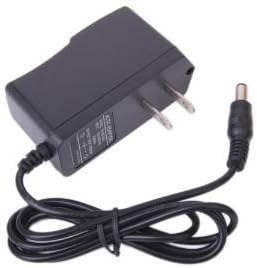
This 9V DC Power Supply 1A AC Adapter combines a supplied rating of 4.6 with a simple 5.5 x 2.5mm center-positive plug. It is a compelling budget-oriented choice for routers, compatible Arduino boards, ellipticals, bicycles, fans, record players, musical instruments, and other devices that explicitly accept 9V at 1A or less. The important qualifier is connector and polarity compatibility.
We may earn a commission when you buy through this link, at no additional cost to you.
Its input specification covers 100-240V AC at 50/60Hz, while the output is 9V DC at 1A. The description explains that it can serve lower-current loads such as 1000mA, 850mA, 500mA, and 300mA devices, although it recommends operating at around 80% full load. This is a meaningful distinction: the adapter is not intended to feed a load above its 1A ceiling.
The main concern is that a 5.5 x 2.5mm plug is not interchangeable with a 5.5 x 2.1mm plug, even though the two dimensions can look similar. It is also center-positive, making it unsuitable for guitar pedals and keyboards that require a negative-tip plug. The product information does not identify specific protection features, so buyers who value explicit safety circuitry may prefer one of the models that lists those protections.
This adapter is best for a user replacing a known 5.5 x 2.5mm center-positive cord. It provides a high rating, broad mains input, and enough output for many common household electronics without the added complexity of a tip set. Confirm the device's barrel size, polarity, and current requirement before making it the only adapter in a toolkit.
This model works particularly well as a direct replacement when the original cord used a 5.5 x 2.5mm center-positive connector. It supplies regulated 9V DC without requiring users to change tips or modify the cable.
The adapter can serve many loads below 1A, but its stated 80% full-load recommendation favors a margin below the maximum. Equipment that draws more than 1A should never be connected to it.
We may earn a commission when you buy through this link, at no additional cost to you.
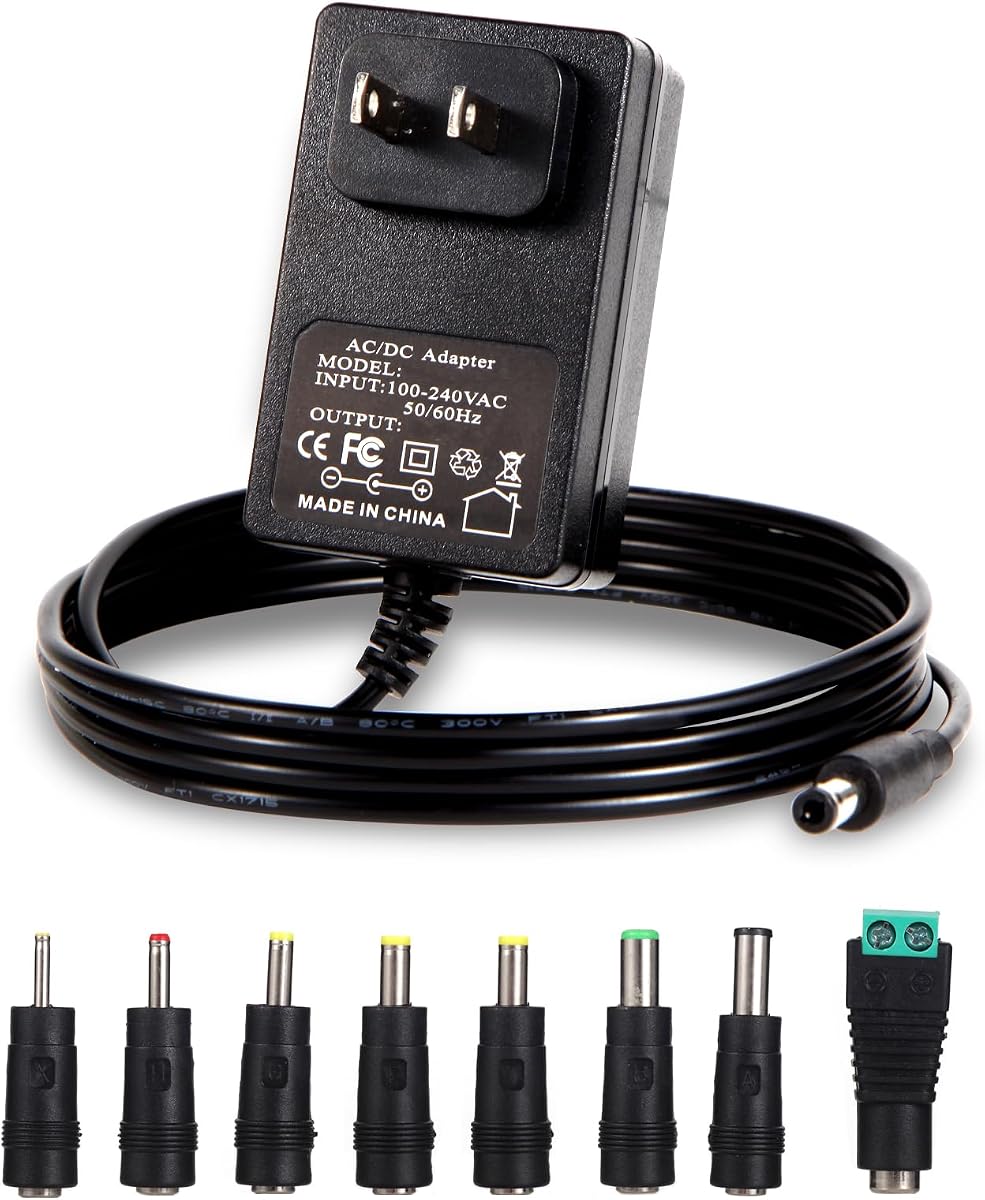
The 9V Power Supply 1A AC Adapter with eight interchangeable plugs is the most connector-flexible center-positive model in this roundup. Its supplied rating of 4.2 is the lowest among the ten products, but the feature set is substantial: eight tips cover several common barrel dimensions and a terminal connection, while a 5.9-foot cable adds placement flexibility.
We may earn a commission when you buy through this link, at no additional cost to you.
The specifications call for 100-240V AC input at 50/60Hz and a regulated 9V DC output of 1A with center-positive polarity. The included plugs are listed as 4.0 x 1.7mm, 4.8 x 1.7mm, 5.5 x 1.7mm, 6.0 x 3.0mm, 6.0 x 4.4mm, 3.5 x 1.35mm, 2.5 x 0.7mm, and an LED terminal connector. This assortment is useful for older radios, test equipment, electronic controllers, and assorted maker projects.
The listing also identifies short-circuit, over-current, over-voltage, and over-temperature protection, making the stated safeguards more comprehensive than those explicitly described for several alternatives. However, interchangeable tips solve connector geometry, not every electrical issue. The output remains center-positive, so guitar pedals and negative-tip piano keyboards remain incompatible. The listing explicitly warns that the product does not fit those devices.
This is the most sensible choice for a household or workshop that owns several positive-center 9V devices and wants one adapter rather than several fixed cords. It is less convincing for a single known device, where a simpler model may be easier to manage, or for negative-tip equipment. Buyers should still match both the tip dimensions and polarity and avoid treating the package as a battery charger.
Eight interchangeable tips make this kit useful when the devices in a home or workshop do not share a barrel size. The range includes common smaller barrels, larger industrial-style connectors, and a terminal option.
The listed short-circuit, over-current, over-voltage, and over-temperature protections provide a more clearly documented safety profile. They do not authorize overloads or reverse polarity, so correct matching remains essential.
We may earn a commission when you buy through this link, at no additional cost to you.
The 9VDC 1A Arduino Compatible Power Supply Adapter is aimed at a narrower but clearly defined audience: maker projects using Arduino Uno, Mega, and MB102 power supply boards. Its supplied rating of 4.4 reflects generally favorable feedback, while the fixed 5.5 x 2.1mm center-positive connector matches a common configuration for compatible boards.
We may earn a commission when you buy through this link, at no additional cost to you.
The adapter uses a two-flat-pin plug and accepts 110V AC input. It converts that to 9V DC at up to 1A, allowing a compatible board to run from a dedicated wall supply instead of taking power from a computer USB port. That can make repeated bench testing more convenient and reduce the need to keep a computer connected during standalone demonstrations.
The main drawback is its 110V-only input range. The product is less flexible outside a 120V electrical environment, although the device output itself remains a standard 9V. Like most models in this guide, it is center-positive and explicitly unsuitable for guitar pedals and label makers that require center-negative power. It also has no tip assortment, so it cannot accommodate other barrel sizes.
For someone building around one of the listed Arduino boards, this adapter offers a purpose-built and uncomplicated solution. It is less attractive for travelers, users in regions with different mains standards, or anyone who wants a versatile power supply for several types of electronics. Confirm the board's barrel input size, polarity, and accepted voltage before use.
Running a compatible board from the wall adapter frees its USB connection and can simplify standalone demonstrations. The output is specified at 9V DC and 1A for devices designed to accept that supply.
The fixed 5.5 x 2.1mm center-positive plug makes the adapter predictable for the listed Arduino boards. Its lack of interchangeable tips is a drawback only when the user expects broader compatibility.
We may earn a commission when you buy through this link, at no additional cost to you.
The 9V DC Power Supply with ten additional tips offers one of the broadest connector ranges in the guide. It has a supplied rating of 4.4 and is positioned for devices requiring 9V DC at no more than 1A, including compatible Arduino boards, Nixie tube clocks, Elegoo and IEIK boards, select Schwinn equipment, and hybrid trainers.
We may earn a commission when you buy through this link, at no additional cost to you.
Its base connector is 5.5 x 2.5mm center-positive, and the additional tips span 2.5 x 0.7mm, 4.0 x 1.7mm, 5.5 x 2.5mm, 5.5 x 1.7mm, 4.5 x 3.0mm, 3.0 x 1.1mm, 3.5 x 1.35mm, 5.5 x 2.1mm, 6.3 x 3.0mm, and a DC terminal connector. This is especially valuable when restoring older or less common equipment with a missing proprietary-style power lead.
The product information lists over-temperature, short-circuit, undervoltage, overvoltage, and overcurrent protection. Input spans 100-240V AC at 50/60Hz, and the cable is 93 centimeters, or 37 inches. As with other high-current models, the listing recommends approximately 80% full-load operation and says the device is center-positive, not center-negative.
This is a compelling option for a multi-device workspace because it combines a wide tip assortment, broad input support, and clearly listed protections. The trade-off is complexity: buyers must still identify the exact connector and polarity, and the kit cannot safely power a negative-tip pedal or keyboard without an appropriate polarity-reversing solution. The included tip range makes it more flexible than most fixed-plug alternatives.
The wide range of barrel sizes and the terminal connector make the kit useful for reviving equipment that uses less common power connectors. It is a practical way to cover several devices without keeping separate wall adapters.
Protection against temperature extremes, short circuits, voltage abnormalities, and overcurrent is explicitly listed. These safeguards supplement, rather than replace, correct voltage, current, connector, and polarity matching.
We may earn a commission when you buy through this link, at no additional cost to you.
The 9V 1A Power AC Adapter is designed as a general household replacement with a supplied rating of 4.1. Its 5.5 x 2.1mm center-positive plug is common on wireless routers, Bluetooth speakers, compatible controller boards, select record players, and other low-voltage electronics. The six-foot cable provides reasonable reach from a wall outlet.
We may earn a commission when you buy through this link, at no additional cost to you.
The adapter accepts 100-240V AC at 50/60Hz and outputs 9V DC with a maximum of 1A. The product description states that it can supply devices drawing less than 1000mA, including loads of 800mA, 600mA, 500mA, 400mA, 300mA, and 100mA. It explicitly warns that exceeding 1A can damage the power supply, making strict load management important.
The stated protective system covers over-current, over-voltage, short-circuit conditions, and stability. The listing also describes aging tests and copper-core wiring. Against those strengths, the fixed connector limits versatility, and the lowest supplied rating in the roundup suggests more mixed customer feedback than the leading options. It is center-positive and therefore unsuitable for many pedals and keyboards.
This adapter is most appropriate for someone who needs a straightforward supply for a router, speaker, toy, camera accessory, or similar item with the exact 5.5 x 2.1mm positive-center configuration. It offers a useful cable length and broad input range, but buyers with several connector types should favor a universal adapter instead. Always confirm the original power supply's voltage, current, and symbol markings.
A six-foot power cord gives a little more freedom than a very short wall adapter. This can help place a router or compact speaker where the outlet is not immediately adjacent to the device.
A 1A maximum does not mean every device should draw exactly 1A. The adapter supports lower-current equipment, but anything above its rated ceiling should use a supply designed for that load.
We may earn a commission when you buy through this link, at no additional cost to you.
The 9V 1A DC Power Supply AC Adapter has a supplied rating of 4.5 and a practical 5.5 x 2.5mm center-positive plug. It also states compatibility with 5.5 x 2.1mm devices, making it a sensible choice when the barrel's outer dimension matches even though the inner hole may differ.
We may earn a commission when you buy through this link, at no additional cost to you.
Its input range is 100-240V AC at 50/60Hz, and its output is 9V DC up to 1A. The product information lists short-circuit, over-current, over-voltage, and over-temperature protection, providing a clearly defined safety feature set. A 4.8-foot cable offers enough length for many tabletop arrangements without creating a large cable-management issue.
The product information is direct about its limits. It is an AC-to-DC power adapter, not a charger, so it should not be used to charge devices containing rechargeable batteries. It is also for indoor use only, and the output current must not exceed 1A. The adapter cannot be reversed or adapted for a center-negative device, and the fixed plug gives it less flexibility than the universal kits.
This is a good fit for a consumer who wants one dependable center-positive supply and has confirmed the 5.5 x 2.5mm dimensions. The listed compatibility with 2.1mm devices adds convenience, provided the actual connector fit is checked. It is less suitable for users with mixed equipment or for charging battery-powered products, and its indoor restriction should be respected in every setup.
The adapter combines a 9V 1A output with listed protection against common electrical faults. It is a straightforward option for devices that need a conventional center-positive barrel connection.
The supplied description explicitly says this is not a charger. It should serve as a mains adapter for compatible devices rather than being connected to a battery pack or rechargeable device as though it were a charging system.
We may earn a commission when you buy through this link, at no additional cost to you.
The Guitar Pedal Power Supply is built for the opposite polarity from most electronics adapters in this guide. Its 5.5 x 2.1mm plug is center-negative, making it relevant to many 9V guitar effects pedals, including common Boss, Ibanez, Fender, Dunlop Crybaby, Strymon, and Orange CR3 mini examples mentioned in the supplied information. Its rating is 4.6.
We may earn a commission when you buy through this link, at no additional cost to you.
The adapter accepts 100-240V AC at 50/60Hz and provides a maximum output of 9V DC at 1A. Available loads include 1000mA, 800mA, 500mA, and 300mA devices. Its 6.6-foot cord is long enough for a pedalboard, while the listed noise-reduction circuit design is intended to minimize hum caused by the current waveform.
The center-negative configuration is its defining benefit and also its central limitation. It should not be connected to a device that expects a positive center pin, and the fixed 5.5 x 2.1mm plug prevents use with unusual barrel sizes. Although it can replace a suitable single-pedal adapter, it is not the same as a dedicated multi-output pedalboard power supply with isolated outputs.
This is a strong recommendation for a musician replacing one compatible 9V pedal adapter, especially where a long cable and reduced electrical noise are priorities. It is not the right choice for a router, Arduino board, or other center-positive product. Before buying, check the original adapter's polarity symbol and confirm that the pedal accepts the available current and connector.
A center-negative plug directly addresses the requirements of many common 9V stompboxes. This avoids the risk and inconvenience of pairing a center-positive adapter with a pedal.
The listed noise-reduction design is useful for audio equipment where adapter hum can be audible. The long 6.6-foot lead also provides practical routing flexibility around a pedalboard.
We may earn a commission when you buy through this link, at no additional cost to you.
The DC 9V Guitar Pedal Power Supply is designed around center-negative 9V pedal equipment and supports loads from 10mA through 1000mA. That low minimum is notable for small-pedal compatibility, while its 1A maximum remains consistent with the guide's core output rating. The supplied customer rating is 4.5.
We may earn a commission when you buy through this link, at no additional cost to you.
The output uses a 5.5 x 2.1mm center-negative plug, with the outer barrel positive. The adapter accepts 100-240V AC at 50/60Hz, and its 110-centimeter, or 43-inch, cable is intended to reach a typical pedalboard. The information also mentions integrated circuit chips, noise reduction, isolation protection, and a magnetic ring at the cable end to further reduce noise.
For multiple pedals, the product can be paired with a daisy-chain cable, although the chain and required arrangement are not part of the stated package. A daisy chain also means the connected pedals share the adapter's available power budget, so their combined draw should not exceed the 1A limit. This is not a substitute for an isolated multi-output pedalboard supply.
The adapter is best for musicians with one compatible pedal or a group whose total current remains under the limit. Its explicitly low 10mA support makes it appealing for compact, low-consumption effects. It is inappropriate for a controller, router, keyboard, or other center-positive device. Confirm the center-negative symbol, barrel size, current, and daisy-chain requirements before use.
Compatibility from 10mA allows the adapter to serve compact effects that draw far less than the maximum output. That makes the 1A capacity more useful as a ceiling than a required operating level.
A compatible daisy chain can simplify connections, but total current still matters. The adapter's 1A maximum applies to the combined load rather than to each pedal independently.
We may earn a commission when you buy through this link, at no additional cost to you.
The 9V DC Power Supply AC Adapter with eight tips has a supplied rating of 4.6 and stands out for including both conventional barrel connectors and Micro-USB and Type-C tips. It is a versatile center-positive option for users who want to cover a broad range of older and newer low-voltage accessories without purchasing several separate adapters.
We may earn a commission when you buy through this link, at no additional cost to you.
Its output is 9V DC at a maximum of 1A, and the input covers 100-240V AC at 50/60Hz. The tip collection includes 5.5 x 2.5mm, which the description says is compatible with 5.5 x 2.1mm, plus 4.0 x 1.7mm, 3.5 x 1.35mm, 3.0 x 1.1mm, 2.5 x 0.7mm, Micro-USB, Type-C, and a terminal connector. The supply can handle devices drawing from 100mA up to 1A.
The product listing mentions protection against overvoltage, short circuits, and internal overheating. However, the inclusion of USB-style tips does not make the adapter a safe charger for every battery-powered product. Its description warns that guitar pedals, P-touch label makers, Casio piano keyboards, and radios may need reverse polarity, and that a polarity-reversing cable is not included. Users should avoid improvised connections.
This model is a strong choice for a mixed collection of small electronics, particularly when a legacy barrel accessory and a modern USB-style device need the same 9V supply. It is less appropriate for a dedicated guitar pedal, a center-negative keyboard, or a device whose current demand exceeds 1A. Always reconfirm connector dimensions, polarity, and whether the device is designed for external 9V power.
The combination of several barrel sizes with Micro-USB and Type-C tips makes this package useful for a varied device collection. Connector versatility reduces the need to search for a separate adapter for each small accessory.
The output is center-positive, and the supplied information specifically notes that some pedals, label makers, keyboards, and radios require center-negative power. A suitable tip does not make an incorrect-polarity connection safe.
We may earn a commission when you buy through this link, at no additional cost to you.
Choosing a 9V 1A power adapter requires matching several electrical and physical details. Voltage and current establish the broad requirements, while polarity, connector size, mains input, and intended use determine whether the selected model can actually be connected safely.
Start with the output label on the original adapter or the device documentation. The products in this guide provide 9V DC output with a maximum current of 1A, so they are appropriate for equipment that requires 9V and draws no more than that amount. A lower-current device can generally use the adapter, while a higher-current device needs a supply with a higher rating.
Choose an adapter with an output that matches the device exactly. Do not assume that a 9V 1A designation guarantees enough power for every product labeled 9V.
Polarity describes which part of the barrel connector carries positive voltage. Most electronics adapters in this guide are center-positive, while two products are center-negative for common guitar pedals. The positive and negative symbols on the original power supply or device are more reliable than the physical appearance of the plug.
Never force a connector whose polarity does not match. A wrong-polarity connection can prevent a device from working and may cause damage. A physical adapter cannot safely power both positive-center and negative-center equipment without the correct conversion.
Connector size is normally written as an outer diameter and inner diameter, such as 5.5 x 2.1mm or 5.5 x 2.5mm. These similar-looking plugs are not interchangeable unless the manufacturer specifically states otherwise. A barrel plug with an outer diameter that fits does not necessarily pass through a smaller center opening.
Measure both the outer barrel and the visible hole in the device's power socket. For terminal-connected equipment, check the required wire arrangement rather than relying on a barrel-style connector.
Fixed-plug models are simple and dependable for one known device, while interchangeable-tip kits can serve equipment with different barrel sizes. Kits with eight or ten tips provide broad coverage, but the extra choices can make setup less intuitive. Store tips in a labeled case and record the correct size beside each device.
The number of tips does not overcome polarity restrictions. Both universal center-positive kits in this guide still require a separate center-negative solution for pedals, label makers, or keyboards that use reversed polarity.
Most adapters accept 100-240V AC at 50/60Hz, making them suitable for a broad range of locations. One listed Arduino-focused model specifies 110V input. Confirm that the adapter's input range covers the local wall supply and that its attached wall plug is physically compatible with the outlet.
A wide input range does not guarantee universal physical plug support. The US Type A plug used by the ELEGOO model may require an appropriate travel adapter, and a two-flat-pin plug may not fit every wall socket.
Protection against over-current, overvoltage, short circuits, and excessive temperature adds useful safeguards. Several products in the guide explicitly list these protections, while others provide less detail. Protection circuits do not make a mismatched connector or an overloaded output safe, so they should complement rather than replace careful matching.
Look for a clear stated output rating, a cable appropriate for the intended installation, and a manufacturer or seller willing to support defective products. A basic fixed adapter may be sufficient for a single low-risk device, while a multi-tip model with documented safeguards is more reassuring in a shared workshop.
Cable lengths range from 4.8 to 6.6 feet across the selected products, with the eight-tip adapter measuring 5.9 feet. A longer lead can make it easier to place a compact device near a wall outlet, but it can also become untidy behind furniture or on a crowded pedalboard. Choose a length that suits the installation rather than assuming the longest option is always preferable.
For a guitar pedalboard, reach and manageable routing are especially important. For a router or small speaker beside a desk, a moderate four-and-a-half-foot lead may be sufficient.
The intended equipment should guide the choice. Compatible controller boards may favor a fixed 5.5 x 2.1mm center-positive adapter, a varied electronics collection may benefit from interchangeable tips, and guitar pedals usually require center-negative power. The listed examples also include routers, Bluetooth speakers, Nixie tube clocks, record players, ellipticals, bicycles, and select keyboards, but each device still requires confirmation of its own requirements.
Read the original adapter label and the device documentation whenever possible. If either is missing, measure the connector, locate the polarity symbol, and identify the required current before purchasing a replacement.
Before connecting the adapter, inspect the plug, cable, and device socket for damage. Confirm that the output is 9V DC, the current requirement is 1A or less, the polarity is correct, and the connector dimensions match the device. Connect the adapter to the equipment before plugging it into the wall, and keep the connection dry and unobstructed.
Do not overload the adapter, force a connector, or use a polarity-reversing arrangement unless the device documentation explicitly supports it. These products are AC-to-DC power supplies, not general-purpose battery chargers. Do not attempt to use one to charge a rechargeable device unless the manufacturer of both the device and adapter expressly permits that application.
For long-term use, place the adapter where it can dissipate heat without being covered. Avoid water, excessive heat, and high-traffic areas where the cable could be pulled or pinched. Unplug it when the device is unattended for extended periods or when you notice unusual heat, odor, discoloration, buzzing, or a loose connection.
Yes, a compatible device can use a 9V 1A adapter when it requires 9V DC, uses the correct polarity, and has a matching connector. The device will draw only the current it needs, while the adapter's 1A figure is its maximum rating. Some product descriptions recommend operating at around 80% full load, so leaving some current headroom is prudent.
Not reliably, even though the outer diameter is the same. The second number represents the inner opening, so a 5.5 x 2.1mm plug may be too small to make proper contact in a 5.5 x 2.5mm socket. Some products explicitly state that their larger plug is compatible with the smaller 2.1mm device, but that should be confirmed for the exact model.
The terms describe where positive voltage appears on a barrel connector. In a center-positive plug, the inner tip is positive and the outer barrel is negative. In a center-negative plug, the inner tip is negative and the outer barrel is positive. Guitar pedals often use center-negative power, while many routers, speakers, and controller boards use center-positive power.
Generally no. These products are listed as AC-to-DC power adapters, and one description explicitly warns that they are not chargers. Connecting an adapter to a rechargeable device can be unsafe unless both manufacturers specify that the voltage, current, polarity, and charging protocol are appropriate.
Only if their combined current draw remains within the adapter's limit and the required connection method is safe. Some pedal adapters can be paired with a suitable daisy-chain cable, but the total current still cannot exceed 1A. A daisy chain also does not provide the electrical isolation offered by a dedicated multi-output pedalboard power supply.
It may work electrically if the local mains supply falls within the adapter's stated input range, but the wall plug must also fit. Adapters with a US Type A plug may require a suitable travel plug. Always verify both the input voltage and physical outlet compatibility before use.
A matching barrel size is only one part of compatibility. The voltage must be 9V, the connector's polarity must match, and the adapter's current rating must meet the device's requirement. The device may also require a connector with a different inner opening or a proprietary power arrangement that is not covered by the selected adapter.
Neither type is inherently safer. A fixed plug reduces the chance of selecting the wrong tip, while an interchangeable model offers broader device coverage. Both require correct voltage, current, polarity, and connector matching, and the presence of protection features can be an additional consideration rather than a substitute for careful use.
The ELEGOO 9V 1A AC/DC Power Adapter is the strongest all-around choice for a standard 5.5 x 2.1mm center-positive device. The 9V DC Adapter with 2.5mm Tip stands out as a budget-focused option for users who know they need that exact plug, while the eight-tip 9V Power Supply offers the greatest connector versatility for a mixed collection of positive-center electronics.
Prioritize the four details that determine compatibility: 9V DC output, current no greater than 1A, correct center polarity, and the correct connector dimensions. Then consider mains input, safety features, cable length, and whether a fixed plug or interchangeable kit better reflects the devices you actually use. Center-negative guitar pedal adapters are a separate category and should not be treated as substitutes for positive-center electronics supplies.
Ratings, availability, and prices can change, so check the current listing before ordering. Reconfirm the device requirements and current feedback at that time, and never rely on connector appearance alone. With the correct match, a dependable 9V 1A adapter can replace a missing cord, support a bench project, or keep a compact piece of electronics powered without occupying a computer USB port.
