
Slinkdsco Low-Profile Omni
3.2Editor score
Low-profile omnidirectional design
698–6000 MHz frequency range
Three-meter RG174 cable
Wall-mount installation
SMA male connector
Compare the best 4x4 Mimo External Antenna for 4G and 5G, covering gain, bandwidth, MIMO, cable, mounting, and compatibility.
A 4×4 MIMO external antenna can materially improve a cellular router, gateway, or hotspot when indoor walls, metal cabinets, and remote tower locations weaken reception. The right model must match the router’s connector layout, supported frequency bands, and installation environment while preserving the four independent signal paths required for full MIMO performance.
We compared the ten antennas in this guide by examining advertised frequency coverage, gain, radiation pattern, cable length and loss, connector standards, mounting options, weather resistance, carrier compatibility, and included installation hardware. The list covers low-profile omnidirectional models, higher-gain screw-mount antennas, directional panels, and complete kits for residential, RV, and industrial deployments.
Each review identifies the product’s strongest use case and practical compromises, from the importance of locating a nearby cellular tower to the benefit of avoiding directional alignment. Ratings and specifications reflect the supplied product information, while availability and prices can change, so compare current listings and your router’s requirements before purchasing.
3.2Editor score

5.0Editor score

4.1Editor score
The comparison below highlights the main design differences among all ten antennas, including radiation pattern, frequency coverage, gain, connector arrangement, mounting method, and kit contents.



The Slinkdsco Low-Profile Omni is a straightforward external antenna for users who need full-direction cellular reception without a complex directional panel. Its supplied rating is 3.2, the lowest among the ten selections, but the product offers a broad 698–6000 MHz range, omnidirectional radiation, and a compact wall-mount form factor that fits many RV and home-internet installations.
We may earn a commission when you buy through this link, at no additional cost to you.
Its primary strength is flexibility. Because the antenna receives signals from all directions, installers do not need to identify and precisely aim at a nearby tower. The 5 dBi advertised gain can improve the usable signal presented to compatible routers and hotspots, while the three-meter RG174 lead and SMA male connector offer a familiar installation arrangement. The listing identifies support for major carriers and suitable use with cellular routers, gateways, and hotspots.
The main compromises are the modest customer rating and the use of relatively thin RG174 cable. Cable loss can become more significant over longer routes, and the included three-meter lead may be too short for installations that require the antenna to sit farther from the router. Its lower profile and 5 dBi gain also place it below higher-gain and panel-style alternatives when a strong tower signal is available.
This is a sensible pick for a straightforward budget installation where a compact omni antenna, broad band support, and simple placement matter more than specialized mounting hardware. Confirm that the router accepts external antennas and has compatible SMA ports, then install the unit near a window, eave, or other unobstructed location. For longer cable runs or more demanding outdoor coverage, a lower-loss kit would be a better fit.
The omnidirectional pattern removes the need to watch the router’s signal meters while adjusting direction. This is particularly useful on an RV, where a fixed tower may sit in a different direction at each stop.
The low-profile housing and fixed wall-mount design are intended to remain out of the way while placing the antenna closer to an unobstructed exterior location.
We may earn a commission when you buy through this link, at no additional cost to you.
The Waveform QuadMini is a polished 4×4 MIMO installation solution for users who want a complete antenna kit rather than assembling cables, adapters, mounts, and entry hardware independently. It carries a 4.1 rating and advertises up to 5.2 dBi gain in a low-profile omnidirectional housing designed for four-port 5G routers.
We may earn a commission when you buy through this link, at no additional cost to you.
The included package distinguishes it from simpler antenna-only choices. It comes with a Window Entry Cable, UltraFlex-Quad cables, weatherproofing boots, a detailed manual, and installation support. Installers can use suction cups for a window, a pole adapter, a desktop stand, or direct wall mounting, making it easier to find the strongest available location without committing to permanent drilling immediately.
Waveform emphasizes that speed is influenced by more than raw signal strength. MIMO isolation, polarization, and the router’s ability to aggregate four spatial streams can all affect throughput and latency. That makes the QuadMini especially interesting for users with a properly configured four-antenna router, although an omnidirectional antenna will not offer the same peak gain as a precisely aimed panel.
The QuadMini is best for homeowners or RV users who value installation flexibility, polished accessories, and a complete package. It is a strong option when the exact tower direction is uncertain, when a removable installation is preferred, or when a professionally finished cable route is desired. Buyers should still verify the router’s antenna ports and gain-focused alternatives when maximum directional reach is the overriding priority.
Cables, entry hardware, weatherproofing boots, and multiple mounts reduce the chance that an otherwise effective antenna will be undermined by improvised accessories.
Window suction cups, a desktop stand, a pole adapter, and wall mounting let users compare several positions before selecting the strongest and least intrusive installation.
We may earn a commission when you buy through this link, at no additional cost to you.
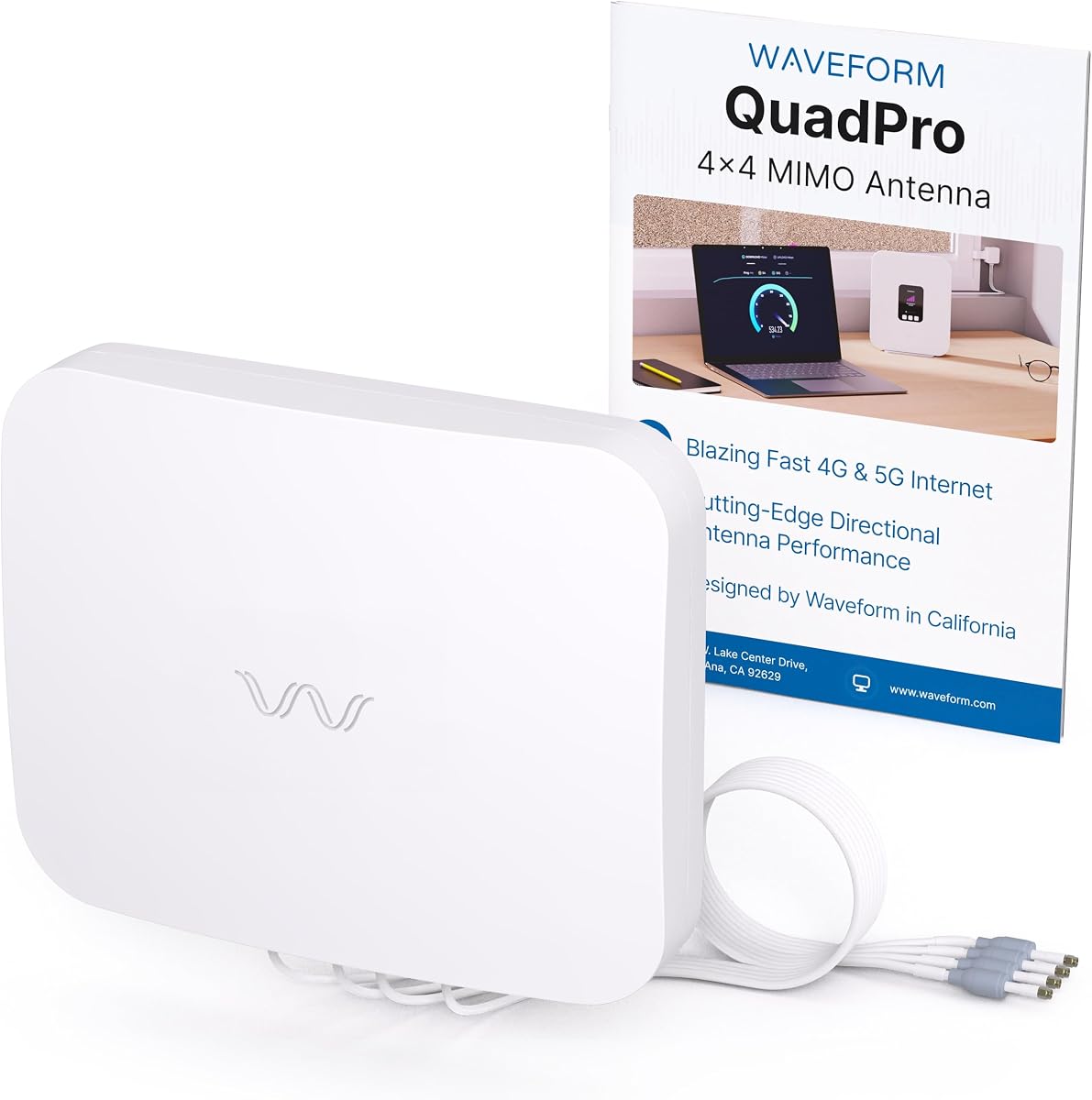
The Waveform QuadPro is a directional 4×4 MIMO panel antenna for users who know they can place and aim an antenna toward a cellular tower. It has a 4.4 rating and advertises up to 9.1 dBi gain across 600–6000 MHz, making it a substantial step up in directional gain compared with the low-profile omnidirectional alternatives.
We may earn a commission when you buy through this link, at no additional cost to you.
The listing says the antenna supports every 4G and 5G band from major carriers, including AT&T, Verizon, T-Mobile, and US Cellular. It also includes a Window Entry Cable, FlexMount, UltraFlex-Quad cable, and weatherproofing boots. Installation guidance is provided for several T-Mobile Home Internet gateways, with compatibility also noted for Verizon 5G Home Internet and AT&T Internet Air.
A directional panel concentrates its radio energy toward a chosen direction, which can make weak marginal service much more useful when the correct tower is known. The trade-off is installation effort: if the beam is pointed incorrectly, the result can be worse than an omnidirectional antenna. The product is also labeled as antenna only, so users should carefully review the included components and what their specific router still requires.
The QuadPro is best for fixed installations near a window, wall, or outdoor mounting point where the tower can be located and aimed at. It suits advanced users who understand cellular bands, connector routing, and directional gain. For a moving RV or a site with uncertain tower direction, one of the omnidirectional kits may be easier to deploy, but in a stable location this panel is a strong high-gain choice.
The directional pattern can improve reception at the edge of coverage when the panel is aligned correctly, offering a useful contrast to antennas that spread gain over a wider area.
The Window Entry Cable and FlexMount provide a way to route a permanent-looking installation without immediately drilling through a wall.
We may earn a commission when you buy through this link, at no additional cost to you.
The Dual-Cable Omni Antenna combines a 5.0 rating with a useful balance of gain, frequency range, and installation flexibility. It advertises up to 7 dBi gain from 600 to 6000 MHz and uses an omnidirectional pattern, allowing it to work without the precise aiming required by a panel antenna.
We may earn a commission when you buy through this link, at no additional cost to you.
Its two dual 10-meter cable assemblies are a central feature. The long leads give an installer much more freedom to place the antenna outside a room, near an upper wall, or at another location with a clearer view of cellular towers. The listing identifies support for major 4G and 5G bands, including n66, n41, n77, n2, n5, and n71, across AT&T, Verizon, T-Mobile, and US or Canadian cellular providers.
The principal compatibility detail is the SMA male interface. The cable can connect directly to equipment with an SMA female port; otherwise, a suitable adapter is required. Cable length is not automatically a benefit, because every additional meter can introduce some loss, particularly with smaller coax. The antenna’s attractive rating should also be considered alongside router configuration and the availability of usable carrier coverage.
This is a strong all-around recommendation for a fixed router or gateway with four external antenna connections. It is particularly useful when the ideal antenna position is far from the device, when tower direction is uncertain, or when an installer wants a simple installation without finding a precise directional bearing. Verify all four ports, cable routing, and connector gender before installation.
The 10-meter cable runs make it practical to move the antenna away from a router’s original location, which can be valuable when a wall, cabinet, or lower floor blocks reception.
Coverage from 600 to 6000 MHz and support for widely used LTE and 5G bands make the antenna relevant to a broad range of carrier networks.
We may earn a commission when you buy through this link, at no additional cost to you.
The Slinkdsco Wide-Band Omni is a compact external antenna centered on broad frequency coverage and an unobtrusive installation. Its supplied rating is 2.9, so prospective buyers should interpret its advertised specifications alongside the limited customer feedback. It offers 6 dBi gain over 600–6000 MHz and an omnidirectional pattern.
We may earn a commission when you buy through this link, at no additional cost to you.
Compared with the related low-profile Slinkdsco model, this version adds 100 MHz at the low end of the stated range and uses a KSR100 cable. The listing describes a cable-optimized design intended to reduce tangles and keep a desktop setup orderly. It is positioned for routers, gateways, hotspots, RV installations, and home internet, with support named for Verizon, AT&T, and T-Mobile.
Its modest gain and short lead make it more suitable for close-range placement than for long cable runs through a home or workshop. The product information also provides less detail about included mounting hardware than several competing kits, so installation planning may require checking the package contents. Omnidirectional reception remains helpful where the tower’s direction is unknown.
This antenna is best for a user who wants a simple, compact omni unit in a convenient position and does not need a long routed installation. Check the exact connector type and supplied mounting pieces, and avoid unnecessary extensions. A model with stronger customer feedback, lower-loss cabling, or a more complete mounting package may be the safer choice for a critical primary connection.
The 600–6000 MHz range covers a wide selection of cellular bands while the compact housing remains suitable for desktop or near-wall placement.
The KSR100 lead and cable-optimized layout aim to keep a relatively short installation neat without requiring a large bundle of excess coax.
We may earn a commission when you buy through this link, at no additional cost to you.
The Outdoor Panel Antenna Kit is built for fixed locations where a user can identify the nearest tower and aim a high-gain panel toward it. It carries a 5.0 rating and advertises up to 10 dBi gain from 600 to 6000 MHz, giving it one of the strongest directional specifications in this comparison.
We may earn a commission when you buy through this link, at no additional cost to you.
The package includes one panel antenna, a mounting pole, four 32-foot low-loss cables with N male-to-SMA male connectors, and four TS9 adapters. That generous cable length supports installations in which the antenna must sit well away from the router or modem. The listing identifies compatibility with major US and Canadian carriers, as well as Bell Canada, Rogers, Telus, Digicel, and Telcel.
Directionality is the central trade-off. A panel can deliver stronger signal in its target direction, but an incorrect angle, obstruction, or nearby competing tower can reduce results. Outdoor installation also requires attention to weatherproofing, cable strain, mast stability, and separation from conductive materials. The four-cable arrangement is suited to a four-port MIMO device, but all ports and cables must be connected appropriately.
This kit is an excellent option for rural homes, workshops, or other fixed installations where marginal service needs maximum directional reach. It is less suitable for travelers who cannot maintain a consistent tower bearing. Buyers should confirm the router’s connector system, use the included adapters correctly, and secure the mast and cables for long-term outdoor exposure.
The 10 dBi maximum gain and directional focus are designed to improve service where a tower is present but blocked from the router by distance, terrain, or building materials.
A pole, weatherproof panel, long low-loss leads, and multiple adapters provide the core components needed for a remote installation.
We may earn a commission when you buy through this link, at no additional cost to you.
The Maswell Cubic-4C is a rugged omnidirectional antenna with a 5.0 rating, up to 6 dBi gain, and a 600–8000 MHz operating range. It is designed for 4G and 5G routers, gateways, CPE equipment, smart meters, automotive networking, agriculture, and industrial IoT applications, giving it broader intended uses than a home-focused antenna.
We may earn a commission when you buy through this link, at no additional cost to you.
The listing highlights the antenna’s cross-polarized MIMO technology and inclusion of a two-meter professional cable with four SMA male connections and TS9 adapters. It also recommends avoiding RG58 and RG174 and keeping the total cable length under five meters, which is practical guidance for preserving signal quality through the four MIMO paths.
Physical durability is a major advantage. The ASA housing is UV stabilized, the antenna is IP67 rated for dust and water resistance, and the package includes mounting screws, brackets, waterproof adhesive, and an M24 screw-hole option. Its compact shape supports wall or pole mounting without requiring a large directional panel. The stated gain was tested with a 20-centimeter cable, so real-world results will vary with routing and the final lead length.
The Cubic-4C is a strong recommendation for users who need a durable omni antenna across cellular and newer wireless bands. It is particularly suitable for RVs, outdoor CPE, smart agriculture, and industrial applications where long-term weather exposure matters. For a router far from the desired antenna position, choose a longer low-loss solution or a professional installation; otherwise, this model offers an excellent balance of robustness and coverage.
The UV-resistant ASA enclosure and dual IP67 dust-and-water certification make the antenna better suited to exposed RV, rooftop, and industrial deployments.
Extending coverage to 8000 MHz allows the same antenna to serve cellular, WiFi 6E, and WiFi 7-oriented equipment across a wide range of frequencies.
We may earn a commission when you buy through this link, at no additional cost to you.
The Slinkdsco Industrial Omni combines a 4.7 rating with a substantial 9 dBi advertised gain in a screw-mounted omnidirectional housing. It is a compelling value-oriented choice for users who want more gain than a low-profile window antenna but do not want to identify and aim at a tower.
We may earn a commission when you buy through this link, at no additional cost to you.
Its 698–6000 MHz range, 50-ohm impedance, and 4×4 MIMO positioning suit compatible 4G LTE and 5G routers, gateways, and hotspots. The five-meter cable provides more placement freedom than the three-meter alternatives, while the screw mount creates a more permanent installation than a suction cup. Major carriers such as Verizon, AT&T, and T-Mobile are specifically identified in the product information.
Nine dBi is a peak figure, and an omnidirectional antenna distributes energy over a broad area rather than concentrating it toward one tower. Actual performance also depends on location, obstructions, and cable loss. The screw-mount format may require drilling, and users should confirm whether their equipment accepts SMA male cables directly or requires an adapter.
This is an excellent middle ground for fixed homes, workshops, RV installations, and outdoor router setups. It suits users who value the rating, compact format, and simple permanent mounting more than a complete professional cable package. Install it high and clear of metal, then use the router’s external antenna mode and restart it to evaluate the connection.
A simple screw mount creates a stable exterior position while retaining omnidirectional coverage and a relatively unobtrusive profile.
The advertised nine-dBi gain is helpful when the router sits behind walls or in a low-signal room, provided the antenna is moved to a genuinely clear position.
We may earn a commission when you buy through this link, at no additional cost to you.
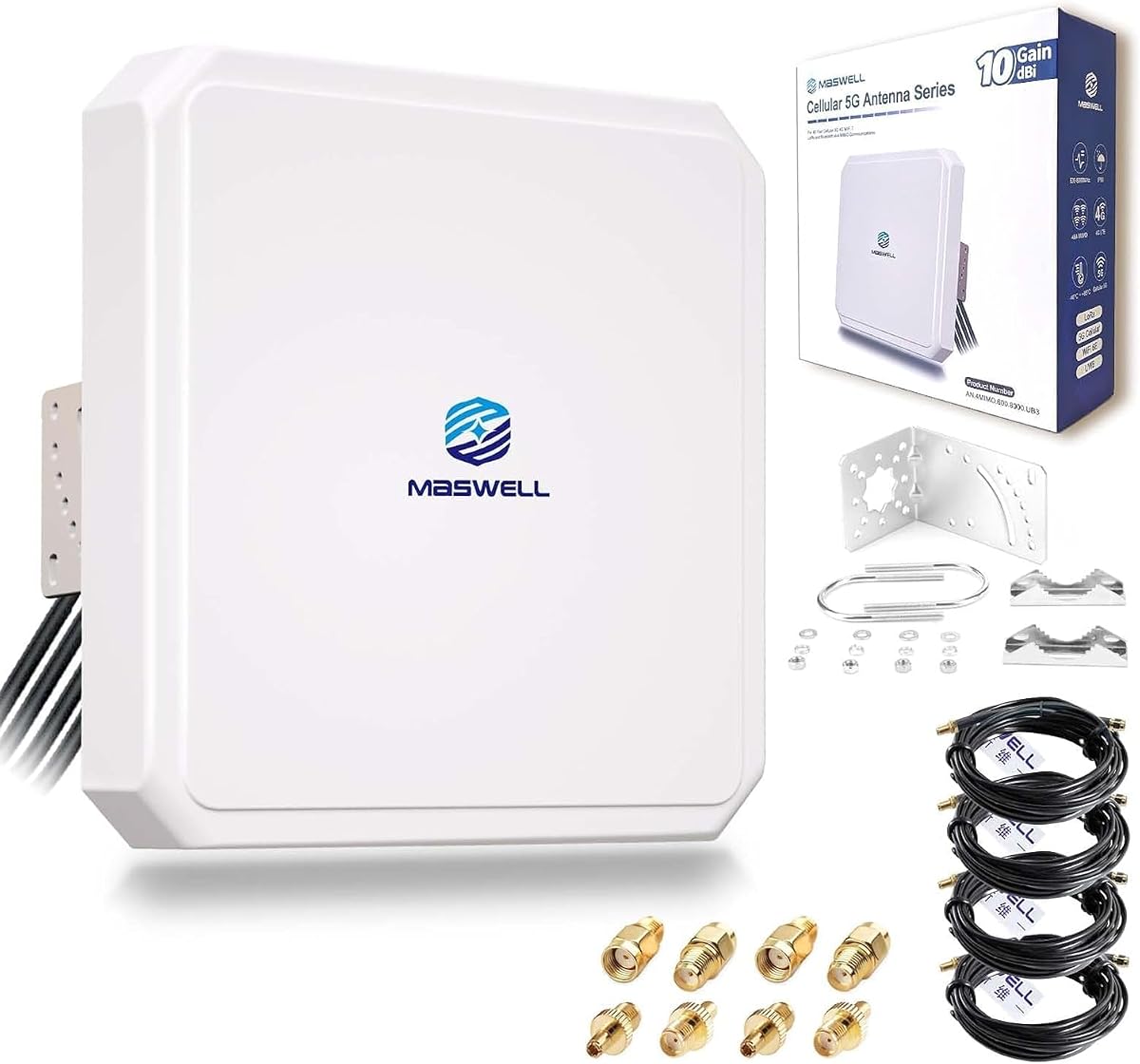
The Maswell 4MIMO Ultra is a premium directional panel system designed for demanding fixed 4G and 5G installations. Its supplied rating is 3.9, while the specifications emphasize a maximum gain of 10 dBi, a 600–8000 MHz range, and a standard 60–80-degree directional beamwidth.
We may earn a commission when you buy through this link, at no additional cost to you.
This complete kit includes four six-and-a-half-foot LMR240-equivalent cables, mounting brackets and screws, and adapters for SMA male, TS9, and RP-SMA interfaces. The included low-loss cabling avoids the signal penalty associated with RG58 or RG174. The product also offers professional technical support and recommends measuring RSRP at several outdoor positions to find a location above the listed poor-signal threshold.
Its practical challenge is placement. The broad beamwidth reduces the need for laboratory-level aiming, but the panel still benefits from being pointed generally toward the serving tower. At 4.4 pounds, it also needs secure mounting and is not intended for casual portable use. The IP66 housing and UV-resistant ASA material support long-term outdoor exposure, while the larger structure requires more space than a compact omni.
The 4MIMO Ultra is best for a homeowner or installer who can identify a tower, mount a substantial panel, and wants a complete professional kit with broad frequency support. It is less appropriate for a temporary RV deployment or an installation where the tower direction is completely unknown. Confirm connector types and router settings, and compare the setup with a high-gain outdoor omni if flexible placement is more important.
Four LMR240-equivalent leads preserve more of the antenna’s signal across the complete four-port MIMO installation than thinner RG-series alternatives.
The 60–80-degree beamwidth provides a useful balance between focused gain and the tolerance needed for practical installation without perfect aiming.
We may earn a commission when you buy through this link, at no additional cost to you.
The Dual-Cable Outdoor Omni offers a 7 dBi advertised gain, 600–6000 MHz coverage, and a 4×4 MIMO design for routers and home-internet gateways. It has no supplied customer rating, so its appeal rests on the listed specifications and the practical convenience of its two long dual-cable assemblies.
We may earn a commission when you buy through this link, at no additional cost to you.
The package contains one antenna, two dual 10-meter cables with SMA male connectors, and a mounting bracket. Long runs make it possible to position the antenna outside the router’s immediate room and improve reception where an internal device would otherwise be surrounded by walls and obstructions. The omnidirectional pattern also means the user does not need to determine the exact direction of a tower.
The equipment must have an SMA female connector for direct connection according to the product details, and the long leads should be routed carefully rather than coiled unnecessarily. As with other high-gain omni models, seven dBi is a maximum figure and real performance varies with the environment. The absence of a customer rating makes field feedback less available than for most products in this guide.
This antenna is a reasonable choice for a fixed home internet or router setup where an installer wants a long cable route and an omnidirectional pattern. It may be especially useful when the tower direction changes or cannot be established with confidence. Buyers should favor a model with more documented customer feedback if that factor is important, but the stated bandwidth, gain, and installation package remain appropriate for 4G and 5G use.
Ten-meter cable assemblies provide substantial freedom in finding a strong location while retaining the convenience of omnidirectional reception.
The 600–6000 MHz range covers major 4G and 5G bands, making the antenna suitable for common cellular routers and home-internet gateways.
We may earn a commission when you buy through this link, at no additional cost to you.
Choosing an external cellular antenna requires matching the radio design to the device, location, and available signal. The most important factors are antenna pattern, supported ports, band coverage, cable quality, and whether the installation can remain properly positioned.
Match all four paths, use the manufacturer’s recommended adapter where necessary, and confirm that external antenna mode is enabled after installation.
Choose omni for flexibility and panel gain for a fixed, properly aligned location.
Confirm the frequency range, carrier, region, and specific bands before installing the antenna.
Favor professional-grade low-loss cable, minimize excess length, and protect every connection from moisture.
Match connector type and gender before ordering, then minimize adapter stacks and seal outdoor joints.
Optimize placement first, then consider gain, and test the connection from several candidate positions.
Match the mount to the location, secure cables, and weatherproof every exposed connection.
Compare before-and-after readings, enable external antenna mode, and relocate the antenna methodically when results fall short.
Begin by identifying the serving tower and the router’s external antenna specifications. For a directional panel, choose an unobstructed position with a general view of the tower and prepare a temporary mounting point. For an omnidirectional antenna, compare several high locations, such as near an upper wall, window, eave, or exterior pole, rather than immediately attaching it beside the router.
Connect each of the four MIMO leads to the intended router port, observing connector gender and using only the appropriate adapter. Route the cables away from sharp edges, power supplies, fluorescent fixtures, metal brackets, and other potential sources of interference. Leave a small service loop, secure the leads, and use the supplied weatherproofing components at outdoor entry points. After connecting, enable external antenna mode and restart the router.
Test signal quality, connection stability, latency, and throughput under representative conditions. If results are weak, inspect every joint, verify that external antenna mode is active, move the antenna incrementally, and compare it with a temporary indoor connection. Clean the radome with a soft damp cloth, inspect seals and mounting hardware periodically, and avoid standing water, harsh cleaners, or repeated connector disassembly that could damage the weather seals.
No. The antenna must be compatible with the router’s cellular radio and available external antenna ports. A router may support only 2×2 MIMO even if it accepts an external antenna, while a 4×4 router may have four distinct ports for cellular connections. Confirm the router specification, connector type, and supported external antenna mode before choosing a four-port antenna.
No. Directional panels usually offer higher peak gain because they concentrate radio energy toward a tower, but they require proper alignment and are less convenient for moving installations. Omnidirectional antennas are more forgiving and easier to position, making them better for RVs, uncertain tower locations, and temporary setups. The best choice depends on whether the installation is fixed and whether the tower direction is known.
The useful amount depends on tower distance, terrain, obstructions, and the router’s internal antenna performance. A low-profile five- or six-dBi omni can be adequate for a modest improvement, while a seven- to ten-dBi model may help a fixed location with weaker service. Placement often has a greater effect than the difference between two similar peak-gain figures, so compare readings from several candidate positions.
They can. Every additional cable length adds some loss, and smaller coax such as RG174 or RG58 is more affected than low-loss LMR240-equivalent cable. Use only the length required, avoid unnecessary splitters and adapter stacks, and keep the four leads comparable where practical. For long outdoor runs, invest in lower-loss cable and secure it against damage and moisture.
Connecting only one port may provide some signal benefit, but it will not exploit the full four-path MIMO capability. Full performance generally requires all four appropriate antenna connections, the correct adapters, and external antenna mode enabled in the router settings. Check the manufacturer’s manual because some gateways treat ports differently or use captive antenna leads.
Choose a position as high as practical, with a clear view toward the serving tower and away from metal, dense wiring, foil-backed insulation, and other obstructions. For an omni, try several sides of the building to identify a stronger location. For a panel, use a mobile signal app or router readings to establish a rough bearing, then fine-tune the aim while monitoring connection quality.
An external antenna can improve signal quality, stability, and throughput when reception is the limiting factor, but it cannot remove tower congestion or add capacity that the network does not provide. If the router already receives a strong, stable signal and performance remains limited, the bottleneck may be network congestion, plan limits, server conditions, or the router itself rather than antenna coverage.
The antennas in this guide are advertised for major carriers including T-Mobile, Verizon, and AT&T, and several also support additional regional or international providers. Carrier-brand compatibility alone is not enough: the router must expose the correct ports, operate on bands within the antenna’s stated range, and use compatible connectors. Check both the antenna and gateway documentation before purchase.
The Slinkdsco Low-Profile Omni is the most accessible compact choice, the Maswell Cubic-4C stands out for rugged construction and a 5.0 rating, and the Waveform QuadMini offers the most polished complete-kit experience. These three cover the key priorities of affordability, durability, and installation convenience, though each should be matched to the router and location.
For users seeking the strongest fixed installation, the Outdoor Panel Antenna Kit, Waveform QuadPro, or Maswell 4MIMO Ultra provide higher directional gain. Choose one only when you can position it toward a serving tower. If the tower direction is uncertain or the setup must move, a seven- or nine-dBi omnidirectional antenna is usually more convenient.
Before buying, verify four-port MIMO support, connectors, frequency bands, cable length, weather requirements, and the router’s external antenna setting. Current listings and prices can change, and installation quality can be as important as the antenna specification, so review the latest product details and compare real signal readings before making a final selection.