
European Travel Plug Adapter, US to European Plug Adapter
4.7Editor score
Seven-port charging design
Three-foot flexible power cord
Type C, G, and A plugs
Power Adapter for Estonia Travel guide comparing plug types, USB charging, voltage support, portability, and protection for modern trips.
Choosing a power adapter for Estonia travel is about more than finding a plug that fits. Estonia generally uses Type C and Type E/F-compatible sockets, so travelers should also check voltage support, grounded-plug needs, USB-C charging requirements, and whether a compact adapter or corded design better suits the trip.
This guide compares ten travel power adapters on the factors that affect everyday use in Estonia. It examines plug compatibility, supported device voltages, AC outlet capacity, USB-A and USB-C outputs, portability, surge protection, and practical limitations involving hair tools, laptops, and grounded chargers.
Each review identifies a different reason to consider an adapter, from a lightweight multi-port option to a universal kit with surge protection. Ratings and specifications reflect the supplied product information, while availability and pricing can change, so shoppers should confirm the current listing before buying.
4.7Editor score
4.6Editor score

4.5Editor score
The table below compares all ten adapters by their most important travel characteristics, including plug coverage, charging ports, power capacity, and practical limitations for devices used in Estonia.




This European travel plug adapter combines a Type C connection with two US-style AC outlets, two USB-A ports, and two USB-C ports. Its 4.6 rating reflects a broadly capable travel design, while the compact dimensions and low listed weight make it easy to place in a carry-on or day bag.
We may earn a commission when you buy through this link, at no additional cost to you.
The adapter is intended for most continental European areas, including Italy, Spain, France, Austria, Belgium, Croatia, Denmark, Finland, Germany, Turkey, Iceland, and Israel. It can charge several small electronics at once, and the USB-C outputs are specified at up to 5V and 3A. Its four-sided shape also helps it fit beside larger wall-plug chargers.
Its main limitation is that it changes plug shape but not voltage. The product information specifically warns against using it with high-power single-voltage heating appliances, including many hair dryers, straighteners, curling irons, and coffee makers. It also has no surge protection, so travelers carrying sensitive or expensive electronics may prefer a protected alternative.
This is a practical choice for a traveler who wants a small Type C adapter and several charging options without carrying a full power strip. It is especially suitable for phones, tablets, earbuds, cameras, and power banks whose chargers support 100-250V or another compatible worldwide input range.
Two AC outlets, two USB-A ports, and two USB-C ports reduce the number of wall chargers required for a typical travel day. The combined USB output is listed at 5V and 3.1A, so it is best viewed as a convenient multi-device option rather than a high-power laptop charging station.
The Type C plug works across many countries relevant to an Estonia itinerary, but it is not designed for the United Kingdom, Ireland, or Scotland. Travelers carrying a dual-plug charger should still verify the socket shown on the accommodation booking page.
We may earn a commission when you buy through this link, at no additional cost to you.
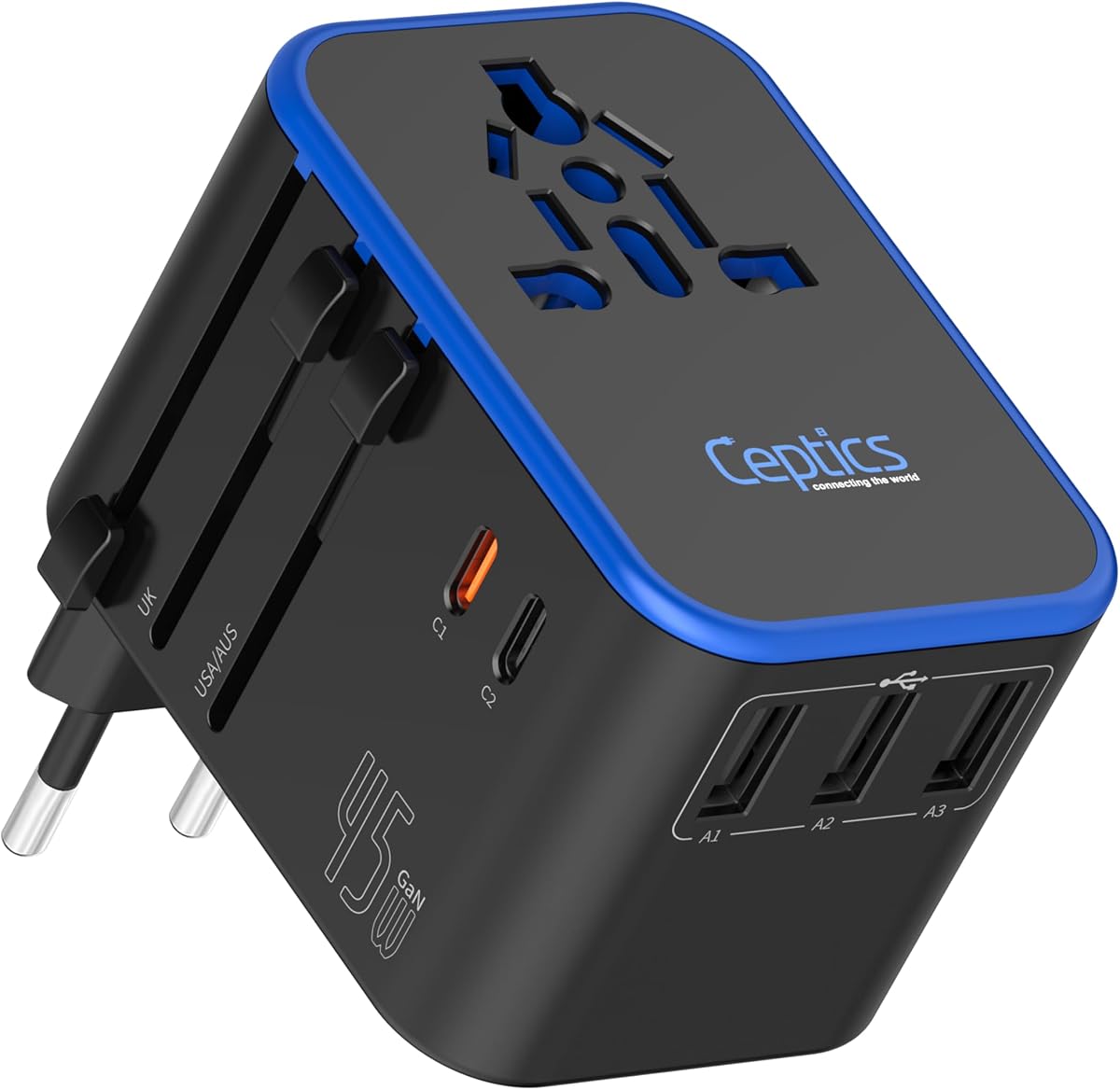
This Ceptics adapter is one of the most complete options for a trip that may begin in the United States and continue through Estonia or several other countries. It combines a universal input socket with three USB-A ports and two USB-C ports, while its 45W output is intended for phones, tablets, and compatible laptops.
We may earn a commission when you buy through this link, at no additional cost to you.
The universal plug design accepts Type A, Type I, Type C, and Type G configurations, covering the European, American, Australian, British, and several Asian socket formats. Safety features include an 8A fuse with an extra fuse, a plug lock, safety shutters, electric shock protection, and FCC, CE, and RoHS certification.
Travelers must not confuse universal plug compatibility with universal voltage support. The unit does not convert voltage, so every connected device must support worldwide 100-240V input. Single-voltage hair dryers, curling irons, and straighteners are expressly excluded, even when their plug could otherwise fit.
This is the strongest all-around recommendation for travelers who want one compact adapter to support an Estonia trip and several future destinations. It is particularly well suited to a mixed itinerary involving modern phones, tablets, and universal-voltage laptops, provided those devices are compatible with the 45W output.
The four supported plug formats reduce the need to research a new adapter for each country. For Estonia, the Type C configuration is the relevant one, but the same unit can remain useful when the route changes before or after the trip.
With 45W available, the adapter has more useful power than many basic five-port travel adapters. Actual charging speed still depends on the device, its cable, and whether the connected laptop accepts the adapter's output.
We may earn a commission when you buy through this link, at no additional cost to you.
This TESSAN two-pack provides a practical way to keep an adapter in both a carry-on and checked bag or to share one with a travel companion. Each Type C adapter has four AC outlets, two USB-A ports, and one USB-C port, allowing up to seven connected devices per unit.
We may earn a commission when you buy through this link, at no additional cost to you.
The Type C plug is listed as compatible with numerous European destinations, including Germany, France, Italy, Spain, Portugal, Greece, Iceland, the Netherlands, Switzerland, Turkey, and Poland. Some countries use multiple socket formats, so travelers should confirm the exact outlet before departure.
It supports a broad voltage range of 100-250V and has a 10A rating, with maximum total power listed as 2500W at 250V and 1000W at 100V. It remains a plug adapter rather than a voltage converter, making appliance compatibility the most important caution.
The two-pack format gives it a practical edge for travelers who value organization or anticipate using an adapter in two locations. It is best for dual-voltage mobile electronics and universal-input chargers, rather than single-voltage heating appliances or equipment requiring a grounded three-prong connection.
Two complete adapters can be useful for couples, families, or anyone who wants redundancy. Keeping one in each bag prevents the inconvenience of leaving the only compatible adapter in checked luggage.
Four AC outlets provide more flexibility than a minimal plug converter, while the USB ports handle cables that would otherwise occupy those outlets. The total output remains limited by the 10A rating, so high-load devices should not be connected together indiscriminately.
We may earn a commission when you buy through this link, at no additional cost to you.
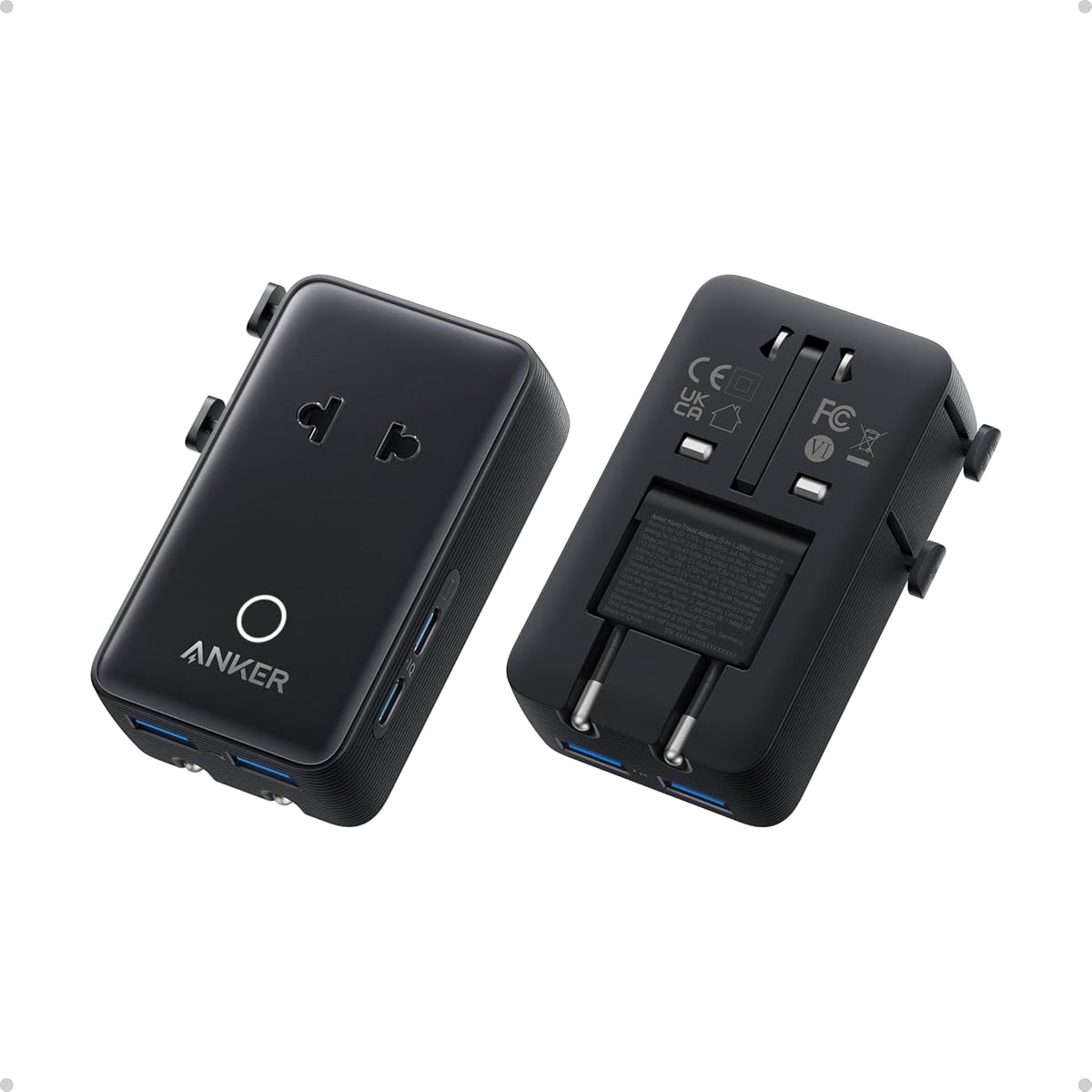
The Anker Nano Travel Adapter is built for travelers who value pack space above the ability to power every kind of grounded device. At 3.39 by 1.97 by 0.98 inches, it has a credit-card-sized footprint, and its foldable and retractable pins keep the body streamlined.
We may earn a commission when you buy through this link, at no additional cost to you.
The universal plug supports Type A, Type C, Type G, and Type I configurations, so the Type C side is suitable for Estonia. Charging options include one AC outlet, two USB-A ports, and two USB-C ports. A single USB-C port can deliver up to 20W, while the listed combined output is 20W or 15W when shared.
The major restriction is its two-pin AC outlet. It does not accept three-prong grounded plugs, including EU Schuko, UK three-pin, and many grounded laptop chargers. The product also does not convert voltage, and users must extend the prongs by holding the side button and sliding them fully into the locked position.
This adapter is best for phones, tablets, headphones, compact cameras, and other dual-voltage electronics. Travelers carrying a grounded laptop charger or other essential three-prong device should choose a different model, but for a minimalist packing strategy this is one of the most attractive options in the guide.
Retractable pins reduce the chance of catching the adapter on other equipment or scratching a device in a bag. Its flat, compact form is particularly useful when luggage space is tight or when the adapter must remain accessible during a long journey.
Before buying, check whether the main charger supplied with a laptop or other valuable device has a grounded three-pin plug. If it does, carrying this adapter alone would leave the traveler without a way to charge that equipment.
We may earn a commission when you buy through this link, at no additional cost to you.
This Ceptics travel kit is the premium choice in the roundup because it combines a broad collection of country attachments, dedicated USB-C charging, surge protection, and a 35W Power Delivery port. The kit is designed to reduce the need to carry separate plug adapters for a broad itinerary.
We may earn a commission when you buy through this link, at no additional cost to you.
Its World-Way system includes attachments for Europe Type C, United Kingdom Type G, United States Type B, Australia and China Type I, Germany and France Type E/F, and Japan Type A. On the main body, travelers find two USA outlets, one USB-A port, one standard USB-C port, and a dedicated 35W USB-C port.
Built-in surge protection is a meaningful advantage over the unprotected models in this list, particularly for expensive electronics. The voltage indicator uses an LED for 110V and both LEDs for 220V. Even so, this is not a voltage converter, and the product remains incompatible with 110V-only hair clippers, dryers, and curling irons.
The adapter measures 2.7 by 1.4 by 3.7 inches, weighs less than five ounces, and comes with a travel pouch and USB-C cable. It is a strong choice for frequent international travelers, especially those who value surge protection and a laptop-capable USB-C output over the smallest possible footprint.
The six included attachments make this kit useful beyond a single-country trip. Even if Estonia is the only destination on the current itinerary, the added coverage can justify the extra bulk for travelers who expect future international travel.
Surge protection gives the kit an edge for cameras, computers, and other costly devices. Its 35W USB-C port offers a practical charging path for compatible laptops, although the connected device must support the appropriate charging protocol.
We may earn a commission when you buy through this link, at no additional cost to you.
This TESSAN two-pack combines a 4.7 rating with a generous port layout. Each Type C adapter provides four AC outlets, two USB-A ports, and two USB-C ports, allowing up to eight devices to be connected to each unit when both outlet and USB connections are counted.
We may earn a commission when you buy through this link, at no additional cost to you.
One USB-C port is listed at up to 20W, while the other is listed at up to 15W. The two USB-A ports provide up to 12W each. These outputs make the adapter useful for charging a mix of phones, earbuds, tablets, and other compatible electronics from a single wall outlet.
The unit is designed for many European countries, including Germany, France, Italy, Spain, Portugal, Greece, Iceland, Switzerland, and others. It does not work in the United Kingdom, Ireland, Scotland, or South Africa, and some destinations accept more than one socket format, so checking the hotel is important.
This two-pack is a good choice for a family or for keeping duplicate adapters in separate bags. It lacks surge protection and does not convert voltage, but its port count, 4.7 rating, and 20W USB-C option make it more versatile than a basic three-outlet plug converter.
The four AC outlets and four USB ports can simplify a room full of travel electronics. Because the total load is constrained, travelers should distribute high-power appliances across outlets rather than assuming every connection receives its maximum rating at the same time.
A second adapter adds redundancy and makes it easier to place charging capacity where it is needed. Families can use one unit in each room, while solo travelers can store one at home and keep the other available for the journey.
We may earn a commission when you buy through this link, at no additional cost to you.
This adapter is an excellent budget-oriented choice when a wall outlet is inconveniently located. Its three-foot flexible cord can extend charging capacity from behind furniture, a bedside table, or another cramped position, while the main block still includes three US-style AC outlets and four USB ports.
We may earn a commission when you buy through this link, at no additional cost to you.
It supplies two USB-A and two USB-C ports, with the USB-C connections listed at 5V and 3A and the combined USB output at 5V and 3.1A. Smart charging is used to identify connected devices and provide a suitable output, making the adapter practical for phones, tablets, smartwatches, and smaller laptops with compatible chargers.
Unlike a basic Type C converter, it includes Type C, Type G, and Type A plug options. The Type C side covers much of continental Europe, while Type G supports the United Kingdom and Ireland. It still does not convert voltage, so single-voltage devices should not be used unless their labels clearly permit the local supply.
This is the best budget pick for travelers who want more flexibility than a compact plug converter. The cord makes it especially suitable for hotel rooms and cruise cabins, while the additional plug types prevent the need to replace it if the broader itinerary includes another region.
The extension cord solves a common travel problem: a technically compatible socket that is hidden, blocked, or too far from the bed. Its flexibility allows the charging block to sit within easier reach without occupying a second wall outlet.
Three AC outlets and four USB ports create a compact charging station for a travel group. As with any multi-outlet adapter, the total power draw should remain within the stated 10A and 2500W limits.
We may earn a commission when you buy through this link, at no additional cost to you.
The One Beat adapter stands out with the highest rating in the group at 4.8 and a design focused on placing power near a nightstand. Its three-foot extension cord can turn a distant or hidden wall socket into an accessible charging point, while the main body provides three AC outlets and four USB ports.
We may earn a commission when you buy through this link, at no additional cost to you.
The two USB-C ports each provide up to 5V and 3A, for 15W per port. Across all four USB ports, total output is listed at 5V and 4.5A, or 22.5W. That is suitable for common phone and accessory charging, but it cannot charge a high-wattage USB-C laptop that requires 20V Power Delivery.
Safety shutters, overload protection, and a fire-resistant PC shell are included. The unit is designed without surge protection to comply with certain cruise-line and international-hotel policies. It supports Type C/E/F sockets and is not intended for the United Kingdom, Ireland, or Scotland.
This is a strong recommendation for travelers who want a corded charging station with strong everyday USB output. It works particularly well for a bedside setup, provided the traveler does not need laptop-class USB-C charging and confirms that the destination socket is supported.
The 22.5W combined USB output exceeds many basic travel adapters, giving connected phones and smaller devices more available power. It remains below the requirements of high-wattage USB-C notebooks, which should be charged with their original power supply.
The flexible cord is especially helpful in hotel rooms, dormitories, and cruise cabins where the only available outlet may sit behind furniture. The blue power indicator also gives a quick visual confirmation that the unit is energized.
We may earn a commission when you buy through this link, at no additional cost to you.
Hero's international adapter is designed for travelers who want one device to cover a wide range of destinations. Its universal plug system supports Europe, the United States, the United Kingdom, Australia, New Zealand, and much of Asia, with compatibility listed for more than 100 countries.
We may earn a commission when you buy through this link, at no additional cost to you.
The body includes two regular US outlets, one USB-A port, and two USB-C ports, allowing up to five devices to charge at once. Built-in protection and a backup fuse add a layer of safety, while GaN III technology is intended to make the unit lighter, cooler, and more efficient than conventional travel adapters.
The wording in the product information distinguishes a universal plug from a universal voltage device. This adapter does not convert voltage. Dual-voltage hair dryers, curling irons, and straighteners are limited to a maximum of 10 amps, and other single-voltage devices remain unsuitable.
The broad regional coverage makes this a compelling option for a multi-country trip or anyone building a long-term travel kit. For Estonia, its European plug support is appropriate, while the remaining plug types make it useful if the itinerary continues to the United Kingdom, North America, Australia, or Asia.
Four plug types cover a substantial portion of international travel without requiring loose adapters. This is especially useful for open-jaw itineraries where the departure and return countries differ.
The backup fuse and built-in protection make the adapter more reassuring for routine travel electronics. These features do not replace correct load management, so travelers should still avoid exceeding the adapter's stated current and power limits.
We may earn a commission when you buy through this link, at no additional cost to you.
This two-pack provides two compact Type C adapters, each with three US-style AC outlets, two USB-A ports, and two USB-C ports. That gives travelers two complete power blocks for use in separate rooms, separate bags, or as a backup when one adapter is unavailable.
We may earn a commission when you buy through this link, at no additional cost to you.
The adapters support a range of common European destinations, including Austria, Belgium, Croatia, Denmark, Finland, France, Germany, Spain, Turkey, Iceland, Italy, and Israel. Their compact dimensions and indicator light make them straightforward to carry and confirm when connected.
The USB system uses smart device detection and provides up to 5V and 2.4A per USB-A port, with USB-C output up to 3A. The USB-C ports do not support Quick Charge 3.0 and cannot provide the 9-22V required by devices that need higher charging voltages, which includes many USB-C laptops.
This is a dependable budget two-pack for phones, tablets, cameras, earbuds, and power banks that use conventional low-voltage USB charging. It does not include surge protection, and travelers with single-voltage appliances or high-power USB-C laptops should plan to carry the appropriate additional equipment.
Two complete units are helpful for longer trips because a misplaced adapter no longer has to interrupt the trip. The duplicates can also serve separate travelers or allow charging in two rooms at once.
The USB-C limitation makes the product's intended use fairly clear. Phones, earbuds, tablets, and accessories that charge at 5V are suitable, while high-voltage USB-C laptop charging requires the original charger and a separate compatible plug arrangement.
We may earn a commission when you buy through this link, at no additional cost to you.
The right adapter for Estonia depends on socket format, device voltage, charger design, and the amount of charging capacity required. These factors determine whether a compact plug converter is enough or whether a multi-port travel power strip is more appropriate.
Estonia uses Type C sockets, and the adapters in this guide are primarily designed around the European plug format. The universal models also include other regional pins, while the dedicated Type C products are intended for continental European destinations. Travelers should inspect the outlet shown on the hotel or rental property listing and compare it with the adapter before departure.
Choose a Type C adapter for a trip confined to Estonia and nearby continental destinations. Choose a universal model if the itinerary also includes the United Kingdom, United States, Australia, China, Japan, or other countries using different socket formats.
A plug adapter changes the shape of the connection but normally does not change the electrical voltage. Most modern phones, tablets, cameras, and many laptop chargers support 100-240V, but single-voltage hair dryers, straighteners, curling irons, coffee makers, and some specialist equipment may not. The appliance or charger label should be checked before it is connected.
If a device supports only 110V or only 240V, it cannot be made safe merely by adding a Type C plug adapter. A separate voltage converter with enough continuous wattage is required, and it may be more practical to leave the device at home and use an alternative.
Many laptop, monitor, and other high-power chargers use a grounded three-prong plug. Some compact universal adapters, including the Anker Nano model in this guide, use a two-pin outlet and cannot accept these connectors. A Type E/F socket may also require a grounded Schuko plug that a basic US-to-Europe adapter cannot physically accept.
List every essential charger before choosing an adapter. If a grounded plug is required, choose a model with compatible grounded outlets and verify the socket's grounding arrangement rather than relying on shape alone.
USB-C is not a single charging standard. A port delivering 5V and 3A is appropriate for many phones, earbuds, and accessories, while a laptop may require 20V Power Delivery at 35W, 45W, or more. Several products in this guide offer 20W or 35W USB-C output, but some are limited to 5V and cannot charge every modern USB-C device quickly.
Match the adapter's stated voltage, wattage, and protocol to the device's charging requirements. For a universal travel kit, carrying the original laptop charger remains the safest way to obtain the full power and protocol support expected by the manufacturer.
The number of ports is only one part of electrical capacity. A multi-outlet adapter may list a 10A maximum and 2500W at 250V, but that is a ceiling for the combined load rather than a promise that every connected appliance can receive it simultaneously. High-wattage devices should be spread across separate wall outlets when possible.
For a typical phone-and-tablet travel kit, the listed capacities are more than sufficient. For a laptop, camera battery, CPAP machine, and several other high-draw devices, calculate the combined requirements and avoid overloading a single adapter.
A direct plug adapter is smaller, lighter, and easier to pack, but it must be used wherever the wall socket is located. A corded travel power strip offers more placement flexibility and can bring charging capacity to a desk or nightstand. The choice depends on whether minimum luggage volume or convenient outlet access matters more.
Travelers with compact luggage should prioritize a direct adapter with retractable pins. Those staying in rooms with hidden or awkward outlets may gain more from a three-foot cord, which can also reduce the need to crowd chargers around one socket.
Surge protection can be valuable for expensive electronics, while some cruise lines and international hotels restrict surge protectors in guest rooms. Fuses, safety shutters, overload protection, and certified construction are separate from surge protection and should not be treated as equivalent. The One Beat model is specifically designed without surge protection for accommodation policies.
Check both the adapter's protections and the destination rules. Travelers carrying especially valuable equipment may prefer a protected adapter, while cruise travelers should verify current line requirements before packing a surge-protective unit.
Two AC outlets may be enough for a short trip, but a traveler carrying a phone, tablet, watch, earbuds, power bank, camera, and laptop can benefit from four USB connections. More ports also make the block larger, so the most useful choice is the smallest layout that covers the devices expected to be charged each day.
Avoid choosing solely by the largest advertised device count. Shared output can be reduced when several ports are active, and bulky plugs may block neighboring sockets. A compact unit with the right connector types is often more useful than a larger one with many unsupported ports.
Before packing, confirm that the adapter's plug matches the outlet in Estonia and inspect the voltage label on every device that will be connected. Dual-voltage electronics and chargers marked for 100-240V are the easiest to use, while single-voltage appliances require a separate voltage converter or should be left behind.
Insert the adapter firmly into the wall socket without forcing it, then connect high-wattage appliances one at a time. Use the included or approved charging cable for USB devices, and check that the selected USB-C output matches the power requirements of the connected phone, tablet, accessory, or laptop.
When the trip ends, unplug each device before removing the adapter. Retract foldable pins, wind any short cord loosely, and keep the unit away from moisture, heat, and crushing pressure. Store it in an easy-to-reach compartment so it does not become buried beneath luggage at the airport.
Most travelers need a Type C European plug adapter for Estonia. Check the accommodation listing or ask the property about the exact outlet, because buildings may also offer Type E or Type F sockets. A Type C plug generally fits these compatible European outlets, but a grounded Type E plug will not work in a basic Type C adapter without an appropriate conversion setup.
You do not need one for most modern phones, tablets, cameras, and laptop chargers that support 100-240V. A separate voltage converter is required for single-voltage appliances such as many hair dryers, straighteners, curling irons, and coffee makers. Always read the device label rather than assuming that a plug fits means the voltage is correct.
Only if the hair dryer explicitly supports dual voltage, often shown as 110-240V or a similar range. A Type C plug adapter changes the plug shape but does not transform the voltage. A 110V-only dryer may run incorrectly or be damaged in Estonia, so travelers should use a proper converter or a compatible dual-voltage travel dryer.
The dedicated Type C adapters listed here are not designed for the United Kingdom, Ireland, or Scotland because those locations use Type G sockets. A universal model with a Type G plug is a better choice for an itinerary that includes the United Kingdom. Confirm the entire route before buying rather than assuming one adapter covers every country.
No. A USB-C port can have very different power and protocol support depending on the adapter. Some travel adapters provide only 5V for phones and accessories, while others support 20W or 35W. A laptop that needs 20V Power Delivery should be checked against the adapter's output and may be best charged with the manufacturer's original charger.
It depends on the traveler and the accommodation. Surge protection can be useful for valuable electronics, but certain cruise lines and hotels restrict surge-protective devices. The One Beat adapter is deliberately made without surge protection, while the Ceptics 35W kit includes it. Check the relevant hotel or cruise policy before packing either type.
The number depends on both outlet count and electrical load. Several options offer three or four AC outlets plus multiple USB ports, but the shared wattage and current limits still apply. A low-power phone and tablet may charge together without issue, while multiple laptops, hair tools, or other high-wattage devices should be connected to separate outlets.
A multi-port adapter can often replace several individual wall chargers, provided it has the correct USB-C output and the laptop's charger plug is compatible. A two-pin AC outlet will not accept a grounded three-prong charger, so travelers with a grounded laptop power brick should choose a model designed for that connector or carry a separate plug.
The European Travel Plug Adapter with Extension Cord is the leading budget-oriented choice because it combines a Type C plug, seven charging positions, and a useful three-foot cord. The Ceptics 45W Universal Travel Adapter earns the editor's choice for travelers who want broad country support and stronger USB-C charging, while the Ceptics 35W kit is the premium pick for surge protection and multiple plug attachments.
Before buying, prioritize socket compatibility, device voltage, grounded-plug requirements, and the charging needs of a laptop or other high-power accessory. A smaller adapter is preferable when it covers the traveler's devices, but a corded or multi-port design can be more useful in a room with an awkwardly placed outlet.
Finally, review the current listing, compatibility notes, and recent traveler feedback before purchasing. Product configurations, ratings, and prices can change over time, and the best choice depends as much on the complete itinerary and packed devices as on the destination of Estonia itself.