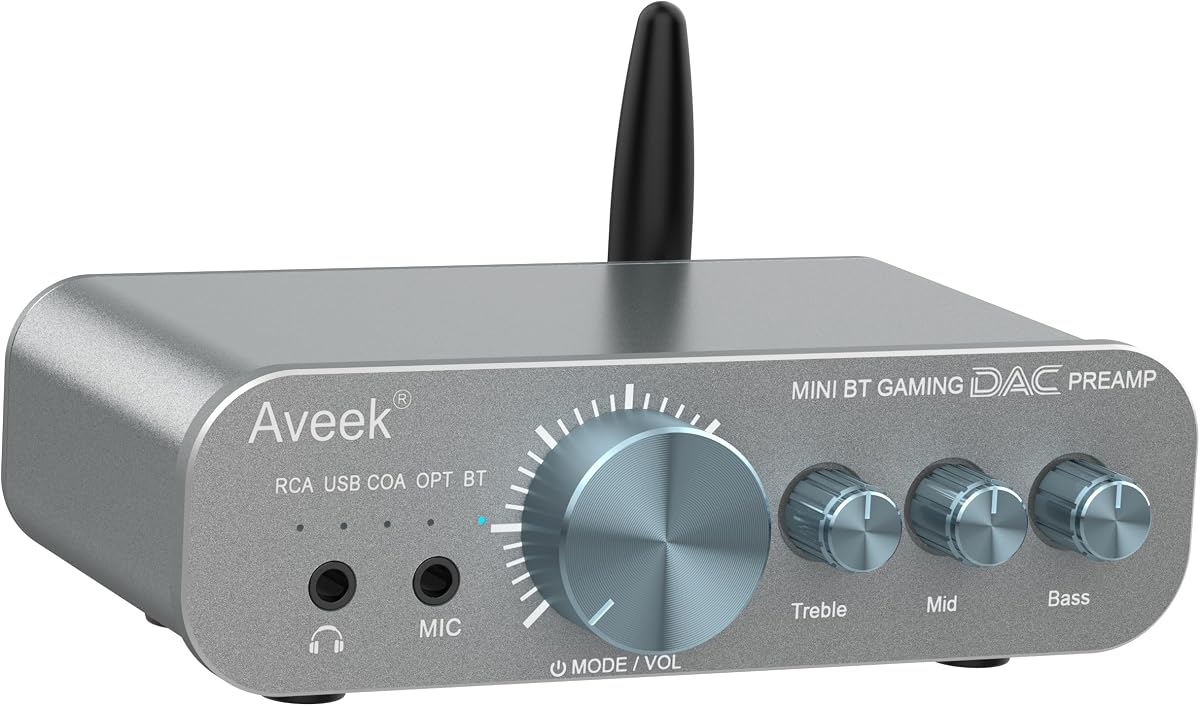
Aveek DAC-200
4.4Editor score
Five flexible audio inputs
True three-band equalizer
Sixteen-ohm headphone support
Discover the best DAC for PS5 in our expert comparison of 10 converters, covering connectivity, audio formats, amplification, controls, and gaming features.
A dedicated DAC for PS5 can improve how game audio reaches compatible headphones or powered speakers, while adding volume control, useful EQ, surround processing, and a cleaner connection to a home audio system. The right choice depends on your console setup, headset, preferred outputs, and whether advanced listening features matter more than a compact footprint.
We compared ten PS5-compatible DACs based on their documented inputs, outputs, decoding capabilities, headphone power, gaming functions, and physical controls. The list covers budget-friendly converters, portable dongles, desktop DAC/headphone amplifiers, and premium units designed to bridge console gaming with high-resolution music playback.
Each review highlights the features that distinguish its featured product from the alternatives, along with sensible compromises to consider before purchase. Ratings and specifications reflect the supplied product information, while availability, configurations, and prices can change, so readers should confirm current details before ordering.
4.4Editor score

4.5Editor score

4.7Editor score
The comparison below highlights each converter's most important connection options, gaming tools, output flexibility, and headline specifications, making it easier to identify the model that best matches a PS5 gaming setup.


The Fosi Audio K5 Pro is a compact gaming DAC and headphone amplifier designed to give a PS5, PC, Mac, or other compatible source a more flexible audio path. With a 4.3 rating, it stands out for combining USB, optical, and coaxial inputs with 3.5mm and RCA outputs, a microphone connection, and enough power to cover a broad range of headphones.
We may earn a commission when you buy through this link, at no additional cost to you.
Its most useful strength is flexibility. USB Type-C supports up to 24-bit/96kHz, while optical and coaxial inputs reach 24-bit/192kHz. A master volume control, separate bass and treble adjustment, and an input selector make it practical for both games and music. The documented output figures provide 1000mW at 16Ω and 500mW at 32Ω, enough to drive many gaming headsets and full-size headphones while still offering RCA connectivity for powered speakers or an amplifier.
The tradeoff is that this is primarily a stereo gaming DAC rather than a dedicated surround decoder. It also does not claim native multichannel processing, and the supplied notes emphasize that phone compatibility depends on connecting the source through the USB-A or USB-C audio port. Buyers seeking advanced positional effects should look at the Fosi Audio C3, while listeners who want balanced output and deeper EQ control may prefer the Topping DX1 II.
This is a strong recommendation for a PS5 player who wants one small box to handle console audio, wired headphones, powered speakers, microphone communication, and basic tonal adjustments. It is especially useful when the television provides the PS5's digital audio and the user wants a central volume control. For uncomplicated gaming with broad headphone support and multiple source options, the K5 Pro earns its place at the top of the list.
USB, optical, and coaxial inputs let the K5 Pro serve a PS5, computer, television, or other digital source without changing the overall signal chain. The 2-in-1 USB Type-C interface also supports charging when the connected source permits it, making the unit convenient as a central desktop audio hub.
Output power ranges from 1000mW at 16Ω down to 80mW at 300Ω, giving it flexibility across gaming headsets, earphones, and higher-impedance headphones. Master volume, bass, and treble controls provide useful adjustments without requiring computer software.
We may earn a commission when you buy through this link, at no additional cost to you.
The Fosi Audio C3 is built specifically for competitive gaming, with native 7.1 surround processing, HRTF-based positioning, and the StepSense footstep radar. Its 4.5 rating reflects a strong feature set for PS5, PC, Mac, and Switch users who want to improve directional cues without abandoning a conventional wired gaming headset.
We may earn a commission when you buy through this link, at no additional cost to you.
The CS43131 DAC supports 32-bit/384kHz PCM and DSD256, while the amplifier provides 320mW per channel across headphone impedances from 16Ω to 300Ω. Intelligent microphone processing can reduce keyboard and background noise, and browser-based controls offer presets and custom EQ profiles. These features make the C3 more than a basic converter, particularly for shooters where dialogue, footsteps, weapons, and explosions need to remain intelligible.
Its central compromise is that the advanced features depend on correct mode and source configuration. The unit supports UAC 1.0 for straightforward console compatibility and UAC 2.0 for higher-resolution PC and Mac playback. Users should not expect its surround processing to duplicate the PS5's native Tempest 3D Audio; instead, it offers an additional processing layer intended to improve spatial cues through stereo headphones.
Choose the C3 when competitive FPS audio is the priority and a stereo headset is part of the setup. It is a compelling match for players who want dedicated footstep emphasis, flexible EQ, and surround processing in one compact unit. Those wanting a broader high-resolution desktop hub should examine the K7, while dedicated balanced-headphone users may favor the DX1 II.
The hardware 7.1 and HRTF processing converts multichannel game audio for stereo playback, while StepSeek emphasizes enemy movement relative to gunfire and explosions. This makes the C3 particularly compelling for players using headsets that lack a native surround implementation.
UAC 1.0 provides a straightforward route to PS5 and Switch compatibility, while UAC 2.0 opens access to 32-bit/384kHz PCM and DSD256 on compatible computers. Switching modes gives the device a useful role in both living-room and desktop gaming environments.
We may earn a commission when you buy through this link, at no additional cost to you.
The Fosi Audio K7 is the most complete premium desktop audio hub in this guide, earning a 4.7 rating and an Editor's Choice-style distinction through its combination of extensive connectivity, high-resolution decoding, flexible outputs, and substantial headphone power. It is designed equally for PS5 gaming, music listening, and a broader desktop system built around headphones, powered speakers, or an external amplifier.
We may earn a commission when you buy through this link, at no additional cost to you.
At its center are the AK4493S DAC, XMOS XU208 USB processor, and TPA6120 headphone amplifiers. They support PCM up to 384kHz/32-bit and DSD256, with output power stated as high as 2100mW. The connection list includes USB-C, coaxial, optical, Bluetooth with aptX HD and LL, and 3.5mm microphone input. Outputs span 4.4mm balanced, 3.5mm single-ended, and RCA, allowing the K7 to serve very different headphone and speaker preferences.
The main trade-offs are physical and operational. A metal chassis, angled desktop design, display, five shortcut buttons, and dual large control knobs occupy more space than a simple dongle. The breadth of inputs also creates more setup decisions than a converter with one digital input and one analog output. However, those complexities are reasonable for buyers who want one device to serve gaming, music, and home listening rather than a single-purpose PS5 adapter.
The K7 is our premium recommendation for anyone willing to make it the center of a desktop audio system. PS5 players benefit from flexible source switching and excellent headphone support, while balanced output is welcome for compatible high-end headphones. Choose it when the goal is a lasting, multi-purpose audio hub; if a smaller enclosure or lower-complexity setup matters more, the Aveek DAC-200 or Topping DX1 II may be more appropriate.
USB-C, optical, coaxial, Bluetooth, and microphone inputs make the K7 useful well beyond the PS5. The same device can serve a console, computer, television, or phone, while RCA and headphone outputs support both personal listening and a larger speaker system.
The 4.4mm balanced jack and documented 2100mW maximum output give compatible high-impedance headphones more useful drive than many compact gaming DACs. The 3.5mm output preserves compatibility with ordinary gaming headsets and earphones.
We may earn a commission when you buy through this link, at no additional cost to you.
The SteelSeries GameDAC Gen 2 is a gaming-focused amplifier with a 3.8 rating and a clear emphasis on wired headset audio. It supports PC, PS5, and PS4, works with any 3.5mm wired headset, and is particularly associated with the Arctis Nova Pro, although that headset is sold separately.
We may earn a commission when you buy through this link, at no additional cost to you.
Its ESS Sabre Quad-DAC processes audio at up to 24-bit/96kHz, while 360-degree spatial audio is available for compatible platforms. The supplied information notes full compatibility with Tempest 3D Audio for PS5 and Microsoft Spatial Sound. ClearCast AI microphone processing on PC can reduce background noise and clean incoming teammate chat, adding a useful communication component beyond simple amplification.
The primary limitation is that some of the most compelling features are platform-specific. ClearCast AI is identified as a PC feature, and the relationship between the GameDAC's virtual surround and console-native spatial processing may differ by setup. Compared with the Fosi Audio C3, it offers less visible control over footstep emphasis and custom EQ; compared with the K7, it lacks balanced output and a wide range of analog source connections.
This model is most appropriate for a PS5 or PC player who already favors wired gaming headsets and wants a straightforward gaming amplifier with virtual surround and microphone cleanup. It is a reasonable alternative for SteelSeries ecosystem users, but users seeking deep equalization, balanced outputs, or extensive high-resolution desktop functionality may find a feature-focused model such as the DX1 II more versatile.
The GameDAC Gen 2 supports 360-degree spatial processing and is compatible with Tempest 3D Audio for PS5 and Microsoft Spatial Sound. This keeps it relevant for console players who want an additional spatial layer while using conventional wired headphones.
Two simultaneous system connections allow a PC and PS5, or another pairing of sources, to remain attached to one unit. A button press changes the active input, reducing the need to reconnect cables when moving between gaming and computer use.
We may earn a commission when you buy through this link, at no additional cost to you.
The Aveek DAC-200 is our Best Budget pick because it combines a 4.4 rating with an unusually broad set of connections for an affordable gaming DAC. It works as a digital-to-analog converter, headphone amplifier, and audio preamp, making it suitable for a PS5, PC, television, smartphone, or existing home audio system.
We may earn a commission when you buy through this link, at no additional cost to you.
Five input options—Bluetooth, USB, optical, coaxial, and RCA—cover most common source types. A true three-band EQ provides independent adjustment of bass, midrange, and treble, which is useful for improving dialogue clarity, reducing harsh treble, or adding low-end impact. The front microphone input and headphone monitoring support game communication and streaming, while the rear 3.5mm output can feed compatible downstream equipment.
Audio processing is specified at 24-bit/96kHz, with a signal-to-noise ratio of 113dB and total harmonic distortion below 0.003%. Headphone support extends from 16Ω to 100Ω, covering many in-ear monitors, gaming headsets, and conventional full-size models. The limitation is that the stated range stops at 100Ω and there is no balanced output, so the K7 or DX1 II would serve more demanding setups better.
Choose the DAC-200 if you want an inexpensive, flexible central hub rather than the smallest possible adapter. Its combination of digital inputs, analog input, Bluetooth, EQ, monitoring, and preamp functionality gives it exceptional practical value for PS5 gaming and everyday listening. As long as your headphones fit within the documented impedance range and balanced connectivity is not essential, it is an easy recommendation.
Bluetooth, USB, optical, coaxial, and RCA inputs let the DAC-200 accept both modern digital sources and legacy analog equipment. That makes it easy to reuse the same compact unit across a console, computer, television, and mobile device.
The front-panel bass, mid, and treble controls provide direct tonal adjustment for games, music, and movies. This is a practical alternative to app-based EQ when the goal is a quick change rather than elaborate profile management.
We may earn a commission when you buy through this link, at no additional cost to you.
The Topping DX1 II combines gaming convenience with high-resolution DAC architecture, detailed EQ, and fully balanced output. Its 4.5 rating and broad feature set make it an Editor's Choice for PS5 players who want precise control over their headset sound rather than only basic volume and bass adjustments.
We may earn a commission when you buy through this link, at no additional cost to you.
The ESS ES9039Q2M DAC and XMOS XU-316 processor support PCM up to 384kHz and DSD256, while a four-channel balanced architecture extends from the converter through the outputs. The 4.4mm balanced port can deliver up to 1000mW per channel at 32Ω, and separate high- and low-gain modes support everything from sensitive in-ear monitors to more demanding headphones. A conventional 3.5mm output keeps ordinary gaming headsets compatible.
Its standout feature is the 10-band parametric equalizer with independent left and right control. Profiles can be stored on the device, and the TOPPING Home web platform supports importing community or AutoEQ files. This is more involved than a front-panel three-band control, but it gives serious users a much greater ability to shape a headset for footsteps, dialogue, or a preferred music curve.
The DX1 II is best suited to gamers who have already identified weaknesses in their headset sound and want a permanent correction. It also supports optical DSP, digital output, and preamp modes, making it more versatile than a gaming-only converter. The compromise is that balanced-capable headphones and the correct cable are needed to exploit its headline feature, and first-time users may find the web EQ less approachable than simple physical controls.
Ten independently adjustable bands make it possible to target narrow frequency ranges instead of applying only broad bass and treble changes. Left/right control, saved presets, and EQ-file import make the feature particularly useful for long-term tuning.
The 4.4mm output provides up to 1000mW per channel at 32Ω, while selectable gain lets the unit serve sensitive earphones and power-hungry headphones. A 3.5mm single-ended output remains available for standard gaming headsets.
We may earn a commission when you buy through this link, at no additional cost to you.
The SMSL PO100 PRO is a mini digital interface rather than a conventional DAC with analog headphone amplification. Its 4.6 rating reflects strong technical specifications, including 32-bit/768kHz PCM, native DSD and DOP64 support, an XMOS XU316 processor, and flexible I2S, optical, and coaxial digital outputs.
We may earn a commission when you buy through this link, at no additional cost to you.
For a PS5 setup, the DOP64 route is particularly relevant: compatible playback software can select DOP output and send audio optically or coaxially to a device that supports that format. The converter's multiple UAC and I2S modes provide additional flexibility for source and downstream equipment. Built-in MQA decoding means compatible MQA files can be played through software that supports ASIO or WASAPI without requiring a separate licensed decoder.
The key compromise is that the PO100 PRO does not provide the familiar 3.5mm or RCA outputs expected from a headphone DAC. It is designed to remain a digital bridge in a chain where another component performs the final analog conversion. It also requires users to select the correct USB UAC or I2S mode before operation, so it is less convenient for a casual plug-and-play PS5 setup.
This is a strong choice for an audiophile building a digital chain or seeking an extremely compact interface for a PS5, computer, phone, Switch, or television. It is less appropriate for someone who wants to connect ordinary headphones directly. Buyers needing a self-contained gaming DAC should favor the Aveek DAC-200 or Fosi Audio K5 Pro, while advanced balanced-headphone users should consider the DX1 II.
Support for 32-bit/768kHz PCM, native DSD, and DOP64 makes the PO100 PRO attractive for users who want a digital interface that is not limited by a full-size desktop chassis. Its portability also makes it convenient to move between entertainment locations.
I2S, optical, and coaxial outputs allow the unit to feed a separate DAC, preamp, or amplifier. This makes it most useful in a thoughtfully planned audio chain rather than as a stand-alone headphone solution.
We may earn a commission when you buy through this link, at no additional cost to you.
The Fosi Audio DS3 combines high-resolution portable DAC design with gaming-focused spatial processing in a sixteen-gram USB-C dongle. Its 3.9 rating is lower than several desktop alternatives, but the ES9039Q2M DAC, XMOS POWERED processor, balanced output, and hardware gaming effects create a distinctive package for travel or compact PS5 setups.
We may earn a commission when you buy through this link, at no additional cost to you.
The converter supports 32-bit/768kHz PCM and native DSD512, with a stated signal-to-noise ratio of at least 122dB and total harmonic distortion below 0.0003%. Balanced output power is listed at 220mW at 32Ω, while a 3.5mm single-ended connection supports conventional gaming headsets. Eight hardware-level PEQ bands, eight filter options, and web-based controls give the DS3 more tuning flexibility than many dongles.
Its gaming tools are especially relevant to PS5 users. A built-in algorithm converts 7.1-channel game audio into a 360-degree presentation, while a dedicated FPS effect highlights footsteps, reloads, and gunfire. UAC 1.0 and UAC 2.0 modes support different source workflows, and volume memory is available in both modes. The trade-offs are its lower supplied rating and more limited balanced power compared with full-size desktop amplifiers.
Choose the DS3 if portability is a priority and you want to travel with one device that can serve a PS5, Switch, PC, or phone. It is also appealing to listeners who want balanced output and detailed EQ without carrying a larger desktop unit. For more generous balanced amplification or a broader collection of analog inputs, the K7 or DX1 II would be the stronger choice.
At sixteen grams, the CNC-milled aluminum DS3 is substantially easier to carry than a desktop converter. Its USB-C connection and supported console modes make it a natural traveling companion for PS5 or Switch sessions.
The hardware algorithm converts 7.1 game audio for stereo listening, and the FPS effect emphasizes footsteps, reloads, and gunfire. Because processing is handled in the unit, users do not need a separate driver for these features.
We may earn a commission when you buy through this link, at no additional cost to you.
The Sound Blaster G8 is a desktop USB DAC and headphone amplifier built around a useful dual-source proposition. Its 4.2 rating reflects strong high-resolution performance, a 130dB dynamic range, and an Xamp discrete bi-amplifier that drives the left and right headphone channels independently.
We may earn a commission when you buy through this link, at no additional cost to you.
Two USB-C inputs can accept separate devices simultaneously, allowing audio from a PS5 or PC to be mixed with another USB source. Native playback extends to 32-bit/384kHz. The Sound Blaster Acoustic Engine adds a suite of audio enhancements intended to improve immersion and battlefield awareness, giving the G8 a gaming identity rather than making it a neutral converter only.
Compared with the Aveek DAC-200 and Topping DX1 II, the supplied specification is less explicit about legacy analog inputs, optical and coaxial connections, EQ depth, and balanced headphone output. It may therefore be less attractive to a buyer who wants to connect a broad collection of source components. The lack of listed balanced output also means the K7 or DX1 II is a more natural choice for balanced-headphone enthusiasts.
The G8 is a good match for PS5 and PC players who regularly use two USB-based sources and want a dedicated gaming enhancement engine. Its dynamic range and independent channel amplification are attractive for listeners seeking a lively, detailed presentation. It is best for users who prioritize dual-source convenience and gaming processing, while the Aveek DAC-200 is a more flexible budget alternative and the K5 Pro is a broader desktop hub.
Dual USB-C inputs separate the PS5 or PC from another connected device, allowing both to remain active. This is useful for streaming from a laptop while gaming, or for combining console and computer audio without frequent cable changes.
The custom Xamp discrete bi-amplifier drives the left and right channels individually. Combined with the stated 130dB dynamic range, this design targets clean separation and a broad range between quiet environmental cues and loud effects.
We may earn a commission when you buy through this link, at no additional cost to you.
The SMSL PS100 is a straightforward digital-to-analog converter for PS5 and television audio, with a 4.2 rating and a focus on uncomplicated integration. It accepts HDMI ARC, USB, optical, and coaxial signals and converts them to stereo left and right RCA output for an amplifier or powered speakers.
We may earn a commission when you buy through this link, at no additional cost to you.
Its independent ES9023 DAC and maximum 24-bit/192kHz resolution cover the core needs of a home entertainment converter. HDMI ARC is particularly useful because it allows the PS5's game audio to pass through a television before being extracted by the PS100. Optical and coaxial inputs broaden compatibility with CD players, Blu-ray components, set-top boxes, and other digital sources, while USB serves computers and mobile devices.
The limitation is that the PS100 does not list a headphone amplifier, balanced output, surround processing, or advanced EQ. It is therefore best viewed as a bridge into an existing stereo system rather than as an all-in-one gaming headset hub. Users who want to connect headphones directly should consider the Aveek DAC-200, Fosi Audio K5 Pro, or another amplifier-equipped converter.
Choose the PS100 when the goal is to send PS5 or television sound into an amplifier, powered speakers, or stereo receiver through a simple RCA connection. It is particularly helpful in a living room where HDMI already carries the console's audio to the television. The setup is less versatile for personal gaming, but its compactness, source selection, and dedicated converter role make it a practical final choice.
HDMI ARC support lets the PS100 receive audio from a television that is already connected to the PS5. The stereo RCA output then feeds an amplifier or powered speakers without requiring the converter to handle headphones.
Optical, coaxial, and USB inputs extend the unit beyond gaming consoles. The same converter can therefore support Blu-ray players, televisions, computers, and mobile devices that provide compatible digital audio.
We may earn a commission when you buy through this link, at no additional cost to you.
The most suitable PS5 DAC depends on how you listen, which outputs your equipment accepts, and how much control you want over game audio. Input compatibility, headphone power, decoding formats, and gaming processing should be considered together rather than judging a converter only by its headline resolution.
Start with how the PS5 will deliver audio to the converter. Optical output is a common route for TV-connected consoles, while USB devices such as the Fosi Audio C3 and Topping DX1 II use selectable UAC modes for console compatibility. Some products are designed around DOP64 playback, and the SMSL PS100 can extract audio through HDMI ARC when the signal first passes through a television. Check whether the converter supports the exact connection, mode, and cable required before settling on a model.
A headphone DAC should provide 3.5mm output for common wired gaming headsets, while a balanced 4.4mm connection can suit higher-end headphones when the amplifier and cable also support it. If the plan is to use powered speakers or a stereo amplifier, RCA stereo output is the relevant choice. The PS100 focuses on RCA, whereas the K7, DX1 II, and DS3 provide both single-ended and balanced headphone paths.
Headphone impedance determines how much voltage and current an amplifier must provide. Gaming headsets with low-impedance earpieces may work with compact outputs, while high-impedance headphones benefit from a unit with more power and selectable gain. The Aveek DAC-200 supports 16Ω to 100Ω, the C3 documents 16Ω to 300Ω, and the K7 reaches as high as 2100mW. Topping's DX1 II also provides high and low gain modes for a broad headphone range.
Gaming effects can make footsteps or environmental cues more prominent, but they are not automatically better than console-native processing. The PS5 supports Tempest 3D Audio, the SteelSeries GameDAC Gen 2 is compatible with it, and the Fosi C3 and DS3 offer their own surround or FPS tools. Consider whether spatial processing, footstep enhancement, custom EQ, or simply clean amplified stereo best matches your preferred game genres and headset.
Maximum sampling rates are useful only when the source, connection, software, and playback device support them. A 768kHz-capable interface may be excellent for high-resolution music without changing the practical sound of a 48kHz console game. USB, optical, coaxial, and HDMI paths carry different format limitations. UAC 1.0 mode prioritizes broad compatibility, while UAC 2.0 can unlock higher-resolution PCM on suitable computers.
Physical bass, mid, and treble controls are easy to use and require no computer setup. Parametric equalizers offer finer frequency adjustment but may depend on a browser-based interface, downloaded profiles, or file imports. The Aveek DAC-200 favors immediate three-band control, the DX1 II provides a ten-band parametric system, and the DS3 includes an eight-band hardware-level PEQ. Choose the level of control you will actually use.
A converter with a headphone connection does not automatically provide a convenient way to route game chat or microphone audio. The K5 Pro includes a microphone interface, the Aveek DAC-200 offers a front microphone input and monitoring, and the DX1 II supports a standard headset microphone through its 3.5mm TRRS connection. The C3 adds intelligent mic processing, while SteelSeries emphasizes AI ClearCast on PC. Confirm which platform supports the feature you need.
A portable dongle such as the DS3 or a compact converter such as the PS100 can keep a gaming area tidy, while the K7, DX1 II, and Sound Blaster G8 provide more controls and connections on a full desktop footprint. Large knobs and displays may be easier to operate during setup, but they consume space. Consider where the console, television, computer, and cable routing will be positioned before buying.
Begin by identifying the intended signal path. For a television-based PS5 setup, determine whether the console's optical output or the television's HDMI ARC output will carry the digital audio. For a direct USB connection, verify that the converter supports the console's required UAC mode and that the included or compatible cable carries both power and data. Connect the converter to the appropriate source before attaching headphones, powered speakers, or an amplifier.
Set the DAC's input selector to match the connected source, then begin with a conservative volume level. If the unit offers UAC modes, gaming effects, or parametric EQ, configure them before extended play rather than changing several settings at once. For a shared system, make the converter the central volume-control point and avoid setting both the console and downstream amplifier near maximum, as doing so can make gain staging harder to control.
Protect the device by placing it on a stable, ventilated surface and keeping ports free of dust. Use the correct gain setting for the connected headphones, especially when switching between low-impedance gaming headsets and high-impedance models. Route cables so they are not pulled by headset leads, and avoid carrying a connected portable dongle by its cable. Periodically inspect connectors, clean the enclosure with a dry soft cloth, and review the manual for firmware, mode, or compatibility updates.
Not always. A television or headset can provide adequate audio, and the PS5 also supports native Tempest 3D Audio with compatible headsets. A DAC becomes more valuable when you want balanced output, a better headphone amplifier, analog speaker connections, refined EQ, multiple source switching, or a cleaner way to integrate the console with a larger audio system.
Only if the converter supports the required USB audio mode and the PS5 recognizes it as a compatible device. Products such as the C3 and DX1 II provide selectable UAC modes for this purpose. Confirm the required mode, cable behavior, and any restrictions described in the product instructions before purchasing.
Neither route is universally better. Optical is a straightforward digital route from the television and avoids USB compatibility questions, while USB can offer a direct connection and very high-resolution computer audio. The right choice depends on the PS5 layout, the converter's supported modes, and whether music playback or gaming convenience is the priority.
A balanced output can provide cleaner signal delivery and more useful power when used with a compatible headphone, amplifier section, and properly wired cable. It is not automatically louder or better in every case. The K7, DX1 II, and DS3 support 4.4mm balanced connections, while the 3.5mm outputs remain useful for ordinary gaming headsets.
No. The SMSL PS100 is a digital-to-stereo converter with RCA output and is intended to feed an amplifier or powered speakers. The SMSL PO100 PRO also remains primarily a digital interface. Products such as the Aveek DAC-200, Fosi Audio K5 Pro, and Topping DX1 II directly include headphone amplification.
The correct requirement depends on headphone impedance and sensitivity rather than a universal wattage target. Low-impedance gaming headsets may work with many compact amps, while high-impedance headphones can require more voltage for adequate volume and control. Compare the converter's documented output at your headphones' actual impedance, and use gain selection where available.
It can provide a different or more controllable presentation, but it does not inherently upgrade the console's native Tempest 3D Audio. The SteelSeries GameDAC Gen 2 is documented as compatible with Tempest 3D Audio, while the Fosi C3 and DS3 provide their own surround and FPS processing. The most useful choice depends on whether you prefer native console processing or added external controls.
A DAC is generally better when your goal is console-to-headphone or console-to-speaker audio with convenient volume, EQ, and high-resolution support. A gaming sound card may be more appropriate when virtual surround, chat processing, or game-specific software integration is the priority. Check the PS5 connection requirements carefully, because some gaming sound cards are designed primarily for PC use.
The Aveek DAC-200 is the best budget choice for its five inputs, three-band EQ, headphone monitoring, and broad source compatibility. The Topping DX1 II takes the Editor's Choice position for balanced construction and precise ten-band EQ, while the Fosi Audio K7 is the premium pick for buyers who want a complete multi-source hub with high-resolution decoding, balanced output, and substantial headphone power.
For most PS5 players, prioritize a connection method that works without difficult setup, an output matching the existing headset or speakers, and enough amplification for the chosen headphones. Advanced users should then decide whether external surround processing, detailed parametric EQ, balanced output, or support for several source devices is worth the added complexity. A simple converter can be more reliable than an overfeatured unit if its core connections are exactly right.
Finally, confirm current specifications, package contents, accessory requirements, and platform compatibility at the time of purchase. Ratings, product revisions, console firmware, and pricing can change, so the most responsible choice is the DAC whose documented connections, output format, and controls still fit the system you own today.

