
Professional Air Duct & Dryer Vent Cleaning Tool Kit
Five flexible five-foot rods
Forward and reverse air tools
Professional blowgun included
Explore the best HVAC duct cleaning tools for dryer vents, air ducts, chimneys, and shop-vac systems, compared for reach, attachments, performance, and ease.
HVAC duct cleaning tools range from simple lint brushes to professional air-powered kits and vacuum attachments designed for different parts of a home’s ventilation system. A useful tool must reach awkward bends, collect debris without damaging ductwork, and suit the cleaning method available at the property.
We compared the included reach, brush or air attachment designs, connector compatibility, operating methods, and intended applications across all ten products. The list covers dryer exhaust systems, flexible and insulated air ducts, fireplace chimneys, and furnace supply openings rather than treating every cleaning job as identical.
Each review shows which cleaning scenario the product best addresses and where compromises may arise. Ratings and product details reflect the supplied marketplace information, while prices and availability can change, so check the current listing before deciding which kit fits your ductwork and maintenance plan.
4.5Editor score

4.4Editor score
The comparison below organizes every tool by its best use, maximum reach, included cleaning components, and power or connection method, making it easier to match a product to dryer vents, air ducts, chimneys, or vacuum-assisted cleaning.


This is the most comprehensive professional-style kit in the list, combining five flexible rods, skipper balls, air whips, tentacle attachments, and an air-controlled blowgun. It is intended for users who need more than a basic lint brush, particularly when cleaning main duct trunks, flexible duct runs, and dryer exhaust routes with compressed air.
We may earn a commission when you buy through this link, at no additional cost to you.
The five rods measure five feet each and use quick-connecting 1/8-inch male and female ends, allowing a long route to be assembled as needed. The forward and reverse skipper balls, forward and reverse eight-tentacle whips, and additional air attachments give the operator several ways to move debris or agitate material inside different duct shapes.
The primary trade-off is equipment complexity. The supplied information states that the forward air whip with skipper ball works best with compressors producing 125 PSI or more, and the whole approach requires suitable pneumatic equipment and confident handling of airflow. It is less convenient for a homeowner seeking a simple hand-powered brush.
This kit is best for technicians, serious DIY users, or anyone cleaning several large duct sections who wants one coordinated air-powered system. It earns the Editor's Choice position because its accessories address more duct geometries than any other listed kit, although the absence of a marketplace rating should be considered when making a final decision.
The memory-material rods combine firmness with flexibility, while the quick connectors allow multiple five-foot sections to be joined. This makes the system more adaptable to long, branching routes than a short single-piece brush.
Forward and reverse tools let the operator select how air travels through a line. The skipper balls and tentacle whips are intended to agitate debris in trunk ducts and navigate tighter or more irregular sections.
We may earn a commission when you buy through this link, at no additional cost to you.
The supplied product record for ASIN B00ZBTTMUE contains only an Amazon link, with the title, rating, image, features, and factual description listed as unavailable. That prevents a responsible comparison of its cleaning method, compatibility, reach, or intended application.
We may earn a commission when you buy through this link, at no additional cost to you.
The product's position in the supplied ranking suggests it was included as an HVAC duct cleaning option, but ranking order alone does not establish what it includes. Without verified details, it would be inappropriate to claim that it has a particular rod length, brush head, air connection, drill adapter, or vacuum attachment.
Its main limitation is therefore not necessarily the product itself, but the lack of available information in the source data. A shopper should open the current listing to examine the item description, customer feedback, dimensions, and compatibility notes before treating it as a serious contender.
We cannot recommend this unidentified listing over the documented products in this guide. It may still be worth investigating, but only a current review of its actual specifications and customer experiences can establish whether it offers a better match for a particular duct-cleaning task.
Check the live Amazon page for the brush design, reach, operating method, and included components. Those details are essential because nearly every product in this category presents itself as a duct-cleaning solution while serving a materially different task.
Look for information about rod diameter, drill or blower requirements, vent diameters, and replacement parts. A broadly stated cleaning purpose is not enough to determine whether the tool can physically enter the duct route you need to service.
We may earn a commission when you buy through this link, at no additional cost to you.
This Holikme kit combines two synthetic brush heads with flexible rods that extend up to 30 feet, earning a 4.4 rating in the supplied data. Its versatility across dryer vents, ducts, exhaust ports, and fireplace chimneys makes it a practical entry point for routine household maintenance.
We may earn a commission when you buy through this link, at no additional cost to you.
The brush can be used with or without a power drill, allowing a homeowner to choose between slower manual control and faster rotational cleaning. Its 30-foot reach is substantial for many residential dryer runs, while the two brush heads offer some flexibility for different openings and deposits.
Its limitations are practical rather than fundamental. Users must move the rod slowly in and out, especially around bends, and sealing rod connections with tape helps reduce the chance of separation. The product also does not provide the vacuum-assisted debris capture found in more expansive kits.
Choose this set when the main goal is inexpensive routine dryer-vent care with occasional chimney or exhaust-port cleaning. It is particularly attractive for new homeowners who want a simple brush and drill option without purchasing a professional air-compressor system.
The 30-foot flexible route is long enough for many dryer exhaust lines and exterior exhaust routes. It gives users a way to address lint beyond the lint screen without buying separate tools for every cleaning location.
Using the brush manually can offer careful control around elbows, while a drill adds rotational force. The ability to choose either method makes the kit approachable for different levels of cleaning experience.
We may earn a commission when you buy through this link, at no additional cost to you.
This compact air whip uses eight flexible tentacles to clean small flexible and insulated ductwork, with a listed rating of 3.3. Its 14-inch length and forward-flow design make it more of a specialized attachment than a complete standalone cleaning system.
We may earn a commission when you buy through this link, at no additional cost to you.
The tentacles can conform around corners and reach into spaces where a rigid brush may not make useful contact. A 1/8-inch connector provides a standard attachment point for compatible cleaning equipment, and the forward airflow is designed to move air away from the technician.
Compared with the long brush kits, its reach is limited and it cannot independently traverse a long dryer vent. It also requires an external source of air, so buyers need to confirm that their blower or compressor can operate the attachment effectively.
This tool is best for a technician or homeowner who already has pneumatic equipment and wants a gentle attachment for tight, flexible duct sections. It is less suitable as the sole tool for routine whole-home cleaning, but it adds useful maneuverability where rigid brushes struggle.
Each flexible tentacle can bend independently, allowing the attachment to negotiate corners and small openings. This makes it better suited to localized ductwork where a broad rotating brush would have limited contact.
The forward air-flow concept is intended to push air away from the person operating the tool. That design can make pneumatic cleaning more comfortable in confined spaces.
We may earn a commission when you buy through this link, at no additional cost to you.
This Holikme kit combines flexible rods extending to 40 feet with a short 4-inch brush head and a long 1.5-inch brush head. Its 4.4 rating reflects a well-regarded option for dryer vents, ducts, and exhaust ports where a long rotating brush can reach substantial depth.
We may earn a commission when you buy through this link, at no additional cost to you.
The included drill attachment enables powered rotation, while manual use remains available. The product guidance specifically recommends turning the rod clockwise and moving slowly, then accelerating gradually through stubborn lint or around corners.
Users must account for the directional operating guidance and connect multiple flexible sections carefully. It is not a vacuum-based kit, so debris is generally loosened and brought back along the route rather than captured through a hose at the vent opening.
This kit is a strong fit for households with long or convoluted dryer exhaust lines that exceed the reach of shorter brushes. Choose it over a compact whip when rotational contact and long reach are the dominant requirements.
The 4-inch head suits wider pipes, while the 1.5-inch head can reach narrower portions of a vent route. Having both sizes helps the tool accommodate changing openings along the same system.
The recommended clockwise technique is particularly useful when navigating corners and stubborn lint traps. Slowing down in restricted areas reduces the chance of binding and gives the operator more control.
We may earn a commission when you buy through this link, at no additional cost to you.
This 35-foot Holikme dryer vent kit gathers the main tools required for routine exhaust cleaning into one package. It includes a heavy-duty brush for 4-inch pipes, flexible nylon rods, a dedicated lint brush, a drill attachment, and protective gloves, earning a 4.4 rating.
We may earn a commission when you buy through this link, at no additional cost to you.
The easy-screw handle and drill connector allow the main brush to attach to a standard household drill quickly. Its rotating action is designed to lift lint from duct walls, while the separate lint brush handles smaller areas such as filters and openings.
The package does not include a vacuum adapter, so it is not a complete debris-capture station. The 35-foot rod also needs careful advancement around bends, particularly where resistance increases and a long flexible assembly can buckle.
This is a balanced choice for homeowners who want more than a basic brush but do not need a large collection of specialty accessories. It works particularly well for standard dryer lines, and the included gloves make it easier to handle dusty residue during the job.
The main brush, flexible rods, lint brush, drill attachment, and gloves cover the basic stages of a dryer-vent cleaning task. This reduces the need to source separate pieces before beginning routine maintenance.
The quick-connecting drill option shortens preparation time for users who already own a compatible drill. A manual handle remains useful for smaller sections or more deliberate control.
We may earn a commission when you buy through this link, at no additional cost to you.
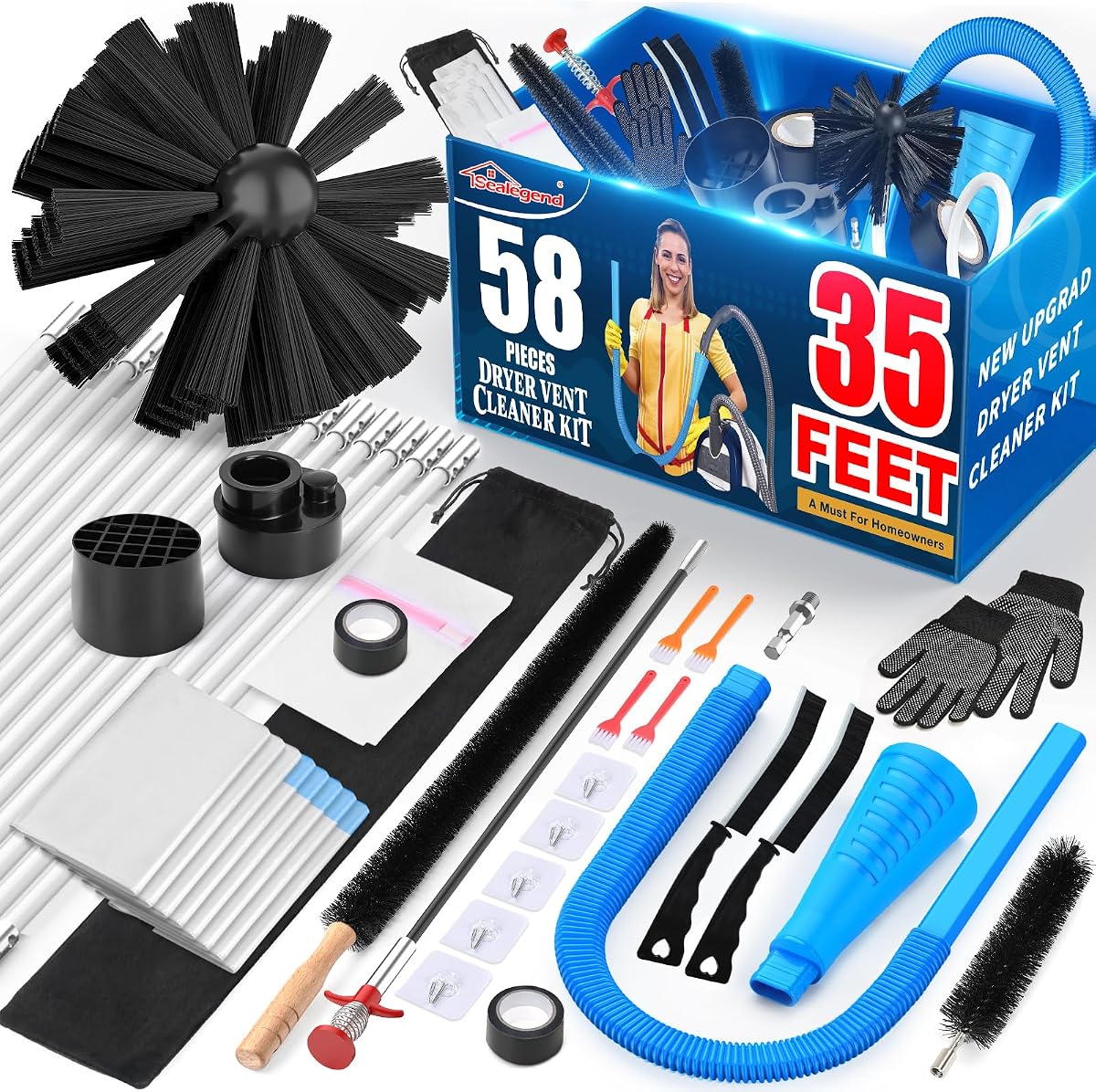
The Sealegend 58-piece system is the most expansive dryer-cleaning package here, combining a 35-foot flexible brush with vacuum, dryer, and drill-related accessories. Its 4.5 rating is the highest confirmed rating among the fully documented products in the supplied list.
We may earn a commission when you buy through this link, at no additional cost to you.
The main brush can rotate with a drill while connected rods extend the working distance. Adapters allow airflow from the clothes dryer, a shop vacuum, or an electric blower, and the included vacuum attachment is intended to help remove lint as the brush works through the line.
Not every component will be needed for every home, and the vacuum attachment is not compatible with some Dyson and Shark models. The large accessory count also makes the package more complex to organize and evaluate than a focused brush set.
This kit is the best general choice for a homeowner who wants a complete dryer-maintenance station with debris collection. It is less relevant to large HVAC air-duct work, but within dryer vent cleaning it offers the strongest combination of reach, airflow options, and supporting accessories.
The dedicated lint vacuum attachment and collection bags provide a way to capture debris during the cleaning process. Compatibility should be checked in advance because some Dyson and Shark vacuum models are excluded.
Included adapters support the clothes dryer, a shop vacuum, or an electric blower. This flexibility allows the user to select an available airflow source and combine rotary brushing with suction.
Lint trap, gap, blockage removal, and multi-use brushes cover smaller components beyond the main vent line. These additions are valuable when moving from the deep duct route to the machine's immediate openings.
We may earn a commission when you buy through this link, at no additional cost to you.
This 17-foot one-piece cleaner offers a deliberately simple design with a solid-core flexible shaft and a specialized double-lock brush head. Its 4.2 rating positions it as a practical alternative for residential vents where avoiding fragile rod connections is a priority.
We may earn a commission when you buy through this link, at no additional cost to you.
The integrated construction is designed to withstand higher torque than a collection of snap-together nylon rods. A universal hex adapter permits drill use, while a positioning hole helps limit reverse rotation and keep the brush locked when heavy lint creates resistance.
Seventeen feet is shorter than the reach offered by several 30-, 35-, 40-, and 60-foot kits. The package also contains only the shaft and custom brush head, so users seeking lint traps, gloves, vacuum adapters, or multiple brush sizes will need separate accessories.
Choose this tool for standard residential runs that fit within 17 feet and for users who value durability over maximum reach. It is especially appealing when navigating tight 90-degree elbows because the one-piece shaft can bend without the joint separation found in sectional kits.
A continuous shaft eliminates the weak points between connected rods. That can reduce separation risk when torque rises or the brush encounters compacted lint.
The brush head includes a double-lock design and a positioning feature intended to reduce reverse rotation. This helps keep the head attached when moving through resistant sections or backing out.
We may earn a commission when you buy through this link, at no additional cost to you.
This attachment connects a shop vacuum to a furnace supply opening, where its 3-by-9-inch nozzle is designed to create a strong seal. It has a 2.6 rating, making it a more specialized option than the well-rated brush kits.
We may earn a commission when you buy through this link, at no additional cost to you.
The tapered inlet is designed to fit most shop vacuums, and the flange can be filed or sanded for a closer match to a particular vent opening. Made from carbon-fiber PETG, the nozzle provides a durable connection when the vacuum is used to capture dust and debris.
It addresses only the portion of the system visible at the opening and does not include rods, brushes, or a blower for deep internal agitation. Users must remove the floor or wall grille before fitting it over the supply opening, and an imperfect seal may reduce performance.
This is the right tool for someone who already owns a compatible shop vacuum and wants to collect debris directly from accessible HVAC supply vents. It is best paired with a longer brush or air tool for routes that require both internal agitation and external collection.
The broad nozzle is intended to seal against a furnace supply duct more effectively than a standard narrow vacuum fitting. A closer seal improves the airflow needed to lift debris from the opening area.
Because openings vary in shape and size, the flange can be filed or sanded for a more precise fit. This adjustment can improve stability and help maintain suction at the connection point.
We may earn a commission when you buy through this link, at no additional cost to you.
This Holikme set leads the group in stated reach, with flexible rods extending up to 60 feet. Its 4.4 rating and broad accessory bundle make it a strong candidate for long dryer lines, complex exhaust routes, and other applications where a shorter brush may not reach far enough.
We may earn a commission when you buy through this link, at no additional cost to you.
The kit includes a heavy-duty brush for 4-inch pipes, flexible nylon rods, a dedicated lint brush, a drill attachment, and protective gloves. The main brush can be used with a standard household drill for rotation or handled manually when finer control is needed.
Maximum length can also introduce handling challenges. Long segmented rods require consistent alignment and slow advancement around elbows, and the package does not include a vacuum attachment for capturing debris. Users must manually protect themselves from released lint during the job.
This is the best choice among the listed products for unusually long dryer vents or household systems with several branches. For shorter routes, the bundle may be more than necessary, but its high reach and useful core accessories provide flexibility across demanding cleaning tasks.
A 60-foot working length can reach through longer exterior runs and more complex networks. This makes the kit useful when the route from the dryer to its termination is not a short, straight line.
The heavy-duty four-inch brush addresses broader pipe sections, while the dedicated lint brush handles finer cleaning tasks. Using both can provide a more complete pass than a single brush diameter.
We may earn a commission when you buy through this link, at no additional cost to you.
The right HVAC duct cleaning tool depends on the type of duct, the length and shape of the route, available power equipment, and whether the priority is brushing, pneumatic agitation, or vacuum-assisted collection. These factors narrow the choices faster than a general cleaning label alone.
Dryer exhaust lines, fireplace chimneys, flexible HVAC ducts, rigid sheet-metal trunks, and furnace supply openings present different cleaning challenges. A brush sized for a dryer vent may be too large for a narrow flexible duct, while a narrow whip may not create useful contact in a broad trunk. Consider the opening, interior diameter, bends, and the type of debris that tends to accumulate in the specific route.
Listed reach ranges from 14 inches for a compact air whip to 60 feet for a sectional lint-brush kit. Compare that figure with the full distance from the cleaning access point to the end of the route. Flexible rods must also be able to negotiate elbows without separating, binding, or buckling. Extra nominal reach can be valuable in branching systems, although it may add handling complexity in short runs.
Rotating brushes agitate lint and dust from duct walls, air whips move and spread debris with airflow, and vacuum attachments capture material at accessible openings. Some tools combine these methods, while others perform only one. A manual brush offers direct control, a drill adds rotational force, and compressed air can reach spaces without physically pushing a long rod through every bend.
Small differences in connector size can determine whether a tool works with an existing blower, vacuum, or drill. The compact air whip uses a 1/8-inch connector, the professional air kit includes 1/8-inch quick connections and a 1/4-inch blowgun plug, and the shop-vac attachment uses a 2.5-inch inlet. One Sealegend component is specifically not compatible with some Dyson and Shark vacuum models.
A brush can dislodge lint effectively but may also push it back toward the access opening. Vacuum-assisted tools improve control by pulling air through the route while the brush agitates debris. Kits with lint collection bags, trap brushes, and gap brushes are especially helpful when the aim is to contain dust rather than merely loosen it. If local exhaust does not draw material into a collection container, plan to remove it safely afterward.
A long tool is only useful if it can follow the route. One-piece shafts can reduce connection failures, while memory-style flexible rods can navigate bends but may be harder to rotate through tight corners. Air tentacles adapt well to small irregular spaces. Check whether the tool supports a recommended rotation direction, how much resistance it can tolerate, and whether the brush head is designed to remain attached when backed out.
A useful package may include several brush diameters, a lint trap brush, drill attachment, gloves, adapters, tape, or collection bags. More pieces can be helpful for whole-home cleaning, but they can also create storage clutter and duplicated functions. Check whether replacement rods, connectors, or heads are available and whether the core brush can address different vent diameters.
Wear gloves and eye protection when disturbing accumulated dust, and work with the appliance disconnected when its instructions require it. Pneumatic tools need appropriate pressure regulation and should not be directed toward people. Dryer vents should also be inspected for crushed or disconnected sections, since a flexible brush cannot correct a collapsed duct. Routine cleaning works best alongside checking airflow and making sure exterior vents open freely.
Begin by identifying the route, opening diameter, likely debris, and the correct brush or attachment. Disconnect or shut down the equipment as required by its instructions, put on gloves and eye protection, and remove loose lint from the accessible opening. Inspect the vent for crushed sections, disconnected joints, screen obstructions, and damage before inserting a long tool.
For brush kits, connect the rods securely and advance the brush slowly. Holikme guidance recommends clockwise rotation and careful movement around corners and stubborn lint traps. If using a drill, begin at low speed and increase gradually; if operating manually, rotate while pulling the brush back through the line. Air-powered attachments require a compatible source and controlled airflow, while a shop-vac attachment must form a secure seal around the vent opening.
After each pass, remove collected debris and clean the brush or tentacles before they dry into a compact mat. Keep connectors straight, dry replacement parts, and store flexible rods without sharp bends. Inspect brush heads for worn bristles, check the vacuum seal, and replace damaged components. Routine inspections and periodic cleaning are more effective than waiting for a heavy blockage to form.
Some multi-purpose kits are designed for both, but the best attachment can vary by system. Dryer vents commonly contain dense lint that benefits from rotating brushes, while air ducts may hold dust spread along walls and benefit from air whips or vacuum assistance. Match the brush diameter and cleaning mechanism to the actual opening and debris rather than relying on a broad product label.
No. Longer reach helps with extended or branching routes, but it can make a tool harder to control around elbows. A long sectional rod may separate or buckle if forced quickly, while a one-piece shaft may offer better durability within a shorter distance. Choose a length that covers the route with practical handling in mind.
A drill can make rotation easier and speed up brush movement, but it is not always required. Several kits support both manual and powered operation. If using a drill, begin slowly, keep the brush moving, and follow the tool's recommended rotation direction to reduce binding or attachment failure.
A brush physically agitates debris and may help pull it toward the access opening. A vacuum attachment uses suction to capture debris at an accessible vent or duct opening. The most effective approach often combines both: rotate a brush inside the line while a compatible vacuum removes the loosened material.
A brush can remove lint from an intact vent, but it cannot restore a crushed, disconnected, or obstructed duct. If the tool meets strong resistance, inspect the route for damage before continuing. Replacing or reconnecting damaged ductwork is necessary for safe and effective airflow.
They can be, provided the blower or compressor matches the tool's requirements and the user understands safe pressure control. Start with the recommended airflow, avoid directing the air toward people, and use eye protection. Pneumatic kits offer strong agitation and maneuverability but require more equipment and technique than a basic brush.
Compare the adapter's inlet diameter with the vacuum hose or port, then check the manufacturer's compatibility notes. The 2.5-inch shop-vac inlet in this guide is intended for most standard shop vacuums, while some vacuum attachments explicitly exclude certain Dyson and Shark models. A stable seal is important for effective suction.
The appropriate interval depends on laundry volume, lint production, pets, dryer condition, and local guidance. Inspect the lint screen and accessible duct openings regularly, and clean when buildup is visible or airflow seems restricted. A brush does not replace routine lint-screen cleaning, so both tasks should be part of normal laundry-area maintenance.
The Sealegend 58-piece kit is the strongest all-around dryer-vent choice because it combines 35-foot reach with rotary, vacuum, and blower-assisted options. The professional air-powered kit is the most flexible option for broader duct geometries, while the Holikme 30-foot set provides a focused and economical brush-based solution.
Prioritize the route and debris over the number of included pieces. Long reach matters in complex systems, while a secure connector, suitable brush diameter, controlled airflow, and debris collection can make a shorter tool more effective. Match the mechanism to the application: use brushes for lint, air whips for flexible spaces, and vacuum attachments for accessible supply openings.
Before purchasing, verify current product details, compatibility, availability, and the latest price on the linked listing. Tools and bundles can change over time, and the live listing may contain updated instructions or package information that will help you complete the cleaning safely.