
Amazon Basics Comb Binding Machine
4.3Editor score
12-sheet punch capacity
350-sheet binding capacity
Three paper size formats
Fixed paper slider alignment
A comb binding machine turns loose pages into organized, professional-looking booklets suited to classrooms, offices, home projects, and archival work. The right model should align holes consistently, handle the paper types you actually use, and provide enough binding capacity without creating unnecessary setup or storage demands.
We compared ten comb binding machines based on the supplied specifications, including punch capacity, binding capacity, supported paper sizes, alignment features, included supplies, construction, and intended workload. The list covers compact manual options, heavy-duty school machines, portable metal models, and electric binders for higher-volume document production.
Each pick highlights a different practical balance, from budget-friendly manual punching to premium electric operation. Ratings reflect the supplied customer feedback, while capacity and compatibility details show how each machine fits common projects. Product prices can change, so confirm current availability and specifications before purchasing.
4.3Editor score

4.8Editor score

4.2Editor score
As an Amazon Associate we earn from qualifying purchases.
This side-by-side comparison organizes the ten machines by operating method, punch and binding capacity, paper compatibility, alignment features, and included accessories, making it easier to match a binder to a particular classroom, office, or home workflow.




The Fellowes Pulsar+ is a well-rounded comb binding machine for teachers, administrators, and document-heavy home users. Its 4.8 rating is the highest among the ten supplied options, and its combination of a 20-sheet manual punch, 300-sheet binding capacity, and classroom-oriented organization features makes it a particularly balanced choice.
We may earn a commission when you buy through this link, at no additional cost to you.
The continuous punch-and-bind design is intended to make bulk document preparation more efficient. The accuracy edge guide and vertical loading path center paper before punching, which is especially useful when producing student workbooks, decodable reading books, lesson planners, handouts, and annual grading portfolios. A built-in tray stores combs, while its measurement tool helps users select an appropriate spine width more quickly.
Manual punching means the user still provides the operating force, so it may not be the ideal choice for a large production run handled by one person. Its 300-sheet capacity is also lower than the 450- and 500-sheet machines in the list. Even so, the strong rating, useful guide, vertical setup, and 20-sheet punch capacity create a convincing combination of consistency and convenience.
Choose the Pulsar+ when you need a dependable manual binder for recurring classroom or office work without moving to an electric model. It is especially appropriate for educators who regularly assemble moderately thick packets and value storage and measurement features as much as raw capacity. For most such users, it is the strongest all-around recommendation in this guide.
With a 20-sheet punch capacity, the Pulsar+ can process standard classroom batches in fewer passes than many compact binders. That makes it useful for student assignments, reading books, teaching resources, and portfolios that are prepared regularly rather than only occasionally.
The vertical loading path works with the accuracy edge guide to support consistent hole placement. The built-in comb tray and document measurement device also reduce the need to keep loose binding supplies and sizing references scattered around the work area.
We may earn a commission when you buy through this link, at no additional cost to you.
The MAKEASY Comb Binding Machine offers a broad combination of punch capacity, paper compatibility, and included supplies. Its 4.4 rating reflects generally favorable feedback, while the metal construction and compatibility with Letter, A4, and A5 paper distinguish it from simpler compact binders.
We may earn a commission when you buy through this link, at no additional cost to you.
It manually punches up to 12 sheets of standard printing paper, with lower limits stated for heavy cover stock and PVC cover material. The stated maximum binding capacity is 400 sheets when used with 2-inch comb spines, although those larger spines are not included. The package does provide 100 black 3/8-inch PVC combs suitable for smaller projects.
A low-force handle and non-slip feet make the unit approachable for office reports and home school projects, yet the manufacturer specifically recommends pressing the handle fully in one continuous motion. That means users should read the instructions before first use rather than testing the punch with important papers. The adjustable guide supports margins from 3 millimeters to 5 millimeters and accommodates several hole patterns.
This is a practical choice for a household, classroom, or small office that works with mixed paper sizes and wants a capable manual binder with combs already included. It may not suit users who want completely effortless punching, but its broad compatibility and strong construction offer useful flexibility.
Supporting 19-hole Letter, 21-hole A4, and 15-hole A5 formats lets the machine serve mixed project collections. The adjustable guide adds another layer of control for users who work with different margins or binding systems.
The 12-sheet rating applies to standard printing paper, while heavier cover materials have lower limits. Users should keep these distinctions in mind when planning covers, textured stock, and other specialized materials.
We may earn a commission when you buy through this link, at no additional cost to you.
The Fellowes Star+ is a compact, light-duty binder designed for everyday school preparation. Its 4.7 rating is the second-highest in the group, and the machine focuses on smoothly turning worksheets, assignments, reading logs, and project templates into reusable packets.
We may earn a commission when you buy through this link, at no additional cost to you.
It punches up to 15 sheets at a time and binds up to 150 sheets with a standard 3/4-inch plastic comb. Although that binding limit is comparatively modest, it is appropriate for individual student books, short reference records, and classroom packets. The vertical document loader and enhanced accuracy edge guide support consistent alignment.
The main compromise is capacity. Users assembling annual portfolios or thick curriculum compilations will find that the 150-sheet limit is less accommodating than the 300- to 500-sheet machines in the guide. Because it is manual, it also lacks the reduced strain associated with the Quasar 500 and Galaxy E electric models.
Despite those limits, the Star+ is a good fit for teachers who create many smaller booklets and want a straightforward manual machine. Its high rating, compact format, 15-sheet punch, and integrated comb storage make it a particularly practical everyday classroom choice.
A 15-sheet punch and 150-sheet binding limit fit common classroom booklets well. This makes the Star+ most appropriate for teaching materials that are handled individually or distributed in manageable quantities.
The integrated comb storage tray includes a measurement device, helping users identify the required spine width without relying on a separate ruler. The result is a tidier setup for frequently changing document sizes.
We may earn a commission when you buy through this link, at no additional cost to you.
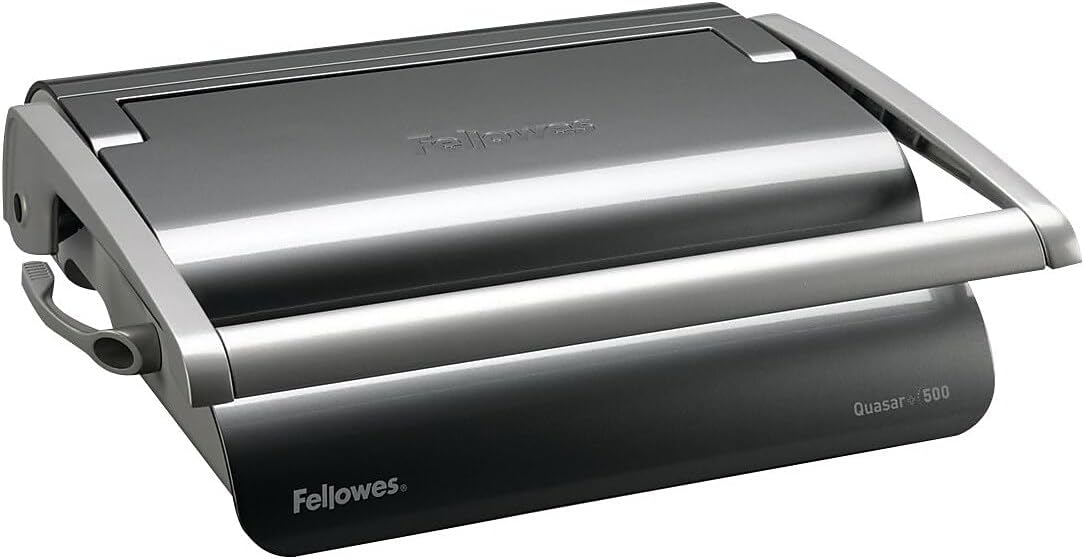
The Fellowes Quasar 500 is built for high-volume classroom organization, combining electric punching with a 500-sheet binding capacity. Its 4.4 rating indicates solid customer reception, and the machine targets users who consistently produce portfolios, textbooks, curriculum planners, and other substantial bound documents.
We may earn a commission when you buy through this link, at no additional cost to you.
A button-operated 20-sheet punch removes the need to manually push a lever through each batch. The heavy-duty binding mechanism can accommodate up to 500 sheets with a large 2-inch plastic comb, and the continuous binding design is intended to streamline continuous production. A precision edge guide centers the document, while the storage tray includes a measurement device.
The trade-off is the need for a suitable power source and more space on the work surface than a compact manual machine. Electric operation is not automatically necessary for moderate volumes, so buyers should consider whether their workload genuinely justifies the added infrastructure and bulk.
For a school or office that regularly handles thick, high-volume documents, the Quasar 500 makes a strong case. It combines electric convenience with one of the largest binding capacities in this comparison and supports a clear classroom-organization use case.
Electric punch activation is valuable when a single user prepares many batches. It reduces the repeated physical effort associated with driving a manual handle through each stack of paper.
The 500-sheet limit and support for 2-inch combs make this model relevant to portfolios and curriculum books. Users can keep the larger spine and supplies organized in the integrated tray.
We may earn a commission when you buy through this link, at no additional cost to you.
The Amazon Basics Comb Binding Machine offers a clear set of capabilities for users seeking a manual binder without a large feature list. Its 4.3 rating reflects a generally positive reception, while the 12-sheet punch and 350-sheet binding capacity cover many reports, manuals, presentations, and home projects.
We may earn a commission when you buy through this link, at no additional cost to you.
The all-in-one design combines hole punching and binding. A fixed paper slider is intended to prevent hole offset, which is valuable for repeatable alignment, and the machine supports A5, Letter, and A4 formats. Construction consists of 90 percent steel and 10 percent plastic, including a durable carbon steel punch blade.
Its fixed slider is not adjustable, so users cannot fine-tune the margin like they can with several other models in the list. Plastic comb-style spines are also not included, which means new users must purchase binding supplies separately. These are important considerations when comparing the machine with bundles that arrive with combs.
The Amazon Basics option is a sound budget-oriented recommendation for occasional reports and general home or office binding. It is less feature-rich than premium classroom models, but its solid construction, three paper formats, and useful capacity make it a sensible uncomplicated choice.
The fixed slider is intended to keep paper positioned consistently from one batch to the next. That repeatable setup can be especially useful for users who create similarly sized documents over time.
Supporting 15-hole A5, 19-hole Letter, and 21-hole A4 paper makes the binder useful for a variety of project dimensions. Users still need the matching plastic comb spines for each format.
We may earn a commission when you buy through this link, at no additional cost to you.
The OFFNOVA Binding Machine is one of the strongest all-around performers in the list, carrying a 4.6 rating. It combines a 12-sheet manual punch, a stated 450-sheet binding capacity, three paper formats, and a starter bundle that includes 100 comb spines, a comb protector, and oil-absorbing paper.
We may earn a commission when you buy through this link, at no additional cost to you.
A positioning knob and adjustable edge guide allow users to select Letter, A4, or A5 layouts and set margins to 3, 4, or 5 millimeters. The curved handle is designed to reduce the force required for punching, while the cast iron base and powder-coated surface help the machine remain stable. The stated 6.3-pound weight also makes it manageable within a workspace.
The maximum 450-sheet figure requires 2-inch comb spines that are not part of the package. New owners should also follow the instruction to clean the machine with the included oil-absorbing paper before use, reducing the possibility that manufacturing lubricant could stain documents.
This machine is well suited to home and small-office users who want the necessary accessories in one package. It offers a strong balance of capacity, adjustability, portability, and customer feedback, making it one of the most complete bundles in the comparison.
The included combs, protector, and oil-absorbing sheet reduce the need for separate starter purchases. This makes the package especially convenient for first-time users who are not yet sure which spine width or accessories they need.
The edge guide and three margin settings help create uniform documents on Letter, A4, and A5 paper. A 12-sheet standard-paper punch keeps manual work manageable for everyday report and project preparation.
We may earn a commission when you buy through this link, at no additional cost to you.
The Binditek Binding Machine is a focused option for people who primarily work with U.S. Letter paper. Its 3.9 rating is the lowest in this group, but the product includes useful guidance and a starter kit of 30 black 1/2-inch combs for reports, manuals, presentations, and classroom work.
We may earn a commission when you buy through this link, at no additional cost to you.
The 19-hole punch is designed specifically for Letter size, using a fixed paper guide and 3-millimeter margin for consistent hole placement. It punches up to eight sheets of 20-pound paper at once, and the dual-function handle combines punching and binding. The included combs support up to 120 sheets, while the overall machine can bind up to 145 sheets with a 3/4-inch comb.
Its limitations are clear: the eight-sheet punch is smaller than most alternatives here, and the machine does not offer the same multi-format flexibility as Letter, A4, and A5 models. Users should punch thicker cover materials separately and use the recommended full-motion handle stroke for cleaner results.
Despite the lower rating, this machine may suit a user who values a simple Letter-size process, a fixed guide, and included binding supplies more than maximum capacity. It is best considered for focused personal or small-office projects rather than high-volume production.
A dedicated 19-hole format keeps the process simple for users who consistently work with standard American paper. The fixed guide and defined margin help avoid frequent readjustment between jobs.
The machine supports PVC and PP covers up to 12 mil as well as cardstock up to 450 gsm. Covers should be punched separately, and only one cover should enter the punch at a time.
We may earn a commission when you buy through this link, at no additional cost to you.
The Fellowes Quasar+ stands out for its combination of manual operation and unusually high capacity. It punches up to 25 sheets at a time and binds up to 500 sheets with a 2-inch comb, matching the capacity of the premium electric models while avoiding the need for a power connection.
We may earn a commission when you buy through this link, at no additional cost to you.
The enhanced accuracy edge guide and vertical loading arrangement support precise punch placement. A built-in comb storage tray and integrated document measurement device assist with setup and spine selection. These features make the Quasar+ well suited to school production, office reports, manuals, and other books assembled in substantial quantities.
A 25-sheet manual punch still requires meaningful physical effort, and the machine's listed dimensions indicate that it needs a dedicated place on a desk or workbench. Buyers seeking the lowest possible effort may prefer an electric model, but the Quasar+ preserves manual convenience without surrendering a 500-sheet binding limit.
This is an attractive choice for experienced users who want maximum manual punch and binding capacity with good alignment and organization. It is particularly compelling for shared school or office workstations where both heavy documents and frequent binding tasks are common.
The 500-sheet binding limit gives the Quasar+ the same headline capacity as premium electric binders. It is a strong option where power access is inconvenient or the workload does not justify an electric machine.
Vertical paper loading and the accuracy edge guide work together to support uniform hole placement. These details become increasingly valuable as batch size and document thickness increase.
We may earn a commission when you buy through this link, at no additional cost to you.
The TIANSE Binding Machine combines broad paper compatibility with a portable 6.3-pound design. It receives a 4.4 rating and includes 100 black 3/8-inch, 21-ring PVC comb spines, making it suitable for Letter, A4, and A5 projects in schools, small offices, and home workspaces.
We may earn a commission when you buy through this link, at no additional cost to you.
The high-leverage arm manually punches up to 12 sheets of standard 80-gram paper, while the stated maximum binding capacity is 450 sheets using 2-inch combs. An adjustable edge guide and selectable 3-, 4-, or 5-millimeter margins support alignment. The solid metal housing and non-slip feet provide stability, while the one-hand carry point helps with repositioning.
Users must follow the full-stroke punching instruction and stop if a jam occurs rather than continuing to force the mechanism. Laminated paper is explicitly unsupported, which narrows the range of projects. The larger 2-inch combs needed to reach maximum capacity are not included, although the standard starter combs cover many common tasks.
The TIANSE is a good middle-ground choice for a mobile or shared workspace where mixed formats, useful capacity, and included supplies matter. Its combination of portability and adjustability gives it broad everyday appeal despite the need to observe certain operating restrictions.
At 6.3 pounds, the machine can be repositioned using the central base handle. That portability is useful for home users, shared classrooms, or small offices where the binder is not permanently stationed.
The edge guide supports 19-hole Letter, 21-hole A4, and 15-hole A5 layouts. Three margin choices help users match a more professional layout while preserving consistency between documents.
We may earn a commission when you buy through this link, at no additional cost to you.
The Fellowes Galaxy E is the premium electric option in this guide, pairing automatic 25-sheet punching with a 500-sheet binding capacity. Its 4.2 rating is not the highest, but the specifications make it the most specialized choice for users who want maximum capacity and reduced manual effort in one machine.
We may earn a commission when you buy through this link, at no additional cost to you.
A button starts the punch, and the 2-inch comb capacity accommodates up to 500 sheets. The binding mechanism can be removed and used separately, potentially improving workflow when users need to move between punching and binding positions. An accuracy edge guide, vertical loader, comb storage tray, and integrated measurement device support the rest of the process.
As an electric machine, it requires a reliable power source and occupies a dedicated workspace. Its 4.2 rating should also be considered alongside the specifications: it offers exceptional stated capacity, but the customer feedback is less emphatic than several manual alternatives. Buyers should be comfortable with the product's size and operating model.
The Galaxy E is most appropriate for a busy school, production office, training department, or serious home binder that regularly creates thick books. For that kind of sustained use, its electric punch, 500-sheet capacity, and removable binding mechanism provide a compelling premium package.
The 25-sheet automatic punch is the highest stated electric punch capacity among the listed machines. It is particularly relevant for users who repeatedly process standard paper in large batches.
Removing the binding mechanism allows it to operate separately from the punch area. This design can support a more organized workflow when a user is preparing, punching, and binding several projects at once.
We may earn a commission when you buy through this link, at no additional cost to you.
The most useful comb binding machine is the one that matches your paper formats, workload, and tolerance for manual effort. Evaluate capacity, alignment, included supplies, physical space, and binding style before making a final choice.
Punch capacity indicates how many standard sheets can be processed in one pass. The list ranges from an eight-sheet maximum on the Binditek to 25 sheets on the Fellowes Quasar+ and Galaxy E. A higher figure can reduce the number of batches required, but it does not necessarily mean the machine can punch the same quantity of heavy cardstock or plastic covers. Those materials have separate limits, so buyers should compare ordinary-paper and cover-paper ratings rather than treating punch capacity as a universal limit.
Binding capacity determines the thickness of the finished book. Models range from 150 sheets for the Fellowes Star+ and 145 sheets for the Binditek to 450 or 500 sheets for several competing machines. Larger capacity requires a wider plastic comb, and the maximum figure is often conditional on a spine that may not be included. Buyers should distinguish the machine's binding mechanism from the number of combs supplied in the package and plan to purchase matching spines for larger projects.
Letter, A4, and A5 support provides useful flexibility for international documents and mixed projects. The Fellowes Pulsar+, Star+, Quasar 500, and Quasar+ are described primarily in classroom and Letter-oriented contexts, while the MAKEASY, Amazon Basics, OFFNOVA, and TIANSE models explicitly list multiple hole patterns. Check both the paper size and number of holes because a binder supporting A4 cannot necessarily use a Letter comb. A dedicated 19-hole machine may be simpler for users who only use one format.
Consistent alignment is essential because incorrectly positioned holes can prevent a document from opening properly or produce an uneven finished edge. Vertical loading, accuracy edge guides, positioning knobs, and adjustable sliders are the main alignment features represented here. Models offering selectable margins from 3 to 5 millimeters provide greater control over the final presentation. A fixed guide can still be effective for repetitive work, but it offers less flexibility when paper dimensions, comb patterns, or layout requirements change.
Manual machines are simpler, portable, and suitable for intermittent projects. Electric models reduce the effort required for repeated punching and are better aligned with sustained production. The Fellowes Galaxy E punches up to 25 sheets automatically, while the Quasar 500 offers a 20-sheet electric punch. Manual alternatives still deliver impressive capacity, including the 25-sheet Quasar+. The right choice depends on how often the machine will be used, how physically demanding the task is, and whether a power source is conveniently available.
Starter bundles can make a new machine much more convenient. The OFFNOVA and TIANSE models include 100 comb spines, while the MAKEASY also includes 100. The Binditek includes 30 half-inch combs, and the Fellowes Pulsar+ includes a 10-pack starter kit. In contrast, the Amazon Basics machine does not include plastic comb spines. A built-in comb tray, document measurement tool, comb protector, or oil-absorbing paper can also simplify setup, so compare the complete package rather than looking only at the headline capacities.
Metal construction and a stable base are desirable in a machine that will be moved or used for large stacks. The MAKEASY, TIANSE, and OFFNOVA machines describe durable metal or cast iron components, while the Amazon Basics model is made primarily of steel with some plastic. Non-slip feet and broad bases help prevent movement during a forceful stroke. Electric models need a stable power source and a permanent work area, whereas a lighter manual machine may be easier to place temporarily on a shared desk.
A comb storage tray keeps binding supplies close to the work area and reduces lost or mismatched spines. Integrated document measurement devices can further speed up setup by helping users select the correct comb width. Larger-capacity machines may require more room, while portable manual models can be moved as needed. Before buying, consider whether the machine will remain in a dedicated classroom or office, be shared between rooms, or need to fit into a compact home workspace.
Begin by identifying the paper size and corresponding plastic comb. Set the edge guide or margin selector for the required hole pattern, then align the pages against the guide and insert them fully into the punching slot. Keep the machine stable on a flat surface and close the handle in one smooth, complete motion rather than stopping halfway. Several models explicitly warn that a partial stroke can leave a stack stuck in the punch.
After punching, check that the holes are open and free of paper debris. Select a comb that matches both the paper's hole pattern and the finished document's thickness. Open the comb, position it around the punched pages, and close it carefully. The Binditek uses a locking feature to hold an opened comb while pages are loaded, while other machines use a more direct comb-opening process described in their instructions.
For maintenance, remove loose scraps from the punch area and use the recommended oil-absorbing paper before important documents when the machine has been stored or protected with manufacturing lubricant. Keep the cutting area clean, avoid punching unsupported laminated material, and separate heavy covers from ordinary pages when the manufacturer recommends it. Store combs in the built-in tray or another dry, organized location.
Punch capacity is the number of standard sheets the machine can punch in one pass. Binding capacity is the maximum number of sheets that can be assembled into one book. Binding capacity also depends on the width of the plastic comb, so a machine may support a large theoretical total only when fitted with an appropriately wide spine.
Several models explicitly support all three formats, including the MAKEASY, Amazon Basics, OFFNOVA, and TIANSE machines. Their hole patterns differ, so users must select or purchase the correct 19-hole Letter, 21-hole A4, or 15-hole A5 comb. Other models are designed more specifically for Letter-size documents.
A manual machine is sufficient for intermittent classroom document preparation and may be easier to relocate. An electric model is generally more comfortable for repeated batches because it reduces the force required to punch. The best choice depends on the volume of work, available power, workspace, and frequency of use.
The comb must match the number of holes in the paper and be wide enough for the document's thickness. The machines in this guide feature integrated measurement tools or width guidance for common projects. Large documents approaching the maximum binding capacity may require 2-inch combs, which are not included with every package.
A partial handle stroke, misaligned paper, or scraps trapped in the punch can cause jams. Press the handle fully in one continuous motion, ensure the pages are inserted all the way, and remove paper debris from the punch area. Stop if the machine remains stuck rather than forcing the mechanism, and follow the manufacturer's cleaning procedure.
They can, but the limits are lower than for ordinary printing paper. The Binditek supports PVC and PP covers up to 12 mil and cardstock up to 450 gsm, while its cover sheets should be punched separately. The TIANSE model states that laminated paper cannot be punched, so always check the specific product instructions before attempting specialty materials.
It depends on the model. The OFFNOVA, MAKEASY, and TIANSE machines include 100 comb spines, the Binditek includes 30, and the Fellowes Pulsar+ includes a 10-pack starter kit. The Amazon Basics machine does not include plastic comb-style binder spines, so those supplies must be obtained separately.
High-capacity electric and manual models need a stable work area with room for the machine, open combs, document stacks, and storage trays. The Fellowes Quasar+ has listed dimensions of 5.1 by 18.1 by 15.4 inches, illustrating why buyers should check available desk space. More compact manual machines are easier to store between uses.
The Fellowes Pulsar+ is the strongest overall choice for classrooms because it combines a high rating, a 20-sheet manual punch, 300-sheet binding capacity, and thoughtful organization features. The Amazon Basics Comb Binding Machine stands out as the budget pick with three paper formats and a useful 350-sheet limit, while the Fellowes Galaxy E is the premium option for high-volume work that benefits from a 25-sheet electric punch and 500-sheet binding capacity.
Prioritize the factors that affect your documents most often. Choose multi-format support if you work with mixed paper, a large binding capacity for books and portfolios, an adjustable guide for varied margins, and electric operation for frequent batches. Also consider starter supplies carefully, because a higher-capacity machine is not as convenient if the required larger combs are not included.
Before making a final purchase, verify the current specifications, availability, required comb pattern, and accessories. Ratings and product configurations can evolve, and prices change over time. Comparing the current machine details with the workload and materials in your classroom, office, or home will lead to the most dependable long-term choice.


