
Outdoor Photoelectric Swivel Sensor
4.5Editor score
Adjustable 180-degree swivel
UL-listed weather-resistant housing
Supports LED and legacy lamps
1800W tungsten rating
Time-delay function included
A light sensor for outdoor lights gives fixtures a convenient way to turn on at dusk and off at dawn without a manual switch or smart-home setup. The right photocell should suit your fixture, electrical system, mounting location, and local weather while providing dependable automatic operation.
We compared ten sensors by examining their stated voltage ranges, load limits, weather ratings, mounting methods, delay functions, included hardware, light-source compatibility, safety listings, and warranty coverage. The list covers hard-wired models, wall-plate options, twist-lock replacements, multipacks, and a lamp-post-specific quick-change design.
Each review explains the details that distinguish one model from another, including installation complexity and practical trade-offs. Ratings reflect the supplied customer feedback, while availability and pricing can change, so readers should confirm current specifications and costs before purchasing.
4.5Editor score

4.4Editor score

4.5Editor score
As an Amazon Associate we earn from qualifying purchases.
The comparison below places the ten photocell options side by side by installation style, electrical range, weather protection, load capacity, and notable features, making it easier to identify the model that matches a particular outdoor lighting setup.




The YCA1030 Dusk to Dawn Sensor is a hard-wired post-eye photocell rated 4.4 out of 5 by customers. Its standout quality is versatility: the stated 120V–277V operating range supports residential and commercial fixtures, while compatibility extends across incandescent, fluorescent, LED, halogen, mercury vapor, high-pressure sodium, and CFL lamps.
We may earn a commission when you buy through this link, at no additional cost to you.
The sensor's IP65 housing is designed to resist rain, dust, and other outdoor exposure. A built-in time delay helps prevent a connected load from momentarily switching off when headlights, lightning, or another brief flash crosses the photocell. Its through-hole mounting design uses a locking nut and washer gasket to reduce moisture intrusion, and the stated 600W tungsten limit provides a clear basis for load planning.
The main limitation is that this is a wired device rather than a plug-in replacement, so installation requires opening a fixture or working with the appropriate wiring. Its 600W tungsten maximum is also more conservative than several options that advertise 1800W. Those factors make it less convenient than a twist-lock model and unsuitable for higher-wattage installations without confirming the complete fixture specifications.
Choose this sensor for a new hard-wired post light, wall pack, floodlight, or sconce when you want a UL-listed unit with broad lamp compatibility and dependable outdoor protection. It is a strong general-purpose choice for contractors and homeowners comfortable with basic electrical work who value clear voltage support and a protective gasket over tool-free installation.
An IP65 rating and sealed through-hole installation help protect the electronics from rain and dust. The gasket is especially relevant on exposed fixtures where water could otherwise collect around the sensor.
The built-in time delay makes short bursts of artificial light less likely to interrupt operation. This is useful near roads, driveways, and outdoor areas illuminated by passing vehicles.
We may earn a commission when you buy through this link, at no additional cost to you.
The YCA1031 Photocell Sensor carries a 4.6 rating and stands out for its included metal wall plate. That accessory gives installers a straightforward way to place the photocell on an exterior or porch wall, while the sensor itself can still be used with lamp posts or as a replacement inside a compatible outdoor fixture.
We may earn a commission when you buy through this link, at no additional cost to you.
Both the photocell and wall plate are rated IP65, and the plate includes a waterproof pad for sealing the mounting area. Electrical specifications cover 100–277V AC at 50/60Hz, with a 600W tungsten rating. Compatibility includes incandescent, fluorescent, LED, halogen, mercury vapor, high-pressure sodium, and CFL fixtures, making it appropriate for floodlights, wall packs, and wall scones.
Its primary trade-off is installation complexity. Unlike a twist-lock photocell, this model requires hard-wired connections and enough room for either the through-fixture sensor or the wall plate. Buyers also need to make sure their fixture has a suitable opening and that the sensor's relatively low 600W tungsten maximum accommodates the connected load.
This is a particularly good fit when the photocell cannot be mounted inside a light fixture or when exterior wall placement is more convenient. It suits homeowners and installers who value the supplied wall plate, high customer rating, UL listing, and broad fixture compatibility over a completely tool-free replacement process.
The included metal plate makes the sensor adaptable to projects where the photocell lens needs an unobstructed view of the sky. Removing the plate allows use with a lamp post or as a component within a compatible fixture.
IP65 protection applies to the photocell and wall plate, while the included waterproof pad helps reduce moisture entry around the wall connection. This dual coverage is useful in exposed residential and commercial locations.
We may earn a commission when you buy through this link, at no additional cost to you.
The Two-Pack Dusk Sensor is rated 4.2 out of 5 and offers two units for projects with more than one outdoor lighting zone. Its stated load support reaches 1800W and 1100VA, while the rotating installation lets users adjust the direction in which the sensor evaluates ambient light.
We may earn a commission when you buy through this link, at no additional cost to you.
The automatic thresholds are specified at approximately 10–20 lumens for turning on at dusk and 30–60 lumens for turning off at dawn. A built-in delay reduces unwanted switching caused by passing headlights or stray light. The hard-wired design supports incandescent, compact fluorescent, halogen, and LED fixtures and is listed for backyards, streets, parking lots, signs, sidewalks, and perimeter lighting.
Compared with the highest-rated models in this guide, this option's IP54 rating offers somewhat less formal weather protection than an IP65 sensor. It is also restricted to 120VAC, so it is less adaptable to 240–277V installations. The multipack format is useful for larger properties, but a single-property owner with one fixture may prefer a one-sensor product.
Choose this model when you need two adjustable sensors, a generous stated load capacity, and operation at 120VAC. It is best suited to residential or commercial properties with multiple fixtures where the installer can provide proper hard-wired connections and the mounting locations offer adequate protection from the elements.
The stated 1800W and 1100VA ratings give this sensor more headroom than several 600W alternatives. Verify the fixture, ballast, and wiring requirements before connecting any load.
The rotating mount helps position the sensor away from direct illumination that could confuse automatic operation. Correct orientation is especially important near signs, windows, and frequently illuminated pathways.
We may earn a commission when you buy through this link, at no additional cost to you.
The Outdoor Swivel Photoelectric Sensor earns a 4.5 customer rating and provides a balanced set of features for standard 120VAC installations. Its most useful feature is the adjustable base, which swivels up to 180 degrees so the sensor can be aimed toward open sky rather than toward a wall, tree, or nearby structure.
We may earn a commission when you buy through this link, at no additional cost to you.
The housing is made from polycarbonate described as corrosion preventive and waterproof, and the product carries an IP65 rating and UL listing. Electrical specifications include 120VAC at 50/60Hz, a 1800W tungsten rating, and a 1100VA ballast rating. It works with LED, CFL, fluorescent, incandescent, and other supported bulbs, allowing it to serve lamp posts, holiday lights, commercial fixtures, and residential pathways.
A built-in time delay helps the controller avoid responding to occasional light. The trade-off is its 120VAC-only specification, which rules out a direct match for 240V or 277V installations. The supplied information also does not explicitly list mounting hardware, so installers may need separate gaskets, locknuts, or conduit fittings.
This is a strong choice for a standard outdoor post or area light that needs reliable automatic control without an application-specific quick-plug system. It offers a generous stated load rating, a protective housing, and adjustable positioning at a straightforward entry-level level.
The 180-degree swivel allows installers to optimize the angle after the fixture is in place. This can reduce interference from nearby walls and other reflected light.
Compatibility with LED, CFL, fluorescent, and incandescent lamps makes this sensor useful across older and newer fixtures. Confirm the ballast and load requirements for the specific installation.
We may earn a commission when you buy through this link, at no additional cost to you.
The Two-Pack Multivoltage Photocell combines a 4.5 rating with an unusually broad electrical range. It handles 120V through 277V at 50/60Hz, making it suitable for more varied residential and commercial installations than models restricted to 120VAC.
We may earn a commission when you buy through this link, at no additional cost to you.
The UL-listed sensor has an IP65 water-resistant body, surge protection, and a swivel mount that lets users focus the sensing direction. It is compatible with LED, CFL, fluorescent, and incandescent bulbs, and the stated operating thresholds are 5–20 lux for on and 20–60 lux for off. A delay helps prevent accidental shutoff from headlights or lightning, while a three-year warranty provides stated after-sales support.
Its installation uses a threaded screw, rubber gasket, and zinc-alloy locknut, which can be more involved than fitting a standard twist-lock base. Some users may also find the heavy-duty body less suited to a small fixture opening. The two-pack is an advantage for larger properties but unnecessary when replacing only one photocell.
This model is a good fit for installers who work across several voltage standards or need two sensors for separate fixtures. It is especially attractive when surge protection, UL listing, a broad voltage range, and warranty coverage matter more than the fastest possible replacement.
The 120V–277V range provides flexibility when maintaining a mixed property. It reduces the need to match a model tightly to each fixture's supply.
Surge protection and an IP65 water-resistant housing add useful protection for exposed outdoor installations. These features complement rather than replace correct wiring and weather sealing.
We may earn a commission when you buy through this link, at no additional cost to you.
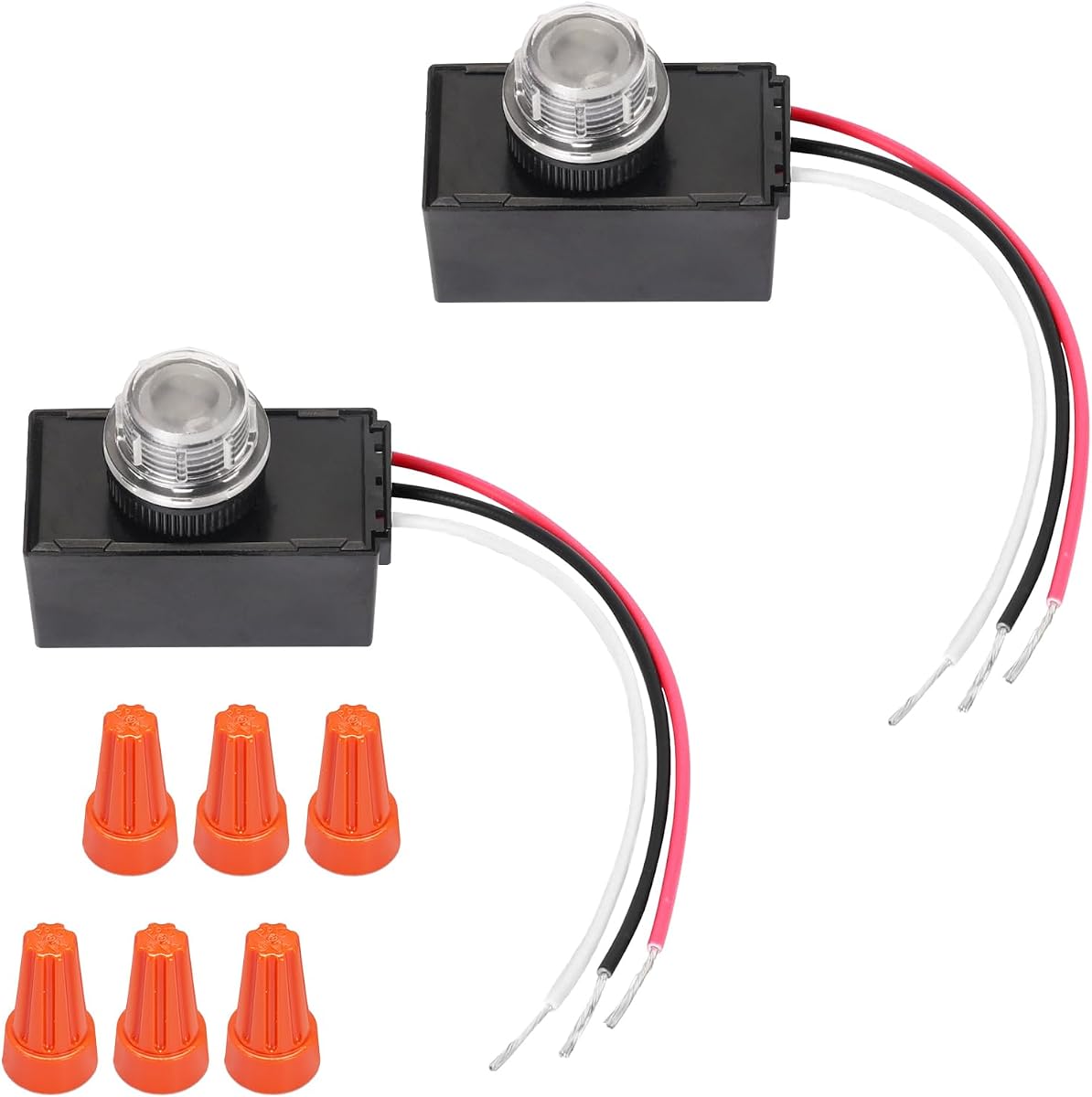
The Two-Pack Photoelectric Switch is rated 4.5 out of 5 and emphasizes convenient installation. Each set includes wire caps, a gasket, a locknut, and a lens cover, reducing the chance that a DIY installer will need to source several small mounting parts separately.
We may earn a commission when you buy through this link, at no additional cost to you.
Its compact dimensions of approximately 2 by 1 by 2 inches help it fit into residential outlet boxes and many outdoor fixtures. The operating range is 120V–277V, and the sensor is stated as compatible with incandescent, CFL, LED, and halogen sources. An IP65 rating and sealed design are intended to withstand rain, wind, and snow in applications such as post lamps, porch lights, and floodlights.
One drawback is that the supplied compatibility list does not name every lamp category found elsewhere in the guide, such as fluorescent, mercury vapor, or high-pressure sodium. The product information also gives no explicit maximum wattage, which makes load verification less straightforward. Buyers should therefore check the fixture label and complete manufacturer documentation before installation.
This two-pack is an attractive option for a household with two compatible outdoor fixtures or a contractor completing a small installation. It combines compact sizing, included hardware, broad voltage support, and a strong rating, making it particularly practical when convenience at installation is the priority.
Wire caps, gaskets, locknuts, and lens covers are included for each sensor. Having the correct pieces together can simplify assembly and help maintain a more complete weather seal.
The small housing is designed to fit residential outlet boxes and many standard fixtures. Measure the available knockout and fixture space before finalizing the installation.
We may earn a commission when you buy through this link, at no additional cost to you.
The Solus Dusk-to-Dawn Sensor has a 4.6 rating and focuses on a specific but common installation: 3-inch outdoor lamp posts. Its Ezee Change Plug allows the sensor to be replaced later without rewiring the fixture after the original setup, making maintenance unusually convenient.
We may earn a commission when you buy through this link, at no additional cost to you.
The unit operates at 120V and supports up to 300W incandescent, 60W LED, 39W fluorescent, and 100W HID loads. It fits a 1.375-inch diameter mounting hole in a 3-inch lamp post and carries a UL listing. A five-year warranty and several color and pack options make it a practical choice for planned residential or commercial post-lighting projects.
The limits are significant for anyone with larger fixtures. Its 300W incandescent and 60W LED maxima are well below the 600W and 1800W ratings advertised by several competitors, and it only handles 120V. Its specialized post-eye form also means it will not suit a standard electrical box or wall-mounted fixture without adaptation.
Choose this sensor when maintaining a 3-inch post light and placing future replacement convenience high on your list. The quick-swap plug, strong rating, UL listing, and long warranty make it a specialized yet compelling choice for correctly sized installations.
The Ezee Change Plug separates ongoing maintenance from the original wiring job. Once installed correctly, replacing a failed sensor does not require repeating the full wiring process.
The stated 3-inch post compatibility and 1.375-inch hole requirement make this less universal than a conventional photocell. Confirm both dimensions before removing an existing sensor.
We may earn a commission when you buy through this link, at no additional cost to you.
The Twist-Lock Photocell Sensor has a 4.6 rating and centers on quick, straightforward replacement. It uses a standard twist-lock interface, allowing an installer to plug the sensor into a matching base instead of rewiring the entire light fixture.
We may earn a commission when you buy through this link, at no additional cost to you.
It supports 120–277VAC and a 1000W tungsten or 1800VA ballast load. The automatic photocell turns connected lighting on at dusk and off at dawn, while a selectable 3–20-second time delay helps reject brief light caused by lightning or other temporary sources. The weather-resistant shell and surge protection are designed for outdoor street, parking, pathway, and landscape applications.
The key constraint is compatibility with the fixture's receptacle. Owners of fixtures with a different mounting interface, integrated sensor, or inaccessible base may still need an electrician or extensive disassembly. Its load rating should also be checked against the installed fixture rather than assumed from the lamp wattage alone.
This is an excellent choice when the existing outdoor light already has a standard twist-lock photocell receptacle. It offers the broadest voltage range in the list, a strong 4.6 rating, adjustable delay, and one of the simplest replacement processes for DIY users with safe access to the fixture.
The twist-lock design connects directly to a standard receptacle. Replacing the unit is generally faster and less invasive than installing a through-hole or hard-wired sensor.
A 3–20 second adjustment provides flexibility around driveways, lightning, and other short light events. More delay can help stabilize switching in locations with intermittent illumination.
We may earn a commission when you buy through this link, at no additional cost to you.
The 120V Hard-Wired Photocell Sensor combines a 4.5 customer rating with stated ETL lighting-control and FCC Part 15 Class B compliance. Its premium distinction comes from the documented service life of up to 50,000 hours and a five-year warranty, giving buyers a clear long-term ownership proposition.
We may earn a commission when you buy through this link, at no additional cost to you.
This compact model operates at 120V AC and 50/60Hz with very low stated consumption of 0.5W. Maximum loads are 100W incandescent, 55W fluorescent, and 55W LED driver. A compact M9x1.0 threaded mount fits through a 3/8-inch hole, while the color-coded connection guide is straightforward: black to line, white to neutral, and red to load.
The load limits are modest compared with the higher-capacity sensors in the guide, and it is intended to be installed inside a weatherproof outdoor fixture rather than exposed as a standalone unit. Those constraints make it best for appropriately sized post lamps, driveway lights, wall packs, pole lanterns, and porch lights rather than large commercial floodlights.
Choose this sensor when certification, low power use, clear wiring instructions, and long-term warranty support are priorities. It is a particularly refined choice for a 120V residential fixture that comfortably falls within its stated wattage limits and where the sensor can be installed inside a properly weatherproof enclosure.
ETL lighting-control compliance, FCC Part 15 Class B compliance, and a five-year warranty distinguish this model. The stated service life also supports long-term maintenance planning.
The 0.5W operating consumption is minimal, and the unit can automatically control compatible post lights and wall packs. Its wattage limits should be checked before installation.
We may earn a commission when you buy through this link, at no additional cost to you.
The Greencycle Water-Resistant Photocell holds the highest customer rating in this group at 4.7 out of 5. It is a hard-wired automatic sensor designed to convert fixtures to on-at-dusk and off-at-dawn operation while supporting loads up to 1800W and circuits with a maximum current of 9.2A.
We may earn a commission when you buy through this link, at no additional cost to you.
Its IP65 housing and sealed design are intended for rain, snow, sun, and seasonal temperature changes. A 20–30-second built-in delay reduces temporary switching caused by vehicle headlights, lightning, or light flashes. The wiring diagram follows black to black, white to white, and red to load, while back-and-side wiring provides installation flexibility. A UL listing and five-year service add confidence.
The most important safety point is that both wattage and current must remain within the stated limits. Exceeding the 1800W or 9.2A maximum could damage the unit and potentially create a hazard. As with any hard-wired device, safe power isolation and correct connections remain essential, even though the clear diagram simplifies the task.
This sensor is a compelling general-purpose choice for porch lights, security floods, lamp posts, and seasonal outdoor decorations that fit within its electrical limits. It combines the guide's highest rating with high capacity, IP65 protection, helpful delay behavior, and strong after-sales support.
The 1800W and 9.2A limits make it suitable for many standard outdoor fixtures. Both figures should be checked independently because wattage and current are related but not interchangeable limits.
An IP65 housing helps handle harsh seasonal exposure, while the 20–30-second delay filters brief interruptions. Together they support steadier overnight operation.
We may earn a commission when you buy through this link, at no additional cost to you.
Choosing a light sensor for outdoor lights requires matching the electrical system, fixture design, environmental exposure, and maintenance preferences. The most important step is to confirm that the sensor's mounting method, voltage, and load limits fit the existing installation before considering convenience features.
Begin with the supply available at the fixture. Several models in this guide operate at 120VAC only, while others support a broader 120V–277V range at 50/60Hz. A 120V-only sensor may be ideal in a standard residential installation, but a multivoltage model offers more flexibility when maintaining properties with different supplies or mixed fixture types.
Briefly confirm both voltage and frequency before buying, and do not assume that a broader rating makes any wattage acceptable. The electrical connection must still match the fixture and the photocell's specified load capacity.
Check the maximum tungsten wattage, ballast VA, and any separate LED-driver limit stated for the sensor. The list ranges from modest limits of 100W incandescent and 55W LED to capacities of 1800W or more. Compatibility should also include the actual lamp technology in the fixture, whether LED, CFL, fluorescent, incandescent, halogen, HID, mercury vapor, or high-pressure sodium.
Choose a sensor whose stated load rating comfortably covers the fixture. When several ratings are listed, use the most restrictive applicable limit rather than assuming the highest wattage applies to every lamp category.
The most convenient option depends on the existing fixture. Twist-lock sensors fit compatible bases without extensive rewiring, while through-hole post-eye sensors use a threaded shaft, gasket, and locknut. Wall-plate models offer exterior placement, and the Solus unit is designed specifically around a 1.375-inch opening in a 3-inch lamp post.
Measure the available knockout, check the sensor's thread or base style, and note whether the photocell must sit inside a weatherproof fixture. A secure mechanical fit and unobstructed view of ambient light are both essential.
Outdoor photocells need protection from rain, dust, snow, and UV exposure. An IP65 rating appears on most of the recommended models, while one option is rated IP54. The difference may matter in highly exposed locations, although proper installation still matters because a high rating cannot compensate for an open fixture or an incorrectly sealed mounting point.
Look for a weather-resistant housing, a gasket, and a supplied sealing pad when exposed mounting is required. Sensors intended to sit inside a fixture should only be installed where that fixture provides the stated environmental protection.
Automatic sensors use ambient light thresholds to decide when the fixture should operate. Some products state precise on and off levels, while others provide general dusk-to-dawn behavior. A built-in time delay is useful where headlights, lightning, or other short light sources could otherwise cause the load to switch off unexpectedly.
Look for a delay long enough to filter temporary illumination but not so long that normal operation feels sluggish. A swivel or rotating mount can also help prevent nearby walls or signs from reflecting light into the sensor.
Hard-wiring is appropriate for new installations and fixture replacements where the installer is comfortable with electrical work. It offers flexibility but requires correct line, neutral, and load connections. Plug-in or twist-lock designs are generally easier for routine replacement because they minimize the number of conductors that must be rewired.
Check the package for wire caps, gaskets, locknuts, lens covers, wall plates, or mounting hardware. The YCA1031 includes a wall plate, the compact two-pack includes basic mounting pieces, and other products may require separately sourced conduit fittings.
Safety listings and recognized compliance marks provide useful evidence that a product has been evaluated for its intended electrical application. UL listing appears on several options, while another states ETL lighting-control compliance and FCC Part 15 Class B compliance. These marks should still be verified against the exact model and installation.
Warranty length ranges from three years for one multipack model to five years for the Solus, 120V hard-wired, and Greencycle choices. Consider warranty coverage together with replacement convenience, since a quick-change plug can reduce long-term service effort.
Consider where the sensor will operate. Lamp posts, porch lights, floodlights, wall packs, streetlights, parking-lot fixtures, signs, and seasonal decorations can all use photocell control, but each presents different exposure and load conditions. Specialized post-eye models suit particular dimensions, while general-purpose sensors may fit more fixture styles.
For areas near roads or parking lots, prioritize a useful delay function. For wall-mounted fixtures without an accessible knockout, prioritize a model with an exterior plate. For frequent maintenance, prioritize a twist-lock or quick-swap design.
Before installing any sensor, turn off and verify that the lighting circuit is de-energized. Open the fixture carefully, inspect existing wiring, and compare the sensor's voltage, wattage, current, thread, and base with the fixture requirements. A replacement that looks similar can still have very different electrical limits.
For a hard-wired model, follow the stated color-coded connections exactly: line, neutral, and load must be identified correctly. Secure the sensor with its specified gasket and locknut or wall plate, tighten the enclosure, and restore power only after all connections are closed and dry. For twist-lock systems, align the prongs with the receptacle and lock the sensor in place.
Allow the sensor to adjust naturally to outdoor light before judging its performance, and keep the lens clean and unobstructed. Periodically inspect gaskets, seals, wiring, and mounting tightness after severe weather. If the fixture flickers or switches incorrectly, check nearby reflected light and the delay setting before replacing the unit.
It is a photoelectric control that detects ambient light and switches a connected fixture on at dusk and off at dawn. Many models include a time delay that prevents brief interruptions caused by headlights, lightning, or other transient light. They are commonly used on post lights, porch lights, wall packs, floodlights, parking-lot fixtures, and landscape lighting.
Most models reviewed here explicitly support LED lamps, but compatibility also depends on the fixture's driver or ballast and the sensor's electrical limits. Check that the wattage or VA rating is adequate and follow the manufacturer instructions. Do not select a sensor solely because it physically fits.
Not automatically. A twist-lock sensor connects to a matching receptacle, while a hard-wired model needs conductor connections and a suitable threaded or wall mounting opening. Conversion may be possible, but it can require fixture modification and safe electrical wiring.
IP65 is an ingress-protection rating indicating protection against dust and water jets under defined test conditions. It supports use in outdoor locations, but proper sealing remains necessary. The sensor, gaskets, conduit fittings, and fixture enclosure must all be installed correctly for the rating to protect the electrical system effectively.
A passing vehicle, lightning, a reflection, or another short light source may reach the photocell. A sensor with a built-in time delay is designed to reduce this problem. You may also need to reposition the sensor, clean the lens, or adjust the delay if the fixture remains unstable.
It depends on your experience, local regulations, and the fixture. Hard-wired installation involves mains electricity and requires correct line, neutral, and load connections. If you are uncertain, have a qualified electrician handle the work rather than risking incorrect wiring or an unsafe enclosure.
IP54 indicates protection against dust ingress and splashing water, while IP65 adds protection against water jets. Neither rating guarantees that every installation is waterproof, because mounting quality, seals, conduit fittings, and the fixture enclosure also affect protection. For directly exposed positions, an IP65 model is generally the stronger choice among these options.
Identify the connected load and its operating type, then compare it with every applicable limit on the sensor. Tungsten, LED, fluorescent, and ballast loads may have different ratings. Use the most restrictive relevant specification and avoid exceeding either the wattage or current limit.
The YCA1030 stands out as the most versatile general-purpose choice in the group, combining a 120V–277V range, IP65 protection, broad lamp compatibility, and a built-in delay. The Outdoor Swivel Photoelectric Sensor is an appealing budget-oriented option for standard 120VAC installations, while the 120V Hard-Wired Photocell Sensor offers certification, low consumption, and long-term warranty support.
Prioritize compatibility before convenience. Confirm the voltage, wattage, current, mounting interface, and environmental requirements, then consider the delay, swivel adjustment, included hardware, and warranty. Twist-lock models are easiest to replace, wall-plate sensors solve awkward fixture openings, and quick-swap post sensors can greatly simplify maintenance.
Ratings and product availability can change over time, and current prices should be checked before buying. Review the seller's latest specifications and installation instructions, especially for load limits and wiring, to ensure that the selected light sensor for outdoor lights is safe and appropriate for the intended fixture.