
Power Wheel Adapter for Ryobi 18V Battery
4.8Editor score
Broad Ryobi 18V compatibility
Includes switch and fuse protection
12 AWG wiring supports power
Our guide compares the best Battery Adapter for Power Wheels Converter Kits, covering battery fit, voltage control, current capacity, safety features, and
Battery adapters for Power Wheels let builders replace disposable or aging lead-acid packs with compatible cordless-tool batteries. A worthwhile converter should match the battery platform, deliver the voltage required by the ride-on toy, provide suitable current, and include dependable protection against wiring mistakes and over-discharge.
We compared all ten kits by battery compatibility, electrical protection, included controls, wire and fuse specifications, installation requirements, and suitability for ride-on vehicles, RC projects, robotics, work lights, and other DIY builds. The list includes simple pass-through adapters, adjustable low-voltage systems, and a regulated step-down converter.
Each review explains the kit's strongest features, practical limitations, and ideal user, while the comparison chart highlights the differences that matter most. Product details, compatibility, and availability can change, so verify the current listing and your vehicle's electrical requirements before purchasing.
4.8Editor score

4.7Editor score

4.3Editor score
The comparison below organizes all ten kits by battery platform, output approach, protection, and project flexibility, helping you distinguish straightforward pass-through adapters from adjustable or regulated converter systems.



This is a feature-oriented adapter for builders who want more control than a simple battery connector can provide. It carries a 4.3 rating and stands out for adjustable low-voltage protection, an LED voltage readout, an integrated electronic switch, and two detachable terminal outputs. Its stated compatibility covers Dewalt 20V batteries and a 12V-to-30V range.
We may earn a commission when you buy through this link, at no additional cost to you.
The monitoring system is the key attraction. Seeing the live battery voltage makes it easier to determine when a battery is approaching the selected cutoff and to disconnect a project before over-discharge becomes an issue. Adjustable protection is particularly useful for different battery chemistries, vehicle loads, and DIY robots whose operating requirements may not remain constant.
The two terminal outputs also distinguish it from basic one-cord designs. Builders can arrange series or parallel applications more flexibly, although the user must understand the electrical consequences of those configurations. Because this is a more sophisticated adapter, installation demands more attention than simply attaching a lead-acid plug. The electronic switch and protection settings should be configured before the converter is connected to a vehicle or other load.
Choose this kit when live voltage feedback and adjustable shutdown matter more than a minimal adapter. It is particularly appealing for serious hobbyists building work lights, remote-controlled platforms, robots, or a Power Wheels conversion where battery condition and system control are important. Verify the intended output configuration and supported current before finalizing the installation.
The LED display turns battery state into information you can check while the vehicle is connected. That visibility is valuable when a low-voltage cutoff is protecting the battery or when diagnosing an unexpected stop during a test run.
Detachable terminals make it easier to create different project layouts. Their usefulness depends on correct series or parallel wiring, so plan the circuit before attaching either output.
We may earn a commission when you buy through this link, at no additional cost to you.
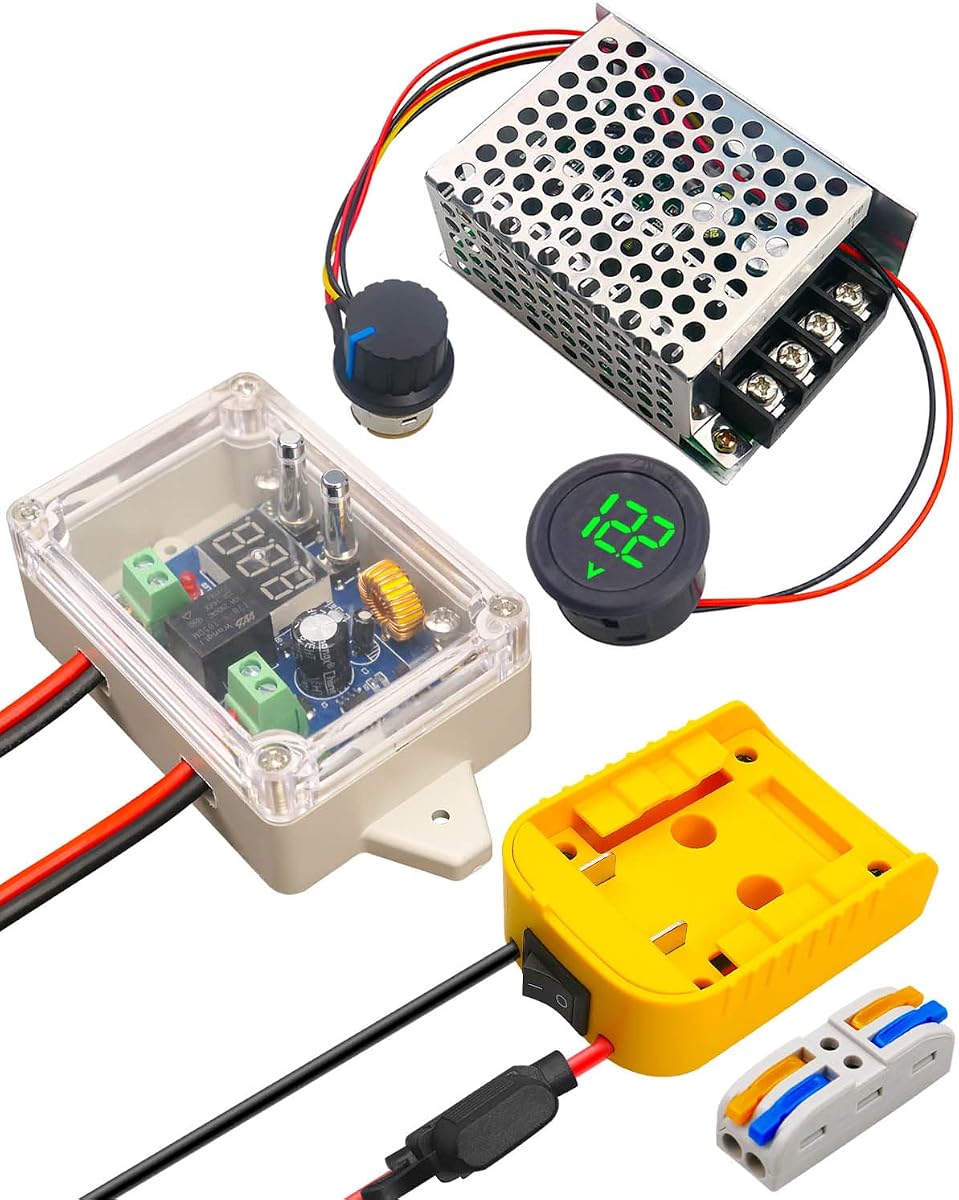
This Milwaukee M18 kit is designed for builders who want more than a passive connector. It has a 3.7 rating and includes an adjustable low-voltage protection module, a DC PWM motor controller, a voltage display, a 30A fuse, and a wire terminal. The package is aimed at ride-on conversions, RC trucks, robotics, and similar 18V-powered projects.
We may earn a commission when you buy through this link, at no additional cost to you.
The PWM controller is especially relevant to motorized builds because it provides a way to manage speed rather than merely supplying raw battery power. A voltage display helps the operator observe output conditions, while the protected low-voltage module is designed to disconnect the circuit after the selected minimum voltage is reached. The external junction-box style enclosure adds physical protection around the circuit board.
Its most important limitation is current. The manufacturer warns that the board's micro-relay and thin wire traces should not operate above 8A, with a maximum of 10A below 12V. It also requires every device in the circuit to support 18V input. Those restrictions make the kit less suitable for heavy startup loads or systems designed around a regulated 12V supply.
The kit makes sense for a moderate-current M18 robotics or RC project where speed control, voltage visibility, and automatic low-voltage shutdown are desired. Check every motor and controller for 18V tolerance, measure expected current, and keep within the stated limits before installation.
The included PWM controller is the defining feature for RC-style builds. It allows speed adjustment through the supplied control and can make vehicle behavior easier to tune during a bench test.
The relay and trace layout impose a lower operating limit than the included fuse may suggest. Current-sensitive projects should use a different solution or stay comfortably within the documented ceiling.
We may earn a commission when you buy through this link, at no additional cost to you.
This DeWalt 18V and 20V ride-on car kit combines a battery adapter with several control and protection components. Its 3.9 rating reflects a versatile package aimed at jeeps, trucks, other ride-on platforms, and DIY projects. Buyers receive an adjustable low-voltage protector, voltage display, DC PWM motor controller, 30A fuse, and fast terminal.
We may earn a commission when you buy through this link, at no additional cost to you.
The adjustable protector is the core safety feature. It can be set to a minimum operating voltage and power off the circuit when that threshold is reached. Its protective shell is intended to reduce exposure to water, debris, and dust, which is useful for outdoor ride-on vehicles that may encounter dust, splashes, or changing weather.
Motor speed adjustment, output-voltage viewing, and current protection make this more than a basic plug-in adapter. However, the kit introduces multiple components that must be wired correctly, and every connected device must be suitable for the battery voltage. Users should not treat the fuse as permission to exceed the relay's actual current rating.
This is a strong candidate for a DeWalt-based ride-on build that needs motor control and automatic battery cutoff. It is less suitable for a simple connection where the owner wants minimal wiring or for equipment that cannot tolerate the pack's nominal voltage.
The covered low-voltage module helps shield sensitive electronics from common contaminants. A sealed installation still matters, so position the enclosure away from standing water and route wires where they cannot be pinched.
The included controller, display, fuse, and terminal reduce the need to source each component separately. The package is therefore most attractive to builders planning a controlled ride-on conversion rather than a quick bench lead.
We may earn a commission when you buy through this link, at no additional cost to you.
This Dewalt adapter is one of the strongest all-around choices in the group. It has a 4.7 rating and supports a broad range of 18V and 20V DCB packs, including the DCB200, DCB201, DCB203, DCB204, DCB205, and DCB206. The simple design is centered on dependable power delivery, an inline switch, and 12 AWG wiring.
We may earn a commission when you buy through this link, at no additional cost to you.
Its connector slides into the battery groove and locks into position, making installation more approachable than a complex multi-module system. The adapter also has two fixing holes for attachment to a chassis, machine, or project enclosure. Heat-resistant 12 AWG silicone copper wire supports the stated twenty-amp maximum current and gives builders a substantial conductor for motorized applications.
Protection is handled by an inline switch and a 30A fuse holder with a rubber cover. This is not a low-voltage cutoff system, so a user who relies heavily on automatic shutdown may prefer one of the adjustable-protection kits. It is also only an output adapter: it does not charge the battery or regulate the voltage, and the ride-on equipment must tolerate the battery's output.
The kit is a strong recommendation for most Dewalt 18V or 20V Power Wheels conversions, particularly when straightforward installation, a high-current path, and manual on-off control are priorities. Verify polarity, secure the fuse holder, and remove the battery during extended storage to prevent unintended drain.
The battery-slot design makes the adapter approachable for first-time builders. Twelve AWG wire and a stated twenty-amp capacity provide a practical foundation for motors, lights, robotics, and other moderate-power projects.
The inline switch lets the user stop the circuit without immediately removing the battery. It is a useful feature during setup because it allows a quick shutdown before troubleshooting polarity or motor direction.
We may earn a commission when you buy through this link, at no additional cost to you.
This Milwaukee M18 adapter brings a strong 4.6 rating and a direct approach to ride-on and robotics projects. It fits a long list of 18V M18 batteries, including the 48-11-1815, 1820, 1828, 1840, 1850, and 1860 families. Its heat-resistant ABS connector locks into the battery and releases when the battery buckle is pressed.
We may earn a commission when you buy through this link, at no additional cost to you.
The electrical path uses heat-resistant 12 AWG silicone copper wire, and the product is rated for a maximum current of 20A. An inline switch makes it possible to turn the circuit off without removing the battery, while the covered fuse holder protects the blade fuse from debris and accidental contact. Two screw holes allow secure mounting to a project chassis.
Like the other pass-through adapters, it outputs the battery voltage directly and does not provide automatic low-voltage shutdown. That distinction matters for builders who want their vehicle to stop before a pack becomes deeply discharged. It is also important to remember that an 18V battery is not a regulated 12V source, so motors, controllers, lights, and accessories must tolerate the pack's voltage range.
This adapter is a compelling choice for an M18-powered RC vehicle, robot, work light, or ride-on toy that needs a straightforward high-current connection. It offers fewer advanced controls than the PWM kits, but that simplicity is often beneficial for builders who want reliable power without a complex circuit.
Support for numerous M18 battery models means owners are less likely to replace their existing battery ecosystem. The locking connector also helps prevent a loose fit during movement on a ride-on vehicle.
The adapter passes battery power directly, which keeps the design efficient and uncomplicated. Confirm that all connected equipment accepts 18V nominal power before testing the system.
We may earn a commission when you buy through this link, at no additional cost to you.
This two-adapter set gives DeWalt users a practical way to service more than one vehicle or project. It holds a 4.6 rating and fits the same broad family of 18V and 20V DCB batteries listed by the manufacturer, including the DCB200 through DCB206 models. Each adapter uses a locking battery-slot connection and heat-resistant ABS construction.
We may earn a commission when you buy through this link, at no additional cost to you.
The included twelve AWG silicone wire is rated for a maximum current of 20A, while each fuse holder has a rubber cap and the set contains six 30A blade fuses. Two wire terminals are also provided. These extras make the package useful for builders who expect to replace a fuse, build more than one ride-on conversion, or keep a spare adapter ready for another vehicle.
The trade-off is that the kit remains a direct-output design without adjustable low-voltage protection, PWM motor control, or a voltage display. It is therefore less suitable for projects where precise battery-state monitoring is central. Users must also ensure that every load is designed for the voltage supplied by the DeWalt battery.
The set is best for someone who values two ready-to-build adapters, broad battery compatibility, and extra fuse coverage. It may be more than a single-project owner needs, but for a workshop, two ride-on vehicles, or paired battery-powered projects, the arrangement provides useful redundancy.
Two units make it easier to work on separate vehicles or keep a replacement on hand. The repeated fuse and terminal hardware also supports maintenance over time.
The stated twenty-amp path is suitable for many hobby motors and ride-on accessories. Verify startup current, particularly for larger motors, and keep all connections secure.
We may earn a commission when you buy through this link, at no additional cost to you.
This two-pack Dewalt 20V conversion kit is a flexible workshop option with a 4.6 rating. It supports the 18V and 20V DCB battery range, including the DCB200, DCB201, DCB203, DCB204, DCB205, and DCB206, and uses a close-fitting connector designed to remain stable during use.
We may earn a commission when you buy through this link, at no additional cost to you.
Safety and convenience come from 30A fuses, rubber-covered fuse holders, heat-resistant 12 AWG wiring, and an inline switch. The package also includes two adapters, two wire terminals, six fuses, four screws, and four drywall anchors. Including mounting hardware is helpful because the adapter's two fixing holes can be used to secure it to a wall, panel, or project frame.
This is a pass-through battery adapter rather than a voltage regulator. It does not reduce 18V or 20V to a fixed 12V, and it does not automatically disconnect when the battery reaches a chosen low-voltage threshold. Any motor, controller, lamp, or accessory must be compatible with the battery output. For a 12V-only ride-on system, a regulated step-down converter is the more suitable option.
The kit is well suited to DeWalt owners with two vehicles, several DIY power projects, or a need for a spare. Its combination of locking connectors, ample wiring, switch control, and mounting hardware makes it a practical general-purpose conversion option.
The included screws and anchors allow the adapter to be secured without locating separate hardware. Use the mounting points to prevent the connector and wire junction from moving during vehicle operation.
Two complete adapters make this an efficient choice for paired builds. A spare can also reduce downtime if a connector or adapter needs replacement during troubleshooting.
We may earn a commission when you buy through this link, at no additional cost to you.
The Ryobi 18V adapter earns the highest rating in this roundup at 4.8, combining broad battery compatibility with a straightforward, protected design. It supports numerous P102 through P109, PBP002 through PBP006, P189 through P197, BPL-1820G, BPL-1815, and BPL-18152 battery models.
We may earn a commission when you buy through this link, at no additional cost to you.
The adapter slides into the battery groove and locks securely, with a release action on the battery buckle. Heat-resistant ABS plastic, 12 AWG silicone copper wire, an inline switch, and a rubber-covered 30A fuse holder provide a practical foundation for ride-on toys, RC cars, work lights, and robotics. The stated maximum permissible current is 20A.
Its limitations are important but easy to understand. This converter does not regulate the output or automatically protect against deep discharge, so connected equipment must accept an 18V-class source. It is also not a charger. The red lead must meet the device's positive input and the black lead must meet the negative input, or the connected electronics may be damaged.
This is an excellent choice for Ryobi owners who want a direct, uncomplicated battery conversion with good current capacity and hardware protection. It is particularly useful for 18V-compatible robots and hobby vehicles. Confirm polarity, secure every splice, and use the switch whenever the project is being worked on.
The broad model list is a major practical advantage for builders who own different packs over time. A secure groove-and-lock connection also helps the converter remain attached while a vehicle moves.
The switch and covered fuse provide basic control and current protection in a design that is easy to understand. Automatic low-voltage shutdown is absent, so battery condition still needs attention.
We may earn a commission when you buy through this link, at no additional cost to you.
This DeWalt 20V adapter kit focuses on adjustable protection and motor control, though its 3.5 rating is the lowest among the products reviewed. It supports common 18V and 20V DCB batteries and includes a low-voltage protector, a 30A fuse, a DC motor controller, and a voltage display.
We may earn a commission when you buy through this link, at no additional cost to you.
The adjustable protector disconnects the system when battery voltage reaches the selected minimum, helping avoid over-discharging a pack. Its upgraded enclosure is described as waterproof and dustproof, which improves protection for outdoor trucks, robots, and ride-on cars. The PWM controller provides speed and switching, and the display shows output voltage during operation.
The main concern is the current ceiling created by the board's miniature relay and thin traces. The manufacturer says current should not exceed 8A, so the included 30A fuse should not be interpreted as permission to draw that amount. This makes the kit better suited to smaller motors and electronics than high-current ride-on systems.
Buyers who want automatic shutdown, visible voltage, and speed adjustment will appreciate the feature set. Before installation, calculate the expected current, confirm that every device supports 18V, and set the cutoff according to the battery type. Disconnect power promptly when the protection threshold is reached.
The adjustable low-voltage threshold is useful for projects that might otherwise continue drawing from a depleted pack. Correct calibration is essential, so test the setting before relying on it during normal operation.
Speed adjustment and voltage visibility make this useful for RC trucks and robots. The eight-amp limit should guide motor selection and prevent the controller from being asked to handle loads beyond its design.
We may earn a commission when you buy through this link, at no additional cost to you.
This is the only kit in the group expressly designed to convert DeWalt 18V or 20V battery power into a stable 12V output. It carries a 4.3 rating, supports the common DCB battery family, and states a maximum output current of 20A with 240W output power.
We may earn a commission when you buy through this link, at no additional cost to you.
Its smart chip provides low-voltage, over-voltage, over-current, short-circuit, overload, and overheat protection. A 30A fuse adds protection against current peaks, and the converter automatically shuts off when the input battery falls below 15.2V. The yellow lead is positive and the black lead is negative, so correct polarity is especially important.
Compared with a pass-through adapter, the step-down design is better suited to legacy 12V ride-on electronics, LED lighting, fans, and other accessories that need a predictable supply. The tradeoff is additional circuitry, which introduces efficiency losses and heat. Users should provide airflow and avoid enclosing the converter in a sealed space during demanding use.
This kit is a strong choice when a 12V system must run from a DeWalt battery. It combines regulation, automatic cutoff, and several protection functions, although builders should still verify startup current and monitor heat under sustained load.
A stable 12V output is valuable for equipment designed for that voltage rather than a full 18V or 20V range. It also simplifies adding conventional 12V accessories to a cordless-tool battery project.
Multiple automatic safeguards address over-current, short circuits, overload, and over-discharge. These protections are valuable, but they do not replace correct polarity, sound wiring, or reasonable load selection.
We may earn a commission when you buy through this link, at no additional cost to you.
The right converter depends on battery platform, output voltage, motor current, protection needs, and the amount of installation work you are prepared to do. Compare the electrical demands of your ride-on vehicle before choosing a connector or control kit.
Begin with the exact battery interface and family used by your project. DeWalt, Milwaukee M18, and Ryobi 18V batteries are not physically or electrically interchangeable, and the listed model numbers provide a useful starting point for confirming fit. Even within one family, verify that the connector seats fully and that the release mechanism works properly. A close-fitting locking connection is important on a ride-on vehicle because road vibration and repeated movement can loosen a poor connection.
A direct adapter outputs the battery voltage and offers little or no regulation. That is appropriate when the motor controller, lights, and other devices are designed for an 18V or 20V source. If the existing Power Wheels system requires 12V, choose a regulated step-down converter rather than assuming that an 18V pack can safely replace a 12V lead-acid battery. Check motor tolerances, lighting requirements, and the voltage expected by any preinstalled controller.
Steady operating current is only part of the calculation. A large ride-on motor may draw a much higher surge when starting, while multiple accessories can add to the total demand. Compare the converter's stated current capacity with the combined load and allow suitable headroom. The kits with PWM boards and micro-relays require particular caution because their relay contacts and thin trace layout impose a lower ceiling than the installed fuse rating.
Low-voltage protection disconnects the project when the battery reaches a selected minimum, helping prevent damaging over-discharge. A fuse provides a separate layer of protection against excessive current. Kits that combine both are especially useful for unattended robots or ride-on vehicles that may continue operating after a pack has lost substantial charge. Protection is not a substitute for correct wiring, so select the threshold according to the battery chemistry and test the circuit before normal use.
Twelve AWG silicone copper wire provides a robust path for high-current hobby projects, while secure crimps or terminals reduce resistance and heat. Look for clear positive and negative conductors, a covered fuse holder, and an inline switch that can be reached during troubleshooting. The adapter should be mounted so that wires do not rub against sharp chassis edges, and every solder or crimp connection should be mechanically supported. Good wire gauge alone cannot compensate for a loose terminal.
A PWM motor controller can make a converted RC truck or ride-on vehicle easier to tune by providing adjustable speed. A voltage display adds visibility during testing and helps identify a low battery or an unexpected voltage change. These controls are most useful for robotics and hobby vehicles where the builder will regularly adjust behavior. If you only need a reliable power connection, a simpler pass-through adapter may be easier to install and fewer components to troubleshoot.
Battery-slot adapters are generally quick to mount, while kits with displays, PWM controllers, and low-voltage modules require more careful wiring. Check whether the product includes screw holes, fasteners, wire terminals, and replacement fuses. Consider access to the inline switch and whether the converter can be fixed inside the chassis without blocking ventilation. A regulated converter needs more space and airflow than a basic connector because it processes power and produces heat during operation.
Indoor RC vehicles and robots generally face less exposure than outdoor ride-on cars, work lights, and conversion projects near dust or rain. A protected low-voltage module and covered fuse holder provide better environmental resilience, but no electronics should be left submerged or installed where it cannot dry. For high-heat locations, use heat-resistant wiring, secure contacts, and airflow around any voltage-regulation or switching module. Outdoor projects also benefit from a reachable manual disconnect.
Before installation, disconnect the ride-on vehicle's original battery and confirm the adapter's positive and negative leads against the device wiring. If the project requires 12V from an 18V or 20V pack, use the step-down converter; otherwise, verify that every motor and controller can tolerate the battery output. Set an adjustable low-voltage cutoff before connecting the main load, and choose that threshold according to the battery manufacturer's guidance.
Mount the adapter securely, route the twelve AWG leads away from moving parts and sharp edges, and make sure the fuse holder and switch remain accessible. Connect the terminals with the correct polarity, inspect every crimp or solder joint, and keep the fuse in its holder during the first test. Start with the vehicle wheels lifted or the drive system disengaged, then verify switch operation, motor direction, voltage display readings, and the low-voltage shutdown behavior before lowering the vehicle.
During use, keep the connector and wiring dry, and do not exceed the converter's documented current or voltage limits. Remove the battery when the project will sit unused for an extended period, particularly when it has an electronic display or low-voltage controller. Inspect the fuse, wires, connector, and terminals periodically, replace damaged parts immediately, and allow any regulator or switching module to remain ventilated. If a fuse blows repeatedly, correct the underlying load or polarity problem rather than fitting a higher-rated fuse.
Only if the converter properly regulates the battery output to 12V. A basic pass-through adapter supplies the battery's higher voltage and is better suited to equipment designed for an 18V or 20V input. A 20V-to-12V step-down converter is the appropriate choice for stable 12V operation, provided its current capacity covers the vehicle's motor and accessory loads.
No. The listed adapters are power-output devices that draw electricity from a compatible cordless-tool battery; they do not recharge that battery. The battery should be removed during long storage to prevent unintended discharge. Any charging should be performed with the battery's original compatible charger.
A kit that includes a DC PWM motor controller is the most appropriate for a robot or RC platform that needs adjustable speed. The Milwaukee M18, DeWalt ride-on, and DeWalt voltage-controller kits include this type of control. Compare their current limits carefully because a PWM module with a micro-relay may be limited to eight amps during operation.
The 30A fuse is intended to interrupt excessive current before the wiring or connected equipment experiences a severe overload. It does not guarantee that every component can safely carry 30A, and it does not override a lower operating limit specified for a relay or circuit board. Investigate the cause whenever the fuse blows rather than replacing it with a higher rating.
The required modification depends on the original connector, vehicle controller, and selected adapter. Most kits provide a battery-side adapter plus terminals and wiring, while some vehicles require removal of the old battery plug and reconnection of the switched positive and negative leads. Follow the adapter instructions, preserve the vehicle's power switch where possible, and avoid cutting a cable until its length and routing have been planned.
The cutoff threshold must be appropriate for the specific battery chemistry and model. Setting it too high can interrupt operation while useful charge remains, while setting it too low can permit damaging over-discharge. If the adapter's threshold cannot be calibrated confidently, use the battery manufacturer's guidance and test the converter with the intended load before relying on automatic shutdown.
A lack of movement commonly indicates reversed polarity, a loose connector, an incorrectly installed fuse, or a disconnected motor lead. Begin with the inline switch and battery seating, then verify positive-to-positive and negative-to-negative connections. If the motor runs in reverse, power down before changing the controller direction rather than swapping high-current leads casually.
A universal-style connector can power compatible 12V accessories, work lights, RC toys, and robots if their voltage and current ratings are appropriate. DeWalt, Milwaukee M18, and Ryobi adapters are not interchangeable between battery ecosystems. The same adapter may also be reused across projects, provided the connector and wiring are undamaged and the load stays within the published limits.
The top selections cover three different priorities. The Ryobi 18V adapter leads the group with its 4.8 rating, broad battery-model support, 20A stated capacity, and useful switch-and-fuse protection. The DeWalt 20V switched adapter offers a similarly capable and well-rated direct conversion, while the Low Voltage Protection adapter stands apart with live voltage monitoring, adjustable cutoff, and dual detachable outputs.
For most builders, the deciding factor is not the number of included components but electrical fit. Confirm the battery family, required voltage, motor startup current, and mounting method first. A direct adapter is appropriate for 18V- or 20V-tolerant equipment, while a regulated step-down converter is the better match for a stable 12V ride-on system. Automatic low-voltage protection is especially valuable for builds that may run unattended.
Finally, check the current product listing, included components, compatibility list, and published electrical limits before ordering. Listings and technical details can change, and the battery is not included with the listed kits. Verifying those details against your vehicle reduces the likelihood of an incompatible purchase and makes the installation safer and more predictable.