
Renogy 12V 200Ah Core Mini
5.0Editor score
Compact enclosure for tight installations
200A BMS with temperature cutoff
IP65 waterproof and vibration resistant
Compatible with remote monitoring
Our 200Ah LiFePO4 Battery guide compares ten options for cycle life, power output, expandability, protection, and fit in RVs, solar, marine, and backup systems.
A 200Ah LiFePO4 battery is a substantial upgrade for RVs, boats, solar storage, and off-grid power systems, but the best choice depends on more than nominal capacity. Battery size, BMS amperage, low-temperature protection, expansion limits, and monitoring features can determine whether a model fits your installation.
We compared all ten options using the supplied specifications, focusing on usable energy, deep-cycle ratings, protection features, physical dimensions, supported applications, and expansion potential. The list includes traditional 200Ah models, a compact design, a dual-100Ah configuration, and a higher-capacity 280Ah alternative.
Each review highlights the circumstances in which a particular battery makes the strongest case, while calling attention to ambiguities or limitations in the available information. Ratings and specifications may evolve, and current prices change frequently, so verify the latest listing and compatibility details before purchasing.
5.0Editor score

5.0Editor score
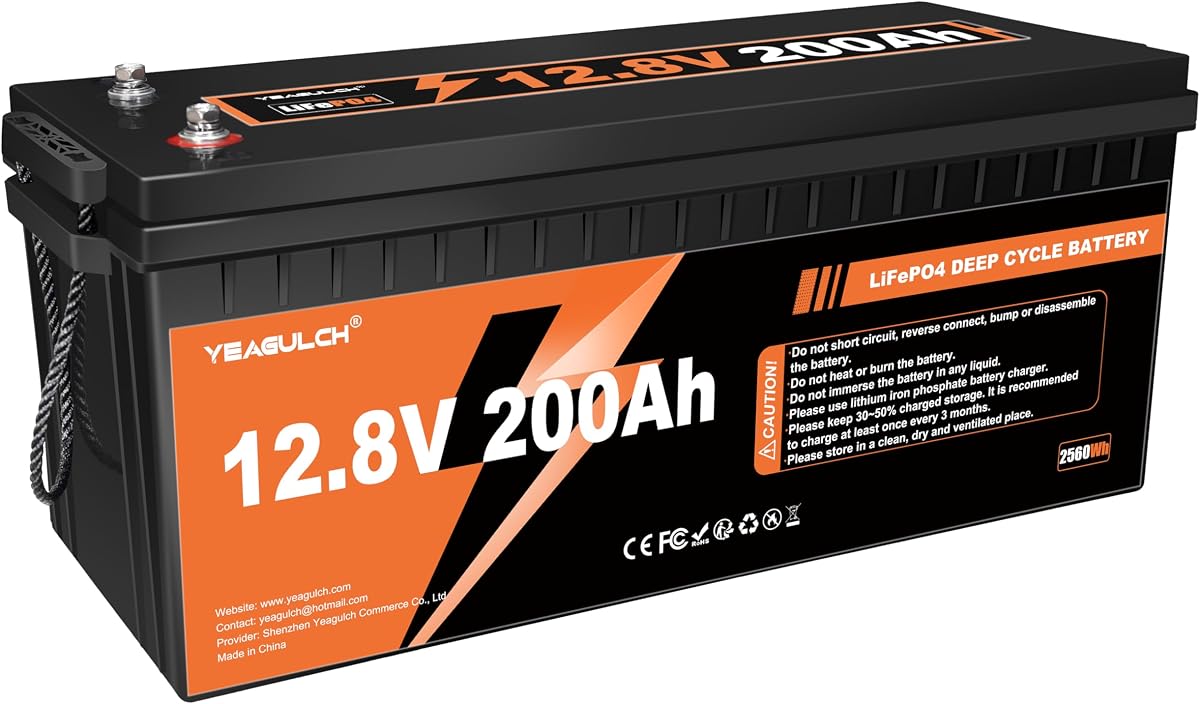
4.6Editor score
This side-by-side comparison highlights each battery's rated capacity, protection hardware, cycle claims, and expansion potential. Because several listings use different terminology or package two smaller batteries together, it is important to confirm the actual electrical configuration before ordering.





This 12V 200Ah LiFePO4 battery combines a 4.6 rating with one of the broadest expansion allowances in the group. Its 200A built-in BMS is designed for deep-cycle duties, while the listed 2560Wh-class capacity makes it relevant to RV appliances, solar storage, trolling motors, and home backup systems where weight is a concern.
We may earn a commission when you buy through this link, at no additional cost to you.
The standout feature is its flexible configuration. Up to four batteries can be connected in series for a 48V system, while four can be combined in parallel for 800Ah at 12V. The listing states that this setup can provide approximately 10.24kWh of usable energy, which is useful for installers who may need more capacity later without changing the fundamental battery format.
Cycle claims are unusually high, reaching 4000 cycles at 100% depth of discharge, 6000 at 80%, and up to 15000 at 60%. That makes disciplined charging and controlled discharge especially important if the goal is to approach the longer-life figures. The included protections cover overcharging, overdischarging, overcurrent, overheating, and short circuits, along with temperature cutoffs.
This is a strong recommendation for buyers seeking a conventional 200Ah deep-cycle battery with generous expansion options and no need for app-based monitoring. It is explicitly not intended for car starting, engine starting, or golf-cart use, and the manufacturer advises charging and discharging it at least once every six months to maintain health during prolonged inactivity.
The ability to move from one 12V 200Ah unit to four-series or four-parallel configurations gives this battery unusual installation flexibility. Verify wire gauge, BMS compatibility, and charge-controller settings before enlarging a bank.
A 200A BMS covers the major electrical fault categories, but cycle longevity still depends on suitable charging voltage, temperature management, and regular use. The different cycle figures depend on depth of discharge.
We may earn a commission when you buy through this link, at no additional cost to you.
DUMFUME's 12V 200Ah model offers a detailed protection specification and an especially large expansion ceiling. It carries a 4.4 rating, a 200A continuous smart BMS, IP65 enclosure protection, and certification for UL and UN38.3, making it a credible option for installations that require more than a single standalone battery.
We may earn a commission when you buy through this link, at no additional cost to you.
Its clearest advantage is the 4S4P configuration. Up to 16 units can be combined into a nominal 51.2V, 800Ah system with 40.96kWh of stated energy. The BMSes use a uniform communication protocol for synchronized operation, a relevant detail when building a bank intended to behave as one coordinated storage system.
Temperature handling is also thorough. Discharge is rated down to minus 20°C, charging stops below 0°C, and charging resumes after the internal temperature reaches 5°C. Fast overcurrent and short-circuit response are listed alongside exact overcharge and overdischarge cutoffs, giving installers useful technical benchmarks.
The trade-off is that the low-temperature protection makes cold-weather charging more involved. A user who leaves the battery outdoors through freezing conditions must warm it before charging rather than expecting the system to operate as a lead-acid battery. This model is best for large RV, solar, marine, and off-grid banks where its expansion and protection details outweigh the need for integrated Bluetooth monitoring.
Few options support as many units as the stated 4S4P arrangement. That makes this model attractive for installers designing a modular system with substantial future capacity rather than a small, fixed bank.
The battery protects cells by preventing charging below 0°C. In cold regions, plan charging around the specified temperature threshold rather than relying on an unattended solar controller.
We may earn a commission when you buy through this link, at no additional cost to you.
HumsiENK's 200Ah battery targets demanding loads, with a stated 3200W continuous output and a 250A BMS. The 4.6 rating reflects a well-rounded specification sheet, including 2560Wh maximum energy, full depth-of-discharge capability, 6000 to 15000 stated cycle options, and a claimed recharge time of 3.33 hours.
We may earn a commission when you buy through this link, at no additional cost to you.
The higher 250A BMS and output rating distinguish it from most competitors, whose integrated systems are commonly rated at 200A or 150A. This makes the model interesting for RV users running refrigerators and other AC appliances together, as well as for solar inverters, UPS systems, and high-demand off-grid equipment.
Its 4S4P expansion also reaches 40.96kWh. Physical dimensions are 20.53 by 9.37 by 8.69 inches, which is wider and slightly taller than several other 200Ah choices, so compartment measurements are important before installation.
The trade-off is the lack of listed Bluetooth or app monitoring. Users must check state of charge through compatible meters or other system instrumentation. Even so, the combination of high output, 250A protection, a five-year warranty, and broad application support makes this a persuasive choice for power-hungry RV and stationary-storage users who prioritize output over compact dimensions.
A 3200W continuous rating provides more headroom than the typical 200Ah deep-cycle configuration. Actual inverter and motor performance still depends on wiring, converters, and the load's starting demands.
The battery's 9.37-inch width may be more restrictive in narrow marine compartments or RV trays. Compare available space with the complete dimensions before finalizing the installation.
We may earn a commission when you buy through this link, at no additional cost to you.
This 12V 200Ah battery stands out with a 5.0 rating, 2560Wh energy, 100% stated depth of discharge, and integrated Bluetooth monitoring. It is the most balanced choice in the group for users who want meaningful remote visibility without adding a separate monitoring module.
We may earn a commission when you buy through this link, at no additional cost to you.
The smartphone application reports state of charge, voltage, current, and battery temperature. More than 20 BMS protections cover overvoltage, undervoltage, overcurrent, short circuits, and high- and low-temperature charging conditions. The IP65 enclosure is also suitable for RV compartments, boats, and outdoor solar installations where dust and water exposure are concerns.
Its cycle claim is more conservative than those of several competitors: over 4000 cycles at 100% depth of discharge. That is still a strong figure, and it may be more useful to buyers who regularly use a larger portion of nominal capacity rather than only a small fraction.
Expansion supports both series and parallel arrangements, including 24V and 48V systems up to four in series. This is the best general recommendation for RV, marine, solar, and off-grid users who value easy monitoring, extensive protection, and a straightforward 200Ah package. It is not for engine starting, and cold charging must be managed around the stated cutoff.
Built-in Bluetooth provides a convenient view of state of charge, voltage, current, and temperature. This is especially valuable for hidden battery compartments and remote solar installations.
The combination of IP65 ingress protection and a broad BMS protection suite makes the battery appropriate for demanding environments. Sealing and mounting still need to follow the manufacturer's instructions.
We may earn a commission when you buy through this link, at no additional cost to you.
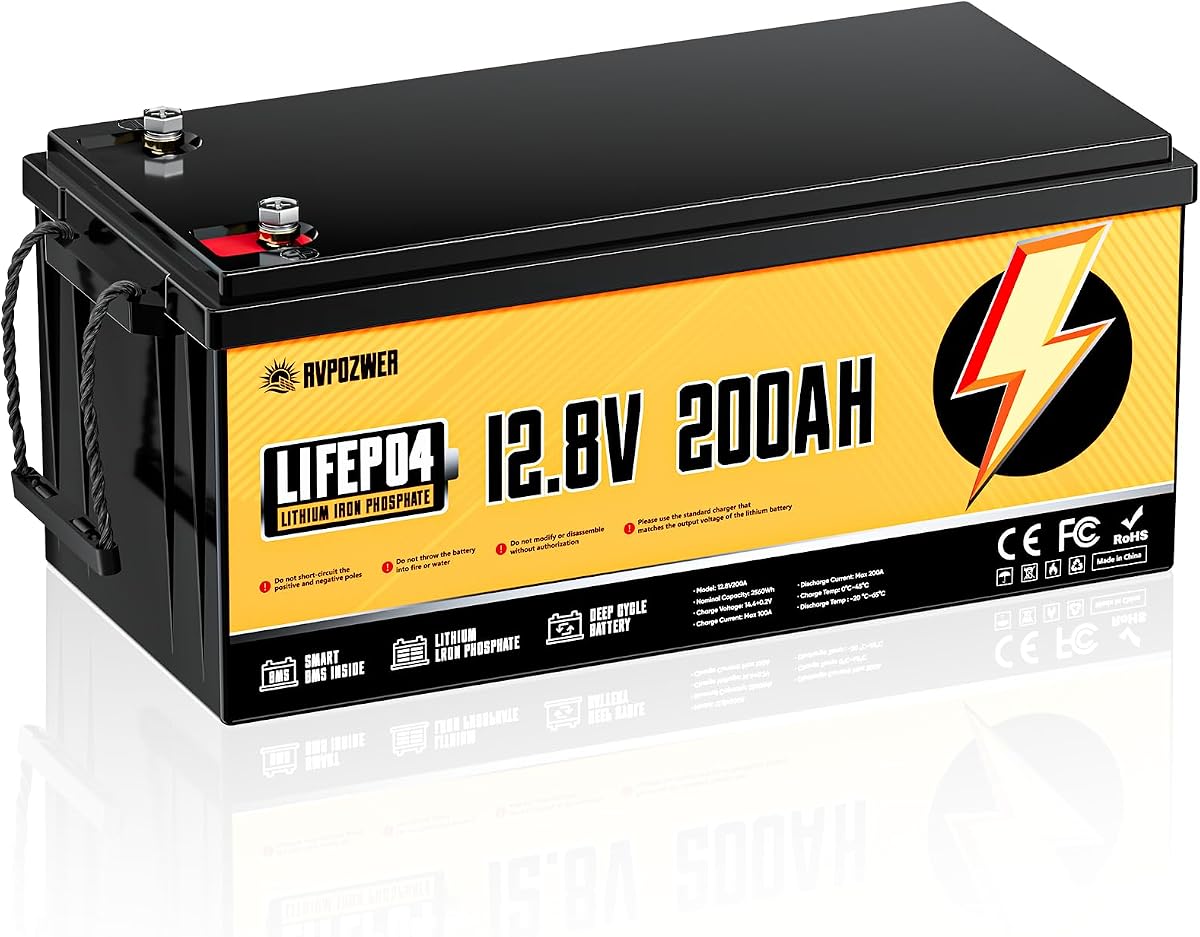
Rvpozwer's battery combines a 200Ah rating with a 4.0 user rating, a 200A smart BMS, and a stated operating range from minus 20°C to 65°C. Its appeal lies in straightforward deep-cycle specifications, a carry handle, and compatibility with RV, marine, solar, and backup applications.
We may earn a commission when you buy through this link, at no additional cost to you.
The cycle ratings follow a common pattern: 4000 cycles at 100% depth of discharge, 6000 at 80%, and as many as 15000 at 60%. The battery can connect with up to four units in series or parallel, allowing 24V through 48V systems or larger 12V capacity banks.
The 4.0 rating is the lowest among these ten listings, so prospective buyers should pay particular attention to the current review details and warranty terms. The specification sheet does not mention Bluetooth monitoring, which makes it less convenient than the app-enabled alternatives.
This model is best for mobile and off-grid users who need a portable 200Ah battery with a wide temperature specification and conventional expansion. It also suits buyers who prefer not to manage an app. The final decision should balance the lower user rating against the support, warranty, and practical features that matter in the planned installation.
The stated minus 20°C to 65°C operating range covers many camping, boating, and seasonal installations. Confirm the required charging profile and observe local safety guidance in extreme conditions.
Without listed app connectivity, users will need another meter or monitoring arrangement to check charge status. That simplicity can be desirable for permanently installed systems.
We may earn a commission when you buy through this link, at no additional cost to you.
Renogy's Core Mini is built around a straightforward proposition: retain 200Ah of deep-cycle capacity while reducing the footprint compared with a standard 200Ah lead-acid battery. It has a 5.0 rating, an upgraded 200A BMS, a 380A peak discharge figure, and IP65 water and dust protection.
We may earn a commission when you buy through this link, at no additional cost to you.
Its compact enclosure is the defining advantage for RVs, boats, and off-grid cabinets where every inch matters. A 200A BMS protects against overcharge, overdischarge, overcurrent, and short circuits, while the cold-weather system prevents charging below 32°F and discharging below minus 4°F.
The battery is also designed to withstand outdoor vibration, making it relevant to road and marine use. Global safety certifications include FCC, UN38.3, ROHS, and UKCA, and the product is backed by a five-year limited warranty.
Its main limitation is that remote monitoring is not integrated. Compatibility with the Renogy 300A Battery Shunt enables status, voltage, and current monitoring through the Renogy App or Renogy One Core Monitor, but those are additional components. For buyers who prioritize space, outdoor durability, strong peak output, and established-brand support, the Core Mini is the premium choice in this roundup.
The mini format addresses one of the persistent problems with large lithium batteries: fitting a useful amount of storage into a crowded compartment. Measure the full battery, including terminals and cable bend radius.
A listed 380A peak discharge rating provides margin for trolling motors and other loads with elevated startup demand. Sustained output remains constrained by wiring, controllers, and the inverter or motor electronics.
We may earn a commission when you buy through this link, at no additional cost to you.
HQST's offering is listed as a 2 by 100Ah configuration reaching 200Ah, with a 4.5 rating, an integrated LED meter, and Group 22NF dimensions. The description also discusses 21-pound 100Ah batteries and 1280Wh output, so buyers should carefully confirm whether the package includes two separate batteries and how they are intended to be connected.
We may earn a commission when you buy through this link, at no additional cost to you.
The separate 100Ah units may be easier to handle and install than one large 200Ah case. They can be combined in parallel for 200Ah, 300Ah, or 400Ah capacity, while series connections can create 12V, 24V, 36V, or 48V banks. The listing states support for up to 16 batteries in a combined arrangement and a capacity of 20.48kWh.
The continuous discharge rating is listed at 100A, lower than the 150A to 250A BMS ratings found among the other 200Ah-class options. This makes the HQST package more appropriate for steady RV, cabin, and solar loads than for demanding motor starting or unusually high inverter demand. It is also explicitly unsuitable for golf carts.
Temperature protection prevents charging below 23°F or above 140°F and stops discharge below 5°F or above 158°F. With a 4.5 rating and a ten-year service commitment, this is an attractive modular option, provided the buyer resolves the listing's capacity and package details before installation.
Separating the stated capacity into two 100Ah units can make transport, positioning, and replacement easier. Both units must still be installed as a coordinated matched pair.
The title and bullet points use 200Ah, 2 by 100Ah, 2560Wh, and 1280Wh. Confirm the number of physical batteries, their individual ratings, and the required parallel connection before ordering.
We may earn a commission when you buy through this link, at no additional cost to you.
Power Queen targets RV, trailer, camping, fishing, and backup users with a 200Ah battery rated at 2560Wh. Its 4.5 rating is supported by a specification set that includes more than 20 BMS protections, IP65 dust and water resistance, and salt-spray protection for marine environments.
We may earn a commission when you buy through this link, at no additional cost to you.
Its listed energy density of 56Wh per pound and weight of approximately one-third that of comparable lead-acid batteries are meaningful for mobile installations. The battery is also rated for more than 4000 cycles at 100% depth of discharge, with automotive-grade LiFePO4 cells described as its core technology.
Expansion is broad. Up to 16 batteries can be configured in a 4P4S arrangement for a 48V, 800Ah system with 20.48kWh of stated energy. The listing also mentions a 20.48kW load figure, but actual deliverable power will depend on the inverter, parallel arrangement, current limits, and wiring.
This is a strong choice for marine and mobile users who need rugged protection but do not require smartphone monitoring. Fast technical help, around-the-clock online service, and a 10-year service-life statement add support. Buyers should still use matched batteries from the same production run when expanding a bank.
Salt-spray resistance differentiates this model for coastal and marine use. It complements, rather than replaces, sound mounting, corrosion-resistant hardware, and appropriate ventilation.
The stated 56Wh per pound helps explain the weight savings over lead-acid. That density advantage is especially useful in RVs, trailers, and boats with strict payload limits.
We may earn a commission when you buy through this link, at no additional cost to you.
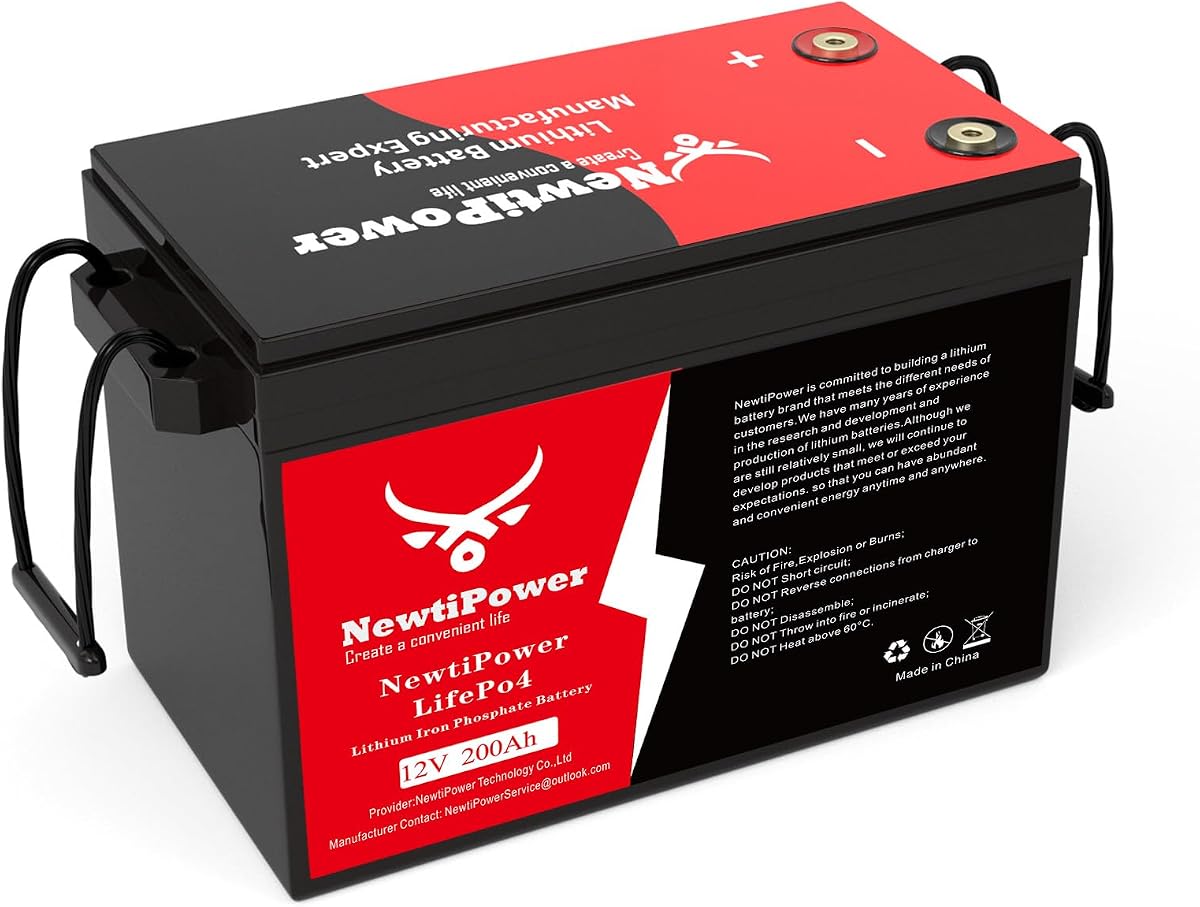
NewtiPower's 200Ah LiFePO4 battery is distinctive for its 150A BMS, 1920W maximum load claim, and unusually broad 6S6P expansion. It carries a 4.2 rating and uses A+ lithium cells, with the listing stating that actual capacity is more than 200Ah in its testing configuration.
We may earn a commission when you buy through this link, at no additional cost to you.
Supporting up to six batteries in series produces nominal systems at 24V, 36V, 48V, 60V, or 72V. Six in parallel can expand capacity to 1200Ah. That flexibility makes the battery interesting for solar arrays, larger marine systems, and off-grid installations designed around uncommon high-voltage battery walls.
The 150A BMS protects against overcharging, overdischarging, overcurrent, and short circuits. It is adequate for many deep-cycle duties, though it is lower than the 200A and 250A systems offered by several competitors, and it is the principal limitation for particularly high-current loads.
This model is best for installers who prioritize unusual series-voltage flexibility, compact installation, and a stated capacity guarantee. A ten-year warranty is available following serial-number activation, and the manufacturer notes more than a decade of industry involvement. Confirm that the charger, inverter, and electrical components support the selected system voltage.
Six-series support can simplify some high-voltage solar or stationary systems that do not align with four-battery configurations. Every connected device must be designed for the resulting nominal and charging voltages.
The listing promises a return or compensation if the battery falls short of its stated capacity. Warranty activation also requires contacting the company and providing the serial number.
We may earn a commission when you buy through this link, at no additional cost to you.
The ECO-WORTHY EnergyRock is a 280Ah model rather than an exact 200Ah alternative, but it offers a larger energy reserve in a reinforced metal case. Its 4.6 rating, Grade A LiFePO4 cells, 200A BMS, Bluetooth monitoring, and mechanical output switch make it worth considering when extra capacity is welcome.
We may earn a commission when you buy through this link, at no additional cost to you.
The metal enclosure is intended to improve heat resistance and fire protection, while internal cell holders and mounting feet help resist shock and road vibration. A one-touch safety switch disconnects the discharge circuit, which can reduce accidental drain during installation or maintenance.
Bluetooth monitoring provides voltage, capacity, and charge or discharge status through an app. The BMS also prevents charging at low temperatures. For charging, the manufacturer recommends a LiFePO4-compatible charger with 14.6V absorption, recommends disabling float, or allows 13.8V float if disabling is impossible, and advises against equalization.
Because it provides 280Ah, it will not match a 200Ah system for parallel capacity calculations unless the system design is adjusted. It is best for buyers seeking more than 200Ah in a durable RV or camper installation, particularly those who value the metal case, switch, and app monitoring.
The reinforced case and mounting feet are designed for shock, vibration, and direct RV or camper installation. Always follow local enclosure and ventilation requirements.
The explicit charging guidance reduces ambiguity. Use a compatible LiFePO4 profile, avoid equalization, and configure the solar controller to the recommended absorption and float settings.
We may earn a commission when you buy through this link, at no additional cost to you.
The best 200Ah LiFePO4 battery is the one that matches your electrical load, installation space, temperature conditions, monitoring needs, and expansion plan. Compare specifications carefully because nominal capacity, usable energy, peak output, and physical packaging can vary substantially.
A 12V 200Ah LiFePO4 battery has a nominal voltage near 12.8V, producing approximately 2560Wh when fully charged under ideal conditions. The real amount available to equipment can differ because of temperature, inverter losses, wiring loss, and the depth to which the battery is discharged. Listings in this roundup generally advertise 200Ah or 2560Wh, but HQST describes a two-100Ah package and ECO-WORTHY offers 280Ah.
Treat watt-hours as the more useful comparison when voltage or battery count differs. Two matched 100Ah batteries in parallel can form a 200Ah bank, while a 280Ah unit changes the system's energy and parallel-current calculations. Confirm the physical number of batteries included and the approved way of connecting them.
Capacity tells you how much energy the battery stores, while current ratings determine how much power it can deliver at once. BMS ratings among the options range from 150A to 250A, and one model states 3200W of continuous output. For inverters, refrigerators, compressors, and trolling motors, the entire electrical path must support the load without creating an unsafe bottleneck.
Peak current is relevant for motor startup, but a high peak rating should not be treated as sustained output. Check converter and inverter continuous ratings, motor surge requirements, cable size, terminal quality, and any manufacturer-recommended fuse. A battery with sufficient energy can still underperform if its electronics or wiring cannot support the intended load.
Cycle claims vary with depth of discharge. Several batteries are rated at 4000 cycles at 100% DoD, 6000 at 80%, and as many as 15000 at 60%. The differing figures show that a shallower daily discharge can extend service life. They are manufacturer claims rather than a guarantee for every installation, and actual results depend on temperature, charging discipline, current, and battery age.
Avoid treating a headline cycle number as a fixed calendar lifespan. A system that regularly uses only part of the stored energy may last longer, while frequent deep discharge, prolonged heat, or prolonged inactivity can shorten it. Review the recommended maintenance schedule, especially for batteries that will sit unused for months.
A quality BMS is the central safety system inside a lithium battery. The products here provide protection against combinations of overcharge, overdischarge, overcurrent, short circuit, overvoltage, undervoltage, and excessive temperature. Several models also specify automatic charging cutoff below 0°C, helping prevent lithium plating when cells are cold.
Cold-weather limits should influence your charging plan. A battery that supports discharge at minus 20°C may still prohibit charging until it warms to a specified level. High-temperature cutoffs and cell balancing are also important in hot RVs, boats, and solar cabinets. Look for a protection system with clear thresholds and confirm that your charger or solar controller is compatible.
Nominal 200Ah capacity does not guarantee identical size. The listed dimensions range from compact models designed to save space to broader cases measuring more than nine inches wide. Measure the compartment, ventilation clearance, terminal orientation, and cable bend space rather than relying only on capacity. The stated weight of the first two options is 58.86 pounds, while the HQST description gives 21 pounds for each stated 100Ah unit.
Weight matters most in RVs, boats, trailers, and golf-cart-like applications where payload is limited. Metal cases may improve impact resistance but add weight compared with some plastic enclosures. Consider whether the battery must be carried into position, stacked, or secured against movement, and use mounting hardware appropriate to the installation.
The available configurations range from four units in series and parallel to the NewtiPower's 6S6P arrangement. Most four-series systems can build a nominal 48V bank, and parallel configurations increase amp-hour capacity. Larger systems can provide substantial usable energy, but each additional battery adds cost, wiring complexity, communication requirements, and failure-management considerations.
Expansion is not simply a matter of connecting cables. Batteries should be compatible, ideally from the same model and production batch, and protected by correctly rated fusing and cable sizes. A high-voltage bank also requires a charge controller, inverter, and loads that support the selected voltage. If future growth is likely, choose a model whose stated architecture matches that plan.
Integrated Bluetooth is available on some models, including the top-rated general-purpose option and the metal-case ECO-WORTHY. Apps can show state of charge, voltage, current, temperature, or operating status, reducing the need to open an enclosure or connect a multimeter. This is valuable in hidden RV compartments and remote solar installations.
Other batteries rely on a built-in LED meter, compatible external monitoring equipment, or a separate battery shunt. The Renogy Core Mini supports the Renogy 300A Battery Shunt and its monitoring ecosystem, but it does not include a Bluetooth module. Decide whether convenient phone monitoring justifies added electronics or whether basic meter readings are sufficient.
Outdoor and mobile installations expose batteries to water, dust, vibration, and impact. Several models carry an IP65 rating, while Power Queen also lists salt-spray protection and ECO-WORTHY uses a reinforced metal case with internal holders and mounting feet. These attributes can improve durability, but they do not make the battery immune to every environment.
Follow the installation instructions, secure terminals, use compatible connectors, and provide any required ventilation. Saltwater, standing water, high heat, and direct sun can still reduce service life. A physically rugged case is valuable, but electrical compatibility and correct mounting remain equally important to safe operation.
Before installation, confirm that the charger, solar controller, inverter, and loads use a LiFePO4-compatible charge profile. A typical 12V system may use a 14.6V absorption setting, but users should follow the battery manufacturer's recommendations, disable equalization, and observe the specified float setting. Use properly rated cables, secure the terminals, and install suitable circuit protection.
Mount the battery in a stable, ventilated location away from direct heat and water. Account for cable movement and vibration in vehicles and boats. Do not use these deep-cycle batteries for engine starting unless the manufacturer explicitly authorizes that use. For trolling motors, follow the listed guidance on steady speed, cable gauge, terminal tightness, and avoiding reverse operation.
To preserve battery health, keep it within the intended temperature range, avoid leaving it deeply discharged, and recharge it with a compatible system. The first product in the roundup recommends charging and discharging at least once every six months to prevent damage from disuse. Periodically inspect connections, check the state of charge, and confirm that Bluetooth or other monitoring readings remain consistent.
A 12.8V 200Ah LiFePO4 battery stores approximately 2560Wh when fully charged. The amount available to a load is lower after conversion losses, wiring losses, temperature effects, and the depth of discharge used. For system planning, compare the battery's watt-hour rating with your equipment's measured daily consumption rather than relying only on the 200Ah label.
Yes, when the model supports the intended arrangement and all batteries are compatible. Series connections raise voltage, while parallel connections raise amp-hour capacity. Match battery models and production batches, size cables and fuses correctly, and use equipment designed for the resulting voltage. Do not mix lithium and lead-acid batteries in the same bank unless a purpose-built conversion system explicitly supports it.
The batteries in this roundup are deep-cycle models, and several listings explicitly prohibit engine, car, or golf-cart starting use. They may provide substantial stored energy, but cranking engines requires high surge current and a charging system designed for the chemistry. Use a dedicated starting battery for that task and reserve deep-cycle LiFePO4 batteries for appliances, trolling motors, solar storage, and backup loads.
Charging a lithium battery while its cells are too cold can cause lithium plating, which may permanently damage capacity. The BMS therefore blocks charging below the specified threshold, commonly 0°C or 32°F, and some models resume only after warming to a higher temperature. Use a charger or solar controller with temperature compensation, and allow the battery to warm before charging.
It can be well suited to an RV because it offers high usable energy at a much lower weight than a comparable lead-acid battery. The best choice depends on available space, expected appliance loads, inverter size, venting requirements, and whether you need Bluetooth monitoring. Measure the compartment and confirm that the battery's terminals and dimensions fit the installation.
Yes, use a charger designed for LiFePO4 chemistry with the correct charge voltages and disabled equalization unless the manufacturer specifically permits it. A lead-acid charger with an aggressive equalization stage can be harmful. Match the charger's current and power to the battery bank, and confirm that its temperature compensation works with the installed BMS.
Two matched 100Ah batteries wired in parallel can behave as a 200Ah bank, while four such 100Ah batteries would provide 400Ah. Parallel connections increase capacity without increasing nominal voltage, but both units should be the same model and age. The HQST listing in this roundup describes a two-100Ah package, so buyers should verify the included hardware and parallel requirements.
Store it in a safe, temperature-appropriate location and avoid leaving it deeply discharged for long periods. Follow the manufacturer's maintenance guidance, which may include charging and discharging the battery at least once every six months. Before reconnecting a stored battery, inspect it for physical damage, verify terminal condition, and confirm that its BMS and charging system are operating correctly.
The strongest all-around choice is the 12V 200Ah Bluetooth Battery because it combines a 5.0 rating, 2560Wh energy, extensive protections, IP65 protection, and convenient app monitoring. The Renogy Core Mini stands out as the premium compact option, while the first 200Ah model in the ranking offers the best blend of cycle potential, a 200A BMS, and flexible expansion.
Prioritize the details that match your installation: usable watt-hours, continuous and peak output, temperature limits, enclosure dimensions, expansion architecture, and monitoring. Deep-cycle use requires a compatible charger, sound wiring, correct fusing, and regular maintenance. If a listing contains conflicting capacity descriptions, confirm the actual package with the seller before ordering.
Ratings, product specifications, availability, and prices can change over time. Review the current Amazon listing, manufacturer documentation, warranty terms, and user feedback before making a final purchase, especially when building a multi-battery system.