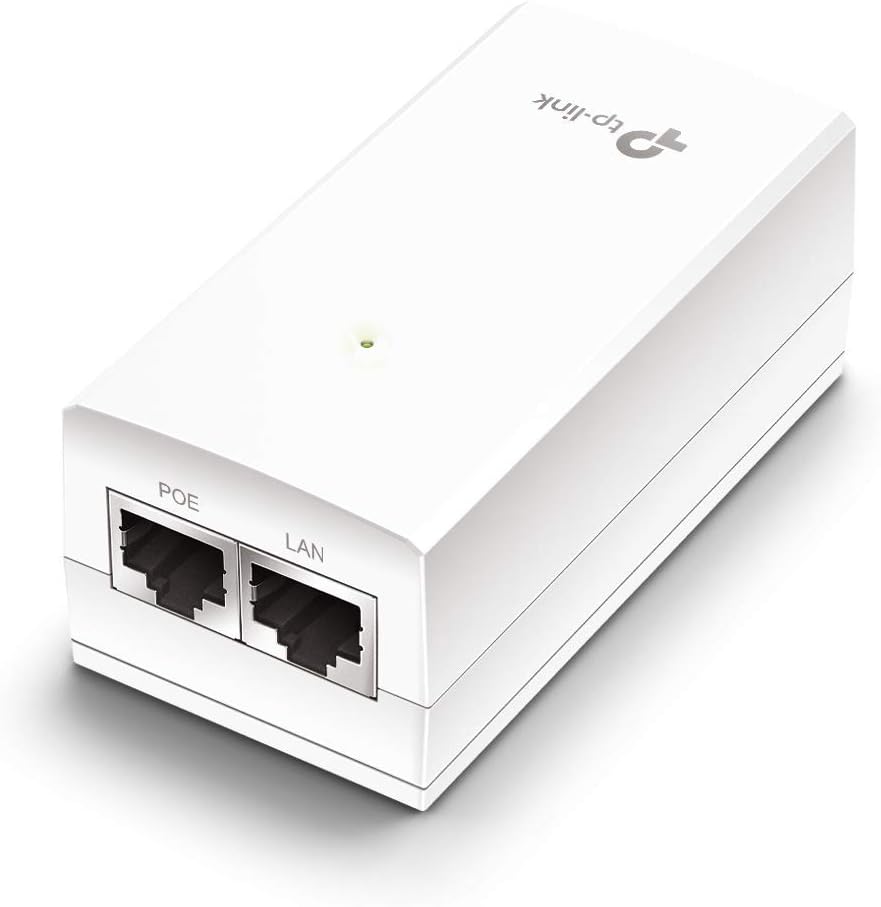
Omada 24V PoE Injector POE2412G
4.4Editor score
24V passive PoE support
Automatic power requirement detection
Gigabit speed support
Convenient wall-mount design
Our expert guide compares 10 Gigabit POE Injector Adapters for power output, standards, range, installation, and compatibility to help you choose.
Gigabit POE Injector Adapters add power and network connectivity to devices that need PoE while allowing the adapter to connect to an existing non-PoE Gigabit port. A well-matched injector can simplify camera, access point, IP phone, and other network deployments where installing a nearby outlet is inconvenient.
We compared the ten injectors in this guide using the specifications and feature information supplied for each model. The evaluation considers supported PoE standards, maximum power output, Gigabit port configuration, transmission distance, mounting options, automatic power detection, and the types of devices each adapter is designed to support.
Each review identifies the product's strongest use case while noting relevant limitations and compatibility requirements. The list includes standard PoE, PoE+, passive PoE, and high-power PoE++ options, so readers can match the adapter to the device, cable run, and deployment environment. Availability and pricing can change.
4.4Editor score

4.7Editor score

4.5Editor score
The comparison highlights power standards, maximum output, Gigabit connectivity, range, and notable installation features so buyers can quickly narrow the field before reviewing the detailed recommendations.


The Omada POE160S is a straightforward Gigabit PoE+ injector that combines a 30W maximum power budget with a single-cable power and data connection. Its supplied rating is 4.6, placing it among the stronger choices in this roundup. It is designed to turn an existing non-PoE Gigabit connection into a source of IEEE 802.3af and 802.3at power for cameras, access points, and other compatible endpoints.
We may earn a commission when you buy through this link, at no additional cost to you.
The most important strength is its balanced feature set. It includes one Gigabit Ethernet input and one Gigabit Ethernet output, allowing a non-PoE switch or router to pass data while the injector adds the required electrical power. Auto Detect technology supplies up to 30W to a PoE+ device and remains backward compatible with 802.3af devices that require up to 15.4W. That makes it a practical option when a deployment includes both standard PoE and PoE+ equipment.
Installation is uncomplicated because the unit operates as a plug-and-play adapter. No software installation or configuration is required, and the injector can deliver power and data as far as 100 meters, or 328 feet. The trade-off is that its 30W ceiling is well below the output offered by the PoE++ models in this guide. Buyers should also confirm that the endpoint uses a compatible PoE standard, since the injector is intended for PoE devices rather than independent power and data arrangements.
This is our Editor's Choice because it covers the most common installation requirements without introducing unnecessary complexity. It suits installers who need reliable Gigabit throughput, backward compatibility, and a moderate power budget in a single adapter. Cameras, wireless access points, and typical PoE+ network devices are the strongest candidates for consideration.
Auto Detect adjusts the available output to match the connected device, supporting up to 30W for PoE+ and up to 15.4W for 802.3af equipment. This is useful when a single network includes endpoints with different power requirements.
The injector supports runs of up to 100 meters while carrying Gigabit data and power together. That simplifies deployments where the camera or access point is located away from a convenient power outlet.
We may earn a commission when you buy through this link, at no additional cost to you.
This generic Gigabit PoE+ Injector Powerline Network Adapter offers a 30W maximum output and full IEEE 802.3af and 802.3at compliance. It carries a 4.6 rating and is designed for IP cameras, VoIP phones, wireless access points, and other endpoints that receive both data and power through Ethernet.
We may earn a commission when you buy through this link, at no additional cost to you.
Auto-sensing technology selects an appropriate power level for the connected equipment. The injector provides up to 15.4W for standard PoE and up to 30W for PoE+, while its Gigabit input and output ports preserve a full-speed wired path. An integrated power supply means the unit can be connected to an outlet without relying on a separate external power brick.
The main limitation is explicitly stated in the supplied information: the product supports PoE devices and PoE cameras, not cameras with separate data and power connections. Equipment should not draw more than 30W. The red output-load light is described as normal during output, while the green light indicates that power is on. These status behaviors are worth noting so users do not mistake normal operation for a fault.
This adapter is a sensible choice for users who want a straightforward 802.3af/at solution with a 100-meter reach. It is particularly relevant to camera and access-point installations where replacing the existing non-PoE switch is inconvenient and the endpoint is known to accept combined PoE power and data.
The unit illuminates green when power is on and may show red while delivering a load, which the supplied information identifies as normal. These indicators provide basic confirmation of operating state.
Support for both 802.3af and 802.3at allows the adapter to serve standard PoE and higher-power PoE+ endpoints. Auto-sensing reduces the need to manually adjust the output for each device.
We may earn a commission when you buy through this link, at no additional cost to you.
The TRENDnet TPE-115GI is a Gigabit PoE+ injector with a supplied rating of 4.7, tying for the highest rating among the products reviewed. It provides one Gigabit Ethernet input, one PoE+ Gigabit Ethernet output, and up to 30W of power, making it a well-rounded choice for cameras, wireless access points, and other standard PoE+ equipment.
We may earn a commission when you buy through this link, at no additional cost to you.
Its installer-friendly details distinguish it from simpler compact adapters. The housing is wall-mountable, LED indicators confirm PoE connectivity, and auto-sensing technology delivers the appropriate output for 802.3at and backward-compatible 802.3af devices. The supported connection distance extends to 100 meters, and full-duplex 2Gbps aggregate Ethernet speeds are specified for the port pair.
TRENDnet also states that the injector is NDAA and TAA compliant for government customers in the United States and Canada, supported by three years of manufacturer protection and English-speaking technical support. These details do not change the core electrical function, but they can matter for institutional, public-sector, or professionally managed installations. Its limitation is power ceiling: a 30W output is appropriate for conventional PoE+ endpoints, not the most demanding 802.3bt devices.
The TPE-115GI is recommended for installers who want traditional PoE+ output, a durable mounting option, visible status indicators, and organizational purchasing support. It is a strong all-around selection for a camera, access point, or IP phone where the endpoint requires up to 30W and the run can remain within 100 meters.
A wall-mountable enclosure and connectivity LEDs make the injector easier to integrate into managed installation environments. The design supports both practical placement and quick visual troubleshooting.
The stated NDAA and TAA compliance in the United States and Canada may help buyers working on government-oriented projects. Three years of manufacturer protection and technical support add institutional reassurance.
We may earn a commission when you buy through this link, at no additional cost to you.
The Omada POE2412G is a 24V passive PoE injector rated at 4.4. Its maximum output is 12W, positioning it as a practical solution for lower-power devices that support the appropriate 24V passive arrangement. Unlike models focused exclusively on 802.3af and 802.3at, passive PoE compatibility gives it a different and potentially useful place in a mixed network toolkit.
We may earn a commission when you buy through this link, at no additional cost to you.
The injector automatically determines the necessary power requirements, reducing configuration work when connected to a compatible low-power endpoint. It also supports Gigabit speed and offers a convenient wall-mounting design. Operation is plug-and-play, so no software or network configuration is required after the Ethernet and power connections are made.
The key trade-off is the 12W limit. This is below the 30W commonly associated with PoE+, so it should not be assumed to support higher-consumption access points, cameras, or phones. Passive PoE also requires especially careful verification because the device's voltage and power requirements must align with the injector. Checking the endpoint documentation before buying is more important here than it would be with a fully standards-compliant auto-negotiating model.
This is our Best Budget pick because it addresses a narrower need efficiently: bringing 24V passive PoE and Gigabit data to a compatible light-load device. It is a good option for knowledgeable users extending a network to a specific supported endpoint, while the 30W models are safer general choices when device requirements are not fully known.
The unit is designed to determine the connected device's necessary power requirements automatically. This reduces setup friction while still making correct endpoint compatibility essential.
Support for 24V passive PoE gives this injector value when a specific endpoint requires that arrangement. It is not a general substitute for a 30W 802.3at injector.
We may earn a commission when you buy through this link, at no additional cost to you.
The BV-Tech 30W Gigabit PoE+ Injector is designed to deliver up to 30W at 54V to IEEE 802.3at and 802.3af devices over runs as long as 328 feet. Its 4.4 rating reflects a dependable feature set aimed at IP cameras, CCTV equipment, wireless access points, and IP phones.
We may earn a commission when you buy through this link, at no additional cost to you.
Automatic detection identifies connected Ethernet terminals and helps ensure that low-power devices receive only the power they need. Gigabit performance is provided through 10/100/1000Base-T support, preserving compatibility across different wired network environments. The unit is also Level VI energy efficient, an important consideration for deployments where the injector remains energized continuously.
Mounting flexibility is another strength. Integrated wall-mount slots allow the injector to be secured in a suitable location, while the listed interlocking feature supports organized multi-unit installations. The limitation is that 30W is the maximum, so power-hungry 802.3bt devices exceed its capability. Buyers should also verify the device's voltage and connection requirements even though automatic protection is included.
The BV-Tech injector is a solid selection for a conventional PoE+ camera or phone deployment that values efficiency, long reach, and flexible mounting. It is especially attractive for multi-device installations where a neat wall-mounted arrangement is important and the endpoint's requirements remain within the 30W and 54V capability.
Level VI energy-efficiency compliance is a useful distinction for an adapter that may remain connected around the clock. It also aligns with buyers who want to minimize unnecessary standby consumption.
Interlocking features and integrated wall-mount slots help keep multiple injectors arranged neatly. That can simplify cable management in camera rooms, communications cabinets, and other shared installation spaces.
We may earn a commission when you buy through this link, at no additional cost to you.
The Gigabit PoE++ Injector is a 60W-capable adapter that supports 802.3at PoE+, 802.3af PoE, and backward compatibility for passive PoE devices. Its supplied 4.6 rating makes it one of the stronger all-around options, particularly for users who want more headroom than a conventional 30W injector offers.
We may earn a commission when you buy through this link, at no additional cost to you.
It has one Gigabit input and one PoE++ Gigabit output, with up to 2Gbps full-duplex Ethernet speeds across the port configuration. Automatic detection identifies PoE and non-PoE equipment, supplies appropriate power to compliant endpoints, and is described as powering off non-standard equipment for protection. The internal AC/DC converter eliminates the need for a separate external power brick.
There are two qualifications. First, a 60W ceiling is not sufficient for every 802.3bt endpoint, so higher-power devices may require the TRENDnet TPE-119GI reviewed later. Second, backward compatibility for passive PoE does not remove the need to verify voltage, polarity, and power requirements. The claimed protection features make the injector more reassuring, but correct matching remains the safest installation practice.
This model is recommended for power-hungry access points, advanced cameras, or other compatible PoE++ devices that do not need the full 95W output of the top premium model. Its integrated converter, automatic detection, and broad standard compatibility make it a versatile middle ground for mixed installations.
The 60W maximum provides meaningful headroom over 30W PoE+ injectors without reaching the 95W offered by the TPE-119GI. That middle range is useful for many modern endpoints with elevated power requirements.
An internal AC/DC converter removes the external power brick, while automatic detection handles compliant equipment and protects against non-standard PoE connections.
We may earn a commission when you buy through this link, at no additional cost to you.
The TRENDnet TPE-119GI is the highest-output injector in this roundup, supplying up to 95W to 802.3bt PoE++ devices. It also supports conventional PoE at up to 15.4W and PoE+ at up to 30W, giving it broad compatibility within one unit. Its supplied rating is 4.5.
We may earn a commission when you buy through this link, at no additional cost to you.
The device interface consists of one Gigabit data input and one Gigabit PoE++ output. Auto-sensing technology delivers the correct wattage for the attached endpoint, which is particularly valuable when switching between standard and high-power devices. A 100-meter connection distance and a sturdy wall-mount metal enclosure support professional placement in demanding installations.
The main limitation is that its advanced capability may be unnecessary for ordinary cameras, phones, and access points. A buyer paying for 95W output without a compatible high-power endpoint gains little functional benefit. It is also important to distinguish this model from a standard 30W PoE+ injector: its broader output range is a genuine feature, but it is intended for equipment that actually needs greater power.
We recommend the TPE-119GI for modern 802.3bt deployments, high-end network equipment, or installations where one injector must accommodate devices spanning standard PoE through PoE++. The enclosure, auto-sensing, and high output make it our Best Premium selection for users who prioritize maximum headroom and installation flexibility.
Supporting PoE, PoE+, and PoE++ lets a single adapter serve multiple device classes. Auto-sensing selects the appropriate output and reduces manual configuration.
The metal enclosure and wall-mount design are suited to organized permanent installations. The injector can support long runs while retaining access to Gigabit data.
We may earn a commission when you buy through this link, at no additional cost to you.
The 30W 48V Gigabit PoE+ Injector provides a familiar 30W power budget, 1000Mbps data throughput, and IEEE 802.3af/at compatibility. Its supplied 4.5 rating makes it a credible general-purpose option for conventional PoE and PoE+ deployments.
We may earn a commission when you buy through this link, at no additional cost to you.
The adapter uses one Gigabit Ethernet input and one PoE/PoE+ Gigabit Ethernet output. Auto-sensing supplies up to 30W to a PoE+ device and remains backward compatible with 802.3af equipment at up to 15.4W. A single Ethernet run can carry data and power as far as 100 meters, helping place network cameras and access points where a local outlet is unavailable.
Its compact, flame-retardant plastic housing is a notable physical characteristic. The listed applications are broad, including CCTV cameras, IP phones, wireless access points, 802.11n/ac/ax routers, network attached storage, and smart TVs. Compatibility still depends on the endpoint accepting the appropriate PoE arrangement; the long application list should not be read as a guarantee that every device will negotiate correctly.
The model is best suited to users who need a compact 30W adapter for a compatible mainstream endpoint. It offers straightforward installation and broad device categories without the complexity of a high-power PoE++ model. Choose it when the endpoint's power and standards requirements are known and conventional PoE+ output is sufficient.
The small flame-retardant plastic housing is easy to position near the connected endpoint. Its size also suits installations where a larger high-power injector would be unnecessary.
The stated use cases span surveillance, voice, wireless networking, storage, and smart displays. The common requirement is an endpoint that accepts compatible PoE power over Ethernet.
We may earn a commission when you buy through this link, at no additional cost to you.
The REOLINK RLA-PI1 is a Gigabit injector intended to convert a non-PoE port into a PoE+ connection. It carries a 4.7 rating, tying the highest rating in the guide, and is specifically recommended for REOLINK PoE IP cameras, video doorbells, and floodlight cameras.
We may earn a commission when you buy through this link, at no additional cost to you.
The adapter supplies up to 30W to PoE+ devices and up to 15.4W to standard PoE devices. Power and data travel over one Ethernet cable for distances of up to 100 meters. This makes it convenient when a REOLINK endpoint needs to be positioned beyond the reach of the existing non-PoE switch or in a location without an accessible outlet.
Its primary trade-off is specialization. Although the technical functions are suitable for many standard PoE endpoints, the supplied compatibility information emphasizes REOLINK products, including compatible NVRs. Buyers outside that ecosystem should verify their device requirements rather than assuming identical support. The 30W maximum also means it cannot meet the needs of 802.3bt equipment requiring a PoE++ budget.
The RLA-PI1 is a strong recommendation for a REOLINK surveillance installation that includes a non-PoE network port. It reduces cabling complexity by removing the need for a separate power cord at each camera and offers an easy plug-and-play arrangement for widely separated endpoints.
Sending power and data through one cable reduces the need to run separate power leads to cameras, video doorbells, and floodlight cameras. That makes remote placement within the 100-meter limit much easier.
The injector handles up to 30W for PoE+ and up to 15.4W for standard PoE. This allows it to cover two common endpoint power classes in a compatible REOLINK environment.
We may earn a commission when you buy through this link, at no additional cost to you.
The TP-Link TL-PI30G is a conventional Gigabit PoE+ injector designed to add power to an existing non-PoE switch or device. With a supplied rating of 4.5, it offers the familiar combination of one Gigabit input, one Gigabit output, IEEE 802.3af/at compliance, and up to 30W of power.
We may earn a commission when you buy through this link, at no additional cost to you.
Auto Detect technology supplies up to 30W to a PoE+ endpoint while maintaining backward compatibility with 802.3af devices that use up to 15.4W. The injector can deliver both power and data as far as 100 meters, or 328 feet, and does not require software installation or configuration.
This is a focused solution rather than a high-power model. Devices with 802.3bt requirements will need a PoE++ injector, and passive-only equipment may not work with the standard 802.3af/at design. As with any injector, the connected endpoint must support the same method of power delivery; simply having an Ethernet connector does not make a device PoE compatible.
The TL-PI30G is a sensible final recommendation for a camera, access point, or IP phone with standard PoE requirements. It suits users who value a recognizable, uncomplicated adapter, a 100-meter reach, and a 30W power budget without needing the additional features or output of premium PoE++ models.
The adapter is installed by connecting the network side and PoE endpoint, then applying power. It adds PoE capability without requiring configuration software or a replacement switch.
Auto Detect accommodates both 802.3at PoE+ endpoints and 802.3af PoE equipment. Users still need to verify that the endpoint requires no more than the available output.
We may earn a commission when you buy through this link, at no additional cost to you.
The right injector depends primarily on endpoint power requirements, PoE standards, cable length, and installation environment. Reviewing those factors before comparing models helps prevent an expensive compatibility mistake or an underpowered deployment.
PoE standards describe how an injector and powered device negotiate power and how much electricity can be delivered. IEEE 802.3af devices generally operate within a 15.4W budget, while IEEE 802.3at PoE+ devices may require up to 30W. IEEE 802.3bt expands the range to higher-power PoE++ equipment, with the TRENDnet TPE-119GI supporting up to 95W and the generic PoE++ injector supporting up to 60W. Passive PoE is a separate arrangement, and the Omada POE2412G specifically supports 24V passive PoE up to 12W. Checking the endpoint documentation before selecting an adapter is essential because a connector alone does not establish compatibility.
A device's stated power consumption should remain within the injector's available output. Several models support up to 30W, which covers many conventional PoE+ cameras, phones, and access points, but the output allowance also needs to account for the standard's specified power budget. The 12W Omada POE2412G is intended for light-load passive devices and is not a substitute for a full 30W adapter. The two PoE++ options provide more headroom for modern equipment. Always use the manufacturer's maximum requirement rather than an average consumption figure, since startup loads and accessory requirements can affect the total.
Most of the selected injectors use one Gigabit Ethernet input and one Gigabit output, creating a path from a non-PoE network port to a powered endpoint. This arrangement allows data and power to share one Ethernet cable while preserving a Gigabit-class connection. The port count matters because an injector is not a multiport switch. Users with several distant endpoints generally need one injector per powered device, unless the upstream device already supplies PoE. It is also important to preserve the full input-to-output path rather than inserting a lower-speed device that could constrain network performance.
Most products in this guide support combined power and data transmission up to 100 meters, equivalent to 328 feet. That figure should be treated as the maximum supported run, not a target with no margin. Longer or poorly terminated cable runs can introduce signal and power issues, particularly when a device draws close to the maximum output. Map the route from the switch or router to the endpoint, account for vertical drops and cable routing, and keep the total run within the stated limit. If the endpoint must be farther away, a mid-span or endpoint-powered PoE switch arrangement may be more appropriate than a single injector.
Auto Detect and auto-sensing features help the injector identify the connected device and provide an appropriate power level. The Omada POE160S, the generic Gigabit PoE+ adapter, the TRENDnet TPE-115GI, the PoE++ injectors, the 30W 48V model, the REOLINK unit, and the TL-PI30G all include some form of automatic power handling. This is particularly helpful in mixed deployments. It does not make every endpoint compatible, however. Passive PoE devices, unusual voltage requirements, and equipment needing more power than the injector provides still need careful manual verification.
An injector may sit beside the endpoint, near the upstream switch, or in a network cabinet. The TP-Link and Omada options emphasize plug-and-play use, while the TRENDnet TPE-115GI, TPE-119GI, and Omada POE2412G include wall-mounting features. The BV-Tech model provides wall slots and an interlocking feature for organized multi-unit setups. The generic 30W 48V model uses compact flame-retardant plastic, while the TPE-119GI has a metal enclosure. Choose based on available space, cable reach, ventilation, and whether the injector will remain exposed to impact or difficult environmental conditions.
LED indicators can make troubleshooting much faster by showing when power is active, a load is being supplied, or PoE connectivity has been established. The TRENDnet TPE-115GI uses LEDs to confirm PoE connectivity, while the generic Gigabit PoE+ powerline adapter displays a green power light and may show red during output. The generic PoE++ injector also includes power and PoE output indicators. These details are particularly valuable when multiple endpoints are spread across a building or installed without continuous technical supervision. The supplied information describes red output on the generic 30W adapter as normal, so users should consult the corresponding guide before assuming a fault.
For professional or institutional installations, warranty coverage and technical support can be as important as the electrical specifications. The TRENDnet injectors include three years of manufacturer protection and English-speaking technical support. Their supplied information also identifies NDAA and TAA compliance in the United States and Canada, which may matter for government-oriented projects. The BV-Tech injector is also listed as NDAA compliant. Buyers should consider these provisions when the adapter will be deployed in a managed environment, but should still verify current compliance documentation for the exact model and project.
Begin by identifying the upstream non-PoE Gigabit port and the endpoint that will receive power. Read both devices' documentation to confirm the required PoE standard, voltage, polarity, and maximum power. For a standards-based injector, connect the Ethernet data input to the non-PoE switch or router and the Ethernet output to the PoE endpoint. Keep the total cable route within the supported distance and avoid introducing unnecessary adapters or couplers.
Connect the injector's power lead to a suitable outlet, then allow the status indicators to settle. Verify that the endpoint receives power and establishes a network link. If the device does not start, disconnect it, confirm that it is genuinely PoE compatible, and check whether its power requirement exceeds the injector's output. For passive models, recheck voltage, polarity, and the stated current requirement before reconnecting anything.
Position the injector where it will not be pinched, exposed to damaging moisture or heat, or easily disconnected. Use the available wall-mount slots or interlocking features when appropriate, and route the Ethernet cable without creating sharp bends or tension. Periodically inspect connections and indicators. If a unit is hot, repeatedly loses link, or behaves differently from its normal indicators, remove it from service and verify compatibility or replace it as needed.
A Gigabit PoE injector adds electrical power to a network connection that comes from a non-PoE port. It generally has an Ethernet input connected to the switch or router and an Ethernet output connected to the PoE device, allowing data and power to travel over one cable. This is useful when replacing a non-PoE switch is inconvenient or the endpoint is too far from a power outlet.
No. The endpoint must support the same PoE method and voltage as the injector. A standard 802.3af/at model is intended for compliant PoE devices, while a passive injector requires especially careful matching of voltage, polarity, and power requirements. Always consult the endpoint documentation rather than relying only on the shape of its Ethernet connector.
It may be, provided the camera's stated power requirement falls within the injector's 30W output and uses a compatible 802.3at or backward-compatible 802.3af arrangement. Some cameras include heaters, illuminators, motors, or other accessories that increase consumption. Check the manufacturer's maximum requirement and accessories before selecting the injector.
A PoE++ injector is appropriate when the connected device requires more than a conventional 30W PoE+ budget. The 60W model in the guide supports higher-power endpoints, while the TRENDnet TPE-119GI reaches 95W for 802.3bt equipment. Buying a high-power injector for a low-power camera adds cost and complexity without improving that endpoint's performance.
Most products in this guide specify a maximum connection distance of 100 meters, or 328 feet. That distance covers the entire Ethernet run, including vertical drops and routing. Keeping the cable within the stated limit and using sound installation practices helps maintain reliable data transfer and power delivery.
No. The purpose of an injector is to work with a non-PoE switch, router, or network port by adding power between that port and the PoE endpoint. The upstream network still needs to provide the necessary data connection, while the injector provides the electrical power that the endpoint lacks.
Active PoE follows standards such as IEEE 802.3af, 802.3at, or 802.3bt and includes negotiation or sensing behavior. Passive PoE applies a defined voltage and power to a compatible device without the same standardized negotiation process. The Omada POE2412G supports 24V passive PoE, so it should only be used with an endpoint that explicitly matches that arrangement.
The products in this guide are single-port injectors with one network input and one powered output, so each unit is intended to power one endpoint. A multiport PoE switch is the appropriate solution when several devices need power from a central location. Adding unapproved splitters can also create standards, power, and safety issues.
The Omada POE160S and TRENDnet TPE-115GI stand out as strong general-purpose choices for conventional PoE+ deployments, offering up to 30W, Gigabit connectivity, automatic detection, and 100-meter reach. The TRENDnet TPE-115GI adds visible status indicators, a wall-mountable design, and stated procurement support, while the Omada POE2412G serves the narrower role of 24V passive PoE for compatible light-load endpoints.
Priority should be given to the endpoint's requirements rather than the highest available output. Verify the PoE standard, voltage, maximum power, and cable length first. Select a 30W model for ordinary 802.3at equipment, a 60W model for a suitable middle-range PoE++ endpoint, and the 95W TRENDnet TPE-119GI for demanding 802.3bt devices. The REOLINK RLA-PI1 is a focused option for compatible REOLINK surveillance equipment.
Before making a final purchase, compare the current specifications, connector arrangement, indicator behavior, mounting needs, and warranty terms with the exact device being deployed. Availability, promotions, and pricing can change, so checking the latest listing details ensures the selected injector still matches the intended installation.
