
Portable UHF/VHF Frequency Counter
4.1Editor score
VHF and UHF coverage
CTCSS and DCS decoding
Compact handheld design
Battery-powered operation
This guide compares the best frequency counter for ham radio, covering accuracy, frequency range, decoding features, portability, display, and connectivity.
A frequency counter for ham radio helps operators identify transmitting frequencies, inspect radio signals, and troubleshoot equipment with greater confidence. The most useful model combines accurate measurements, sensitive reception, understandable controls, and coverage suited to the bands and equipment you actually use.
We compared ten frequency counters and compact RF instruments using the specifications and product information available for each listing. The list covers portable meters, bare counter boards, multifunction spectrum analyzers, and a GPS-disciplined precision instrument with significantly different capabilities.
Each review explains where a product fits best, along with its practical limitations and ideal operator profile. Ratings reflect the supplied customer feedback, while prices and availability can change, so check the current listing before making a final purchasing decision.
4.1Editor score

4.4Editor score

5.0Editor score
The comparison below highlights the major differences in frequency coverage, measurement purpose, signal decoding, portability, and reference features. It includes dedicated counters for two-way radios, bare counter modules, a portable spectrum analyzer, and a professional precision timing platform.


The Mcbazel Surecom SF401 Plus is a portable frequency counter designed for continuous carrier signals used by two-way radios. Its supplied rating is 4.1, but its stronger appeal comes from the combination of 27MHz-to-3000MHz coverage, selectable ranges, a signal strength indicator, and CTCSS/DCS decoding. It is aimed at radio technicians, club operators, and enthusiasts who want a dedicated counter that is easier to carry than a bench instrument.
We may earn a commission when you buy through this link, at no additional cost to you.
The package supports practical field use with a 144/430MHz antenna, a 400-470MHz UHF antenna, an AC power adapter, and an 11.8-inch USB cable. Four-button control keeps the interface straightforward, while the compact enclosure makes the unit suitable for maintenance work or temporary station setups. Its temperature-compensated crystal oscillator is specified to maintain accuracy within positive or negative 2 to positive or negative 4ppm across a temperature range of -45°C to 65°C.
There are important boundaries. The manufacturer describes the SF401 Plus as a tool for measuring the transmission frequency of walkie-talkies and other continuous carriers, not as a wideband analyzer. It is therefore better suited to confirming a radio's operating frequency and checking basic signal presence than to investigating a broad spectrum of activity or complex digital modulation. The product listing does not provide the same depth of analysis software found in the higher-end instruments in this guide.
This is a convincing choice for a ham operator who primarily works with VHF and UHF two-way equipment and wants frequency, signal strength, and tone decoding in one portable tool. It is less appropriate for HF experimentation, precision oscillator calibration, or detailed spectrum diagnosis. For those everyday tasks it was designed to perform, however, the feature set and field-ready accessory bundle make it a well-rounded recommendation.
The supplied VHF and UHF antennas, power adapter, and USB cable cover the core needs of a portable radio-testing setup. The unit is intended to count continuous carrier transmissions, making it practical for checking programmed frequencies and signal strength around common walkie-talkie bands.
A TCXO-based time base is an important improvement over a simple temperature-sensitive crystal. The stated accuracy varies from positive or negative 2ppm to positive or negative 4ppm between -45°C and 65°C, helping maintain dependable readings in changing environments.
We may earn a commission when you buy through this link, at no additional cost to you.
The Surecom SF401 Plus is another compact counter aimed at two-way radio users, with a supplied rating of 4.3. It measures continuous carrier signals from 27MHz through 3000MHz and adds a signal strength indicator plus CTCSS and DCS decoding. That combination makes it a practical tool for identifying the operating frequency and squelch signaling of compatible handheld radios.
We may earn a commission when you buy through this link, at no additional cost to you.
Its straightforward design reduces the learning curve. Selectable ranges cover many common two-way radio frequencies, while four-button operation and a small housing support use in a vehicle, radio shop, club room, or field setting. The temperature-compensated crystal oscillator is specified to deliver accuracy within positive or negative 2 to positive or negative 4ppm over temperatures from -45°C to 65°C.
The limitation is scope. This is a frequency meter for continuous carrier transmissions, not a general spectrum analyzer. It will not replace a wideband instrument when the objective is to observe many signals, inspect a crowded band, or examine complex digital waveforms. Likewise, its user interface and measurement focus are less suited to advanced timer or phase analysis.
Choose the Surecom SF401 Plus if you need a portable counter for VHF/UHF radio work and value a favorable 4.3 rating along with tone decoding. It is particularly attractive for operators who want a simple dedicated frequency counter without the complexity of a touchscreen analyzer. Those needing HF coverage, detailed spectrum views, or precision timing should look elsewhere in this comparison.
Four-button operation and selectable ranges keep the device focused on routine counter tasks. It is a sensible choice when an operator needs to read a carrier frequency quickly rather than configure a larger analysis platform.
CTCSS and DCS decoding can help identify the squelch signaling used by compatible radios. The signal strength indicator adds context, allowing the displayed frequency to be paired with a simple indication of received level.
We may earn a commission when you buy through this link, at no additional cost to you.
The FC-2800M is a dedicated frequency counter for ham radio, CB, and two-way radio use. It carries a supplied 4.4 rating and stands out for two selectable measurement ranges: 2MHz to 200MHz and 27MHz to 2800MHz. This gives it broader utility than a meter restricted to one conventional ham band, particularly for operators who also maintain VHF, UHF, CB, or DMR equipment.
We may earn a commission when you buy through this link, at no additional cost to you.
A digital mode supports DMR radio frequency measurement, while a built-in CTCSS/DCS decoder helps with common two-way radio signaling. The low-PPM crystal time base is intended to provide high measurement accuracy. Four-button operation keeps interaction manageable, and the compact enclosure is convenient for maintenance benches, mobile kits, and club work rather than requiring a permanently installed laboratory instrument.
This remains a counter, not a full spectrum analyzer. It is designed around frequency measurement of continuous carrier signals and will not offer the broad visual overview, selectable resolution bandwidths, or signal generator found in the TinySA. Buyers who need detailed spectral inspection or advanced frequency references may need a more specialized instrument, even if the FC-2800M is more approachable.
For most operators seeking a compact counter that can handle 2m through 2.8GHz radio signals, the FC-2800M offers one of the most balanced combinations of capability and simplicity in this list. Its strong rating, range options, DMR support, and decoding features make it an excellent general-purpose choice for ham radio and two-way radio maintenance.
The lower 2MHz-to-200MHz range and upper 27MHz-to-2800MHz range cover the 2m band and the larger VHF/UHF spectrum. These choices make the counter more adaptable than models limited to common handheld-radio frequencies.
Digital DMR support and built-in CTCSS/DCS decoding address practical two-way radio work. These features help identify a transmission's frequency and its associated signaling when checking compatible equipment.
We may earn a commission when you buy through this link, at no additional cost to you.
The SEESII TinySA V0.3.1 is a compact spectrum analyzer with a 2.8-inch color touchscreen and a supplied 4.4 rating. Rather than concentrating on a single counter function, it gives ham operators a visual view of RF activity across 100kHz to 960MHz, making it useful for checking band conditions, interference, antenna-related behavior, and more than one signal at once.
We may earn a commission when you buy through this link, at no additional cost to you.
Its dual-range analysis covers 0.1-350MHz and 240-960MHz, with selectable resolution bandwidths from 2.6kHz to 640kHz. A built-in signal generator produces a sine wave from 0.1-350MHz and a square wave from 240-960MHz. An internal calibration source supports self-testing and low-input calibration, while USB CDC connectivity enables control from Windows or Linux systems.
The obvious limitation is that this is an analyzer rather than a conventional precision frequency counter. It tops out at 960MHz and does not offer the dual-channel 7GHz measurement, 40ps resolution, or integrated GPSDO found in the AURSINC TinyGTC. Its broad analysis function also means it is not automatically the simplest choice for someone whose only need is to read one carrier frequency.
The TinySA is best for mobile operators, builders, and experimenters who want visual RF analysis in a compact package. The rechargeable battery, included antenna and cables, and computer connectivity broaden its use beyond the shack. It is a strong second-stage instrument for a ham radio toolkit, especially when a dedicated counter cannot show the surrounding spectrum.
The color screen can display up to 290 scan points, giving the user a useful view of signal distribution. That broad perspective is valuable when diagnosing interference, comparing transmissions, or examining an antenna system.
USB CDC control allows measurements, settings, and serial commands to be managed from a compatible Windows or Linux computer. The built-in generator and calibration source also make the unit useful beyond a quick frequency check.
We may earn a commission when you buy through this link, at no additional cost to you.
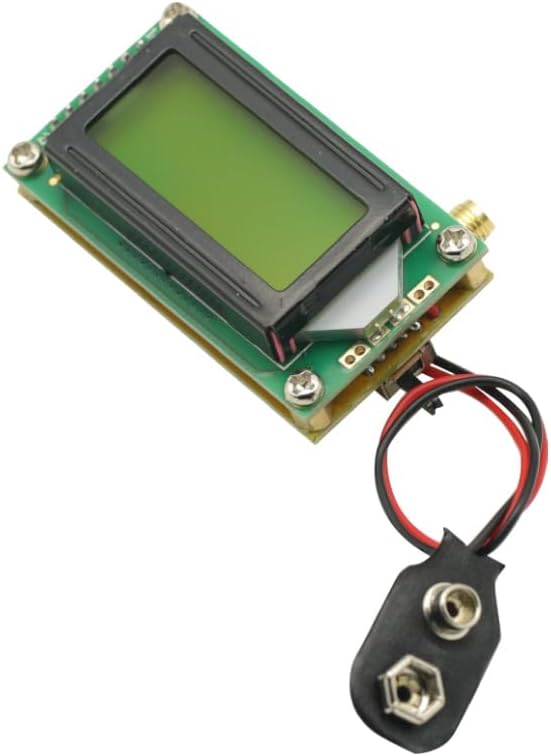
The Portable UHF/VHF Frequency Counter is an affordable, highly focused meter for common two-way radio bands. Its supplied rating is 4.1, and the core specification is easy to understand: 136-174MHz VHF and 400-470MHz UHF coverage, CTCSS/DCS decoding, and a 9V-battery-powered handheld format. It is a sensible first counter for operators who work primarily with local handheld radios.
We may earn a commission when you buy through this link, at no additional cost to you.
One-button control keeps operation simple. A long press turns the device on or off, while a shorter press advances through testing after the frequency is displayed. The supplied dimensions of 9 by 5.5 by 2cm make it easy to carry in a tool pouch, vehicle, or portable radio kit. An antenna and 9V battery are included, reducing the number of extra accessories needed for basic use.
The trade-off is a narrow measurement scope. Unlike the SF401 Plus models, it cannot cover the entire 27MHz-to-3GHz range, and it excludes the 2m band's lower-frequency portion. The product information also states that radio frequency should be measured within one meter, which is a meaningful limitation when the transmitter cannot be brought close to the meter.
This counter makes the most sense for clubs, students, and casual users who need a small, uncomplicated way to check selected VHF and UHF radios. It is less appropriate for HF, wideband monitoring, or distant signal measurements. Within that focused use case, it provides a useful combination of frequency reading, tone decoding, and portability at a modest entry point.
The two specified ranges align with many common VHF and UHF two-way radios. This makes the device a practical companion for programmed-frequency checks and local repeater or handheld equipment maintenance.
A single operating button, 9V battery, and compact body reduce both setup time and carrying bulk. The device is accessible to newcomers while still providing the CTCSS and DCS information experienced operators often want.
We may earn a commission when you buy through this link, at no additional cost to you.
The Anysecu SF-103 is a portable frequency counter with 2MHz-to-2.8GHz coverage, a supplied rating of 4.2, and a feature set aimed at two-way radio maintenance. As an upgraded SF401-style design, it emphasizes the kind of measurements used by maintenance personnel and wireless enthusiasts: carrier frequency and basic signal strength across several common radio ranges.
We may earn a commission when you buy through this link, at no additional cost to you.
Selectable ranges help narrow the instrument to the appropriate portion of the spectrum, improving usability when working on a known band. Four-button operation is simple enough for routine counter use, and the small enclosure supports mobile work. The product is positioned as a practical tool for testing frequency and signal strength without the size and complexity of a full laboratory analyzer.
As with the other SF401-derived meters, the SF-103 is centered on continuous carrier signals from two-way equipment. It does not provide the graphical spectrum inspection of the TinySA, nor the timing, phase, GPS reference, and 7GHz reach of the TinyGTC. A user expecting a full-band panoramic display would be choosing the wrong category of instrument.
The Anysecu SF-103 is a good fit for a technician, club operator, or radio hobbyist who needs portable frequency and signal-strength measurements from 2MHz through 2.8GHz. Its range is especially useful when work spans 2m, VHF, and UHF equipment. For users who need only those practical measurements, the straightforward interface and portable form are meaningful advantages.
Frequency and signal-strength readings address common questions encountered during radio servicing. The result is a more useful field tool than a bare display when the goal is to confirm that a transmitter is operating as expected.
Coverage beginning at 2MHz allows the meter to reach the 2m ham band, while its upper limit covers the main VHF and UHF radio spectrum. Multiple selectable ranges help organize measurements across that broad span.
We may earn a commission when you buy through this link, at no additional cost to you.
The Mcbazel Surecom SF-103 is a handheld counter spanning 2MHz to 2.8GHz. Its supplied 4.3 rating, temperature-compensated crystal oscillator, DMR support, and signal strength indicator make it an attractive choice for technicians and radio enthusiasts who need accurate measurements without a desktop setup.
We may earn a commission when you buy through this link, at no additional cost to you.
The stated time-base accuracy ranges from positive or negative 2ppm to positive or negative 4ppm between -45°C and 65°C. That temperature compensation supports consistent readings in changing field conditions. Four-button controls, selectable ranges, and a compact body also make the device practical for mobile maintenance. Its coverage includes the 2m ham band as well as VHF and UHF areas used by two-way radios.
The listing provides an important safety warning. Maximum direct input is 5V peak-to-peak, and the device should not be connected directly to a radio antenna output, as doing so may damage it. This means the meter is intended to receive suitably conditioned or attenuated signals rather than connect directly to high-power RF output. The product is also a carrier counter rather than a wideband spectrum display.
Buy the Mcbazel SF-103 when portability, broad radio coverage, and temperature stability matter more than advanced analysis. It suits users who maintain 2m, VHF, or UHF equipment and want both frequency and signal-strength information. Observing the input limits carefully will help preserve the device and maintain measurement reliability.
The TCXO time base is specified to maintain accuracy within positive or negative 2 to positive or negative 4ppm over a wide temperature range. This is particularly useful for equipment checks performed in changing conditions.
The 2MHz-to-2.8GHz range includes the 2m ham band and the principal VHF and UHF radio regions. DMR support broadens the types of two-way transmissions the counter is intended to address.
We may earn a commission when you buy through this link, at no additional cost to you.
The Acxico RF Counter Module is a bare-board frequency counter intended for ham radio projects and simpler electronics tasks. It measures from 1MHz to 500MHz and uses a compact 0802 digital LCD. Unlike the handheld products in this guide, it is a construction-oriented module rather than a finished portable meter with a housing, battery system, and extensive controls.
We may earn a commission when you buy through this link, at no additional cost to you.
The PCB and FR4 construction and integrated display keep the module focused on its core function. It may appeal to builders who want to incorporate a frequency readout into a custom project, experiment, or educational setup. The supplied rating of 3.1 is lower than the ratings of the finished counters, so buyers should be comfortable with a comparatively basic product experience.
Accuracy adjustment is limited to the second decimal place, and the listing notes that precision is less than one-tenth of that value. Its upper limit of 500MHz also excludes much of the UHF range and the full extent of the 2m amateur band. There is no stated tone decoding, signal-strength analysis, spectrum display, or advanced digital-radio support.
The Acxico module is best for a maker who wants an uncomplicated counter board and already understands RF input requirements. It is less suitable as a first all-purpose tool for a ham operator who needs accurate VHF/UHF identification, decoding, or portable operation. Within its simple display-oriented purpose, it provides a focused 1MHz-to-500MHz counter without the cost and complexity of a multifunction analyzer.
The board provides a basic frequency display across 1MHz to 500MHz. That narrow purpose can be useful when a custom project needs a dedicated readout rather than a broad suite of radio-analysis functions.
The 0802 LCD is small and intentionally straightforward. Calibration is described as adjustable only to the second decimal digit, so operators requiring finer resolution should consider a more advanced instrument.
We may earn a commission when you buy through this link, at no additional cost to you.
The 1MHz-to-500MHz Frequency Counter Meter Board is one of the simplest products in this guide. It consists of a counter board with an LCD display and is marketed for ham radio kits and electronics projects. Its low-power consumption and compact, integrated design can make it useful when an experimenter wants a frequency display without a complete handheld instrument.
We may earn a commission when you buy through this link, at no additional cost to you.
The stated 1MHz-to-500MHz range gives the board access to the lower VHF spectrum, some of the 2m band, and portions of higher-frequency radio use. The LCD allows the measurement to be viewed directly, and the single-board format may suit users assembling an enclosure, power supply, input arrangement, or larger instructional project.
The board is not presented as a finished portable counter. The supplied rating of 3.6 reflects a basic product with limited listed information, and there are no stated CTCSS, DCS, signal-strength, spectrum, or computer-control features. Its 500MHz ceiling also means it cannot cover the full amateur radio spectrum above that point. Integrating the board safely and effectively requires more technical involvement than operating a finished meter.
This board is a sensible option for a kit builder or classroom project where low power use and a direct frequency display are the priorities. It is a weak choice for a general-purpose ham station instrument or a technician who needs broad-band coverage. The buyer is effectively choosing a component for a specific build rather than a ready-to-use frequency counter.
Low-power consumption is one of the board's clearest advantages. It can suit custom installations where low heat generation, a small footprint, and a persistent numeric display are more important than portability.
As a bare board with an LCD, it is best treated as a kit component. Users seeking a self-contained meter with defined controls, batteries, and a protective housing should favor one of the finished handheld counters.
We may earn a commission when you buy through this link, at no additional cost to you.
The AURSINC TinyGTC is a high-precision, dual-channel frequency counter and timer with an integrated GPS-disciplined oscillator. It has a supplied 5.0 rating and represents a different class of instrument from the small radio counters and bare boards elsewhere in the guide. Its 40ps time resolution, two independent channels, and support for frequency, phase, count, and time-interval measurements make it relevant to advanced ham radio calibration and RF engineering.
We may earn a commission when you buy through this link, at no additional cost to you.
Channel A supports measurements from 0.1Hz to 7GHz, while Channel B covers 0.1Hz to 350MHz. The GPSDO uses a premium TCXO and is specified to achieve approximately 1e-10 ADEV at averaging periods from 1 to 100 seconds. An external 10MHz reference input can be used when calibrating SDR boards, signal generators, and radio equipment. The supplied 5.0 rating reflects a particularly strong customer-feedback profile, although advanced capability does not remove the need to understand signal conditioning and reference setup.
The instrument is much more versatile than a dedicated carrier counter. On-device tools include real-time charting, histograms, ADEV, FFT, and FM deviation analysis. USB logging, SD card storage, SCPI remote control, and compatibility with TimeLab and professional analysis software support longer measurement sessions. It also accepts an external 10MHz reference, an important capability for users who want to verify the stability of another oscillator or receiver chain.
A 4-inch touchscreen, backup jog wheel, and rechargeable 4000mAh battery make the TinyGTC practical in a lab or field toolkit. The included active GPS antenna, USB cable, two 30cm coax cables, and SMA tee support immediate setup. This is the premium selection for operators who need more than a simple frequency reading, especially those calibrating homebrew radios, checking SDR references, or making precise phase and timing measurements.
The integrated GPSDO disciplines the internal TCXO against a stable satellite reference, providing the long-term stability needed for demanding measurements. Automatic locking and the specified ADEV make it particularly valuable for oscillator and reference verification.
Two channels, 40ps resolution, phase and interval measurements, and on-device FFT and deviation analysis extend far beyond reading one carrier frequency. These features make the TinyGTC suitable for calibration workflows, SDR development, and professional RF diagnostics.
The rechargeable 4000mAh battery, compact enclosure, touchscreen, and mechanical jog wheel make precision measurements possible away from a desk. The accessory kit provides the main connections needed for mobile reference checks and bench work.
We may earn a commission when you buy through this link, at no additional cost to you.
The best frequency counter depends on whether you need a simple radio-frequency check, a broad spectral view, or laboratory-grade reference measurements. Consider frequency coverage, input safety, time-base quality, decoding, display needs, portability, and the kind of equipment you maintain.
Begin with the bands and devices you expect to measure. The Mcbazel and Surecom SF401 Plus models cover 27MHz to 3000MHz, the FC-2800M and SF-103 counters extend down to 2MHz for the 2m band, and the smaller board products stop at 500MHz. The TinySA reaches 960MHz, while the AURSINC TinyGTC supports measurements up to 7GHz on its primary channel. A counter that includes the 2m band is more useful for amateur operators than one limited to 136-174MHz VHF, while an HF-capable instrument or analyzer may be needed for lower-frequency work.
A frequency counter answers a focused question: at what frequency is a signal being received? A spectrum analyzer also shows how energy is distributed across a range of frequencies. The dedicated SF401, FC-2800M, and SF-103 products concentrate on continuous carrier signals, while the TinySA provides a visual spectrum display and selectable resolution bandwidths. Choose a counter for straightforward programmed-frequency and signal-strength checks; choose an analyzer when interference, crowded bands, antenna behavior, or multiple signals need visual context.
Accuracy is more than the size of the digits on the display. The SF401 products and Mcbazel SF-103 use temperature-compensated crystal oscillators, with stated accuracy ranging from positive or negative 2ppm to positive or negative 4ppm across -45°C to 65°C. The FC-2800M uses a low-PPM crystal time base, and the TinyGTC adds a GPSDO with approximately 1e-10 ADEV at 1-100-second averaging periods. More stable references are valuable when checking oscillators, calibrating equipment, or taking measurements that must remain consistent over time.
Squelch-tone decoding can be valuable when identifying compatible two-way transmissions. The SF401 models, FC-2800M, Mcbazel SF-103, and compact UHF/VHF counter offer CTCSS and DCS decoding, while the FC-2800M and Mcbazel SF-103 also advertise DMR signal support. These features are mainly relevant to two-way radio maintenance and repeater work. They do not turn these products into general-purpose digital signal analyzers, so operators examining complex modulation should choose a more capable RF analysis platform.
A counter connected to a radio output must be protected from excessive voltage and RF power. The Mcbazel SF-103 listing specifically states a maximum direct input of 5V peak-to-peak and warns against direct connection to a radio antenna output. Other products may have their own input expectations that should be confirmed in the documentation. Appropriate attenuation, shielding, and impedance matching are essential, especially near transmitters. A sensitive-looking display is not evidence that the front end can safely accept arbitrary transmitter output.
A compact meter with a battery is useful for club activities, field days, vehicle installations, and on-site troubleshooting. The compact UHF/VHF counter uses a 9V battery and measures just 9 by 5.5 by 2cm, while the TinySA includes a rechargeable battery and a 2.8-inch touchscreen. The TinyGTC goes further with a 4000mAh rechargeable battery, a touchscreen, and a backup jog wheel. By contrast, bare counter boards require an enclosure, power design, and integration before they become field-ready.
Simple numerical displays suit operators who only need a carrier reading, and four-button control can be quicker in the field than navigating a complex interface. The 2.8-inch TinySA screen provides a visual spectrum and can connect to Windows or Linux over USB CDC. The TinyGTC adds real-time charts, histograms, ADEV, FFT, FM deviation analysis, USB logging, SD card storage, and SCPI remote control. More analysis is valuable for advanced work, but it also increases the learning curve and can make basic checks less convenient.
Finished handheld counters are the most straightforward option for routine operation, while bare boards are best for custom projects. The Acxico module and the 1MHz-to-500MHz board use integrated LCDs, but they require integration and offer fewer documented functions. A finished enclosure improves protection, portability, and repeatability. A kit-based approach can be rewarding when you want to design the power supply, enclosure, input connector, or surrounding application around a compact counter board.
Before taking a measurement, confirm that the counter's specified input range can safely accept the signal. Read the product documentation, identify the appropriate antenna or cable, and use attenuation or suitable signal conditioning when working near a transmitter. For portable models, install the specified battery or fully charge the internal battery, attach the correct antenna, and allow the instrument to stabilize before relying on a displayed result.
Select the measurement range that contains the expected frequency and place the counter close enough to receive the signal. If the product requires a nearby measurement, satisfy that placement requirement rather than expecting distant reception through walls or other structures. For counters with CTCSS, DCS, or DMR support, let the decoder settle and use the decoding result as supporting information. A spectrum analyzer should be configured with an appropriate resolution bandwidth and displayed range for the band being investigated.
After use, disconnect antennas and cables, power the unit down, and store it in a dry environment. Do not connect a radio antenna output directly to a counter unless the manual explicitly permits it. For high-stability instruments such as the GPS-disciplined TinyGTC, allow the reference to lock, keep the supplied active GPS antenna unobstructed, and use the included 10MHz reference path when calibrating connected equipment. Clean the enclosure and contacts without immersing the device or using aggressive solvents.
A frequency counter can help you confirm a radio's programmed or actual transmitting frequency, identify a received signal, and support two-way radio maintenance. It is most useful when troubleshooting frequency offsets, programming issues, or repeater equipment. Operators who primarily tune using a conventional receiver or software-defined radio may need one less often, but it remains a valuable diagnostic instrument for anyone maintaining multiple radios.
For common handheld and repeater work, coverage from 136-174MHz and 400-470MHz is practical. For access to the 2m amateur band, look for a lower limit around 2MHz, while broad VHF/UHF maintenance calls for coverage extending toward 2.8GHz or 3GHz. HF requirements are different because the dedicated counters in this list generally do not cover the lower amateur bands; a suitable spectrum analyzer or precision counter is needed for that work.
Basic carrier counters primarily count continuous carrier signals and may not provide meaningful details about complex modulation. Devices advertising CTCSS, DCS, or DMR support can add information about common radio signaling, but that is not equivalent to full modulation analysis. The TinySA offers a broad spectral view, while the TinyGTC provides more advanced measurement and analysis functions for demanding users.
A frequency counter presents a numerical measurement of one signal, often with signal strength or tone information. A spectrum analyzer displays energy across a range of frequencies, making it better for seeing interference, nearby signals, antenna behavior, and band conditions. The right choice depends on whether you need a direct reading or a broader view of RF activity.
A GPS-disciplined oscillator uses satellite timing to maintain a highly stable internal reference over time. That stability is valuable for calibrating radios, checking SDR references, measuring oscillators, and conducting repeatable phase or interval tests. The extra hardware and analysis capabilities go well beyond a simple direct frequency display, so they are most useful for advanced calibration and professional RF work.
Only connect a radio output when the manufacturer's instructions explicitly permit that connection and the signal is within every stated voltage, power, and impedance limit. The Mcbazel SF-103, for example, specifies a maximum direct input of 5V peak-to-peak and warns against direct antenna-output connection. Use appropriate attenuation or signal conditioning whenever there is any doubt.
Choose a bare board when you are building a custom project and want to integrate the display, power supply, enclosure, and input hardware yourself. Choose a handheld model for immediate use, consistent protection, and straightforward field operation. A finished counter will usually be more convenient for routine radio maintenance, while a board can be more satisfying for an electronics kit project.
For checking a handheld radio or repeater output, a counter with a ppm-rated crystal time base is generally practical for most users. Calibration, oscillator verification, and repeatable laboratory comparisons demand tighter stability, making a GPS-disciplined model more appropriate. Match the instrument's accuracy claims and input specifications to the accuracy required by your own test procedure rather than relying on display digits alone.
The Mcbazel and Surecom SF401 Plus models offer practical portable counting with broad two-way radio coverage, tone decoding, and temperature-compensated references. The FC-2800M stands out for selectable ranges, 2m access, and DMR support, while the compact UHF/VHF counter is the straightforward lower-cost option for common handheld-radio bands.
Prioritize the instrument that matches your actual work. A dedicated counter is ideal for direct readings, the TinySA is better for visual spectrum analysis, the bare boards suit custom builds, and the GPS-disciplined TinyGTC serves advanced calibration and precision measurement. Always verify frequency coverage, input limits, required accessories, and signal-conditioning needs before connecting a radio.
Ratings, product availability, and prices can change, so consult the current listing and manufacturer information before purchasing. Comparing the present specifications with the way you operate your station will help you select a frequency counter that remains useful rather than one that simply offers more features than you need.