
5 Gram 50 Pack Silica Gel Packets
4.7Editor score
Fifty compact packets included
Color-changing saturation indicator
Reusable through controlled heating
Our best silica gel desiccant packets guide compares capacity, packet size, indicators, reusability, and storage uses to help you choose the right option.
Silica gel desiccant packets are small but useful tools for controlling humidity inside sealed containers. They help protect dry foods, medicines, electronics, clothing, collectibles, camera gear, and other moisture-sensitive belongings. The right packet depends on container volume, saturation visibility, reusability, and the level of protection required.
This guide compares ten silica gel desiccant packets across packet weight, quantity, adsorption capacity, color indicators, reheating options, and suggested applications. It includes compact packets for jars and drawers, high-capacity packs for storage bins, and rechargeable options for electronics, 3D printer filament, safes, luggage, and other enclosed spaces.
Each pick below highlights the product's strongest use case, along with practical limitations to consider before buying. The top selections represent a budget choice, an editor's choice, and a premium option, while the remaining reviews explain where alternative sizes or designs may work better. Product availability and prices can change.
4.7Editor score

4.8Editor score

4.7Editor score
The comparison covers packet quantity, desiccant weight, monitoring features, reusability, and practical storage applications so readers can identify a suitable option for small containers or larger enclosed spaces.




This 50-pack of 5-gram silica gel packets is an economical, flexible choice for controlling moisture in many small enclosed spaces. It carries a 4.7 rating, and its most useful feature is the color-indicating bead system: orange indicates dry silica gel, while dark green signals saturation. That takes much of the guesswork out of routine storage care.
We may earn a commission when you buy through this link, at no additional cost to you.
The packets are designed to absorb up to 35% of their weight in water vapor, making them suitable for medicine bottles, food canisters, jewelry boxes, camera lenses, seasonal wardrobes, and storage bins. Because the 5-gram packets use food-safe wrapping for direct contact with food and medicine, they are especially convenient for small containers where a larger packet would be awkward.
The main limitation is capacity. Each packet contains only 5 grams, so a large storage bin, closet, or dense collection may require several packs and more frequent monitoring. The product description also cautions against excessive heat or lengthy heating because the outer wrapping can melt. Reactivation should therefore be controlled and supervised rather than treated as an indefinite unattended process.
This is a strong budget recommendation for people who want numerous small packets, a visible replacement cue, and the flexibility to reactivate them in an oven, microwave, or sunlight. It is less suitable for a large safe, suitcase, or electronics enclosure that needs fewer but substantially heavier packets. For those jobs, one of the 50-gram or 100-gram options offers more efficient coverage.
The 5-gram format makes it easy to distribute packets among multiple jars, drawers, spice canisters, shoes, or electronics storage cases. Instead of placing one oversized pouch in a large space, you can give each compact container its own source of moisture control.
Orange beads turn dark green as the silica gel becomes saturated, so you can check condition at a glance. This is especially helpful when packets are distributed among storage locations that are not opened frequently.
We may earn a commission when you buy through this link, at no additional cost to you.
The VOISEN 24-pack of 100-gram packets is built for larger storage jobs and buyers who want multiple high-capacity packets on hand. Its 4.7 rating reflects a strong overall reception, while the advertised adsorption capacity of up to 40% of packet weight makes it a practical choice for spaces where several small sachets would be inconvenient.
We may earn a commission when you buy through this link, at no additional cost to you.
The product description estimates that one 100-gram packet can cover a container with a volume of approximately 6.94 cubic feet, while also recommending that users place more packets than the minimum calculation for additional protection. That guidance is sensible for large storage bins, safes, electronics cases, luggage, and collections where humidity levels, container leakage, and initial moisture loads can vary considerably.
Color-indicating orange beads turn dark green as saturation increases. The packets are also described as cobalt-chloride-free and suitable for use with foods, although direct-contact decisions should still follow the instructions and the specific storage situation. Reactivation can be performed with an oven, microwave, or sunlight, offering flexibility for people with different household equipment.
This option is best when capacity and future replacement convenience matter more than compactness. The trade-off is obvious: 100-gram packets are unnecessarily large for spice jars, small jewelry cases, or other modest containers. Choose this set for bulk storage protection or a collection of similarly sized boxes, and opt for smaller packets when space is the priority.
A 100-gram packet offers more active material without requiring a large number of sachets. This can simplify placement in big totes, equipment cases, and storage bins while providing a useful margin of adsorption capacity.
The listed options include reheating at controlled temperatures, microwave defrost mode, and sunlight. Users should follow the manual, avoid overly long heating, and confirm that the packet material is compatible with the selected method.
We may earn a commission when you buy through this link, at no additional cost to you.
This 50-pack of 50-gram silica gel packets occupies a practical middle ground between compact sachets and heavy 100-gram pouches. It has a 4.7 rating, and its high packet count makes it well suited to organizing moisture control across many medium-sized boxes, drawers, cabinets, or storage containers.
We may earn a commission when you buy through this link, at no additional cost to you.
The description states that a 50-gram packet can cover approximately 3.47 cubic feet, while recommending additional packets for stronger protection. Its orange indicating beads change toward dark green as the desiccant becomes saturated, and the product is advertised as cobalt-chloride-free and safe for use with foods. The stated maximum adsorption capacity reaches 40% of the packet's own weight.
The 50-gram size is less awkward than a 100-gram packet but still more substantial than a 5-gram sachet. That makes it a good middle option for a reasonably sized airtight tote, a drawer, a electronics case, or grouped seasonal storage. The principal disadvantage is that 50 separate packets may be more than a homeowner needs for a single small cabinet, particularly if the goal is simple, discreet placement.
Overall, this set is best for buyers who want broad coverage without moving to the largest packet format. It supports oven, microwave, and sunlight reactivation and includes enough packets to handle many separate storage zones. Those who need only one protected container should calculate their required capacity first and consider a smaller or more concentrated alternative.
Fifty grams gives each packet meaningful adsorption capacity while retaining a size that can fit into medium totes and storage boxes. It is a practical compromise when 5-gram packets would require an excessive count and 100-gram packs would occupy too much room.
The orange-to-dark-green system makes it easier to identify packs that need regeneration. Checking colors during periodic storage maintenance helps keep moisture control consistent across many locations.
We may earn a commission when you buy through this link, at no additional cost to you.
The 15-piece, 20-gram silica gel pack set is the most versatile option in this comparison, earning a 4.8 rating—the highest listed score. Its moderate packet weight works for spice containers, jewelry boxes, shoes, books, documents, decorations, and electronics without taking up as much room as the largest packets.
We may earn a commission when you buy through this link, at no additional cost to you.
The transparent silica gel beads are described as non-toxic, chemically stable, and safe to use with food. They do not provide a visible saturation color, so the absence of an indicator should be considered when deciding how often you will inspect them. A convenient alternative is to set a calendar reminder and reactivate the packets on a regular schedule.
Reactivation instructions include heating the packets in an oven for approximately 0.5 to 2 hours at 200 to 250 degrees, or using microwave defrost mode for about 7 to 12 minutes. Following the listed instructions carefully is important because the outer packet material can be damaged by unsuitable heat. The lack of a color window is the main drawback relative to many competing sets.
This is an excellent choice for people who value versatility, food-safe positioning, and a moderate format over instant visual saturation alerts. It works particularly well for a mixed household with several modest storage spaces. The best reason to choose it is its balance: enough capacity for useful moisture control, a manageable packet size, and a strong customer rating.
Twenty grams is large enough to be useful in closed storage boxes but compact enough to fit many jars, cases, and drawers. The same set can serve pantry goods, footwear, small electronics, documents, and decorative items.
Because the transparent beads do not visibly change when saturated, set a recurring maintenance date rather than waiting for a sign of moisture. Periodic reheating and careful storage help maintain reliable performance.
We may earn a commission when you buy through this link, at no additional cost to you.
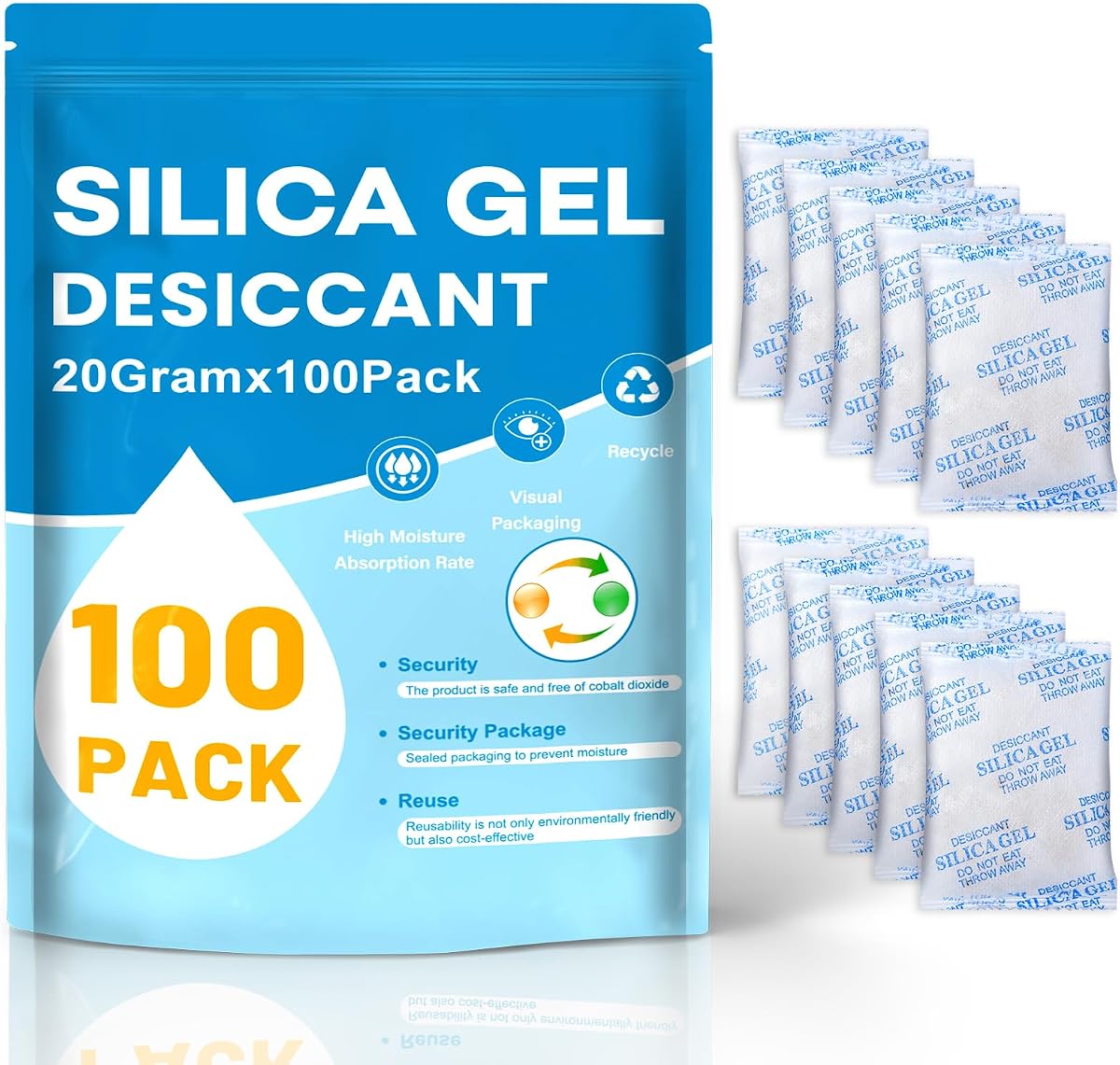
This VOISEN set is notable for its very high packet count, providing 100 small packets for widespread household or organizational use. It has a 4.7 rating and combines a manageable 20-gram format with orange-to-dark-green indicating beads, making it particularly attractive for people who want to distribute many small packets among jars, shelves, drawers, and storage boxes.
We may earn a commission when you buy through this link, at no additional cost to you.
The advertised adsorption capacity reaches 40% of packet weight. The description also states that a 20-gram packet can cover approximately 1.39 cubic feet and recommends placing more than the calculated minimum for stronger protection. Suggested uses include electronics, medicines, nuts, spices, 3D filament, jewelry, bags, clothing, books, documents, and seeds.
One detail deserves attention: the listing's descriptive text contains a line that instead says 24 pieces of 100-gram packets, even though the product title states 100 pieces of 20-gram packets. Because that inconsistency could affect expectations, buyers should verify the package contents on the listing. The weight and quantity shown in the title are the most relevant factors for selecting the correct model.
For extensive organization, this high-count set can be highly efficient. The trade-off is that you may end up with far more packets than necessary for one project, and the full container may occupy extra storage space. It is best for users managing many separate moisture-sensitive items or wanting a broad reserve for future containers.
A 100-piece count makes it easy to place several packets in each storage area without repeatedly opening and redistributing a smaller set. This is useful for seasonal organization, travel packing, or maintaining numerous small containers.
The title and bullet text do not fully agree on packet count and weight. Reviewing the current package details and images can help confirm that the shipment matches the 100-piece, 20-gram configuration before purchase.
We may earn a commission when you buy through this link, at no additional cost to you.
Dry & Dry's 50-pack of 5-gram packets is a well-established all-purpose option with a 4.7 rating. Each packet measures 2 by 2.7 inches, and the manufacturer states that a single packet can cover approximately 600 cubic inches of container volume, with additional packets recommended for extra protection.
We may earn a commission when you buy through this link, at no additional cost to you.
The coated-paper packet material is described as tested under food specifications and designed for moisture absorption and heat resistance. Applications extend from foods, medications, vitamins, seeds, nuts, snacks, spices, and pet food to 3D filament, collectibles, jewelry, documents, camera lenses, clothing, cosmetics, books, watches, electronics, and shoes.
A useful practical feature is the resealable bag that keeps unused packets protected from premature moisture exposure. The packets are also described as non-perishable and as not expiring, which is useful for occasional or seasonal use. On the other hand, there is no stated color-indicating system, so users need to follow a proactive inspection and reactivation schedule.
This is a good choice for households that want a large number of small, established-format desiccant packets and value protected storage for the unused supply. It is less compelling for a large enclosure that calls for fewer, heavier packs. The combination of food-grade positioning, broad applications, and compact size makes it a dependable multipurpose recommendation.
Keeping spare packets in an airtight outer bag helps prevent them from absorbing humidity while waiting for use. This is especially valuable when the supply will be stored through a humid season or kept in an unheated garage or cupboard.
The stated volume is a guide rather than a guarantee because humidity, closure quality, and starting moisture levels differ. For valuable contents or consistently damp conditions, using more than the minimum number can provide a safer margin.
We may earn a commission when you buy through this link, at no additional cost to you.
This 50-pack of 5-gram packets is aimed at small but moisture-prone spaces, and its 4.7 rating indicates generally strong customer satisfaction. The nonwoven breathable fabric and compact format make the packets suitable for clothing drawers, shoes, jewelry, spices, books, cameras, cabinets, and sealed electronics storage.
We may earn a commission when you buy through this link, at no additional cost to you.
The product is described as non-toxic, odorless, and eco-friendly, with safe use around food-storage containers, spice jars, and pantry shelves. It should not be mistaken for a packet approved for direct contact with food; the intended arrangement is to keep the desiccant separate from dry goods while using it within the same enclosed storage environment.
Reactivation instructions are unusually granular. The recommended oven method uses low heat for one to two hours, with a check every 30 minutes until the beads turn orange. For microwaves, the instructions call for 30-second defrost cycles, observing the color and repeating four to eight times as needed. This incremental method reduces the risk of overheating but requires more attention.
This set is a strong option when you want a visible saturation cue in numerous small containers and prefer a breathable outer design. Its limitation is the modest 5-gram charge. It works best for targeted moisture control rather than large, damp environments. For a safe, wardrobe, or sizable electronics box, heavier packets may be more appropriate.
The nonwoven construction is designed to permit airflow while keeping the beads contained. That makes the packets easy to tuck into shoes, drawers, jewelry boxes, and other spaces where a rigid packet would be inconvenient.
Checking the packet every 30 seconds in microwave defrost mode lets you stop as soon as the beads return to orange. This incremental approach is safer than leaving a packet heating continuously without inspection.
We may earn a commission when you buy through this link, at no additional cost to you.
The wisedry 50-gram, 10-pack combines a useful packet size with unusually quick microwave reactivation, earning a 4.7 rating. It is a premium option for people who want to maintain several dry storage environments without waiting through a long oven cycle whenever the indicating beads need resetting.
We may earn a commission when you buy through this link, at no additional cost to you.
Its orange indicating crystals change to a blackish green as they become increasingly saturated, providing a clear cue for maintenance. The product description highlights a two-minute microwave process, along with food-grade silica gel that is cobalt-chloride-free and suitable for foods and pharmaceuticals. A stated adsorption capacity of up to 35% of its own weight gives buyers a useful performance reference.
Double packaging adds protection before use. The packets are hermetically packed and placed inside a resealable outer bag, reducing the chance that unused desiccants will absorb ambient moisture while waiting. That is a thoughtful feature for people who use the packs seasonally or keep the remaining supply in a humid location.
Compared with very small sachets, ten 50-gram packets provide meaningful capacity without the bulk of 100-gram pouches. Compared with high-count sets, they feel more specialized and premium. This product is an excellent choice for 3D filament, drawers, electronics, safes, valuables, and other medium-to-large enclosed storage where fast monitored reactivation is important.
A short microwave cycle can restore the desiccant much faster than many conventional reheating methods. Follow the included manual, use the appropriate microwave setting, and keep the packets under observation.
Hermetically sealed individual packets and a resealable outer bag help preserve the dry condition of unused stock. This is particularly beneficial for long-term or intermittent use.
We may earn a commission when you buy through this link, at no additional cost to you.
The FURWEY set provides six rechargeable 100-gram packets with a 4.5 rating. Each packet measures 5.5 by 3.1 inches, offering a flat format that may be easier to slip into luggage, drawers, equipment cases, and storage bins than a bulk sack of smaller sachets.
We may earn a commission when you buy through this link, at no additional cost to you.
The adsorption capacity is listed at 25% to 35%, and the packet weight rises above 130 grams when fully saturated. A color-changing window provides a clear maintenance signal: the window starts blue, turns light pink when charging is needed, and returns to blue after reactivation. This makes the condition of the pack understandable at a glance.
Individual packaging helps prevent premature absorption during transport and storage. Reactivation can be performed in a microwave at a temperature not exceeding 210 degrees Fahrenheit, equivalent to 100 degrees Celsius. The manufacturer recommends replacing the product after ten uses, which differs from packets marketed as indefinitely reusable and should be considered as a planned maintenance limit.
This set works well for travelers, collectors, and households needing a small number of substantial packets rather than dozens of tiny ones. Its lower rating does not indicate a lack of core functionality, but it is the only product in this group with a 4.5 score. The explicit replacement guidance and compact heavy design are the main factors to weigh.
The broad, shallow shape can fit under clothing, beside electronics, or along the bottom of a case where a round pouch would create a bulge. Each unit still contains enough desiccant for substantial enclosed storage.
The recommendation to replace after ten uses gives the product a clear service life. Track recharge cycles if you rely on these packs for valuable belongings, especially when the color window indicates saturation.
We may earn a commission when you buy through this link, at no additional cost to you.
This five-pack of 100-gram wisedry desiccant packets is designed for larger enclosed spaces and has a 4.7 rating. With 500 grams of silica gel in total, it offers a substantial amount of active material for storage bins, suitcases, safes, 3D filament, electronics, closets, drawers, luggage, photographs, shoes, jewelry, and collectibles.
We may earn a commission when you buy through this link, at no additional cost to you.
Its most distinctive feature is the saturation indicator dot. The dot changes from blue to pink when the desiccant becomes saturated and returns to blue after charging. This simple signal makes routine maintenance clearer than relying on an invisible change, particularly for a packet that is buried behind other belongings.
The product listing says a saturated packet can be reactivated in as little as six minutes in a microwave, and a detailed manual is included. Each packet is individually sealed to help prevent premature moisture uptake, while the unused supply remains protected in a resealable outer bag. These packaging details are especially useful for travel, seasonal storage, and long periods between uses.
The trade-off is that five heavy packets cannot be spread among dozens of small spaces. This set is best for a handful of larger or moisture-sensitive storage zones. Buyers seeking broad distribution across many small jars should choose a high-count 5-gram set, while those who want fewer but more powerful packs will find this format more efficient.
Five 100-gram packs offer meaningful total desiccant mass for larger bins and cases. The format is especially relevant for safes, suitcases, electronics storage, and sealed collections exposed to variable humidity.
The blue-to-pink dot tells you when to recharge, while individual seals and a resealable outer bag protect unused packets. Together, these features support dependable long-term storage between uses.
We may earn a commission when you buy through this link, at no additional cost to you.
The most useful packet depends on the volume of the container, how much protection is required, whether visual saturation monitoring matters, and how often you want to reactivate the desiccant. These factors are more important than the total number of packets alone.
For valuable or moisture-sensitive items, use more packets than the stated minimum. For small jars or inexpensive dry goods, a minimum-based estimate may be sufficient. Measure the container first, then select a packet weight and count that fit without preventing the lid or door from closing properly.
Choose a high count of small packets for broad, granular organization. Choose a low count of heavy packets when space efficiency and large-volume protection matter more. A mixed strategy can work well, but all packets should remain compatible with the planned reheating method.
Do not treat a percentage as a fixed amount of water that will be removed from a room. Silica gel is primarily useful inside a relatively sealed enclosure. Pair the stated capacity with an accurate container estimate and plan for periodic checking.
Indicating packets are preferable when they will be stored in hard-to-reach locations or when irregular attention is likely. Plain packets can still work well if you establish a monthly or seasonal inspection routine and reactivate them on a fixed schedule.
Use the stated temperature and time ranges, monitor the packet, and stop if the wrapping shows damage. Avoid leaving packets unattended in a microwave or oven. If you do not have suitable heating equipment, sunlight can be an alternative for models specifically designed for it.
Read the product-specific instructions and follow them. Even when a packet is described as food safe, keeping it in a separate breathable sachet or dedicated compartment can reduce the risk of accidental contact, spills, or transfer of loose beads.
Prioritize enough total capacity for the entire protected area, then choose a packet shape that can be placed without creating pressure points or preventing proper closure. The container must be tightly sealed for the desiccant to perform effectively.
Choose a set with an appropriate maintenance cycle for your needs. Keep unused packets in a sealed bag, inspect active packets periodically, and follow the supplied heating instructions. A simple maintenance plan is more useful than a larger total capacity that you rarely monitor.
Begin by placing the dry packets inside the container with the items you want to protect. Position them where they can collect moisture without pressing against fragile objects or preventing the container from closing. A tightly sealed container is important because the desiccant works by reducing moisture within a limited enclosed space rather than controlling the humidity of an entire room.
Inspect the packets at regular intervals. Packs with indicating beads should be checked for the listed color change, while transparent or plain packs require a schedule-based approach. If the color changes, remove the affected packet for regeneration and replace it with a dry spare so protection does not stop while the original packet is being heated.
Recharge packets according to the product instructions. Use the specified oven temperature, microwave mode, and heating time, and inspect the packet frequently. Allow the packet to cool before returning it to storage, and discard it if the wrapper is torn, warped, discolored, or otherwise damaged. Keep unused packets sealed in an airtight bag to preserve their dry condition.
Lifespan depends on the container volume, starting humidity, packet capacity, and how tightly the container is sealed. There is no fixed number of days because some enclosed spaces remain nearly dry while others quickly load the silica gel. Check indicating packets regularly or establish a preventive maintenance schedule. Replace a packet if its wrapper is damaged or if it no longer restores to its dry color after appropriate reactivation.
Most packets in this comparison are designed to be rechargeable using controlled heat, sunlight, or a microwave procedure that varies by model. Follow the instructions supplied with the specific product rather than assuming one temperature or time works for every packet. Keep the packet under observation during heating and stop if the outer material shows damage. Cooling and inspecting the restored color are important before returning it to storage.
Several products are described as food-grade, cobalt-chloride-free, or suitable for use with foods, but direct-contact rules can differ by packet size and design. One 5-gram product specifies food-safe wrapping for direct contact, while larger packets are intended to sit alongside contents. Other products recommend placement without direct contact. Read the current labeling and keep packets separate from food whenever the instructions require that separation.
An orange bead normally turns dark green, blackish green, or pink as the silica gel becomes increasingly saturated, depending on the product. Once the listed saturated color appears, the packet should be recharged or replaced. After successful regeneration, the indicator should return toward its original dry color. Check the product instructions because the specific color sequence varies.
Start with the manufacturer's volume estimate for one packet, then consider the bin's size, the sensitivity of the contents, and the quality of its seal. For important electronics, documents, collectibles, or other vulnerable items, using more than the calculated minimum provides a useful safety margin. Small containers usually need only one compact packet, while large bins, safes, and suitcases benefit from heavier packets or several distributed packs.
Only if the specific product instructions allow microwave use. Listed procedures commonly include microwave defrost mode, short heating intervals, and close monitoring. Do not leave packets unattended, because overheated packaging can melt or catch fire. Some products also offer oven or sunlight alternatives, but the safest method is the one explicitly described in that product's manual.
No. These compact desiccants are most effective inside small, sealed containers where they can capture moisture from the trapped air. They are not a substitute for room dehumidifiers, air conditioners, or ventilation in a damp room. Their strongest uses include storage boxes, jars, drawers, cabinets, luggage, equipment cases, and other enclosed environments.
Yes, storing unused packets in a sealed or resealable bag helps prevent them from absorbing moisture before use. Several products in this comparison emphasize individual packets or an airtight outer bag for this reason. Keep the package closed in a cool, dry location, and return unused stock to its bag promptly after taking out the packet you need.
The best budget choice is the 5-gram, 50-pack with orange-to-green indicators because it combines a large packet count, useful visibility, and flexible reactivation options. The 20-gram, 15-piece transparent set earns the editor's choice for its versatile size, food-safe positioning, and strong 4.8 rating. The wisedry five-pack of 100-gram packets stands out as the premium option for large storage areas, fast microwave reactivation, and individually sealed packaging.
Prioritize container fit, total desiccant capacity, closure quality, and monitoring convenience rather than focusing only on packet count. Small packets suit jars, drawers, shoes, and distributed organization, while heavier packets are more efficient for large totes, safes, suitcases, and electronics storage. Choose indicators if you may forget to inspect the packs, and select a reactivation method that fits your available equipment.
Before ordering, verify the current package quantity, packet weight, food-contact guidance, and reactivation instructions. Product listings can contain inconsistent details, and prices, availability, and packaging may change over time. Checking those current details helps ensure the chosen silica gel desiccant packets match your storage conditions and maintenance routine.